The search template for object
detection in natural scenes:
Contents, characteristics, neural underpinnings, and
individual differences
Reshanne Reeder
Center for Mind/Brain Sciences, University of Trento
Acknowledgements
I planted the corn, I harvested the corn, I baked the corn, and now I’ve got a big heaping plateful of cornbread. But unlike the unfortunate Little Hen, I get to
thank some people who helped me arrive at this thesis feast. First, Marius Peelen for his supervision on these projects and specifically for refining my experimental design and writing skills and preparing me to be an independent researcher: because of this I am now ready to step off into the land of postdoctoral research. I also thank the many members of the Peelen lab who have offered their comments and criticisms of my studies at all stages of development, from design to
interpretation of results: they have undoubtedly made those studies better. I also thank Wieske van Zoest for her work as a member of my advisory committee: her comments on my presentations and thesis, help and encouragement with
applications, and her collaboration have been invaluable. I must give great thanks to Rakesh Sengupta, who has seen me through it all: who got excited with me over
crazy theories, listened to my woes, read my papers, and promised to be a future collaborator. Finally, I must thank two others responsible for my continued
psychological well-‐being: Philipp Ruhnau, for his untiring reinforcement and advice (having done it all before) and Jana, for making me laugh about this whole thing even if she had no idea what I was doing.
Table of Contents
Abstract ... 4
Chapter one: Introduction ... 5
1.1 Major models of visual search ... 5
1.2 Characteristics of the search template ... 9
1.3 Category-‐level search templates ... 10
1.4 Templates for naturalistic search ... 13
1.5 Neural correlates of the search template ... 13
1.6 Individual differences in the search template ... 16
1.7 Expertise and visual search ... 18
1.8 Summary of thesis chapters ... 19
Chapter two: The contents of the search template for category-‐level search in natural scenes ... 25
2.1 Abstract ... 26
2.2 Introduction ... 27
2.3 Methods ... 31
2.4 Results ... 39
2.5 General Discussion ... 52
Chapter three: Involuntary attentional capture by task-‐irrelevant objects that match the search template for category detection in natural scenes ... 59
3.1 Abstract ... 60
3.2 Introduction ... 61
3.3 Experiment 1 ... 64
3.4 Methods ... 67
3.5 Results ... 72
3.6 Experiment 2 ... 74
3.7 Methods ... 76
3.8 Results ... 78
3.9 General Discussion ... 80
Chapter four: TMS reveals a causal role of object-‐selective cortex in preparation for real-‐world category detection ... 85
4.1 Abstract ... 86
4.2 Introduction ... 87
4.3 Experiment 1 ... 88
4.4 Methods ... 90
4.5 Results ... 96
4.6 Experiment 2 ... 98
4.7 Methods ... 100
4.8 Results ... 106
4.9 General Discussion ... 108
Chapter five: Effects of perceptual expertise on category-‐level detection in natural scenes ... 115
5.1 Abstract ... 116
5.4 Results ... 128
5.5 Discussion ... 130
Chapter six: General discussion ... 135
6.1 The search template for category-‐level search in naturalistic scenes ... 136
6.2 Future directions ... 142
6.3 Conclusions ... 144
Abstract
The work presented here is at the meeting point of two branches of visual search research, one of which focuses on the proposition that visual search is guided
by preparatory internal representations of targets (i.e., search templates: e.g., Bravo & Farid, 2009; 2012; Castelhano & Heaven, 2010; Duncan & Humphreys, 1989; Malcolm & Henderson 2009; 2010; Schmidt & Zelinsky, 2009; Vickery, King, & Jiang, 2005; Wolfe, 2007; Wolfe, Cave, & Franzel, 1989; Yang & Zelinsky, 2009), and the other of which focuses on investigating target detection in naturalistic search environments (e.g., Delorme, Richard, & Fabre-‐Thorpe, 2010; Delorme, Rousselet,
Macé, & Fabre-‐Thorpe, 2004; Li, VanRullen, Koch, & Perona, 2002; Peelen, Fei-‐Fei, & Kastner, 2009; Peelen & Kastner, 2011; Thorpe, Fize, & Marlot, 1996; VanRullen & Thorpe, 2001). The search template for objects presented in naturalistic scenes is relatively unknown in terms of its content and characteristics, neural
underpinnings, and individual differences in its representation. This thesis explores
these topics in depth using behavioral and neurostimulation methods in four experimental chapters.
Chapter one: Introduction
This chapter will begin with a review of the relevant literature on the aforementioned topics, including a short history of selective attention and the current models of visual search, what we have learned so far about the preparatory template for object categories and naturalistic search targets, the cortical regions presumably involved in search template activity, and the individual differences associated with category-‐level search in naturalistic scenes. I will then summarize
the four experimental chapters of this thesis.
1.1 Major models of visual search
In the natural world, there are millions of stimuli to which one can attend.
The visual system is limited in its capacity to process items in the visual field (Duncan, 1980; Kastner, Pinsk, De Weerd, Desimone & Ungerleider, 1999; Kastner, De Weerd, Pinsk, Elizondo, Desimone & Ungerleider, 2001), but we are very good at selecting and filtering visual input to perform efficient visual processing. For
example, when you are looking for cars while crossing a busy street, your attention
is focused on the vehicles around you and not on the buildings or trees nearby. Early studies of visual selective attention suggested that we filter our
Detecting an item based on its category (e.g., a number among a display of letters) was considered “partial processing”, where detailed information about a target (such as the identity of the number) was ignored, resulting in more rapid target
detection. Processing the identity of a target was considered “full processing”, which was thought to be less efficient than partial processing. In support of this
hypothesis, Gleitman and Jonides (1978) asked subjects to detect a target
surrounded by distractors from the same category (e.g., the number 2 in a display composed of numbers) or distractors from a different category (e.g., the number 2 in a display composed of letters). Within-‐category search showed significantly steeper
search slopes with an increase in set size compared to between-‐category search, which the authors took as evidence that attention can be allocated more efficiently when targets and distractors are semantically dissimilar. In further support of this claim, the authors found that when subjects were cued to detect the number “zero” among letters, they showed shallower search slopes than when they were cued to
detect the letter “oh” among letters. This was referred to as the “oh-‐zero” effect, in which the ambiguous character was detected with different efficiency depending on its semantic association, suggesting that targets were optimally detected if they were conceptually dissimilar from distractors. However, later studies could not replicate the “oh-‐zero” effect (Duncan, 1983), and instead posited that efficient
the number 3 and a stylistically similar letter B would be presented in the same display). With the addition of this control, the between-‐category advantage was eliminated.
These studies led to a seminal paper by Duncan and Humphreys (1989), who suggested that visual search efficiency is dependent on the physical discriminability between targets and distractors. According to this model, in the earliest stages of search, all items in a display are rapidly processed in parallel and segmented into groups based on feature similarity and proximity. Limited attention resources are spread among these items in the visual field, equally distributed at first, but later in
different quantities depending on the search goals. Greater resources directed to an item leads to a decrease in the resources directed to other items in a competitive fashion, and this increases the chances that the item will be preferentially selected and represented in visual short term memory. An item may be pre-‐assigned a particular weight, or bias, of resources if it is the target of goal-‐driven search. In this
way, attention can be directed by a preparatory “template” of target information to items in the visual field that have the highest “match” of features with the template (i.e., they receive the greatest bias of resources).
The idea that attention resources are distributed by competitive bias among items in a display led to the advent of the biased competition model of selective
with a collection of features separable from other items in the display); for examples, search for two properties of the same object is easier than search for a different property of two different objects. Competition is a neural process: objects
in a neuron’s receptive field (RF) are mutually suppressive, which means that when there are two items in a display, each suppresses the excitatory neural response of the other, resulting in a weaker neural response to either object compared to a single object in isolation. Increasing the number of objects in the RF leads to more competition between them for limited resources and a weaker neural response to items that would show a strong response when presented alone. Objects outside of a
neuron’s RF do not have a suppressive effect on items within the RF, so objects presented far apart from each other (e.g., on opposite sides of a computer screen) will not compete for resources. All stimuli in a neuron’s RF initially compete for attention, but if a stimulus has high physical salience or if it is a predetermined target, attention can be biased to that stimulus preferentially over other items in the
display, thus eliminating the suppressive effect on that object by the other objects. In other words, the neural competition for selection can be biased toward a
particular stimulus, which is the basis for the biased competition model. This model further integrates the idea that an attentional template can influence the
competitive bias among stimuli in the visual field. Stimuli that are poor matches to
the attentional template receive a weak competitive bias, lifting their suppressive effect from items that match the template.
environment reach the visual system in parallel in the initial stage of processing, but selective attention for items matching the search template enables a filter for
further processing referred to as a “bottleneck” of attention. Features that match the
active search template may pass through the bottleneck, whereas those that do not match the template may not be processed further than the initial stage. Template-‐ matching features are accumulated until a threshold is reached at which a target can be identified, while other information in the visual field is ignored, thus optimizing search performance (Wolfe et al., 1989). Nowadays, many researchers argue that a search template is critical in guiding attention in the environment, and thus heavily
influences visual perception (Kuo, Stokes, & Nobre, 2012; Malcolm & Henderson 2010).
1.2 Characteristics of the search template
Previous behavioral studies suggest that the search template can only represent a single item at one time (Houtkamp & Roelfsema, 2009), but multiple features of that item may be activated simultaneously (Malcolm & Henderson, 2010), and different features may be selectively attended for different tasks (Folk, Remington, & Johnston, 1992). Different templates can also be activated depending
an image representative of a target category, or a word cue with a visually
descriptive adjective (e.g., “red purse”), are both less effective than an exact image but more effective than a single word cue (e.g., “purse”; Castelhano & Heaven, 2010;
Malcolm & Henderson 2009; 2010; Schmidt & Zelinsky, 2009; Vickery et al., 2005). Search templates approximate, rather than perfectly represent, the features of an object, which allows for a certain amount of flexibility between the cue and the target image (Bravo & Farid, 2009; Vickery et al., 2005). Templates activated by a specific image cue can still guide attention to targets that do not exactly match the cue (Bravo & Farid, 2009; Li & DiCarlo, 2008; Vuilleumier, Henson, Driver, & Dolan,
2002), perhaps because we expect certain changes in the appearance of an object (in lighting, distance, occlusion, etc.) in the dynamic natural world. Evidence for this comes from a study by Bravo and Farid (2009), which showed that a specific image could efficiently cue targets that varied in size or orientation. Additional evidence comes from a study by Ghose and Liu (2013); in one experiment, subjects were
instructed to sort images as “new” or “old”, in which repetitions of a specific image were considered “old” and different viewpoints of the same image were considered “new”. The authors found that subjects responded “old” more often than “new” to different viewpoints of the specific image. This suggests that subjects involuntarily activated a view-‐invariant template for the specific targets.
1.3 Category-‐level search templates
behavioral studies have found that processing speed and detection accuracy depend on the level at which a target must be classified (Delorme et al., 2004; Large, Kiss, & McMullen, 2004). Processing efficiency also depends on the category level of non-‐
targets in the environment: subjects are fastest at identifying targets if distractors are from a different superordinate category (e.g., search for a target dog among furniture results in faster RT than search for a target dog among other animals; Macé, Joubert, Nespoulous, & Fabre-‐Thorpe, 2009), presumably because the features of targets and distractors of different superordinate categories are maximally discriminable from one another, whereas items of the same
superordinate category share more features (Markman & Wisniewski, 1997), and so require greater attention resources for efficient detection.
It therefore comes as no surprise that the target features activated in the search template can change with different task demands (Bravo & Farid, 2012; Foulsham & Underwood, 2007; Large et al., 2004; Underwood, Foulsham, van Loon,
& Underwood, 2005; Vickery et al., 2005; Wolfe et al., 2004). For example, Yang and Zelinsky (2009) found that both specific (picture) and general (name) cues were effective for target detection if subjects were instructed to look for various targets at the basic category level, but if subjects were required to search for a target at the subordinate level, only the specific cue was effective, suggestive of a less flexible
In line with this, there is evidence that people attend to different visual features of an object if it must be identified on a basic or subordinate level. One behavioral study found that high spatial frequency information (such as texture
patterns) is necessary to classify objects at the subordinate level (e.g., Labrador), whereas low spatial frequency information (such as general object shape) is sufficient to classify images at the basic level (e.g., dog); this suggest a qualitative difference in the processing of objects at subordinate and basic category levels (Collin & McMullen, 2005).
Basic-‐level (from now on simply referred to as “category-‐level”) detection
requires the activation of a template that can generalize across both typical and atypical category exemplars (Castelhano, Pollatsek, & Cave, 2008), and how we prepare for those exemplars is not well understood. For example, preparing for a particular layout of category-‐diagnostic features would work if targets were typical (e.g., chairs with a high back and four legs), but then atypical exemplars would be
overlooked (e.g., Papasan chairs, which share very few features with wooden chairs); nevertheless, searchers are quick to fixate both typical and atypical
exemplars from a target category (Castelhano et al., 2008). What features must the category-‐level search template be composed of that would allow searchers to adequately prepare for such varied exemplars of a single object category while
simultaneously excluding all other categories? This is not a trivial question, and it becomes even more complicated when object categories must be detected in realistic settings.
1.4 Templates for naturalistic search
An effective search template must consist of features that optimally distinguish targets from non-‐targets, but features of even a single object in the
natural world may vary in perspective, size, and location, and changes appearance constantly due to motion, lighting, distance, viewpoint, position, and occlusion; different objects within the same category (e.g., cars) additionally vary in color pattern, texture, size, and shape (e.g., a sports car versus a truck). Furthermore, non-‐ targets in the natural world normally share many low-‐level features (e.g., colors, orientations) with targets. Despite these many variations between targets and the
feature overlaps between targets and non-‐targets, humans are surprisingly efficient at detecting many different kinds of objects in naturalistic contexts, even at the category level (Li et al., 2002; Peelen & Kastner, 2011; Thorpe et al., 1996; VanRullen & Thorpe, 2001). A large portion of this thesis is devoted to resolving how this is achieved. In particular, I used behavioral methods to investigates the
contents (Chapter 2) and characteristics (Chapter 3) of the search template for familiar object categories presented in naturalistic contexts, and neurostimulation methods (Chapter 4) to explore the neural underpinnings of this search template to gain a broader perspective of the resources it recruits.
1.5 Neural correlates of the search template
Early neural evidence for the search template comes from single cell
between cue and target presentation, which is indicative of sustained preparatory attention for the target (Chelazzi, Duncan, Miller, & Desimone, 1998; Chelazzi, Miller, Duncan, & Desimone, 1993; Fuster & Jervey, 1982). Another defining feature of the
search template is that it biases top-‐down attention to relevant stimuli and away from task-‐irrelevant stimuli, which is reflected in enhanced neural activation to task-‐relevant features and suppressed activation to task-‐irrelevant features primarily in IT cortex (Chelazzi et al., 1998; Chelazzi, Miller, Duncan, & Desimone, 2001; De Weerd, Peralta, Desimone, & Ungerleider, 1999; Moran & Desimone, 1985). Finally, several previous studies have found evidence that single neurons in
IT can activate to multiple properties of the same object (Booth & Rolls, 1998; Fuster, 1990; Li & Dicarlo, 2008; Tanaka, 1996), as well as variations in those
properties (David, Hayden, Mazer, & Gallant, 2008; Fuster & Jervey, 1982; Miyashita & Chang, 1988), suggesting that IT represents flexible, view-‐invariant features of targets. These studies provide evidence for a complex preparatory mechanism in
monkey IT cortex that facilitates the selection of task-‐relevant stimuli throughout the search process.
Neuroimaging studies in humans also provide evidence that object
information activated in high-‐level visual cortex results in more efficient detection of targets (e.g., Puri, Wojciulik, & Ranganath, 2009). Comparable to non-‐human
primate studies, humans show selective neural enhancement for task-‐relevant features and suppression of task-‐irrelevant features in target-‐selective regions such as the Parahippocampal Place Area (Gazzaley, Cooney, McEvoy, Knight, &
areas such as V4 for color (Corbetta, Miezin, Dobmeyer, Shulman, & Petersen, 1990), as well as prefrontal cortex (Barceló, Suwazono, & Knight, 2000; Bar et al., 2006). However, the neural mechanisms involved in naturalistic, category-‐level search
have only recently been explored in humans.
Two recent studies used fMRI methods to explore the neural correlates of our nearly automatic ability to detect object categories (people and cars) in diverse images of real-‐world scenes (Peelen et al., 2009; Peelen & Kastner, 2011). Peelen et al., (2009) found evidence for car and person-‐specific patterns of activity in object-‐ selective cortex (OSC) even when cued categories were task-‐irrelevant and
presented in task-‐irrelevant locations, suggesting that real-‐world category search is nearly attention free. More recently, Peelen and Kastner (2011) found that category-‐ specific patterns of activity in an area of the right posterior temporal cortex (pTC), overlapping both object-‐ and scene-‐selective regions, is positively correlated with behavioral performance; conversely, category-‐specific patterns in early visual
cortex (EVC) was negatively correlated with behavioral performance in this study. These results suggest that naturalistic, category-‐level search is an efficient process based on a high-‐level search template in high-‐level visual cortex, particularly pTC. Peelen & Kastner (2011) found evidence for a correlation between category-‐ specific preparatory activity and search performance in pTC, but there are a few
open questions related to this study: first, because fMRI can only be used to explore correlational relationships, the causal role of pTC in search template activity
different levels of specificity. Trans-‐cranial magnetic stimulation (TMS) is an adequate tool to address these questions, as it can be used to selectively disrupt activation in small areas of cortex during a task to explore causal relationships
between a cortical region and behavioral performance.
TMS is placed on the head with the center of the coil over the targeted stimulation area. The coil then generates a magnetic field, which, when placed on the scalp, painlessly penetrates the cortex and creates an electrical pulse that
disrupts normal neural function for about 100 ms. Subjects often do not even notice the disruption of function in such a brief amount of time, but it is enough to measure
accuracy and reaction time (RT) differences on behavioral tasks. TMS is highly localized, in that very small areas of cortex can be selectively stimulated. An area of cortex is thought to be critically involved in a particular behavioral task if an
impairment of performance is observed following TMS to that area. Chapter 4 of this thesis reports investigations of the causal role of pTC in the search template for
naturalistic, category-‐level search using TMS.
1.6 Individual differences in the search template
Top-‐down search requires locating predetermined targets amongst
distractors, so the optimal strategy relies on heightened attention to target features and suppression of task-‐irrelevant information during the search process; however, there is evidence that the ability to do this varies across individuals. Target
capacity perform better during goal-‐driven search than those with lower WM capacity (Sobel, Gerrie, Poole, & Kane, 2007). Additionally, a more effective preparatory representation of target features (i.e., search template) is correlated
with enhanced attention orienting capabilities (Giesbrecht, Weissman, Woldorff, & Mangun, 2006), but not all searchers activate effective templates; for example, previous studies have found that preparatory activity in high-‐level object selective cortex such as the lateral occipital complex (LOC) and an area of the right posterior temporal cortex (pTC) correlates positively with category-‐level search performance in naturalistic scenes (Peelen & Kastner, 2011; Soon, Namburi, & Chee, 2012);
conversely, preparatory activity in early visual cortex (EVC) correlates negatively with category-‐level search performance (Peelen & Kastner, 2011) and only correlates positively with performance on low-‐level visual search tasks (Ress, Backus, & Heeger, 2000). In other words, activating high-‐level visual cortex for category-‐level search is beneficial to performance, whereas activating low-‐level
visual cortex reduces performance except during low-‐level feature search tasks. All of these studies have found that individual differences in search
performance correlates with BOLD response in different regions. Therefore, using TMS, we should find that individuals use different cognitive and neural strategies for category-‐level search (e.g., high-‐level preparatory strategy, low-‐level post-‐stimulus
strategy) that should present as beneficial or detrimental to performance.
features, they should also rely on different neural regions for successful completion. In order to establish the causal involvement of pTC in preparing for naturalistic object categories, we focused on the extent to which natural search strategies
(general or specific) and preparing for different search tasks (high-‐level or low-‐ level) rely on pTC. We hypothesized that pTC would be critically involved in general strategies and search templates for high-‐level search tasks, but not specific
strategies and search templates for low-‐level search tasks; this is explored in Chapter 4 of this thesis.
1.7 Expertise and visual search
Thus far in the discussion of individual differences in search strategies, I have speculated on the characteristics of good and poor search strategies, but what about the strategies of people who have an expert level of experience with discriminating
individuals from a particular object category? Can perceptual expertise somehow facilitate category-‐level detection? Despite extensive literature on work-‐related search expertise such as lifeguarding, airport security, and radiology (e.g., Koller, Hardmeier, Michel, and Schwaninger, 2008; Manning, Ethell, Donovan, & Crawford, 2006; McCarley, Kramer, Wickens, Vidoni, & Boot, 2004; Nodine, Kundel, Lauver, &
category (e.g., Bukach, Phillips, & Gauthier, 2010; Gauthier, Williams, Tarr, & Tanaka, 1998; Tanaka & Curran, 2001; Tanaka, Curran, & Sheinberg, 2005; Tanaka & Taylor, 1991) and detection abilities on par with faces (e.g., Gauthier & Tarr,
2002; Myles-‐Worsley, Johnston, & Simons, 1988); therefore, it will be a useful endeavor to explore the search abilities associated with perceptual expertise, despite a lack of search training. Specifically, it is important to investigate the relationship between individuation ability (perceptual expertise) and detection. Whether these processes rely on similar or different representations is highly disputed (Delorme, Rousselet, Macé, & Fabre-‐Thorpe, 2004; Grill-‐Spector &
Kanwisher, 2005; Large, Kiss, & McMullen, 2004; Mack, Gauthier, Sadr, & Palmeri, 2008; Rosch, Mervis, Gray, Johnson, & Boyes-‐Braem, 1976; Thorpe, Fize, & Marlot, 1996), and facilitated detection following individuation training would suggest a link between these processes. In Chapter 5 of this dissertation, I explore the effects of perceptual expertise on category-‐level detection performance.
1.8 Summary of thesis chapters
1.8.1 Chapter two: The contents of the search template for category-‐level search in
natural scenes
features that overlap with other object categories. In this study, we sought to determine the features that are most diagnostic for the categories “cars” and “people”.
Subjects were cued to detect people and cars in photographs of real-‐world scenes. On a subset of trials, task-‐irrelevant stimuli appeared instead of scenes, directly followed by a dot that subjects were instructed to detect. We hypothesized that task-‐irrelevant stimuli that matched the active search template would capture attention, resulting in faster detection of the dot probe when it was presented in the same location as a template-‐matching stimulus (consistent trials) than when it was
presented in the opposite location (inconsistent trials).
Silhouettes of cars and people presented in various orientations (0°, 90°, or 180°) resulted in faster detection of the dot probe on consistent trials compared to inconsistent trials. Consistency effects were also observed for silhouettes of
category-‐diagnostic parts, such as the arm and torso of a person. Finally, we found
consistency effects on trials in which silhouettes were presented in locations that were irrelevant to the search task. We argue that search for object categories in real-‐ world scenes is mediated by a search template composed of a set of view-‐invariant shapes of diagnostic object parts represented globally across the visual field.
1.8.2 Chapter three: Involuntary attentional capture by task-‐irrelevant objects that
match the search template for category detection in natural scenes
first behavioral study (Reeder & Peelen, 2013). After five experiments, we concluded that the search template is composed of view-‐invariant shapes of
diagnostic object parts represented globally across the visual field. One assumption
of the first study was that results reflected template-‐guided search in our paradigm, but they could just as easily have been due to trivial influences of the semantic cue (e.g., priming or a passive preference to attend to the cued category) or other top-‐ down factors not accounted for.
In Experiment 1, we developed a variation of our previous paradigm and compared consistency effects on dot probe detection during two search tasks: one in
which subjects could activate a visual search template, and one in which they could not. No cue-‐consistent effects were found in the probe task when subjects could not activate a visual search template, suggesting that attentional capture in our
paradigm is contingent on an active search template.
In Experiment 2, we addressed whether the consistency effects observed in
our previous paradigm are modulated by other top-‐down strategies than contingent attentional capture. We changed the paradigm so that attending to cued stimuli in the probe task would be detrimental to performance. Subjects were told that attending to cued silhouettes would impair performance (Experiment 2a) or that attending to uncued silhouettes would improve performance (Experiment 2b); in
either case, subjects continued to orient to template-‐matching stimuli. These results support our hypothesis that the search template guides attention automatically and independently of other top-‐down strategies.
1.8.4 Chapter four: TMS reveals efficient category detection relies on preparatory
activity in object-‐selective cortex prior to visual stimulation
In this chapter, we explored the extent to which category-‐level search in
naturalistic contexts relies on the activation of search templates in object selective cortex. Detecting the presence of an object category in real-‐world scenes requires a relatively abstract search template that is flexible enough to account for the many ways in which object category members can appear. A previous fMRI study
investigating the neural basis of category-‐level search in real-‐world scenes (Peelen & Kastner, 2011) found that category-‐specific preparatory activity patterns in a
region in right posterior temporal cortex (pTC) was positively correlated with category-‐level search performance.
In two experiments, subjects were cued to detect cars and people in
photographs of naturalistic scenes. In Experiment 1, we used TMS to disrupt an area thought to be involved in high-‐level search templates (pTC) and a control area
(vertex) at 4 different time points before (-‐200 ms, -‐100 ms) and after scene onset (+100 ms, +200 ms). Results indicated that subjects who reported to use a more high-‐level search strategy showed a larger decrement in performance under stimulation to pTC compared to vertex in the pre-‐scene time window only. Additionally, these subjects showed superior search performance under vertex
In Experiment 2, we applied TMS to pTC and early visual cortex (EVC) while participants searched for objects in real-‐world scenes at the category level (people or cars) or at the individual level (a specific person or car). We found a
significant interaction between TMS region and task: TMS over pTC significantly impaired category-‐level search relative to TMS over EVC, whereas a trend in the opposite direction was observed for the individual-‐level search task. These results provide causal evidence for a neural distinction between search for categories and search for individuals in real-‐world scenes, suggesting that mechanisms mediating search in real-‐world scenes might flexibly adapt to meet current task demands;
importantly, our results suggest that pTC is specifically involved in high-‐level attentional templates.
1.8.5 Chapter five: Behavioral effects of perceptual expertise on category-‐level
detection in natural scenes
In this chapter, we were interested in researching the effects of perceptual expertise on category-‐level detection in naturalistic scenes, for which the ability to discriminate objects from the expert category is seemingly irrelevant. Perceptual expertise for an object category results in many processing advantages over other categories, and a detection advantage would suggest a link between the templates
activated for individuation (expertise) and detection, a topic that is currently highly debated.
search. Self-‐proclaimed car experts completed a car discrimination task that assessed their level of expertise, and then they performed a real-‐world detection task in which they were cued to search for cars and people on separate trials.
Results revealed that car experts who scored higher on the discrimination task showed greater detection efficiency during car search relative to person search than experts who scored lower on the discrimination task. This indicates that perceptual expertise for cars significantly improves search performance for cars compared to people in naturalistic scenes, indicative of a link in the cognitive resources, and perhaps the template, recruited for individuation and detection.
Chapter two: The contents of the search template for category-‐level search in
natural scenes
Reshanne R. Reeder1, Marius V. Peelen1
1Center for Mind/Brain Sciences, University of Trento, 38068 Rovereto, Italy
The work reported in the following chapter is published as Reeder, R. R., & Peelen, M. V.
(2013). The contents of the search template for category-‐level search in natural
scenes. Journal of vision, 13(3), 13.
Acknowledgements:
We thank Timo Stein and Wieske van Zoest for helpful comments and discussions.
2.1 Abstract
Visual search involves the matching of visual input to a “search template” – an internal representation of task-‐relevant information. The present study investigated
the contents of the search template during visual search for object categories in natural scenes, for which low-‐level features do not reliably distinguish targets from non-‐targets. Subjects were cued to detect people or cars in diverse photographs of real-‐world scenes. On a subset of trials, the cue was followed by task-‐irrelevant stimuli instead of scenes, directly followed by a dot that subjects were instructed to detect. We hypothesized that stimuli that matched the active search template would
capture attention, resulting in faster detection of the dot when presented at the location of a template-‐matching stimulus. Results revealed that silhouettes of cars and people captured attention irrespective of their orientation (0°, 90°, or 180°). Interestingly, strong capture was observed for silhouettes of category-‐diagnostic object parts, such as the wheel of a car. Finally, attentional capture was also
observed for silhouettes presented at locations that were irrelevant to the search task. Together, these results indicate that search for object categories in real-‐world scenes is mediated by spatially global search templates that consist of view-‐
invariant shape representations of category-‐diagnostic object parts.
2.2 Introduction
Real-‐world visual search involves the selection of target objects among complex and diverse non-‐targets. In daily life, this selection often operates at the
category level (e.g., looking out for cars when crossing a road, or for pedestrians when driving). Considering the infinite number of ways in which objects can appear in the real world, humans are remarkably good at selecting behaviorally relevant object categories in natural scenes (Li, VanRullen, Koch, & Perona, 2002; Thorpe, Fize, & Marlot, 1996)
It has been hypothesized that the attentional selection of a target object
among distractors is achieved through the matching of incoming visual input to a top-‐down attentional set that guides visual search to items containing task-‐relevant features (Duncan & Humphreys, 1989; Wolfe, Cave, & Franzel, 1989). There is currently great interest in how visual features activated in the attentional set, or “search template”, guide search. Studies of eye movements have found that
searchers may mistakenly fixate distractors that share visual features with targets, which increases search times (Castelhano & Heaven, 2010; Castelhano, Pollatsek, & Cave, 2008; Pomplun, 2006). The more visual information provided by a cue, the better the search performance (Hwang, Higgins, & Pomplun, 2009; Schmidt & Zelinsky, 2009; Wolfe, Horowitz, Kenner, Hyle, & Vasan, 2004); therefore, an image
Henderson 2009; 2010; Schmidt & Zelinsky, 2009; Vickery, King, & Jiang, 2005). At the same time, a search template that approximates, rather than perfectly replicates, an image allows for a certain amount of flexibility between the visual features of the
cue and the target (Bravo & Farid, 2009; Vickery, et al., 2005). Some visual features may be preferentially represented in the search template. A previous study of feature search found that searchers are faster to detect targets based on color than orientation (Hannus, van den Berg, Bekkering, Roerdink, & Cornelissen, 2006), suggesting that some features are naturally weighted higher than others in the visual/attention system, thus biasing the search template. The contents of the
search template may also be determined by task demands (Bravo & Farid, 2012; Foulsham & Underwood, 2007; Underwood, Foulsham, van Loon, & Underwood, 2005; Vickery, et al., 2005; Wolfe, et al., 2004). For example, the search template may represent different visual information for targets at different category levels. Searchers can rely on specific visual features of a single exemplar to find a target in
individual-‐level search, but in the case of category-‐level search, activated visual features in the template must generalize across exemplars (Bravo & Farid, 2012; Yang & Zelinsky, 2009). Category-‐level search in real-‐world scenes adds even more complexity to the equation. An effective search template must consist of features that optimally distinguish targets from non-‐targets, but features of targets in real-‐
What might the template consist of for search tasks in which certain physical properties (size, perspective) and low-‐level features (color, orientation) are unlikely to be informative of the presence of a target category? One possibility is a holistic
representation of the target category, one that contains information about both the shape and typical configuration of object parts. Previous research has proposed that such a prototype template may underlie face and body detection (Lewis & Ellis, 2003; Stein, Sterzer, & Peelen, 2012), which would explain the drop in detection performance when faces and bodies are inverted. Alternatively, the template may consist of view-‐invariant category-‐diagnostic shape features of intermediate
complexity, such as a car’s wheel or a person’s leg (Evans & Treisman, 2005; Treisman, 2006). Activating various diagnostic features of an object category in parallel (e.g., arms, legs, or a torso) may be a more effective preparatory strategy than activating a holistic layout of features when the specific target exemplar is unknown prior to detection. In agreement with this idea, a computational study
(Ullman, Vidal-‐Naquet, & Sali, 2002) showed that features of “intermediate complexity”, such as a portion of a face that reveals the mouth and nose area, are optimally suited for classifying novel images, presumably because these features are consistent across variable exemplars (also see Yang & Zelinsky, 2009).
Complementing these findings, Delorme, Richard, and Fabre-‐Thorpe (2010) found
that the detection of animals in natural scenes is significantly impaired in the
To better investigate the contents of the search template for naturalistic visual search, we developed a variant of the contingent attentional capture paradigm (Folk, Leber, & Egeth, 2002; Folk, Remington, & Johnston, 1992).
Contingent attentional capture refers to the orienting of attention toward task-‐ irrelevant stimuli that contain task-‐relevant features. For example, when subjects are instructed to attend to red items in a central rapid serial visual presentation stream, the appearance of an irrelevant red item in the periphery captures attention, as indicated by a decrement in central target identification (Folk, et al., 2002). A related study (Downing, 2000) showed that an irrelevant object that matches a
target held in working memory captures spatial attention, leading to better
discrimination of an immediately subsequent probe presented at the same location as the memory-‐matching object. Combining these approaches, we used a modified dot-‐probe paradigm (MacLeod, Mathews, & Tata, 1986) to measure the degree to which particular stimuli capture attention when subjects are prepared to detect
real-‐world object categories.
In the current study, subjects were cued to detect people or cars in diverse photographs of natural scenes. Of interest was a subset of trials (25%) in which task-‐irrelevant stimuli without scene background appeared instead of scenes.
Subjects were instructed to ignore these stimuli and simply indicate the location of a
subsequently presented dot that could appear on the left or right of a central
systematically varied the properties of the task-‐irrelevant stimuli to reveal the contents of the search template during visual search for object categories in real-‐ world scenes.
2.3 Methods
2.3.1 Subjects
Sixty-‐six undergraduate and graduate students from the University of Trento (53 females) participated in the experiments for course credit or payment: 11 in
Experiment 1, 17 in Experiment 2, 13 in Experiment 3, 14 in Experiment 4, and 11 in Experiment 5. All subjects had normal or corrected-‐to-‐normal visual acuity and were between the ages of 18 and 38 years (mean=23.1 years). Four subjects participated in more than one experiment separated by at least one month. The research protocol of all experiments adhered to the tenets of the Declaration of
Helsinki.
2.3.2 Stimuli
All stimuli were presented on a 19-‐inch Dell 1905 FP monitor with a screen resolution of 1280x1024 pixels and 60Hz refresh frequency. A fixation cross and
using A Simple Framework (Schwarzbach, 2011), based on the Psychophysics Toolbox for MATLAB.
2.3.3 Natural scene stimuli
Stimuli presented in the search trials (75% of trials) were 864 color photographs of real-‐world scenes obtained from the LabelMe online database (Russell, Torralba, Murphy, & Freeman, 2008; see Figure 1a for some examples) and were divided into scenes containing cars (216), people (216), both cars and people (216), or neither cars nor people (216). Two scenes appeared on every trial and no
scene was repeated within an experiment.
Scenes were scaled to 548x411 pixel resolution, subtending a visual angle of 16.07° x 12.1°. In Experiments 1-‐4, scenes were presented at a visual angle of 8.96° from the center of the screen to the center of the image, to the left and right of fixation. In Experiment 5, scenes were presented at a visual angle of 6.95° from the
center of the screen to the center of the image, above and below fixation.
2.3.4 Attentional capture stimuli
Stimuli presented in the dot-‐probe trials (25% of trials) showed aspects of 192 photographs of cars (96) and people (96) without scene background (see
previous imaging studies that used headless bodies as reference stimuli to
investigate neural correlates of the search template for the same real-‐world search task as in the current experiment (Peelen, Fei Fei, & Kastner, 2009; Peelen &
Figure 1. Examples of stimuli used in 1a) the search task and 1b) the prime task.
Upright silhouettes of the person and car photographs were presented in
every experiment. Additional transformations of the photographs were presented in Experiments 1-‐4. In Experiment 1, textures were cut from sections of the
photographs. For person stimuli, textures consisted mainly of clothing patterns, although skin was used if the original photograph showed large amounts of exposed skin. Car textures were cut from the bodies of cars, which could include streaks, shines, the lines around doors, and the area above the wheel. Color/texture patches
were based on the largest surface area occupied by a given color/texture in the original color photograph, with the additional constraint that the patches did not reveal shape features. All textures were adjusted to a constant radius of 150 pixels subtending a visual angle of 4.43°, located 8.52° from the center of the screen. In Experiment 2, silhouettes were rotated 180 degrees to create inverted images. In
Experiment 3, silhouettes were rotated clockwise by 90 degrees. In Experiment 4, small diagnostic parts were taken from the upright silhouettes (e.g., an arm, a pair of feet, or the wheel of a car). The size of each part (based on the number of black pixels) never exceeded 25% of the size of the whole silhouette (range: 4.61-‐24.19%, mean=14.66% for cars and range: 7.68-‐23%, mean=14.27% for people). The parts
Stimuli could appear in three possible sizes (100x100, 180x180, or 200x200 pixels, or 2.95° x 2.95°, 5.31° x 5.31°, or 5.90° x 5.90° of visual angle, respectively) and at three different screen locations along the X-‐axis, subtending 6.46°, 7.99°, or
10.75° of visual angle. Size and location values were chosen randomly on each trial and independently for the left and right stimulus. On each prime trial, a single aspect of a car and person appeared to the left and right of fixation. Aspects of cars and people appeared on the left and right an equal number of times. Each image was repeated once per experiment under two different transformations (e.g. 192 upright silhouettes and 192 rotated silhouettes). Transformations were randomly
intermixed within the experiment but were not mixed within a trial, that is, an upright silhouette of a person always appeared with an upright silhouette of a car, and never with a rotated silhouette of a car.
2.3.5 Procedure
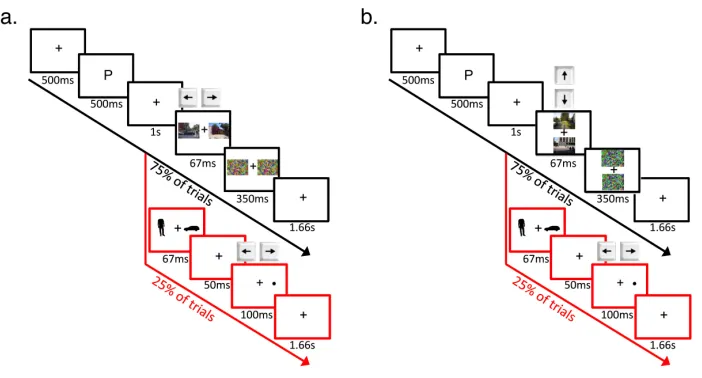
Figure 2. Schematic outline of the experimental paradigm for 2a) Experiments 1-‐4 and 2b) Experiment 5. In the prime task (25% of trials), subjects were required to respond whether the dot probe appeared on the left or right of fixation. In the
search task (75% of trials), subjects were required to respond whether the cued object appeared in the left or right scene (Experiments 1-‐4) or in the top or bottom scene (Experiment 5).
For both tasks, a trial began with the presentation of a fixation cross for 500ms, followed by a single letter for 500ms: “P” for “persona” or “M” for