Student Perspective on Technology Enabled/Enhanced
Active Learning in Educational:
Rasch Measurement Model
https://doi.org/10.3991/ijoe.v16i06.13575
Nur Farha Hassan (*), Saifullizam Puteh, Amanina Muhamad Sanusi, Nor Hartini Che Mohamad Zahid
Universiti Tun Hussein Onn Malaysia, Johor, Malaysia
Abstract—Nowadays, the industrial revolution 4.0 had given a great impact on education. An active environment in teaching and learning that involves stu-dents in order to develop the skills of workability with the use of technology to become quality graduates. Technology Enabled/Enhanced Active Learning (TEAL) is one of the active environments that used technology in education. TEAL is the combination of several active learning domains that enhances stu-dents' understanding of learning and built job-related skills. However, students have lack of knowledge in their field which led to increase in unemployment of students. Hence, TEAL is crucial to help students broaden their knowledge and acquire high-level technical skills. This study conduct to produce evidence about the validity and reliability of the questionnaire of TEAL application among the engineering students. The survey is consisted of 141 items and was distributed to 40 respondents. This study were measured using Rasch Measure-ment Model for measuring the validity and reliability of survey questions. That used to check the functionality of the item in terms of (i) Reliability and separa-tion of respondents - items; (ii) detect the polarity items of PTMEA CORR Value; (iii) the item fit based on MNSQ Value; and (iv) Determine the depend-ent items based on the standardized residual value measuremdepend-ent correlation. The final analysis found that 109 items is suitable to use for measurement of the real study in future work.
Keywords—Technology Enabled/Enhanced Active Learning (TEAL); Rasch Measurement Model; Winsteps Software
1
Introduction
nology user [1][2]. At the same time, students can train themselves how to learn and explore a concept learning which can improve their understanding in their fields, as they can be practiced that skill when working in industries [3][4]. This is necessary to encourage students to venture into the digital technology industries in competing globally to achieve success [2][5]. Therefore, the rapid development of advanced technology is important to support the enhancement of the quality of product manu-facturing in industry.
Thus, educational institutions have to provide TEAL approach to produce highly skilled workers, who have the ability and special skills to applied technologies. This technology learning is one of the educational institutions platforms in Malaysia to produce professional manpower, which have good in tech savvy, expert in handling technology, able to compete in work, ability to handle pressure at work, have high confidence and various employability skills [6][7]. This approach starts from build-up the flexible learning space to create an active activity to give opportunity for student. That can help students to explore by their own lesson about the contents of their subject by using effective pedagogy techniques to become quality graduates. The TEAL approach is about Teaching and Learning (TnL) process that uses technology to assist in producing active learning activities. This process focus on learning outcomes and not on technology equipment only, but to attract students' involvement in the learning process for gain knowledge, skill and experience in the engineering fields [8].
The purpose of this study was to conduct a test of validate and reliability of the in-strument that had been developed using TEAL approach. According to [9], [10], [11] state that the pilot study need to be conducted carefully to improve the quality of items, based on confidence in interpreting data. However, before pilot studies, instru-ment needs to undergo the validity of content and construct, face and language. This is important to see the recommendation from the experts for improving the items in questionnaire. Three conditions that need to be occupied when conducting a pilot study were: i) Make sure respondent not involved in actual study. ii) Given complete instrument to respondent iii) Used simple terms that can clarity the meaning for each item easily.
Rasch measurement model via Winsteps was used to analyze the data from the pilot study in this research. Referring to suggestion from Aziz [12] Wright and Stone [13] mention that Rasch Measurement Model is one of model that formed a result of con-siderations of each respondents and items ability. i) Respondent who answer ques-tionnaires and; ii) Difficulty level of each item [36].
2
Literature Review
2.1 Technology enabled / enhanced active learning
on experiences of student to applied digital technology [14][15][16][17]. This learn-ing approach is the core of formation smart classroom for uslearn-ing innovation technolo-gy that applied to create an active environment with variety of activity to ensure stu-dents more understand with their lesson [18][19][20][21][22]. The TEAL approach is pedagogical innovation established first at Massachusetts Institute of Technology (MIT) in 2001 by John Belcher to upgrade system teaching and learning (TnL) with active elements for make students is engage with their own lesson enjoyable [14][18][23].
This approach had been applied in a few of university from around the world to enhance the system of educational. That few universities such as National Chung Cheng University (CCU) in Taiwan on 2004, Indiana University South Bend (IUSB) in United States on 2010, North Carolina State University (NCSU) in United States on 2011 and Singapore University of Technology and Design (SUTD) in Singapore on 2013 were collaborating with MIT in apply TEAL approach [24][25]. This collabora-tion shows that this TEAL approach was needed to be practice at any educacollabora-tional institutions, to help student volunteer participation in their own learning for more understanding about what they learn in classroom. The TEAL approach involved the adaptation of new technologies to support contents of learning in applied effective pedagogical in creating an active environment for student [26][27][28][29].
2.2 Technology enable / enhanced active learning instrument development
In this study, the instrument known as the Technology Enabled/Enhanced Active Learning (TEAL) aimed to produce quality graduates which can understand clearly in their fields to applied technologies in practical work for gain their employability skill. The skills can prepare students to face the industries need, especially to perform their ability in technical work using digital technology, tools, equipment and machine that have in industry [30][31]. This TEAL instrument development is based on the previ-ous finding from the qualitative phase. The domains were identified from previprevi-ous studies, articles, journals, books and theories or models, while elements of the do-mains were from interview sessions and consensus agreement with experts. The ques-tionnaire was developed based on the 5 domains of active learning:
1.Online Learning is the application using websites of internet for get some materials and information that student’s needs. This part is consisting of 11 elements and 36 items have developed;
2.Blended Learning is a combination of online and face to face learning approach that is used to support content and integrated learning activities in applied technol-ogy for produce an optimal and effective learning. This part is consisting of 8 ele-ments and 24 items have developed;
4.Practical Learning is to train students to do experiment, that needs develop hands on skills using digital and electronic tool for improve their technical works. This part is consisting of 8 elements and 24 items have developed;
5.Interactive Learning is the simulation and visualized concept to exposure about learning content by using multimedia application, that for students to more under-stand about what they learn. This part is consisting of 11 elements and 33 items have developed.
However, the pilot study conducts all the 141 items of 46 elements in one process directly. The item development is based on adaptation from previous studies to help-ing create questions from elements that obtained from the qualitative research. Then the questionnaire was validated by the experts in terms of content and construct, face and language to ensure the items was suitable to measure the research questions of this study [32][33]. Two experts in languages and four experts in contents and face of the active learning area were used in the validation.
3
Methodology / Materials
3.1 Sample and data collection
This study was a survey research conducted at the Department of Civil Engineer-ing, University Tun Hussein Onn Malaysia (UTHM). A total of 40 students from final year students who take the Bachelor of civil engineering involved in this study. In this research, survey was considered as a pilot study; at first 60 set of questionnaires was distributed to the respondents but only 54 sets were given back and only 40 sets can be used for the pilot study. The balance of the questionnaire was rejected because the answer was not complete. The total of the questionnaire collected was enough to run the pilot study because according to Abdul Ghafar [34], Creswell [35] the total of 30 respondents is sufficient for the analysis of external validity and reliability index. Process of data collection started when researcher makes a deal with dean of engi-neering faculty to allow the distribution of the survey to final year’s students. Then, after getting the permission, researcher needs to deal with student representative for distribute survey to their classmates. Researcher was allowed to enter the classroom to explain the purpose of the study. Those strategies help researcher to collect data smoothly with monitoring the students answer the items.
3.2 Survey of research and data analysis
This survey consists of 141 items for 5 domains. The survey used Likert scale of five options to measure agreement from respondent. Either 1) Strongly disagrees; Disa-gree; Not aDisa-gree; Agree and; Strongly agree [9].
Then, data were analyzed by using Rasch Measurement Model via Winsteps soft-ware to validate and reliability the items use in [36]. To check the functionality of each item needs:
1.Reliability and separation of respondents (person) and items.
2.Detect the polarity items of Point Measure Correlation (PTMEA CORR) Value. 3.The item fit based on MNSQ Value.
4.Determine the dependent items based on the Standardized Residual Correlation Value measurement.
4
Results and Findings
4.1 The content validation
After pilot study was conducted, researcher needs to check the validity of tionnaire to ensure the content of items was accurate to measure the research ques-tions in this study. Checking by experts was one of the validity in these studies which have three processes, first is content and constructs validation is needed to ensure the content of item is referring with the construct or elements that find in previous pro-cess. Each of items should have ability to measuring instrument that successfully to elicited respondent for represent the whole domain of online learning, blended learn-ing, collaborative learnlearn-ing, practical learning and interactive learning to cover all finding. The items should be able to measure the needs to clarity of content constructs of study.
Secondly is face validation was to ensure the surface of questionnaire to identify that item level is for bachelor, easy to understanding and the design clearly to help respondent answer smoothly. That face validation was one of important part to pre-pare the good instrument because the surface or design that use in survey is to attract respondent to answer it. Then, the thirdly was language validation to ensure the ques-tions used short word and simple term to make it easy to answer. The language term was important to declare the meaning of each question can measure constructs or elements in this study. In this study six experts were involved to checking the instru-ments. The comment and recommendation from experts needs to repair for improve the validity of instrument.
4.2 Reliability and separation index
mean, instrument is very good and effective level of consistency to use in actual re-search.
Table 1. Interpretation of Cronbach Alpha-Score
Cronbach Alpha Score Reliability
0.8 - 1.0 Very good and effective level of consistency
0.7 - 0.8 Good and acceptable
0.6 - 0.7 Acceptable
< 0.6 Item need to be repaired < 0.5 Items need to be dropped
Then, to check the functionality of each item needs to follow the requirement of Rasch measurement model which is show in Table 2. According to Rasch [36] the correct procedure of pilot test is important to measure the validity and reliability of item that development in research.
Table 2. Criteria for Examining Outliers
No. Criteria for Examining Requirement
1. Reliability person- items 0.67 ≤ Reliability ≥ 0.80
2. Separation person- items ≥ 2.00 or ≈ 2.00
3. Point Measure Correlation (PTMEA CORR) value PTMEA CORR ≠ negative (-) 4. Outfit mean square (MNSQ)value 0.6 < MNSQ > 1.4
5. Outfit z-standard (ZSTD) value -2.0 < ZSTD > 2.0 6. Standardized Residual Correlation Value >0.70
Firstly, examine reliability and the separation of the item and the respondent. Which is reliability states that value greater than 0.80 is mean very good and re-ceived strongly. However, if the approximate value of 0.8 is also calculated at a good and strong [38]. Then for separation index if greater than 2.0, mean have very good isolation index value and able to continuous in actual study. However, if the approxi-mate value of 2.0 is also good condition and acceptable [37]. The result analysis relia-bility of respondents (person) showed that reliarelia-bility index is 0.99 in which is very good and high acceptable and the separation index is 8.66 also showed very good result and that mean good to continuous. The Table 3 shows the analysis reliability of respondents (person) for this pilot study.
Table 3. Analysis Reliability of Respondents (Person)
Person Reliability Person Separation
0.99 8.66
Table 4. Analysis Reliability of Items
Item Reliability Item Separation
0.72 1.62
4.3 Polarity items of PTMEA CORR value
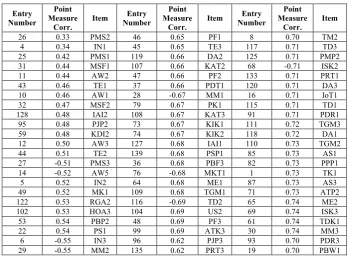
The examination of polarity items of Point Measure Correlation (PTMEA CORR) value is to determine the validity of the items produced in measuring the effectiveness of an element to be measured. This is to detect the polarity items which to test how far that item to achieve the goal of study. According to Bond and Fox [37] if the value found in the PTMEA CORR is the positive (+), it show the items can measure the constructs that want to measured, but if the value found in the PTMEA CORR is the negative (-), it show the items does not to measure the constructs and needs to re-paired or dropped. Based on Table 5 showing have 12 items that negative value in the PTMEA CORR namely; PMS3 (-0.51), AW5 (-0.52), IN3 (-0.55), MM2 (-0.55), AW4 (-0.60), PS3 (-0.62), AW6 (-0.65), MKT3 (-0.65), MM1 (-0.67), MKT1 (-0.68), TD2 (-0.69) and ISK2 (-0.71). While the other rest items show the value of PTMEA CORR is positive. After discuss with expert of instrument the researcher decide, the finding result shows 12 items should be dropped and the other rest items is able to moving on direction of construct to being measured [37]. The code of item is referring to elements of this study. That element is none provided in this study.
Table 5. Point Measure Correlation Value
Entry Number
Point Measure
Corr.
Item Number Entry
Point Measure
Corr.
Item Number Entry
Point Measure
Corr.
Item
26 0.33 PMS2 46 0.65 PF1 8 0.70 TM2
4 0.34 IN1 45 0.65 TE3 117 0.71 TD3
25 0.42 PMS1 119 0.66 DA2 125 0.71 PMP2
31 0.44 MSF1 107 0.66 KAT2 68 -0.71 ISK2
11 0.44 AW2 47 0.66 PF2 133 0.71 PRT1
43 0.46 TE1 37 0.66 PDT1 120 0.71 DA3
10 0.46 AW1 28 -0.67 MM1 16 0.71 IoT1
32 0.47 MSF2 79 0.67 PK1 115 0.71 TD1
128 0.48 IAI2 108 0.67 KAT3 91 0.71 PDR1
95 0.48 PJP2 73 0.67 KIK1 111 0.72 TGM3
59 0.48 KDI2 74 0.67 KIK2 118 0.72 DA1
12 0.50 AW3 127 0.68 IAI1 110 0.73 TGM2
44 0.51 TE2 139 0.68 PSP1 85 0.73 AS1
27 -0.51 PMS3 36 0.68 PBF3 82 0.73 PPP1
14 -0.52 AW5 76 -0.68 MKT1 1 0.73 TK1
5 0.52 IN2 64 0.68 ME1 87 0.73 AS3
49 0.52 MK1 109 0.68 TGM1 71 0.73 ATP2
122 0.53 RGA2 116 -0.69 TD2 65 0.74 ME2
102 0.53 HOA3 104 0.69 US2 69 0.74 ISK3
53 0.54 PBP2 48 0.69 PF3 61 0.74 TDK1
22 0.54 PS1 99 0.69 ATK3 30 0.74 MM3
18 0.55 IoT3 24 - 0.62 PS3 72 0.70 ATP3
121 0.56 RGA1 7 0.62 TM1 17 0.70 IoT2
123 0.56 RGA3 42 0.63 MST3 35 0.70 PBF2
137 0.57 PIW2 3 0.63 TK3 38 0.74 PDT2
62 0.58 TDK2 60 0.64 KDI3 84 0.75 PPP3
70 0.58 ATP1 52 0.64 PBP1 77 0.75 MKT2
58 0.58 KDI1 90 0.64 AKT3 136 0.75 PIW1
132 0.58 PTT3 106 0.64 KAT1 63 0.75 TDK3
94 0.58 PJP1 100 0.64 HOA1 66 0.75 ME3
55 0.58 KP1 105 0.64 US3 131 0.76 PTT2
97 0.59 ATK1 2 0.64 TK2 57 0.76 KP3
134 0.59 PRT2 33 0.64 MSF3 140 0.76 PSP2
41 0.59 MST2 88 0.64 AKT1 40 0.77 MST1
75 0.60 KIK3 129 0.64 IAI3 80 0.77 PK2
13 -0.60 AW4 51 0.65 MK3 20 0.77 PBW2
9 0.60 TM3 112 0.65 PIP1 92 0.79 PDR2
101 0.60 HOA2 67 0.65 ISK1 98 0.79 ATK2
89 0.60 AKT2 50 0.65 MK2 113 0.79 PIP2
114 0.60 PIP3 15 -0.65 AW6 141 0.79 PSP3
124 0.61 PMP1 21 0.65 PBW3 126 0.80 PMP3
54 0.62 PBP3 78 -0.65 MKT3 86 0.80 AS2
23 0.62 PS2 56 0.65 KP2 138 0.82 PIW3
39 0.62 PDT3 34 0.69 PBF1
103 0.62 US1 130 0.70 PTT1
4.4 Item fit measure construct
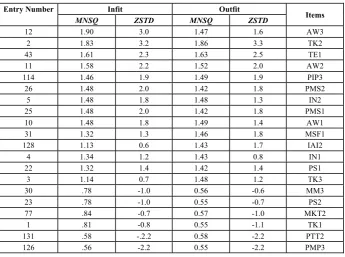
The examination of the item fit measure construct is to measure the constructs that can be seen from the value of index Mean-Square (MNSQ) Outfit. The value of Index MNSQ Outfit should be in range between to 0.60 to 1.40 and if other than that items need to considerate to dropped or repaired [37]. This is to ensure that the items used are appropriate in measuring the constructs of the study. That item need to follow two conditions, namely
i) If value of MNSQ Outfit smaller than 0.60, it mean items is too easy to expect by the respondent; and
ii) If greater than 1.40, it mean items is confusing and misleading to answer by re-spondent. Besides that, the index Standardized Z Values (ZSTD) value also should be -2 to +2, but if the MNSQ Outfit value be accepted, the ZSTD value can be ig-nored in this study.
TE1 (1.63), AW2 (1.52), PIP3 (1.49), PMS2 (1.42), IN2 (1.48), PMS1 (1.42), AW1 (1.49), MSF1 (1.46), IAI2 (1.43), IN1 (1.43), PS1 (1.42) and TK3 (1.48). This diag-nosis shows that the 20 items were dropped according to the needs of researchers and expert views.
Table 6. Item fit based on MNSQ Outfit Value
Entry Number Infit Outfit
Items
MNSQ ZSTD MNSQ ZSTD
12 1.90 3.0 1.47 1.6 AW3
2 1.83 3.2 1.86 3.3 TK2
43 1.61 2.3 1.63 2.5 TE1
11 1.58 2.2 1.52 2.0 AW2
114 1.46 1.9 1.49 1.9 PIP3
26 1.48 2.0 1.42 1.8 PMS2
5 1.48 1.8 1.48 1.3 IN2
25 1.48 2.0 1.42 1.8 PMS1
10 1.48 1.8 1.49 1.4 AW1
31 1.32 1.3 1.46 1.8 MSF1
128 1.13 0.6 1.43 1.7 IAI2
4 1.34 1.2 1.43 0.8 IN1
22 1.32 1.4 1.42 1.4 PS1
3 1.14 0.7 1.48 1.2 TK3
30 .78 -1.0 0.56 -0.6 MM3
23 .78 -1.0 0.55 -0.7 PS2
77 .84 -0.7 0.57 -1.0 MKT2
1 .81 -0.8 0.55 -1.1 TK1
131 .58 -.2.2 0.58 -2.2 PTT2
126 .56 -2.2 0.55 -2.2 PMP3
4.5 Measurement of standardized residual correlation value
The analysis of standardized residual correlation value is to determine whether the items have similarly meaning and overlap with other items. Referring to Table 7 shows have 2 pairs of items of standardized residual correlation value is above 0.70. According that result, one of items in pairs need to dropped because the item is likely similar or both items is share same purpose. Based on Linacre [38], if the correlation value of the two items exceeds 0.70, this indicates the value of correlation is high and only one items to be used in measuring the constructs in this study.
According to the finding there are two pairs of items:
i) TD1 pair with TD2
ii) PMS1 pair with PMS2. For find the final result, need to see the MNSQ Outfit of items is pairs and the smaller value need dropped.
pairs items of PMS1 (1.42) pair with PMS2 (1.42) have same MNSQ Outfit value that mean both items need dropped, but actually in item fit measure construct examination that items is done dropped, that mean both of items is automatically removed in this questionnaire.
Table 7. Standardized Residual Correlation value
Correlation Entry Number Items MNSQ Outfit Result
0.78 115 TD1 0.86 Retained
116 TD2 0.82 Remove
0.74 25 PMS1 1.42 Remove
26 PMS2 1.42 Remove
4.6 Finding of items in pilot study
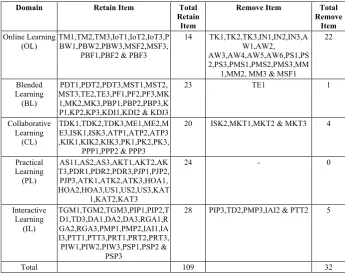
After the entire functionality checker from Rasch measurement model examina-tion, summary of final result for pilot study is shows in Table 8. Based on the pilot test result 32 items not meet requirement of analysis and need to remove from ques-tionnaire. But this decision still referring to expert considers supporting this finding. The finding of the pilot study have obtained 109 items for 39 elements that can be used and 32 items for 7 elements that need to be delete when analysis is done.
Table 8. Summary Final Result of Items Survey
Domain Retain Item Total
Retain Item
Remove Item Total
Remove Item Online Learning (OL) TM1,TM2,TM3,IoT1,IoT2,IoT3,P BW1,PBW2,PBW3,MSF2,MSF3,
PBF1,PBF2 & PBF3
14 TK1,TK2,TK3,IN1,IN2,IN3,A W1,AW2, AW3,AW4,AW5,AW6,PS1,PS 2,PS3,PMS1,PMS2,PMS3,MM
1,MM2, MM3 & MSF1
22 Blended Learning (BL) PDT1,PDT2,PDT3,MST1,MST2, MST3,TE2,TE3,PF1,PF2,PF3,MK 1,MK2,MK3,PBP1,PBP2,PBP3,K P1,KP2,KP3,KDI1,KDI2 & KDI3
23 TE1 1
Collaborative Learning (CL) TDK1,TDK2,TDK3,ME1,ME2,M E3,ISK1,ISK3,ATP1,ATP2,ATP3 ,KIK1,KIK2,KIK3,PK1,PK2,PK3,
PPP1,PPP2 & PPP3
20 ISK2,MKT1,MKT2 & MKT3 4
Practical Learning (PL) AS11,AS2,AS3,AKT1,AKT2,AK T3,PDR1,PDR2,PDR3,PJP1,PJP2, PJP3,ATK1,ATK2,ATK3,HOA1, HOA2,HOA3,US1,US2,US3,KAT 1,KAT2,KAT3
24 - 0
Interactive Learning (IL) TGM1,TGM2,TGM3,PIP1,PIP2,T D1,TD3,DA1,DA2,DA3,RGA1,R GA2,RGA3,PMP1,PMP2,IAI1,IA I3,PTT1,PTT3,PRT1,PRT2,PRT3, PIW1,PIW2,PIW3,PSP1,PSP2 & PSP3
28 PIP3,TD2,PMP3,IAI2 & PTT2 5
According the finding that can conclude the validity and reliability of instrument is important procedure to create new items in questionnaire. Researcher need to consider this procedure of pilot test is very important to measure the reliability of new items and respondent test to answer that item. Referring to Bond and Fox [37], the ad-vantage of using Rasch Measurement Model is able to identify the fitness, difficulty level and problematic scan of items and respondent in pilot study. The new item should be do pilot test to ensure that items can be used in researcher correctly. Thus, that ways can be improve the items validity and reliability to ensure each constructs is acceptable to fulfill research question.
5
Discussion and Conclusion
In this study, the validity and reliability of the test instrument were reinforced by the Rasch measurement model. Overall, show that reliability and separated person and item is in good and accepted in this study. Then the polarity items of PTMEA CORR value, item fit based on MNSQ value and measurement of standardized residual cor-relation value is shows 32 items of 7 elements need to remove from the questionnaire. That means 109 items of 39 elements for Technology Enabled/Enhanced Active Learning (TEAL) is ability to measure the understanding of learning and built job-related skills among students in civil engineering fields. The beneficial of using Rasch measurement model is able to illustrate the construct of validate item clearly and reli-able and legitimate to measure student perspective in active learning surrounding using technology tools. After data analysis, the validity and reliability of each item in this pilot study is important to ensure data is accurate with research. Data finding is to test the item in questionnaire is able to use in actual study. To conclude, the findings of this study, the pilot test were able to accommodate of research design in survey. That mean terms of suitability of items in questionnaire is can be conform of construct to the research question. This is to enhance the quality of instruments development when measuring the domains and elements of TEAL.
6
Acknowledgement
The author would like to thank to Malaysian Ministry of Higher Education and Universiti Tun Hussein Onn Malaysia (UTHM) for supporting this research under the scholarship of the Ministry of Higher Education (Mybrain15).
7
References
[1] Zhou, T. Liu, and L. Zhou, "Industry 4.0: Towards future industrial opportunities and chal-lenges. In Fuzzy Systems and Knowledge Discovery (FSKD)," pp. 2147-2152, 2015.
[2] F. Hassan, S. Puteh, and R. Buhari, "Student understanding through the application of technology enabled Active Learning in practical training.," Procedia-Social Behav. Sci., vol. 204, pp. 318-325, 2015. https://doi.org/10.1016/j.sbspro.2015.08.158
[3] Drake and D. Battaglia, "Teaching and learning in active learning classrooms.," Fac. Cent. Innov. Teach. Cent. Michigan Univ., 2014.
[4] F. Hassan and S. Puteh, "A Survey of Technology Enabled Active Learning in Teaching and Learning Practices to Enhance the Quality of Engineering Students.," Adv. Sci. Lett., vol. 23, no. 2, pp. 1104-1108, 2017. https://doi.org/10.1166/asl.2017.7509
[5] W. Tsai, C. F. Lai, M. C. Chiang, and L. T. Yang, "Data mining for Internet of Things: A survey.," IEEE Commun. Surv. Tutorials, vol. 16, no. 1, pp. 77-97, 2014.
https://doi.org/10.1109/SURV.2013.103013.00206
[6] Abdullah, M. F. Ramlan, and M. S. Sabran, "Developing A Student Development Index: A Conceptual Paper.," 2014.
[7] F. Hassan, S. Puteh, and A. Sanusi, "Fleiss's Kappa: Assessing the Concept of Technology Enabled Active Learning (TEAL).," J. Tech. Educ. Train., vol. 11, no. 1, pp. 109-118, 2019. https://doi.org/10.30880/jtet.2019.11.01.014
[8] S. T. Classrooms, "Technology Enabled Active Learning (TEAL) Classroom. www.unh.edu.," 2017.
[9] Wiersma, "Research methods in education: An introduction," Bost. Allyn Bacon, 2000. [10] S. Parmjit, Y. F. Chan, K. S. Gurnam, and K. Ranjit, "Panduan Komprehensif Penulisan
Cadangan Penyelidikan.," Shah Alam Pus. Pnb. Univ. UiTM., 2010.
[11] G. A. Johanson and G. P. Brooks, "Initial Scale Development: Sample Size for Pilot Stud-ies.," Educ. Psychol. Meas., vol. 70, no. 3, pp. 394-400, 2010. https://doi.org/10.11 77/0013164409355692
[12] A. Aziz, "Anthelmintic Resistance, Validation of FAMACHA and Effects of Management Practices in Selected Goat Farms in Terengganu, Malaysia.," Univ. Putra Malaysia., 2010. [13] B. Wright and M. H. Stone, "Best Test Design. Rasch Measurement.," Chicago MESA
Press., 1979.
[14] Y. J. Dori and Belcher.W.J, "How Does Technology Enabled Active Learning Affect Un-dergraduate Students' Understanding of Electromagnetism Concepts?.," J. Learn. Sci., vol. 14, no. 2, pp. 243-279, 2005. https://doi.org/10.1207/s15327809jls1402_3
[15] R. S. Shieh, W. Chang, and J. Tang, "The Impact Of Implementing Technology- Enabled Active Learning (TEAL) In University Physics In Taiwan.," Asia-Pacific Educ. Res., vol. 19, no. 3, pp. 401-415, 2010. https://doi.org/10.3860/taper.v19i3.1850
[16] J. L. Morrison and P. Long, "The iCampus Technology-Enabled Active Learning Project at MIT: An Interview with Phillip Long," Innovate," J. Online Educ., vol. 5, no. 4, p. 1, 2009. [17] L. Cinganotto, S. Panzavolta, P. Garista, L. Guasti, and P. Dourmashkin, "TEAL as an in-novative teaching model Insights from 'Educational Avant-Garde' Movement in Italy.," J. e-Learning Knowl. Soc., vol. 12, no. 2, 2016.
[18] J. Belcher, "Technology enabled active learning," 2005.
[19] C. R. Dourmashkin, "Bridging the Gap: How Interactive Mapping Can Facilitate Public Participation in a Wired Community (Doctoral dissertation, Columbia University)," 2010. [20] C. Ostermeier, M. Prenzel, and R. Duit, "Improving Science and Mathematics Instruction:
The SINUS Project As An Example for Reform as Teacher Professional," Dev. Int. J. Sci. Educ., vol. 32, no. 3, pp. 303-327, 2010. https://doi.org/10.1080/09500690802535942
[22] P. H. P. Chiu, "A technology-enriched active learning space for a new gateway education programme in Hong Kong: A platform for nurturing student innovations.," J. Learn. Spac-es, vol. 5, no. 1, 2016.
[23] N. F. Hassan, S. Puteh, and A. Sanusi, "Elements of Technology Enabled/Enhanced Active Learning (TEAL) to Enhance Quality and Employability of Bachelor's Students. In MATEC Web of Conferences," EDP Sci., vol. 150, 2018.
https://doi.org/10.1051/matecconf/201815005005
[24] K. T. Foote, "Factors Underlying the Adoption and Adaption of a University Physics Re-form over Three Generations of Implementation.," Electron. J. Sci. Educ., vol. 18, no. 3, 2014.
[25] D. Peberdy and D. N. Consultancy, "The Case for Active Learning Environments in Uni-versity Education.," Droitwich Net., 2014.
[26] L. Breslow, "Wrestling with Pedagogical Change: The TEAL Initiative at MIT Change." Mag. High. Learn., vol. 45, no. 2, pp. 23-29, 2010. https://doi.org/10.1080/00 091383.2010.503173
[27] D. Peberdy, "Active Learning Spaces and Technology. Advances in Higher & Further Ed-ucation," Droitwich Net, 2014.
[28] N. Parishan, E. M. Jafari, and Fatemehnosrat, "The Effect of Technology Enabled Active Learning (TEAL) Method in Biology on The Academic Achievements of Students. Proce-dia - Social and Behavioral Sciences," World Conf. Educ. Technol. Res., vol. 28, no. 1, pp. 542-546, 2011. https://doi.org/10.1016/j.sbspro.2011.11.104
[29] T. Long, J. Logan, J. Cummins, and M. Waugh, "Students' and Instructor's Attitudes and Receptions of the Viability of Using A Flipped Classroom Instructional Model In A Tech-nology-Enabled Active Learning (TEAL) Classroom.," J. Teach. Learn. with Technol., vol. 5, no. 1, p. 46, 2016. https://doi.org/10.14434/jotlt.v5n1.18879
[30] M. Chida and G. Brown, "Evaluating The Gap Between Industry Assessment of Job Read-iness and Graduation Standards in Higher Education Institutions: The Case of Fashion Studies.," Int. J. Fash. Des. Technol. Educ., vol. 4, no. 2, pp. 71-82, 2011.
https://doi.org/10.1080/17543266.2010.525533
[31] K. Schuster, K. Groß, R. Vossen, A. Richert, and S. Jeschke, "Preparing for industry 4.0-collaborative virtual learning environments in engineering education. In Engineering Edu-cation 4.0," Springer, Cham., pp. 477-487, 2016. https://doi.org/10.1007/978-3-319-46916-4_36
[32] V. P. Clark and J. W. Creswell, "Designing and conducting mixed methods research.," 2011.
[33] W. Wiersman and S. G. Jurs, "Research methods in education: An introduction.," 2009. [34] M. N. Abdul Ghafar, "Reka Bentuk: Soal Selidik Pendidik.," Skudai Univ. Teknol.
Malay-sia., 2003.
[35] J. W. Creswell, "Research Design: Qualitative, Quantitative, and Mixed Methods Ap-proaches.," Los Angeles Sage Publ. Inc., vol. 3, 2009.
[36] G. Rasch, "Probabilistic Models for Some Intelligence and Attainment Test.," Chicago, Univ. Chicago Press., 1980.
[37] T. G. Bond and C. M. Fox, "Applying the Rasch model: Fundamental measurement in the human sciences.," Lawrence Erlbaum Assoc. Publ. Mahwah, New Jersey, London., vol. 2, 2007
8
Authors
Nur Farha bte Hassan, received the B.S. degree in Electrical Engineering from Universiti Tun Hussein Onn Malaysia in 2015, and the Ph.D. degree in Technical and
Vocational Education in 2020. Her current research interests include Technology Enabled Active Learning. Email: [email protected]
Saifullizam bin Puteh, received the B.S. degree in Electrical Engineering from Universiti Teknologi Malaysia in 1998 and the Ph.D. degree in Computational Intelli-gent in Nottingham Trent University in 2014. He is currently an Associate Professor with the Universiti Tun Hussein Onn Malaysia in Faculty Technical and Vocational Education. His current research interests include innovation and technology in TVET, Computational Intelligent, Electronic and Electrical Engineering, Occupational Work and Competence Development, Shaping Work and Technology. Email: [email protected]
Amanina binti Muhamad Sanusi, received the B.S. degree in Electrical Engi-neeing from Universiti Tun Hussein Onn Malaysia in 2015, where she is currently pursuing the Ph.D. degree in Technical and Vocational Education. Her current re-search interests include talents and workability in education. Email: [email protected]
Nor Hartini Binti Che Mohamad Zahid, received the B.S. degree in Electrical Engineering from Universiti Tun Hussein Onn Malaysia in 2009, where she is cur-rently pursuing the Ph.D. degree in Technical and Vocational Education. Her current research interests include rubric assessment in education. Email: [email protected]