
Project, Technology And Active (PROTECTIVE)
Learning Model To Develop Digital Literacy Skills
In The 21st Century
Fatkhur Rohman, Ahmad Fauzan, YohandriAbstract: This research aims to find out the impact of implementing a physics learning based on Project, Technology and Active (PROTECTIVE) learning model in building three digital literacy skills namely information literacy, media literacy, and ICT literacy. This research is an alternative solution to the students’ Skills and awareness to utilize and integrate technology in learning physics. The subject of this research is early semester students who took a basic physics course. The sample of the research is 71 students majoring in physics education from Universitas Negeri Padang (UNP) and Universitas Islam Negeri Imam Bonjol (UIN IB). Data on digital literacy Skills is obtained through performance observation and assessment of structured task reports during the learning process. The instruments used are observation sheets and analytic rubrics. The data were analyzed by using descriptive statistics interpreted in 4 rating scales, they are: very good, good, fair and poor. Based on the results of the observation at the stage of the project, project and practicum tests, there were 13% of students experiencing little difficulty in using, managing and evaluating information data from the technology software or platform for physic learning. The analysis result of research samples from UNP and UIN IB respectively suggests that 20% and 23% of students achieve very good predicate in information literacy skills, the good predicate has a considerable portion of 64% and 69%, The remaining 16% and 8% fall into the fair predicate. On the assessment of media literacy, there were 18% and 12% of students who fall into a very good predicate of 78% and 81% and 4% and 8% fall into the good predicate. For very good predicate, ICT literacy Skills has 22% and 15% of students, while 62% and 62% of the students fall into good predicate. Besides, the rest of 16% and 23% of the students fall into the fair predicate. The conclusion of the achievement of these three literacies show that the digital literacy Skills achieved by students of UNP and UIN IB is said to be at a good level of 77% and 76%. The findings in this research are highly relevant and interesting in the world of education because the application of PROTECTIVE learning is one of the best solutions for teachers, lecturers and education managers to build digital literacy Skills for the participants in the 21st century.
Index Terms: Learning-based PROTECTIVE, digital literacy skills, physics learning.
—————————— ——————————
1.
INTRODUCTION
The rapid development of Science and Technology (IPTEK) that occurred in the 21st century brought human civilization into the new phase of The era of industry 4.0 [1],[2]. This change has impacted the paradigm shift of the old education in which the learning process is still oriented towards reading, writing, and arithmetic skills [3],[4]. The skills of reading, writing and arithmetic alone are not enough to meet the relevance of future workplace demands in the face of the era of industry 4.0 [5],[1],[2],[6] but must also be supported with digital literacy skills detailed on three literacies including information literacy, ICT literacy and media literacy [7]. From the results of preliminary research at the Universitas Negeri Padang and the state Islamic University Imam Bonjol Padang, it is found that the basic physics course does not generally have awareness of the utilization of ICT in understanding the concept of physics and use it as a media for practicum activity. This is also accompanied by a lack of student skills in using some supporting software such as Physics (Tracker, Audacity, Logger Pro, Scope, Overtone, etc.).
Based on a literary study of several recent studies, to build digital literacy skills in learning physics in the 21st century, researcher has gained three key points that must exist in the learning of 1) project-based learning [4],[8],[9],[10],[11], 2) technology integrated learning [12],[13][14], and 3) active learning environment [15],[16]. These three key points are the
basis of PROTECTIVE (Project, Technology, and Active) learning implementation. To report the impact of (Project, Technology and Active) learning implementation, this article seeks to demonstrate the discoveries gained in learning. Reporting multiple discoveries of the PROTECTIVE learning implementation (Project, Technology, and Active) can build students’ digital literacy skills in physics learning.
2
LITERATURE
REVIEW
2.1 What is digital literacy in physics?
Digital literacy is a term that is often used to describe a person's Skills in accessing, managing, evaluating, understanding, and using technology as a medium and source for information [17],[7]. Specifically, Trilling and Fadel [7] state that digital literacy skills includes three aspects (1) Information literacy, (2) ICT literacy and (3) Media literacy. In Indonesia, government policy of digital literacy Skills can be represented in the Perpres RI Nomor 8 Tahun 2012 [18] about KKNI with the substance that the achievement of undergraduate student (S1) of physics education is expected to have the ability to apply logical, critical, systematic, and innovative thinking in the implementation of knowledge of science and technology that is related to the field of physics. Achievement of performance indicators of digital literacy Skills in physics learning can be presented in Table 1 below.
————————————————
Fatkhur Rohman is currently a student of Educational Sciences Doctoral Program in Universitas Negeri Padang, Indonesia. E-mail: [email protected]
Ahmad Fauzan is currently a professor in Universitas Negeri Padang, Indonesia. E-mail: [email protected]
Yohandri is currently a lecturer at Physics Department in Universitas Negeri Padang. E-mail: [email protected]
13 2.2 Why Learning Model PROTECTIVE can Build Digital
Literacy?
Learning model PROTECTIVE is project-based learning that is integrated with technology and an active learning environment. Based on literary study, the three main characteristics of this
technology and active project in learning model PROTECTIVE can build 21st-century skills that supports the achievement of digital literacy. The first characteristic in the learning model PROTECTIVE is project-based learning that will give students opportunities to build an understanding of media, information sources, collaborative skills, critical and creative thinking skills [4], [8], [9]. The second characteristic is technology-integrated learning. Integrating technology in a learning environment can hone ICT literacy skills and information literacy skills by accessing, organizing, analyzing and evaluating, and interpreting the information that the students get [12], [13], [14]. Besides, in the application of project-based learning, it is more effective if the project is integrated with the utilization of technology as a media learning [19], [20], [21], [22], [11]. The third characteristic is active learning which is able to encourage students' commitment for independent group performance both in groups and individuals, and to construct knowledge with a little help from lecturers [15],[16]. With those three characteristics, the implementation of the learning model PROTECTIVE for the students has the potential to hone and build digital literacy in selecting, accessing, organizing, analyzing and evaluating, and interpreting the information needed to support critical thinking, problem-solving and collaboration skills.
3
METHODOLOGY
This section describes the method or technical implementation of the PROTECTIVE learning model and the research sample in the field. The sample consists of two classes, the first class consists of 45 students of Universitas Negeri Padang (UNP) and the second class consists of 26 students of Universitas Islam Negeri Imam Bonjol (UIN IB). The data on digital literacy skills is obtained through performance observation and assessment of structured tasks report during the learning process. The instruments used are observation sheets and analytic rubrics. The current research data is analyzed using
the interpreted descriptive statistics in 4 rating scales; very good, good, fair, and poor by referring to Table 2. PROTECTIVE learning model is implemented in groups and
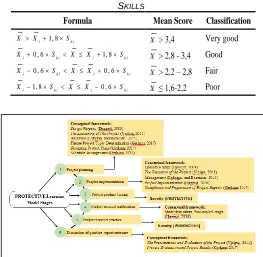
lasted for 5 meetings with three different project topics. The learning implementation consists of 6 stages (see Figure 1).
According to figure 1, each stage of the implementation of the
PROTECTIVE learning model can be explained explicitly as follows:
Stage 1. Project Planning (meeting 1)
The implementation stage of students’ project planning in groups is focused on choosing and designing the topic of the project to be completed in learning. Students are given the freedom to choose the topics of the project to be completed from several themes that have been determined by lecturers before learning. Based on Doppelt [23] and Violeta [24] in the selection of project topics, students are required to observe, analyze the problem, and describe a logical reason related to their project topic. It aims to build several students’ skills in identifying the tools/media and materials needed in the completion of the project, arranging cost plan and schedule to complete the project as well as planning the tasks for every group member during the completion of the project they choose. The focus on the project planning stage is more on the development of media literacy skills and information in physics learning.
Stage 2. Project Implementation
The second stage is an action activity towards the achievement of the project purposes that has been designed and set. The project was carried out as a home assignment for one week. During the completion process, the lecturer controls
TABLE1
PERFORMANCE INDICATORS OF DIGITAL LITERACY IN PHYSICS
No Digital literacy Skills Performance (SP)
1. Information literacy 1.1.Students are able to access, assess and evaluate data information from technology platforms or software of physics learning (SP 1.1).
1.2.Students are able to evaluate information critically and competently (SP 1.2).
1.3.Students are able to use the information accurately and creatively to solve their problems (SP 1.3).
1.4.Managing information from various sources of technology or software platform for physics learning (SP 1.4).
2. ICT literacy 2.1.Students are capable of using technology as a media to study, research, evaluate, and communicate information in physics learning (SP 2.1).
2.2.Students are able to use digital technology as a media to access, manage, integrate, evaluate, and make information to succeed in acquiring physics knowledge (SP 2.2).
3. Media literacy 3.1.Students are able to understand well how, why, and for what purpose messages in media are built (SP 3.1). 3.2.Students are able to examine how individuals interpret messages differently, how values and viewpoints are incorporated or excluded and how the media can influence beliefs and behaviors (SP 3.2).
.
TABLE2
INTERPRETATION OF ASSESSMENT REPORT OF DIGITAL LITERACY SKILLS
Formula Mean Score Classification
1, 8
i b i
X X S X > 3,4 Very good
0 , 6 1, 8
i b i i b i
X S X X S X > 2,8 - 3,4 Good
0 , 6 0 , 6
i b i i b i
X S X X S X > 2,2 – 2,8 Fair
1, 8 0 , 6
i b i i b i
X S X X S X ≤ 1,6-2,2 Poor
the progress of the project of the students through the virtual class. Through this virtual class, the lecturer can provide closed-ended questions to dig in some information regarding their preparation for the implementation of the project, while the open-ended questions are intended to ask for their explanations of their project progress (see table 3).
TABLE3
CLOSED-ENDED QUESTIONS IN PROJECT IMPLEMENTATION
The focus on the stage of project implementation is to train the students to build ICT and information literacy skills through the assignment of searching for information from the technology platform. In addition, students' skills in media literacy will be awakened through their understanding of the self-explanatory explanation of the tools and materials’ functions used in completing their project.
Stage 3. Project product testing (meeting 2) At this stage, students internally conduct testing on products in their respective groups, product testing is related to the practicality of products in learning. There are several criteria to be tested they are: 1) is the product produced from the project easy to use in the learning activity?; 2) is the product being produced generated from the project can be used to retrieve data following variables on the topic of the physics lessons (technical thoroughness and accuracy of the product) and 3) is the product being produced from the project is safe to use in learning. In the activity of project product testing, the lecturers act as facilitators who provide feedback in the form of constructive inputs of the results of project product testing in order to fix before getting published.
Stage 4. Project product publication (meeting 3)
Project product publication is conducted internally by the mechanisms of each student group presenting their findings (products) to their classmates by providing detailed explanations of the products they produce and the scientific principles of product use. It aims to facilitate other groups in the implementation of practicum, because students will practicum with products produced by other groups. In this stage, lecturers act as facilitators and reflectors towards some explanations that the students do not understand during the project publication process.
Stage 5. Project product practicum (meeting 4)
In the 5th stage, students perform practical activities by using product project, with the regulation of exchanging different products between groups. At this stage, it aims to see the students ' ability to use the products of the practicum tools produced in other group projects. Media and ICT literacy are highly tested as project products produced by the students generally utilize technology.
Stage 6. Discussion of practicum report outcome (meeting 5) The discussion is conducted jointly in one class or group study which is related to the results of the practicum activity report. Content that becomes a discussion material include 1) testing procedure; 2) analysis of practicum data results; 3) the thoroughness and accuracy of the data produced by the laboratory equipment (project product), and 4) problems generalization of data information generated by the practicum tools (project product).
4 RESULTS
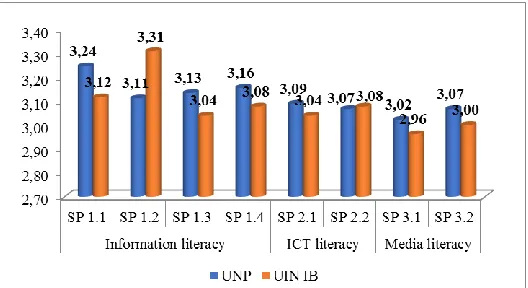
The successful implementation of the PROTECTIVE learning model in establishing digital literacy is measured by the average score and the percentage of students' personal or classical skills in fulfilling the achievement of the skills that is established (see table 1). In this research, data on digital literacy skills is derived from the results of observation and assessment of structured task reports during students’ learning activity with the implementation of the PROTECTIVE learning model. From the data analysis results, the classical average score of the digital literacy skills achievement can be seen as in Figure 2.
Fig. 2. The calculation of classical mean score of the digital literacy
skills achievement
15
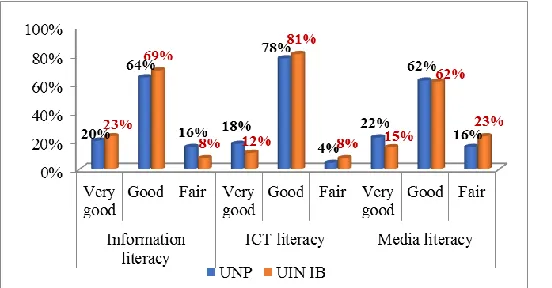
Fig. 3. The graph of digital literacy skills level and percentage
In figure 3, the percentage result of digital literacy skills achievement can be explained that the number of students from UNP and UIN IB respectively in information literacy skills are 9 and 6 students who achieve a very good predicate, predicate while the good predicate is pretty much in portion of 29 and 18, the rest 7 and 2 falls into fair predicate. On the assessment of media literacy, there are 8 and 3 students who get very good predicate, while 35 and 21 students get good predicate and 2 and 2 students are fair. Further for the ICT literacy skills, 10 and 4 students get very good predicate, 28 and 16 students get good predicate and 7 and 6 students are fair.
5 CONCLUSION
Based on the results of analysis data derived from UNP and UIN IB students’ sample, it is respectively suggested that 20% and 23% of students achieve very good predicate in information literacy skills, good predicate has enough portion with the percentage of 64% and 69%, and the remaining 16% and 8% is fair. On the assessment of media literacy, there were 18% and 12% of students who got very good predicate, 78% and 81% both as well as 4% and 8% were in a good predicate. For very good predicate, ICT literacy skills has 22% and 15% of students, while 62% and 62% of students got good predicate and the rest predicate 16% and 23% of students got fair predicate. The conclusion of these three literacies achievement represents that the implementation of the PROTECTIVE learning model is capable of establishing digital literacy skills. In addition, researcher found some important notes during the learning process in order to develop digital literacy skills, students must have some important parts that are very essential among them which are (1) understanding towards the variety of information contexts in the digital world (2) the power of thought in assessing and analyzing (3) constructive attitudes and commitments and (4) communicative and critical attitudes towards new things.
ACKNOWLEDGMENT
The authors wish to thank to Ayu Lusiyana, Febrianto and Rudi that have been helpful as an observer in retrieving research data in the learning process. Furthermore, the researcher is also thankful for RISTEKDIKTI, through a research grant program this doctoral research funded.
REFERENCES
[1] Pozdnyakova, Ulyana A., Golikov, Vyacheslav V., Peters, Irina A., and Morozova, Irina A.. 2019. Genesis of the Revolutionary Transition to Industry 4.0 in the 21st Century and Overview of Previous Industrial Revolutions. Springer International Publishing AG, part of Springer Nature 2019 E. G. Popkova et al. (eds.), Industry 4.0: Industrial Revolution of the 21st Century. P 11-19.
[2] Ragulina, Yulia V., Alekseev, Alexander N., Strizhkina, Irina V. and Tumanov, Arseniy I. 2019. Methodology of Criterial Evaluation of Consequences of the Industrial Revolution of the 21st Century. Springer International Publishing AG, part of Springer Nature 2019 E. G. Popkova et al. (eds.), Industry 4.0: Industrial Revolution of the 21st Century. P 235-244.
[3] Alismail, Halah Ahmed. and McGuire, Patrick. 2015. 21st Century Standards and Curriculum: Current Research and Practice. Journal of Education and Practice. Vol.6, No.6, 2015. 150-154.
[4] Erdogan, Niyazi and Bozeman, Todd Dane. 2015. Models of Project-based learning for the 21st century. A. Sahin (Ed.), A Practice-based Model of STEM Teaching, 31–42. Sense Publishers. All rights reserved.
[5] Gijsbers, G. and van Schoonhoven, B. 2012. The future of learning: a foresight study on new ways to learn new skills for future jobs. European Foresight Platform (EFP) Brief, No. 222. [6] Scott, Cynthia Luna. 2015. The Futures of Learning 2: What
Kind of Learning for The 21st Century?. Education Research and Foresight Working Papers No 14. United Nations Educational, Scientific and Cultural Organization (UNESCO). 1-14.
[7] Trilling, B. & Fadel, C., 2009. 21st Century learning skills. San Francisco, CA: John Wiley & Sons.
[8] Hugerat, Care. 2016. How teaching science using project-based learning strategies affects the classroom learning environment. Learning Environ Res (2016) 19:383–395. [9] Hussin, Anealka Aziz. 2018. Education 4.0 Made Simple:
Ideas For Teaching. International Journal of Education & Literacy Studies. Volume: 6 Issue: 3. P 92-98.
[10]McGrath, D. (2002). Getting started with project-based learning. Learning and Leading with Technology, 30(3), 42-50. [11]Rohman, F., Fauzan, A., and Yohandri. 2019. Integration of
technology in project based learning with tracker on practicum activities. IOP Conf. Series: Journal of Physics: Conf. Series1185 (2019) 012036.
[12]Ananiadou, K. and Claro, M. 2009. 21st Century Skills and Competences for New Millennium Learners in OECD Countries. OECD Education Working Papers, No. 41. Paris, OECD Publishing.
[13]Huang, Ronghuai. Spector, J. Michael. Yang, Junfeng. (2019). Educational Technology A Primer for the 21st Century. Singapore: Springer Nature Singapore.
[14]Pheeraphan, Nutteerat. 2013. Enhancement of the 21st Century Skills for Thai Higher Education by Integration of ICT in Classroom. Procedia - Social and Behavioral Sciences. 103. 13th International Educational Technology Conference. P 365 – 373.
[16]Thinnukool, Orawit. 2018. Analysis of the Use of Social Network in the 21st Century Active Learning for Undergraduate Students Based on the Subject of Rapid Application Development. International Journal of Innovation and Technology Management Vol. 15, No. 3 (2018) 1850020 (14 pages). DOI: 10.1142/S0219877018500207.
[17]Belshaw, Douglas A.J. 2011. What is ‘digital literacy’?. Dissertation. England: Durham University.
[18]Presiden Republik Indonesia. (17 Januari, 2012). Kerangka Kualifikasi Nasional Indonesia. Peraturan Presiden Republik Indonesia Nomor 8 Tahun 2012. Jakarta, Jakarta, Indonesia: Menteri Hukum dan Hak Asasi Manusia Republik Indonesia. [19]Bottino, R. M., & Robotti, E. (2007). Transforming classroom
teaching & learning through technology: Analysis of a case study. Educational Technology & Society, 10(4), 174–186. [20]ChanLin, L-J. (2008). Technology integration applied to
project-based learning in science. Innovations in Education and Teaching International, 45(1), 55-65.
[21]Colley, K. 2008. Project-based science instruction: A primer. The Science Teacher, 75, 5–9.
[22]Dogan, Bulent and Robin, Bernard. (2015). Technology’s Role in stem education and the stem SOS model. A. Sahin (Ed.), A Practice-based Model of STEM Teaching, 77–94. Sense Publishers. All rights reserved.
[23]Doppelt, Y. (2003). Implementation and assessment of project-based learning in a flexible environment. International Journal of Technology and Design Education, 13, 255-272.
![Design of new anti Alzheimer drugs: ring expansion synthesis and synchrotron X ray diffraction study of dimethyl 4 ethyl 11 fluoro 1,4,5,6,7,8 hexahydroazonino[5,6 b]indole 2,3 dicarboxylate](data:image/gif;base64,R0lGODlhAQABAIAAAP///wAAACH5BAEAAAAALAAAAAABAAEAAAICRAEAOw==)