Language Learning Through Mobile Learning: A Content Analysis
Análisis de documentos publicados en Scopus acerca de la enseñanza de lenguas
con el uso de dispositivos móviles: un análisis de contenido
Huseyin Uzunboylu
1*Near East University, Mersin, Turkey
Zeynep Genc
2**University of Kyrenia, Kyrenia, Cyprus
The purpose of this study is to determine the recent trends in foreign language learning through mobile learning. The study was conducted employing document analysis and related content analysis among the qualitative research methodology. Through the search conducted on Scopus database with the key words “mobile learning and foreign language learning”, the study is based on the analysis of the documents published between the years 2005 and 2017; their distribution took place by years, subject areas, document types, country/regions, and the affiliated universities of the authors. The varied findings revealed that the analysis of the studies published on Scopus database was important in terms of content for the significance of foreign language learning through mobile learning.
Key words: Content analysis, foreign language, foreign language teaching, mobile learning.
El objetivo de este estudio es identificar las tendencias recientes sobre la enseñanza de lenguas extranjeras con el uso de dispositivos móviles. Se trata de un análisis documental y de contenido dentro de la metodología de la investigación cualitativa. La búsqueda se realizó en la base de datos de Scopus con las palabras clave “enseñanza con dispositivos móviles” y “aprendizaje de lenguas extranjeras” en documentos publicados entre el 2005 y el 2017. El análisis de los documentos se hizo de acuerdo a su distribución por años, materias, tipo, país/región, y universidades de los autores. Los resultados revelan que este tipo de análisis tiene importancia para la enseñanza de lenguas extranjeras con el uso de dispositivos móviles. Palabras clave: análisis de contenido, enseñanza con dispositivos móviles, enseñanza de lengua extranjera, lengua extranjera.
* E-mail: [email protected] ** E-mail: [email protected]
How to cite this article (apa, 6th ed.): Uzunboylu, H., & Genc, Z. (2017). Analysis of documents published in Scopus database on foreign
language learning through mobile learning: A content analysis. Profile: Issues in Teachers’ Professional Development, 19(Suppl. 1), 99-107. http://dx.doi.org/10.15446/profile.v19n_sup1.68624.
This article was received on September 3, 2017, and accepted on November 9, 2017.
Introduction
The literature survey reveals that mobile learning has become a rapidly expanding research and application area in many educational institutions, particularly universities, as a result of the increasing technological capacity of mobile devices that attract new users and provide advanced opportunities along with the widespread use of wireless networks (Rahimi & Mouri, 2016; Uzunboylu, Hursen, Ozuturk, & Demirok, 2015). Extensive theoretical and conceptual frameworks have yet to be found that explain the relationships between the characteristics of rapid and, at times, groundbreaking technological developments and their role in the users’ daily lives and educational potentials (Basöz & Can, 2016; Ozcan & Bicen, 2016; Pachler, Bachmair, & Cook, 2010; Saran & Seferoğlu, 2010). However, mobile learning is becoming increasingly widespread both in the scope of “formal” and “non-formal” education and has gained significance by attracting the interest and attention of practitioners and researchers in all areas of education. National and international conferences, new books, and periodicals which can be used for both in and out of class activities clearly demonstrate the importance attributed to mobile technologies in education (Madieva, Tausogarova, & Tayeva, 2016).
This learning model that provides the opportunity to learn “anytime, anywhere,” for which the mobile technologies are used, also supports (a) individual learning in which the learners can determine their learning speed, (b) situated learning that includes a real context, and (c) cooperative learning in which the individuals work in groups and learn through helping each other (Baskan & Ozcan, 2011; Bicen & Uzunboylu, 2013; Cheon, Lee, Crooks, & Song, 2012; Çuhadar & Yücel, 2010; Naismith & Corlett, 2006; Traxler, Barcena, & García-Laborda, 2015).
Foreign language education is one of the educational fields in which technology plays a significant role. Mobile learning is also prominent in foreign language education (Bicen, Sadikoglu, & Sadikoglu, 2015; Kukulska-Hulme,
2006; Saran & Seferoğlu, 2010; Uzunboylu & Ozcinar, 2009) and even in language testing (García-Laborda, Giménez López, & Magal Royo, 2011; García-Laborda, Magal Royo, & Bakieva, 2016). Tablet computers, more functional “smartphones” with operating systems as Android and ios, digital cameras, personal digital assistants (pdas), mp3 players, and e-readers have become widespread, particularly among the younger population (Baglama, Yikmis, & Demirok, 2017; Sert & Boynueğri, 2017; Uzunboylu & Tugun, 2016). Along with this, foreign language education with mobile devices in technology-supported language education has become a field in which many research projects and applications are conducted (Godwin-Jones, 2011).
Learners can reach language learning materials more easily and quickly and get in touch with others anytime, anywhere in mobile supported language learning. By the very nature of digital technologies that are used, it becomes easier for the learners to participate in both collaborative and individual learning activities simultaneously and/or non-simultaneously (Akça, Demir & Yilmaz, 2015; Bajrami & Vela, 2017). This brings up a potential that contributes to the development of all language skills. A variety of language materials and learning tools with mobile technologies can provide opportunities for autonomous and situated learning, encourage social interaction, and strengthen motivation of students (Hu, 2017).
of the participants expressed that the mobile technol-ogy added a positive value to the course. Ninety-three percent of the participants stated that mobile learning was useful when commuting while 50% expressed that they would have doubts about courses delivered through mobile technologies only. This finding points out that it is more favorable to use mobile phones to support traditional education environments rather than to use it alone. Jones and Marsden (2004) in their project “Text Worm” designed a system in which the students can respond via text messages to the multiple choice or open-ended questions that are reflected on the board through an overhead projector during the lesson. With computers that can receive text messages, the researchers evaluated the responses of students in real time and sent the results instantly to the students’ mobile phones. The researchers have reported that the students found this application useful; however, they have been distracted while reading and answering the open ended questions from their mobile phone screens. The researchers have also pointed out that paying for sending text messages is one of the downsides of this application. Regan, Nash, and Licata (2000) have investigated the effectiveness of the sms (text message) feature of mobile phones together with the web in teaching Spanish. The findings of this research revealed that the mobile phones have a positive impact on the language learning process. However, the participants complained regarding the small screens of the mobile phones. Thornton and Houser (2005) have sent the definitions of English words to students’ mobile phones and investigated the effectiveness of this method and the reactions of students. Pre/post-test results have revealed that vocabulary courses delivered via sms through mobile phones are effective in vocabulary building. Ninety-three percent of the students have reported positive views towards mobile learning. In another study, Levy and Kennedy (2005) sent the definitions of words and idioms via short messages at pre-designated intervals to the students of Italian.
At the end of the research the students were asked about the number and timing of the messages. The participants reported that the most convenient time to receive messages is between 9 am and 10 am and that the best number of messages is two in a day. Koren (1999) and Abdulhay (2015) emphasized that for effective English language learning and vocabulary acquisition in particular; in-class activities are not sufficient and that practices and applications should be carried out outside the classroom as well. Although this implication is stated by many educators, students do not make enough effort outside the classroom (e.g., Baturay, 2007; Kuimova, Uzunboylu, & Golousenko, 2017). The most important reason for this can be explained as the students’ lack of internal motivation to start studying. However, the significance of motiva-tion for effective learning is stated by all educators. In a study conducted by Korkut and Akkoyunlu (2008), information and computer literacy self-efficacy of foreign language teacher candidates were investi-gated. The findings of the research revealed that the teacher candidates could use computers and that the possession of a computer and the contribution of computer courses in the Education Faculty curricula were stated as the reasons for this. Moreover, when the computer literacy of the teacher candidates were evaluated in terms of sex variable, the findings of the research revealed that there was a significant difference in favor of male candidates. In addition, Ozdamli and Uzunboylu (2015) examined the mobile learning adequacy and perceptions of teachers in secondary schools and showed that teachers were motivated to use mobile learning in education; however, their adequacy levels for using mobile learning were not high enough.
general aim; the answers to the following sub-objective questions are sought:
• How are the efl teaching and learning documents distributed over the years?
• How is the distribution of efl teaching and learning according to subject areas?
• How is the distribution of efl teaching and learning according to document type?
• How is the distribution of efl teaching and learning according to country/regions?
• How is the distribution of efl teaching and learning according to the affiliated universities of the authors?
The Purpose and Importance of the Study
The purpose of this study is to systematically analyze the articles on Scopus database with selected key words based on themes through discussing other related basic concepts. Through the research the views regarding the use of mobile learning in foreign language learning will be evaluated to contribute to further studies in the related subject areas.
Limitations
• This research is limited to the selected and reviewed documents in the Scopus database.
• The research is limited to the documents published from the years 2005 to 2017, accessed through Near East University Scopus database.
• The content analysis of the documents is limited to the five themes specified above.
Method
The study was conducted employing document analysis and related content analysis among the quali-tative research methodology. The document analysis was restricted to efl teaching and learning. The basic process in content analysis is to compile similar data within the framework of specified concepts and themes and interpret them organized in a way that readers can
understand (Yildirim & Şimşek, 2006). Content analysis is a scientific frame that allows a systematic analysis of written, verbal, and other resources (Demirok, Baglama, & Besgul, 2015; Tavşancil & Aslan, 2001). Cohen, Manion, and Morrison (2007) define content analysis as present-ing the messages included in the existpresent-ing documents briefly and succinctly.
Data Collection and Analysis
Within the scope of the research on foreign language learning through the mobile learning method, a search was conducted primarily on Scopus database using the key words “mobile learning and foreign language learning” from the years 2005 to 2017 and yielded 32 documents of efl teaching and learning. The documents retrieved through the Scopus database were analyzed, integrated by correlation with each other, and the data were analyzed through content analysis.
Findings
The Distribution of the Documents by Years
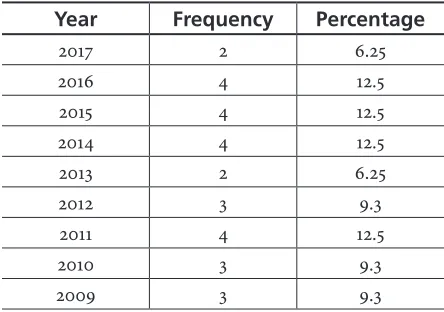
At this stage of the research the distribution of the documents from the years 2005 to 2017 was examined. In this context, 32 studies were accessed through Scopus database, their distribution is presented in Table 1.
Table 1. Distribution of the Documents by Year
Year Frequency Percentage
2017 2 6.25
2016 4 12.5
2015 4 12.5
2014 4 12.5
2013 2 6.25
2012 3 9.3
2011 4 12.5
2010 3 9.3
Year Frequency Percentage
2008 0
-2007 1 3.1
2006 0
-2005 2 6.25
Total 32 100
When the studies on efl learning through mobile learning method were analyzed it was revealed that the majority of the studies were conducted between the years of 2011 and 2016. The first study was conducted in 2005; and it was revealed that in 2006 and 2008 there were no studies.
Distribution of the Documents by Subject Areas
When the studies on efl teaching and learning through the mobile learning method were analyzed, it was revealed that most of the studies were conducted in the subject area of computer science (23) and social sciences (18). It was also revealed that the fewest num-ber of studies was conducted in the subject area of psychology (see Table 2).
Distribution of the Documents by Document Types
When the studies on foreign language learning through the mobile learning method were analyzed it was revealed that the majority of the studies were published as conference papers (21). There was one book and one book chapter on foreign language learning through the mobile learning method (see Table 3).
Distribution of Documents by Author Countries
When the author countries of the studies on foreign language learning through the mobile learning method were analyzed it was revealed that the majority of the studies were conducted in China (5). There were two studies from Turkey (see Table 4).
Table 2. Distribution of the Documents by Subject Areas
Subject Area f %
Computer science 23 71.8
Social sciences 18 56.25
Arts and humanities 3 9.3
Business, management, and accounting 3 9.3
Mathematics 3 9.3
Engineering 2 6.25
Psychology 1 3.1
Total 32 100
Table 3. Distribution of the Documents by Document Types
Document Type f %
Conference paper 21 65.6
Article 8 25
Book 1 3.1
Book chapter 1 3.1
Conference review 1 3.1
Total 32 100
Table 4. Distribution of Documents by Author Countries
Country f %
China 5 15.6
Japan 4 12.5
Spain 4 12.5
Italy 3 9.3
Taiwan 3 9.3
Bulgaria 2 6.25
Turkey 2 6.25
Australia 1 3.1
Brazil 1 3.1
Canada 1 3.1
Iran 1 3.1
Malaysia 1 3.1
Portugal 1 3.1
Romania 1 3.1
Sweden 1 3.1
Distribution of Documents by the Authors’ Affiliated Universities
When the affiliated universities of the authors of the studies on foreign language learning through the mobile learning method were analyzed, it was revealed that the author who published the most was affiliated with Tokushima University in Japan. This might be related to the fact that Japan is a developed and industrialized country and therefore using mobile devices for foreign language learning as a part of technological development is frequently studied (see Table 5).
Table 5. Distribution of Documents by the Authors’ Affiliated Universities
Affiliation f %
Tokushima University 3 9.3
Kyushu University 3 9.3
Universidad de Cadiz 3 9.3 University of Rousse 2 6.25 Japan Science and Technology
Agency 2 6.25
Bei-Zheng Junior High School 1 3.1 Chihlee University of Technology 1 3.1
Osel srl 1 3.1
Universidad de Cordoba 1 3.1 Universiti Teknologi mara 1 3.1 Bogazici University 1 3.1 Near East University 1 3.1
Bohai University 1 3.1
Jilin University 1 3.1
National Chung Cheng University 1 3.1
Total 32 100
Conclusion and Discussion
In the research designed as content analysis that was initiated with the search conducted on Scopus database with the keywords “mobile learning and foreign language learning” and restricted to efl teaching and learning, five themes were specified and a total of 32 documents were accessed and the documents analyzed with regard
to the specified themes. According to this, when the distribution of the documents by the years published from the years 2005 to 2017 was analyzed, the studies conducted on efl teaching and learning through the mobile learning method increased in time while the highest number of studies, 12, were conducted between the years of 2011 and 2016. It is noticeable that there were no studies conducted in 2006 and 2008.
The studies conducted on efl teaching and learning through the mobile learning method from the years 2005 to 2017 were analyzed and it was found that the highest number of studies was conducted in the subject area of computer science (23) and social sciences (18). The fewest number of studies was conducted in the subject area of psychology.
The studies conducted on efl teaching and learning through the mobile learning method from the years 2005 to 2017 were analyzed and it was revealed that the majority of the studies were published as conference papers (21). There was one book and one book chapter on foreign language learning through the mobile learning method.
The countries of the authors of the studies on efl teaching and learning through the mobile learning method from the years 2005 to 2017 were analyzed and it was revealed that the majority of the studies were conducted in China (5). This implies that both subjects were given significance in China. There were two studies from Turkey.
The sources of the studies published on efl learning through the mobile learning method from the years 2005 to 2017 were analyzed it was revealed that mostly there were two publications. When the graphic was analyzed it was found that the highest number of studies was published in security and communication networks.
References
Abdulhay, H. (2015). Effectiveness of strategy instruction for
vocabulary learning: A narrative review. Contemporary
Educational Researches Journal, 5(2), 47-54. https://doi. org/10.18844/cerj.v5i2.234.
Akça, F., Demir, S., & Yilmaz, T. (2015). The comparison of academic locus of control and the perceptions of self
efficacy of teacher candidates. International Journal of
Innovative Research in Education, 2(1), 10-15.
Baglama, B., Yikmis, A., & Demirok, M. S. (2017). Special education teachers’views on using technology in teaching
mathematics. European Journal of Special Education
Research, 2(5), 120-134.
Bajrami, L., & Vela, V. (2017). Technology enhanced learning in
efl classrooms. Global Journal of Information Technology:
Emerging Technologies, 7(2), 65-70.
Baskan, G. A., & Ozcan, D. (2011). Current tendencies in curriculum and instruction studies presented in World
Conferences on Educational Sciences. Procedia: Social and
Behavioral Sciences, 15, 4005-4012. https://doi.org/10.1016/j. sbspro.2011.04.405.
Basöz, T., & Can, D. T. (2016). The effectiveness of computers on vocabulary learning among preschool children: A
semiotic approach. Cypriot Journal of Educational Sciences,
11(1), 2-8. https://doi.org/10.18844/cjes.v11i1.266.
Baturay, M. H., (2007). Effects of Web-based multimedia
annotated vocabulary learning in context model on foreign language vocabulary retention of intermediate level English language learners (Doctoral dissertation). Teknik Üniversitesi, Ankara, Turkey.
Bicen, H., Sadikoglu, S., & Sadikoglu, G. (2015). The impact of social networks on undergraduate students learning
foreign language. Procedia: Social and Behavioral Sciences,
186, 1045-1049. https://doi.org/10.1016/j.sbspro.2015.04.072.
Bicen, H., & Uzunboylu, H. (2013). The use of social networking
sites in education: A case study of Facebook. Journal of
Universal Computer Science, 19(5), 658-671.
Cheon, J., Lee, S., Crooks, S. M., & Song, J. (2012). An investigation of mobile learning readiness in higher education based on the theory of planned behavior.
Computers & Education, 59(3), 1054-1064. https://doi. org/10.1016/j.compedu.2012.04.015.
Cohen, L., Manion, L., & Morrison, K. (2007). Research methods
in education (6th ed.). London, uk: Routledge.
Çuhadar, C., & Yücel, M. (2010). Yabanci dil öğretmeni adaylarinin bilgi ve iletişim teknolojilerinin öğretim amaçli kullanimina yönelik özyeterlik algilari [Perceptions of foreign language education pre-service teachers on educational use of information and communications
technologies]. Pamukkale Üniversitesi Eğitim Fakültesi
Dergisi, 27, 199-210.
Demirok, M. S., Baglama, B., & Besgul, M. (2015). A content
analysis of the studies in special education area. Procedia:
Social and Behavioral Sciences, 197, 2459-2467. https://doi. org/10.1016/j.sbspro.2015.07.311.
García-Laborda, J., Giménez López, J. L., & Magal Royo, T. (2011). Validating mobile devices in the Spanish University
Entrance Exam English paper. The New Educational
Review, 25(3), 160-171.
García-Laborda, J., Magal Royo, T., & Bakieva, M. (2016). Looking towards the future of language assessment:
Usability of tablet pcs in language testing. Journal of
Universal Computer Science, 22(1), 114-123.
Godwin-Jones, R. (2011). Emerging technologies: Mobile apps
for language learning. Language Learning & Technology,
15(2), 2-11. Retrieved from http://llt.msu.edu/issues/
june2011/emerging.pdf.
Hu, P.-Y. (2017). The correlation between need satisfaction and learning motivation: A self-determination theory
perspective. International Journal of Learning and Teaching,
9(1), 319-329.
Jones, M., & Marsden, G. (2004). “Please turn ON your mobile phone”: First impressions of text-messaging in lectures.
In S. Brewster & M. Dunlop (Eds.), Proceedings of the6th
International Symposium on Mobile Human-Computer Interaction (Mobile hcı’04) (pp. 436-440). Berlin, de: Springer.
Regan, M., Nash, M. J., & Licata, D. (2000). Mobile learning. Ring, G. (2001). Case study: Combining web and wap to deliver
e-learning. Learning Circuits. Retrieved from http://www. pubhealth.spb.ru/Handheld/WAP.htm.
Saran, M., & Seferoğlu, G. (2010). Yabanci dil sözcük öğreniminin çoklu ortam cep telefonu iletileri ile desteklenmesi [Supporting foreing language vocabulary learning through multimedia messages via mobile
phones]. Hacettepe Üniversitesi Eğitim Fakültesi Dergisi,
38, 252-266.
Sert, N., & Boynueğri, E. (2017). Digital technology use by the students and English teachers and self-directed language
learning. World Journal on Educational Technology: Current
Issues, 9(1), 24-34.
Tavşancil, E., & Aslan, E. (2001). İçerik analizi ve uygulama
örnekleri[Content Analysis and Application Examples].
Istanbul, tr: Epsilon Yayinlari.
Thornton, P., & Houser, C. (2005). Using mobile phones
in English education in Japan. Journal of Computer
Assisted Learning, 21(3), 217-228. https://doi. org/10.1111/j.1365-2729.2005.00129.x.
Traxler, J., Barcena, E., & García-Laborda, J. (2015). Mobile technology for foreign language teaching: Building bridges
between non-formal and formal scenarios. Journal of
Universal Computer Science, 21(10), 1234-1247.
Uzunboylu, H., Hursen, C., Ozuturk, G., & Demirok, M. (2015). Determination of Turkish university Students’ attitudes for mobile integrated efl classrooms in North Cyprus
and scale development: ellmtas. Journal of Universal
Computer Science, 21(10), 1283-1296.
Uzunboylu, H., & Ozcinar, Z. (2009). Research and trends in computer-assisted language learning during
1990-2008: Results of a citation analysis. Eurasian Journal of
Educational Research, (34).
Uzunboylu, H., & Tugun, V. (2016). Validity and reliability of tablet supported education attitude and usability scale. Journal of Universal Computer Science, 22(1), 82-93.
Yildirim, A., & Şimşek, H. (2006). Sosyal bilimlerde nitel
arastirma yöntemleri [Qualitative research methods in the social sciences]. Ankara, tr: Seçkin Yayincilik. Retrieved from http://www.tesl-ej.org/wordpress/issues/
volume4/ej13/ej13a2/.
Korkut, E., & Akkoyunlu, B. (2008). Yabanci dil öğretmen adaylarinin bilgi ve bilgisayar okuryazarlik öz-yeterlikleri [Foreign language teacher candidates’ information and
computer literacy perceived self-efficacy]. Hacettepe
Üniversitesi Eğitim Fakültesi Dergisi, 34, 178-188. Kuimova, M. V., Uzunboylu, H., & Golousenko, M. A. (2017).
Foreign language learning in promoting students’ spiritual
and moral values. Ponte, 73(4), 263-267. https://doi.
org/10.21506/j.ponte.2017.4.56.
Kukulska-Hulme, A. (2006). Mobile language learning now and
in the future. In P. Svensson (Ed.), From vision to practice:
Language learning and ıt (pp. 295-310). Härnösand, se: Swedish Net University.
Levy, M., & Kennedy, C. (2005). Learning Italian via mobile
sms. In A. Kukulska-Hulme & J. Traxler (Eds.), Mobile
learning: A handbook for educators and trainers (1st ed., pp. 76-83). Abingdon, uk: Routledge.
Madieva, G., Tausogarova, A., & Tayeva, R. (2016). Innovations
in teaching linguistic disciplines. New Trends and Issues
Proceedings on Humanities and Social Sciences, 2(5), 184-192.
Naismith, L., & Corlett, D. (2006, October) Reflections on
success: A retrospective of the mLearn conference series
2002-2005. Paper presented at the mLearn 2006 Conference,
Athabasca University, Banff, Canada.
Ozcan, D., & Bicen, H. (2016). Giftedness and technology. Procedia Computer Science, 102, 630-634. https://doi. org/10.1016/j.procs.2016.09.453.
Ozdamli, F., & Uzunboylu, H. (2015). M-learning adequacy and perceptions of students and teachers in secondary
schools. British Journal of Educational Technology, 46(1),
159-172. https://doi.org/10.1111/bjet.12136.
Pachler, N., Bachmair, B., & Cook, J. (2010). Mobile learning:
Structures, agency, practices. London, uk: Springer. https:// doi.org/10.1007/978-1-4419-0585-7.
Rahimi, A., & Mouri, S. (2016). The impact of computer-assisted language learning on Iranian efl students’ vocabulary
learning. Global Journal of Foreign Language Teaching,
About the Authors
Huseyin Uzunboylu holds a phd in education from Ankara University (Turkey). He is an assistant
professor in the Department of Computer Education and Instructional Technology at the Near East University (North Cyprus).
Zeynep Genc is currently pursuing her phd degree in Education at the Near East University and works