MANAGING EMPLOYEE REWARD: IMPLEMENTING
COMPETENCY BASED PAY AS AN ALTERNATIVE TO
SENIORITY BASED PAY
Dr. ENO A. MAYCOCK
Senior Lecturer, School of Marketing and Management, Faculty of Business, Environment and Society, Coventry University, Coventry, UK
OLAKUNLE AKINWALE IKUOMOLA
Research Candidate, UK
OLUWABUSOLA JOHNSON
Research Candidate, UK
INTRODUCTION
The concept of Reward has been defined as all tangible benefits given to the employee as a part of employment relationship (Milkovich and Newman, 2004). Bratton and Gold (2003) posit that it comprises of cash, non-cash and even psychological payment received by the employee as a result of their contribution to the organisation. Malhotra et al. (2007) also states that it is a determinant of job satisfaction and commitment. Although, all these definitions focus on rewards from different perspectives, the emphasis on ‘employee’ and ‘payment for employee effort’ is apparent. Employees are the most important assets of any organisation and it is assumed that their loyalty, commitment and maximum performance may be assured with a good reward structure (Schuster and Zingheim, 1992).
According to Perkins and white (2011), Service Based Pay (SBP) focuses on rewarding employees as a result of length of service. The rationale is based on the assumption that experience translates into effectiveness and therefore employees become more valuable to the organisation hence the need for them to be rewarded accordingly. This reward system has been mostly abandoned by the private sector but is still being used in Public sectors around the world (Heery 1996, Lee et al. 2011.) however; this system has encouraged complacency amongst employees in the public sector and assumed to be the cause of underperformance in this sector. It does not recognise some employees contribute more than others, and therefore rewards poor performance equally (Fischer 2008, Lee et al. 2011). These make it necessary to review the system.
To compete in today’s global market however, human resources practises are changing to improve employees’ performance and contribution in the workplace. One such change is in reward strategy. Reward systems usually reflect the Organisation’s values and could attract or repel prospective talents (Rynes, 1987) and shape employee behaviour (Edvarsson, 2008). However, due to the constant shift of employee preferences, it is important for organisations to constantly review and redesign reward schemes to satisfy these preferences
ABSTRACT :
Seniority Based Pay has been a traditional reward system used by many organisations for many years but has failed to improve employees’ performance and development, and enhance competitive advantage. In this study, the use of Seniority Based Pay was reviewed and Competency Based Pay was proposed as an alternative reward strategy. The Competency Based Pay linked reward to competencies of employees. Therefore, employees are rewarded for their contributions to the organisation. This review will benefit organisations in Strengthening the knowledge base and skills of its employees, thereby enhancing their competitive advantage as it rewards employees for skills, behaviour and attitudes in their job roles. For Competency Based Pay to be successful, it must align with organisational strategic objectives.(Armstrong, 2004). One strategy proposed in this study is Competency Based Pay (CBP). The Competency Based Pay provides a flexible, effective reward alternative for most organisations.
The increasing change as a result of globalisation characterised by economic uncertainty and high competition has caused organisations (public and private sector) to gradually shift to contingent pay systems as opposed to traditional pay systems to achieve competitive advantage (Heery, 1996). Therefore, the aim of this paper is to critically evaluate the use of service based pay and recommend an alternative contingent reward system. Drawing on academic journals and researches, it will discuss the benefits, tensions, limitations and challenges of service based pay in practise using organisational examples from different countries. As an alternative scheme the implementation, monitoring and evaluation of a competency based pay will be examined. Finally, recommendations are made.
Rationale for use of Seniority Based Pay, benefits and challenges
The Government in most countries are assumed to be the largest employers of labourand the constant changing business environment has caused a shift in focus to productivity (Burgess et al. 2011) in order to keep up with these changes. However, the use of service related pay system which was appropriate in the past has been criticised for its lack of suitability for sustainable productivity (Freibert, 1997). Service Based Pay (SBP) also known as seniority based pay is a reward structure that provides greater rewards according to the length of service (Rowbottom, 2010). It is based on the assumption that length of service equals improved knowledge and experience (improved performance). Seniority Based Pay operates on the basis of fixed steps or increments on a scale from minimum to the maximum of the grade. Though increments may be withheld for poor performance, the expectation of employees is that progression to the maximum grade is guaranteed. Seniority Based Pay is embraced in the public sector because of its suitability for use in organisations with hierarchical structure and a large workforce, therefore the adoption of this pay system by government organisations (Heery, 1996). However, this traditional compensation system has come under attack despite its use for so long (Heneman, 2002), as critics believe that this system is too rigid and has failed to adapt to the changes in the external labour market (Chan, 1999). Moreover, seniority has permitted unequal pay because it does not recognise that some employees will be contributing more than the others and should be paid accordingly.
In countries that are highly unionised, the view that SBP is fair and equal (Armstrong 2004) is prominent, and supported by Adam’s equity theory (1965), but it is imperative to note that this theory is based on perceptions and there are several variables (culture, gender) other than this that can influence individual perceptions. Furthermore, the bulk of this theory was carried out in a laboratory leaning more to rhetorical assumptions than reality (Huseman et al. 1987). According to Perkins and White (2011) Seniority Based Pay is based on the perception that length of service comes with experience and thus translates into effectiveness, this view is based on Kolb’s learning curve (1984). However this model is said to be unrealistic as not all learning processes always follow the four learning stages (Smith, 2001). Moreso, the relationship between the learning process and actual knowledge acquisition is problematic (Jarvis, 1987) as the learning process can also be influenced by a number of other factors such as individual behaviour, engagement level of the individual (Richman, 2006), the fit of the individual with the job or even the organisation (Schneider, 1987).
Other justification for Seniority Based Pay is that it increases loyalty and identification with a particular organisation, although it becomes more relevant when used to compare organisations. It can put an organisation at a differential advantage over other organizations (Fischer 2008). For instance, there is a clear difference between NHS in England and Wales - 2013/14 interim seniority factors for NHS GPS are £96,183 in England,
£84,497 in Wales and £82,176 in Northern Ireland (HSCIC 2013). SBP also attracts and reward those that intend to stay in the same organisation throughout their career (Bayo - Moriones et al. 2010). This can be beneficial to employees who are willing to stay with the organisation so as to move to the seniority ladder over time.
encourages self-selection of workers who are willing to stay longer with an organisation. This has positive impact due to subsequent low turnover. Also, seniority is used in lay-off under the discriminating monopoly model. The ‘last in, first out’ rule of the model implies that senior member’s job are more secure which can increase their commitment to the organisation. Also, firms can influence quitting rate by introducing seniority pay especially for talented young workers (Collier and Knight, 1985).
Fischer (2008) argued that senior employees have valuable knowledge and experience of company’s process which should translate to productivity because less time and effort will be spent in understanding the organisational system. However, SBP makes it difficult to acknowledge productivityand qualifications as the structure is standardised. This means workers are not paid for their contributions and individual merit (Zangelidis, 2008). Although some scales in Seniority Based Pay have bar or criteria to progress further, it does not reflect differences in individual contributions and professional growth (Azmi et al. 2009).
There is positive influence of union on seniority pay but their effort on productivity of workers is zero (Williams, 2009). It is popular with trade unions because all staff are guaranteed progression to the maximum pay and line managers are not involve in pay decisions. Consequently, Williams (2009) argued that Seniority Based Pay is a means for organisations to avoid spending money on measuring individual performance. However, it can become expensive in times of low labour turnover as every employee moves to the maximum grade. A system to prevent all employees moving to the maximum grade is salary freeze. But this can cause dissatisfaction and labour turnover. It is also expensive because it does nothing to facilitate the departure of employees whose skills are no longer needed. This negatively affects productivity.
Seniority Based Pay has also been criticised in terms of gender and age discrimination. Female staff may be on a lower increment because they have taken a maternity break. This has led to several inequality and gender discrimination claims in court. For some employees that take career breaks, it does not reflect the learning curve especially with some jobs that take many years to learn (Perkins and White 2011).
Case study of NHS
The Seniority Based Pay is predictable as employers can calculate salary base on salary point. An example is the seniority pay at NHS. The SBP for GP practitioners in the UK rewards experience and years of service. It is for GPs who have spent at least 2 years in ‘reckonable service’. The reckonable service is calculated from date of registration with General Medical Council. This is used to calculate the full annual payment GPs are entitled to (Fig. 1 shows the seniority figures in England and Wales for GPs). Though breaks in service are not counted as part of the reckonable service, a leave of absence such as maternity leave, sick and study leave counts. The following are final seniority figures in England and Wales.
Fig. 1: Seniority figures in England and Wales (HSCIC 2013)
Bayo-Moriones et al. (2004) argued that Seniority Based Pay is used to motivate employees and discourages inappropriate behaviour. However, it is becoming unpopular in places like Japan because it has failed to
2010/11 - £94,080 for England and £82,237 for Wales
2009/10 - £93,678 for England and £82,266 for Wales
2008/09 - £92,955 for England and £79,096 for Wales
2007/08 - £90,375 for England and £78,938 for Wales
2006/07 - £92,140 for England and £82,399 for Wales
2005/06 - £91,123 for England and £81,413 for Wales
motivate and retain workers (Conrad, 2009). Notwithstanding, public sectors use it as a means of maintaining stability and order in bureaucratic and formalised system (Fischer, 2008).
In Africa, Seniority Based Pay has become ingrained in public sector organisations with the perception of assured job security (Freibert, 1997). This has led employees to view Seniority Based Pay as an entitlement that are to be paid regardless of performance (Armstrong, 2004). However, the increasing globalization has heightened the need for a change from the status quo. For instance, the economic recession in the UK, characterised by government deficit and dwindling economic growth has caused the government to place emphasis on public sector reforms (Chan, 1999) and challenge the systems that gives automatic pay increase to poor or inefficient employees, and adopt a strategy that reward employees who contributes the most (Cabinet Office 1999).
Some countries are also under pressure to improve performance in the public sector and reduce expenditure, but since Seniority Based Pay is based solely on length of service and assumed to have no linkage to performance and productivity (Chan, 1999), employees are not motivated to perform, as rewards are not based on any objectives or targets (Curristine et al., 2007). However, individuals that exhibit high levels of engagement might be high performers irrespective of the reward schemes in place (Bates, 2004).
In Nigeria for example, the civil service became highly corrupt from the time of military rule and the use of Seniority based pay was associated with job security within this sector as employees knew they had a job for life which was not dependent on their performance or competency on the job (Freibert, 1997), the workforce of the civil service rose from 30,000 in 1960 to 273,392 in 1988. Many unqualified individuals were employed resulting in an over populated workforce and high levels of absenteeism (ghost workers), swallowing up about 87% of the government revenue. This greatly encouraged laziness, inefficiency, corruption and wastefulness (Anazodo et al., 2012).
The shift from tradition-based pay to contingent reward schemes is also informed by various Governments’ need to adapt to the growth of the modern state (Horton, 2006). This state includes the need for the public service to effectively and efficiently use public resources (Boyatzis, 2008), curb public expenditures and improve service delivery of employees. This is due to increasing competition from private and voluntary sectors (Horton, 2006).
Lawler (1966) also posits that job seekers are more interested in reward plans based on achievements than seniority based plans even if the level of pay is the same for both plans. This enforces the view that seniority based pay is gradually becoming unpopular and organisations need to start considering alternative reward options. Though in countries plagued with corruption, shift from traditional-based pay to contingent rewards will meet a lot of resistance.
OVERVIEW AND USE OF COMPETENCY BASED PAY
The need for a change in reward system is also as a result of change in organisational environment and culture (Lawler, 1994). The shift has therefore caused organisations to reconsider the types of employees they need, their level of performance and how they will be adequately rewarded. Organisations are therefore seeking a reward system that will be suitable considering the diverse organisational demands of employees within their organisations. The success of any contingency reward system therefore will depend on the ability to align it with the organisational strategic objectives, and the changing culture and structure of the organisation.
The rationale for a Competency Based Pay is not different to any other contingency pay scheme. It includes:
Motivation: To motivate for higher performance.
Message: Places value on what the organisation want and communicates this to employees.
Equity: To ensure fairness with all employees.
Organisational success: Cofsky (1993) emphasised that Competency Based Pay helps organisation to stress its strategic job competencies, capability required and compensate employees for adding value which impact on organisational success.
An adoption of competence-related pay would be based on the assumption that the organisation may recruit and try to retain competent individuals influenced by behaviours that encourage exceptional performance (Tucker and Cofsky, 1994) although according to Armstrong and Brown (1998) most organisations used competencies for performance management, learning and development and recruitment and selection than for pay. However research has shown that linking pay to competencies is likely to motivate employees to work harder and perform better (Azmi, 2009).
Competency Based Pay is increasing in usage (Ledford, 1991, Zaim 2007, Hon 2012) and it rewards employees for skills, behaviour and attitudes in their job roles (Azmi et al., 2009). Competency started with McClelland in 1973 who posits that vocational success is a function of competencies (Azmi et al., 2009). It therefore pays for skills and knowledge employees are capable of using. Although they are more customer focus and flexible (Lawler, 1994), it is suggested that Competency Based Pay will be more effective with participative managerial style. Contextualisation information is therefore necessary to recommend a Competency Based Pay because needs of organisations differ. Competency Based Pay is mostly valuable where employees can add value to product and services (Lawler, 1994). It rewards individual performance and capability. Cofsky (1993) argued that competencies can lead to performance that reflects in organisational success. For instance, core competencies such as design of products in Apple can put the organisation in competitive advantage (Cardy and Selvarajan, 2006). Also in Malaysia for example, it is now implemented in the public sectors to provide quality service (Azmi et al., 2009). Nevertheless, for Competency Based Pay to be successful (Fig. 2), it must align with organisational strategic objectives (Cardy and Selvarajan, 2006).
Researchers have criticised the concept of competence-related pay as being quite difficult to measure behavioural competencies for pay purposes (Lawler, 2000), arguing that Competency Based Pay has no relationship with organisational success (Sparrow, 1996). However despite all these presumed difficulties, organisations are still embracing Competency Based Pay systems in practice. In a survey carried out on 1000 public sector staff across UK by HAYS recruiting in Public Services (2012), 73% of respondents agree that the public sector needs to do more to attract top talent, and 50% of the same set of the respondents believe that pay could be improved to attract these top talents. It can be deduced that the need for talent is key in the public sector and skills and competence are vital (HAYS 2012). This therefore supports the argument that competence-related pay could be considered to help achieve organisational outcomes (Tucker and Cofsky, 1994), although it has been criticised to lead to unfair and discriminatory outcomes (Cira and Benjamin, 1998) and empirical evidence on its effectiveness is still limited (Zhou and Shalley, 2003). However compensating competent employees will encourage self-development (Risher, 2000) and motivate employees to perform better in job roles (Vroom, 1964). According to the human capital, CBP increases competencies and flexibility (Bratton and Gold 2003). Pay is attached to competence and change of job role does not affect it until employee proves proficiency at skills for the new role (Ledford, 1991). The Competency Based Pay has positive effect on organisational performance; it allows employees’ flexibility (Ledford, 1991) and organisational competitive advantage (Lawler 1994, Cardy and Selvarajan, 2006).
Fig. 2: Strategic aim of CBP Adapted: (Cardy and Selvarajan, 2006)
There are a number of approaches to implementing CBP, but research has shown that combining competence-related pay with a broad-banding platform might yield maximum performance in the rapidly changing environment (Tucker and Cofsky, 1994), though this approach is perceived to be difficult and stressful to implement.
Broad-banding blends the fundamentals of market pay with an individual’s competencies and contribution and organisational goals and strategies (Tucker and Cofksy, 1994). According to Azmi (2009), in 2002, the Malaysian Public service adopted the use of competency-based human resources management, with pay being one of the practices introduced. This was as a result of the need for improved service quality. CBP was based on three dimensions; reward behaviours required to complete specific job tasks, reward top performers more than average performers and individual’s present level of competence (Azmi, 2009).
Linking Competence to Pay
The following individual and organisational skills could be measured and rewarded through financial reward and training: decision making, leadership, problem solving, customer service (including emotions questioning and listening skills projecting positive image etc.), dealing with different views and achieving certain qualifications. Measuring the skills levels allows organisation to attach pay to it and to determine what skills to develop in its employees.
The link between competence and pay could be informal or formal as there is much diversity in practice.
Formal: A pay matrix could be adopted by relating pay increase to competence assessments. This is the system in place at Derby General Hospital, NHS Trust (Armstrong, 2004).
Informal: competence is considered as one of the factors taken into consideration in addition to other factors such as internal relativities during individual assessments (Armstrong, 2004; Neathey and Reilly, 2003).
However in delivery of the new pay scheme, it would be foolhardy to completely ignore the benefits of Seniority Based Pay in the public sector, which are believed to foster employee retention and loyalty (Armstrong, 2004). It is proposed in agreement with Brown and Armstrong (1999) that public sector organisations that would adopt competence-related pay should use competencies partly to evaluate jobs and rewards, with 60% of the evaluation based on competencies. The rationale is that it makes job evaluation more flexible and possible easier measurement of job quality and size (Neathey and Reilly, 2003).
Skill blocks – pay the person
Different salary schemes for Competency Based Pay exist, they include entry, standard, advanced and top levels schemes (Risher, 2000). The base pay increases as the set of defined competencies increases for each level (Azmi et al., 2009). Employees are paid for the block of skills that are needed by the organisation (Lawler,
Reward for Knowledge
Reward for Skills Competency
Based Pay (Identification and
Implementation)
Organisational Effectiveness Strategic
1994). To start with, the organisation can start with market rates for satisfactory performance and above market rates for superior performance (Cofsky, 1993).
Training and certification
Training is crucial to the success of Competency Based Pay (Lawler, 1994). Training is viewed differently in Competency Based Pay system because increment in skills and pay is dependent on it (Ledford, 1991). The implication of this is that organisations have to invest in and develop their training strategy which will be made available for all employees on equal basis since it has effect on their pay. However, how much training can an employee usefully receive, and to develop skills that will move the employee to the management position is a concern. The Competency Based Pay requires certification of skills. This places more value and recognition on skills acquired. However the methods used by various organisations still vary. This means the same value may not be placed on skills acquired from different organisations.
Design process
In designing and implementing a Competency Based Pay, management and HR professional play important role. Also the involvements of employees are necessary (Ledford, 1991). From the onset, the union should be involved. This can reduce unnecessary restructuring of the system. The design of Competency Based Pay should involve sets of skill blocks, progressive skills path, and training. Rather than focusing on job description, emphases are on skills and person description (Lawler, 1994). Although experience will still be needed at selection stage of recruitment process, focus will be on candidates that can learn and follow the career path provided by the organisation. For a successful implementation of Competency Based Pay therefore, Cofsky (1993:50) identified ‘evaluation system, a good market data, a good performance measurement system, and an automated salary administration system’ as critical factors.
Communication
Competency Based Pay requires extensive communication for it to be successful. Different aspects such as the career path, training requirement, certification etc. need to be effectively communicated (Ledford, 1991). The various stake holders which include the employees and their representatives (unions), the managers who are involve in appraisals, implementation committees and management must have a forum for communication. This will help to identify the potential threat to the system and develop a way of avoiding it.
Challenges to adoption
Cost Implications: In view of the delivery method above, introducing Competency Based Pay in addition to SBP would be expensive to implement. However the ROI is higher than initial cost of implementation and would save the organisation training and development costs in the long run. In addition, assessment and documentation of employee competence levels can be time-consuming and expensive; however this can be contained if it is realised on time that mobilisation of resources will take time to implement and monitor (Armstrong, 2004).
Resistance to change: A key aspect of change management is that it is an assumed not everyone will accept the change. The followings are possible resistant groups:
a) Trade Unions: In countries that are highly unionised, acceptance and implementation of Competency Based Pay might meet with some resistance. For example, The Nigerian Union of Teachers (NUT) is very influential in the education sector and any opposition from them could be a major setback.
b) Employee resistance: Humans are presumably not receptive to change and if there is any chance that they might be affected negatively, the stronger the resistance (Del Val and Fuentes, 2003). In Nigeria for instance, introducing Competency Based Pay might help weed- out the non-performers, hence the resistance. To mitigate this, communicate clearly the opportunities for training and development and reward self-development.
For any organisation to adopt a new framework there should be a defined return on investment. The increasing globalisation and changing business environments need to be managed and competency is an assumed answer to Globalisation, therefore adopting Competency Based Pay will help address that issue (Azmi, 2010). Implementing a blended Competency Based Pay /Seniority Based Pay system would help address the increasing need for competent individuals who will achieve organisational outcomes efficiently and effectively (Short term) and satisfy the needs of senior committed staff (Long term) (Lawler, 1994). In addition the increased focus on Competencies should save the organisation resources on training and development in the Long run, this is because recruiting competent staff and also motivating older staff to build their competencies should reduce the expenditure off the organisation (Azmi, 2010).
Appropriateness for introduction of Competency Based Pay
Competency Based Pay is not appropriate in all organisations, as it could be difficult and disruptive to implement. However once properly implemented, it should result in positive organisational outcomes (Neathey and Reilly, 2003). Competency Based Pay must be introduced as a part of a Competency based human resource programme in the organisation. Once the human resource programme implementation is successful, Competency Based Pay system would be easy to achieve and emphasis should be placed on linking the competency based HR programme to pay (Armstrong, 2004).
Implementation, monitoring and evaluation
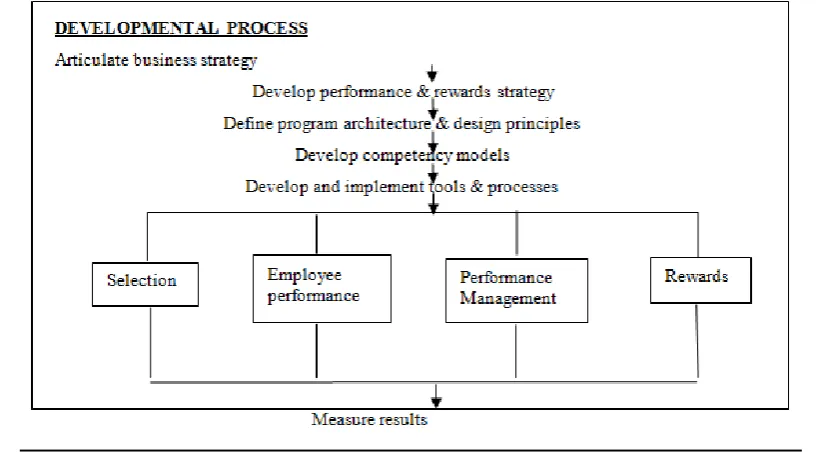
After identifying needed competencies, it should form the basis for evaluation and employees’ development (Cardy and Selvarajan, 2006). This helps to focus attention on what is important and drives process of recruitment and selection. Starting with a competency model however is one factor that has made Competency Based Pay unsuccessful in most organisations (Cira and Benjamin, 1998). Cira and Benjamin (1998) developed a model (fig. 3) that highlighted the necessary practices that need to be put in place before and after implementing a Competency Based Pay. If this model is adequately implemented, success rate of Competency Based Pay will increase.
In this study, a pilot scheme is proposed to test run the strategy. Depending on the organisation, it may mean the organisation have to implement a variable pay rate for a defined period. It could also mean organisation introduces it within some sections and departments as pilot scheme. However, this decision should involve the stakeholders. Also a two – three years period should be given to employees to get the necessary skills required before the implementation. During this time, a system that protects the grades of employee should be in place until they acquire the necessary skills requires within the stipulated time.
Satisfying the above conditions, the following steps suggested by Armstrong (2004) can introduce Competency Based Pay.
1. Evaluate the need for Competency Based Pay and readiness of the organisation.
2. Obtain views of appropriate stakeholders about Competency Based Pay, after communicating clearly its benefits and purpose.
3. Set up a cross-functional project team to develop the process.
4. Identify the broad approach to Competency Based Pay and the work involved in setting it up; measurement and monitoring methods, introduction of Broad-banding structures, procedures for linking competencies to pay, and the cost implications.
5. Continue with a development programme, while consulting and communicating with all the stakeholders.
6. Communicate details to everyone; the whole workforce and discuss implications for themselves and the organisation.
7. Organise an introduction and training programme. 8. Monitor the programme.
9. Evaluate the outcomes of the introduction process. 10. Amend as appropriate.
Fig. 4: Evaluation methods: Adapted Cofsky (1993)
In addition, evaluation of the implementation of Competency Based Pay in practice should include the following:
Evaluate stakeholder’s resistance after pilot test of Competency Based Pay scheme, this would show the level of acceptance towards the new scheme.
Identifying organisational outcomes derived as a result of individual’s competences and performances.
Also important to monitor is the growth in self-development of employees, as the implementation of Competency Based Pay should encourage employees to indulge in self training and development.
Therefore in evaluating the process, it impacts should be measured. This will be evidence in the level of employee engagement, retention rates, reduction in number of equal pay and age claims and proportion of fully qualified and competent staff.
CONCLUSIONS
Service-related pay has been portrayed to be a pay system that is not solely suited to address the constantly changing business environment and globalisation. The need for a more flexible pay system to motivate and encourage employees brought about the need for introduction of an alternative contingent reward system. Recommending the adoption of competence-based pay was based on the premise that competence translates into performance and competent employees will perform maximally and produce desired organisational outcomes. The organisation might be wary of the costs associated with implementing this system, however studies have shown that it has substantial benefits, positively changing organisational cultures and supporting HR strategies.
Moreover, the organisational objectives determine what strategy to implement to achieve such objectives. This includes the reward strategy. While organisations motivate employees through rewarding them for their contributions, they also want to get maximum performance from employees. The re-design of reward strategy may be imperative to achieve this. The benefits of introducing a Competency Based Pay over a seniority based pay overweight its challenges (e.g problems of design, implementation and evaluation) in the long run. Therefore, a shift from seniority based pay to competency based pay is open for all organisations (including public sectors) to consider. However, organisations considering this type of pay strategy must be ready for change of culture and organisational practices to make it a success. The followings recommendations are made for successful implementation of Competency Based Pay discussed in this study.
RECOMMENDATIONS (CRITICAL SUCCESS FACTORS)
Based on the conclusions above, the following recommendations could ensure a smooth and easy adoption and implementation of the new reward scheme.
The competency criteria adopted should be well researched, tested and clear enough for everybody (Armstrong and Brown, 1998). Other best practises such as PM and career development should be implemented first to address some of the issues with Competency Based Pay (Azmi et al., 2009). It must also align with the goals, values, and strategic objectives of the organisation.
When implementing the Competency Based Pay, the following factors should also be put into consideration.
Scheme design: Trade union should be involved from the start. This allows for necessary negotiations and agreements before the scheme start. And an in-depth understanding of the competencies required by employees is necessary. This can be achieved through adequate communication throughout the process through one to one meetings, group meetings, company’s newsletters and magazines.
Piloting: The introduction of the scheme should be piloted for one to two years. This allows period of adjustment for employees to acquire and established necessary competencies required. It also ensures its objectivity and fairness. At this level, variable pay scheme that accommodates the Competency Based Pay can be implemented. This allows for a critical review of the system before adopting it as a permanent reward system.
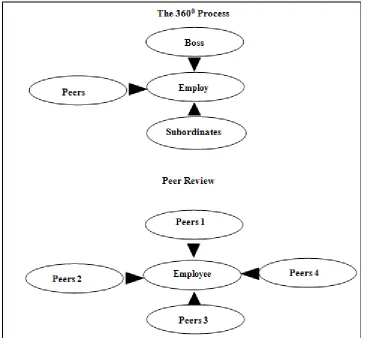
Adequate appraisal: The question of how skill and competency level is assessed and who does the assessment can be resolved through the use of peer ratings, technical expert judgment and tests to eliminate the limitations experience with managers in judging the employees’ capabilities though they are involved in that they gather the necessary information from the individuals. However, use of 3600 process and peer review (Fig. 4) provide a method of multisource assessment (Cira and Benjamin, 1998) which have the advantage of making the assessment process more constructive as it draws inputs from wider sources.
Training: Training the managers to avoid bias and discrimination in their appraisal system. Training and development opportunity should also be made available for all employees to develop the competency level.
Record keeping: A good record should be kept that establish accurate competency baseline and progress.
Monitoring: Monitoring the scheme for any inconsistencies and identification of equality issues. If any concern is discovered, this should be investigated. The equality factsheet by Equality and Human Right Commission (Appendix) provides a comprehensive list to identify potential pay issues which should be investigated.
Fairness: The scheme should be assessed on basis of fairness, for instance training opportunities should be accessible to all staff.
REFERENCES
[1]. Adams, J. S. (1963) ‘Towards an understanding of inequity’. The Journal of Abnormal and Social Psychology67(5), 422
[2]. Al-Mashari, M. and Zairi, M. (1999) ‘BPR implementation process: an analysis of key success and failure factors’. Business Process Management Journal 5(1), 87-112
[3]. Altonji, J.G. and Shakotko, R. A (1987) ‘Do wages rise with job seniority?’. The Review of Economic Studies 54(3), 437-459
[4]. Anazodo, R., Okoye, J. and Chukwuemeka, E. (2012) ‘Civil service reforms in Nigeria: The journey so far in service delivery’. Journal of Political studies 19(2), 1-19
[5]. Armstrong, M. (2004) Employee Reward. 3rd edn. London: CIPD
[6]. Armstrong, M. and Brown, D. (1998) ‘Relating competencies to pay: The UK experience’. Compensation & Benefits Review30(3), 28-39
[7]. Ayee, J. R. (2008). Reforming the African public sector: retrospect and prospects. Senegal: African Books Collective
[8]. Azmi, I. (2009) ‘Competency-based human resource practices in Malaysian public sector organisations’.
African Journal of Business Management 4(2), 235-241
[9]. Azmi, I. A. G., Ahmad, Z. A., and Zainuddin, Y. (2009) 'Competency-Based Pay and Service Quality: An Empirical Study of Malaysian Public Organisations'. Asian Academy of Management Journal 14(1), 21-36
[10]. Bates, S. (2004) ‘Getting engaged’. HR Magazine 49(2), 44-51
[11]. Bayo-Moriones, A., Galdon-Sanchez, J.E and Güell, M. (2010) ‘Is seniority-based pay used as a motivational device? Evidence from plant-level data’. Research in Labor Economics 30, 155-187 [12]. Boyatzis, R. E. (2008) ‘Competencies in the 21st century’. Journal of Management Development27(1),
5-12
[13]. Bratton, J. and Gold, J. (2003) Human Resource Management: Theory and practice. 3rd edn. New York: Palgrave Macmillan
[14]. Brown, D. and Armstrong, M. (1999) Paying for contribution: Real performance-related pay strategies. UK: Kogan Page Publishers
[15]. Burgess, S., Propper, C., Ratto, M. and Tominey, E. (2011) ‘Incentives in the public sector: Evidence from a Government Agency’ CMPO Working Paper Series 11: 3-28
[16]. Cabinet Office (1999) Modernizing Government, London: The Stationery Office (Cm 4310)
[18]. Chan, K. K. (1999) An Assessment of Hong Kong Civil Service Pay System: Lessons from Reform Measures of the OECD Countries. Unpublished PhD thesis. Hong Kong: University of Hong Kong [19]. Cira, D.J and Benjamin, E.R (1998) ‘Competency-Based Pay: A Concept in Evolution’. Compensation
and Benefits Review 30 (21), 20-28
[20]. Cofsky, K. M. (1993) 'Critical Keys to Competency-Based Pay'. Compensation and Benefits Review
25(6), 46-52
[21]. Collier, P. and Knight, J.B (1985) ‘Seniority payments, quit rates and internal labour markets in Britain and Japan’. Oxford Bulletin of Economics and Statistics 47(1), 19-32
[22]. Conrad, H. (2009) ‘From Seniority to Performance Principle: The Evolution of Pay Practices in Japanese Firms since the 1990s’. Social Science Japan Journal 13(1), 115-135
[23]. Curristine, T., Lonti, Z. and Journard I. (2007) ‘Improving Public Sector Efficiency: Challenges and Opportunities’. OECD Journal on Budgeting 7(1), 1-41
[24]. Del Val, M. and Fuentes, C. (2003) ‘Resistance to change: a literature review and empirical study’.
Management Decision41(2), 148-155
[25]. Edvarsson, I. (2008) ‘HRM and knowledge management’. Employee Relations 30(5), 553-561
[26]. Equality and Human Rights Commission (2013) ’Performance related pay checklist’ [online] available from<http://www.equalityhumanrights.com>[28/02/14]
[27]. Fischer, R. (2008) ‘Rewarding Seniority: Exploring Cultural and Organizational Predictors of Seniority Allocations’. The Journal of Social Psychology148(2), 167-186
[28]. Freibert, A. (1997) ‘Public Pay Programs in OECD countries’. In new Strategies for Public Pay: Rethinking Government Compensation Programs. Ed. Risher, H., Charles
[29]. H. fay and Associates, San Francisco: Jossey-Bass Publishers
[30]. HAYS (2012) The Changing face of the public sector: How employers need to adapt. UK: Hays Specialist recruitment limited
[31]. Heery, E. (1996) ‘The new new unionism’. Contemporary Industrial Relations: A Critical Analysis, 175-202
[32]. Heneman, R. (2002) Merit pay: Strategic reward Management: Design, Implementation, and Evaluation
Information Age Publishing: Connecticut
[33]. Heneman, R., Ledford Jr, G. and Gresham, M. (2002) ‘The changing nature of work and its effects on compensation design and delivery’. Strategic reward management: Design, implementation, and evaluation, 35-73
[34]. Horton, S. (2006) ‘General trends and challenges regarding performance evaluation of staff: The UK experience. Seminar: ‘Civil service performance Appraisal’ held 23-24 May 2006 at Vilnius
[35]. Hon, A.H.Y (2012) ‘When competency-based pay relates to creative performance: The moderating role of employee psychological need’. International Journal of Hospitality Management 31(1), 130–138 [36]. HSCIC (2013) ‘Final Seniority Figures for GMS GPs in England and Wales 2009/10’.
[37]. [online] available from < http://www.hscic.gov.uk>[ 30th March 2014]
[38]. Huseman, R., Hatfield, J. and Miles, E. (1987) ‘A new perspective on equity theory: The equity sensitivity construct’. Academy of Management Review12(2), 222-234
[39]. Jarvis, P. (1987) Adult Learning in the Social Context. London: Croom Helm
[40]. Jones, M., Blunt, P. and Sharma, K. (1996) ‘Managerial perceptions of leadership and management in an African public service organization’. Public administration and development. 16(5), 455-467
[41]. Kolb, David (1984). Experiential learning: Experience as the source of learning and development. Englewood Cliffs, NJ: Prentice-Hall
[42]. Lawler, E. (1966) ‘Ability as a moderator of the relationship between job attitudes and job performance’.
Personnel Psychology19(2), 153-164
[43]. Lawler, E. (2000) ‘Pay strategy: New thinking for the new millennium’. Compensation and Benefits Review, 7-12
[44]. Lawler III, E. E. (1994) 'From Job-Based to Competency-Based Organizations'. Journal of Organizational Behavior 15(1), 3-15
[45]. Ledford, G.E. (1991) ‘Three Case Studies on Skill-Based Pay: An Overview’. Compensation and Benefits Review 23(2), 11-23
[47]. Lincoln, J.R. and Kalleberg, A.L. (1985) ‘Work Organization and Workforce Commitment: A Study of Plants and Employees in the US and Japan’. American Sociological Review 50(6), 738-760
[48]. Malhotra, N., Budhwar, P. and Prowse, P. (2007) ‘Linking rewards to commitment: an empirical investigation of four UK call centres’. The International Journal of Human Resource Management
18(12), 2095-2128
[49]. Milkovich, G. & Newman, J. (2004) Compensation. 8th edn. Burr Ridge,IL: Irwin Mc-Graw-Hill [50]. Ministry of Finance (2006) The Finnish public sector as employer. Helsinki: Edita Prima Plc. [51]. Neathey, F. and Reilly, P. (2003) Competency-based Pay. Institute for Employment Studies
[52]. Office for National Statistics (2014) ‘Redundancies’ [online] available from http://www.ons.gov.uk/ons/taxonomy/index.html?nscl=Redundancies [31/03/2014]
[53]. Perkins, S. and White, G. (2010) ‘Modernising pay in the UK public services: trends and implications’.
Human Resource Management Journals 20(3), 244-257
[54]. Perkins, S. and White, G. (2011) Reward management: alternatives, consequences and contexts. UK:CIPD
[55]. Richman, A. (2006) ‘Everyone wants an engaged workforce how can you create it?’ Workspan, 49, 36−39
[56]. Risher, H. (2000) ‘Compensating today’s technical professional’. Human resource management International Digest 8(7), 50-56
[57]. Rowbottom, D. (2010) ‘Justifying Service-Related Pay in the Context of Sex Discrimination Law’.
Industrial Law Journal 39(4), 382-407
[58]. Rynes, S. (1987) ‘Compensation strategies for recruiting’. Topics in Total Compensation 2, 185-196 [59]. Schneider, B. (1987) ‘The people make the place’. Personnel psychology40(3), 437-453
[60]. Schuster, J. and Zingheim, P. (1992) New Pay: linking employee and organisational performance. New York: Lexington Books
[61]. Smith, M. K. (2001) ‘David A. Kolb on Experiential Learning’. The Encyclopedia of Informal Education. [Online] available from www.infed.org/biblio/b-explrn.htm. [01/04/2014]
[62]. Sparrow, P. (1996) ‘Too good to be true’. People Management5, 22-27
[63]. Thompson, J. (2006) ‘The federal civil service: The demise of an institution’. Public Administration Review66(4), 496-503
[64]. Tucker, S. A., and Cofsky, K. M. (1994) ‘Competency-based pay on a banding platform’. ACA Journal 3(1), 30-45
[65]. Vroom, V. H. (1964). Work and motivation. NY: Wiley & Sons
[66]. Wescott, C. (1999) ‘Guiding principles on civil service reform in Africa: An empirical review’.
International Journal of Public Sector Management12(2), 145-170
[67]. Williams, N. (2009) ‘Seniority, experience, and wages in the UK’. Labour Economics 16(3), 272-283 [68]. Zaim, H. (2007) ‘Competency Based Pay a New Approach to Compensation Policy’. Journal of
Academic Studies 9(32), 115-133
[69]. Zangelidis, A. (2008) ‘Seniority profiles in unionized workplaces: do unions still have the edge?’ Oxford Bulletin of Economics and Statistics 70(3), 327-345
[70]. Zhou, J. and Shalley, C.E. (2003) ‘Research on employee creativity: a critical review and directions for future research’. Research in Personnel and Human Resources Management 22, 165–217
APPENDIX (CONTINGENCY PAY CHECKLIST)
This checklist covers all forms of performance-related pay (PRP) systems, including those with a competence-based element. It also deals separately with incentive-competence-based pay systems, such as bonus arrangements.
A performance / competence measurement and pay system should, all other things being equal, generally deliver equal average performance payments to women as to men.
Some issues of concern regarding equal pay in performance / competence based pay systems are:
Groups of workers being excluded from the system or bonus arrangement.
Applying different performance/competence pay systems to different groups of employees.
The first part of the pay checklist identifies those aspects of any competence pay system where problems could arise. The remaining parts of the checklist deal with specific aspects of the pay systems.
In order to work through this checklist you will need:
Copies of the performance/competence appraisal/measurement guidance and instructions.
Analyses of performance/competence assessments, or equivalent, overall and by grade/band and by gender, ethnicity, disability.
Analyses of performance/competence payments, overall and by grade/band and by gender, ethnicity, disability.
The checklist below will assist in identifying potential equal pay issues. If you answer ‘no' (or you do not know the answer) to any of the questions in the checklist you will need to further investigate the pay data and pay practice to ensure that it is free from discrimination.
There have been particular issues in relation to performance payment systems and ethnicity of employees. Even if your data is not sufficiently robust to carry out a full equal pay audit in relation to ethnicity, it may be worth using whatever data you have to analyse performance payments by ethnicity.
All performance/competence based pay systems
You should answer the following questions by checking pay practice, rather than relying on your pay policy.
Access Yes No
Are all groups of workers included in the performance/competence pay system or systems?
In particular, are part-time workers, temporary or casual staff, those on maternity leave or taking career breaks, or any other group which is likely to be predominantly female or BME or disabled, included in the performance pay system?
Does the same performance/competence pay scheme apply to different groups of workers with jobs of equal value?
Do all employees have equal access to opportunities to develop/acquire competencies, irrespective of race, gender or disability and do they benefit equally from them?
Design issues: the measurement of performance/competence Yes No
Have all those involved in the design and development of performance appraisal schemes been trained in diversity awareness and the avoidance of bias?
Are the criteria/objectives that are rewarded by the performance appraisal system objectively justified and have they been checked for potential bias?
Are performance/competence criteria which may favour attributes and roles often perceived to be ‘male’/white (e.g. assertion, leadership, decision making skills) and those often perceived to be ‘female’ (e.g. co-operation, consultation, and other people-related features) included in a balanced way?
Do the performance criteria avoid any which could be indirectly discriminatory, for example, those related to attendance, flexibility in hours of work?
Implementation Yes No
Have all those involved in implementing the scheme been trained in diversity awareness and the avoidance of bias, as well as in the operation of the scheme?
Where managerial discretion applies, are there clear guidelines on the exercise of discretion over performance appraisal and payments?
Is the performance/competence pay system transparent to all employees covered by it e.g. does each employee receive information about her or his individual performance ratings and how they convert into pay?
Impact: performance pay outcomes Yes No
Does the distribution of performance/competence assessments show that there may be bias between protected groups within each grade?
Is the distribution of performance/competence payments broadly similar as between protected groups in each grade?
Is the distribution of performance pay broadly similar as between protected groups across the organisation (within and between schemes)?
In a scheme where performance/competence payments are consolidated, do protected groups undertaking equal work achieve equal earnings over time?
If differences have been revealed, have you checked whether historical practices are causing the pay gaps?
In a scheme where performance payments are not consolidated, are the average and distributions of such payments similar as between protected groups undertaking equal work?
If differences have been revealed, have you checked whether current practices are causing the pay gaps?
If differences have been revealed, have you checked whether historical practices are causing the pay gaps?
Can any differences in pay between protected groups which are attributed to performance/ competence be objectively justified?
Is the treatment of non-consolidated performance payments for pension purposes the same or similar as between protected groups undertaking equal work?
Monitoring and review Yes No
Are performance targets and ratings regularly monitored by gender, ethnicity and disability and by working pattern etc.?
Are performance payments regularly monitored by gender, ethnicity and disability and by working pattern etc.?
Have schemes been checked for their impact on women who have taken maternity leave?
Incentive based productivity/bonus schemes Yes No
If the base point is not demonstrably equivalent, have adjustments been made to the measurement system to take account of this? In particular, have reasonable adjustments been made for disabled staff?
Do the measurement steps above the base point represent equivalent levels of additional effort (mental and/or physical) for work generally undertaken by women and work generally undertaken by men?
Does the system for converting productivity into bonus or other payment result in equivalent pro-rata payments for full-time and part-time staff where appropriate?
Does the system for converting productivity into bonus or other payment result in broadly similar payments for women and men?
Are the average payments over a suitable period equal by gender, ethnicity etc?
If differences have been revealed, have you checked whether current practices are causing the pay gaps?
If differences have been revealed, have you checked whether historical practices are causing the pay gaps?
Can any differences in pay between protected groups, which are attributed to performance/competence, be objectively justified?
If you cannot answer ‘yes’ to any of the questions (or you do not know) you will need to investigate the practice to ensure it is free of discrimination.
Action – what you can do to put things right
Answering the questions in the checklists has probably already highlighted where some of your problems may lie and what needs to be done.
Ensure CBP assessments are monitored and that access to pay is fair across the organisation.
Ensure the criteria for rewarding competencies are clearly defined and achievable and that competency levels are fair across departments in the organisation.
Look to link competency to a quantifiable target, which can be seen as objective. However, 'softer skills’ - which may be primarily done by women - may be harder to quantify but they should not be excluded from access to performance pay.
Ensure training in diversity and the avoidance of bias for all involved in assessing competencies and awarding pay.
Limit the element of discretion in appraisal