R E S E A R C H
Open Access
Social enterprises in the Indian context:
conceptualizing through qualitative lens
Subhanjan Sengupta
*and Arunaditya Sahay
* Correspondence:
Birla Institute of Management Technology, Plot Number 5, Knowledge Park 2, NCR, Greater Noida, Uttar Pradesh 201306, India
Abstract
Adopting an inductive theory building approach through qualitative research methodology of data collection and analysis spread across six months, followed by inter-rater reliability testing using quantitative technique, this empirical study researches the meaning of the‘social enterprise’construct in the Indian context, and develops a conceptual framework that represents the construct. This sets an
orientation needed for aspiring social entrepreneurs and social entrepreneurship researchers to ease out their understanding of the‘social entrepreneurship’ phenomenon within the boundaries of an Indian context. The contested nature of the phenomenon in discourses across the globe is largely due to local/regional/ national variations in practice.‘Market Orientation’,‘Social Value Creation’, ‘Social Entrepreneur’, and‘Balanced Impact’emerged as key constructs comprising Indian social enterprises. The principle philosophical paradigms for this theory construction are Social Constructionism and Interpretivism, which give impetus to reflective and analytical thought trials for extracting the conceptual framework interwoven in textual data. The study sets course for further research to refine the vocabulary list, identify conceptual densities, create scales for statistical inquiries, and enable further inclusiveness of the conceptual framework.
Keywords:Social entrepreneurship, Social Enterprise, Qualitative research
Background
A rich collection of peer-reviewed scholarly literature is available today after close to two decades of social entrepreneurship research. This has escalated acceptance and en-abled better understanding of the phenomenon globally. The proliferation of grey lit-erature, as well as empirical and conceptual litlit-erature, has led to the discovery of different dimensions of the phenomenon across different local/national/regional con-texts (Peredo & McLean 2006; Dacin, Dacin, & Matear 2010; Doherty, Haugh, & Lyon 2014; Sengupta & Sahay 2017a). The phenomenon is interpreted differently in different countries and regions, given the diversity of historical and contextual factors. Thus, the meaning of the ‘social entrepreneurship’construct is localised, in accordance with the local practices. However, the convergence of concepts emerging on the construct across peer-reviewed scholarly literature leads to a common understanding that social enterprises are of a hybrid nature, which marries‘market’and‘social’for a double bot-tom line (Sengupta & Sahay 2017a). Hoque and Nahid (2015) had suggested that busi-ness mission and market exploitation are quite central constructs in the phenomenon
of social entrepreneurship, in addition to the social missions. This contrasting logics of economic and social bottom-line, talked with seemingly equal depth, has been causing the contested nature and complexity in comprehension of the phenomenon (Tan, Wil-liams, & Tan 2005; Hill, Kothari, & Shea 2010; Kittilaksanawong, Hu, Shou, & Chen 2012; Choi & Majumdar 2014; Doherty et al. 2014).
India is a country with socio-economic and cultural diversity, and a very high popula-tion. The country offers no legal definition for social enterprises. The ecosystem of so-cial entrepreneurship in India is created by different organizations and universities/ institutes advocating, promoting, and supporting social enterprises. Multiple stake-holders such as these have formulated their own meaning of social entrepreneurship in India; their work being influenced by the social, economic, and cultural diversity across the geographical length and breadth of the country, and the regulatory frameworks of the state and central governments. The novelty of this study is in its effort to come up with a framework on what a‘social enterprise’means in the Indian context. The frame-work was developed from narrative accounts (social constructions) of stakeholders interviewed in this study. Due to the theory building nature of this research, the social constructionist approach was used for data collection, and grounded theory coding for data analysis. The key constructs that emerged to be clustering together to form the concept of social entrepreneurship in the Indian context are social value creation, mar-ket orientation, social entrepreneur, and balanced impact.
Social enterprises: Perspectives Perspectives from academic literature
The phenomenon of social entrepreneurship had been in progressive discussion for a long time, due to the raising need and significance of rapidly changing economic, envir-onmental, social and political factors (Bornstein 2004). The need originates in the in-ability of governments in providing innovative solutions for sustainably meeting social challenges. Quite consequentially, policy-makers and practitioners have been attracted towards the phenomenon of social entrepreneurship, considering the potential of this movement to cause change sustainably (Wilson & Post 2013).
movement of social entrepreneurship enables the unbundling of the socio-political ad-versities posing contextual constraints in perpetrating positive social change. The re-peated governmental failures in solving social problems, such as in the emerging economies (Sengupta et al. 2017) and the nature of capitalism to be pro-profit-maximization led to the emergence of the social entrepreneurship movement. (Sen 2007; Trivedi & Stokols 2011). The social entrepreneurship phenomenon has been well researched on both sides of the Atlantic. But the social entrepreneurship concept in the Asian context and in the context of emerging economies, is in need of extensive empir-ical investigation to identify what is relevant and replicable from the social entrepre-neurship structures and systems developed in the West (Doherty et al. 2014; Sengupta & Sahay 2017a; Sengupta et al. 2017). In the emerging economies, the social cause-attractors (Dietz & Porter 2012) are very elementary and the critical issues are triggered by shared necessity (Defourny & Kim 2011); such as, livelihood generation, poverty eradication, rural entrepreneurship, improved education, to name a few. These are ad-dressed through group collectivism, and implemented by connecting beneficiary indi-genous communities within the format of micro-institutional structures such as self-help groups (Poon, Zhou, & Chan 2009; Chan, Kuan, & Wang 2011; Sloan, Legrand, & Simons-Kaufmann 2014; Kao & Huang 2015). The social entrepreneurship process gen-erates both economic and social value in these emerging economies (Sengupta et al. 2017).
However, though the phenomenon has gone through many developments, there is still need of far more consensus among policy makers, practitioners and researchers on what social entrepreneurship actually means (Choi & Majumdar 2014). The Global Entrepreneurship Monitor (GEM) defined social entrepreneurship in their special re-port1in 2016 as “any activity, organization or initiative that has a particularly social, environmental or community objective”. The definition is inclusive of the core mission, which is strongly linked to community mobilization and environment protection. How-ever, research is in a continuous debate on whether social enterprises are for-profit or not-for-profit. Perceptions include viewing social enterprises as for-profits for the poor (Seelos & Mair 2005) or not-for-profits using for-profit techniques to raise money to meet their goals (Boschee & McClurg 2003). And then, there are those who perceive social innovation as the key to social entrepreneurship, irrespective of whether com-mercial activities are adopted or not (Martin & Osberg 2007). Sengupta and Sahay (2017a) suggest, after observing a convergence of concepts in a systematic literature re-view, that a social enterprise is a hybrid organization that tries to achieve both market orientation and social value creation for a double bottom-line. However, the phenomenon is strongly influenced by contextual, structural and institutional forces, thereby leading to regional perspectives (Kerlin 2010; Sengupta & Sahay 2017a). There-fore, in a few select parts of the world, policy makers have given different identities to social enterprises, thereby acknowledging their contribution and creating an eco-system supportive for the evolution of the enterprises.
Legal identities for social enterprises
The eco-system for supporting social enterprises in South Korea is strong. As per the
organizations are certified as social enterprises, which carry out business activities through production and sales of goods and services for social purposes, such as gener-ating livelihood for residents in vulnerable social groups.2The priority of such enter-prises is supposed to be the pursuit of social purposes by reinvesting profit in the business or community; and not adopting profit-maximization approaches.
The legal framework of UK defines social enterprises as businesses with social objec-tives as primary mission. It means that they should use their assets for public good, and surpluses are to be reinvested in the business and community, rather than redistribut-ing among owners and shareholders.3The companies which come under the jurisdic-tion of such a definijurisdic-tion, are Community Interest Companies (CICs), Limited Companies, and Industrial and Provident Society.
The European definition of social entrepreneurship surfaced first in Italy, after which it disseminated and evolved through discourse and practice across the EU. As per the European definition, known as EMES3(Emergence of Social Enterprise in Europe), so-cial enterprises are not-for-profit private organizations commenced by communities, in-volved in production of goods and services specifically for the benefit of communities, bearing high autonomy and full responsibility of their economic situation.4
Two schools of belief in the US social entrepreneurship sector4, which evoke an un-ending debate, are the Social Innovation School and the Social Enterprise School. The Social Enterprise School postulates the fulfillment of the social objectives with the aid of commercial strategies. Quite contrary to that, the Social Innovation School believes that social innovation is primary to social entrepreneurship, whether business centric activities are conducted or not. These two factions of belief reflect across the social entrepreneurship literature, which factors into the complexity and never ending solu-tion to the definisolu-tional debate.
In India, the central and state governments have not given legal identity to social en-terprises. What has been achieved until date is the provision of registering companies under Section 8 (previously, Section 25) of the Companies Act, 1956. Section 8 com-panies can promote ‘commerce, art, science, religion, charity or any other useful object’, under the condition that all income and profit, if made, is re-invested for the objectives of the company, and not to be paid as dividend to board members. This does not expli-citly talk about social enterprise as a legal identity for the Indian context. This situation, coupled with multiple stakeholder approach towards the meaning of the phenomenon in the Indian context, as discussed earlier, stimulated the authors to explore the mean-ing of social entrepreneurship in the Indian context, so that the suggested framework can come to aid for social entrepreneurship researchers, academicians, practitioners, and policymakers.
Methods
Approach and context
interestingly, most scholarly peer-reviewed social entrepreneurship research already conducted till now in the Indian context have skipped the inductive research necessary for clarifying what the term‘means’as per the context, and moved on to case develop-ment, impact studies, finding social entrepreneurial intensions, or studying social innovation. While those are also essential areas of enquiry, it is a logical flaw to re-search the phenomenon without discovering what it means in the local context, and by making definitions based on literature in western context for an empirical enquiry in the Indian context. Western perspectives would be more as guiding tools for advancing the social entrepreneurship concept in the local context of the Asian countries which have entirely different culture, societies, and problems. The relevance and novelty of this empirical study is that it intends to research the meaning of social entrepreneur-ship in the Indian context by exploring the social construction of different sector ex-perts, who are the brains working fingers to the bone to build the social entrepreneurship eco-system in the country.
To formulate a conceptual framework that would be close to a consensus on what a social enterprise means in practice in the Indian context, a qualitative lens of enquiry was adopted with a social constructionist approach. Social Constructionists believe that knowledge is not discovered; it is constructed by the subjective reality of everyday life (Berger & Luckmann 1991; Andrews 2012). Reality is constructed not from within a person but from social realm (Burr 1995). An organization is a society itself which changes, evolves, sustains, through interpersonal interactions (Kemeny 2002). Social constructionists do not believe in biological reductionism (i.e. human behavior is a result of underlying natural essence).
such as strategic management, management communication, organizational studies, entrepreneurship, institutional environment, and even marketing and sales (Eriksson and Kovalainen, 2015). Moreover, social entrepreneurship cannot be detached from hu-man emotions, experiences, and passion. Therefore this inductive research gives value to the experiences and personal feelings and opinions of the respondents, as ontologic-ally speaking, those are important data points for this study.
This research follows the philosophy of social constructionism also because it uses grounded theory for framework / theory construction on the meaning of a social enter-prise organization in a specific context. The respondents’views on these constructs are constructed by the subjective reality of their everyday life, which is influenced by the social realm that they are a part of. For the researcher too, this would be a subjective view of reality. At the same time, there is interpretivism in this research. Interpretivists also value subjective experience of humans, but they develop objective science to de-scribe it (Young & Collin 2004). Since we will be suggesting a framework, we are actu-ally developing an objective science to describe what we learnt about the constructs from the subjective experience of the respondents. Therefore, the qualitative lens used to describe, interpret, and explain the construct of social entrepreneurship, can also be said to be interpretive. In entrepreneurship research, qualitative approach is often rec-ommended to identify relational structures among processes and constructs to facilitate theory building for subsequent quantitative research (Yin 2003; Eisenhardt & Graebner 2007).
Sampling and data collection
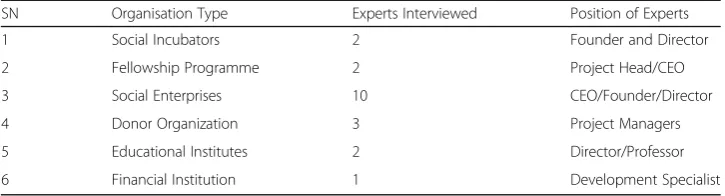
Expert interviews are a time tested valid tool for theory generation (Bogner & Menz 2009). Exploratory interviews were conducted with respondents who possess “ context-ual knowledge”. Purposive sampling was used for selecting respondents who can be source of rich information (Patton 1990). The selection of the experts was on the as-sumption that they were in possession of relevant knowledge pertaining to the subject. These experts, being from different stakeholder communities, gave rich and diverse data. From experts surfacing through initial purposive sampling, snowball sampling was further done to reach out to other experts with substantial contextual knowledge. A total of 20 experts were interviewed, with 40 to 50 min spent on most interviews, some stretching to even one hour. Table 1 gives further information about them.
Names of experts and organizations have not been disclosed for anonymity. The ab-sence of legal definition in India leads to lack of any government record of social enter-prises. Therefore, senior professors/researchers with exhaustive background on social
Table 1Experts Interactions
SN Organisation Type Experts Interviewed Position of Experts
1 Social Incubators 2 Founder and Director
2 Fellowship Programme 2 Project Head/CEO
3 Social Enterprises 10 CEO/Founder/Director
4 Donor Organization 3 Project Managers
5 Educational Institutes 2 Director/Professor
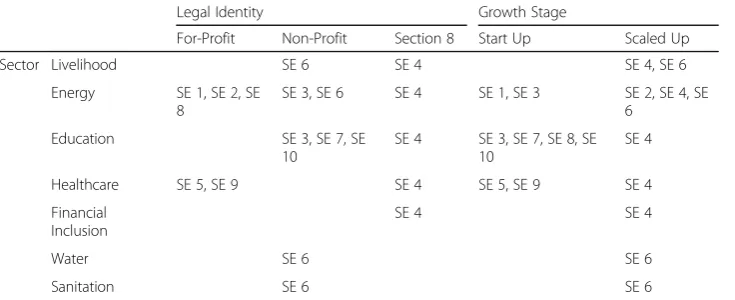
entrepreneurship research were consulted to reach out and interview an initial set of experts. Snowballing from these experts led to the rest of the expert interactions. The combined experience of all the experts taken together had a wide geographical coverage from western India, across northern and eastern India, to the north-eastern states of India. The experts were all senior ranked, mostly in their middle ages. The social enter-prises approached (Table 2) were across different sectors; start up as well as scaled up, and for-profit, not-for-profit and Section 8 Company. Most social enterprises approached have past and active projects in more than one sector.
The respondents included social investors, founders of social enterprises, project heads of social entrepreneurship fellowship programs, and project heads of donor organizations. All interviews and discussions started with how the respondents de-fine social enterprises, which led to snowballing of further questions and responses leading to further exploration of the phenomenon. While a few interviews were re-corded with permission, field notes were taken in the rest where recording was not possible or permitted on ethical grounds. Interviews/field notes were subsequently transcribed for data analysis.
Data analysis
Transcriptions are subject to a coding technique for identification of thematic pat-terns (Patton 1990). These themes, which are empirical evidence emerging from the data, support the formulation of emergent theory and theoretical propositions. The interviews and the coding process stop when the researcher reaches to the point of theoretical sufficiency for analytical generalization (Strauss & Corbin 1990; Sandberg 2000; Creswell 2005; Eisenhardt & Graebner 2007).
The transcriptions and field notes were subject to three levels of coding as pos-tulated by Charmaz (2006): (a) initial coding, (b) focused coding, and (c) concep-tual coding, to come up with a list of key vocabularies (social constructions) grounded in the context of Indian social enterprises. In initial coding, all data was coded, leading to 86 codes. In focused coding, these codes were further segregated into more compact codes. In theoretical coding, the codes were further combined to bring more refinement, observe conceptual density, and unravel the framework.
Table 2Social Enterprises Approached
Legal Identity Growth Stage
For-Profit Non-Profit Section 8 Start Up Scaled Up
Sector Livelihood SE 6 SE 4 SE 4, SE 6
Energy SE 1, SE 2, SE 8
SE 3, SE 6 SE 4 SE 1, SE 3 SE 2, SE 4, SE 6
Education SE 3, SE 7, SE
10
SE 4 SE 3, SE 7, SE 8, SE 10
SE 4
Healthcare SE 5, SE 9 SE 4 SE 5, SE 9 SE 4
Financial Inclusion
SE 4 SE 4
Water SE 6 SE 6
Sanitation SE 6 SE 6
The coding of the data from expert interviews was done using qualitative data ana-lysis tool, Atlas.ti. The list of vocabulary generated by the coding process would fall under key constructs that would lead to formulation of the conceptual frame-work. These vocabularies are reliable as they were grounded in the narratives of expert respondents; the narratives being social constructions of the reality of the social entrepreneurship environment of which the respondents were an integral part. Nonetheless, the authors chose to assess inter-rater reliability as it is an im-portant method to assess rigor (Armstrong, Gosling, Weinman, & Marteau 1997). While a great many qualitative researchers would not like to believe in assessing the inter-rater reliability of qualitative findings of a research, Armstrong et al. (1997) found inter-rater reliability to be particularly helpful in bringing more reli-ability on the packaging of codes under certain constructs. This study, therefore, brings further reliability on the findings reached through grounded theory coding, by using multi-rater reliability tests like Krippendorff’s Alpha, postulated by Klaus Krippendorff (2004), and Fleiss’s Kappa Statistic, postulated by Joseph L. Fleiss (1971). Computing this ensured that the vocabularies explaining the constructs were close to representation of reality. The application of the tool is independent of the number of units of analysis. The formula for computing Krippendorff’s Alpha is:
∝¼1−Do De
α= Krippendorff’s alpha reliability.
Do= Observed disagreement.
De= Expected disagreement.
If the raters (can be of any number more than two) agree completely,Dowould be 0, and thusαwould be 1. When the raters are not able to distinguish the vocabs and dis-agree to the list coming together to form the constructs,αwould be 0. So the range of
αis from 0 to 1. Closer to 1 would mean that the degree of agreement is high, thereby leading to reliability of the list of vocabulary in terms of its inclusion under a construct. 0.7 is a good cut off for closer inter-variable reliability. Any vocabulary having the ma-jority disagreement were omitted.
The Fleiss’s Kappa statistic is calculated by the formula:
K¼P Að Þ−P Eð Þ 1−P Eð Þ
K= Fleiss’s Kappa reliability.
P (A)= Proportion of times that the raters agree.
P (E)= Proportion of times that we expect the raters to agree by chance.
Results and discussion
Conceptual development from the narratives
Social enterprises explore opportunities to create social change and gathers intelligence on how to address those opportunities by applying for-profit principles. One of the so-cial entrepreneurs believed:
“A social enterprise is an enterprise which identifies a social problem in a local context, applies a business plan, and utilizes it as an opportunity to ensure a gradual process of social change”.
The local context of opportunities makes a social enterprise gather context-specific intelligence needed for accessing market opportunities. A for-profit with a business model would be a corporate. A social enterprise would be, as one of the social entre-preneurs believed,
“An enterprise having a social angle with a business model”.
Both social mission and market oriented business modeling are mandatory, and not optional, in the pursuit of social entrepreneurship. However, the social mission is the primary objective of the enterprise. Market orientation is borrowed from the for-profit business models to act as enablers for achieving scalability and sustainability of the so-cial mission. All experts corroborated this in their interviews. One of the entrepreneurs, whose enterprise is registered as a Trust, mentioned adoption of earned income strat-egies for the purpose of community development. Another respondent, whose enter-prise is registered as a private limited company, differentiated social enterenter-prise as one, which creates.
“Financial incentives to help them become self-sustaining in creating social impact”.
A social investor clearly mentioned:
“A social enterprise is one that creates social value, which is greater than private value, and is sustainable with business-like operations, thereby breaking the stereotyp-ing of the social sector and creatstereotyp-ing new markets”.
The recurrence of importance on social mission over wealth-maximization, while achieving sustainability and scalability in social mission, through social value creation activities as well as an orientation towards market principles and forces, repeatedly emerged in the interviews as a prime argument differentiating social enterprises from NGOs, or from pure for-profits.
The director of a nationally reputed educational institution engaged in entrepreneur-ship education and incubation, mentioned that while the ardent and hardest of social values had been historically created by NGOs and market value by businesses entities,
value and businesses will create economic value; but a triple bottom line–social bottom-line, economic bottom-line and environmental bottom-line”.
This marriage between market and social is a key factor to the identity of a social en-terprise. This leads to a debate on which of these constructs has precedence over the other. On this note, it is interesting to hear the CEO of one of the most reputed social entrepreneurship fellowship programs in India say,
“A social enterprise is an enterprise that creates social value that is greater than private value and is sustainable with the operations of the business. The government has been taking its hands away from social welfare. Private sector is least bothered. Social entrepreneurship has opened up alternative approaches to people. They have broken the stereotyping of the social sector and created new markets.”
This indicates that though the business orientation towards exploration of market and response to market need is vital, the social cause takes an important slice of the phenomenon because one of the factors differentiating social enterprises from commer-cial ones are the target consumers, which are‘beneficiary communities’in this case. A seasoned social entrepreneur strongly commented,
“What you sell, who you sell to, and how inclusive is your business model, would give you the identity of a social enterprise”.
The community of beneficiaries accessing the products or services of social enter-prises and the consequent social change of those communities are important dimen-sions of the phenomenon. Social value creation in the form of social change is closely tied to the phenomenon, sometimes with higher importance, and sometimes with equal importance, to market orientation. An expert leading one of the social entrepreneur-ship fellowentrepreneur-ship programs in India mentioned:
“A social enterprise is one which has a social context attached to it which is being addressed with a market oriented business model to resolve issues related to a target group of beneficiaries. Social change has to be the outcome of the enterprise.”
The frequent reference to business model, market and social value by the experts in-dicate the need of a social enterprise to have a market-driven for-profit model for bringing growth in the beneficiary community. Quite interestingly, the experts echoed a similar consensus that while it is imperative for a social enterprise to have a market-oriented solution to a social problem; it is not of relevance whether they have registered their legal identity as a for-profit or a not-for-profit. The Director of a social incubator specifically implied in her interview that the social purpose and the impact fetch far more relevance and importance than the legal identity of the social enterprise. She said,
It is easy to say that you should not just have a good financial impact but also a good social impact. However, I also believe that there are people who just think of social impact, and not about financial impact. Even that, is not social entrepreneurship. Social entrepreneurship for me is something that touches upon all three aspects of financial, social, and environmental. It tries to create a balance among these three.”
The respondents believed that this balanced impact differentiates social enterprises from commercial enterprises, as the latter is focused majorly on profit, rather than people and planet. The difference in the legal identities of social enterprises may have an impact on the way they develop market orientation and create social value. The legal identity of a not-for-profit organization facilitates the organization to also access rev-enue from local governments, which may be a relatively difficult task for a for-profit registered social enterprise. And in the initial years of scalability of a social enterprise, accepting grants from the government is not a sacrilege, as any enterprise, while setting up the business, “asks for financial support from family members and friends”, as says
one of the respondents, thereby making it pointless to use the word ‘grant’as a taboo for the social sector.
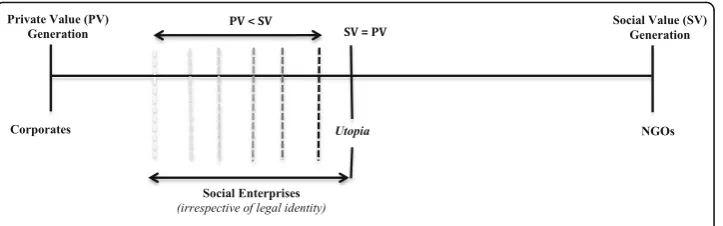
This may sound idealized. To be precise, the question is whether the enterprise is oriented towards achieving this balance. The founder of one of the incubators mentions that while the balance is a utopia, what identifies a social enterprise is the chase for achieving that utopia. The tension between private value generation and social value generation is a key dimension in the phenomenon of social entrepreneurship (Fig. 1). What differentiates social enterprises from commercial enterprises is the importance of the social mission, but not undermining the relevance and criticality of market orienta-tion to fulfill that social mission. This combinaorienta-tion of two different logics enables the sustainability and scalability of a social enterprise, and therefore is core to the social entrepreneurship phenomenon. A perfect combination will be utopic. What is observed is that social enterprises are those that strive to achieve both private and social value, and a good balance of the two; despite the road being one of struggle, irrespective of the legal identity of the company.
An expert respondent, heading a social entrepreneurship fellowship programme, shared the same set of beliefs with a strong stance:
“The legal identity of a business should not decide whether it is a social enterprise. Its identity should be decided on whether it has a social change model. It does not matter whether it is for-profit, not-for-profit, or hybrid. Moreover, there cannot be a
definition of social entrepreneurship on the basis of whether a social enterprise is for-profit, not-for-for-profit, or hybrid. It has to be an inclusive definition on the basis of the end result achieved using a blended model of for-profit and not-for-profit.”
By blended model he spoke about the merging of a market oriented approach and so-cial value creating mission:
“When we are referring to an enterprise with a social mission that is being fulfilled with a market-oriented approach, we are refereeing to one with a blended model that is inclusive of market orientation as well as social value creation.”
This marriage between the market and the social enables social enterprises to create both social and economic value, which facilitates them, as an expert said,“create finan-cial incentives that helps sofinan-cial enterprises become self-sustaining”.
It is the blended model of social value creation and market orientation that differenti-ates social enterprises; not just because of impact, but also in achieving sustainability. Experts from a donor organization mentioned:
“Sustained social change happens when the enterprise operations scale up using business practices. Social opportunity and social change is definitely linked to business model. A social enterprise is an enterprise, which identifies a social problem in the local context, applies a business plan, and utilizes it as an opportunity to ensure a gradual process of social change.”
The application of a business plan means the assessment of existing community ne-cessities central to its development and creation of markets based on the necessity, which is tapped by generating both economic and social bottom line. The experts added that a social enterprise“converts social opportunity into a business opportunity to create social change”.
Another dimension that emerged as a key to sustainability and scalability of a social enterprise is the qualities of the social entrepreneur himself. An expert made an inter-esting comment that“if the entrepreneur is right, the enterprise will stand”. Another
ex-pert quite passionately voiced that‘creativity’and‘compassion’is important:
“If you want to do something, you need to have your heart in the right place. There are talks of strategy and most of that big stuff in sector, but we are not talking about the creativity and compassion.”
Another expert mentioned,
“Social enterprises are enterprises, which shape innovative solution for large-scale im-pact in underserved community”.
many years of experience in the sector, mentioned, that the success of a social enterprise depends on the change maker. A change maker is the person with innovative ideas; ideas that have some potential to scale up and eventually become replicable. According to the expert, the social entrepreneur is the key; the entrepreneur is able to build up‘social cap-ital’that becomes a participant in enabling market orientation in a social enterprise for bringing change. The creativity and compassion of a social entrepreneur drives him and the enterprise towards community engagement and create SHGs (Self-Help-Groups) in the communities, which is a strong form of social capital. However, the contribution of the social entrepreneur is not just in capacity building and creation of social capital at community level, but also in capacity building within the organization. That calls for the social entrepreneur to build managerial capacity of the social enterprise by recruiting and retaining a dedicated team of men and women who have compassion and business acu-men for sustainability and scalability of the social enterprise. An expert made an interest-ing reference to this when he said that if the social entrepreneur moves out, the enterprise should not fall, but should sustain with the managerial capacity built into it by the entrepreneur.
Conceptual framework
The narratives clearly, and logically, bring out four key constructs — social value cre-ation, market orientcre-ation, social entrepreneur,andbalanced impact—as important di-mensions to the meaning of social entrepreneurship. Activities targeted at social value creation, orientation towards the market, and the qualities of the change maker (social entrepreneur), emerge as drivers for the scalability and sustainability of a social enter-prise in the pursuit of its social mission. The final level of coding (selective coding) lead to the creation of a social entrepreneurship framework (Fig. 2) that is a snapshot of what a social enterprise means in the Indian context in the absence of a legal identity, which, if existed, would have specifically defined which enterprise, can be called a social enterprise in India. Until the time the Indian parliament or state judiciaries come up with a legal definition of social enterprises in India, this framework would be able to fa-cilitate aspiring entrepreneurs, future investors, policymakers, CSR wings of corporates, and universities, to understand social entrepreneurship as grounded in practice in the Indian context. The following statement comprehensively explains the framework and the meaning of ‘social enterprise’in the Indian context:
A social enterprise is an enterprise that tries to attain sustainability and scalability in their social mission (which is their primary mission) through a blend of social value creation, market orientation, and entrepreneurial qualities, in order to achieve a balanced impact, irrespective of the legal identity of the social enterprise.
& Kohli 1993; Dong, Zhang, Hinsch, & Zou 2016). Past research had proposed that the notion of market orientation formulated in the west in the context of larger corpora-tions is inadequate for organizacorpora-tions with social missions in developing economies, be-cause these organizations are much smaller in size and scale of operations, with in-depth engagement in specific communities (Modi 2012). Through some literature it is known that social enterprises adopt marketing capabilities to penetrate potential mar-kets for not just awareness and revenue generation, but also to attract additional re-sources for more growth opportunities (Mottner & Ford 2005; Liu, Eng, & Takeda 2015; Dohrmann, Raith, & Siebold 2015). Despite previous research reiterating that market orientation affects the performance of social enterprises, there has been little empirical examination of what social enterprises actually adopt in market orientation for deploying market-based resources (Liu et al. 2015; Dohrmann et al. 2015). This con-struct definitely needs deeper exploration in the context of social entrepreneurship in India.
The term “social value” mostly signifies the wellbeing of people and communities, built on a set of basic values. In social psychology, social value orientation is connected to research on social dilemmas and is defined as“the importance an individual attaches to their own and others’outcomes in situations of social interdependence”(Joireman et al. 2001). Social value creation is a term frequently used in literature, though there has been inadequate effort to conceptualize it (Sinkovics, Sinkovics, Hoque, & Czaban 2015). In social entrepreneurship literature, social value creation is inclusive of altruistic and virtuous behavior, and promotion of social purposes (Choi & Majumdar 2014). It is an intervention creating positive change, i.e. social value, for subjective well-being and
life satisfaction (Kroeger & Weber 2014) of people seeking subsistence, or amour propre, or freedom from subjection or enslavement (Sinkovics et al. 2015). Social value creation is achieved by successfully attending complex and diverse ‘social cause-attractors’ (Dietz & Porter 2012), i.e. social issues, with priority over economic value. While popular wisdom talks about the social mission leading to the creation of social value, not much of social entrepreneurship literature was found which elicited the con-cept of social value (Stevens, Nathalie, & Johan 2015). This construct has come up with some indicative vocabularies. Nevertheless, it needs to be more explored in depth in the context of social entrepreneurship in India.
Measure of agreement for further reliability
The qualitative tool of coding in grounded theory is a strong tool for generating codes for creating conceptual frameworks or for postulating new theory. However, achieving inter-rater reliability would add more rigor to the the data analysis process and establish more accuracy in the representation of the vocabulary under the identified constructs (Armstrong et al. 1997). Krippendorff’s Alpha was computed to ensure that the vocabularies explaining the constructs were close to representation of reality. Krippendorff’s Alpha was a coefficient of reliability developed by Krippendorff (2004). In this study, this tool had been used to measure the agreement among four raters (all PhDs) who rated the list of vocabularies to nominate them under four key constructs–
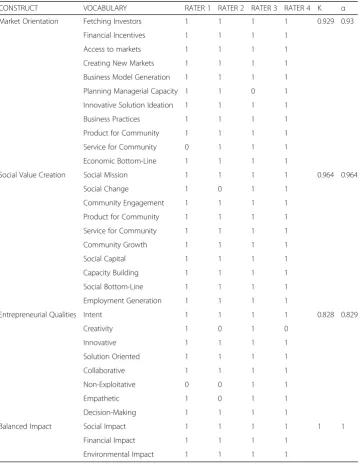
market orientation, social value creation, social entrepreneur,andbalanced impact. The highest Krippendorff’s Alpha as well as Fleiss’s Kappa was 1, which was of Balanced Impact. That was quite evident due to the common understanding of the construct. For market orientation, social value creation and social entrepreneur, theαvalues were 0.93, 0.964 and 0.829 respectively, and K values were 0.929, 0.964, and 0.828 respect-ively (Table 3). The results confirmed significant inter-rater reliability of the vocabulary list with respect to the constructs, thereby validating the reliability of the constructs in terms of being decisive elements in the suggested operational/working definition of social entrepreneurship.
Conclusion
to take up these issues in the coming years and contribute to the evolution of the social entrepreneurship phenomenon.
Endnotes
1
Source: http://gemconsortium.org/report/49542, Accessed on 22nd January 2017
2
Source: http://www.fomin.org/Home/FOMINblog/Blogs/DetailsBlog/ArtMID/13858/ ArticleID/7098/Ecosystem-for-supporting-social-business-in-South-Korea.aspx,
Accessed on 22nd January 2017
3
Source: https://www.gov.uk/government/uploads/system/uploads/attachment_data/ file/31677/11-1400-guide-legal-forms-for-social-enterprise.pdf, Accessed on 22nd Janu-ary 2017
Table 3Test for Reliability
CONSTRUCT VOCABULARY RATER 1 RATER 2 RATER 3 RATER 4 K α
Market Orientation Fetching Investors 1 1 1 1 0.929 0.93
Financial Incentives 1 1 1 1
Access to markets 1 1 1 1
Creating New Markets 1 1 1 1
Business Model Generation 1 1 1 1
Planning Managerial Capacity 1 1 0 1
Innovative Solution Ideation 1 1 1 1
Business Practices 1 1 1 1
Product for Community 1 1 1 1
Service for Community 0 1 1 1
Economic Bottom-Line 1 1 1 1
Social Value Creation Social Mission 1 1 1 1 0.964 0.964
Social Change 1 0 1 1
Community Engagement 1 1 1 1
Product for Community 1 1 1 1
Service for Community 1 1 1 1
Community Growth 1 1 1 1
Social Capital 1 1 1 1
Capacity Building 1 1 1 1
Social Bottom-Line 1 1 1 1
Employment Generation 1 1 1 1
Entrepreneurial Qualities Intent 1 1 1 1 0.828 0.829
Creativity 1 0 1 0
Innovative 1 1 1 1
Solution Oriented 1 1 1 1
Collaborative 1 1 1 1
Non-Exploitative 0 0 1 1
Empathetic 1 0 1 1
Decision-Making 1 1 1 1
Balanced Impact Social Impact 1 1 1 1 1 1
Financial Impact 1 1 1 1
4
Source: http://www.emes.net/site/wp-content/uploads/EMES-WP-12-03_Defourny-Nyssens.pdf, Accessed on 22nd January 2017
Acknowledgements
The authors wish to acknowledge the critical feedback and support received from the Centre of Research, Birla Institute of Management Technology, Greater Noida, and Dr. Srinath Jagannathan of Indian Institute of Management, Indore. They also wish to acknowledge the support of Dr. Pooja Ghosh of IIT, Delhi, for technical assistance. The authors also wish to acknowledge the cooperation of all the respondents in this study who took their time out from their practice and engaged in substantial discussions on the concept of social entrepreneurship. The authors thank from the core of their heart to the reviewers for their excellent comments which pushed the authors towards more rigor for bringing the paper to its current form so as to offer novelty.
Funding None
Authors’contributions
SS carried out literature review, data collection, data analysis, and drafting of the paper. AS participated actively in setting the epistemological orientation of the research, planning of the research methodology, and the drafting of the paper. All authors read and approved the final manuscript.
Author information
Subhanjan Sengupta is pursuing his doctoral program at Birla Institute of Management Technology, Greater Noida, where the PhD program is affiliated to Mohanlal Sukhadia University, Udaipur. His teaching interests include strategic management, marketing management, and social entrepreneurship. His research interests are in strategy,
entrepreneurship, and qualitative research methodologies. He is the corresponding author and may be contacted at [email protected].
Arunaditya Sahay is a Professor of Strategic Management and a Dean of Research at Birla Institute of Management Technology, Greater Noida. His teaching and research interests include innovation, entrepreneurship, sustainability and CSR. He has been a turnaround manager, corporate entrepreneur, researcher, educator and an institution builder. He has advised leading companies in the area of“Corporate Strategy”. He was the lead consultant in many projects sponsored by European Union, Govt. of India and corporates. He can be reached at [email protected].
Competing interests
The authors declare that they have no competing interests.
Publisher’s Note
Springer Nature remains neutral with regard to jurisdictional claims in published maps and institutional affiliations.
Received: 23 April 2017 Accepted: 8 January 2018
References
Andrews, T. (2012). What is Social Constructionism? Grounded Theory Review, 11, available at: http:// groundedtheoryreview.com/2012/06/01/what-is-social-construction/
Armstrong, D, Gosling, A, Weinman, J, Marteau, T. (1997). The place of inter-rater reliability in qualitative research: An empirical study.Sociology,31(3), 597–606.
Berger, P, & Luckmann, T (1991).The social construction of reality. London: Penguin Books.
Bogner, A, & Menz, W (2009). The theory-generating expert interview: Epistemological interest, forms of knowledge, interaction. In A Bogner, B Littig, W Menz, et al. (Eds.),Interviewing Experts, (pp. 43–80). Great Britain: Palgrave Macmillan.
Bornstein, D (2004).How to change the world: Social entrepreneurs and the power of new ideas. Oxford: Oxford University Press.
Boschee, J., & McClurg, J. 2003. Toward a better understanding of social entrepreneurship: Some important distinctions. Working paper (https://www.law.berkeley.edu/php-programs/courses/fileDL.php?fID=7289. (accessed on 15th
October, 2016)).
Bruner, J. (1986). Actual minds, possible worlds (The Jerusalem-Harvard lectures). Burr, V (1995).An introduction to social constructionism. London: Routledge.
Chan, K, Kuan, Y, Wang, S. (2011). Similarities and divergences: Comparison of social enterprises in Hong Kong and Taiwan.Social Enterprise Journal,7(1), 33–49.
Charmaz, K. (2006). The power of names.Journal of Contemporary Ethnography,35(4), 396–399.
Choi, N, & Majumdar, S. (2014). Social entrepreneurship as an essentially contested concept: Opening a new avenue for systematic future research.Journal of Business Venturing,29(3), 363–376.
Creswell, J (2005).Research design: Qualitative, quantitative, and mixed methods approaches. Newbury Park: Sage Publications.
Dacin, PA, Dacin, MT, Matear, M. (2010). Social entrepreneurship: Why we don't need a new theory and how we move forward from here.Academy of Management Perspectives,24(3), 37–57.
Defourny, J, & Kim, S. (2011). Emerging models of social enterprise in eastern Asia: A cross-country analysis.Social Enterprise Journal,7(1), 86–111.
Doherty, B, Haugh, H, Lyon, F. (2014). Social enterprises as hybrid organizations: A review and research agenda.
International Journal of Management Reviews,16(4), 417–436.
Dohrmann, S, Raith, M, Siebold, N. (2015). Monetizing social value creation–a business model approach.
Entrepreneurship Research Journal,5(2), 127–154.
Dong, XD, Zhang, Z, Hinsch, CA, Zou, S. (2016). Reconceptualizing the elements of market orientation: A process-based view.Industrial Marketing Management,56, 130–142.
Eisenhardt, KM, & Graebner, EM. (2007). Theory building from cases: Opportunities and challenges.Academy of Management Journal,50(1), 25–32.
Eriksson, P., & Kovalainen, A. (2015). Qualitative methods in business research: A practical guide to social research. Sage. Fleiss, JL. (1971). Measuring nominal scale agreement among many raters.Psychological Bulletin,76(5), 378–382. Gummesson, E. (2006). Qualitative research in management: addressing complexity, context and persona. Management
Decision, 44(2), 167–179.
Haigh, N, & Hoffman, AJ. (2012). Hybrid organizations: The next chapter of sustainable business.Organizational Dynamics,41(2), 126–134.
Hill, TL, Kothari, TH, Shea, M. (2010). Patterns of meaning in the social entrepreneurship literature: A research platform.
Journal of social entrepreneurship,1(1), 5–31.
Hoque, MZ, & Nahid, KA. (2015). Business format in social entrepreneurships for Bangladesh’s water sector.
Journal of Global Entrepreneurship Research. https://doi.org/10.1186/s40497-015-0043-6.
Jaworski, BJ, & Kohli, A. (1993). Market orientation: Antecedents and consequences.Journal of Marketing,57(3), 53–70.
Jay, J. (2013). Navigating paradox as a mechanism of change and innovation in hybrid organizations.Academy of Management Journal,56(1), 137–159.
Joireman, J. A., Lasane, T. P., Bennett, J., Richards, D., & Solaimani, S. (2001). Integrating social value orientation and the consideration of future consequences within the extended norm activation model of proenvironmental behaviour. British Journal of Social Psychology, 40(1), 133–155.
Kao, MR, & Huang, CY. (2015). Competing identity: The role of family in social entrepreneurship.VOLUNTAS: International Journal of Voluntary and Nonprofit Organizations,26(4), 1066–1083.
Kemeny, J. (2002). Re-inventing the wheel? The interactional basis of constructionism.Housing, Theory and Society,19, 140–141.
Kerlin, J. (2010). A comparative analysis of the global emergence of social enterprise.VOLUNTAS: International Journal of Voluntary and Nonprofit Organizations,21, 162–179.
Kittilaksanawong, W, Hu, CS, Shou, YY, Chen, XD (2012).Institutionalization in organizational form of social entrepreneurship: Cases from China and Bangladesh in management of innovation and technology (ICMIT), (pp. 39–44). IEEE International Conference.
Krippendorff, K (2004).Content analysis, an introduction to its methodology. Thousand Oaks: Sage Publications. Kroeger, A, & Weber, C. (2014). Developing a conceptual framework for comparing social value creation.Academy of
Management Review,39(4), 513–540.
Liu, G, Eng, TY, Takeda, S. (2015). An investigation of marketing capabilities and social enterprise performance in the UK and Japan.Entrepreneurship Theory and Practice,39(2), 267–298.
Martin, R.L. & Osberg, S. (2007). Social entrepreneurship: The case for definition. Stanford Social Innovation Review,29– 39 (Spring). https://ssir.org/articles/entry/social_entrepreneurship_the_case_for_definition.
Modi, P. (2012). Measuring market orientation in nonprofit organizations.Journal of Strategic Marketing,20(5), 447–460. Mottner, S, & Ford, JB. (2005). Measuring nonprofit marketing strategy performance: The case of museum stores.Journal
of Business Research,58(6), 829–840.
>Narver, JC, & Slater, SF. (1990). The effect of a market orientation on business profitability.Journal of Marketing,54(4), 20–35.
Nicholls, A, & Opal, C (2004).Fair trade: Market-driven ethical consumption. London: Sage Publications. Patton, M (1990).Qualitative evaluation and research methods. Newbury Park: Sage.
Peredo, AM, & McLean, M. (2006). Social entrepreneurship: A critical review of the concept.Journal of World Business,
41(1), 56–65.
Polkinghorne, D. E. (1988). Narrative knowing and the human sciences. Suny Press.
Poon, PS, Zhou, L, Chan, TS. (2009). Social entrepreneurship in a transitional economy: A critical assessment of rural Chinese entrepreneurial firms.Journal of Management Development,28(2), 94–109.
Riessman, C. K. (1993). Narrative analysis (Vol. 30). Sage.
Sahay, A, & Nirjar, A (2006).Entrepreneurship: Education, research and practice. New Delhi: Excel Books.
Sandberg, J. (2000). Understanding human competence at work: An interpretative approach.Academy of Management Journal,43(1), 9–25.
Seelos, C, & Mair, J. (2005). Social entrepreneurship: Creating new business models to serve the poor.Business Horizons,
48(3), 241–246.
Sen, P. (2007). Ashoka's big idea: Transforming the world through social entrepreneurship.Futures,39(5), 534–553. Sengupta, S, & Sahay, A. (2017a). Social entrepreneurship research in Asia-Pacific: Perspectives and opportunities.Social
Enterprise Journal,53(1), 17–37.
Sengupta, S, & Sahay, A. (2017b). Comparing mission statements of social enterprises and corporate enterprises in the new and renewable energy sector of India: A computer aided content analysis study.Journal of Global Entrepreneurship Research,7(21), 1–16.
Sengupta, S, Sahay, A, Croce, F. (2017). Conceptualizing social entrepreneurship in the context of emerging economies: An integrative review of past research from BRIICS.International Entrepreneurship and Management Journal. https://doi.org/10.1007/s11365-017-0483-2.
Sloan, P, Legrand, W, Simons-Kaufmann, C. (2014). A survey of social entrepreneurial community-based hospitality and tourism initiatives in developing economies: A new business approach for industry.Worldwide Hospitality and Tourism Themes,6(1), 51–61.
Smith, WK, Gonin, M, Besharov. (2013). Managing social-business tensions: A review and research agenda for social Enterprise.Business Ethics Quarterly,23(3), 407–442.
Stevens, R, Nathalie, M, Johan, B. (2015). The social and economic mission of social enterprises: Dimensions, measurement, validation, and relation.Entrepreneurship Theory and Practice,39(5), 1051–1082.
Strauss, A, & Corbin, JM. (1990). Grounded theory research: Procedures, canons, and evaluative criteria.Qualitative Sociology,13(1), 3–21.
Tan, WL, Williams, J, Tan, TM. (2005). Defining the‘social’in‘social entrepreneurship’: Altruism and entrepreneurship.The International Entrepreneurship and Management Journal,1(3), 353–365.
Tiwari, P., Bhat, A. K., & Tikoria, J. (2017). An emperical analysis of the factors affecting social entrepreneurial intentions, Journal of Global Entrepreneurship Research, 7(9), https://doi.org/10.1186/s40497-017-0067-1.
Trivedi, C, & Misra, S. (2015). Relevance of systems thinking and scientific holism to social entrepreneurship.Journal of Entrepreneurship,24(1), 37–62.
Trivedi, C, & Stokols, S. (2011). Social enterprises and corporate enterprises: Fundamental differences and defining features.Journal of Entrepreneurship,20(1), 1–32.
Wiguna, AB, & Manzilati, A. (2014). Social entrepreneurship and socio-entrepreneurship: A study with economic and social perspective.Procedia - Social and Behavioral Sciences,115, 12–18.
Wilson, F, & Post, JE. (2013). Business models for people, planet & profits: Exploring the phenomena of social business, a market-based approach to social value creation.Small Business Economics,40, 715–737.
Yin, RK (2003).Case study research: Design and methods. Thousand Oaks: Sage.
Young, RA, & Collin, A. (2004). Introduction: Constructivism and social constructionism in the career field.Journal of Vocational Behaviour,64, 373–388.