International Doctorate School in Information and Communication Technologies
Department of Information Engineering and Computer Science
(DISI) - University of Trento
Extraction and Exploitation of User Goals and
Intentions for Querying and Recommendation
Dimitra Papadimitriou
Advisor:
Prof. Velegrakis Yannis
Universit`a degli Studi di Trento
Thesis Committee:
Prof. Fabian M. Suchanek, Telecom ParisTech, France
Prof. Felix Naumann, Hasso-Plattner-Institut fur Softwaresystemtechnik, Germany Prof. Kostas Stefanidis, University of Tampere, Finland
Prof. John Mylopoulos, University of Trento, Italy
Users are often found in situations where they need to make selections from very large collections of items. These items may be digital artifacts, e.g., web pages or forum posts, or digital representations of real world objects, e.g., products or people. There is a great deal of techniques for assisting users in making such selections. However, the plethora of systems and the size of the item collections makes the ability to provide the users with the items that really meet their standards in terms of interestingness and usefulness, a challenging task.
We are dealing with the problem of providing items of interest to the users as response to explicit user requests or in the form of recommendations by exploiting a factor that has been poorly investigated so far in information systems: the goals for which items are intended, i.e., the goals for which items have been generated or produced; and the goals that may lead the user to “consume”them, i.e., the goals that s/he is willing to fulfill. The items may not be just items but interactions with items or actions that the user may be interested in performing. In this dissertation, we provide the required background and framework for exploiting goals in building better data managements systems. Within this context, we study three different problems.
First, we are dealing with the problem of finding posts of interest (related posts) given a post-query in forums within user communities. Forum posts consist of segments each one serving a different goal that the author had in mind to communicate to the reader through the text. Therefore, plain content comparisons often fail to retrieve posts of interest, or they retrieve posts that despite the similar content are not related to the post-query. Instead, we have developed a goal-aware matching approach that uses content similarity over intention-based segmentations, i.e., over segments that are intended for different communication goals to perform more effective comparisons.
Second, we are dealing with the goal-aware recommendation problem. This problem, opposed to the post matching mechanism to which we have referred earlier does not con-sider domain specific characteristics; thus it can be applied to any domain. The goal-aware mechanisms we have developed handle the diverse goals that the user can fulfill by first recognizing the intended user goals, deciding the priorities among them, and by quantifying the benefit of each item.
algorithms and techniques that deal with all the individual tasks that are required for a goal-aware approach: the identification and extraction of goal-related information in the examined data sources, the modeling of the derived information, the matching of the user’s request or previous activityto the goal model elements, and finally the exploitation of this matching into the forming of the system’s response.
The goal-aware techniques have been found to retrieve items that would not have been considered by the traditional techniques giving to the user a different and more complete view of the item collection. Moreover, the scalability of the techniques and the efficient structures and indexes that we use to store and retrieve the items alongside the goal-related data allows us to meet the requirements of modern online systems.
Keywords[data management, goal-aware systems, retrieval, recommendations, querying, goal models, goal, intention, matching, segmentation, indexing]
First, I would like to thank my advisor, Prof. Yannis Velegrakis for his guidance and support and for sharing with me his valuable experience all these years. I believe that the lessons I have learnt thanks to our collaboration will be proven precious not only in my next career steps but in my life in general. I would also like to thank Prof. John Mylopoulos for all his support. I am grateful for all the great opportunities they both gave me, and for the possibility to work on problems that I found interesting and challenging, and to meet and discuss with researchers from all over the world. My sincere thanks also goes to Dr. Georgia Koutrika for sharing her valuable experience and knowledge with me, for her encouragement and support to my ideas, and for the opportunity she and Jerry Liu gave me to visit their lab and join their team.
I would also like to thank the rest of my PhD committee: Prof. Fabian M. Suchanek, Prof. Felix Naumann, and Prof. Kostas Stefanidis and everyone that has provided me with feedback and comments helping me to improve this work.
A special thanks goes to all the (former and current) dbTrento group members and co-PhD students with whom we had very interesting discussions and shared important experiences and to all my friends for always being there for me even when they were far away.
Finally, I want to express my gratitude to my family, to my dear parents that have always been on my side and raised me to follow my dreams without forgetting the real values of life; to my beloved sister who has been always a source of inspiration and strength as well of joy and optimism; and last but not least to my partner who has been tirelessly supportive and encouraging, keeping me safe and happy. I deeply appreciate their selfishless love and support. Their faith in me makes me a better person.
Dimitra Papadimitriou
Work partially supported by the ERC grant Lucretius 267856.
1 Introduction 1
1.1 Problem . . . 1
1.2 Motivation . . . 2
1.3 Our position . . . 3
1.4 Research Challenges and Contributions . . . 4
1.5 Application domains . . . 8
1.6 Outline . . . 9
1.7 Scientific Outcome . . . 9
2 Goal-aware Systems 11 2.1 Key Concepts . . . 13
2.1.1 System Components & Tasks . . . 16
2.2 Goal Modeling and Recognition . . . 20
2.2.1 Based on Complete Records . . . 20
2.2.2 Taxonomy-based . . . 25
2.2.3 Corpus-based . . . 29
2.2.4 Behavioral theories . . . 37
2.2.5 Based on Text Corpus . . . 40
2.2.6 Discussion . . . 42
2.3 Goal Exploitation . . . 47
2.3.1 Exploitation through Dynamic Environment Changes . . . 48
2.3.2 Exploitation Through System Responses . . . 51
2.3.3 Discussion . . . 55
3 Finding Related Posts through Intention-based Matching 57 3.1 Introduction . . . 58
3.2 Post Matching and Segmentation Techniques . . . 60
3.3 Motivation . . . 60
3.4 Preliminaries . . . 62
3.6.1 Feature Selection . . . 65
3.6.2 Coherence and Depth Computation . . . 67
3.6.3 Border Selection . . . 68
3.7 Segment Grouping . . . 70
3.8 Matching . . . 74
3.9 Experimental evaluation . . . 78
3.9.1 Segmentation Evaluation . . . 78
3.9.2 Overall Technique Evaluation . . . 83
3.9.3 Derived Segment Clusters . . . 90
4 Recommendation through Goal Exploitation 95 4.1 Introduction . . . 96
4.2 Recommender Systems . . . 99
4.3 Goal-Based Recommendation Approach . . . 100
4.4 Strategies . . . 103
4.4.1 Focus . . . 103
4.4.2 Breadth . . . 106
4.4.3 Best Match . . . 108
4.5 Goal Modeling . . . 110
4.6 Query Answering on the Association-based Goal Model . . . 112
4.7 Experimental evaluation . . . 114
4.7.1 Evaluation and Comparisons . . . 115
4.7.2 Scalability . . . 123
5 Building Goal Implementation Sets from text descriptions 125 5.1 Introduction . . . 126
5.2 Motivation . . . 127
5.3 Problem Statement . . . 129
5.4 Goal Implementation Extraction . . . 129
5.4.1 Action Chunk Recognition . . . 129
5.4.2 Action Identification . . . 135
5.5 Experimental Evaluation . . . 138
5.5.1 Comparison of Methods for Candidate Refinement . . . 138
5.5.2 Evaluation of the Final Actions . . . 139
5.5.3 Evaluation of the Goal Implementations . . . 142
Bibliography 147
2.1 Environment Variables For Query Answering Systems . . . 29
2.2 Goal Model Type Descriptions . . . 43
2.3 Goal Recognition. . . 45
2.4 Goal Exploitation . . . 49
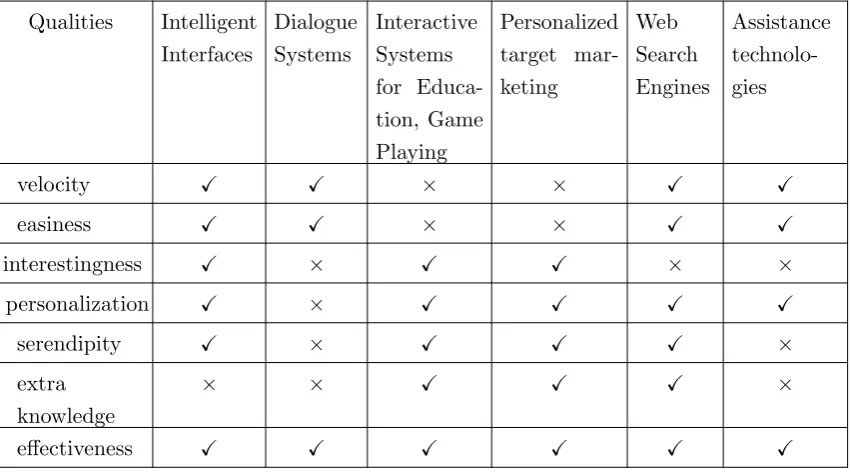
2.5 Qualities added to the usage of certain applications by considering goals. . . 56
3.1 Features (cells) and Communication Means (rows) . . . 65
3.2 User agreement on the segmentation task . . . 79
3.3 Segmentation Granularity of Sample Post Queries . . . 86
3.4 Test Corpus . . . 86
3.5 Comparison of Methods - Mean Precision . . . 86
3.6 Execution times (StackOverFlow dataset) . . . 88
3.7 Segment Granularity - Percentage of Segments . . . 90
3.8 Intention Clusters-Distinguishing Top Terms . . . 92
3.9 Evolution of Intention Clusters in 2 years. . . 93
4.1 Indexes for goal-based recommendation . . . 111
4.2 Overlap of the top-10 recommendation lists produced by the goal-based mechanisms with the lists produced by the standard recommendation approaches. . . 117
4.3 How correlated are the recommendation lists with the top-20 popular actions in the user activities. . . 117
4.4 How complete become the goals of the userafter s/he followsthe actions in the recommed-nation list that was formed based on her/his activity. . . 118
4.5 Pairwise similarity (based on the features of the products) among the actions within each recommendation list for the foodmarket dataset. . . 119
4.6 Common actions in the top-10 recommendation lists of the goal-based mechanisms. . . 122
4.7 Goal Implementation Sets. . . 123
4.8 Average Execution Time in secs. . . 124
5.1 Syntactic Patterns For (Non) Action Chunks. . . 135
5.4 Evaluation of final actions (for different thresholds). . . 140 5.5 Examples of action chunks correctly (True Positives or True Negatives) or incorrectly
(False Positives or False Negatives) placed in the same or different action. . . 141 5.6 Efficiency of Set-Based Clustering. . . 141 5.7 User evaluation of the extracted implementations. . . 142
2.1 A goal-aware System Architecture. . . 17
2.2 Methods that may be employed during Goal Modeling and Goal Recognition. . . 19
2.3 Example of Hierarchical Plan Library. . . 21
2.4 An example of a state-variable representation of a simple goal recognition problem. . . 24
2.5 Ensembles for goals: (a) Coffee Making, and (b) Table Cleaning. . . 33
2.6 An example of a Dynamic Bayesian Network. . . 37
2.7 Behavioral model for Intention Prediction. . . 39
2.8 Answering web queries using (a) only IR techniques, or (b) in combination with goal recognition and exploitation. . . 52
3.1 Four posts from a technical forum. . . 61
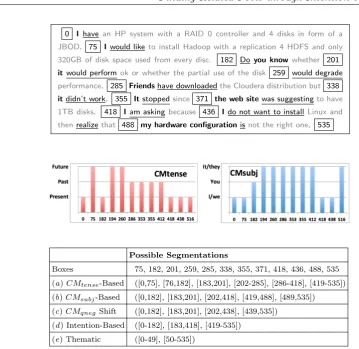
3.2 CMs and Segmentations. . . 66
3.3 Segments of forum posts A and B of the Figure 3.1. Segments found to belong to the same intention cluster appear together. . . 71
3.4 Derived Intention Clusters after Segment Clustering . . . 73
3.5 Weighting for the same term in different intention clusters. . . 75
3.6 On the left, a document collectionD={d1,d2}. On the right,Dafter the segmentation, segment grouping, and indexing step. . . 76
3.7 Annotators’ labels, grouped in categories, for the goals that the segments are intended for. 80 3.8 Comparison of border selection mechanisms . . . 82
3.9 Error under different coherence/depth functions . . . 82
3.10 Overlapping of the posts in the top-5 lists retrieved by our method (IntentIntent-MR) and the rest of the methods considering the post-queries in the collections HP forum and Trip Advisor. . . 84
3.11 Overlapping with IntentIntent-MR in HP Forums dataset of 10k and 100k. . . 84
3.12 Retrieved lists by FullText and IntentIntent-MR.. . . 87
3.13 True Positives retrieved by the examined methods. . . 88
3.14 Comparison of execution times (HP Forum Dataset) . . . 89
3.15 Distribution of posts (i.e., the respective segments) to the different derived clusters. . . 91
4.3 Theaverage goal completeness per listafter the user follows the recommended actions. . 118
4.4 Percentage of recommended actions that the user has indeed performed (True Positive Rate for top-5 and top-10 lists). . . 120
4.5 How often the same action appears in the recommendation lists that have been formed for the user activities of the food market dataset. Distribution of actions in frequency ranges. . . 121
4.6 How often the same retrieved action appears in the goal implementation set (herein recipes). Distribution of actions in frequency ranges. . . 121
4.7 Average recommendation time considering implementation and action sets with different characteristics (ref. Table 4.7). . . 124
5.1 Three example posts from 43things and the respective actions and goals. . . 128
5.2 The goal implementation extraction process. . . 130
5.3 Textual description for the goal buy a house. . . 131
5.4 PTB parse tree. . . 132
5.5 Verb phrases in the parse tree. . . 132
5.6 Comparison of methods for candidate refinement. . . 139
5.7 User Evaluation Of Action Chunks. . . 142
Introduction
Αshoe is similar to ahammer if one is looking around for somethingto bang with, but not if one wantsto extract nails
Trewin 2000
People are daily facing situations in which they have to make choices from really large collections of items. Selecting the best answer to a search engine query among those satisfying the query conditions, selecting a movie to watch, an item to purchase, or the friends activities to read about in social media, are only some of the most characteristic examples. In order to help people (users under the context of a system) to deal with all these situations, a plethora of systems and services that search and recommend different types of items and information have been developed.
Despite the remarkable progress in recommendation and retrieval tasks the last years, in many cases, users still fail to deal effectively with the information overload. As a conse-quence a large volume of items remains unexplored and unexploited. Moreover, together with the scientific progress in the related fields, the user expectations have evolved as well. Users, being bombarded with all sort of recommendations, are not pleased anymore with just relevant and accurate information. Therefore, in order to achieve the user approval and satisfaction, there is a need of introducing novel ideas and practices in item retrieval and recommendation systems.
1.1
Problem
user given a number of items that the user has already found to be of interest. The already selected items of interest constitute either the user history, or a specificuser request. We should highlight that the term item here is not implying only a physical object, but an action, or an interaction with a physical object as well. Examples of items are wear tie
pj, read post di. When there is only one type of interaction with an object, e.g., always read or wear, we refer to the items using only their type. In the previous example, the type is documents and clothes respectively. On the other hand, when there are more than one types of interactions. e.g., buy book bk, or read book bk, we refer to them simply as actions instead of items. Note that actions may be even more abstract, i.e., they may not involve a specific item, e.g., eat healthy, exercise etc.
1.2
Motivation
In order for a technique of finding items of interest to be successful, it should be in accordance with the policies that humans, herein users, employ in order to select one or more items, i.e., with the selection policies. Existing approaches mainly embrace two policies. The first one advocates that users select items being aware or seeking certain characteristics of the items; while the second advocates that user selections are determined by the past selections of other users.
In the first category, we find traditional IR and Web searching techniques that employ features such as weighted terms (e.g., based on the boolean vector space model or tf-idf weighting scheme) [Robertson et al.,1998], or upper-level features such as hidden topics ( e.g., latent Dirichlet allocation) [Blei,2012;Zhou et al.,2011], links, html tags and so forth ; as well as content-based recommendations that employ domain-specific characteristics, (such as “material”, or “color”for clothes, or “author”for books), and/or other auxiliary data [Adomavicius and Tuzhilin,2008], [Balakrishnan,2010], [Fouss et al.,2007]. On the other hand, examples of techniques that adopt the second policy are those exploiting groups of items appearing together, e.g., frequent patterns and association rules [Sandvig et al.,2007], or similarity to the selections of the user’s neighborhood [ Bal-akrishnan, 2010], [Deshpande and Karypis, 2004], [Li et al., 2004], [Rendle et al., 2010]. Alternatively, other methods that are embracing this policy monitor the interactions of users with the items and infer how likely a user would be interested in a certain item based on models that capture previous user selections [Sadikov et al., 2010], [Patterson et al.,2003].
Ubuntu may also like to read it as well. Likewise, a user that has read almost all the books of an author is likely to read the latest book of the same or a similar author.
Similarity based on previous user preferences indeed affects user selections. However, it can deprive users of a great number of interesting and useful items. For instance, the action of reading a book about the reinforcement of the self-esteem will not be recommended to a user that has read a book about mediterranean cuisine, and another about nutrition. The reason is that those books neither belong in popular subsets, nor have been selected (preferred) by the current user’s neighborhood, nor share common characteristics with the books to which the user has shown her/his preferrence, i.e., those that s/he has already read. However, reading a book about self-esteem in combination with the other two books can be of great help to a user that, for instance, is willing to lose weight or to adopt healthy eating habits.
In some cases, the use of plain similarity may even lead to items that are neither interesting nor useful. Considering the previous example, a user that has read a book about self-esteem in her/his effort to lose weight is not necessarily interested in other psychology books as well. Even more often plain similarity can be misleading in cases of items that consist of text. Although similar words or topics in, for instance, two text-items do indicate a connection between those text-items, the purposes that those words or topics are used for can change their meaning radically.
The above examples indicate that humans both produce (or generate) and consume items to serve certain purposes, or else goals. In fact, based on studies in psychology and social sciences, goals have been found to be the factor that can rationalize and provide context and meaning to all human actions [Austin and Vancouver,1996], [Newell, 1982], [Sadri, 2014], [Sen et al., 1986], [Thompson and McEwen, 1958]. Consequently, neither item selections are random and disjoint events. They are driven by the goals that the items are serving. Therefore, techniques that are retrieving or recommending items of interest to the users can significantly benefit from embracing goals in their selection mechanism, i.e., by adopting agoal-aware mechanism.
1.3
Our position
Our position has been reinforced by the fact that goals have already been exploited in different systems and applications in computer science [Papadimitriou et al., 2016]. However, existing works are focusing on inferring the current goal of the user so as to handle her/his next actions, e.g., the system may automatically perform the inferred action [Armentano and Amandi, 2009], or to facilitate the action in any way, e.g., by providing useful information [Maragoudakis et al., 2007], or even to prevent users from performing an action [Schank, 1995]. For instance, in web (keyword) query answering techniques, the life cycle of a goal (e.g., to be informed or to watch a video) starts with the user request and ends when the user stops searching because s/he is satisfied or quits [Jansen et al., 2008; Kofler et al.,2016].
On the contrary, we consider that every item serves a number of goals alone or together with other items independently from the current user. We have moved the focus from “what the user will do next” to “what each item or action is intended for”. We see goals as an integral part of the data that not only changes the way that items are seen and represented but should be embraced in the core functionality of the used algorithms. Of course we do not neglect the user. The user activities or the user requests constitute the input of the goal-aware system. Specifically, the system, considering that the user is willing to fulfill a number of goals (without necessarily taking into consideration or knowing the available items and/or goals), and that the items are serving a number of goals matches those two accordingly and generates a list of items of interest for the user.
1.4
Research Challenges and Contributions
Following a goal-aware approach of solving the problem of finding items of interest in-troduces a number of demanding challenges that regard the identification and extraction of goal-related information, the modeling of the goal-related information, and the de-velopment of the algorithms that capture and exploit this information effectively and efficiently.
Next the contributions of this thesis are briefly summarized.
Goal aware systems.
Goals have been used in different fields in computer science with each field approach-ing the topic from its own perspective and havapproach-ing different objectives. Intelligent inter-faces [Lieberman, 2009] is one such example, in which the system tries to guess what the user intends to do from a single or from a number of user actions, and then adjusts the interface options accordingly so that the user can achieve the intended task faster and more conveniently. Story generators and computer games [Gold,2010;Meehan,1981] are extensively using techniques to guess the user goal and adjust the way the story is going to evolve in the future. Predictions of interactions and next actions, such as queries, likes, purchases, downloads and comments [Chelmis and Prasanna, 2012; Cheung and Lee, 2010;Sadikov et al., 2010] are also benefiting from the consideration of goals. Goals have also been used in real environment applications, for instance, in applications that help the elderly. In order to exploit goals in building better data managements systems, one should first be provided with the required background under a single prism that takes into consideration the special needs of systems meant for storing, querying and retrieving information.
In this dissertation, we study the different goal-related approaches together under such a prism, without focusing only on a specific area or discipline. We provide a complete and global study alongside a generic formal definition of goals and the related concepts. We intend to enable the exploitation of goal management methods in fields where goals have not considered in the past, significantly improving that way their functionality. We show that this is possible and present the mechanisms for achieving it.
retrieval and ranking mechanism that will measure the relatedness of the post-query to the rest of the posts in the collection and will match it to the most related ones in an efficient way.
In this dissertation, we are dealing with the current problem following a different ap-proach from traditional apap-proaches that perform content comparisons across the post contents as a whole. We see each post as a set of segments, each written intended to express a different communication goal. We advocate that the relatedness between two posts should be based on the similarity of their respective segments that have the same intention. This means that it is possible for the same terms to weigh differently in the relatedness score depending on the intention of the segment in which they are found. We have developed a complete goal-aware intention-based matching technique that in its first step segments the posts by monitoring a number of text features and identifying the parts in which significant jumps occur indicating a point where a segmentation should take place. For the segmentation procedure we have introduced a number of feature groups (referred to as communication means), measures for evaluating the borders, and three different border selection mechanisms. Subsequently, the generated segments of all the posts are clustered to form the intentions and then similarities across the posts are cal-culated through similarities across segments with the same intention. For the clustering, any well-known technique can be employed, but it should be used a post representation that captures the distribution of the features that constitute the communication means features. For the post representation, we have introduced 2 types of weights resulting in a vector representation of 28 dimensions that effectively captures the required information. On the other hand, the similarity is estimated using a variation of a well-known weighting scheme the BM-25 that we have adequately modified to consider the intentions of the segments where each term belongs. For the ranking we have developed an algorithm that first generates ranking lists for each intention and then combines the results into a single list. The time efficiency of the ranking is ensured by a number of indexes that are built on the terms of the segments. We experimentally illustrated the effectiveness and the efficiency of our segmentation method and of our overall matching approach.
on the identification of the items that are more appropriate based on the goals that the user will be willing to accomplish. Adding goals into the equation can modify the whole perception of what a recommender system is.
In this dissertation, we are formally introducing the dimension of goals into the item recommendation problem. We do not consider items alone but interactions with items or more abstract actions that lead to the fulfillment of goals. As a first step, we generate a space of candidate goals inferred from the actions performed by a user. The candidate goals define indirectly a space of candidate actions for recommendation. We rank the candidate actions to form the recommendation list for the user activity. The ranking requires a solution that deals with the fact that actions can be combined with different action sets to accomplish more than one goal, and also the fact that a goal may be fulfilled through different sets of actions. We have devised three different strategies on ranking the candidate actions, namely the Best Match, the Focus and the Breadth, depending on the preference on the way the goals should be fulfilled. To model the associations among actions and goals through goal implementations (i.e., sets of actions that lead to the fulfillment of goals) we introduce a goal model, referred to as association-based model. The association-based model considers each action set that leads to the fulfillment of a goal as a hyper-edge that connects the actions within the set and at the same time with the goal(s) those actions serve. In practice, we implement our model using a number of indexes. We have performed a comprehensive experimentation where our technique has been found to retrieve novel yet useful items.
Building goal implementation sets. How-to articles and personal success stories on the Web constitute a valuable source of information about goal implementations, i.e., sets of actions that are needed in order to accomplish certain goals. Recent years have witnessed great successes in information extraction from text and the organization of the extracted knowledge. However, information extraction techniques have so far focused mainly on the creation of ontologies through entity identification, event detection and relationship extraction. Similarly works that regard goal related data also aim to trans-form the data into a structured trans-form, like an ontology [Jung et al., 2010],[Pareti et al., 2014],[Ryu et al., 2010], a taxonomy [Chulef et al., 2001],[Strohmaier et al., 2009],[Smith and Lieberman, 2010a] or an activity model (ref. Section 2.2.5). Therefore, the problem of extraction of sets of goal implementations can not be handled through the existing approaches.
collected from an online platform where users describe their success stories, i.e., how they managed to accomplish their goals, and we evaluate it. The results confirm the effectiveness of our approach.
1.5
Application domains
Goals can provide a formal foundation for going beyond the traditional modeling and analysis of data, and can help build better systems and services for the end user for different application domains. Below we briefly present those that constitute the focus of interest of this research.
Retrieval and Data Mining Systems. User posts can cover any aspect of the daily life or any specific topic and interest such as technology, science, psychology. Especially posts in forums span a great range of domains like health (Medhelp), traveling (TripAdvisor), law (ExpertLaw) and technology (HP support forum or IBM). Therefore, the functionality of finding related posts can bring great benefit to users being in completely different situations. Posts are usually organized in threads of a large number of posts. One or more of these posts may contain the solutions to the issue expressed in the initial post. The solution-posts may be either marked as correct by the users, or automatically classified by the system [Jenders et al., 2016]. This way, users can also seek solutions and make decisions regarding diverse problems by exploiting other users’ experience. For instance, a user reading a post on a technical problem in a customer care site could find related forum posts that describe similar situations and alternative solutions. Or, someone with a health problem reading a medical forum post where a user is describing similar symptoms could find additional related forum posts that contain different opinions, explanations, and various courses of actions. This functionality also offers businesses the ability to connect and support their customer base.
where they belong are known to serve real-life goals, e.g., a book about mediterranean cuisine, another about obesity, and a third one about the reinforcement of the self-esteem can support the goal of losing weight (ref. Section 1.2), at the same time the first book about mediterranean cuisine together with a guide for wine selection and the benefits of olive oil can support a user’s goal to adopt mediterranean food habits. We further discuss such options in Section 4.3. An interesting type of goal implementations that opens up the road for novel recommendation services is that of social data that describe how users fulfill real-life goals such as to learn english, to visit Athens, to eat healthy and so forth (ref. Section 2.2.5).
Social Data and Services. Beyond goal-aware recommenders, mechanisms that extract information related to goals (information regarding actions, goals, and how goal are ful-filled, i.e., goal implementations) can be proven valuable for the analysis of data from social networking sites and applications. For instance, for analyzing the content that a specific user shares online to extract her/his goals. The detection of information about the user goals and actions in social media can trigger several marketing services. Users with similar goals could get connected to discuss common problems and get motivated. Moreover, special services can be implemented for groups of users with common goals.
1.6
Outline
Chapter 2 presents our study of the techniques of inferring and exploiting goal related information that have been used in different fields in computer science, and explains what is required for introducing goals in a new unseen scenario. The next two chapters, namely Chapters 3, 4, introduce, formally define and provide complete goal-aware solutions, and extensive evaluation to the problems of finding related forum posts and item (action) recommendation, and Chapter 5 presents a technique for text extraction that is used to build goal implementation sets. We summarize our findings and provide insight for the open challenges in Chapter 6.
1.7
Scientific Outcome
• D. Papadimitriou, Y. Velegrakis, G. Koutrika, and J. Mylopoulos. Goals in social media, information retrieval and intelligent agents. In IEEE 31st International Con-ference on Data Engineering (ICDE) 2015 [Papadimitriou et al., 2015] (tutorial).
Database Systems (TODS) 41(4), 23. 2016 [Papadimitriou et al., 2016](survey).
• D. Papadimitriou. Goal-aware data management for retrieval and recommendations. In 32nd ICDE PhD Workshops. IEEE Computer Society, 2016 [Papadimitriou, 2016].
• G. Koutrika, D. Papadimitriou, and S. J. Simske. Matching of an input document to documents in a document collection. U.S. Patent No. 20,160,299,891. 13 Oct. 2016 [Koutrika et al., 2013](patent).
• D. Papadimitriou, G. Koutrika, Y. Velegrakis, and J. Mylopoulos Finding Related Forum Posts through Content Similarity over Intention-based Segmentation IEEE Transactions on Knowledge and Data Engineering (TKDE) (accepted for publica-tion), 2017.
• D. Papadimitriou, G. Koutrika, and Y. Velegrakis, Recommendations through Goal Exploitation (under submission).
Goal-aware Systems
This Chapter, provides an extensive and comprehensive study of the techniques and the ways that goals have been used so far. Section 2.2 provides the list of different techniques that have been used so far for goal modeling and recognition and also explains how this information is actually exploited. Subsequently Section 2.3 describes a series of applications in which goals have or can be used, and the benefits that they can offer to the functionality of these applications. It also provides some examples of how the tasks and concepts described in the unified framework work in a real application scenario. Prior to all these, in Section 2.1, it provides a unified overview of goals and the related concepts offering a formal framework that can work as a reference point to the concepts and challenging tasks in any goal-oriented approach and system. All the methodologies and application scenarios are discussed under the prism of this framework.
The organization of the sections of this chapter is based on the different tasks that a goal-aware system should perform. The main different tasks are three. First, a goal-aware system has to be able to model and store user goals. Second, it should be capable of identifying the goals given a set of observed actions that the user has performed. Recall that goals are rarely mentioned explicitly or communicated, but instead exist in the users’ mind. Last, but not least, the system should be able to exploit the recognized goals and adapt its functionality and output accordingly.
activity recognition sensors that send personalized activity reminders; and (d) physical locations monitored by sensors, e.g., an airport monitored for suspicious behavior.
We categorize goal modeling approaches according to the source of data used for the construction of the model. In particular, we consider those that are based on:
− Complete records of all the required information about goals, actions and plans,
− Taxonomy records containing actions matched to classes of a goal taxonomy,
− Corpuses containing all the information for a subset of the goals, actions etc.,
−Behavior theories providing all the required information about human goals and actions within a specific environment.
Goal recognition. To recognize goals, one needs to observe user actions within an environment and identify patterns that lead to the satisfaction of user goals. User actions include queries, purchases, menu item selections, free-text input, preference statements, publishing multimedia objects, moves in a natural environment or moves of certain human parts, user interactions, and so forth. Data mining techniques, such as association rules that could capture knowledge in the form of “a set of actions X is followed by the set of actions Y with high probability”, can provide useful correlations among observed actions and system conditions. However, they cannot answer the question of “what the user wants to achieve with these actions?”, i.e., identify and assign a goal to these actions [Wilcox and Bush,1992]. Goal representation is tightly coupled to goal recognition, thus, we study them together.
Goal exploitation. Understanding a user’s goal as the user interact with the system can help the system to adapt its operation, personalize its responses, and facilitate the user in achieving their goal. For instance, imagine a user of a text editor, who opens the submenu for tables but changes nothing, then checks the printing settings a couple of times. The user is probably trying to print a table so that it fits the page. Knowing the user goal, the system can facilitate, e.g., by highlighting related menu options. Exploitation of goals can save the user from performing irrelevant steps, or putting extra effort, and the system from unnecessary operations and costly computations [Armentano and Amandi, 2009;Carberry,1983; Gold, 2010; Zhe et al., 2010]. Or it can make available knowledge, information or any other type of response that is derived consider the current goal of the user [Broder, 2002; Maragoudakis et al., 2007; Sadikov et al., 2010].
The exploitation of goals in practice is strongly dependent on the application scenario. We categorize existing approaches across two dimensions:
− Exploitation Through Dynamic Environment Changes, i.e., changes in the environ-ment states by taking into consideration the inferred goal(s).
by algorithms that embrace goals into their core functionality (i.e., the system performs its tasks considering the inferred goal).
Goals can be exploited at any given point of a system’s lifecycle. During requirement specification, goal-oriented approaches aim at capturing the objectives a system should achieve [Mylopoulos et al., 1999]. Since the focus of this study is on systems, we do not consider such works. Furthermore, we do not consider studies on goals and human behaviour from a psychological and sociological perspective. There also exist a few surveys on goal exploitation, and they focus mainly on goal recognition. One of these surveys studies ways through which a goal can be recognized by observing the actions that a system agent performs and provides an overview of techniques on how the recognized goals can be used in decision making [Anh and Pereira, 2013]. Along the same lines, another survey emphasizes on plan recognition and probabilistic methods [Armentano and Amandi, 2007], while a third one approaches the challenge of goal recognition through logic-based formalisms [Sadri, 2014]. All the above works are agent-oriented, thus, they consider approaches typically employed by agents. They have an Artificial Intelligence (AI) flavor, ignoring issues like performance or usability. Furthermore, they have not considered works in areas like recommendation systems or information retrieval, and is hard to see how the presented approaches can be adopted by other areas. There also exists a survey focusing on the special needs of multimedia searching [Kofler et al., 2016] that covers certain aspects of text retrieval as well. However, we are approaching these techniques considering a generic formal definition of what a goal is and all the related concepts.
2.1
Key Concepts
Before studying the way goals have been used, it is necessary to establish a common terminology and formally define a number of concepts.
Definition 1 An environmentEis a finite set{v1, v2, . . . , vk}⊆V. The variablesv1, v2, . . . , vk are referred to as the environment variablesand the numberk, denoted as|E|, is the cardi-nalityof the environment. Astate, or instance, of the environment is a set{Sv1, Sv2, . . . , Svk},
with Svi∈Dvi, for i=1..k.
The symbol SE, or simply S will denote the set of all possible states that an envi-ronment E can be. The state of an environment is changed by actions performed by the actors or by external factors. For example, a variable that represents time changes independently of any actor actions.
Definition 2 An actionis a function act:SE→SE, expressed as a conjunction of “v=S v” pairs, where v is an environment variable of E and Sv∈Dv.
For brevity, we will write (v1, . . . , vi) act
→(Sv1, . . . , Svi) to denote v1=Sv1 ∧. . .∧vi=Svi. Furthermore, if for an action act, it holds that act(S)=S, where S∈SE, then the action will be said to have no effect on the environment state. Finally, the symbol A will be used to denote the set of all possible actions.
Example 1 Consider an environment E={place, time, status} that describes the posi-tion of a person at some point in time, and whether she is alone or not. Assume that at the current moment it is night and the person is at the sea alone. The current state of the environment is Scurr={“Sea”,“N ight”,“Alone”}. An action (time)
act1
→ (“Day”) will bring the environment into the new state Snew={“Sea”,“Day”, “Alone”}, while the action (place)act→2(“M ountain”) will lead into the new state Snew={“M ountain”, “N ight”,“Alone”}
By definition, an action can always be executed. However, there are many practical scenarios, in which it is important to restrict when this can happen. For this reason, an action may be associated to a set of preconditions for its execution.
The actions that the actors perform are not random but are performed for a reason, i.e., the actor wants to achieve a goal.
The term goal has been defined in different contexts as the point that marks the end of a process, the purpose towards which an endeavor is directed, an objective1, or a desired
state of affairs. All these definitions converge into a generic description of a goal as one or more desired states described through some common properties.
Definition 3 Agoal g in an environmentE is a boolean expression of environment vari-ables of E. The goal is fulfilled (or achieved or satisfied) in a state S of the environment
1
E, and denoted as S|=g, if after the replacement of each environment variable in the boolean expression g with its state in S, the expression evaluates to true. The set of all possible goals is denoted by G.
Example 2 Consider the environment of Example 1 and the desire of the person to go to the mountains during the day. This desire can be modeled as the goal g: ((place =
“M ountain”)∧(time = “Day”)). Note that the goal is independent of the state of the
variable “status”.
In order to fulfill their goals, actors are typically making plans on what actions to perform. This is known in the literature as theoperationalization of a goal [Dalpiaz et al., 2014].
Definition 4 A planis a sequence hact1, act2, . . . , actniof actions. The operationaliza-tion of a goal g in an environment E with a state S is a plan hact1, act2, . . . , actni for which S0=actn(actn−1(. . . act2(act1(S)). . .)) and S0|=g. Such a plan is also referred to as
a successful plan for this goal. Lack of a successful plan makes the goal infeasible.
Example 3 The plan that consists of the two actions mentioned in Example 1, in any sequence, is a successful plan for the goal g: ((place = “M ountain”) ∧(time = “Day”)) since the final state of the system after the execution of these two actions isS0={“M ountain”,
“Day”, “Alone”}, which satisfies the goal. The plan with the additional action (status)
act→3
(“W ithCompany”) is also a successful plan since it brings the system in the state
S00={“M ountain”, “Day”, “W ithCompany”}, which also satisfies the goal.
The implementation (or execution) of the plan is the execution of its actions. The life-time of a goal consists of the states that the environment goes through from the time a goal was set to the time a state was reached in which the goal is satisfied.
People often talk about how close they are in achieving a goal, or to what degree a goal is fulfilled. Hence, there is a notion of proximity between the current state of the environment and the set of states that satisfy the goal, i.e., the set Sg = {S| S|=g}. To quantify this proximity, we assume the existence of afulfillment function, scrg:S→ [0,1], which is a scoring function with scrg(S)=1, for every S∈Sg, and scrg(S)6=1 otherwise. Such a scoring function is typically goal- and application-specific, since it depends on what factors of the environment are considered important and how much. A goal is partially fulfilled with respect to a state S, if the value of this goal fulfillment function for the specific state is in (0,1).
of goal-oriented requirements engineering [Mylopoulos et al., 1999]), to be distinguished from the “hard” goals introduced in Definition 3, which are based on a boolean function.
Definition 5 A soft goal is a function g:SE→
R.
Intuitively, a soft goal provides a way to quantify whether one state of an environment is preferable to another, but there is no state in which it can be said that the goal has been satisfied. Due to this fact, a fulfillment function cannot be computed. However, between two states S1 andS2, it is typically said that the state S1 has better fulfilled the
soft goal g than S2 if and only if g(S1)>g(S2).
Example 4 An example of a soft goal is web searching in which users search for resources in order to get informed about a topic. For this purpose, the actions they perform are: to submit keyword queries, and click on the available web resources. It is hard to say that at some point the goal has been fulfilled (i.e., that the user knows everything about the topic). However, in an environment defined by features such as the diversity of the web resources, the position of the keywords within a page etc. (ref. Section 2.2.2, especially Model Construction & Table 2.1 for more examples), it can be defined a function having as parameters a subset of the environment variables, i.e., the goal function, to return whether one environment state is preferable to another. The environment states are actu-ally matched to a number of web resources. According to the selected state, the respective web resources become available to the user.
Setting goals means typically some commitment to perform a sequence of actions for achieving that goal. The term intention is used to capture that commitment.
2.1.1 System Components & Tasks
We consider systems that allow us to store, retrieve, and discover information and knowl-edge from a data repository. In the physical or virtual workspace defined by the system, actors perform actions, such as submitting searches or sending requests (e.g., for services), and the system responds by changes in the environment, services or data in its environ-ment. The actors are users or other systems/applications that interact with the system. Thus, the systems we consider are interactive.
statistical analysis that will be running over the stored data. A recommendation system would comprise different recommendation methods, while a traditional database system would entail methods for accessing the underlying data based on the specifications of the actor’s queries.
Actors’ actions support a goal that the actor wants to achieve. For example, a user that poses a query “europabank, credit card, pay” is likely looking to pay the monthly statement balance rather than finding the cost for a new card. Respectively, the user would expect results that are different from the results when they try to find the cost for a new card.
A system that ignores goals, i.e., a goal-agnostic system, misses the big picture, i.e., “why is the actor doing this?”, hence it cannot help the user as effectively as possible. In our earlier web search example, that would signify an increased user effort to achieve their goal. Knowing actors’ goals can help the system understand their actions and adapt its behavior and functionality to a goal faster and more effectively, resulting in better system resource usage as well as user experience. Agoal-aware system would require the components to record the goal-related information, analyze it, and then use the analysis results to recognize the goals of the actors, and respond accordingly. These components are shown in green in Figure 2.1.
Figure 2.1: A goal-aware System Architecture.
experts or user annotations. Figure 2.2(a) shows several alternatives for collecting goal data.
Goal Model Constructor. Goal data can be used to create the so-called goal model, which is a model used to recognize and subsequently to exploit the actor goals. The goal model construction can be done either in a top-down fashion, where experts or actors themselves explicitly state their goals and actions, or in a bottom-up fashion, where models are constructed by observing and analyzing the actions of the actors in the system. The goal model is constructed offline and may be updated periodically as new actions and their goals are recorded into the goal repository. Figure 2.2(b) shows alternative approaches for building goal models. The goal data collector and the goal model constructor comprise the goal modeling operations of a goal-aware system.
Goal Recognizer. With the goal model constructed, the next challenging task is the goal inference orrecognition.i.e., the ability to infer the goal(s) that an actor is currently pursuing by observing her actions [Sadri, 2012]. The task is challenging because the actions provide only partial information. The idea is to recognize the goal way before all the actions that operationalize the goal have been completed. Depending on whether or not the actor wants to disclose the goals, the task can be characterized as intended, in which the actor tries to communicate her goals to the system, keyhole, in which the actor is unobtrusively observed and does not attempt to impact the recognition process, and adversarial in which the actor is hostile and tries to hide her actual goal [Geib and Goldman, 2001]. An example of the intended case are the natural language dialogues, where speakers explicitly try to communicate their goals. An adversarial example is the cases of computer security and information warfare, where the actor tries to hide her intentions and the system tries to predict them in order to identify possible attacks. Finally, an example of the keyhole case is in query answering systems where users interact normally with the system without explicitly expressing their goals nor hiding them from the system. Moreover, apart from the user’s effort to keep her/his goals unrevealed, there are cases where we havepartial observability of the environment for reasons such as sensor limitations, uncertain action logs, or privacy issues. In these cases, the matching between the actions that are actually performed and what is observed in the environment is not deterministic; making goal recognition more challenging [Hoelzl et al., 2012;Keren et al., 2016a]. For instance, an action may be matched to more than one sets of effects on the environment. Figure 2.2(c) shows alternative goal recognition approaches for different goal models.
set of actions, hence, a plan can be identified by matching these actions against the actions in a goal model such as a plan library representing the operationalization of the various goals. This decision cannot be done with a complete certainty, either because the observations match partially and are not enough to make a firm decision, or because the representations themselves are incomplete or uncertain.
Goal Exploitation Component. The recognized goal (and possible plan) can be ex-ploited at run-time by the system algorithms. The module can select the responses to provide in order to drive the actor towards the fulfilment of the set goal. We highlight that the system “responses” are not necessarily returned data. They may be actions that the system takes even if not explicitly requested by the actor, for example as performed by intelligent interfaces. This means that the goal exploitation module may provide different responses to the same request if the identified goals are different or if different plans are used for the operationalization of the goals. In a query answering system (e.g., a Web Search Engine), the results retrieved with the existing techniques are all related to the query in general, but based on the goal that has been recognized some may be more important than the others. Thus, the results can be further processed to keep only those that will enable or facilitate the goal fulfillment. To achieve this functionality, the main system component (system engine) that performs data selection should be aware of the identified goal, its operationalization choices (i.e., the plans that lead to goal fulfillment), and the interaction history of the specific actor.
Note that goal exploitation is not necessarily an additional processing step. Existing algorithmic techniques can be adapted (or novel techniques can be designed) to take goals into consideration by performing the respective reasoning (that requires goal modeling and recognition) that has just been described.
!
!
!
!
!
!
!
!
!
!
!
!
!
!
"#$%&'(! )(#*'&'+! ,(-.!"&'&'+! /0(*!1.23&(045''6.#76'0! 1.#707$#84 9*6:#:&8&07$! !5'#8;0&0! !"<=>)!?<@1,A/?,B<@! >-C(*.! !5'#8;0&0! A28(! =(D'&76'!! E(#.2*(! =&0$6F(*;! G(%#F&6*!! ,%(6*;! 1(8($76'! H;C6.%(0(0!! E6*I28#76'! /0(*!1.23;!! ?6'32$76'! >-C(*.!5'#8;0&0! 9*6$(00&'+! !6J!)6+!E&8(0! 5''6.#76'0! A($6*3&'+!! K0('06*0L!$8&$M! .*#$M(*0! !6*!6.%(*!! 8&0.('(*0! A($6*3&'+!6J! ?6II6'!1('0(4! =6I#&'!N'6O8(3+(! >-C(*&I('.#8!! /0(!6J! 16PO#*(!! ! ! ! ! ! ! ! ! ! Q*#C%!.*#F(*0#8! ?6'0&0.('$;!$%($M&'+!
?#.(+6*&R! S#76'! 9*6:#:&8&07$!B'J(*('$(! "63(8!! 9*(3&$76'! Q<5)!A>?<Q@B,B<@! !!Q<5)!=5,5!?<))>?,BTU! K#V! K:V! 5'#8;0&0!! <J! A(062*$(0!!!! K$V! Q<5)!!"<=>)B@Q!! 9#W(*'RA28(! "#.$%&'+!
!
!
!
!
!
!
!
2.2
Goal Modeling and Recognition
Goal models, and by extension goal recognition techniques, are not restricted to a certain application scenario. The same modeling method can be used in different goal exploitation scenarios. The available data based on which the goal models are constructed together with the needs of the system determine the goal modeling approaches that can/should be used. Based on themain source of goal data used for the construction of the models, goal models can be clustered into models derived from: complete records,taxonomies,corpuses (training data), and behavioral theories. In these methods, different ways to collect the goal data are applied as we will see (Figure 2.2(a)). We also consider another alternative, collecting goal data from text corpuses. Text analysis is not offering a complete solution for goal modeling and inference. However, as we will see, challenging issues in terms of data management get raised by the discovery of goal knowledge in text data.
For each goal model type, we present the most common techniques for constructing the model based on the goal data, and for inferring the goals based on the current observations (goal inference).
2.2.1 Based on Complete Records
Approaches based on complete expert records assume that experts provide all the infor-mation needed for building a model sufficient to match any set of observations to a latent goal (and possibly to a plan) within the examined environment. Goal recognition proceeds as follows. Initially, all the goals that require the actions observed so far are considered as candidates. As the actor continues to perform more actions, some of the candidate goals become logically infeasible due to missing actions in their implementation plans, due to violated preconditions or due to other observations. These goals are excluded from the candidate set reducing the search space. During the check for the goal infeasibility, logic-based reasoning (mainly logic abduction) can be employed to provide explanations of the observations [Sadri, 2012] when this is possible. The goal recognition task does not always lead to some conclusion but when it does, it returns one and only one goal. We identify three categories of approaches based on complete records: (a) plan libraries, (b) consistency graphs, and (c) action-centric representations.
Plan libraries
Problem Domain Hacking
Goal notation (theft), (vandalism)
Actions Description
(reconnaissance)recon→ (“true”) make a reconnaissance, scan the system to determine
vulnerabil-ities
(breakedIn)break→−in(“true”) exploit the system weaknesses (root)gain→−root(“true”) gain entry break in escalate
privileges gain root
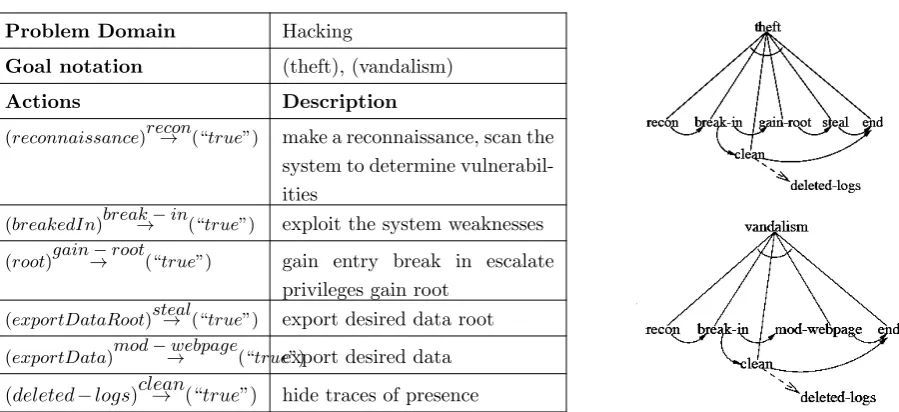
(exportDataRoot)steal→ (“true”) export desired data root (exportData)mod−→webpage(“trueexport desired data”) (deleted−logs)clean→ (“true”) hide traces of presence
Figure 2.3: Example of Hierarchical Plan Library.
to perform and (ii) the preconditions of each action alongside its effect on the environ-ment [Carberry, 2001a]. Plan libraries have to be complete i.e., to exhaustively describe all the actions that may be performed in the domain under study and all the alterna-tive plans for all the possible goals. Moreover, they have to be correct since they lack mechanisms for handling inconsistencies [Sadri, 2012].
Model Construction. The construction of a plan library demands a lot of effort by experts who master the problem domain. In general, experts try to organize the goals and actions into plans in a way that enables the generalization of the plans to cover new facts. Even psychological theories about how human observers understand the actions of others have been used in the task [Schmidt et al., 1978]. In many cases, the domain experts perform closed-world reasoning [Kautz,1991], i.e., they isolate a part of the world in which they are mainly interested and focus on the minimum sets of independent plans that explain the observations and are sufficient for fulfilling the goals of the observed agents.
Simple plan libraries may be represented as rules of the form g ⇒ act1, act2, . . . actn, where g denotes a goal, and act1. . . actn is the sequence of actions which comprise the operationalization of the goal. Actions in the literature may be represented as predicates, e.g., land(jet101, airbase1) describes the action of landing of jet101 to airbase1 [Sadri, 2012]. Respectively, in a simple environment E (ref. Section 2.1), the action land∈ A
for instance would be defined as: (jet101Loc) land
→ (“airbase1”), wherejet101Loc ∈E and
Djet101Loc={airbase1, airbase2, airbase3}.
the left, the goals and the actions (together with a short description) are shown. On the right, the actual library is illustrated as two diagrams that correspond to two plans for the goals: (theft) and (vandalism). As we see, the actions in the plans are not sequential; there exist links that determine ordering constraints among the actions.
Moreover, dashed lines represent the fact that a change in the environment is observed after the execution of an action (i.e., the action postconditions are illustrated). For instance, if clean is executed, a change in the environment will be observed, i.e., deleted-logs value will change from “false” to “true”. This information about action effects can be critical to inferring the execution of unobserved actions (all actions except from clean are not observed). For example, in Figure 2.3, the ordering constraints allow us to conclude that in order for clean to be performed without being observed, an earlier unobserved break in should also occur.
Goal Inference. Goal inference using plan libraries requires the detection of the plan that is consistent with the current observations. The correctness and completeness of the library is of major importance for the inference task. If the observations can be matched to more than one plan, the system should either wait until one or more actions exclude all the candidate plans but one, or return all the matching candidate plans. This approach is extremely sensitive to noise. One misidentified action may cause the exclusion of the real plan from the candidate set of solutions. However, inference in plan libraries is not always straightforward. In cases of adversarial recognition, in which hostile agents try to hide their actions from the system, there is no fully observable sequence of actions. Thus, probability distributions are introduced in the inference technique by algorithms such as Poole’s PHA to first infer unobserved actions, based on the observed actions or the state of the system, and then infer the most probable goal [Geib and Goldman,2001]. The search space can be limited by considering the ordering of constraints and/or by excluding disabled actions. An action is considered to be disabled when in all the plans of the library, it is preceded by actions that have not been observed.
Consistency graphs
postconditions), and the system functionality (i.e., the allowed actions and goals). In contrast to goal recognition systems with complete libraries, where a goal is con-sistent, if there is a plan that starts with actions already observed leading to the goal, consistency graphs are able to recognize new plans as well [Hong, 2000]. However, since the action restrictions are not modeled, consistency graphs cannot capture causal links among actions and goals. That makes them more appropriate for explaining past actions rather than making predictions.
Model Construction. Initially, all the actions and goals that are feasible in the exam-ined environment are recorded by the domain experts and are inserted as nodes in the consistency graph. Then, all the action nodes and the goal nodes are fully connected to each other without checking for inconsistencies, i.e., without checking whether the se-quences of actions (plans) that are connected to a goal violate any conditions and if they actually lead to the fulfillment of the graph. Inconsistent goals are then repeatedly pruned from the consistency graph. The consistency control may be performed by the experts or automatically.
Goal Inference. The main idea is to reduce the set of candidate goals by eliminating the goals that cannot be explained by the actions that the actor performs. If more than one goal can be explained by the observed actions, consistency graphs cannot return a result since only one consistent explanation is possible.
Action-centric representations
Action-centric representations, originally proposed for classical planning problems, have recently been for goal and plan recognition by exploiting the progress in modern plan synthesis [Sun and Yin, 2007], [Ramırez and Geffner, 2009].
Initial State
(and(garbage) (clean hands) (quiet) (not present) (not dinner))
Goals
g1 (and(dinner)(present)(not garbage) (quiet))
g2 (and(dinner)(present)(garbage)(quiet))
g3 (and(dinner)(not present)(garbage)(quiet))
Actions
Preconditions Effects Short Explanation
(clean hands) (dinner) COOK. Before: your hands should be clean.
After: dinner is ready.
(not present) (present) WRAP UP. Before: present is not ready
After: present is ready.
(garbage) (and (not garbage) CARRY GARBAGE. Before: garbage exists.
(not cleanHands) After: there is no garbage, the agent’s hands
(quiet)) are unclean and there is silence
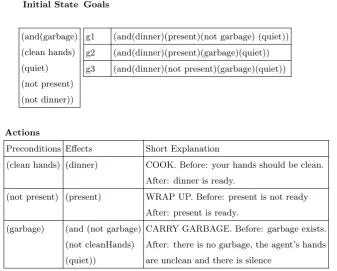
Figure 2.4: An example of a state-variable representation of a simple goal recognition problem.
girlfriend.
According to Section 2.1, the environment in the above problem can be defined as: E={dinner,present, garbage, quiet, clean hands}. The domains of each of the respective environment variablesvi∈E are Dvi={“true”,“false”}. Moreover, the goals g1, g2, g3 are determined by the respective environment states, i.e., in g1 (dinner) will be translated intodinner=“true”. Thus, g1 will consist of two environment states ofSE: g1={{“true”, “true”, “false”, “true”, “true”}, {“true”, “true”, “false”, “true”, false}}. As the state of variable clean hands (which is the last variable) is not explicitly stated in g1, both environment states are desired.
The construction of the goal model starts with the initial state of the environment. After having produced all the possible actions (derived actions), the transition graph is constructed layer by layer, with the first layer being the initial state. Specifically, all the derived actions are examined and if the preconditions of an action are satisfied or there are no other inconsistencies, the state is updated according to the effect of the current action. Inconsistencies include: actions with inconsistent effects (effect-effect), actions where an action effect interferes with the precondition of another action (effect-precondition), or actions. The process is run recursively until the planning graph stabilizes.
Goal Inference. To infer goals from the derived transition graphs, search space algo-rithms are used, such as breadth-first search (BFS) andA∗, in combination with heuristics to boost up performance. According to the BFS strategy, search is performed level by level; first, all the existing sibling nodes (nodes of the same level) are visited, then the next level of nodes is examined, and the procedure goes on until a node that represents a goal consistent with the observations is visited. A∗ strategy reaches the node represent-ing the consistent goal by followrepresent-ing the path of the minimum cost accordrepresent-ing to a cost function, such as minimizing the length of the path which contains all or some of the action nodes that have been observed. The starting search point is the current state of the system. Ramirez and Geffner showed how algorithms originally designed for planning can be slightly modified and used for plan recognition over a domain theory [Ramırez and Geffner,2009].
2.2.2 Taxonomy-based
were derived from extended user studies using questionnaires and interactive tools on web browsers tracking user moves such as clicks and form submissions in combination with expert knowledge. Examples of goal taxonomies [Broder,2002; Kang and Kim,2003;Lee et al.,2005; Rose and Levinson,2004] are briefly presented in Section2.2.2.
In taxonomy-based approaches, there exist 2 types of actions: (a) the actions that initially trigger the functionality of the system, and (b) the actions that become available after the system response. The first type of action are the user requests or queries. For instance, in a web search engine, the requests are the keyword queries, while the actions are the clicks on the web resources, e.g., pages, snippets, that the system returns to the user after the query is posed. The actor requests are used for goal inference while the actions performed after the system response may be tracked by the system to evaluate the actor’s satisfaction. Ideally, the actor would be satisfied by clicking a single web resource. Thus, the plan would consist of a single action. However, more actions, i.e., clicks on the top related resources returned, may be required, creating longer plans.
Model Construction. Once the categories of the taxonomy are decided, the model that will classify a user query into one of the goal classes should be built. To build the model, experts select a number of environment variables that are considered appropriate for grouping the requests into the classes of the goal taxonomy. Manual classification can be used to understand the user goals and whether it is feasible and meaningful to incorporate them in the existing system. To automate (at least partially) this laborious task, the analysis of the involved resources can be employed, e.g., in Web Information Retrieval query logs and snippets have been used. The selected environment variables are then used in rule-based annotators [Jansen et al.,2008;Lee et al.,2005;Li et al.,2006] or to train automatic classifiers, such as Support Vector Machines (SVMs) with RBF (Radial Basis Function) kernel [Baeza-Yates et al., 2006; Herrera et al., 2010], can be built.
instance.
Goal Inference. Goals in taxonomy-based approaches are soft goals(ref. Section 2.1, Definition 5). Thus, goal inference is about defining a function over the environment variables. Considering the set of environment variables selected in the model construction step, the constructed model (i.e., the rule-based annotator or classifier) matches every new request in the system to one (or possibly more) of the goal categories. The goal class sketches (or else partially defines) the goal since for each goal class, there is a set of conditions on the environment variables. The goal takes its complete form by extra conditions on the environment variables based on the request itself and the goal class. Hence, goal inference requires two tasks: (a) categorization of the request to one of the categories of the taxonomy, and (b) definition of a function that captures conditions on environment variables based on the goal class and the request.
Some works have treated goal inference from user queries as a problem of query re-formulation. They define goals in web search as sets of semantic concepts [He, 2010] or as sets of “verb-object” pairs derived from the sentences that are implied by the queries [Chang et al., 2006]. Although these approaches showcase interesting results, the focus of this work is on goals that can (even approximately) describe a desired state of the environment, so we do not consider them further.
[User satisfaction]. An important aspect in taxonomies has been the evaluation of goal inference. Even if the model is accurate, it may not correctly classify a request, mainly because of the subjective nature of soft goals. In contrast to hard goals (ref. Definition 3), soft goals (ref. Definition 5) are defined by a functiong:SE→
R. To define this function,
one needs to know whether the actor will characterize a plan as successful, which is not possible to know in advance. To cope with this challenge, analysis of action patterns (e.g., sequences of queries or clicks within user sessions) have been employed by the information retrieval community. These analyses have been based on Markov Models [Hassan et al., 2010] or on Hierarchical Conditional Random Field techniques [He, 2010].
Examples in Taxonomy-based Approaches
The Broder taxonomy [Broder, 2002] was the first created. It was implemented by examining whether it is feasible to identify what users expect from a web search engine so as to consider their search successful and stop submitting similar queries. The outcome of that work was a taxonomy of user queries that reflects a categorization of latent user goals. The taxonomy describes three types of web queries: informational, navigational and transactional. Informational queries consist of terms that describe or capture vague notions, e.g., “bugs”, or consist of specialized terms, e.g., “Peruvian Dubia cockroach”. Both types of queries indicate that the desired target is a collection of links which will enlighten the user on the subject. Navigational queries consist of query terms that describe a specific url, e.g., the query “american airlines home” indicates that the user’s most probable target is http://www.aa.com. Finally, transactional queries contain terms that indicate that the target url enables a transaction such as downloading a file, buying an item or watching a video. For instance, with the query “Athens photo” the user most probably expects to get direct access to image files related to Athens.
User surveys proved that the consideration of Broder’s query taxonomy into the selec-tion of the query results has a positive impact on user satisfacselec-tion [Broder,2002]. Conse-quently, further research was triggered towards this direction and differentiations of the taxonomy have been developed towards more detailed ones [Jansen et al.,2008;Rose and Levinson,2004] or more abstract ones [Baeza-Yates et al.,2006]. For instance, Rose and Levinson elaborated Br