The perception of intonation in native and non-native linguistic contexts
and by different individuals:
From question-answer categorization to the integration of prosody and
discourse structure
Doctoral Course in Psychological Sciences and Education
XXX Cycle
Disciplinary Sector: L-LIN/01 Linguistics
Ph.D. Candidate
Alessandra Zappoli
1
2
To all my family, to my father, to Luigi, Ada, Inge and Zeno.
4
Acknowledgments
First and foremost, I would like to thank my family, for allowing me to study, for having supported me in all these years, during my journeys and years I have spent abroad from a young age, for never questioning my decisions, and for encouraging me during difficult times. In particular, I want to thank my father for the greatest support, and I want to thank and dedicate this work to the four little ones, who reminded me the joy and pleasure of learning, whenever I risked forgetting.
I believe language and foreign languages have been in my life from my childhood. I remember my first encounters with English, German and French during my school years, and I remember playing around with them, attempting to talk with “foreigners” on vacation and on the other occasions I had.
However, it is during the year I spent abroad as a foreign exchange student that I have made the decision to pursue the study of language and foreign languages. For this reason, I would like to thank the people I met in Duluth, in particular, my host-family Kim, Sam and Pat; and two special people that I will always remember dearly, Diane and Jake. In particular, I will always hold fond memories of my linguistic conversations in “Italish” with Jake, and his true talent as a second language learner.
Then, my interest and passion for languages bloomed in the years of my bachelor’s and master’s degrees at the University of Bologna. I want to thank Edoardo Vineis and Emiliano Guevara for inspiring me during the beginning of my formation, Mario Vayra and Cinzia Avesani for introducing me to, and forming me in the study of speech sciences.
I chose to focus on the perception and acquisitional mechanisms of language, turning my attention to the field of cognitive sciences and psycholinguistics during my Ph.D.
I want to thank, my advisor, Francesco Vespignani for believing in my project and giving me the opportunity to develop new competencies, covering many fields. Above all, I appreciated and gained from Francesco’s multidisciplinary background, and I have learned a new perspective on my topics of interest, as well as new methodological skills during our thoughtful conversations. The quality of my reasoning undoubtedly increased, thanks to him, as well as my awareness on what means to be a scientist. Above all, I am extremely grateful for his moral support during these years.
For the help and support, I received during the developing of my project and the data collection I would like to thank Massimo Grassi, and again for her thoughtful advice Cinzia Avesani. Moreover, I would like to thank Vivian Grillo, who assisted me in finding the participants and running the experiments. She shared with me her enthusiasm and passion for the study of sound in language and music, and I have sincerely enjoyed it and learned from it.
5
Firstly, I would like to thank Martine Grice and Stefan Baumann for their advice, collaboration, and guidance. I would like to thank Silvia Dahmen for her time, her voice, and suggestions during the recording of the stimuli, and Francesco Cangemi for the smart tips during the preparation of the experimental material. I would like to thank Lena Straßburger, Florian Bogner, Barbara Tomaszewicz-Özakın, Hanna Weiland -Breckle, Diana Dimitrova, Rebekka Wanka, Melanie Fuchs, Filiz Oezden and Claudia Kilter for their help and support, their time, for having shared their competencies and know-how with me, and for the good time in Cologne.
My sincerest thank goes to all the people with whom I shared my Ph.D. experience, joy, pain, and panic. Thanks to my office-mate Marco Bressan, to whom I owe the developing of my statistical skills, and without whom, the Ph.D. program would not have been the same. Thanks to Diego Azevedo Leite with whom I shared great moments exploring Trentino and engaging in deep philosophical conversations. Thanks to Nicoletta Biondo for the great discussions about linguistics and good times in Rovereto; and to Giulia Calignano for her true passion in science, and the fruitful exchange of opinions, points of view, and knowledge in the cognitive sciences and in the study of language acquisition. Thanks to Andrea Beretta and Michele Giannotti for the nights out rescuing the world, and the developing of a common scientific ground; and to Giuditta V. Smith for her kind support and sharing of new ideas debating language topics.
I would also want to thank my dearest and closest friends that I have met along the years, during school, university and during the periods I have spent abroad. I want to thank my dearest friend Elisa, with whom I have shared so many experiences since we were teenagers, who has always been there with a smile and a deep thought whenever I needed it. For the same reasons, and a friendship lasting as well over 20 years, a special thank goes to Michel and his peaky points of view that can be lovely annoying, but never trivial. I am incredibly thankful for the support I have received during my university and Ph.D. years from Sara, with whom I shared the passion for foreign languages and the panic for exams, and funny episodes during our trips, and with whom I have always exchanged thoughtful opinions.
A huge thank you to Claudia, whom I have randomly met in Heidelberg in one of the best years of my life, finding out we came from the same good old town, with whom I shared the craziest stories about the craziest people, and with whom I truly feel a citizen of the world. Distance does not matter.
I want to thank all the people I have met in Würzburg, in another curious set of circumstances. It was the year right before I started the Ph.D. program, and I was young, inexperienced and hungry, and for some reasons I did meet people who contributed making that time, one of the most scientifically stimulating and creative of my life. In particular, I want to thank Maria Luisa Lamberto, for the advice she gave me in teaching Italian as L2, her vast and deep knowledge in philosophy and literature, and mostly for teaching me resilience while reaching our goals. Finally, I express my gratitude to Chiara Esposito, who showed me a part of my country I did not know before, discussed mathematics with me as if I were a mathematician, and indicated me the path as a good advisor, in a time in which I was, in truth, clueless about the academic life.
In conclusion, I want to thank Oliver Niebuhr and again Petra B. Schumacher for their comments and indications on a first version of the manuscript. All remaining errors are, of course, only mine.
6
Table of Contents
Acknowledgments ... 4
Introduction and outline of the thesis ... 17
Chapter 1 An intonational big picture ... 21
1.1. A Phonological model to describe intonation ... 21
Autosegmental Metric theory of Intonation (AM) and the ToBI system ... 21
The annotation of German intonation and the adoption of GToBI ... 24
The annotation of Italian intonation and the adoption of ToBIt ... 26
1.2. How intonation maps with discourse information structure ... 29
Universal vs. linguo-specific function of intonational movements. ... 30
The pragmatics of Discourse ... 32
The referential approach ... 33
The prosodic marking of the status of a referent... 35
Prosodic marking of referential Givenness in German... 36
The relational approach – the notion of Focus ... 37
Plasticity ... 41
Prosodic marking of Discourse Structure in Italian: Focus types and Deaccentuation ... 44
Summary ... 46
1.3. The perception of speech: segmental and intonational categories ... 48
The notion of Category ... 48
Categorizing ... 50
The Categorical Perception Paradigm ... 53
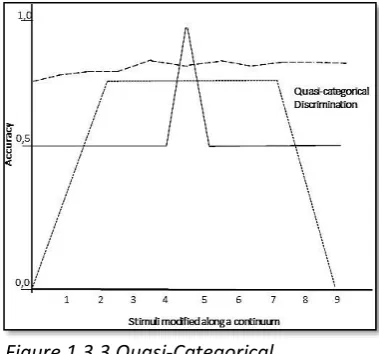
Continuous and Quasi-Categorical Perception... 55
The perception of prosodic categories: the special role of alignment ... 56
A cognitive interpretation of Categorical Perception of Alignment ... 60
On Phonetic Details and Exemplar Memory ... 64
Summary ... 66
1.4. Neuroscientific evidences and models of pitch perception ... 69
1.5. The Second Language Acquisition of speech categories: The challenge of modelling the acquisition of intonation. ... 75
Fundamental concepts in Second Language Acquisition ... 75
The acquisition of the L2 phonological system ... 81
Aspects of L2 acquisition of suprasegmental features ... 86
Studies on the perception of L2 intonation ... 88
7
1.6. Covariates, Individual differences & Language Aptitude ... 92
Cognitive factors ... 94
Pragmatic and social factors ... 98
The adopted Questionnaires as correlated measures ... 99
Three open questions in perception ... 101
The studies... 104
Chapter 2 The role of segments: ... 105
Categorically perceiving vs. Categorizing while perceiving ... 105
2.1. Outline ... 105
2.2. The categorical perception paradigm applied to linguistic intonation. Are Boundary Tones categorically perceived? ... 106
2.3. Categorizing and The Multistore Model of Memory ... 112
2.4. Experiment 1 ... 117
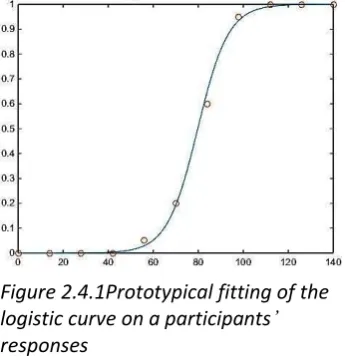
2.4.1. Logistic function and parameters of interest ... 119
2.4.2. Hypothesis ... 120
2.5. Method ... 123
2.5.1. Stimuli Elicitation and Recording ... 123
2.5.2. Real-words and Pseudo-words elicitation ... 123
2.5.3. Foreign Russian pseudo-word elicitation ... 124
2.5.4. Stimuli manipulation ... 124
2.5.5. Stimuli presentation ... 126
2.5.6. Participants ... 126
2.5.7. Procedure ... 127
2.6. Results ... 129
2.6.1. Excluded Participants ... 129
2.6.2. Descriptive Statistics ... 131
2.6.3. Word vs. Humming in sequences’ first position comparison ... 133
2.6.4. Correlations across conditions in the two sequences ... 134
2.6.5. Linear Mixed-effects Models (LMEMs) with 4 conditions ... 136
2.6.5. LMEMs of only linguistic segmental information (3 conditions) ... 141
2.6.6. Test – Retest phase’s Results ... 146
2.6.7. Correlated Measures of Individual Differences ... 150
2.7. Discussion ... 155
2.8. Conclusion ... 160
Chapter 3 Categorical Perception & Discrimination Threshold’s estimation ... 161
8
3.2. Method ... 163
3.2.1. Perceivers ... 163
3.2.2. Procedure ... 164
3.3. Results ... 165
3.3.1. Categorization Task – Results ... 166
3.3.2. Linear Mixed-effects Models (LMEMs) with 2 conditions ... 170
3.3.3. Correlated Measures of Individual Differences ... 171
3.3.4. Discrimination task - Results ... 173
3.3.5. Correlated Measures of Individual Variability and Discrimination’s thresholds ... 192
3.3.6. Clusters formation ... 195
3.3.7. Comparison of Threshold average values in Cluster1 and Cluster2 ... 199
3.4. Discussion ... 199
3.5. Conclusions ... 202
Chapter 4 The processing of German Pitch Accents by Italian learners of German ... 205
4.1. Outline ... 205
4.2. Introduction ... 206
4.3. Psychophysiological evidence about the integration of Intonation and accessibility of referents 208 4.4. Italian L2 learners of German ... 211
4.4.1. Specific predictions of the processing of the Deaccentuation condition in L2 ... 213
4.5. Differences in the implementation of the present study vs. Schumacher & Baumann (2010): A Contrastive Focus accent. ... 214
4.6. Focus-related ERP components ... 216
4.7. L1 vs. L2 processing of focused referents (interacting with referential givenness) ... 220
4.8. L2 Learners profile – internal vs. external factors affecting L2 perceptual processing. ... 221
4.9. Method ... 223
4.9.1. Material and Procedure ... 223
4.9.1. Preprocessing ... 224
4.9.2. L1 speakers ... 224
4.9.3. L2 speakers ... 224
4.10. Referring ERP response in the original study of Schumacher and Baumann (2010) ... 230
4.11. Results ... 231
4.11.1. Replication of Schumacher & Baumann (2010) ... 234
4.11.2. New Analysis with 3 time-windows: L1 and L2 processing ... 237
4.11.3. Discussion of group effects... 247
9
4.12.1. Results: ... 258
4.12.2. Cluster Formation ... 264
4.13. ERP – Deaccentuation wave in function of cluster’s structure. ... 267
4.13.1. Results of main factor PROSODY and lateral topographic distribution... 269
4.13.2. Pairwise Comparisons in 4 ROI for each cluster ... 269
4.13.3. Between clusters comparison of each condition ... 270
4.14. Discussion of the first cluster analysis – external factors and L2 prosody acquisition ... 272
4.15. Results of MFA of internal factors (AQ and IRI variables) ... 275
4.15.1. Cluster Formation ... 279
4.16. ERP - MFA of internal factors (AQ and IRI variables) ... 282
4.16.1. Analysis of effects within each cluster ... 282
4.16.2. Results of main factor PROSODY and lateral topographic distribution... 284
4.16.3. Between clusters comparison of each condition ... 286
4.17. Discussion of the cluster-analysis considering AQ and IRI variables ... 287
4.18. Final Cluster Formation: Easiness vs. Impairments in the L2 acquisition of prosodic marking 289 4.18.1. Results of the cluster analysis ... 289
4.18.2. Cluster Formation ... 293
4.18.3. Cluster’s descriptive analysis ... 295
4.19. ERP – Final Cluster ... 298
4.19.1. Results of main factor PROSODY and lateral topographic distribution... 299
4.20. Discussion of the final cluster comparison in the L2 sample ... 301
4.21. Conclusion ... 302
Summary and Conclusion of the thesis ... 305
References ... 311
10
List of Figures
Figure 1.1.1 Alternation of strong and weak syllables ... 22
Figure 1.1.2 Metrical structure of an IP ... 22
Figure 1.1.3 Pierrehumbert's tune-text association system ... 23
Figure 1.3.1 The warping of the perceptual space - adapted from(Kuhl, 1994, p.813) ... 51
Figure 1.3.2 Categorical and Continuous Identification and Discrimination ... 55
Figure 1.3.3 Quasi-Categorical discrimination ... 56
Figure 1.5.1 L1 vs. L2 alignment affecting the position of the perceived word-stress - adapted from Mennen (2007) ... 87
Figure 2.3.1 Multistore Model - adapted from Xu et al. (2006) ... 115
Figure 2.4.1Prototypical fitting of the logistic curve on a participants’ responses ... 119
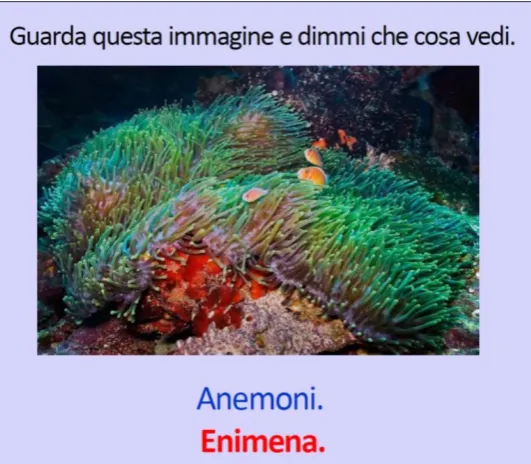
Figure 2.5.1 Example of the material used during the elicitation phase ... 123
Figure 2.5.2 Schematic representation of the generation of the 1000 artificial rising contours ... 125
Figure 2.5.3 Schematic representation of the alignment of the two categories’ prototypical contours . 125 Figure 2.5.4 Distributions of L2s spoken by participants in Sequence 1 and 2 ... 127
Figure 2.6.1 Distribution and Boxplot of LL values of 34 participants... 129
Figure 2.6.2 Excluded nsub14 ... 130
Figure 2.6.3 Excluded nsub27 ... 130
Figure 2.6.4 Excluded nsub31 ... 130
Figure 2.6.5 Excluded nsub32 ... 130
Figure 2.6.6 Excluded nsub36 ... 130
Figure 2.6.7 Slope values in Sequence 1 and 2 ... 131
Figure 2.6.8 Slope values in Sequence 1 and Sequence 2 ... 131
Figure 2.6.9 Midpoint values in Sequence 1 and 2... 132
Figure 2.6.10 Midpoint values in word and humming test conditions ... 133
Figure 2.6.11 Correlation of slope values in Sequence 1 and 2 ... 134
Figure 2.6.12 Correlation of midpoint values in Sequence 1 and 2 ... 135
Figure 2.6.13 Hierarchical analysis of AoV LMEMs ... 137
Figure 2.6.14 Longitudinal trends of slope values in sequence 1 and sequence 2, with and without humming conditions ... 144
Figure 2.6.15 Longitudinal trends of midpoint values in sequence 1 and sequence 2, with and without humming conditions ... 145
Figure 2.6.16 Correlation of slope values in Test-Retest comparison ... 147
Figure 2.6.17 Slope in word and humming conditions in Test-Retest comparisons ... 148
Figure 2.6.18 Midpoint in word and humming conditions in Test-Retest comparisons ... 148
Figure 2.6.19 PCA dimensions' proportion of explained variance ... 151
Figure 2.6.20 Significant correlations of PCA dimensions and fm3 model in sequence 1 ... 152
Figure 2.6.21 Significant correlations of PCA dimensions and fm3 model in sequence 2 ... 152
Figure 3.2.1 Distribution of CEFR's level in known L2 ... 163
Figure 3.3.1Distribution of LL values across conditions ... 166
Figure 3.3.2 LL distribution after outliers' removal ... 167
Figure 3.3.3 LM of slope and midpoint relation within category ... 168
Figure 3.3.4Slope and midpoint values in word and humming conditions ... 169
Figure 3.3.5 PCA ( = MFA) dimensions' proportion of explained variance ... 171
Figure 3.3.6 Longitudinal trend across conditions of slope and midpoint values ... 172
11
Figure 3.3.9 Distribution of threshold estimate values after outliers' removal ... 175
Figure 3.3.10 Threshold values in A M and Q points in word condition - not averaged ... 176
Figure 3.3.11 Threshold values in A M and Q points in humming condition - not averaged ... 177
Figure 3.3.12Thresholds in word vs. humming conditions ... 178
Figure 3.3.13 Normality check and mean thresholds aggregated in (A) (M) and (Q) in word condition .. 180
Figure 3.3.14 Normality check and mean thresholds aggregated in (A) (M) (Q) in humming condition .. 183
Figure 3.3.15 Mean thresholds aggregated per condition ... 183
Figure 3.3.16 Mean thresholds aggregated per category ... 184
Figure 3.3.17 LM of slope values and (M) mean threshold in word condition ... 185
Figure 3.3.18 Figure 3.3.17 LM of slope values and (M) mean threshold in humming condition ... 186
Figure 3.3.19 LM of midpoint values and (Q) mean threshold in word condition ... 187
Figure 3.3.20 LM of midpoint values and (M) mean threshold in humming condition ... 188
Figure 3.3.21 Single subjects thresholds trends in word condition ... 189
Figure 3.3.22 Single subjects thresholds trends in humming condition ... 189
Figure 3.3.23 Single subjects’ comparison of thresholds trends in word and humming condition (1) .... 190
Figure 3.3.24 Biplot of Dim2 and Dim3 of PCA of AQ and IRI variables ... 192
Figure 3.3.25 Composition of Dim2 and Dim3 ... 193
Figure 3.3.26 PT ... 194
Figure 3.3.27 PD ... 194
Figure 3.3.28 Att_Dett_30 ... 194
Figure 3.3.29 Sp_Att_30 ... 194
Figure 3.3.30 Communic_30... 195
Figure 3.3.31 Cluster formation on the basis of AQ and IRI variables ... 195
Figure 4.9.1 Distribution of spoken L2 ... 225
Figure 4.9.2 Competence in German... 225
Figure 4.9.3 Distribution of Age of First Immersion ... 227
Figure 4.9.4 Length of Immersion at the time of the Experiment... 227
Figure 4.9.5 Distribution of Tv-Movies exposure in German ... 228
Figure 4.9.6 Distribution of Hours of Radio per week in German L2 ... 228
Figure 4.10.1 Biphasic pattern (adapted from Baumann & Schumacher, 2010) ... 230
Figure 4.11.1 L1 German speakers ... 232
Figure 4.11.2 L2 German speaker (L1 Italian) ... 233
Figure 4.11.3 L1 results with new time-windows ... 242
Figure 4.11.4 L2 results with new time-windows ... 243
Figure 4.11.5 L1 results aggregated in 4 ROIs in new time-windows ... 244
Figure 4.11.6 L2 results aggregated in 4 ROIs in new time-windows ... 245
Figure 4.11.7 L1 vs. L2 Deaccentuation's un-subtracted waveforms in AR - ROI ... 246
Figure 4.11.8 L2 vs. L2 Deaccentuation's un-subtracted waveforms in PL - ROI ... 246
Figure 4.11.9 L1 vs. L2 Deaccentuation's un-subtracted waveforms in PR - ROI ... 246
Figure 4.11.10 Figure 4.10.11 L1 vs. L2 Contrastive condition's un-subtracted waveforms in PR - ROI ... 247
Figure 4.11.11 L1 vs. L2 Congruent-condition's un-subtracted waveforms in PR - ROI ... 247
Figure 4.12.1 Explained variance of MFA's dimensions ... 258
Figure 4.12.2 Groups distributions in the sample, according to group coordinates, selecting Dim1 and Dim5 ... 260
Figure 4.12.3 CEFR_GER_Oral_P ... 261
Figure 4.12.4 CEFR_GER_Listening ... 261
Figure 4.12.5 Tv_Hours ... 261
12
Figure 4.12.7 Speech_Training in University education ... 261
Figure 4.12.8Speech_Training in Free Time classes ... 261
Figure 4.12.9 Presence of a L1 instructor in University education ... 262
Figure 4.12.10 Presence of a L1 instructor in Free Time classes ... 262
Figure 4.12.11 Spoken_Language during immersion ... 262
Figure 4.12.12 Occupation during immersion ... 262
Figure 4.12.13 Immersion length at the time of the experiment ... 262
Figure 4.12.14 Years of University education specific for German L2 ... 262
Figure 4.12.15 Cluster formation on the basis of the Screening Questionnaire ... 264
Figure 4.13.1 4 ROI - Cluster 1 ... 267
Figure 4.13.2 4 ROI - Cluster 3 ... 268
Figure 4.13.3 4 ROI - Cluster 4 ... 268
Figure 4.13.4 Congruent condition un-subtracted waves of cl1 cl3 & cl4 ... 271
Figure 4.13.5 Figure 4.20.4 Contrastive condition un-subtracted waves of cl1 cl3 & cl4 ... 271
Figure 4.13.6 Figure 4.20.4 Deaccentuation condition un-subtracted waves of cl1 cl3 & cl4 ... 271
Figure 4.15.1Proportion of explained variance in the first 4 Dimensions (MFA analysis AQ-IRI) ... 275
Figure 4.15.2 Biplot of Squared-Cosine of AQ and IRI's variables in Dim1 and Dim2 ... 276
Figure 4.15.3 Squared cosine of quantitative variables in Dim2 ... 277
Figure 4.15.4 Squared cosine of quantitative variables in Dim1 ... 277
Figure 4.15.5 Gender ... 278
Figure 4.15.6 Age ... 278
Figure 4.15.7 EC ... 278
Figure 4.15.8 PD ... 278
Figure 4.15.9 Immag_30 ... 278
Figure 4.15.10 Att_Dett_39 ... 278
Figure 4.15.11 Cluster formation from MFA analysis of AQ & IRI variables ... 279
Figure 4.16.1 4 ROI - Cluster2 (MFA analysis of AQ & IRI's variables) ... 282
Figure 4.16.2 Cluster1 (MFA analysis of AQ & IRI's variables) ... 283
Figure 4.16.3 Cluster3 (MFA analysis of AQ & IRI's variables) ... 283
Figure 4.16.4 Congruent condition's AQ & IRI's Cluster1 and Cluster3 ... 286
Figure 4.16.5 Contrastive condition's AQ & IRI's Cluster1 and Cluster3 ... 286
Figure 4.16.6 Deaccentuation condition's AQ & IRI's Cluster1 and Cluster3 ... 286
Figure 4.18.1 Proportion of explained variance in final cluster analysis ... 289
Figure 4.18.2 Biplot of Dim1 and Dim2 (Final Cluster analysis) ... 290
Figure 4.18.3 Gender ... 291
Figure 4.18.4 Length of Immersion ... 291
Figure 4.18.5 Age of Acquisition ... 291
Figure 4.18.6 Age of 1st Immersion ... 291
Figure 4.18.7 PT ... 292
Figure 4.18.8 EC ... 292
Figure 4.18.9 Sp_Att ... 292
Figure 4.18.10 Att_Dett ... 292
Figure 4.18.11 Final Clusters ... 293
Figure 4.18.12 Age of 1st Immersion in Cluster1 and Cluster2 ... 296
Figure 4.18.13 Age of Acquisition in Cluster1 and Cluster2 ... 296
Figure 4.18.14 Att_Dett_30 in Cluster1 and Cluster2 ... 296
Figure 4.18.15 Sp_Att_30 in Cluster1 and Cluster2 ... 296
13
Figure 4.18.17 EC in Cluster1 and Cluster2 ... 296
Figure 4.19.1 4 ROIs in L1 speakers for final comparisons ... 298
Figure 4.19.2 Final Comparison - 4 ROIs of Talented L2 learners ... 298
14
List of Tables
Table 1.1.1 GToBI System ... 26
Table 1.1.2 PAs in ToBIt ... 28
Table 1.1.3 Edge Tones in ToBIt ... 29
Table 1.2.1 Whole-Part relationships - adapted from Winston, Chaffin, Hermann (1987) p.421 ... 35
Table 1.2.2 Results from Baumann & Grice (2006) ... 36
Table 1.2.3 Relational structures ... 38
Table 1.2.4 QUDs and Focus Types ... 39
Table 1.6.1 Relation between perception, motor-source and acoustical properties of the signal - adapted from Grice & Baumann, 2007; p. 27 ... 102
Table 2.4.1 Order of the experimental conditions in Sequence 1 ... 118
Table 2.4.2 Order of the experimental conditions in Sequence 2 ... 118
Table 2.6.1 Descriptive Stats of LL ... 129
Table 2.6.2 Calculation of the Tukey Limit ... 129
Table 2.6.3 Slope values in Sequence 1 ... 131
Table 2.6.4 Slope values in Sequence 2 ... 131
Table 2.6.5 Midpoint values in Sequence 1 ... 132
Table 2.6.6 Midpoint values in Sequence 2 ... 132
Table 2.6.7 Slope values comparison in first condition ... 133
Table 2.6.8 Midpoint values comparison in first condition ... 133
Table 2.6.9 Correlation of slope values in Sequence 1... 134
Table 2.6.10 Correlation of slope values in Sequence 2... 134
Table 2.6.11Correlation of midpoint values in Sequence 1 ... 135
Table 2.6.12Correlation of midpoint values in Sequence 2 ... 135
Table 2.6.13 LMEMs of slope values in Sequence 2 - selecting fm2 ... 138
Table 2.6.14 LMEMs of slope values in Sequence 2 - selecting m2 over fm2 ... 138
Table 2.6.15 LMEMs of slope values in Sequence 2 - selecting m2 over m3 ... 138
Table 2.6.16 LMEMs of slope values in Sequence 2 - selecting m2 over m0 ... 138
Table 2.6.17 LMEMs of midpoint values in Sequence 2 - selecting fm1 ... 139
Table 2.6.18 LMEMs of midpoint values in Sequence 2 - fm1 model ... 139
Table 2.6.19 LMEMs of midpoint values in Sequence 1 - selecting fm1 ... 141
Table 2.6.20 LMEMs of slope values in Sequence 2 - selecting fm1 over fm2 ... 141
Table 2.6.21 Table 2.6.20 LMEMs of slope values in Sequence 2 - selecting fm3 over fm1... 141
Table 2.6.22 Table 2.6.20 LMEMs of midpoint values in Sequence 2 - selecting fm1 ... 142
Table 2.6.23 Overall LMEMs selection ... 144
Table 2.6.24 Descriptive Statistics of Test-Retest comparison ... 146
Table 2.6.25 Correlation of slope and midpoint values in Test-Retest comparison ... 147
Table 2.6.26 Slope and midpoint t-test in Test-Retest comparison ... 149
Table 2.6.27 Principal Component Analysis of covariate measures ... 151
Table 2.6.28 Correlation of PCA dimensions with slope of the fm3 models ... 151
Table 2.6.29 Composition of PCA dimensions that significantly correlate with fm3 models ... 151
Table 3.3.1 Descriptive Statistics of LL values across conditions ... 166
Table 3.3.2 Calculation of the lower Tukey limit - criterion for outliers' removal ... 167
Table 3.3.3 Table 3.3.3Descriptive Statistics of slope values ... 168
Table 3.3.4 Descriptive statistics of midpoint values ... 168
Table 3.3.5 Correlation between slope and midpoint within category ... 168
15
Table 3.3.7 Correlations of slope and midpoint values across conditions ... 170
Table 3.3.8 LMEMs of slope - model selecting (m0) ... 170
Table 3.3.9 PCA dimensions ... 171
Table 3.3.10 LMEMs of slope - model selecting (fm1) ... 172
Table 3.3.11 Descriptive statistics after first data cleaning ... 174
Table 3.3.12 Calculation of the Tukey limits ... 174
Table 3.3.13 Descriptive stats of threshold estimates in A M e Q points ... 176
Table 3.3.14 Descriptive stats of threshold values in word condition - not averaged ... 176
Table 3.3.15 Descriptive stats of threshold values in humming condition - not averaged ... 177
Table 3.3.16 Descriptive stats of threshold values in word and humming conditions ... 178
Table 3.3.17 T-test of threshold values in word and humming conditions ... 178
Table 3.3.18 Post-hoc t-tests in word condition ... 181
Table 3.3.19 Post-hoc t-tests between categories between mean values independently from cond. ... 184
Table 3.3.20 LM of slope values and (M) mean threshold in word condition ... 186
Table 3.3.21 LM of slope values and (M) mean threshold in humming condition ... 186
Table 3.3.22 LM of midpoint values and (Q) mean threshold in word condition ... 187
Table 3.3.23 LM of midpoint values and (M) mean threshold in humming condition ... 188
Table 3.3.24 PCA dimensions ... 192
Table 3.3.25 Cluster 1 - Discrimination Threshold Exp ... 196
Table 3.3.26 Cluster 2 - Discrimination Threshold Exp ... 196
Table 3.3.27 Threshold values in Cluster1 ... 197
Table 3.3.28 Threshold values in Cluster2 ... 198
Table 4.11.1 Replication: Post - Hoc T-tests N400 window over the Midline in L1 German speakers ... 234
Table 4.11.2 Replication: Post - Hoc T-tests Late Pos window over the Midline in L1 German speakers .. 235
Table 4.11.3 Replication: Post - Hoc T-tests N400 window over the Lateral electrodes in L1 German speakers ... 235
Table 4.11.4 Table 4.10.3 Replication: Post - Hoc T-tests Late Pos window over the Lateral electrodes in L1 German speakers ... 235
Table 4.11.5 Table 4.10.4 Table 4.10.3 Replication: Post - Hoc T-tests Late Pos window in Anterior Left quarter in L1 German speakers ... 236
Table 4.11.6 New Analysis - New Late Pos window over frontal electrodes in L1 German speakers ... 238
Table 4.11.7 New Analysis – Post-Hoc T-tests - Late Pos window over posterior electrodes in L1 German speakers ... 239
Table 4.11.8 New Analysis - New Late Pos window over frontal electrodes in L2 German speakers ... 241
Table 4.11.9 New Analysis - New Late Pos window over posterior electrodes in L2 German speakers .... 241
Table 4.12.1 Proportion of exp. Var. of the first 5 Dim ... 258
Table 4.12.2 Contribution of each group to the first 5 dimensions (Dim 1 – Dim 3) ... 258
Table 4.12.3 Contribution of each group to the first 5 dimensions (Dim 4 & Dim 5) ... 259
Table 4.12.4 Squared Cosine of each group to the first 5 dimensions (Dim 1 – Dim 3) ... 259
Table 4.12.5 Squared Cosine of each group to the first 5 dimensions (Dim 4 & Dim 5) ... 259
Table 4.12.6 Clusters on the basis of Screening variables... 265
Table 4.15.1 Proportion of exp. Var. in the first 4 Dimensions (MFA analysis AQ-IRI) ... 275
Table 4.15.2 Group contribution in each Dimension (MFA analysis AQ-IRI) ... 275
Table 4.15.3 Squared - cosine of each Group in each Dimension (MFA analysis AQ-IRI) ... 275
Table 4.15.4 Clusters composition on the basis of the MFA analysis of AQ & IRI variables ... 280
Table 4.18.1 Proportion of explained variance in final cluster analysis ... 289
Table 4.18.2 Contribution of each group to each Dimension (Final Cluster analysis) ... 290
16
Table 4.18.4 Final Comparison - Cluster1 ... 294
Table 4.18.5 Final Comparison - Cluster2 ... 294
Table 4.18.6 Descriptive Statistics of the values of the most relevant variables in Final Cluster1 ... 295
17
Introduction and outline of the thesis
Pitch in language expresses both linguistic and paralinguistic functions, and it operates both at lexical and at sentence-level. At the lexical level, in tonal languages, pitch has a lexical function: it acts as a distinctive feature carrying information that is necessary to disambiguate homophonic lexical entries, and it allows to access one specific meaning. At the sentence-level, in intonational languages, pitch is one of the suprasegmental features that combine into a complex structure, allowing certain portions of speech to stand out within discourse and to change sentence modality. At the sentence-level, pitch also has a paralinguistic function, called "emotional prosody": the pitch range, together with intensity, the use of pauses and durations conveys to the listener the emotional state of the speaker. The combination of pragmatic and paralinguistic information allows disambiguating whether the speaker is serious, happy, or angry, and disentangles if the utterance has to be interpreted literally, sarcastically, or as a joke.
Pitch is defined as the perceptual correlate of the Fundamental Frequency (F0) within a complex sound wave. It is the perceptual sensation of a rising tone associated to the increase of F0, and the sensation of a lowering tone associated to the decrease of F0 (Raphael, Borden, & Harris, 1994). Apart from serving a linguistic function, it is primarily a perceptual dimension also belonging to the domain of music and singing. By observing the several pitch function and interpretations, it is fascinating to see how broad its area of application in communication is, and how large is the conceptual distance between each of these functions. At an abstract level, two F0 modulations could be processed as two different musical melodies, as two Chinese tones allowing to access either the meaning of the word “jade” (pinyin transcription: yù – 4th tone) or of the word “fish” (pinyin transcription: yú – 2nd tone), as a statement opposed to a question, as an emotional state having lost patience or being doubtful about a situation.
By focusing on the linguistic functions: what allows to switch from the auditory perception of a rising frequency, to the recognition of the word “fish” in Chinese, or to the decoding of the pragmatic instruction, conveying that the speaker terminated the conversational turn and waits for a reply – recognizing a question? In intonational languages, is the same rising movement undoubtedly a question for every speaker of a language? And if yes, what undoubtedly makes it a question? And across languages, when speakers acquire a second language (L2) later in life, is the pragmatic function of an F0 rise undoubtedly a question, if, for example, in the native language of the speaker, questions are uttered with a descending contour? Do speakers of different languages process an F0 rise and decode its pragmatic function in the same way? Pitch and intonation are a part of the phonological system that a learner needs to acquire when approaching an L2. The phonological aspects of the L2 are the aspects of Second Language Acquisition (SLA) that are more difficult to learn by late/adult learners. Moreover, their phonetic implementation in the L2 speaker's speech frequently allows a native speaker to recognize whether an L2 learner has a foreign accent. The deterministic linguistic approach assumes that, despite several years of training or exposure, almost no L2 late learner can ever reach a native-like mastering of the L2 phonologic segmental and suprasegmental features.
18
starting from perception - that allow these talented individuals to maintain the ability to acquire the sound properties of an L2 in adulthood.
Since the processing of intonation entails the ability: to appropriately integrate the acoustic features with word-meaning and with the syntactic structure of the utterance, and to deal appropriately with the exchange of information between interlocutors, a specific talent in the processing of intonation can be a signal of above-average skills in the processing of pragmatic aspects of language. A talent in processing L2 suprasegmental features in late learners can be a predictor of above-average abilities in pragmatic processing. Adopting a specular perspective, a particular deficit in the decoding of pragmatic aspects in language can be a predictor of non-efficient processing of intonation and construction of the discourse model. Aside from the possibilities of causal links between the two competencies, a correlation between pragmatic competence and talent in (L2) intonation processing can thus be hypothesized.
A population of interest, reported to show deficits in the decoding of pragmatic aspects of language, and that is often not included in the linguistic investigation, is the one affected by atypical development and diagnosed with Autism Spectrum Conditions (ASC). ASC are neurodevelopmental conditions that are characterized by social and communication difficulties, and by the presence of unusually narrow interests and stereotyped patterns of behavior, that include the resistance to change (APA, 1994; Ruta, Mazzone, Mazzone, Wheelwright, & Baron-Cohen, 2012). The variability with which cognitive and linguistic abilities vary in the population led to the notion of spectrum disorder. By adopting the notion of the spectrum, the population distributes ranging from people displaying normo-typical social and cognitive abilities, to individuals displaying atypical behavior. The disorder can be circumscribed to the social sphere, or in the extreme cases, it can also imply the presence of severe mental retardation (Rice, Warren, & Betz, 2005; Volkmar, Lord, Bailey, Schultz, & Klin, 2004).
These constructs, developed in the field of pathological conditions, are indeed a source of information for linguistic research. For example, the analysis of the deviating patterns in intonation is actually used as a diagnostic criterion in the clinical assessment of ASC (Diehl, Watson, Bennetto, McDonough, & Gunlogson, 2009; Le Couteur, Haden, Hammal, & McConachie, 2008; Lord et al., 2000; Rutter, Le Couteur, & Lord, 2003). Conversely, one can hypothesize that ASC traits or measures in the neurotypical population can be used as a possible predictor of talent or deficits in dealing with prosodic aspects of language that have essential roles in pragmatics.
These two groups of individuals, one showing exceptional talent in processing pitch and pragmatic functions, and on the other demonstrating an impairment, can be considered as two opposite tails of a single distribution, representing the ability to appropriately master the voice modulation to express linguistic and paralinguistic information in speech.
19
The main aim of this thesis is to investigate, in normo-typical adults, the relevant factors, allowing or impairing the correct pragmatic interpretation of pitch movement in discourse, in native and second language, and to consider the results in a broad perspective that overcomes strict monodisciplinary borders. This will be done in 3 experiments. Two psychophysical behavioral experiments are devoted to the study of pitch processing at a sensory level a third experiment will study how congruent and violating pitch movements are integrated within discourse, at a higher level, in L1 and L2, through the neurophysiological technique of Electroencephalography (EEG).
All 3 experiments manipulate pitch in relation to its pragmatic functions (question vs. statements disambiguation and information packaging at the discourse level), and all experiments manipulate pitch in function of the access to the meaning of the target elements to which it is aligned. How a non-native language impacts on pitch processing is central in Experiment 3, but it is present also in Experiment 1 as an intermediate experimental condition.
In all 3 experiments, the cognitive aspects at the individual level and related to the presence of an efficient or inefficient processing of the pragmatic functions linked to pitch modulation are captured by the adopted questionnaires: the Autism Spectrum Quotient (AQ) (Baron-Cohen et al., 2001) and the Interpersonal Reactivity Index (IRI) (Davis, 1983, Albiero et al.,2006). These two questionnaires are composed overall of 9 subscales (for a more extensive description of the scales see Paragraph 1.6.3.). These two scales have been chosen because they can grant a quantitative numerical measure of the individual traits of the participants considered relevant for the processing of the pragmatic function of speech and they provide a reference to what is recognized as atypical processing, belonging to the Autism Spectrum Conditions (ASC). In particular, two specific subscales of the AQ indicate the presence of atypical functioning of the attentional mechanisms. These measures will be used to study the presence of individual variability correlated with the efficient processing of pitch movements and their function in discourse.
One specific aim of the research is to try to adopt a multidisciplinary perspective, by giving similar weights to the different theoretical and experimental aspects involved in this research. This requires to consider the merits and limitations of assumptions coming from each of the presented areas and the implications they have on one another. On one side, the processing of intonation involves several levels of linguistic investigation, from phonetics to pragmatics, on the other side, pragmatics from a psychological perspective is observed and measured in terms of appropriate, typical and efficient social interactions between individuals. Pragmatics: is the ability to decode the interlocutors’ mental states (Theory of Mind - ToM), the ability to imagine and empathize with others’ conditions, the ability and to successfully and comfortably conduct a conversation. Impairments in the area of pragmatics, on the other hand: are related to the difficulty of decoding implicit and inferable information; are related to the higher allocation of attention on the details of the physical signal and difficulties in the understanding of the context of use; and are related to the feeling of distress in social situations.
20 The thesis is thus structured in the following way: Chapter 1 introduces:
• the Autosegmental Metric (AM) theory of intonation, which is adopted as the general theoretical framework, as well as the phonological inventories (ToBI systems) of the two languages under investigation (Italian and German);
• the notion of category and categorical perception and the evidence of its application in the field of intonation;
• the main concepts in the field of SLA, and how perception is known to vary in L2 when compared to native-language processing;
• the main evidence about individual variability and the adopted questionnaires.
Chapter 2 reports the first psychophysical experiment that specifically addresses the topic of Categorical Perception of Boundary Tones (BTs) in Italian. The presence of CP in intonation is controversial since there is evidence that at the same time supports it and dismisses it. The currently more supported position is that intonation is quasi-categorically perceived. I suggest that a relevant factor modulating perception from continuous to categorical is played by segmental and lexical aspects co-occurring with pitch and that, at a later stage, are integrated with pitch. The presence of categorical perception can be necessarily linked to the presence of specific segmental and lexical information, and the efficiency with which segmental and suprasegmental features are processed and integrated can vary across individuals – some decoding, more efficiently than others, the pragmatic function linked to the pitch movement. In this experiment the amount of information carried on by the segmental material is modulated in 4 levels, ranging from high to low recognizability. The experiment is performed in two experimental orders allowing to observe two perceptual strategies that normally are not observable in a CP paradigm, and that may be in my view relevant to disentangle whether pitch is linguistically processed or not.
Chapter 3 reports, by adopting only two experimental conditions of the previous experiment (highest and lowest linguistic recognizability of segments), the application of the full Categorical Perception (CP) paradigm to the perception of BTs. Concerning the original paradigm, I also introduced a different discrimination procedure that estimates the minimum perceptual threshold of pitch movements within and across prosodic categories with the aim to have a more fine-grained measure of individual sensitivity to small changes in tones.
21
Chapter 1
An intonational big picture
1.1.
A Phonological model to describe intonation
Autosegmental Metric theory of Intonation (AM) and the ToBI system
Pitch, as perceptual correlate of the Fundamental Frequency (F0), is a cue for both linguistic and paralinguistic information in speech. Its organization in each language gives rise, together with other phonetic parameters (e.g., intensity, duration, spectral information), to what it is referred to as the intonational system. Intonational phenomena belong to the suprasegmental features in speech. They, thus, set the constraints of the domain of interest at the sentence level.
In this thesis, intonation is described adopting the Autosegmental Metric theory of intonation (AM)(Bruce, 1977; Ladd, 1996, 2008; Liberman & Prince, 1977; Pierrehumbert, 1980). The AM approach allows analyzing the continuous variation of the F0 signal in discrete phonological representations. Within AM, intonation is a system always composed of two levels: the segmental and suprasegmental one, and by the rules that associate these two levels. F0 can be decomposed in phonological units only considering its association to the segmental level, which is metrically and hierarchically organized in prosodic units.
The F0 contour within the Pierrehumbert model is composed by a sequence of peaks and valleys corresponding to high (H) and low (L) level tones. Ramps and falls are labeled adopting a combination of the original level tones, creating bitonal units: from low to high (L + H) and from high to low (H+L).
The hierarchical organization of the segmental level has the syllable as its minimal unit, mandatorily composed of at least one vowel, and then it spans to the highest level comprehending the whole utterance, through the intermediate prosodic units: the foot, the phonological word, the intermediate phrase (ip) and the intonational phrase (IP)(Beckman & Pierrehumbert, 1986; Ladd, 1986). The original model of Pierrehumbert was strongly relying on the notion of foot which is the distance between one stressed syllable and the following one(Hayes, 1980; Selkirk, 1980). In the course of the years, different models of hierarchical structures have been proposed introducing further intermediate prosodic units 1. The phonological word is
a domain in which the intonational events can spread within the same lexeme across morphemes, including clitics (Hall, 1999). The intermediate phrase (ip), officially introduced by Beckman and Pierrehumbert (1986), refers to a prosodic unit larger than a phonological word but still dominated by the intonational phrase (IP). There are cases in which, an IP can be further subdivided into smaller units, but these smaller units are not delimited by long pauses and breaks, that usually delimit constituents at the higher IP level. Finally, the highest level of the hierarchy is represented by the whole utterance, that can correspond to an IP if uttered in one single prosodic unit.
The Intonational Phrase (IP) represents the typical domain of investigation of intonation. The criteria required for the identification of an IP are summarized by von Heusinger (1999, p. 72):
1) Timing: a pause can precede and follow an IP;
2) Metrical: marking, e.g., the position of the metrical head;
1 The definition of “intermediate phrase” is based on tonal properties only within Beckman & Pierrehumbert model,
22 3) Tonal: the presence of BTs.
4) Junctural: the boundaries of an IP can block junctural phenomena across prosodic units. 5) Syntactic-prosodic: the boundaries of an IP are mapped with the syntactic structure. 6) Semantic: the content of an IP must constitute a unit of sense.
The syllables within a prosodic unit do not have equal weight; on the contrary, within each multiword-unit, a single syllable always stressed at the word level, is metrically stronger becoming the metrical head of the prosodic unit.
In the original model, this relation is proposed as an alternation between strong (s) and weak (w) syllables across feet. The metrical head, thus, is the syllable marked as strong which is not dominated in the hierarchical structure by any other weak syllable (see an example adapted from Pierrehumbert, 1980, p.33 in Figure 1.1.1).
The resulting metrical structure of the IP in the example can be then finally formalized as in Figure 1.1.2:
Languages can differ in their positioning of the head of the prosodic unit. Some languages have the metrical-head on the right or on the left. In right-dominant languages, the metrical-head corresponds to the last stressed syllable on the right of the prosodic unit; vice-versa in left-dominant languages, the metrical head is positioned on the first stressed syllable of the prosodic unit.
The tune-text association is granted by the alignment of the F0 contour with the metrically organized segmental level generating a linear tonal structure of tonal events. Tones aligned to stressed syllables assume the status of Pitch Accents (PAs), PAs aligning to the metrical head represents the most prominent elements within the prosodic unit and are referred as Nuclear PAs (NPAs). Tones aligning to the edge of an intermediate prosodic unit (e.g., the intermediate phrase) are referred as Phrase Accents (PhAs), and tones aligning to the edges of the prosodic unit assume the status of Boundary Tones (BTs). A tune is therefore composed of at least one pitch accent, (in the case this is the only accent within a unit it can also assume the status of NPA), a phrase accent and a boundary tone.
Syllables that are pitch-accented acquire acoustical salience and, depending on the referring language system, they can be characterized by a longer duration. The perceived prominence of a specific syllable, within the AM system, therefore, is the combination of two separated independent tiers: pitch and stress. Overall the structure proposed by the AM theory is composed of 3 tiers: the segmental one, in which at least one vowel needs to serve as an anchor point; the tonal tier, where for each vowel there has to be at
23
least one tone; and the association tier that contains the mapping rules of tones and segments (Goldsmith, J., 1976).
The tune-text association is signaled in the transcription by specific labels.
The alignment of a tonal movement to a stressed syllable is marked with a * (star), the alignment with the edge of an intermediate prosodic unit with a dash (-), and the alignment with the edge of the utterance is marked with the symbol % as in figure 1.1.3 below, adapted from Pierrehumbert (1980, p. 29):
In Figure 1.1.3, it is reported the original phonological inventory of PAs, PhAs, and BTs proposed by Pierrehumbert (1980) for English. The labels H* and L* represent level tones, while the labels H*+L, H+L*, L*+H, L+H* and H*+H represent bitonal units. In addition, two phrase accents are present H- and L-, and two BTs: H% and L% signaling that utterance begins or end respectively with high or low tone.
The transcription of the intonational contour adopting AM has been then formalized with the Tone and Break Indexes (ToBI) system in the early 1990s. The ToBI system is conceived as a transcription containing several tiers of analysis, in which it is possible to annotate the speech's orthographic transcription and the suprasegmental events aligning with it. It combines the aspects strictly pertaining to the annotation of the intonational contour and the aspects pertaining to the prosodic organization of the segments, such as the marking of pauses and of the hierarchical structure. The ToBI system allows for a standardization of the inventory of PAs, PhAs, and BTs. The first ToBI system was specifically introduced to describe the phonological inventory of American English: the MAE ToBI (Mainstream American English ToBI). In this formalization, the original inventory proposed by Pierrehumbert is reduced to 5 PA types with the introduction of a diacritic symbol (!) marking the presence of downstep (Ladd, 2008). The concept of downstep was already present in the original Pierrehumbert system and accounts for a sequence of two H tones, where the second target shows to be lower than the first one but not labelable as L. The notion of downstep allows to account for declination effects along the utterance and local lowering phenomena, overcoming the limitations of strict binary classification. Only high tones, therefore, can be downstepped. The 5 PAs in the MAE ToBI are H*, L*, L+H*, L*+H, and H+!H*. The description of phrasing uses the original analogous marking of phrase accents and boundary tones proposed by Pierrehumbert (1990).
The hierarchical organization of prosodic constituents is then granted by the Break Index (BI) annotation that labels each orthographic words’ disjunction from 0 to 4.
Break Indices (Beckman & Elam, 1993; version 3.0 updated in 1997; p.31):
“represent a rating for the degree of juncture perceived between each pair of words and between the final word and the silence at the end of the utterance. They are to be marked after all words
24
that have been transcribed in the orthographic tier. All junctures — including those after fragments and filled pauses — must be assigned an explicit break index value; there is no default juncture type.”
Thus, the indices indicate the perceived separation between prosodic constituents from the word to the IP level. The indices that annotate the presence respectively of an ip and an IP are the ones labeled with the highest numbers (3) and (4). The lowest index (0) is rarely used, marking phenomena belonging to some specific types of speech, such as the broadcasting one, to indicate the presence of connected speech. The index (1) is the lowest level most commonly used, representing the "default" marking of word boundaries in phrase-medial position; and the index (2) is used to mark the presence of an incongruency between the presence of a perceived pause and the absence of a tonal event, which should typically be present.
The annotation of German intonation and the adoption of GToBI
Following the introduction of the AM approach and of the MAE ToBI system, different annotation systems have also been proposed for the transcription of German intonation. In the '90s both (Wunderlich, 1988) and (Uhmann, 1991) proposed their models. Wunderlich's model, despite adopting the main concept of AM (the distinction between a phonological abstract representation and a phonetic implementation) mainly focused on a phonological description. He proposed 6 accents: H*, H*HL* (bridge accent), %HL* (resembling the later introduced H+L*), L*H%, L* H (H%), H* H. The peculiar aspect of his system was the presence of 3 types of accent - PAs, BTs and non-BTs - and the formalization of phonological and binary oppositions pertaining the BTs. In his system, a BT could or could not be present, and could be either high or low. He also introduced the concept of markedness defining the BTs and non-BTs are low when unmarked and high when marked, and PAs are low when marked and high when unmarked.
Uhmann (1991) proposed a description with 4 PAs: H*+L, H*, L*+H, and L* and two BTs: H% and L%. BTs were assumed to have two levels also in offset of an IP, and the ip level was not represented. Since both Wunderlich and Uhmann models represented essential steps in the developing of a common standardized system of German intonation but are not the currently most adopted systems, the systems will not be further described here, but for a more detailed review, see (Grabe, 1998).
A comprehensive annotation system was followingly proposed by (Féry, 1993). In this work, intonation was also put into relation with pragmatic aspects of discourse, and information structure. In her system, she declares 3 NPAs: H* L, L* H, and L*HL, and no phrase accent is needed. Féry, (1993) proposed that pitch movements between the NPA and the BT could be accounted as trailing tones and were not necessary to describe the ip. BTs were present only in final position but not at the beginning of the IP, and a low BT was not necessary to be marked since the annotation of falling contours is already sufficient. (Féry, 1993)'s model also agreed with the studies of Kohler (1987, 1991) on Categorical Perception of alignment properties in intonation. In particular, she supported the evidence that the difference between an early and middle peak in a falling contour must be categorically perceived, while the difference between a middle and late contour must not. Kohler,(1987, 1991), in fact, introduced the notion of early peak for high modulations in pre-accentual position.
In 1995, the ToBI system was adapted to be suitable for the transcription of German intonation (Grice, Reyelt, Benzmuller, Mayer, & Batliner, 1996) with the name of GToBI.
25
information (originally taken from MAE ToBI system) which corresponds to intermediate and intonational phrase boundaries (3 e 4). The phonological inventory comprehends the 5 PAs formalized within the MAE ToBI: H*, L*, L+H*, L*+H, and H+!H* with the addition of the falling H+L* PA. Downstepping is also present with the analogous symbol ‘!' and it is also possible to mark upset with the symbol ^. Differently, from the ToBI developed for English, GToBI does not mandatorily require a PA within an ip, and contrary to (Féry, 1993) it marks phrase accents as either low or high L- and H-, and contrary to Grabe (1998) marks BTs as either low or high. PhAs and BTs can combine in final position to express final rises and final falls.
The system accounts for leading tones displaced before the accented syllable. A high tone preceding the accented syllable is considered an early peak and a valley forms with the following high tone a rising onglide. This description results in two possible annotations of early peaks: H+!H* and H+L*. The first one is the early peak described by Kohler and transcribed as H+H*+L by (Féry, 1993) and the second one corresponds to the contour that Grabe (1998) analyzes in her dissertation focusing on the effects of downstep.
The rising onglide L+H* is described as a pattern that jumps up (Fox, 1984; Grice, Baumann, & Benzmüller, 2006) to the high-level tone on the vowel of the accented syllable and that is perceived as higher than the pitch on preceding syllables.
26
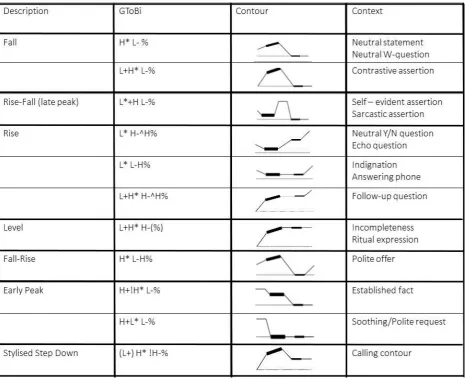
The following table reports the combination of PA, PhAs and BTs adapted from Grice et al. (2006).
Table 1.1.1 GToBI System
Grice et al. (1996) investigated the Inter-transcriber consistency in PA labeling in GToBI, finding a percentage of 71%. One-third of the disagreeing judgments pertained the labeling of L+H* and H*. In addition, the two accents happened to be merged in one representation in studies in English adopting the MAE ToBI.
The annotation of Italian intonation and the adoption of ToBIt
Italian intonation is part of a bigger and extremely complex picture which deals with the description of the Italian language's phonological representations and phonetic realizations. Italian spoken language has been subjected to the process of language evolution responsible of the formation of all Romance languages from a common Latin root and has been influenced during its evolution process from other languages (given the historical, cultural, and political situation of the Italian territories in those years). The way the spoken language evolved did not similarly and homogeneous affected the spoken language within the whole country. This evolution mechanism result is the presence on the territory of different linguistic systems, which qualify as dialects and some in cases as recognized minority languages, that formed both a substratum for the Florentine variety, from which the standard written national language developed, and parallelly nowadays coexists with it.
27
recent years, then, several studies annotated the intonational systems in different varieties (for a fully detailed review of the analyzed varieties see (Barbara Gili Fivela et al., 2015; Grice, D’Imperio, Savino, & Avesani, 2005; Savino, 2009, 2012) with the aim to develop a common inventory of PAs and BTs to allow for both: cross-variety comparison and generalization. (Janet Pierrehumbert & Hirschberg, 1990)
The Italian version of the ToBI system is labeled ToBIt and has been formalized by Avesani (1995). The original system is provided with 3 NPAs: two monotonal, H*, L*, and three bitonal, H+L*, L+H*, L*+H; and with the following combination of intermediate phrase accents and BTs: L- L%, H- H%, L- H%, H-L%.
The BT, in sentence-initial position, is described adopting only one tone (H%), and it is proposed as relevant phonological marking of exclamative utterances and opposed to initial non-marked initial pitch movements uttered within the non-marked pitch range of the utterance.
28
The diacritics: ‘<’ refers to late peaks, ‘>’ refers to early peaks, and ‘i’ refers to extremely high peaks.
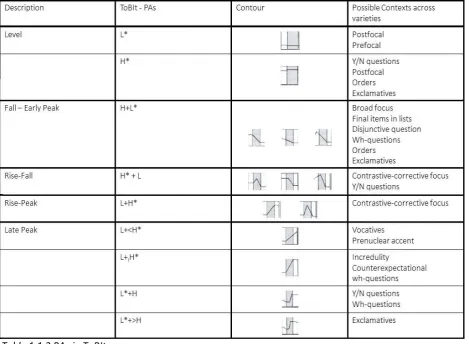
Since in this work I restrict the participants in two experiments to speakers coming from an area positioned at the north-east of the Garda lake in the north of Italy, and in one experiment investigating L2 acquisition I select participants ranging from north to southern areas, the specific phonological inventory of each variety and its phonetic implementation is not of specific interest. Nonetheless, the overall attested inventory of spoken Italian is relevant in order to set specific predictions in the CP experiments and for the cross-linguistic comparison involving perception in native and second language. Table 1.1.2 reports the phonological inventory of PAs in Italian across varieties (adapted from Gili Fivela et al. 2015)
29
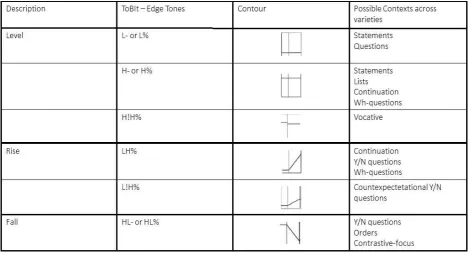
In the following Table 1.1.3, are reported the attested edge tones across varieties (adapted from Gili Fivela et al., 2015).
1.2.
How intonation maps with discourse information structure
In the following section, I describe how pitch modulation has been linked to specific functions in speech, before and after the adoption of the AM modeling. It is possible to address this topic focusing on two main perspectives: i) the fact that intonation is present in speech independently from the language of use; thus, it must have a universal function in oral communication, linked to biological features of the vocal tract; ii) the fact that languages can show typological differences that can be expressed at different levels (see Ladd, 1996; and Mennen 2015 in section 1.5.3.)
Before addressing the question of how intonational categories are processed and acquired in L2, it is relevant to address: i) which aspects of the mapping of pitch modulation with discourse information are language-dependent; ii) which aspects are shared by individual independently from typological differences and iii) what different theoretical models imply. I will in particular address the role of AM theory, that specifically positions its basic unit, the tone, and its combination in Pitch Accents, within the phonological domain, and I will address in detail the literature concerning the association between pitch modulation and discourse information structure in West-Germanic and Romance languages, since the focus will be in the next chapters on German and Italian.
30
Universal vs. linguo-specific function of intonational movements.
Before the development of the AM approach, the intonational contour was either considered a whole, inseparable unit - holistic approach (Bolinger, 1989) – or decomposable in smaller units, that, nonetheless, had only a phonemic value – e.g., British School (Crystal, 1969; Halliday, 1967). Within these two perspectives the meaning of an intonational contour was not the combination of smaller meaningful units (Bolinger, 1964; M. Y. Liberman, 1975), but rather a holistic concept expressing, for example, modality (M. Liberman & Sag, 1974; Sag & Liberman, 1975), and attitude and emotion (O’Connor & Arnold, 1973). These interpretations were based only on the assumption that intonation reflected a universalistic function guided by two mechanisms (Ladd, 1996): a pure biomechanical one (A. M. Liberman, Cooper, Shankweiler, & Studdert-Kennedy, 1967) and the assumption of the existence of a universal sound symbolism (Bolinger, 1978, 1989; Cruttenden, 1981).
According to the biomechanical perspective, the universal mechanism guiding the organization on intonation in prosodic constituents is constrained by the necessity of the speakers to breathe while producing speech. There appears to be a natural correspondence between prosodic units, representing a "breath group" and the conveying of meaning. An IP is an entity. The act of phonation itself reflects its dependence from breathing since the subglottal pressure is higher at the onset of a breath group, causing F0 to decline naturally – declination effect – along with an IP. In this sense, a decreasing pitch contour signals the non-marked end of a speech act and conveys finality. On the contrary, a final rise can be interpreted as a voluntary intention of the speaker to contrast the non-marked declining pattern, and therefore, it can be pragmatically interpreted as either: the intention to continue the speech, or the intention to pass the conversational turn to the interlocutor, as it happens in questions. In the same way, a local rise, or rise-fall within a prosodic unit, would represent a voluntary deviation from the declining natural pattern, and this, therefore, can be interpreted as a signal of relevance.
According to the second sound-symbolism perspective, apart from biomechanical reasons, high and low pitches oppose on the basis of an assumed prelinguistic meaning (Ladd, 1996). This approach comes at the end to interpretations that are similar to the ones based on the biomechanical approach, but the underlying reasons are different. In this perspective, high pitch signals incompleteness, tension and interest, and it is opposed to low pitch signaling, again, finality and completeness. In some cases, the difference in the explanation provided by the two approaches affects the interpretation assigned to specific tonal events. For example, a high Boundary Tone aligned in onset of an IP is explained referring to the higher subglottal pressure, adopting a biomechanical perspective, or referring to a prelinguistic intention to generate interest in the interlocutors, in the symbolistic one. Bolinger (in Ladd, 1996; p.114) defines 3 fundamental principles that according to his theory are common across languages:
1. The tendency of pitch to drop at the end of an utterance, and to rise at major breaks where the utterance remains incomplete;
2. The use of higher pitch in questions. Since in questions, the speaker expresses interest, and since the exchange is incomplete until the addressee answers;
3. The use of local pitch peaks on words of particular importance or newsworthiness in an utterance;
31
relation between intonation and the communicative function in language and, in addition, showed to have significant limits in the description of the organization of intonation across different languages.
Firstly, within each language, there is no 1-1 correspondence between contours and pragmatic functions. One contour can be associated with different contexts of use. Moreover, different "shades" of the same pragmatic interpretation can be expressed by qualitatively different contours. Secondly, the universal approach fails to explain why in some languages a final declining contour it is reported as a prosodic marking of polar questions (D’Imperio & House, 1997; Savino, 2012), violating the assumption that a declination always corresponds to the notion of finality and completeness. The rather intuitive association of the final rising movement with the turn-taking function in conversation is also probably not universal, or at least requires a further detailed description of phonetic implementation (often it appears that the final rise is somewhat shifted in an earlier position within the prosodic unit, e.g., D’Imperio & House, 1997).
Contrary to the holistic approaches to the intonation description, the AM approach assumes that the abstract tones also have the status of "morphemes." In this way, the meaning can be composed as the sum of smaller discrete units and, in the same way, the tune constitutes the combination of discrete phonological representations (von Heusinger, 1999).
The meaning of a tune can thus be conceived as a combination of PAs, PhAs, and BTs. The meaning of each single unit is related to the node of the prosodic hierarchy to which they are attached and therefore granted by the hierarchical organization of the phonological domain (Pierrehumbert & Hirschberg, 1990). The phonological domain and its association with text determine, therefore, the pragmatic function of the contour.
The open question remained, therefore, to disentangle which aspects are shared across languages, and what aspects are linguo-specific. This has been addressed by Gussenhoven (2002). In Gussenhoven perspective both the biomechanical aspects and the phonological representations belonging to the grammar of each different language converge in a complex picture. The investigation of intonational meaning has to consider both perspectives. The biomechanical approach is therefore reorganized in 3 mechanisms, that the author defines as "codes" and that are assumed to be related to the act of speaking, therefore valid across languages. The previously described constraints generated by the mechanical properties of the vocal tract and by the act of phonation, as well as the segmenting of speech in function of breath groups, belong to what Gussenhoven defines as the Production Code.
The Frequency Code is the description of the relationship existing between the dimension of the larynx and of the vocal tract, and the rate of vibration of the vocal chords. The larger is the dimension of the larynx and of the vocal chords, the slower they vibrate, resulting in an overall lower range of pitch modulation. The perception of overall higher voices' pitch ranges is, thus, associated to the presence of a speaker (or animal in animals' vocalizations), potentially, physically more powerful and aggressive than a speaker displaying overall a significantly higher pitch range. In human beings, this mechanism indicates for example whether the speaker is an infant, a young adolescent or an older person, and helps disambiguate female and male speakers (Ohala, 1994).
32
House, & Rietveld, 1997). The Effort Code plays a relevant role in the developing of models integrating the prosodic modulation with the information structure of discourse, that will be addressed in the section 1.2.2 and Chapter 4.
In Gussenhoven perspective, the 3 codes then have to deal with the grammatical organization of the phonological system in each language, and therefore they can be subverted if the specific grammar predicts it (e.g., conversational turn exchange through low Boundary Tones). According to Gussenhoven, thus, the property of discreteness is granted by the organization of pitch modulation in each language. Language grants to pitch the organization in discrete entities and systematization of meaning. Gussenhoven 2002, p. 2:
"Intonation is used to route the semantic contents of particular morpho-syntactic constituents to semantic categories of information status."
Adopting such a perspective, it is possible to investigate both:
• the structure of the discrete linguistic nature of an