R E S E A R C H
Open Access
Shape optimization of turbine blade cooling
system using topological sensitivity analysis
method
Emna Ghezaiel
1, Maatoug Hassine
2, Mohamed Abdelwahed
3*and Nejmeddine Chorfi
3*Correspondence:
3Department of Mathematics,
College of Sciences, King Saud University, Riyadh, Saudi Arabia Full list of author information is available at the end of the article
Abstract
The topological sensitivity analysis method gives the variation of a criterion with respect to the creation of a small hole in the domain. In this paper, we use this method to solve an inverse problem related to the turbine blade cooling. The aim is to optimize the hole characteristics created in the blade vane in order to improve the behavior of the cooling system. A topological optimization algorithm is proposed and some numerical results, showing the efficiency of our approach, are presented.
Keywords: Geometric inverse problem; Topological sensitivity analysis; Heat equation
1 Introduction
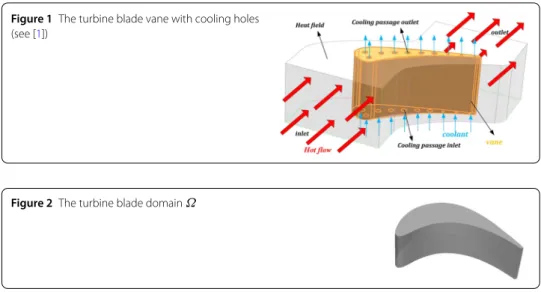
Modern gas turbine engines are designed to operate at high temperature (1200–1400◦C) to improve thermal efficiency and power output. The temperature variation within the blade material (which causes thermal stresses) must be limited in order to ensure a rea-sonable lifetime. Therefore, there is a need for an efficient cooling system. Discrete jet film is one of the techniques most used for protecting the blades. This process is achieved by injecting cooler air through discrete holes created in the blade vane (see Fig.1).
In order to improve the behavior of this cooling system, a considerable effort has been devoted to optimize size, location, and shape of the created holes. Various approaches and techniques have been developed and exploited to address this issue [1–3].
In this paper, we suggest a mathematical approach based on the topological sensitivity analysis method [4–11]. The main idea is to compute the asymptotic topological expan-sion with respect to the insertion of a small cooling hole.
This technique has been successfully used in different applications: identification of gas bubbles created during the mould filling process [12], optimization of injectors locations in water reservoirs [13], geometric control problem for fluid flow [14], etc.
However, most contributions have been limited to the steady state regime. In this pa-per, we exploit this idea for solving a time-dependent topological optimization problem associated with a parabolic partial differential equation.
The paper is organized as follows. We begin by the problem formulation in Sect.2. The topological sensitivity analysis method is introduced in Sect.3. The variation of the cost function with respect to a small topological perturbation of the domain is computed and
Figure 1The turbine blade vane with cooling holes (see [1])
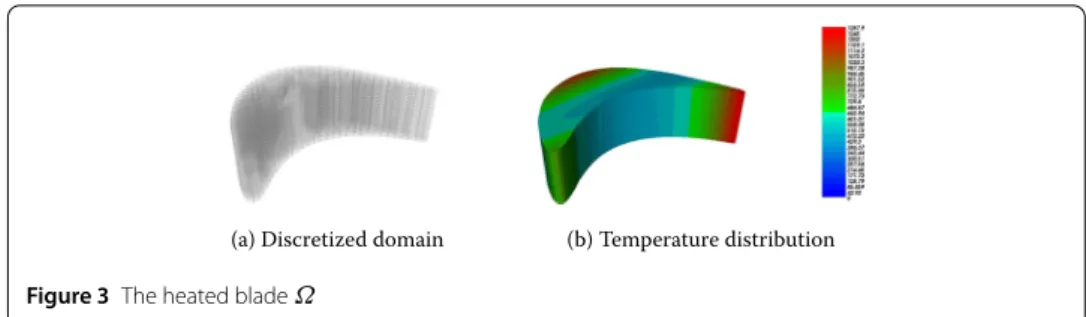
Figure 2The turbine blade domainΩ
an asymptotic expansion is presented. Based on the obtained theoretical results, we pro-pose in Sect.4a simple and efficient reconstruction procedure that we use for some nu-merical investigations.
2 Formulation of the problem
LetΩ⊂R3be the domain describing the turbine vane (see Fig.2). We denote by{H∗
k,k=
1, . . . ,m}the cooling holes to be created inΩ. The size, location, and shape of the un-known holesH∗k can be formulated as solution to the following topology optimization problem:
(P) min
H⊂Ωj(Ω\H).
Herejis a shape function measuring the temperature gradient, defined by
j(Ω\H) =
T
0
Ω\H
|∇θH|2dx dt,
whereθHis the temperature field solution to the following heat transfer problem:
⎧ ⎪ ⎪ ⎪ ⎪ ⎪ ⎨ ⎪ ⎪ ⎪ ⎪ ⎪ ⎩
∂θH
∂t –θH=Q inΩ\H×(0,T),
∇θH.n=gN on∂Ω×(0,T),
θH= 0 on∂H×(0,T),
θH(·, 0) =ϕ inΩ\H,
withQbeing a given source term,gN a heat flux, andϕthe initial temperature
distribu-tion.
3 Topological sensitivity analysis
We present in this section a topological sensitivity expansion of the design functionjwith respect to the insertion of a small cooling holeHz,εinside the domainΩ. We consider
– θ0to be the solution to the heat transfer problem in the nonperturbed domainΩ
⎧ ⎪ ⎪ ⎨ ⎪ ⎪ ⎩
∂θ0
∂t –θ0=Q inΩ×(0,T),
∇θ0.n=gN on∂Ω×(0,T),
θ0(·, 0) =ϕ inΩ.
(1)
– v0to be the solution to the associated adjoint problem
⎧ ⎪ ⎪ ⎨ ⎪ ⎪ ⎩
–∂∂v0t –v0= –DJ0(θ0) inΩ×(0,T),
∇v0.n= 0 on∂Ω×(0,T), v0(·,T) =ϕ inΩ,
(2)
whereJ0is a cost function defined onH1(Ω)by
J0(θ) =
Ω
|∇θ|2dx, ∀θ∈H1(Ω).
The shape functionjsatisfies the following theorem (see [15]).
Theorem 3.1 LetHz,ε=z+εHbe a small geometric perturbation inserted in the
back-ground domainΩ.The shape function j admits the following asymptotic expansion:
j(Ω\Hz,ε) =j(Ω) +εδj(z) +o(ε). (3)
Hereδj is the topological sensitivity function defined inΩby
δj(x) =
T
0
θ0(x,t)
v0(x,t) +θ0(x,t)
dt –
∂H
q(y)ds(y)
, ∀x∈Ω, (4)
where q∈H–1/2(∂H)solves the following boundary integral equation:
∂H
Γ(y–x)q(x)ds(x) = –1, ∀y∈∂H. (5)
In the particular case whereH=B(0, 1), we have
Corollary 3.2 IfHis the unit ball centered at the origin,then
∂H
q(y)ds(y) = –4π,
and we have
where
δj(x) = 4π T
0
θ0(x,t)
v0(x,t) +θ0(x,t)
dt, ∀x∈Ω,∀x∈Ω. (6)
4 Numerical results
In order to improve the behavior of the cooling system, we need to optimize the lo-cation and shape of the created cooling holes. The unknown cooling holes {H∗k,k= 1, . . . ,m} are likely to be created at zones where the topological sensitivity function δj is most negative. More precisely, each hole H∗k will be approximated by a level set curve of the scalar function δj. The main steps of our procedure are the follow-ing:
One-iteration algorithm:
• Solve problem (1) and its associated adjoint problem (2),
• Compute the topological sensitivity functionδj(x),∀x∈Ωdefined by (6), • Determineζ∗∈[0, 1]such thatj(Ω\Hζ∗)≤j(Ω\Hζ),∀ζ∈[0, 1], where
Hζ ={x∈Ω;δj(x) <ζ δmin}, withδminis the minimal value ofδjinΩ.
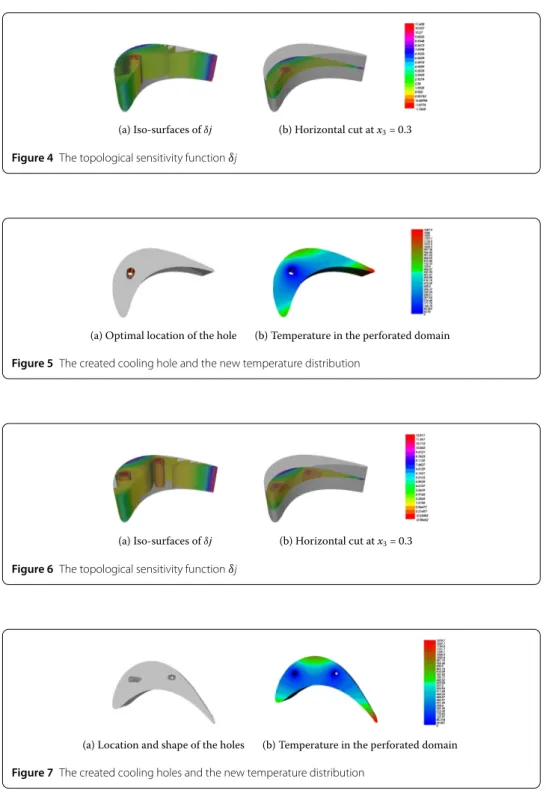
Next, we will present some numerical simulations using the proposed algorithm. The two problems are discretized using triangular mesh andP1finite element method [16] for the spacial variable. The temporal discretization is based on a finite difference approxima-tion method where the time computaapproxima-tional is given byT= 1. The numerical simulations are done using the free software FreeFem++ [17]. The initial computational domain is shown in Fig.2. The temperature distribution in the heated blade domainΩ is depicted in Fig.3. Next, we will present some numerical results. The first example is concerned with the creation of one cooling hole. Then, we present the case of two holes, and finally the case of multiple cooling holes.
4.1 Creating one cooling hole
The aim is to determine the best location to create a cooling hole that will reduce the tem-perature gradient as much as possible. The results of this test are summarized in Figs.4
and5. The iso-surfaces of the topological sensitivity functionδjand an horizontal cut of δjatx3= 0.3 are plotted in Fig.4. The created cooling hole and the new temperature dis-tribution in the perforated domain are illustrated in Fig.5. As one can observe, the hole is inserted at the zone where the topological sensitivity function is the most negative. We can see that the temperature distribution is reduced comparing with the initial temperature presented in Fig.3.
(a) Discretized domain (b) Temperature distribution
(a) Iso-surfaces ofδj (b) Horizontal cut atx3= 0.3
Figure 4The topological sensitivity functionδj
(a) Optimal location of the hole (b) Temperature in the perforated domain
Figure 5The created cooling hole and the new temperature distribution
(a) Iso-surfaces ofδj (b) Horizontal cut atx3= 0.3
Figure 6The topological sensitivity functionδj
(a) Location and shape of the holes (b) Temperature in the perforated domain
Figure 7The created cooling holes and the new temperature distribution
4.2 Creating two cooling holes
(a) Iso-surfaces ofδj (b) Horizontal cut atx3= 0.3
Figure 8The topological sensitivity functionδj
(a) Location and shape of the cooling holes (b) Temperature in the perforated domain
Figure 9The created cooling holes and the new temperature distribution
Table 1 The percentage of reduction after inserting the holes
Test cases Creating one hole Creating two holes Creating multiple holes
j(Ω) 1230 103 1230 103 1230 103
j(Ω\H) 753 103 639 103 438 103
Percentage of reduction 38% 48% 64%
4.3 Creating multiple cooling holes
This test is devoted to the creation of multiple cooling holes. In Fig.8, we present the iso-surfaces of the topological sensitivity function. As one can observe, the functionδjadmits five negative local minima{zk, 1≤k≤5}inside the domainΩ. We will create a holeHk
around each pointzk. The shape and size of the holesHk, 1≤k≤5 are defined by a level
set curve of the functionδj
Hk=
x∈Ω;δj(x)≤ck
,
whereckis chosen in such away that the shape functionjdecreases as much as possible.
In Fig.9, we present the obtained location of the cooling holes and the new temperature distribution in the perforated domain.
4.4 Optimization quality
Finally, in order to show the effects of the created holes on the behavior of the cooling system, we summarize in Table 1the percentage of reduction of the cost function ob-tained after inserting the holes in the studied cases. This shows the efficiency of the used approach.
5 Conclusion
variation of the domain. A fast and accurate algorithm is proposed for creating cooling holes in the blade vane. The presented numerical simulations show the efficiency of the suggested approach.
Acknowledgements
The authors would like to extend their sincere appreciation to the Deanship of Scientific Research at King Saud University for funding this Research group No (RG-1435-026).
Funding
Not applicable.
Availability of data and materials
Not applicable.
Competing interests
The authors declare that they have no competing interests.
Authors’ contributions
The authors declare that the study was realized in collaboration with equal responsibility. All authors read and approved the final manuscript.
Author details
1ESSTHS, Sousse University, Sousse, Tunisia.2Department of Mathematics, Faculty of Sciences, Monastir University,
Monastir, Tunisia.3Department of Mathematics, College of Sciences, King Saud University, Riyadh, Saudi Arabia.
Publisher’s Note
Springer Nature remains neutral with regard to jurisdictional claims in published maps and institutional affiliations.
Received: 19 July 2019 Accepted: 15 October 2019 References
1. Wang, B., Zhang, W., Xie, G., Xu, Y., Xiao, M.: Multiconfiguration shape optimization of internal cooling systems of a turbine guide vane based on thermomechanical and conjugate heat transfer analysis. J. Heat Transf.137(6), 1–8 (2015)
2. Dulikravich, G., Martin, T.: Determination of void shapes, sizes, numbers and locations inside an object with known surface temperatures and heat fluxes. In: TanakaHuy, M., Bui, D. (eds.) Inverse Problems in Engineering Mechanics, pp. 489–496. Springer, Berlin (1992)
3. Kennon, S.R., Dulikravich, G.S.: Inverse design of multiholed internally cooled turbine blades. Int. J. Numer. Methods Eng.22(2), 363–375 (1986)
4. Abdelwahed, M., Chorfi, N., Malek, R.: Reconstruction of Tesla micro-valve using topological sensitivity analysis. Adv. Nonlinear Anal.9(1), 567–590 (2020)
5. Abdelwahed, M., Hassine, M.: Topological optimization method for a geometric control problem in Stokes flow. Appl. Numer. Math.59(8), 1823–1838 (2009)
6. Allaire, G., Jouve, F., Toader, A.M.: Structural optimization using sensitivity analysis and a level-set method. J. Comput. Phys.194(1), 363–393 (2004)
7. Belaid, L., Jaoua, M., Masmoud, M., Siala, L.: Image restoration and edge detection by topological asymptotic expansion. C. R. Math.342(5), 313–318 (2006)
8. Bonnet, M.: Topological sensitivity for 3D elastodynamic and acoustic inverse scattering in the time domain. Comput. Methods Appl. Mech. Eng.195(37), 5239–5254 (2006)
9. Guillaume, P., Idris, K.S.: The topological asymptotic expansion for the Dirichlet problem. SIAM J. Control Optim.41(4), 1042–1072 (2002)
10. Amstutz, S., Takahashi, T., Vexler, B.: Topological sensitivity analysis for time-dependent problems. ESAIM Control Optim. Calc. Var.14(3), 427–455 (2008)
11. Garreau, S., Guillaume, P., Masmoudi, M.: He topological asymptotic for PDE systems: the elasticity case. SIAM J. Control Optim.39(6), 1756–1778 (2001)
12. Benabda, A., Hassine, M., Jaoua, M., Masmoudi, M.: Topological sensitivity analysis for the location of small cavities in Stokes flow. SIAM J. Control Optim.48(5), 2871–2900 (2009)
13. Abdelwahed, M., Hassine, M., Masmoudi, M.: Control of a mechanical aeration process via topological sensitivity analysis. J. Comput. Appl. Math.228(1), 480–485 (2009)
14. Abdelwahed, M., Hassine, M., Masmoudi, M.: Optimal shape design for fluid flow using topological perturbation technique. J. Math. Anal. Appl.356(2), 548–563 (2009)
15. Ghezaiel, E., Hassine, M., Abdelwahed, M., Chorfi, N.: Topological sensitivity analysis for a parabolic type problem. Math. Methods Appl. Sci. (2019)
16. Girault, V., Raviart, P.-A.: Finite Element Methods for Navier–Stokes Equations, Theory and Algorithms. Springer, Paris (1987)