Testing of catchment module of integrated reservoir-based
canal irrigation model for kangsabati irrigation project
P. M. Dhage*, A. Bhadra, N. S. Raghuwanshi and R. Singh
Department of Agricultural and Food Engineering, Indian Institute of Technology, Kharagpur-721 302, West Bengal, India *Corresponding author: [email protected]
Paper No. 276 Received: 21 May, 2014 Accepted: 16 October, 2014 Published: 17 December, 2014
Abstract
Bhadra, (2007) developed Integrated reservoir based canal irrigation model (IRCIM). It consist of catchment, reservoir, crop water demand modules. In this study, IRCIM was applied on Kangsabati irrigation project, West Bengal, India for period of 1998 to 2003. Runoff was predicted using two techniques namely, Distributed SCS Curve Number (CN) with Muskingum routing and Artificial Neural Network (ANN) Backpropogation techniques available in catchment module. Distributed SCS CN method requires subbasin information, land cover characteristics, overland and channel information and daily rainfall on subbasin, whereas ANN method requires daily rainfall and runoff values. Catchment module was calibrated and validated using performance criteria modelling efficiency (ME) and coefficient of residual mass (CRM). ANN technique of runoff prediction involves extensive training of the network, where the unpredictable correlation of rainfall and runoff is also been taken into consideration which is not possible for conceptual model such as SCS CN method. Thus, results showed that for Kangsabati reservoir catchment, runoff values, predicted using ANN result in better match with observed runoff values compared to semi-distributed conceptual SCS CN method.
Highlights
Runoff prediction by Empirical method ANN with Levenberg-Marquardt algorithm more accurate than Physical based distributed (GIS-based SCS CN method with muskingum routing)
Keywords: Integrated reservoir-based canal irrigation model, artificial neural network, levenberg-marquardt, SCS curve number.
In India, the distribution of water resources is highly uneven over both space and time. A fierce competition for water among the urban, industrial, agricultural and environmental users has begun. Although, there is increasing demand for food to feed the expanding population, less water is available for boosting the agricultural production. Further, investment constraints and environmental issues limit irrigation expansion, thus it is essential to improve the performance of the surface irrigation which operate at low overall efficiency of 33%
(Kumar and Senseba, 2008). The land eventually irrigated is often less than planned and crop yields are not as high as expected. As a consequence, the irrigation sector has to become more efficient to produce more per unit of water. However, water management in major irrigation projects is a complex issue as it involves reservoir catchment, reservoir, canal network hydraulics and command area hydrology. The mathematical models can help in better decision making to operate irrigation project more efficiently.
A number of models have been developed by various researchers for runoff prediction using SCS method (Hawkins, 1993; Hamer et al., 2007 and Qui et al., 2014) with Muskingum routing technique (Gelegenis and Serrano, 2000) and by using back propagation artificial neural network (Jain et al., 1999; Raghuwanshi et al.,
2006; Vivekanandan, 2011; Phukoetphim et al., 2014 and Vafakhah et al., 2014). Several models have been developed for reservoir operation (HEC, 1971; Tu et al.,
2003; Ganji et al., 2007; Talukdar et al., 2011 and Guo et al., 2014), crop water demand calculation (Rowshon et al., 2009; George et al., 2011; Hlavinka et al., 2011 and Sakaguchi et al., 2014), and for canal flow simulation: Merkely (1995) reported a hydraulic simulation model CANALMAN (Canal Management) for unsteady flow simulation in branching canal networks. Shende et al. (2005) developed model for irrigation canal network with object oriented approach. The model solves the hydrostatic Saint Venant equations using an explicit Finite volume method with a Godunov-type high resolution shock capturing technique. Islam et al. (2008) developed a canal hydraulic simulation model ‘CanalMod’ that can simulate both steady flow and unsteady flow. Bautista et al. (2009) developed an unsteady flow hydraulic model WinSRFR for analyzing surface irrigation systems. The model was developed to analyze performance of irrigation events to formulate design and operational alternatives through simulation studies using an unsteady one-dimensional flow model. Lozano et al. (2012) used the unsteady state Simulation of Irrigation Canal (SIC) model to investigate the influence of roughness on the performance of an irrigation canal in Spain. These models work independently and interlinking them is quite a difficult task. It involves setup, calibration and validation of all the models separately and formatting of one model’s output to use it as input to other model. The entire process becomes time consuming and tedious as one faces many difficulties like, repetitive data entry, different modelling approach, incompatible data format, varied time scale, etc. Over the years some attempts have been made to combine the hydraulic-hydrologic simulations of canal-command for efficient irrigation water management,
one in Mahanadi Reservoir Irrigation Scheme (Singh
et al., 1997) and the other in Right Bank Main Canal
(RBMC) of Kangsabati Irrigation Project, West Bengal (Mishra et al., 2005). Both studies, however, did not take into account reservoir component. Rowshon et al. (2009) developed a Rice Irrigation Management Information System (RIMIS) for analyzing different scenarios of the water allocation with changes in canal inflows, rainfall, crop evapotranspiration and irrigation efficiency. Hajilal et al. (1998a and b) though incorporated a reservoir component in a similar study in Jayakwadi Irrigation Project, Maharashtra; they did not consider reservoir catchment hydrology. To overcome these limitations of the existing models, Bhadra et al. (2009a) developed an Integrated Reservoir Canal Irrigation Model (IRCIM) by integrating all the components (catchment, reservoir, canal and command) responsible for the efficient management of reservoir-based irrigation projects. The aim of the present study is to test the runoff prediction performance of the SCS curve number and ANN based techniques, which are available in the catchment module of the IRCIM. The present study is carried out for the Kangsabati irrigation project, West Bengal. Kangsabati irrigation project acts as the lifeline for the predominantly rice based agrarian economy of Bankura, Midnapore and Hoogly districts of West Bengal.
Study Area and Data
at the head regulator of RBMC system, LBFC system and the spillway of the Kangsabati dam are 79.10, 199.55 and 6372 m3/sec, respectively.
Daily rainfall data of six years (1998-2003) measured at five rain-guage stations in Kangsabati reservoir catchment, namely, Kangsabati Dam, Rangagora, Khariduar, Tusama and Simulia were collected from Central Water Commission, Asansol, Ministry of Water Resources, Govt. of India. The toposheet of Kangsabati catchment, land use classification map and soil map were available in the Agricultural and Food Engineering Department, IIT Kharagpur, from previous study. General characteristic curves, such as stage-area curve, stage-volume curve of the Kangsabati reservoir; dead storage level; full storage level; daily flow releases at head regulators of RBMC and LBFC; spillway discharges as downstream flow from reservoir and daily inflow to the reservoir from the catchment were collected for the period of six years (1998-2003) from the Office of the Superintending Engineer, Irrigation and Waterways Department, Bankura, Govt. of West Bengal. In addition, canal network information was also collected. Seepage loss rate in the canal and value of field application efficiency were taken from the Water and Power Consultancy Services (India) Ltd. report (WAPCOS, 2003). Daily rainfall, pan evaporation, maximum temperature, minimum temperature, average relative humidity, sunshine hour and wind speed data of Susunia farm of Bankura, Jhargram and Kharagpur were collected for the same 6 years period (1998-2003) from the Department of Agriculture, Govt. of West Bengal. Kharif and rabi crop data were obtained from the Water and Power Consultancy Services (India) Ltd. report (WAPCOS, 2003).
In the Kangsabati irrigation project, a variable discharge, variable duration and variable frequency delivery scheduling is practiced. On an average, four irrigations are provided in each cropping season (kharif and rabi). Here, an irrigation represents canal water supply over 10 to 15 days, followed by an equal or longer duration of canal closure. The duration and frequency of irrigation are decided jointly by the official of Irrigation and Waterways Department
and Agriculture Department, Government of West Bengal.
Brief Description of IRCIM
postseason evaluation of the irrigation system, using performance indicators like adequacy, equity, and dependability.
The front end of the IRCIM was developed in Visual Basic 6.0 and the back end coding was done in C language. Required input files were created by VB and saved in a particular project folder. During run time, the required program (C executable) is called through Shellexecute function. The Graphical User Interface (GUI) is the most important feature of the model as it provides a better interaction between the model and its user. It is based on a mouse-driven approach with pop-up windows, pull-down menus and button controls. The reservoir and crop water demand modules can be operated independently or these can be simulated together under the irrigation management system.
Methodology
IRCIM consists of mainly three modules; namely, catchment, reservoir and crop water demand module. Irrigation management system is the core of IRCIM which control the operations among these three modules.
In the catchment module of IRCIM, runoff from reservoir catchment can be predicted by using either the SCS curve number (CN method, SCS 1967) combined with the Muskingum routing technique (Neitsch et al., 2002) or the artificial neural network (ANN) technique using the Levenberg–Marquardt algorithm, depending on the data availability. Bhadra et al. (2009b) delineated sub-basins; and extracted basin and reach parameters from DEM of the Kangsabati catchment area. Those values were used as input to IRCIM to predict the runoff from the watershed using distributed curve number method. The catchment has five raingauge stations (Kangsabati Dam, Rangagora, Kharidwar, Tusama and Simulia) and the area corresponding to each station was determined using the Thiessen polygon method. The number of subbasins under each rain gauge was determined by overlaying the Thiessen polygon map over the delineated watershed map in a geographical information system (GIS) environment.
Land use and soil type of each land cover of the subbasins were determined by overlaying the land use classification map and the soil map over the delineated watershed map.
To predict the runoff using the SCS CN technique, the model needs to be calibrated to determine correct combination of seven calibration parameters within the specified range. These calibration parameter are Manning’s n for longest path in sub-basin (0.025 - 0.1); Manning’s n for overland flow in sub-basin (0.01 - 0.4); Manning’s n for reach (0.025 - 0.1); initial abstraction coefficient (0.1 - 0.3); weighting factor, X, for Muskingum routing (0 - 0.3) and Muskingum routing coefficients, coef1 (0 - 1.5) and coef2 (0 - 1.5). For calibration, rainfall-runoff data of three successive years (1998 - 2000) were used. The best combination was chosen on the basis of two performance indicators, namely, Modelling Efficiency (ME) and Coefficient of Residual mass (CRM). For the perfect model values of ME and CRM should be closer to 1 and 0, respectively. The validation was done for the period of three years (2001 - 2003) using average values of all seven calibrated parameters.
hidden layers for 5 simulation cycles to obtain the best network architecture. One of these three parameters was varied at a time while keeping others constant. The training process was terminated when one of the two criteria was fulfilled, i.e., either the error reduced below a given error tolerance (0.001-100.0) or the number of training cycles reached maximum limit. Subsequently, that best network was trained for different number (5, 10, 15 and 20) of training cycles to find out the optimum number of training cycles. The training of neural networks for rainfall-runoff modelling was performed for successive 3 years (1998-2000), whereas testing was performed for years 2001 to 2003, using the Levenberg-Marquardt algorithm technique.
Performance measures
Performance of catchment module is evaluated using two dimensionless statistical performance criteria viz., Modelling Efficiency (ME) and Coefficient of Residual Mass (CRM). The modeling efficiency (ME) is estimated using the following equation:
(
)
(
)
(
)
d d
n 2 n 2
v
v,i v,i v,i
i=1 i=1
n 2
v v,i i=1
O - O
-
P - O
ME =
O - O
∑
∑
∑
(1) Where, Pv,i = predicted or simulated value; Ov,i = observed value;
O
v = average observed value and nd = number of data used for evaluation.Table 1. Calibration parameters for SCS CN method
Year ‘n’ for longest path of sub-basin flow of sub-basin‘n’ for overland reachn for Ia X coef1 coef2
1998 0.075 0.01 0.05 0.2S 0.2 0.5 0.6
1999 0.075 0.01 0.05 0.2S 0.2 0.8 0.4
2000 0.075 0.01 0.05 0.3S 0.1 0.9 1.1
Table 2. Comparison among the networks for same number of cycles
Cases Network hidden layerNumber of Number of cycles ME CRM
1. Varying number of input neurons for same number of hidden neurons and hidden layers
5-20-1 1 5 0.27 0.12
10-20-1 1 5 0.50 -0.13
15-20-1 1 5 0.87 -0.01
20-20-1 1 5 0.94 -0.05
25-20-1 1 5 0.43 -0.56
30-20-1 1 5 0.60 -0.52
2. Varying number of hidden neurons for same number of input neurons and hidden layers
20-5-1 1 5 0.12 0.09
20-10-1 1 5 0.58 -0.41
20-15-1 1 5 0.76 0.08
20-20-1 1 5 0.94 -0.05
20-25-1 1 5 0.58 -0.17
20-30-1 1 5 0.93 -0.32
3. Varying hidden layers for same number of input and hidden neurons
20-20-1 1 5 0.94 -0.05
The coefficient of residual mass (CRM) is estimated using the following equation:
d d
d
n n
v,i v,i i=1 i=1
n v,i i=1
O -
P
CRM =
O
∑
∑
∑
(2) This criterion indicates the overall under- or over-estimation of the observed value. For a perfect model, the value of CRM is zero. A positive value of CRM indicates the tendency of the model to underestimate, whereas a negative value indicates a tendency to overestimate the observed data.
Results and Discussion
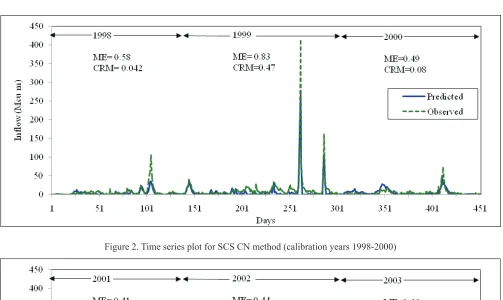
In SCS method, for all three calibration years, best results were obtained for Manning’s n for longest path in sub-basin (Nch) = 0.075; Manning’s n for overland flow in sub-basin (Nov) = 0.01; and Manning’s n for reach (Nrch) = 0.05 (Table 1). These calibrated Manning’s n values satisfactorily represented the existing characteristics of sub-basins and reaches of the study area. The values of other calibration parameters however varied from year to year. Figure 2 shows that predicted inflow is matching well with observed inflow in peak and off peak period for most of the calibration years (1998-2000). Using average calibrated values of all seven parameters, model was validated for years 2001, 2002 and 2003 (Figure 3). During validation, ME value is as high as 0.46 and CRM as low as 0.04, which are quite acceptable. However, all the positive CRM values indicate that the model is under-predicting runoff or reservoir inflow.
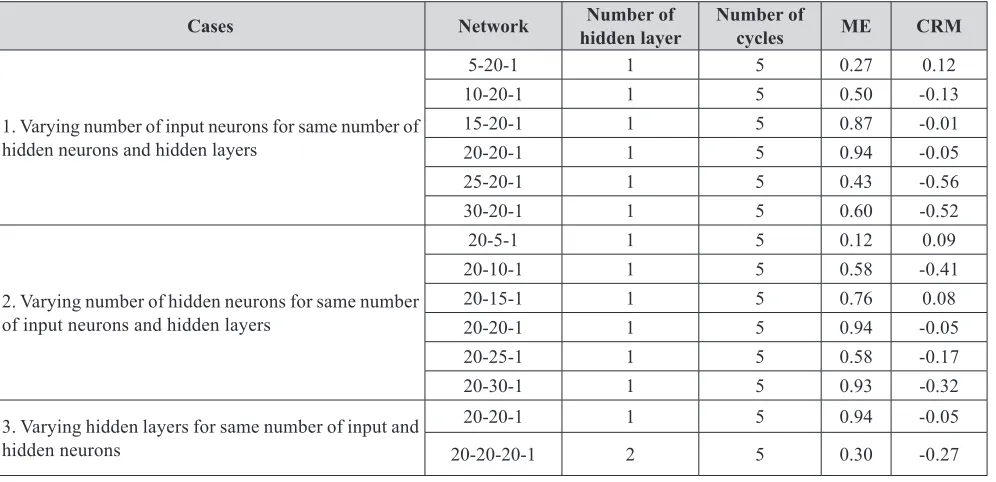
In ANN technique, Table 2 presents set of results for each of the three cases viz., varying either number of input neurons or hidden neurons or hidden layers while keeping other two parameters constant. The other two constant parameters in each of these three above cases were kept at their best-network value. The model performance improved with increase in input neurons (20) and number of hidden neurons (20) up to a limit and therefore after it varied. The
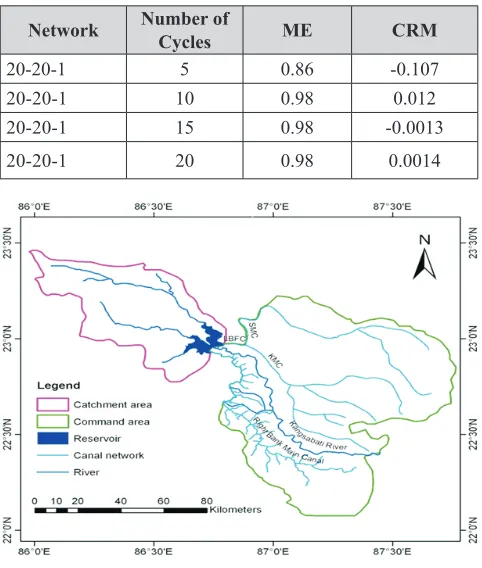
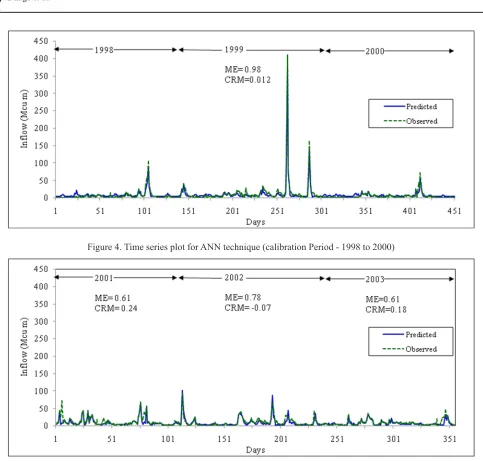
network 20-20-1 (20 input neurons to consider past three days rainfall data in addition to present day rainfall data of five rain-gauge stations, and 20 hidden neurons in a single hidden layer) for 10 simulation cycles performed the best after training (Table 3). Time series plot of observed and predicted runoff for the calibration period of 1998 to 2000 using the selected network 20-20-1 is shown in Figure 4. It can be seen from the figure that there is a very good agreement between the observed and predicted runoffs for both peaks and off-peak periods. ANN module was validated for the monsoon season of years 2001, 2002, and 2003 (Figure 5). In the validation years, ME range from 0.61 to 0.78 and CRM from -0.07 to 0.24 as shown in Figure 5.
Table 3. Comparison among the networks for the different number of cycles
Network Number of Cycles ME CRM
20-20-1 5 0.86 -0.107
20-20-1 10 0.98 0.012
20-20-1 15 0.98 -0.0013
20-20-1 20 0.98 0.0014
Figure 2. Time series plot for SCS CN method (calibration years 1998-2000)
Figure 4.Time series plot for ANN technique (calibration Period - 1998 to 2000)
Figure 5.Time series plot for ANN technique (validation years 2001-2003)
From validation results, it is evident that ANN technique predicted daily runoff values more accurately compared to SCS CN method. Because, for the same length of rainfall-runoff dataset, ANN technique of runoff prediction involves extensive training of the network, where the unpredictable correlation of rainfall and runoff is also been taken into consideration which is not possible for conceptual model such as SCS CN method.
Thus, runoff values, predicted using ANN model, resulted in better match with observed runoff values compared to the semi distributed conceptual SCS CN model.
Summary and Conclusion
catchment module, reservoir module and crop water demand module. The rainfall-runoff modelling was performed using SCS curve number method combined with muskingum routing technique and ANN with Levenberg-Marquardt algorithm technique, included in catchment module. In case of more data requiring semi-distributed conceptual SCS CN model, all subbasin and channel parameters were successfully extracted using GIS techniques in a time and cost effective manner. For Kangsabati catchment, 0.075 as Nch; 0.01 as Nov; 0.05 as Nrch; 0.2 as Ia,coef; 0.2 as X; 0.725 and 0.675 as coef1 and coef2, respectively, can be used as representative values for validation of the model in future studies. For empirical ANN model, trained weight file of selected network architecture (20–20–1) can be taken for further validation. During validation, ANN model was proved to be better than SCS CN model. That may be because of extensive training of the network in case of ANN model which takes into account all the factors affecting rainfall-runoff relationship in the training data which was beyond the scope of SCS CN model. In addition to that, runoff from the catchment was predicted using rainfall data of only five rain-gauge stations. The performance of the catchment module was evaluated on the basis of performance criteria ME and CRM. Runoff from catchment as inflow to Kangsabati reservoir was predicted using ANN technique better match with observed inflow than distributed SCS CN method. It was concluded that IRCIM can provide reliable information on inflow to reservoir under different data availability conditions.
References
Bautista, E., Clemmens, A.J. Strelkoff, T.S. and Schlegel, J. 2009. Modern analysis of surface irrigation systems with WinSRFR. Agricultural Water Management96:1146-1154. Bhadra, A. 2007. Development and application of an
integrated reservoir-based canal irrigation model. Ph.D. Thesis, Indian Institute of Technology (IIT), Department of Agriculture and Food Engineering, Kharagpur, WB, India. Bhadra, A., Bandopadhyaya, A. Singh, R. and Raghuwanshi,
N. S. 2009a. Integrated reservoir based canal command model (IRCIM) – I: Description. Journal of Irrigation and Drainage Engineering135(2):149-157.
Bhadra, A., Bandopadhyaya, A. Raghuwanshi, N. S. and Singh, R. 2009b. Integrated reservoir based canal command model (IRCIM) – II: Application. Journal of Irrigation and Drainage Engineering135(2):158-168.
Ganji, A., Khalili, D. and Karamouz, M. 2007. Development of stochastic dynamic Nash game model for reservoir operation. I. The symmetric stochastic model with perfect information. Advances in Water Resources30(3): 528-542. Gelegenis, J.J., and Serrano, S.E. 2000. Analysis of
Muskingum equation based flood routing schemes.
Journal of Hydrologic Engineering5(1): 102-105.
George, B., H. Malano, B. Davidson, P. Hellegers, L. Bharati, and Massuel, S. 2011. An integrated hydro-economic modelling framework to evaluate water allocation strategies I: Model development. Agricultural Water Management98(5): 733-746.
Guo, X., Hu, T. Zhang, T. and Lv. Y. 2014. Bilevel model for multi-reservoir operating policy in inter-basin water transfer-supply project.Journal of Hydrology424: 252-263. Hajilal, M.S., Rao N.H. and Sarma, P.B.S. 1998a. Planning
intraseasonal water requirements in irrigation projects.
Agricultural Water Management37: 163-182.
Hajilal, M.S., Rao, N.H. and Sarma, P.B.S. 1998b. Real time operation of reservoir based canal irrigation systems.
Agricultural Water Management38: 103-122.
Hamer de, D. Love, Booij, M.J. and Hoekstra A.Y. 2007.
Arainfall-runoff modelfor two small ungauged catchment using the water balance of a reservoir for calibration. In: 8th WATERNET/WARFSA/GWP-SA Symposium, 31 October-2 November 2007, Lusaka, Zambia.
Hawkins, R.H. 1993. Asymptotic determination of runoff curve number from data. Journal of Irrigation and Drainage Engineering119(2): 334-345.
HEC. 1971. HEC-3 reservoir system analysis. Technical Report, Hydrologic Engineering Center (HEC), United States Army Corps of Engineers, Davis, California.
Hlavinka, P., Tranka, M. Balek, J. Semeradova, D. Hayes, M. Eitzinger, M. Mozny, J. Fischer, M. Hunt, M. and Zalud, Z. 2011. Development and evaluation of the Soilclim model for water balance and soil climate estimates. Agricultural Water Management98: 1249-1261.
Islam, A., Raghuwanshi, N.S. and Singh, R. 2008. Development and testing of a hydraulic simulation model for irrigation canal network. Journal of Irrigation and Drainage Engineering134(1):49-59.
Jain, S.K., Das, A. and Srivastava, D.K. 1999. Application of ANN for reservoir inflow prediction and operation. Journal of Water Resources Planning Management125(5): 263-271. Kumar, J.L.G., and Senseba, T. 2008. Yield, irrigation production
under different irrigation methods and schedules. Journal of Environmental Research and Development2(4):513-522. Lozano, D., Dorchies, D. Belaud, G. Litrico, X. and Mateos,
L. 2011. Simulation study on the influence of roughness on the downstream automatic control of an irrigation canal.Journal of Irrigation and Drainage Engineering138(4): 285-293.
Merkley, G.P. 1995. CANALMAN - A hydraulic simulation model for unsteady flow in branching canal network. User Manual, Utah State Univ., Logan, Utah, USA. Mishra, A., Singh, R. and Raghuwanshi, N.S. 2005. Development
and application of an integrated optimization-simulation model for major irrigation projects. Journal of Irrigation and Drainage Engineering131(6): 504-513.
Neitsch, S.L., Arnold, J.G. Kiniry, J.R. Williams, J.R. and King, K.W. 2002. Soil and water assessment tool. Theoretical documentation, Ver. 2000, Soil and Water Res. Laboratory., Agric. Res. Service (ARS), Texas and Blackland Res. Center, Texas. Agric. Experiment Station, Texas.
Phukoetphim, Phanida, Y. Asaad, Shamseldin, and Melville, B. 2014. Knowledge extraction from artificial neural network for rainfall-runoff models combination system.Journal of Hydrologic Engineering19(7):1422-1429.
Qui, C., Hattori, Y. Kaji, M. Onodera, M. and Hitokoto, M. 2014. Development of a river flow forecast model by coupling a snow accumulation/melt model with a distributed run-off model. Journal of Flood Risk Management7(1):89-99. Raghuwanshi, N.S., Singh, R. and Reddy, L.S. 2006. Runoff
and sediment yield modeling using artificial neural networks: Upper Siwane river, India. Journal of Hydrologic Engineering11(1): 71-79.
Rowshon, M.K., M.S.M. Amin, Lee, T.S. and Shariff, A.R.M. 2009. GIS-integrated rice irrigation management information system for a river-fed scheme. Water Resources Management23: 2841-2866.
Sakaguchi, A., S. Eguchi, T. Katob, M. Kasuya, K. Ono, A. Miyata, and N. Tase. 2014. Development and evaluation of paddy module for improving hydrological simulation in SWAT. Agricultural Water Management137:116-122.
SCS. 1967. Irrigation water requirements. Technical Release 21 (TR-21), Soil Conservation Service (SCS), USDA, Washington, D.C., USA.
Shende, S., C. Scott, and I. Smout. 2005. Development of an object-oriented Hydraulic simulation model for canal networks using relational database. Computing in Civil Engineering 1-12.
Singh, R., Refsgaard, J.C. Yde, L. Jogensen, G.H. and Thorsen, M. 1997. Hydraulic-hydrological simulations of canal-command for irrigation water management. Irrigation Drainage System11: 185-213.
Talukadar, B., Deb, D. and Srivastava, S.K. 2011. Development of Multiobjective reservoir operation model for flood control benefit. World Environmental and water resources congress, 3978-3989.
Tu, M., Hsu, N. and Yeh, W.W. 2003. Optimization of reservoir management and operation with hedging rules. Journal of Water Resources Planning Management129(2): 86-97. Vafakhah, M., Sedighi, F. and Javadi, M. R. 2014. Modelling
the Rainfall-Runoff data in snow affected watershed.
International Journal of Computer and Electrical engineering
6(1) :40-43.
Vivekanandan, N. 2011. Prediction of annual runoff using artificial neural network and regression approaches.MAUSAM Quarterly journal of Meteorology, Hydrology & Geophysics 62(1): 11-20.
Vyas, S.K. and Sarma, P.B.S. 1992. An analytical model for estimation of flows at various locations in a canal command area. Journal of Irrigation Power48(1): 125-137.