PURE Insights
Volume 4
Article 8
2015
Full Issue (Volume 4, Issue 1)
Follow this and additional works at:
https://digitalcommons.wou.edu/pure
This Article is brought to you for free and open access by the Student Scholarship at Digital Commons@WOU. It has been accepted for inclusion in PURE Insights by an authorized editor of Digital Commons@WOU. For more information, please [email protected].
Recommended Citation
Full Issue (Volume 4, Issue 1)
Abstract
The full contents ofPURE Insights, Volume 4, Issue 1.
Keywords PURE Insights
!
Song | MONMOUTH - INDEPENDENCE - WOU!
!
!
Song | MONMOUTH - INDEPENDENCE - WOU!
!
!
Song | MONMOUTH - INDEPENDENCE - WOU!
!
!
Song | MONMOUTH - INDEPENDENCE - WOU!
!
!
Song | MONMOUTH - INDEPENDENCE - WOU!
!
!
Song | MONMOUTH - INDEPENDENCE - WOU!
!
!
Song | MONMOUTH - INDEPENDENCE - WOU!
!
!
Song | MONMOUTH - INDEPENDENCE - WOU!
!
!
Song | MONMOUTH - INDEPENDENCE - WOU!
!
!
Song | MONMOUTH - INDEPENDENCE - WOU!
!
!
Song | MONMOUTH - INDEPENDENCE - WOU!
!
!
Song | MONMOUTH - INDEPENDENCE - WOU!
!
!
Song | MONMOUTH - INDEPENDENCE - WOU!
!
!
Song | MONMOUTH - INDEPENDENCE - WOU!
!
PURE Insights Volume 4, Issue 1!
T
his brochure can be seen as a veryimportant media and tool which introduces this community to everyone who may be interested, including students, business men, mothers, and travelers. The most important purpose of this brochure is to
possible. Thus, the images are the key parts brochure uses many high quality pictures on almost every page. People will be reading the text beside those pictures. This brochure also uses a lot of blank spaces very crowded way. Therefore, readers will
A publication of the Program for Undergraduate Research Experiences at Western Oregon University
!
digitalcommons.wou.edu/pure ©2015
The Potential Conflict between Forensic Ethnic Identification and
Societal Interpretation in America
Jerielle Cartales, Departments of Biology and Anthropology, Western Oregon University
Faculty Sponsor: Dr. Kristin Latham
Forensic anthropology is the application of the history, structure, and development of mankind in a forensic setting and serves as a bridge between societal and anthropological views on race. Forensic anthropology is a relatively new field and yet it, like all sciences, is impacted by the works of those who came before. While forensic anthropology is aided by the classification groups created in the past, it is hindered by the mantel of racism that covers any study into human differences. This study was intended to determine how the general educated public, as portrayed by members of Western Oregon University, viewed forensic anthropological terminology and to establish whether or not this opinion was influenced by age, position at WOU, or ethnicity. Age appeared to be the most significant factor when studying a participant’s reaction to and understanding of the selected forensic anthropological terminology. Although a wide variety of participant definitions was given for each term, relatively few respondents connected the terms with the scientific use: racial classifications based on biological accumulation of traits seen in the skeleton. The wide variety of definitions indicates that the field of forensic anthropology in general, and at Western Oregon University specifically, has not satisfactorily educated the general public as to the use, and reason behind the use, of the terms Mongoloid, Negroid, and Caucasoid in their appropriate scientific setting. However, the forensic anthropology program at WOU has begun only recently. As the program expands and more members of the campus community, particularly students, understand the terms Mongoloid, Negroid, and Caucasoid in their proper forensic anthropological setting, perhaps we will see a trend towards unity in definitions in the coming years.
Keywords: Forensic, Ethnicity, Ethnic, Society, Identification, ID, Anthropology, Forensic Anthropology, Caucasoid, Mongoloid, Negroid, Societal Conflict, Forensic Conflict
Introduction
Today, America is continuing to struggle away from racial stereotypes and discrimination, turning the validity and importance of racial identification in forensic anthropology into a cross-disciplinary debate involving biology, anthropology, and society as a whole. Biology and anthropology both claim that discrete human races do not exist, while society continues to use race to describe human life. Forensic anthropology is the application of the history, structure, and development of humankind in a forensic setting and serves as a bridge between societal and anthropological views on race. However, forensic anthropologists are sometimes accused of racism by supporting the existence of discrete races and perpetuating this idea in society. In this paper, I specifically address the reaction of society to select forensic anthropological racial classificatory terminology: Mongoloid, Negroid, and Caucasoid.
What is Race?
Biology and society do not agree on the concept of race. For this reason, there are different terms used in conjunction with social and biological views of human differentiation.
Ethnicity is defined by society for use in society [1]. It is constantly changing and has no scientific foundation. This term reflects a person’s cultural heritage more than any physical differences. However, what constitutes racial divisions is not clearly defined. For example, while the Irish generally possess fair skin, for immigration purposes in the early twentieth century the Irish were not considered white [2].
!
!
Cartales | Conflict between Forensic Ethnic ID and Societal Interpretation
tress
PURE Insights Volume 4, Issue 1
disregarded the idea of discrete biological differences between populations of humans.
Social race and biological race are not the same. A person described as “Hispanic” is described by a social race; this term could refer to populations such as “southern European white, Spanish-speaking Mesoamerican or South American Indian, or…a blend of the two” [5]. These populations are not discrete biological races, but rather populations with higher frequencies of a particular trait, such as dark hair or light skin, than a surrounding population.
What, then, is race? Race is a social construct perpetuated by social recognition of superficial physical differences between populations.
Classification Systems
Humans have an inherent need to classify and organize the world around them. Understanding how people are organized socially today requires a look back at how they were classified in the past. What follows is a brief description of three examples of historic classification systems: the Great Chain of Being, Carolus Linnaeus’ classification system, and Johann Blumenbach’s separation of humanity.
Aristotle’s Great Chain of Being was furthered during the Enlightenment from the 17th century to the early 18th century. The Great Chain of Being emphasized three central concepts: plentitude, continuity, and gradation [6]. Plentitude meant that everything that could exist did exist. Continuity meant that everything in the universe had an infinite series of forms and that each form shared at least one attribute with its neighbor. Finally, gradation meant that all forms were represented, from the least existence to God Himself, in a line from inferior form to superior form.
This system was used to place the world in order. God was the highest form as He was most perfect. Angels were second only to God. Man, created in God’s image, fell just below angels and the rest of creation lined up below man. However, man was not created identical; some had lighter and some darker skin. European scientists of lighter skin began to hypothesize that men of lighter skin must be closer to God and those of darker skin closer to the beasts [7].
Carolus Linnaeus lived during the end of the Great Chain’s reign and was most famous for creating the binomial classification system scientists use today. However, he also divided humanity into different varieties based on geographic regions representing the four corners of the earth: Europaeus (European), Americanus (American Indian), Asiaticus (Asian), and Afer (African) [7]. Though Linnaeus described people of geographical areas, he described Europeans as having
more desirable traits than any other variety. In this way, he perpetuated and even legitimized the idea of white superiority.
Johann Blumenbach had a “primary role in founding the science of modern anthropology” [8]. When Linnaeus separated humanity, he grouped them as varieties of a whole, with none higher and none lower than the others. However, in the 1780’s, Blumenbach organized Linnaeus’ 4 varieties into 5 races - Caucasian, Mongolian, Negroid or Ethiopian, Malayan, and American Indian - that extended outwards from a Caucasian ideal [9, 10]. Blumenbach created the term “Caucasian” because he hypothesized that people in the region of the Caucasus Mountains, the theoretical location of the Garden of Eden, were the most beautiful, and therefore the closest to God. Since humanity was created in God’s image and thereafter changed from the “ideal”, “we may fairly assume [white] to have been the primitive color of mankind” as it is easier for light to become dark than dark to become light [as quoted by Quintyn, 2010]. According to Blumenbach, humanity arose as beautiful, white beings and spread across the globe, acquiring variations in physical characteristics as time passed.
The Great Chain of Being placed white humans just inferior to God, while relegating those with darker pigmentation closer to the animals. Carolus Linnaeus broke from this classification of the natural world to categorize humanity according to geography. Blumenbach agreed that all humanity was related, spreading out from a single location; however, he reinforced the ideas that were prevalent at the time: white humans were more beautiful than, and thereby superior to, others [8]. His classification scheme, created over 200 years ago, is still used today.
Forensic Anthropology
!
!
Cartales | Conflict between Forensic Ethnic ID and Societal Interpretation
tress
PURE Insights Volume 4, Issue 1
terms which reflect the everyday usage of the society with which they interact [13-17].
However, some anthropologists feel that racial identification perpetuates racial stereotypes and validates the concept of discrete races [12, 18]. Contrarily, George Gill, a biological anthropologist, claims that it is not a problem if anthropologists in general ignore traditional concepts of race if they prefer quantitative approaches, however, “the forensic
anthropologist must address race” [5, his emphasis]. Norman Sauer, a forensic anthropologist, furthers Gill’s assertion by stating that “race identification by forensic anthropologists has little to do with whether or not biological races exist” [13].
Regardless of whether or not race exists, research into racial identification has slowed in recent years, in part because “there is a fear that the mantle of ‘racist’ will settle upon anyone unwise enough [to study skeletal variability in terms of race]” [17]. As Americans in particular have become more and more socially aware, so, too, does the stigma attached to racial classification.
American forensic anthropologists have traditionally identified remains using three of the five main races set forth by Johann Blumenbach in the 1780’s: Mongoloid, Negroid, and Caucasoid. These three categories are among the most commonly seen in America. However, as humanity grows ever more homogeneous due to the ease of travel and the relaxing of racial segregation throughout the world, the identification process becomes more ambiguous. Currently, forensic anthropologists can reliably determine the race of a set of remains 85 to 90% of the time [13]. Yet, without further research, current methods could eventually become obsolete, especially if budding forensic anthropologists shun research pertaining to racial classification due to social taboo.
Methods
My research on society’s interpretation of the three main “races” in America - Mongoloid, Negroid, and Caucasoid - was conducted through a survey designed to test for pre-existing awareness as well as pre-existing understanding of the terminology. Additional information, such as age, position at Western Oregon University, and ethnic self-identification, were collected for comparison.
I distributed this survey both online and in person. Online, the participant was merely required to agree to take the survey; I collected signed informed consent forms during the in-person survey. These consent forms were folded and placed in a sealed box by the participant. The box was then shaken on occasion, mixing the forms and making it impossible to match a consent form with the anonymous questionnaire.
!
!
Cartales | Conflict between Forensic Ethnic ID and Societal Interpretation
tress
PURE Insights Volume 4, Issue 1
50 surveys in person, with a collective total of more than 300 responses.
The results were catalogued and analyzed using Microsoft Excel. Paired T-tests were performed using Microsoft Excel.
Results
The majority of survey respondents were between the ages of 18 and 29 (58%). Fourteen percent were 30 to 39, 10% were 40 to 49, 11% were 50 to 59, and 7% were 60 or older. The remaining 2% did not provide their age. Almost 200 participants (65%) were students at Western Oregon University. Additionally, 16% were faculty, 15% were staff, and 4% did not fall into the above categories. Of the participants that provided an ethnic self-identification, 80% self-identified as white or Caucasian. One percent was African-American, 2% American Indian, 4% Asian, 1% Pacific Islander, 7% Hispanic, and 5% identified as other. The “Other” category ultimately included identifications such as Finnish-American and German because these are not necessarily indicative of an ethnic group.
Previous Experience with Terminology
Sixty-three percent of respondents had heard the term “Mongoloid” before. Of these, 35% had heard it in an academic setting. Fourteen percent had heard it at home, 18% in any form of media, and 7% through social interactions. Thirteen percent read the term in literature, 5% heard it at work, and 8% were unsure of where they had heard it before (Fig 1a).
Roughly half (52%) had heard the term “Negroid” before. Of these, 38% heard it in academia, 11% at home, 12% through the media, and 7% through social interactions. Seventeen percent had read the term in literature, 5% had heard it at work, and 10% were unsure (Fig 1b).
Approximately one third (33%) of participants had heard the term “Caucasoid” before; 46% in academia, 7% at home, 10% in media, and 5% through social interactions. Seventeen percent read it in literature, 7% heard it through work, and 8% were unsure (Fig 1c).
Participant Definitions
To establish how well each participant understood the terminology, participants were asked to provide a definition, regardless of whether or not they had heard the term before. Six percent of respondents did not provide a meaning for the term “Mongoloid”. After compiling the responses, the remaining 94% were sorted into six categories: Unsure (13%), From Mongolia
Directly (14%), Of Asian Ancestry/Descent/
Characteristics (19%), Relating to Down Syndrome/ Mental Deficiency (23%), Relating to Ancient Humans (3%), and Other (22%) (Fig 2a). Responses which
mentioned Asia or Mongolia without referencing ancestry, descent, or characteristics of any sort were placed in the “From Mongolia Directly” category. Some responses vaguely mentioned human or racial classification in general. These were placed in “Other” because they did not specifically mention Asian or Mongolian ancestry, descent, or characteristics.
Six percent of respondents did not attempt to define the term “Negroid”. The remaining 94% were sorted into six categories: Unsure (10%), From Africa Directly (5%), Of African Ancestry/Descent/Characteristics (27%), “Black” (25%), Relating to African (American) Culture/ Ethnicity (11%), and Other (16%) (Fig 2b). Participant responses that mentioned Africa but did not specify
! Figure'2c'Meanings'Attributed'to'the'Term'“Caucasoid”' by'Respondents' 21! 7%! 7! 3%! 92! 31%! 121! 41%! 11! 4%! 42! 14%! Don't know!
From Europe/America Directly!
Of European/Caucasian ancestry/descent/characteristics! White/Caucasian!
Associated with the Caucasus Mountains directly! Other! ! Figure'2b'Meanings'Attributed'to'the'Term'“Negroid”'by' Respondents' 33! 11%! 16! 5%! 87! 29%! 80! 27%! 34! 11%! 50! 17%! Don't know! From Africa!
Of African ancestry/descent/ characteristics! Black! African(American) culture/ ethnicity! Other! ! Figure'2a'Meanings'Attributed'to'the'Term'“Mongoloid”' by'Respondents' 42! 13%! 46! 15%! 64! 20%! 77! 25%! 11! 4%! 72! 23%! Don't know! From Mongolia!
Of Asian ancesetry/descent/ characteristics!
Down Syndrome/mentally deficient!
Ancient human!
!
!
Cartales | Conflict between Forensic Ethnic ID and Societal Interpretation
tress
PURE Insights Volume 4, Issue 1
ancestry, descent, or characteristic traits were classified as “From Africa Directly”. Others mentioned African or African-American culture or ethnicity. These were separated from African ancestry, descent, and characteristics because of the difference between ethnicity and ancestry; ethnicity is a social classification while ancestry is biological history.
Seven percent of respondents did not provide a definition for the term “Caucasoid”. The remaining 93% fell into six general categories: Unsure (6%), From Europe Directly (2%), Of European/Caucasian Ancestry/Descent/Characteristics (29%), White/Caucasian (39%), Associated with the Caucasus Mountains Directly (4%), and Other (13%) (Fig 2c). Any responses which mentioned Europe without mentioning ancestry, descent, or characteristics in general were categorized as “From Europe Directly”. This category also differed from “White/Caucasian”, a category reserved especially for the social classification.
Forensic and Biological Aspects
To determine how they felt about the terminology participants were asked to rate their reactions to the use of Mongoloid, Negroid, and Caucasoid as positive, negative or neutral. The terminology was defined from both a forensic and a biological viewpoint. The former described the use of the terminology in a criminal justice setting, illustrating the use of skeletal features for racial identification. The latter described the terminology in a biological setting, with emphasis on the gradual accumulation of traits in a particular population. Participants were given a brief summary of how a forensic anthropologist looks at a skull for the presence, absence, and significance of pre-established features to “translate” into social race. They were then given a brief summary of biological evolution and what the accumulation of traits means to a population and, therefore, to a forensic anthropologist. The majority of participants reported neutrality for both forensic and biological perspectives (51.5% and 57.4% respectively). Twenty-six percent of reactions to the forensic use of the terminology were positive and 22.2% were negative. On a rating scale from 1 to 10, with 1 being indifferent and
10 being strongest, 53% of the positive responses to the forensic use were rated 5 or below; 47% were above 5 (Fig 3a). Contrarily, 73% of negative responses to the forensic use received a strength rating above 5. Respondents neutral to the forensic usage largely rated their reaction as either 1 or 5. Few (15%) neutral responses were above a strength rating of 5.
Thirty-one percent of respondents found the biological use of the terminology positive and 11.3% found it negative. Fifty-two percent of all positive responses fell between a strength rating of 5 and 8. The negative responses were also predominantly high (64% above 5), although largely 8, 9, and 10 (Fig 3b). The neutral responses were again largely 1 or 5.
When asked to rate their overall reaction after the different aspects were explained, 56.9% of respondents were neutral, 28.8% found the biological and forensic aspects to be positive, and 14.2% found them to be negative. The majority (57%) of positive responses were above 5, with the highest ratings between 5 and 8. Sixty-eight percent of negative responses were above 5, with ratings highest between 7 and 10. Of the neutral responses, most rated their reaction as either 1 or 5 (Fig 3c).
Participant responses were then compared between forensic and biological aspects; there was a significant correlation between positive responses to the forensic aspect and positive responses to the biological aspect (Table 1). Additionally, there was a significant correlation between positive responses to the forensic aspect and positive responses to the overall application. That is, respondents who found the forensic aspect to be positive were more likely to find the biological aspect and the overall application to be positive as well. However, there was no correlation between positive biological aspect and positive overall application of the terms (Table 1, response vs. strength). There was a significant correlation between neutral responses to the forensic aspect and neutral responses to both the biological aspect and the overall application. Additionally, there was a significant correlation between the neutral ! Figure'3a'Strength'of'Response'to' Forensic'Use' 0! 10! 20! 30! 40! 50! 60!
1! 2! 3! 4! 5! 6! 7! 8! 9! 10!
# Responses
!
Strength of Response!
' Figure'3b'Strength'of'Response'to' Biological'Use' 0! 10! 20! 30! 40! 50! 60!
1! 2! 3! 4! 5! 6! 7! 8! 9! 10!
# Responses
!
Strength of Response!
! Figure'3c'Strength'of'Response'to'Overall' Terminology' 0! 10! 20! 30! 40! 50! 60!
1! 2! 3! 4! 5! 6! 7! 8! 9! 10!
# Responses
!
Strength of Response!
!
!
Cartales | Conflict between Forensic Ethnic ID and Societal Interpretation
tress
PURE Insights Volume 4, Issue 1
Table'1'pJvalues'and'r2'values'
Response vs Strength
p r2 p r2 p r2
PF v PB 0.00 0.88 NUF v NUB 0.00 0.96 NEF v NEB 0.15 0.24
PF v PC 0.01 0.60 NUF v NUC 0.00 0.90 NEF v NEC 0.06 0.38
PB v PC 0.00 0.09 NUB v NUC 0.00 0.95 NEB v NEC 0.04 0.42
Definition vs Age
MONGOLOID p r2 NEGROID p r2 CAUCASOID p r2
18 v 30 0.82 0.02 18 v 30 0.01 0.82 18 v 30 0.01 0.85
18 v 40 0.72 0.04 18 v 40 0.08 0.57 18 v 40 0.01 0.82
18 v 50 0.60 0.07 18 v 50 0.00 0.90 18 v 50 0.00 0.92
18 v 60 0.46 0.14 18 v 60 0.10 0.54 18 v 60 0.03 0.72
30 v 40 0.00 0.96 30 v 40 0.39 0.19 30 v 40 0.04 0.70
30 v 50 0.05 0.67 30 v 50 0.00 0.90 30 v 50 0.00 0.95
30 v 60 0.04 0.69 30 v 60 0.12 0.49 30 v 60 0.01 0.83
40 v 50 0.09 0.55 40 v 50 0.17 0.41 40 v 50 0.04 0.69
40 v 60 0.04 0.68 40 v 60 0.13 0.48 40 v 60 0.01 0.88
50 v 60 0.01 0.86 50 v 60 0.04 0.70 50 v 60 0.03 0.73
Reactions vs Age
Forensic Pos p r2 Biological Pos p r2 Overall Pos p r2
18 v 30 0.57 0.04 18 v 30 0.28 0.14 18 v 30 0.32 0.13
18 v 40 0.23 0.17 18 v 40 0.86 0.00 18 v 40 0.03 0.46
18 v 50 0.53 0.05 18 v 50 0.98 0.00 18 v 50 0.60 0.04
18 v 60 0.92 0.00 18 v 60 0.92 0.00 18 v 60 0.39 0.10
30 v 40 1.00 0.00 30 v 40 1.00 0.00 30 v 40 0.37 0.10
30 v 50 0.90 0.00 30 v 50 0.91 0.00 30 v 50 0.37 0.10
30 v 60 0.15 0.24 30 v 60 0.61 0.03 30 v 60 0.54 0.05
40 v 50 0.03 0.46 40 v 50 1.00 0.00 40 v 50 0.78 0.01
40 v 60 0.18 0.22 40 v 60 0.06 0.37 40 v 60 0.23 0.18
50 v 60 0.91 0.00 50 v 60 0.15 0.24 50 v 60 0.11 0.28
Forensic Neu p r2 Biological Neu p r2 Overall Neu p r2
18 v 30 0.42 0.08 18 v 30 0.02 0.53 18 v 30 0.00 0.69
18 v 40 0.00 0.89 18 v 40 0.00 0.72 18 v 40 0.00 0.80
18 v 50 0.11 0.29 18 v 50 0.01 0.58 18 v 50 0.03 0.48
18 v 60 0.01 0.65 18 v 60 0.00 0.83 18 v 60 0.85 0.01
30 v 40 0.20 0.19 30 v 40 0.20 0.19 30 v 40 0.03 0.45
30 v 50 0.07 0.35 30 v 50 0.01 0.56 30 v 50 0.00 0.79
30 v 60 0.40 0.09 30 v 60 0.01 0.62 30 v 60 0.75 0.01
40 v 50 0.07 0.35 40 v 50 0.06 0.36 40 v 50 0.09 0.32
40 v 60 0.00 0.74 40 v 60 0.00 0.72 40 v 60 0.38 0.10
50 v 60 0.03 0.47 50 v 60 0.00 0.65 50 v 60 0.78 0.01
Forensic Neg p r2 Biological Neg p r2 Overall Neg p r2
18 v 30 0.52 0.05 18 v 30 0.69 0.02 18 v 30 0.91 0.00
18 v 40 0.51 0.06 18 v 40 0.55 0.05 18 v 40 0.85 0.00
18 v 50 0.67 0.02 18 v 50 1.00 0.00 18 v 50 0.92 0.00
18 v 60 0.76 0.01 18 v 60 0.36 0.11 18 v 60 0.54 0.05
30 v 40 0.28 0.15 30 v 40 0.10 0.30 30 v 40 0.23 0.17
30 v 50 0.01 0.62 30 v 50 0.40 0.09 30 v 50 0.83 0.01
30 v 60 0.48 0.06 30 v 60 0.84 0.01 30 v 60 0.72 0.02
40 v 50 0.08 0.33 40 v 50 0.06 0.36 40 v 50 0.03 0.46
40 v 60 1.00 0.00 40 v 60 0.40 0.09 40 v 60 0.17 0.22
!
!
Cartales | Conflict between Forensic Ethnic ID and Societal Interpretation
tress
PURE Insights Volume 4, Issue 1
biological aspect and the neutral response to overall application. However, there was no correlation between any negative responses.
Participant Definition and Age
The data were then analyzed to determine if there was a correlation between the participant definition of Mongoloid, Negroid, and Caucasoid and participant age. There was a significant correlation between definition of Mongoloid and participants 30 or older, as well as between the definition of Negroid and most age ranges. There was also significant correlation between the definition of Caucasoid and all age ranges (Table 1, Definition vs. Age). In this case, a significant correlation between ages indicated that the selected age ranges defined the term similarly, and the definitions did not change.
Participant Reaction and Age
Positive and negative reactions to the forensic and biological uses indicated a normal level of variation. This was also the case in the reaction to the uses once the differences were clear. However, there were several instances of significant correlation as well as significant lack of correlation in the neutral responses to all uses (Table 1, Reactions vs. Age).
Discussion
Age proved to be the best factor for comparison. Overall, strength of response to Mongoloid, Negroid, and Caucasoid increased as age increased. Definitions, however, remained relatively constant as age increased; Negroid was most often associated with ancestry and Caucasoid most often associate with “being white”. Ages 18-29 and 40-59 most often associated Mongoloid with Down Syndrome. However, these categories are very broad and hide the wide array of participant definitions; such diversity in participant definitions suggests more work is to be done on educating society as to the practical application of biological differences between populations in forensic anthropology.
On average, nearly 64% of participants had encountered the terminology Mongoloid, Negroid, or Caucasoid at school, at home, or in the media; these three areas also tend to be the places where people spend the bulk of their time. It is therefore concerning to the field of forensic anthropology that 26% associated “Mongoloid” with Down Syndrome, mental inferiority, or an ancient ancestor of modern human. Many participants also specified, regardless of definition, that “Negroid” was “a racist” term. Even “Caucasoid” was not free from the stigma of racism; one participant wrote that it referred to “people [who] only like white people” while another said is a “racial slur for a Caucasian”. Participants who associated the term with racism or mental deficiencies were more likely to have heard the
term used this way by family, friends, teachers, or media personalities than to have read it in literature (70% and 16%, respectively).
Strength of reaction to the forensic, biological, and overall aspects of Mongoloid, Negroid, and Caucasoid was rated on a scale of 1 to 10; 1 meant the participant was indifferent to the practical application of Mongoloid, Negroid, or Caucasoid presented to them, while 10 meant they felt very strongly about the application. A reaction strength rating of either 1 or 5 occurred in higher-than-normal amounts across the board. The high occurrence of 1 was expected; it was the lowest score the participant was able to give and therefore the best way to portray that the participant did not care about the use or was not concerned in the slightest. The high occurrence of 5 was anomalous, but was potentially due to the similarity between the study’s scale and scales other studies use. For instance, in standard scales, 5 is the indifferent number. In this study, 1 was used to indicate indifference. If the participant was not aware of this, possibly because they did not read the question thoroughly, then they would potentially choose 5, thinking it was neutral. In fact, when asked for comments on the study, several respondents admitted they were not paying close attention when reading the different aspects and overall application. The anomaly in itself indicated that respondents in general were not overly concerned by the use of racial classifications in science; those that read the survey thoroughly and responded in kind are the minority.
Especially interesting in defining terms, participants age 18 to 29 and age 40 to 59 both associated “Mongoloid” with Down Syndrome or mental deficiency most frequently (average of 28%). The remaining two age ranges did not. This could indicate that the younger participants are learning the term Mongoloid in classes, such as history, as a term to avoid; it could also have been heard from parents, teachers, or media personalities in a derogatory sense. The majority of each age range, however, associated “Negroid” with African ancestry, descent, or characteristics, rather than with just “being black” (although this was a close second in every case). This was not the case with “Caucasoid”; most associated the term with “being white”. There was, in fact, no significant difference between definition of a term and the age of an individual; that is to say, the frequency of a definition did not change significantly with age.
!
!
Cartales | Conflict between Forensic Ethnic ID and Societal Interpretation
tress
PURE Insights Volume 4, Issue 1
satisfactorily educated the general public as to the use, and reason behind the use, in its appropriate scientific setting. However, as the forensic anthropology program at WOU is just beginning, and not all participants have been exposed to courses explaining the proper use; perhaps we will see a trend towards unity in definitions in the coming years as the program develops.
As it stands, participants who responded positively to the forensic aspect of Mongoloid, Negroid, and Caucasoid were more likely to respond positively to the biological aspect as well as to the terminology as a whole. However, those that found the biological aspect to be positive, independent of the forensic, were less likely to find the terminology as a whole to be positive (Table 1, response vs. strength). The forensic aspect in the survey discussed practical applications in a criminal justice setting; the biological aspect mentioned changes in populations over time which can then be traced by a forensic anthropologist. The results indicated that participants view terminology positively when separated from biological differences, although these differences are the accumulated changes that are used in the criminal justice setting. The forensic anthropologist, then, must be aware of the broader social implications of biological differences, however slight, between humans; the reliance on slight biological differences to establish race is largely the reason that anthropology in general disagrees with forensic anthropology. However, these biological differences exist and are helpful; the best way to counter the social stigma is to educate society.
As age increased, the reaction to the forensic use shifted from a rating of 4 or 5 (18-29) to a rating of 7, 8 or 9 (50-60+), indicating a stronger reaction to the particular term. Since the 18 to 29 age range made the same association with Down Syndrome as the 40 to 59 ranges, the difference between reaction strengths is most likely due to the introduction of the proper forensic setting; since I did not ask participants for their strength of reaction to their own definition, it was impossible to tell which age group felt strongest about the terms before the different aspects were introduced. However, it became apparent that neutral responses to the uses aspects were generally in the lower numbers, negative responses were generally stronger, and positive responses were in the middle (between 4 and 6). If forensic anthropologists intend to educate the public about the terminology that is behind racial classification, they will have to first counter the strong negative responses and nurture the weaker positive responses.
Conclusion
Forensic anthropology is a relatively new field and yet it, like all sciences, is impacted by the works of those who came before. While forensic anthropology is aided
by the classification groups created in the past by Linnaeus and Blumenbach, it is hindered by the mantel of racism that covers any study into human differences. This study, then, was intended to determine how the general educated public, as portrayed by members of
Western Oregon University, viewed forensic
anthropological terminology and to establish whether or not this opinion was influenced by age, position at WOU, or ethnicity.
Overall, the results of this survey indicated that people at WOU were largely indifferent to the different ways in which the racial classification terms are applied. However, the minority that did react either positively or negatively to the use also reacted stronger on average than those that felt neutrally. The younger generations (age 18-39) felt less strongly about the use of the terminology as it pertains to science than did the older generations (age 50-60+), although the two groups defined the terms similarly.
Age appeared to be the most significant factor
when studying a participant’s reaction and
understanding of the selected forensic anthropological terminology. Since the younger ages felt less strongly about the uses than the older ages, it would be best to devote most attention to educating adults age 18 through 39. Although a wide variety of definitions was given for each term, relatively few respondents connected the terms with the scientific use: racial classifications based on biological accumulation of traits seen in the skeleton. Instead, bringing biology into the discussion resulted in an increase in strong negative responses.
Participants who associated Mongoloid, Negroid, or Caucasoid with racism or mental deficiencies were more likely to have heard the term used this way by family, friends, teachers, or media personalities than to have read it in literature. The best way to counter association with racism is through continual education of the public. The wide variety of definitions indicated that the field of forensic anthropology in general, and at Western Oregon University specifically, has not satisfactorily educated the general public as to the use, and reason behind the use, of the terms Mongoloid, Negroid, and Caucasoid in their appropriate scientific setting.
!
!
Cartales | Conflict between Forensic Ethnic ID and Societal Interpretation
tress
PURE Insights Volume 4, Issue 1
Western Oregon University. In this way, perhaps we can counter the fear that the “mantle of ‘racist’” [17] will fall upon those studying human skeletal variation in general and upon forensic anthropologists in particular.
Sources
1. Helms, Janet E. "The Conceptualization of Racial Identity and Other "racial'' Constructs." Human Diversity: Perspectives on People in Context. By Edison J. Trickett, Roderick J. Watts, and Dina Birman. San Francisco: Jossey-Bass, 1994. Print. 2. Stewart, T. D., MD. Essentials of Forensic
Anthropology. Springfield: Charles C. Thomas, 1979. Print.
3. Ousley, Stephen, Richard Jantz, and Donna Freid. "Understanding Race and Human Variation: Why Forensic Anthropologists Are Good at Identifying Race." American Journal of Physical
Anthropology 139.1 (2009): 68-76. Print.
4. Brues, Alice M. "Racial Concepts: The Objective View of Race." Race, Ethnicity, and Applied
Bioanthropology 13 (1993): 74-78. Print.
5. Hinkes, Madeleine J. "Race, Ethnicity, and Forensic Anthropology." Race, Ethnicity, and Applied Bioanthropology 13 (1993): 48-53. Print.
6. Gill, George W., PhD. "Craniofacial Criteria in the Skeletal Attribution of Race." Forensic Osteology. Reichs, KJ ed. Springfield: Charles C. Thomas, 1998. 293-313. Print.
7. “Great Chain of Being." Encyclopedia Britannica. 15th ed. 2010. Print.
8. Quintyn, Conrad B. The Existence or Non-existence of Race?: Forensic Anthropology, Population Admixture, and the Future of Racial Classification in the U.S. Youngstown, NY: Teneo, 2010. Print. 9. “Johann Friedrich Blumenbach." Science and Its
Times. Ed. Neil Schlager and Josh Lauer. Vol. 4. Detroit: Gale, 2001. Biography In Context. Web. 25 Mar. 2013.
10. Brisson, Roger. "The Question of Race in the 18th Century." Johann Friederich Blumenbach and the Emergence of Scientific Anthropology. Nov. 2007. Web. 10 Dec. 2011.
11. Gould, Stephen J. "The Geometer of
Race." Discover 1 Nov. 1994. Biography in Context. Web. 25 Mar. 2013.
12. Iscan, M. Yascar. "Determination of Sex and Race: Accuracy and Assumptions."Reconstruction of Life from the Skeleton. By Lucile E. St. Hoyme. New York: Alan R. Liss, 1989. 53-94. Print.
13. Cox, Katharine, Nancy G. Tayles, and Hallie R. Buckley. "Forensic Identification of “Race” The Issues in New Zealand." Current Anthropology 47.5 (2006): 869-74. Print.
14. Sauer, Norman J. "Forensic Anthropology and the Concept of Race: If Races Don't Exist, Why Are Forensic Anthropologists so Good at Identifying
Them?" Social Science and Medicine 34.2 (1992): 107-11. Print.
15. Stewart, T. D., MD. Essentials of Forensic
Anthropology. Springfield: Charles C. Thomas, 1979. Print.
16. Gill, George W., PhD. "Challenge on the Frontier: Discerning American Indians from Whites
Osteologically." Journal of Forensic Sciences 40.5 (1995): 783-88. Print.
17. Byers, Steven M. "Attribution of
Ancestry." Introduction to Forensic Anthropology. 3rd ed. Boston: Pearson/Allyn and Bacon, 2008. 152-74. Print.
18. Rhine, Stanley. "Skeletal Criteria for Racial Attribution." Race, Ethnicity, and Applied Bioanthropology 13 (1993): 54-67. Print.
19. Kennedy, Kenneth A.R., PhD. "But Professor, Why Teach Race Identification If Races Don't
Exist?" Journal of Forensic Sciences 40.5 (1995): 797-800. Print.
Graph Nim
Breeann Flesch and Akaanchya Pradhan
1. Introduction
Nim is a well-known two-player impartial com-binatorial game. Various versions of playing Nim on graphs have been investigated. We investigate a new version of Nim called Graph Nim. Given a graph with n vertices and multiple edges, players take turns removing edges until there are no edges left. Players have to choose a vertex and remove at least one edge incident to the chosen vertex. The player that removes the last edge or edges wins the game. In this paper, we give the solution for certain game boards of Graph Nim, compare the game of Graph Nim to another impartial combi-natorial game, and discuss open problems.
2. Impartial Combinatorial Games.
An impartial combinatorial game has several
features that set it apart from other games, specif-ically [5]:
1. There are two players that alternate moves;
2. There are no elements of chance - for example, no rolling dice or distributing cards;
3. There is perfect information - all possible moves are known to both players;
4. The game must end and there are no draws;
5. The last move determines the winner - in nor-mal play, the last player to move wins the game.
Examples of games that are not impartial com-binatorial games are Go, since the last person to move is not necessarily the winner, Backgammon, since there is an element of chance (rolling the
dice), Tic-Tac-Toe, since it can end in a draw, and Rock-Paper-Scissors, since the players do not al-ternate moves. Impartial combinatorial games are purely about strategy. In 1912 it was proven that in an impartial combinatorial game one player has a strategy to win the game [7].
Nim is one of the most common impartial com-binatorial games. It is played with n piles of to-kens withk1, k2, ..., kntokens in each pile. The two
players take turns removing at least one token from one selected pile. The player that removes the last token or tokens wins the game. Although the ex-act origin of Nim is unknown, it is reported to date back to ancient times. Charles Bouton found the solution to Nim in 1902 [1], and that result is con-sidered to have given rise to combinatorial game theory. The solution to Nim uses binary numbers and is very interesting. We will not go over the solution here, since it is not the solution to the game we investigated. In [2] and [4], there is a comprehensive solution to Nim.
Study of combinatorial games consists of find-ing the winnfind-ing and losfind-ing possibilities of players from a given game position or game board. For the purpose of this paper, we define a W-position as a position in which the next player has a strat-egy to win the game (so a winning position), an L-position as a position in which the next player will lose the game if the opponent plays optimally (so a losing position) and a terminal position is a position from which there are no more moves avail-able. Notice that all game positions are either an L-position or a position, so L-positions and W-positions partition the set of all game W-positions for a given game.
impartial combinatorial games [4]. Proving that these three properties hold is finding a solution to the game. The three properties are:
1. All terminal positions are L-positions.
2. From every W-position, there is at least one move to an L-position.
3. From every L-position, every move is to a W-position.
Another way to think about these three prop-erties is:
1. If it is your turn and there are no more moves to make, you just lost the game.
2. If you are in a winning position (W-position), there is at least one move you can make to hand your opponent a losing position (L-position).
3. If you are in a losing position (L-position), every move you make hands your opponent a winning position (W-position).
3. Graph Nim
Here we introduce some necessary graph the-ory definitions. For a comprehensive treatment of graph theory see [6]. Agraph G consists of a ver-tex set V(G), an edge set E(G), and a relation that associates each edge with two vertices called its endpoints. Whenu and v are the endpoints of an edge, we say thatuandvareadjacent. If vertex v is an endpoint of edgee, thenvand eare called
incident. Multiple edgesare edges having the same
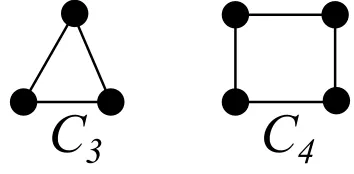
pair of endpoints, and aloop is an edge whose end-points are equal, i.e., an edge that connects a ver-tex to itself. Acycle is a graph whose vertices can be placed around a circle so that two vertices are adjacent if and only if they appear consecutively along the circle. Notationally, C3 and C4 are
cy-cles of 3 vertices and 4 vertices respectively (see Figure 1).
A variation of Nim, called Graph Nim, can be played on graphs with multiple edges, but no
Figure 1: AC3 and C4.
loops. During each turn of this game, a player first chooses a vertex, then removes at least one edge incident to the chosen vertex. The players take turns until all the edges have been removed, and the player that removes the last edge or edges wins the game.
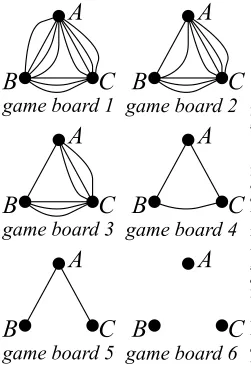
This version of Graph Nim was introduced at a Research Experience for Teachers led by Dr. Michael Ferrara and Dr. Breeann Flesch at Uni-versity of Colorado Denver in 2010. The teachers proved Theorem 3.1, but the result never appeared in print. Here we independently prove Theorem 3.1 and then prove other results about this game. To understand the game better, let’s consider an example of Graph Nim on a C3 with multiple
Figure 2: An example of a game played onC3with
multiple edges.
3.1. Graph Nim on C3
Theorem 3.1 In Graph Nim on C3 with multiple edges, a position is an L-position if and only if
a = b = c such that a, b and c are the number of
edges as shown in Figure 3.
Proof: Letn be the largest value of a,b and c. We proceed by way of strong induction on n. For the base case let n = 0, so a= b = c = 0. Since this is the terminal position, it is an L-position. Thus our base case has been proved.
Now we assume that for all valuesk < n, that a position is an L-position if and only if a =b = c=k. We now consider the case where the largest value of a, band cis n. Without loss of generality
Figure 3: A C3 with multiple edges, where a, b,
and care the number of edges.
let n = b and abe the smallest value of a, b and c. Either a6=b ora=b. If a6=b,the move is to choose vertex A and remove c a edges between verticesAand B and b aedges between vertices A and C. Now we have c0 =c (c a) =a edges between A and B, b0 = b (b a) = a edges between A and C and a0 = a edges between B and C. Since, a < n and a = a0 = b0 = c0 by our inductive assumption, we have moved to an L-position. Therefore, it was a W-position.
Now assume that a=b, so a=b=c =n. By the rules of the game, it is necessary for the player to remove at least one edge. However, the player can remove edges from at most two edge sets. Here the game is moved to the situation in the previous case, which implies it is an L-position.
By induction, a position is an L-position if and only if a=b=c.
Now let us look back at the game that was played in Figure 2. On game board 1,a= 3, b= 4 and c = 4, so Player 1 was in a winning position (W-position). However, he/she did not know the correct move to make to hand Player 2 a losing po-sition (L-popo-sition). To figure out the correct move, we look to the proof of Theorem 3.1. The small-est of a, b and c is a = 3, so we choose vertex A and remove b a = 4 3 = 1 edge between A and B andc a= 4 3 = 1 edge between A and C. After removing these edges, it would be that a=b=c= 3,which is an L-position.
L-position. When Player 2 moves, he/she must re-move at least one edge and can rere-move at most two edges, regardless of which vertex is chosen. Either way, this will leave the opponent with a way to win the game by removing all of the remaining edges.
Similar to Graph Nim onC3,this game can be
played on graphs with more vertices. Next, we will see the solution to Graph Nim played on C4 with
multiple edges.
3.2. Graph Nim on C4
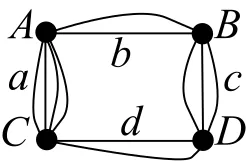
Figure 4: A C4 with multiple edges, where a, b, c,
and dare the number of edges.
Theorem 3.2 In Graph Nim on C4 with multiple edges, a position is an L-position if and only if
a = c and b = d such that a, b, c and d are the
number of edges as shown in Figure 4.
Proof:
Let n be the largest value of a, b, c and d. We proceed by way of strong induction onn. For the base case let n= 0, so a=b =c =d= 0, which implies that a = c and b = d. Since this is the terminal position, it is an L-position. Thus our base case has been proved.
Now we assume that for all valuesk < n, that a position is an L-position if and only ifa=c and b = d, where if a b then a= c = k or if a b thenb=d=k . We now consider the case where the largest value ofa, b, c and disn. Without loss of generality let n = b and a c. Either a = c and b=dor not. If not, we choose vertexA then remove b dedges between verticesAand B and removea cedges between verticesAandC.Now we have a0=a (a c) =c,b0 =b (b d) =d, c0 = c and d0 = d, so a0 = c0 and b0 = d0. This
is now an L-position, implying we started in a W-position.
Now assume that a = c and b = d. By the rules of the game, it is necessary for the player to remove at least one edge. However, the player can remove edges from at most two edge sets. Here the game is moved to the situation in the previous case, which implies it is an L-position.
Thus a position is an L-position if and only if a=c and b=d.
After proving these two results, we started to look at Graph Nim on other game boards, for ex-ample on C5.However, the results were not
forth-coming, so we decided to investigate other impar-tial combinatorial games to try to inform our re-search. There are many other impartial combina-torial games that are variations of Nim. One such game that we will now consider is called Circular Nim.
4. Circular Nim.
Circular Nim was introduced by Matthieu Du-four and Silvia Heubach in 2013 [3]. In this alter-ation of Nim, n stacks of tokens are arranged in a circle. The two players take turns removing at least one token from one or more ofk consecutive stacks. The game is denoted by CN(n, k) where n is the number of stacks of tokens and k is the number of consecutive stacks from which the play-ers can remove tokens. The player that removes the last token or tokens wins the game. When k= 1,the game is just Nim, but when k >1 the solution to Nim does not apply.
A position in Circular Nim can be denoted by a vector p = (p1, p2, p3, ..., pn) where pi
rep-resents the number of tokens in stacki. With the use of legal moves, if the position p is moved to
p0= (p01, p02, ..., p0n), we call this p0 position to be the option of p. This change in position can be represented by the notationp!p0 [3].
po-Figure 5: An example of a game ofCN(5,2).
sition p = (5,1,6,3,2). Player 1 starts the game by choosing stacks 1 and 5 and removing 2 tokens and 1 token, respectively. This results in game board 2 in Figure 5, which isp= (3,1,6,3,1).Now player 2 removes 2 tokens from stack 4 and 1 token from stack 5,resulting is positionp= (3,1,6,1,0) depicted in game board 3. Removing the token from stack 4 and 4 tokens from stack 3, Player 1 makes position p = (3,1,2,0,0). Now Player 2 is faced with game board 4 and chooses to remove the one token in stack 2, resulting in position p
= (3,0,2,0,0). Player 1 removes all the tokens from stack 3, giving Player 2 game board 6 and a chance to win. From here Player 2 will remove all three tokens from stack 1 and win the game.
If k = 2, then Circular Nim with n stacks is equivalent to Graph Nim on Cn with multiple
edges. We prove this now.
Theorem 4.1 The game CN(n,2) is equivalent
to Graph Nim on Cn with multiple edges.
Proof: In case of CN(n,2), there aren stacks, and the players can choose up to two consecu-tive stacks from which they remove at least one token. Let’s assume there are k1,k2,k3,...,kn
to-kens in stacks 1, 2, 3,...n respectively, so p = (k1, k2, k3, ..., kn). For a Graph Nim on Cn, we
have n vertices that are connected to each other by a number of edges. Let’s assume that there are k1 edges connecting vertices N1 and N2,k2 edges
connecting vertices N2 and N3,k3 edges
connect-ing N3 and N4, continuing in this way until we
haveknedges connecting verticesNnandN1.The
number of stacks in CN(n,2) is equivalent to the number of sets of edges in Cn.The number of
to-kens in each stack inCN(n,2) is equivalent to the size of the set of edges connecting the respective vertices in the graph.
In CN(n,2), without loss of generality, let’s assume the player removes i tokens from stack 1 and j tokens from stack 2, where i k1 and
j k2. This implies we reach to a position p0 =
(k1 i, k2 j, k3, ..., kn). The equivalent move in
Graph Nim onCnis where the player chooses
ver-tex N2, then removes iedges between vertices N1
and N2, and j edges between N2 and N3. This
leads to a position in Graph Nim on Cn where
there arek1 iedges connectingN1andN2,k2 j
edges connecting verticesN2andN3,k3 edges
con-nectingN3 andN4, continuing in this way until we
have kn edges connecting vertices Nn and N1.
Thus the game boards and moves inCN(n,2) are equivalent to those in Graph Nim on Cn with
multiple edges, and the games are equivalent.
In [3] there are three results for Circular Nim when k = 2, which are listed below. Notice that the first two results are the same as Theorem 3.1 and 3.2.
Theorem 4.2 [3] For the game CN(3,2), the set
Theorem 4.3 [3] For the game CN(4,2), the set
of losing positions is L={(a, b, a, b)|a, b 0}.
Theorem 4.4 [3] The game CN(5,2) has losing
positions L={(a, b, c, d, b)|a+b =c+d and a is
the max(p)}.
The third result is equivalent to a result for Graph Nim on C5 with multiple edges. We use
the proof in [3] to inform the following result for Graph Nim on C5 with multiple edges.
Figure 6: AC5with multiple edges, wherea, b, c, d
and eare the number of edges.
Unlike the previous proofs, this one does not lend itself to induction. Instead, we partition the positions into the set of L-positions, as defined in the theorem, and its compliment, defined to be the W-positions. We prove the three properties in Section 2 hold, from which it follows that L-positions and W-L-positions correspond to losing and winning positions, respectively (see Section 2).
Theorem 4.5 In Graph Nim on C5 with multiple edges, a position is an L-position if and only if we
can assign a, b, c, d, e consecutively to the size of
the edge sets such that b=e, a+b=c+dand a
is maximum of {a, b, c, d, e}.
Proof: Unlike our other proofs a, b, c, d, and e may move around in this proof, since amust be a maximum ofa, b, c, d and e.Notice that a may be one of many maximum values.
In Graph Nim a terminal position is wherea= b=c=d=e= 0.This implies thatb=e, a+b= c+d = 0 and a is the maximum of a, b, c, d and e. Therefore, it is an L-position, and this satisfies
the first characteristic property of L-positions and W-positions.
Note that a position is an L-position if and only if adding or removing one from every edge set is also an L-position. For instance, the graph in Fig-ure 6 is an L-position. If we add an edge to ev-ery edge set in the graph, we get a = 5, b = 3, c = 4, d= 4,and e= 3. We still have b =e= 3, a+b=c+d= 8 andais a maximum. Similarly, if we remove two edges from every edge set in the graph, we get b = e = 0, a+b = c+d = 2 and a = 2 which is still a maximum of a, b, c, d and e. Therefore, it can be generalized that a position is an L-position if and only if removing or adding the same amount of edges to each edge set is also an L-position. This allows us to assume that the minimum number of edges is zero.
Claim: If every labeling of the edge sets with
{a, b, c, d, e}has at least one ofb6=eora+b6=c+d ora is not a maximum, then a player can remove edges in such a way that the new labeling of the edge sets{a0, b0, c0, d0, e0} satisfiesb0 =e0, a0+b0 = c0+d0 and a0 is the maximum of{a0, b0, c0, d0, e0}.
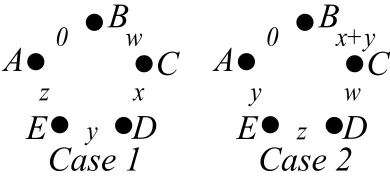
Proof of Claim: As stated earlier, we will as-sume that the minimum size edge set is zero. We will look at two cases: either a zero edge set is next to a maximum size edge set or a zero edge set is not next to a maximum size edge set.
Figure 7: A picture for the two cases in the proof for Theorem 4.5
Case 1: A zero edge set is next to a maximum size edge set.
and D and w (z+y) edges between B and C. Now, a0 =w (w (z+y)) =z+y corresponds to the edge set between B and C. The zero edge sets between A and B and C and D correspond to b0 and e0, and the edge sets of size y and z corre-spond toc0 and d,0 respectively. Thusb0 =e0 = 0, a0+b0 = c0+d0 =z+y and a0 is the maximum, implying it is an L-position.
If w < z+y, choose vertex D and remove x edges between C and D and y (w z) edges between D and E. Now, a0 = w corresponds to the edge set between B and C. The zero edge sets between A and B and C and D correspond tob0and e0.Lastly, the edge sets of size c0 =y (y (w z)) = w z and d0 = z correspond to the vertex sets between D and E and E and A, respectively. Thusb0 =e0= 0, a0+b0 =c0+d0 =wand a0 is the maximum, implying it is an L-position.
Case 2: A zero edge set is not next to a maxi-mum size edge set.
Without loss of generality, assume the number of edges betweenB andC is greater than or equal to the number of edges between E and A. Now assume there are 0 betweenAandB, x+ybetween B and C, w betweenC and D, z between D and E and y betweenE and A (see Figure 7 Case 2). Also assume either w orz is a maximum number of edges. If z x, choose vertexD and remove w edges betweenCandDandz xedges betweenD and E. Nowa0 =x+y corresponds to the vertex set between B and C. The zero edge sets between A and B and C and D correspond tob0 ande0.The edge sets of size c0 = z (z x) = x and d0 =y correspond to the edge sets between D and E and E and A, respectively. We now have b0 = e0 = 0, a0+b0 = c0+d0 = x+y and a0 is the maximum implying it is an L-position.
If z < x, choose vertex C and remove x z edges between B and C and w edges between C andD.Nowa0=x+y (x z) =y+zcorresponds to the edge set between B and C. The zero edge sets between C and D and A and B correspond tob0 and e0.Furthermore,c0=zand d0 =y correspond to the edge sets between D and E and E and A, respectively. We now have b0 = e0 = 0, a0 +b0 = c0+d0 =y+zanda0is the maximum, implying it is
an L-position. Therefore the two cases satisfy the second characteristic property of L-positions and W-positions.
Now assume there is a labeling of {a, b, c, d, e}
to the edge sets so thatb=e, a+b=c+dandais the maximum as shown in Figure 6. By the rules of the game, it is necessary for the player to remove at least one edge. If we choose vertexA and remove edges from the set of sizeathena+b6=c+dor if we remove edges from the set of size ethenb6=e. If we choose vertexB and remove edges from the set of size bthenb6=eor if we remove edges from the set of size a thena+b6= c+d. If we choose vertex C and remove edges from the set of size c thena+b6=c+dor if we remove edges from the set of size b then b 6= e. If we choose vertex D and remove edges from the set of size c or dthen a+b 6=c+d. If we choose vertex E and remove edges from the set of size d then a+b 6= c+d or if we remove edges from the set of size e then b6=e.In other words, no matter where we remove an edge or edges, we will move to a W-position. This satisfies the third characteristic property of L-positions and W-positions.
Therefore, in Graph Nim on aC5with multiple
edges, a position is an L-position if and only if we can assign a, b, c, d, e consecutively to the size of the edge sets such thatb=e, a+b=c+dand a is maximum of{a, b, c, d, e}.
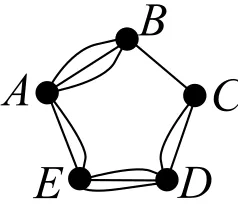
Figure 8: An example game board for Graph Nim on C5 with multiple edges.
Let us go over an example of how the proof of Theorem 4.5 helps us make a move when playing Graph Nim on C5. Figure 8 is an example game
position is an or W- position. For it to be an L-position we must be able to assigna, b, c, d, e con-secutively to the size of the edge sets such that b=e, a+b=c+dandais maximum ofa, b, c, d, e. Since there are three edges between A and B and betweenEand D, one of these two edge sets must be assigned a. In the former case, thenb = 1 and e= 2, so b6=eand it fails to meet the criteria for being an L-position. If we assign ato the edge set betweenEand D, thenb=e= 2,which is a good first step. However, then c = 3 and d = 1, and a+b 6= c+d, again failing the criteria for being an L-position. Thus there is no way to meet the criteria of being an L-position, so the game board in Figure 8 must be a W-position.
This is good news if it is your turn, because that means you are in a winning position. However, you must know the correct move to give your opponent an L-position. This is where we look to the proof of Theorem 4.5. Although none of the edge sets are of size 0, like in the proof, we can think of the minimum as being the set of size 0.We can also see a minimum set of edges is next to a maximum set of edges, so we can use case 1 from the proof. Thus we choose vertex E and remove one edge between AandE and one edge betweenDandE. Here we have that a = 3 is from A to B, and b = e = 1, which is betweenB and C and between A andE. Nowc+d= 4 =a+b,so it meets the criteria for an L-position.
Now your opponent will make a move, which result in you again having a W-position. If you can keep finding the correct move to give your op-ponent an L-position, then you will eventually win the game.
5. Conclusion
In this paper, we proved the solution for three di↵erent Graph Nim game boards. We also proved the equivalence of Graph Nim on Cn and certain
versions of Circular Nim. However, there are many di↵erent graphs that could be used as game boards for Graph Nim. For example, there is no known solution for Graph Nim on C6 or K4.Thus there
are many open problems in this area.
References
[1] Charles L. Bouton. Nim, a game with a com-plete mathematical theory. Ann. of Math. (2), 3(1-4):35–39, 1901/02.
[2] Richard A. Brualdi. Introductory
Combina-torics. Prentice Hall, 2009.
[3] Matthieu Dufour and Silvia Heubach. Circular Nim games. Electron. J. Combin., 20(2):Paper 22, 26, 2013.
[4] Thomas Ferguson. Impartial combinatorial game notes. https://www.math.ucla.edu/ ~tom/Game_Theory/comb.pdf, 2013.
[5] Richard J. Nowakowski. History of combinato-rial game theory. Lisbon, 2008.
[6] Douglas B. West. Introduction to Graph The-ory. Prentice Hall, 2 edition, September 2000.
[7] E. Zermelo. ¨Uber eine anwendung der mengen-lehre auf die theorie des schachspiels. In Proc.
5th Int. Cong. Math. Cambridge 1912, II:501–
A publication of the Program for Undergraduate Research Experiences at Western Oregon University
!
digitalcommons.wou.edu/pure ©2015
Dmanisi: A Taxonomic Revolution
Joshua Henderson
, Department of Anthropology,
Western Oregon University
Over the past two decades, five different skulls have been found in the Dmanisi site located in the Republic of Georgia. These skulls are all very different in cranial features, but they are also some of the most complete and well preserved hominin skulls ever discovered. There is a major concern with these skulls, and with concern also comes controversy. We know that Homo erectus migrated from Africa into Eurasia. That is why some paleoanthropologists believe that, despite the cranial differences, the skulls found at the Dmanisi site all belong to Homo erectus. They claim that skeletal variations are common in a single species in multiple geographical locations. The opposing theory is that the remains seem to have both characteristics of Homo habilis and Homo erectus. They propose a new species called Homo
georgicus, that fits between Homo habilis and Homo erectus. Using comparative analysis, I will
demonstrate that the remains found at Dmanisi are in fact Homo erectus, and that the species as a whole contained many variable skeletal features throughout various populations, challenging current taxonomy and placing many species of Homo in the new Homo erectus spectrum.
Keywords: Dmanisi, Paleoanthropology, Archaeology, Biological Anthropology, Homo erectus, physical
anthropology
Introduction
Imagine yourself in an abandoned medieval village in the Republic of Georgia. This village is located at the base of the Caucasus Mountains and is filled with the crumbled cobblestone ruins of a former medieval trade center. As with all historical sites, it often draws the attention of archaeologists to preserve its history. This was the case for this medieval village named Dmanisi. In 1936, archaeologists first excavated the remains of the city. Beyond finding medieval artifacts, the site seemed to be the average archaeological site. However in 1983 archaeologists discovered, beneath the ruins, sediment and faunal remains dating back to the Pleistocene. This new discovery invigorated archaeological efforts, which resulted in one of the most important finds in paleoanthropological history. Five skulls dating back to 1.8 million years ago were found in the sediment, each having different cranial characteristics. The brains associated with these skulls were quite small. The postcranial evidence found at the site suggests that the hominins to whom the skulls belonged were quite small as well. This seems to contradict what anthropologists previously believed, that the exodus out of Africa could only have occurred when hominin species were bigger brained with a larger physical frame. The remains found at Dmanisi are small brained with small physical frames, resembling Homo habilis, but also sharing many similarities to Homo erectus. The original research team concluded that the remains should be given their own species name; they patriotically named
it Homo georgicus. That designation was later retracted
after further evidence showed similarities to samples of
Homo erectus (Georgian National Museum 2013). Yet
there are still some paleoanthropologists who believe these remains found at Dmanisi should belong to their own new species, and should still be named Homo georgicus
(Schwartz et al. 2014), but the Georgian research team still holds true to their new classification as Homo erectus. If this is the case, we need to broaden our characteristics for
Homo erectus and revise our current taxonomy to account
for the variation among individuals (Mgeladze et al. 2011). By a comparison of the remains found at the Dmanisi site with African and Asian Homo erectus remains, I will demonstrate that the remains found at Dmanisi are in fact
Homo erectus, and that the species as a whole contained
many variable skeletal features throughout various populations, challenging current taxonomy and placing many species of Homo in the new Homo erectus
spectrum.
Site and Setting
!
!
Henderson | Dmanisi: A Taxonomic Revolution
tress
PURE Insights Volume 4, Issue 1
Lordkipanidze unearthed a complete mandible (D211) with its full set of dentition. In 1999, two craniums, D2280 and D2282, were found. A third cranium (D2700) was then discovered in 2001, the fourth and toothless cranium (D3444) was found in 2002, and the fifth and final cranium (D4500) found to date was found in 2005. Cranium number five (D4500) is the most complete cranium representing the genus Homo from Dmanisi. All of the skulls and postcranial evidence found at Dmanisi dates to around 1.8 million years ago (Georgian National Museum 2013). These remains suggest that Homo erectus left Africa much sooner than previously thought.
The Controversy
The discovery of the remains at Dmanisi has generated some very different viewpoints on the designation of species. After discovering the fifth cranium, Lordkipanidze and colleagues published a paper to which some opposing theorists responded (Lordkipanidze et al. 2013). Schwartz, Tattersal and Chi argue that the mandibles, dentition and cranial vaults of the skulls found at Dmanisi have too many differences between them, and compared to other Homo erectus specimens the differences could not be the result of within-species variation. These morphological differences provide sufficient evidence for the new species Homo georgicus and possibly other new species designations, pending further research (Schwartz et al. 2014).
The research team at the Dmanisi site led by Lordkipanidze recently published a paper documenting the anatomical features of skull five and the implications they have on the theory of variability within Homo erectus. In their article "A Complete Skull from Dmanisi, Georgia, and the Evolutionary Biology of Early Homo," they demonstrate how the fifth skull exemplifies their theory of the variability of the Homo erectus paleodeme (Lordkipanidze et al. 2013). The endocranial volume of skull five is very small compared to the other remains found at Dmanisi. The