LAUTECH Journal of Engineering and Technologt 5(I) 2009: 7- 12
STORAGE STABILITY INDICES FOR MAIZE FLOUR
O.J. Oyelade
Department of Food Science & Engineering,
Ladoke Akintola University of Technology, PMB 4000, Ogbomoso, Nigeria
ABSTRACT
Maize has maintained an important position in the dietary habits of many people in developittg countries, It becomes low-mokture food when processed into tlour although it may stilt be susceptible to deleterious elfect of exogenous (fungi, bacteria and insects) factors whose ectivities are climatic dependent after processittg to flour. However, ot e of the central areas of research infood processlng is to ensure quatity stability of foott items or products in storage structures in order to cdnserve the nutritional contposition and ensure its ovailability during the off-season periods.
In an attempt to ensure durability for maize flour, an onalysis of moisture sorptiott data was andertaken to determine storage environment boundaries and moisture content levels at which the uctivities of exogenous factors will he inhibited for the flour uniler tropical practicol storage conditiorrs.
Consequently, water activity (a) range of 0,05 to 0,61 and moisture contents of 6.66 to 7.22 (%, dry basis) was estimated to ensure quality stability for meize flour, when storage structutes are exposed to a tropical situation of temperature 2/C to 4f C and water activity of 0.10 to 0.80. BET monolayer moisture co,ttent varied between 3,47 and 4,59 %, dry basis. The infonnation can benefit stakeholders in the maize processing sector to ensure the availability of high quality Jlour as a food ingredient in various forms and for iiltlustrial utilisation. This has high tendency to improve customerts satisfactiotr and invariably provoke groh'tlr iil the
Keywords : maize fl our, sorption, s torage, stability
lntroduction
Maize plays a very important role in food security of many developing countries in Africa such as Togo, Nigeria, Cameroon, Siera-Leone and Ghana (Tagne et al 2003). On-farm harvesting for maize grains at varying moisture contents due to many interwoven factors that include climatic conditions. farming system and the available technology for the farm operations is a common phenomenon. ln this situation, the grain can assume a moisture value which makes it susceptible to storage molds especially during the warm months of the year (Reed et al, 2007). To extend the durability of the grains, fresh maize are usually dried and milled to flour in order to make its use elastic in regards to food ingredients and industrial applications. Although dried maize products are intrinsically more stable than fresh grains, their deterioration can be caused by exogenous factors such as fungi, bacteria and insects. These deteriorative agents require combir,ed effect of water and temperature for their activities. The various ranges of water activities (a*) for the spoilage organisms to grow in food products are: 0.75 to 0.99 (bacteria), 0.62 to 0.90 (yeasts) and 0.61 to 0.96 for moulds (Butt et al, 2006). A* can be influenced by the availability of free water in foods. Consequently, the free water can either directly or otherwise affect the shelf-life of stored food products or items through its effects on the stability of the components in food.
However, stability of components in food under preservation is a variable index for determining quality. Food components can be stable when environmental factors such as a*, relative humidity and pH in the food are maintained at a state that is not favourable to deleterious organisms (Cardello,
1998; Chinachoti, 1998; Yang, 1998). Invariably shelf-life will be enhanced because of the inhibition of fungal growth and mycotoxin production during storage practices which may adversely affect quality (Samapundo et al, 2007). Whilst in storage with regard to stability, water migration in relation to its translational mobility influences the physicochemical and biological attributes of foods. Water migration is presurned as most important aspect in food drying and packaging technology. The implication is that tlre rate at which moistr-rre is lost in food that is being stored can affect its quality (Chinachoti, 1 998).
T
Oyeladc,O,IJI'IUTECHJournalofEngineeri.ngandTechnohgltS(I)2009:7-12.
in storage, there is evidence to suggest that relationship between fu and moisture content can stand as index for determining the effects of water content on its stability (Samapundo et al,2007).
Moisture sorption relates to the ability of water molecules to penetrate into, diffuse within the food or escape out ofthe food matrix to the enveloping environmenl Specifically, the rate of diffusion is affected by the driving force which is linked to the water chemical potential difference between the food and the environment. Migration of moisture at the microscopic, macroscopic and molecular levels can be controlled through water activity or relative vapour pressure. This can have effect on the sorption characteristics of food products. Therefore, sorption data could be used to predict the stability of food products in storage because its application provides an understanding of the relationship between a* and moisture content which is an absolute necessity to achieve optimal storage stability in food products (Samapundo et al, 2007., Lasekan & Lasekan,2000., Ajisegiri, 1987). This aspect has not been investigated a prior for maize flour, 'in relation to Nigerian climatic conditions and many other developing countries despite the economii' impacts of maize and its associated products in the emerging economies and beyond.
In a previous paper by Oyelade et al, (2008), five widely recommended isotherms (GAB, Modified GAB, Modified Oswin, Modified Henderson & Modified Chung-Pfost) equations were used to fit experimental sorption data under practical storage conditions for maize flour. In this study an analysrs ofthe experimental sorption data was undertakento estimate the water activity range required in the ideal storage sffuctures for maize flour, and the moisture contents at which the flour can be produced and maintained during storage in order to retain good quality when storage is carried out in the selected tropical environment,
Materials and methods
Determination of the monolayer moisture content for maze flour
To calculate the monolayer moisture value for maize flour in this study, the least square and linear regression method of Munay (1981) was used: BET plots for the flour using the experimental sorption data for maize flour (Table l) were made for this purpose by using the Brunneur-Emmet-Teller expression in the form ofequation (1.):
Monolayer=
aw : water activity ; M : moisture iu the equilibrated samples (o/o, dry basis); Mo = moisture cont€nt of monomolecr.rlar layer; c = constant. From the plots, the monolayer moisture contents were calculated from tlre expression showu in equation (2):
(Intercept + Stope)"
" " "
Determination of water activity range suitable for storing maize flour
The local isotherm concept (LI) was adopted to relate the isotherm curves that were previously irbtained for maize flour at 27,32,37 & 40oC by Oyelade et al, 2008 to storage environment according to the procedure reported by lgbeka et al, (1975). This was done by linearising the Henderson equation (3) as shown:
(I - a-) = e-Kr'v n
= logKT + nlogM
(2)
/?',|
(4)
"Gil=;*tu
:: (r)
Where, n and k are constants
Equation (4) was interpreted graphically by
plotting togf tn(t - o,, )] against logM and used to determine the suitable a* at which the flour could be stored through the application ofpoints at which LI breaks occur in the HeMerson plot.
Determinetion of moisture stability isotherms of maize flour
The procedure of Alisegiri (1987) was used to gen€rate the paran":eters used to plot maize flour moisture stability curves. Therefore, the ratio of differential equilrbrium moisture content to differential relalive humidity I eM ) between n and
\eRH.)
(n+l) points was ploued againstM. The RH values were obtained as a* multiplied by a factor of
100, respectively. \tihere eM and ekH are
diffetential changes in equilibrium moisture contents and relative humidity from one relative humidity point to :he other during study into sorption phenomena.
Results and discussion Monolayer moisture content
i
Oyelade,O.f.n-lUTECHlournalofEngineeringrudTechnologjtS(1)2009:7-12.
properties to changes due to its implications on microbial and chemical deteriorations (Al-Muhtaseb et aL, 20A2). Physical adsorption forces between food solid matrixes had been implicated to indicate that dispersion forces represent the major contribution to total energy of adsorption. This energy is vital to the rate at which solid food structure attains equilibrium in the storage climate (Ngoddy & Bakker-Arkema, 1972). Rizvi & Benado (198a) had provided evidence to suggest that this energy, energy of adsorption is affected by the moisture content of the food as well as the storage temperature because the water imbibed have structural, dyramic and thermodynamic effects.
The determined monolayer moisture contents (Nd) for maize flour were affected by the emc values during the sorption experiment and were determined as 4. 5 8, 4,22, 3.87 and 3. 49o/o at 27, 32, 37 and 40oC, respectively during the adsorption process. Slightly higher values of 4.59, 4.33, 3.93 and 3.47Vo, dry basis at 27, 32, 37 and 40oC, respectively were determined from the desorption isotherms (Table 2). This trend in monolayer values which showed higher values because of higher emc during desorption cycles compared to the adsorption cycles agreed with the trend that Samapundo et al (2007) determined for whole yellow dent corn. Climatic temperature also has effect on the monolayer moisture contents because the values decrease as the storage temp€rature increases in the sorption process, This consequently reflects the temperature dependence of equilibrium moisture content which has important practical bearing on chemical and microbiological reactions that are associated with food spoilage (Al-Muhtaseb et al, 2004), At the same moisture. content, there is high tendency of increase in rates of deterioration because higher temperatures entail a higher a* (Van den Berg & Bruin, 1981),
The Mo value has been reported to correspond to the least water content required in the food for stability because it is the index that approximates the number of sorption sites in the food products (Ajisegiri, 1987). Moreira et al (2002) had suggested that food substances should be maintained at the monolayer values as it minimizes spoilage reactions. It has also been emphasised that monolayer moisture values could be considered a critical parameter in food storag€ and package selection (Kumar, 2000; Ertugay & Certel, 2000). The determined mo values are significantly less than the estimated values of 10.27% reported for degermed corn flour by Kumar (1974) and 6.03 -8.47 that were reported for whole yellow dent com by Samapundo et al (2007). The variation in values in this study could be due to effect of variety and the degerming process. However, the trend in the
N4 in this study corroborated the earlier observation presented by researchers that it is a temperature dependent function, and as sirch s,hopld be of importance in storage plrenomena (Diosady it't 'r' al. ,1996; Sopade et al, 1994).
Storage Environment
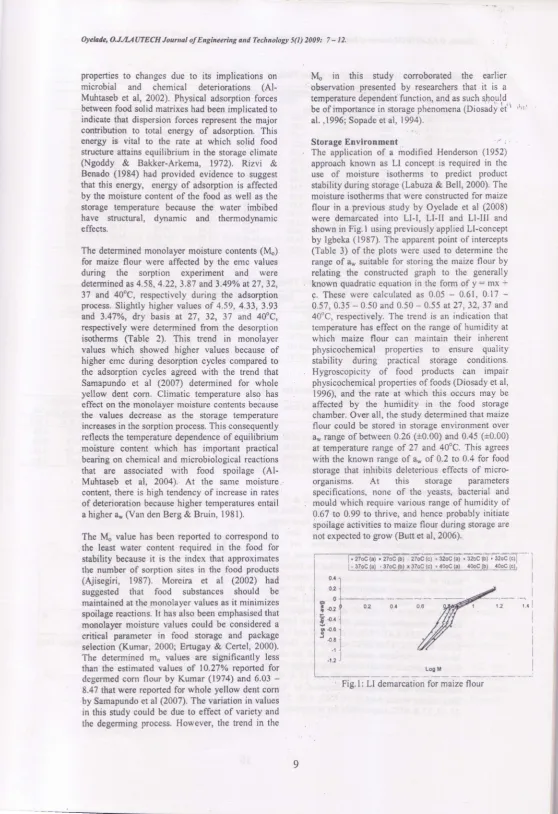
The application of a modified Henderson (1952) approach known as LI concept is required in the use of moisture isotherms to predict product stabif ity during storage (Labuza & Bell, 2000). The moisture isotherms that were constructed for maize flour in a previous study by Oyelade et al (2008) were demarcated into LI-I, LI-II and LI-III arrd shown in Fig. I Lrsing previously applied Ll-concept by Igbeka (1987). The apparent point of intercepts (Table 3) of the plots were used to determine the range of a* suitable for storing the maize flour by relating the constructed graph to the generally known quadratic equation in tl.re form of y = n',* * g. These were calculated as 0.05 0.61, 0. 17 -0.57, 0.35 - 0.50 and 0.50 - 0.55 at 27, 32,37 and 40oC, respectively. The trend is an indicatiorr that temperature has effect on the range of humidity at which maize flour can maintain their inherent physicochemical properties to ensure qLrality stability during practical storage conditions. Hygroscopicity of food products can impair physicochemical properties of foods (Diosady et al, 1996), and the rate at which this occurs may be affected by the humidity in the food storage chamber. Over all, the study determined that maize flour could be stored in storage environment over aw range of between 0,26 (+0.00) and 0.45 (t0.00) at temperature range of 27 and 40oC. This agrees with the known range of a* of 0.2 to 0.4 for food storage that inhibits deleterious effects of
micro-organisms. At this storage parameters
specifications, nol're of the yeasts, bacterial and mould which require various range of humidity of 0.67 to 0.99 to thrive, and hence probably initiate spoilage activities to maize flour during storage are not expected to $ow (Butt et al, 2006).
Log M
\ | .27oc (a) . 27oc (b) 27oC (c) , 32oc (a) ' 32oc lb) ; 32oc (c)l I
I i . szoc t"t - 3l9g1p_l_{qq9_(I " 40oc_(a) _10.oc {b) lo!ep-), l
Oyelade, OJ./UATECH Journal of Enghteering and Technologt 5(1) 2009: 7 - 12.
Table 1: Sorption Isotherm Data for Maize Flour art27,32,37 & 40"C
o/o
Activity 27'C 32"C gToC
(e*)" . . Ads Des Ads Des . .A.ds Des Ads Dcs _
0 . 1 0 4 . 4 0 5 . 0 8 4 , 0 6 4 . 2 9 3 . 9 5 4 , 0 6 3 . 8 4 3 . 9 8
U . I J
0.20 0.25 0.30
5.08 5.87
o . t I
6 , 8 9
0.35 7.00 0.40 7.22 0.45 7.56 0.50 7.68 u.)i
0.60 0.65 0.70
0."15 14.22 0.80 r 5.84 0,85 r 6.03
5 1 5 3 4 . 9 7 6 3 2 5 . s 3
6.66 6.21
6.96 6.43
5.08 4,97 5 . t 9 s . 9 8
6.47 5.98
6 . 6 3 6 . t 0
5 . 0 5 4 . l 8 5 . 0 5
6.00 4.9',7 s.50
6.00 5.42 5.56
1 . 6 /
6.29
9.03
r0.0s
12.1.9 12.64
7 . 1 1
L J +
7.60 8.s4 9.90 I 1 . 4 0 12.30
1 7 7 l 15.24 1 5 . 9 5 1 6 . 0 3
6.55 6.66 7.00 '7.56 8.92 9.82 I t.40 12.42 14.00 14.79 I 5 . 0 1
5 . 5 3
5 . 9 8
5.42 5 . 7 2
6 . 2 1 7.00
7.45 8.01 9.26 1 0 . 3 8 I 1 . 8 5 l 3 . 0 9 t4,22 14.82 1 5 . 0 I
6 . 2 1
O . J J
7.00 8 . 0 1 9.22 I 1 . 0 6 I 1 . 9 6 1 3 . 6 6
l + . t ) I
1 4 . 8 2
6.06 5.42 6 . t 7
6.43 6.77 7.ZZ 8 . 2 4 o ( o I 1 . 0 6 12.53 1 4 . 0 0 t 4 . 6 1 i 4 . 8 2
5,64 5.'7 6 6.66 6.71
. i . ) 0 7 . 8 9
8 . 5 8 9 . 0 3
10.2'] I l . 6 l I 3 . 0 9 14.67
1 0 . 6 0 i i . 8 5 1 3 . 4 3 14.56 14.67
Table 2: BET Monolayer Parameters and Values for Maize Flour Temperature
cc)
Eouation for BET Plots Monolayer Moisture (%,d.b)Adsorption Desorption
Equation R' Equation
27 32
3 t
40
0 . 2 1 0 1 x + 8 E - 0 5 0 . 9 8 6 8 0 . 2 1 0 1 x + 8 E - 0 5 0.2256x + 0.0004 0.9197 0.2756x + 0.0004 A.244lx - 0.0002 0.9791 0.2441x - 0.0002 0.2565x + 0.0016 0.9701 A.2565x -0.0016
0.9868 0.9797 0.979r 0.9701
4 . 5 6 4 . 3 5 4 . 0 6 3 , 8 3
4.76 4.43 4 . 1 0 3 . 9 2
Table 3: Storage Environment Parameters for Maize Flour Tenp.
cc)
Eouation of lines ofEquation oflines Intersectionpoints (log M)b & a c & b 27 J I 40 2.4869x-2.5648 6.252'7x-5.6908 2.5649x-2.5532 4A190x4.9946 2.8174x-2.6837 4.6775x4.4686
3.1892x-2.8161 3.7386x-3.1850
1.2666x-1.3124 0.9806 1.237lx-t.2657 0.9869 l.l215x-1.1234 0.9564 1.0706x-1.0468 0.9766
0.9709 0.71 0.80
0.98',77 0.74 0.82
0.9876 0.79 0.86
0.9709 0.83 0.88
0 . 9 4 8 3 0 . 8 8 8 5 0 . 8 8 2 3 0 . 8 9 9 1
Moisture stability
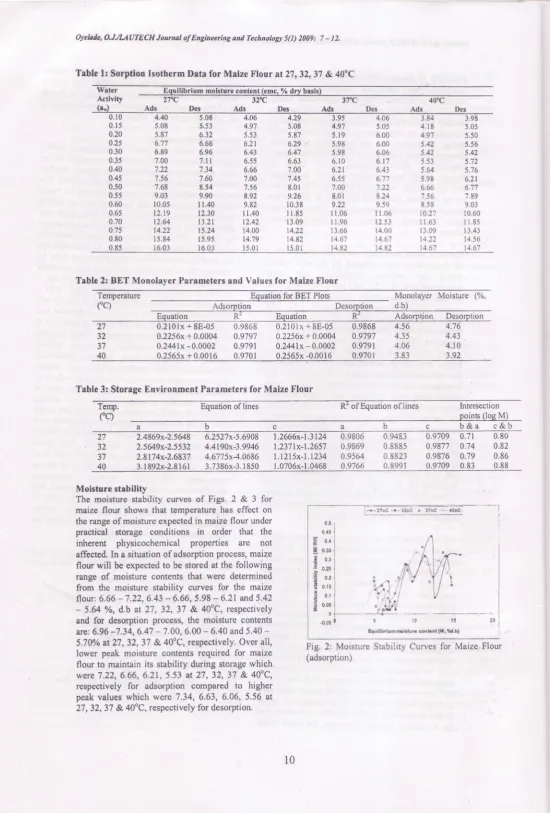
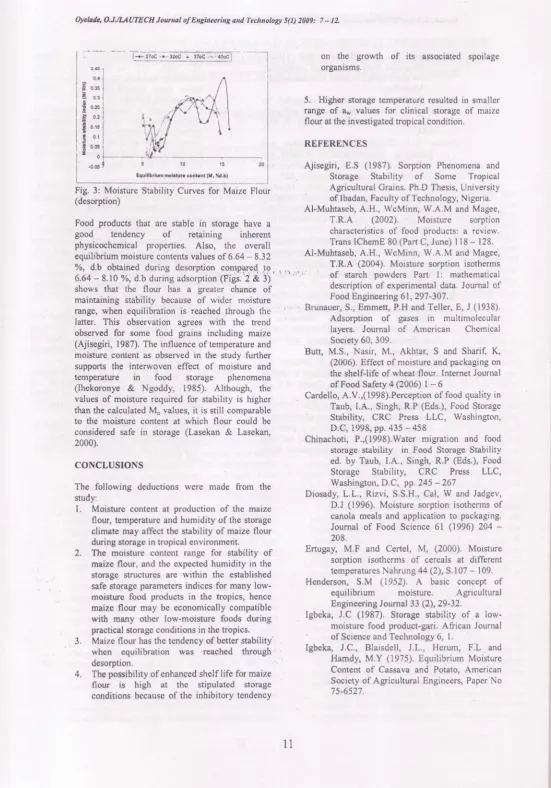
The moisture stability curves of Figs. 2 & 3 for maize flour shows that temperature has effect on the range of moisture expected in maize flour under practical storage conditions in order that the inherent physicochemical properties are not affected. In a situation ofadsorption proaess, maize flour will be expected to be stored at the following range of moisture contents that were determined from the moisture stability curves for the maize flour: 6.66 - 7 .22, 6.43 - 6.66, 5.98 - 6.21 and 5.42 - 5.64 yo, d.b at 27 , 32, 17 & 40oC, respectively and for desorption process, the moisture contents are: 6.96 -7.34,6.47 7.00, 6.00 6.40 and 5.40 -5.70% at27,32,37 & 4AoC, respectively. Over all, lower peak moisture contents required for maize fler.rr to maintain its stability during storage which w e r e 7 . 2 2 , 6 . 6 6 , 6 . 2 1 , 5 . 5 3 a t 2 l , 3 2 , 3 7 & 4 0 o C , respectively for adsorption compared to higher peak values which were 7.34, 6.63, 6.06, 5.56 at 27,32,37 & 40"C, respectively for desorption.
5 i c 1 5 E q u i l i b r i u m m i i t u r e @ n t n t ( M , 7 d , b l
Fig. 2: Moisture Stability Curves for Maize,Flour (adsorption)
o t I 0.15 l
^ i
r 0 . { 1
i o.rs.l E o r l
: 0.25 1 ; o a i t 0 { 5 1
0 f
-- 0 . 0 5 v
0.4s I o . . l
^ l
E o s l
= ^ ^ I E 0.2s j g 0 . 2 i
E o " l
. l I 0 . 1 . i . - l 005 i; ^ l
.0.* I
Oyebdc, O,J,/LAATECII Jourual ofEngineering arul Techaologt 5(l) 2009: 7 - 12,
ll_':r"S_:__rr"i S_t_194
I
on the growth of its associated spoilage organisms.5. Higher storage temperature resulted in smaller range of aw values for clinical storage of maize flour at the investigated tropical condition.
REFERENCES
Ajisegiri, E.S (1987). Sorption Phenomena and
Storage Stability of Some Tropical
Agricultural Grains. Ph.D Thesis, University of Ibadan, Faculty of Technology, Nigeria.
Al-Muhtaseb, A.H., WcMinn, W.A.M and Magee,
T.R.A (2002). Moisture sorption
characteristics of food products: a review. Trans IChemE 80 (Part C, June) I l8 - 128.
Al-Muhtaseb, A.H., WcMinn, W.A.M and Magee,
T.R.A (2004). Moisture sorption isotherms
: of starch powders Part l: mathematical
description of experimental data. Journal of Food Engineering 61, 297-307.
Brunauer, S., Emmett, P.H and Teller, E, J (i938). Adsorption of gases in multimolecular layers. Journal of American Chemical Society 60, 309.
Butt, M.S., Nasir, M., Akhtar, S and Sharif, K, (2006). Effect of moisture and packaging on the shelf-life ofwheat flour. Internet Journal of Food Safety 4 (2006) I - 6
Cardello, A.V.,(1998).Perception of food quality in Taub, I.A., Singh, R.P (Eds.), Food Storage Stability, CRC Press LLC, Washington, D . C , 1 9 9 8 , p p . 4 3 5 - 4 5 8
Chinachoti, P.,(1998).Water migration and food storage stability in Food Storage Stability ed. by Taub, I.A., Singh, R.P (Eds.), Food Storage Stability, CRC Press LLC, Washington, D.C, pp. 245 - 267
Diosady, L.L., Rizvi, S.S.H., Cal, W and Jadgev, D.J (1996). Moisture sorption isotherms of canola meals and application to packaging. Journal of Food Science 61 (1996) 204 -208.
Ertugay, M.F and Certel, M, (2000). Moisture sorption isotherms of cereals at different temperatures Nahrung 44 (2), S.107 - 109. Henderson, S.M (1952). A basic concept of
equilibrium nloisture. Agri*rltural
Engineering Journal 33 (2),29-32.
Igbeka, J.C (1987). Storage stability of a low-moisture food product-gari. African Journal ' ofScience and Technology 6, 1.
Igbeka, J.C., Blaisdell, J.L., Herum, F.L and Hamdy, M.Y (1975). EquilibriLrm Moisture Content of Cassava and Potato, American Society of Agricultural Engineers, Paper No 75-6527.
Equlllbrlu'llml.ru.ronrili*_l]
Fig. 3: Moisture Stability Curves for Maize Flour (desorption)
Food products that are stable in storage have a
good tendency of retaining inherent
physicochemical properties. Also, the overall equilibrium moisture contents values of 6.64 - 8.32 oh, d.b obtained during desorption compg1.g{ lg, , ,, 6.64 - 8. 10 o/o, d.b during adsorption (Figs. '2 & 3) shows that the flour has a greater chance of maintaining stability because of wider moisture range, when equilibration is reached through the ' latter. This observation agrees with the trend observed for some food grains including maize (Ajisegiri, 1987). The influence of temperature and moisture content as observed in the study further supports the interwoven effect of moisture and
temperature in food storage phenomena
(Ihekoronye & Ngoddy, 1985). Although, the values of moisture required for stability is higher than the calculated Mo valnes, it is still comparable to the moisture content at which flour could be considered safe in storage (Lasekan & Lasekan, 2000).
CONCLUSIONS
The following deductions were made from the study:
l. Moisture content at production of the maize flour, temperature and humidity of the storage climate may affect the stability of maize flour during storage in tropical environment. 2. The moisture content range for stability of
maize flour, and the expected humidity in the storage structures are within the established safe stomge parameters indices for many low-moisture food products in the tropics, hence maize flour may be economically compatible with many other low-moisture foods during practical storage conditions in the tropics. 3. Maize flour has the tendency of better stability'
when equilibration was reached through' desorption.
4. The possibility of enhanced shelf life for maize flour is high at the stipulated storage conditions because of the inhibitory tendency
11
n
Oyehde, O,IJLAATECH ,Iournal o;fEugineering and Technologlt S(l) 2009: 7 - 12,
Ihekoronye, A.I and Ngoddy, p.O (1985). Integrated Food Science and Technology for the Tropics, London and Basingstoke Macmillan.
Kumar, K. (1974). Water vapour adsorption on whole com flour, degermed flour and germ flour. Journal of Food Technology 9,433-444.
Kumar, K.R (2000). Moisture sorption and packaging characteristics of Arabian dry cereal foods. Journal of Food Science and Technology - Mysore 37 (3), 330 - 333. Labuza, T.P and Bell, L.N (2000). Moisture
sorption: practical aspects of isotherm measurement and use. American Association of Cereal Chemists, St. Paul, MN 55121-2097. USA 2000
Lasekan, O.O and Lasekan, W.O (2000). Moisture sorption and the degree of starch polymer degradation on flours of popped and malted sorghum (sorghum bicolour). Journal of Cereal Science 3 1, 55 - 6 1.
Moreira, R., Vazqueze, G and Chenlo, F (2002). Influence of the temperature on sorption isothemrs of Chick Pea: Evaluation of isosteric heat of sorption. Electronic Journal of Environmental, Agricultural and Food Chemistry.
Murray, R,S (1981). Outline of Theory and Problem of Statistics. Schaum's Outline Series, McGrawHill Pub. Comp; N.Y, St Luis London.
Ngoddy, P.O and Bakker-Arkema, F.W (1975). A generalised theory ofsorption phenomena in biological materials part iii - a pore size distribution function of the power law type for biological materials. Transactions of the A S A B r 5 ( 6 ) , 1 1 6 0 - 1t64.
Oyelade, O.J., Tunde-Akintunde, T,Y., Igbeka, J.C., Oke, M.O & Raji, O.Y (2008). Modelling moisture sorption isotherms for maize flour. Journal of Stored Products Research 44,179-185.
Reed, C., Doyuchell, S. Ioerger, B & Getchell, A Q$AT. Response of storage molds to different initial moisture contents of nraize (corn) stored at 25oC, and effect on respiration rate and nutrient composition. Journal of Stored Products Research 43.
443-458.
Rizvi, S.S.H and
B e n a d o , A . L ( 1 9 8 4 ) Thermodynamics properties of dehydrated food. Food Technology 38, 83 - 92.Samapundo, S., Devlieghere, F., Meulenaer, 8., Atukwase, A,, Lamboni, Y & Debevere, J (2007). Sorption isotherms and isosteric heats ofsorption ofwhole yellow dent corn. '
Joumal of Food Engineering 79,168-115. Sopade, A.A & Ajisegiri, E.S (1994). Moisture
sorption study on Nigerian foods: maize and
sorghum. Journal of Food Process
Engineering 17,33 - 56.
Tagne, A., Kongsdal, O., Ngoko, Z & Mathur, S.B (2003). Fusarium pallidoroseum in maize samples of three agro-ecological zones of Cameroon. Journal of Stored Products Research 39,367-374.
Van den Berg, C & Bruin, S (1981). Water activity and its estimation in food systems in L.B Rockland & G.F. Stewart (Eds), Water activity: influences on food quality (pp
147-177). Neu'York: Academic Press.
Yang, T.C.S (1998) Ambient storage in Taub, I.A., Singh, R.P (Eds.), Food Storage Stability, CRC Press LLC. Washington, D.C, pp.435-4 5 8