24
Egypt. J. Soil Sci. Vol. 53, No.3, pp. 347-360 (2013)Corn Yield Response to some Irrigation Methods
and Fertilization with Macro and Micronutrients
Manal A.El-Nady* and Amany M. Abdallh**
*Soil Science and **Agronomy Department, Faculty of Agriculture, Cairo University, Giza, Egypt.
FIELD experiment was conducted to evaluate the response of corn yield to different irrigation methods and combination of macro and micro fertilizers. Treatments were comprised of three methods of irrigation: alternate furrow irrigation (AFI), fixed furrow irrigation (FFI) and conventional furrow irrigation (CFI)} as main plots and four different fertilizer combinations: NPK, NPK + Zn , NPK + Zn + B and NPK + Zn + B + Fe as sub-plots, in a split plot design. The results revealed that methods of irrigation significantly influence corn yield. Higher grain yield were recorded under (CFI) compared to (AFI) and (FFI). In both seasons, there were no significant difference between (CFI) and (AFI) while, a significant difference between each of (CFI) and (AFI) with (FFI) was found. The grain yield under (AFI) and (FFI) decreased by 4% and 15 %, respectively comparing with (CFI). Performance of (AFI) and (FFI) decreased irrigation water amount at the rates of 15 and 26%, respectively comparing with (CFI). Application of complete fertilizers, treatments (F4), recorded the highest grain yield compared with the other fertilizer treatments. The result also revealed that (CFI) increased the 100 grain weight, no. of grains and ear length followed by (AFI) and (FFI), respectively. Under (F4) treatment, no significant difference between (CFI) and (AFI) was found. These results indicated that (AFI) and (FFI) are ways to save water. The interaction between irrigation method (AFI) and (F4) treatment was the best combination for yield and yield contributing characters of corn in both seasons. The fertilization treatment (F4) is recommended to be usedin order to increase the performance of corn and help in maximizing yield production.
Keywords: Alternate furrow irrigation, Fixed furrow irrigation, Macro and micro nutrients, Corn yield, Water use efficiency.
It is very important to evaluate ways for increasing water and nutrient use efficiency. Research targeted to irrigated crops as affected by combined supply of macro and micro nutrients is very limited.
The irrigation and fertilizer research results indicated that irrigation improves the efficiency of fertilization and there is a strong correlation between fertilizer utilization and the water supply of plant because irrigation water dissolved the fertilizers and made available to the crop for proper growth and development.
Barker et al. (1997) indicated that nutrient elements supply, uptake and transport are impaired without sufficient water. Nagy (1997 and 1999) also indicated that water supply plays a significant role in the utilization of fertilizer. A combination of irrigation and appropriate nutrient management could be available economic alternative to dry land production (Norwood, 2000).
Scientists have confirmed the effect of nutritional elements on the resistance of plant against deficit irrigation (Pritchard et al., 1999). Corn is a high water demanding crop in all stages of its physiological development and can achieve high yields when water and nutrients are not limiting (Song and Dia, 2000).
Researchers working on corn have identified a better spatial coupling effect when using alternate furrow irrigation and fertilization in the same and different furrow, by producing higher crop yield per unit of irrigation water and fertilizer, compared to using the conventional irrigation fertilization scheme (Benjamin et al., 1997 and Howard et al., 1999).
O'Neill et al. (2004) reported greater yield response for corn with nitrogen application under adequate soil water conditions. Nitrogen availability or uptake may be modified by water supply (Mansouri-Far et al., 2010).
Furrow irrigation is commonly used in arid and semi arid zones to supply crops with water. Deep water percolation and chemical leaching is a recognized environmental problem with furrow irrigation. Earl and Davis (2007) reported that water application can be reduced by 20 to 30 % through every other row irrigation, while, corn yield was not much reduced. El-Noemani et al. (1990) also found that using every other furrow irrigation increased yield compared to every furrow irrigation in corn. Alternate furrow irrigation is a method whereby water is applied to every other furrow rather than to every furrow. Therefore, less water is usually applied with alternate furrow irrigation method, (Graterol et al., 1993). He also reported that alternate furrow irrigation method may supply water in a manner that greatly reduces the amount of surface wetted, leading to less evapotranspiration and less deep percolation. Sepaskhah and Parand (2006) also showed that deep percolation was reduced when the every other furrow irrigation method was compared to the every furrow method.
Alternate furrow irrigation was proposed as a method to increase water use efficiency and decrease chemical leaching compared with every furrow irrigation method and with small yield losses for different crops compared with fixed furrow irrigation system (Mailhol et al., 2001).
2008). When the plant has access to elements, such as boron (B), potassium (K) and Zinc (Zn), the growth of root increases, thus producing more carbohydrates and proteins which enabling the plant to utilize the humidity of soil more efficiently specifically during the drought periods (Parasad and Power, 2002). Utilization of these elements will increase the efficiency of plant when utilizing the water (Nasri and Khalatbari, 2008).
Among micronutrients, boron and Zinc play a key role in pollination and seed set processes; so that their deficiency can cause decrease in seed formation and subsequent yield reduction. Rehem et al. (1998) stated that boron plays a key role in water and nutrients transportation from root to shoot. Similarly Zinc supply is considered as an important factor in reproduction process (Marschner,1999).
Zinc activate several enzymes and hence the metabolic activities, viz nucleic acid and carbohydrate metabolism and utilization of nitrogen and phosphorus (Khanda and Dixit, 1995). It was indicated by Vahedi (2011) that lack of Zinc is a major problem in the world and shortage of zinc will reduce crop yield. Zinc and Fe can play a useful and effective role on plant growth and increase in the harvest (Baybordi et al., 2000). Therefore, spraying plants with Fe, Mn, Zn and Cu increased yields of many crops (El- Kadi et al., 1990). However, boron is essential micronutrient for plants, its range between deficiency and toxicity is narrower than that of any other microelements (Goldberg, 1997).
Reduction in water availability, along with an increase in agricultural production input cost, oblige producers to search for more efficient irrigation methods that reduce irrigation water losses and do not decrease yields. Therefore, the objective of this study was to investigate the effects of three different furrow irrigation methods in relation to fertilizer combination on yield and yield components of corn.
Material and Methods
The macronutrients were added as ammonium nitrate (120 unit of nitrogen), 200 kg/fed, phosphorous as super phosphate (15 % P2O5) and potassium as sulphate potassium (48 % K2O). Full dose of phosphorous, potassium and one third of nitrogen fertilizer added at sowing and the remaining was applied at the beginning of germination.
The Fe and Zn applied at a rate of 6.0 ppm and B at a rate of 4.0 ppm, each chelated element. They were sprayed as solely element or mixture of three elements and applied at two intervals, after 30 and 50 days after sowing.
The experiment was a split plot design replicated three times. A sub-plot size of 5 x 8 m with a row spacing of 75 cm was used. There were 2 and 1 m distance between the main plots and sub-plots, respectively.
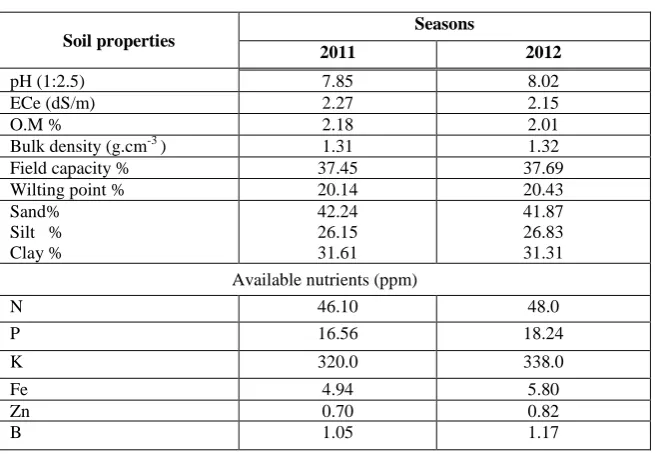
Undisturbed and disturbed soil samples were collected from the 0-40 cm depth to determine some physical and chemical properties of the experimental site. The physical and chemical properties were determined according to Klute (1986) and Page et al. (1982) (Table 1).
TABLE 1. Some physical and chemical properties of the experimental soil site for the two seasons.
Soil properties
Seasons
2011 2012
pH (1:2.5) 7.85 8.02
ECe (dS/m) 2.27 2.15
O.M % 2.18 2.01
Bulk density (g.cm-3) 1.31 1.32
Field capacity % 37.45 37.69
Wilting point % 20.14 20.43
Sand% Silt % Clay %
42.24 26.15 31.61
41.87 26.83 31.31 Available nutrients (ppm)
N 46.10 48.0
P 16.56 18.24
K 320.0 338.0
Fe 4.94 5.80
Zn 0.70 0.82
B 1.05 1.17
Irrigation water economy (IWE):
Irrigation water economy (IWE) was calculated according to James (1988) as follows:
IWE = Y / Wa
IWE = irrigation water economy, kg. m3 Y = total grain yield, kg/fed. Wa = total applied water, m3/fed.
Water consumptive use (WCU):
Soil moisture content at every 20 cm depth of active root depth (60 cm) was determined before and after each irrigation to calculate the actual evapotranspiration for each irrigation treatment. The (WCU) determined according to Hansen et al. (1979).
WCU = (θ2 - θ1 /100) d Where:
WCU : Water consumptive use in the active root zone (60 cm). θ2 : Volumetric soil moisture content after irrigation (%). θ1 : Volumetric soil moisture content before irrigation time (%). d : Depth of soil layer (mm).
Water use efficiency (WUE):
Water use efficiency (WUE) of crop was calculated according to Giriappa (1983) using the following equation:
WUE= Grain yield (kg/fed) / WCU (m3/fed). Where: WCU = water consumptive use (m3/fed).
Yield and yield components:
At harvest, five field corn plants were sampled from the center of each subplot to determine: plant height, ear length in cm, number of grains per row, weight of 100 grains. The grain yield was recorded within each plot; an area of 4 m2 was harvested.
Statistical analysis:
Data were statistically analyzed using analysis of variance technique. Least significant difference was applied for mean separation according to Steel and Torrie (1980).
Results and Discussion
Effect of irrigation methods on grain yield and yield components
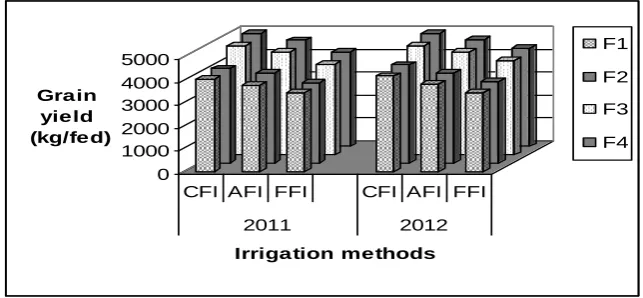
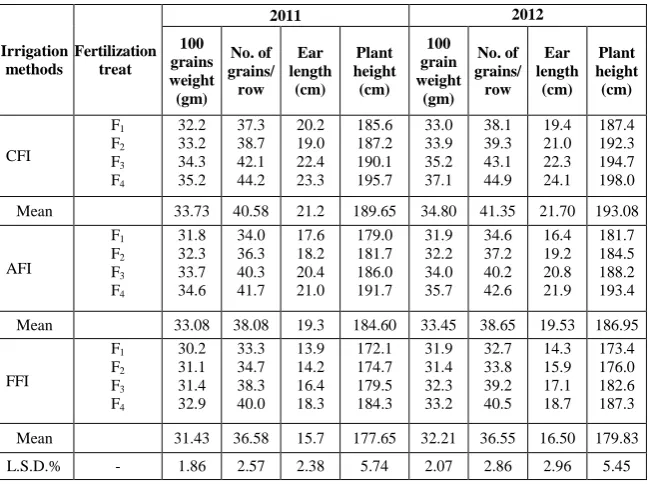
season, respectively. Regarding yield components and plant height, (CFI) recorded the highest yield components and plant height followed by (AFI) and (FFI) respectively. No significant differences, in plant height and all studied yield components, were found between (CFI) and (AFI) under fertilization treatments F2, F3 and F4. While, a significant difference under F1 treatment was found for plant height, no. of grains/row and ear length. These results indicate the effect of applied micronutrients on these yield components. Reducing irrigation water amount under (FFI) significantly reduce plant height and yield components as compared to (CFI) and (AFI). Irrigation methods (AFI) and (FFI) reduced grain yield by 6.0 % and 16.0% for the first season and 5.0 and 15.0 % for the second season, respectively as compared to (CFI) in both seasons. These results showed that (AFI) had the lowest grain yield reduction compared with (FFI). Sepaskhah and Ghasemi (2008) explained that (FFI) reduced the applied irrigation water and induced a decrease in growth and yield due to water stress caused by smaller amount of applied irrigation.
0 1000 2000 3000 4000 5000
Grain yield (kg/fed)
CFI AFI FFI CFI AFI FFI
2011 2012
Irrigation methods
F1
F2
F3
F4
Fig. 1. Response of corn grain yield to studied irrigation methods and fertilization treatments in both seasons.
Fertilization
(NPK+ Zn+B vs. NPK+ Zn+ B +Fe), did not change grain yield and yield components significantly, i.e., there was no significant difference between F3 and F4. Therefore, sufficient of both macro and micro nutritional elements plays a significant role in increasing grain yield and its component. Marschner (1999) declared that using Zn and Fe elements increases the total amount of carbohydrate, starch and proteins in plant and so increases the weight of 1000 grain. In this connection, many investigators have been reported that application of micronutrients significantly increased all yield components, as well as seed and straw yields of different crops (Azer et al., 1992, Osman et al., 1991 and Amin et al., 1988).
Fertilization treatments brought out significant variations on yield and yield components and increased the response of corn plant to moisture stress especially under irrigation method (FFI). Under all irrigation methods, F4 treatment increased grain yield by about 23 % in both seasons as compared with F1. El-Hariri et al. (1988) reported that micronutrients are becoming important in improving crop production and yield components. The results of the present study show that, balanced fertilization including micro and macronutrients could influence the yield and yield components of corn.
TABLE 2. Corn yield parameters and plant height as affected by irrigation methods and studied fertilization treatments in both seasons.
Irrigation methods
Fertilization treat
2011 2012
100 grains weight (gm) No. of grains/ row Ear length (cm) Plant height (cm) 100 grain weight (gm) No. of grains/ row Ear length (cm) Plant height (cm) CFI F1 F2 F3 F4 32.2 33.2 34.3 35.2 37.3 38.7 42.1 44.2 20.2 19.0 22.4 23.3 185.6 187.2 190.1 195.7 33.0 33.9 35.2 37.1 38.1 39.3 43.1 44.9 19.4 21.0 22.3 24.1 187.4 192.3 194.7 198.0
Mean 33.73 40.58 21.2 189.65 34.80 41.35 21.70 193.08
AFI F1 F2 F3 F4 31.8 32.3 33.7 34.6 34.0 36.3 40.3 41.7 17.6 18.2 20.4 21.0 179.0 181.7 186.0 191.7 31.9 32.2 34.0 35.7 34.6 37.2 40.2 42.6 16.4 19.2 20.8 21.9 181.7 184.5 188.2 193.4
Mean 33.08 38.08 19.3 184.60 33.45 38.65 19.53 186.95
FFI F1 F2 F3 F4 30.2 31.1 31.4 32.9 33.3 34.7 38.3 40.0 13.9 14.2 16.4 18.3 172.1 174.7 179.5 184.3 31.9 31.4 32.3 33.2 32.7 33.8 39.2 40.5 14.3 15.9 17.1 18.7 173.4 176.0 182.6 187.3
Mean 31.43 36.58 15.7 177.65 32.21 36.55 16.50 179.83
L.S.D.% - 1.86 2.57 2.38 5.74 2.07 2.86 2.96 5.45
Interaction effects
height (Table 2). Corn plants that received the most water and fertilizers had the highest plant height, 100 grains weight, no. of grains/row, ear length and grain yield. These results were obtained with (CFI) method combined with fertilization treatment (F4). The lowest plant height, grain yield and its components were obtained with (FFI) and fertilization treatment (F1). These results due to the enough water supplied by furrow irrigation method, which allowed the plants to have the required water and nutrients, and hence, grow much faster and have more photosynthesis level which make more spikes and finally high grain yield. On the other hand, the lowest grain yield and yield components obtained under (FFI) combined with (F1) resulted from insufficient water and nutrients under these treatments. However, applying fertilization treatment (F4) under (FFI) method, higher up the grain yield and yield components. This trend had been explained by lauer (2006) who indicated that using some elements such as enough Zn, B and K in the soil leads to increase the resistance of plant against the possible damages resulted from deficit irrigation water.
Irrigation water applied
Amounts of irrigation water applied for each treatment in the two seasons are shown in Fig. 2. The data indicated that, furrow irrigation method (CFI) resulted in higher amount of applied irrigation water to be 71.34 and 69.8 cm in the first and second seasons, respectively. Irrigation water applied under alternate (AFI) and fixed (FFI) methods was 62.18 and 53.96 cm in the first season and 59.31 and 51.36 cm in the second season. The (AFI) and (FFI) reduced the applied irrigation water compared to (CFI). The percentage reduction in water amount under (AFI) and (FFI) was about 13 % and 24% in the first season and about 15% and 26% in the second season, respectively compared to (CFI). Yonts et al. (2007) reported that water application through every other row irrigation can be reduced by 20 to 30% while corn yield was not much reduced. The data also declared that irrigation water amounts for the fertilization treatments, gradually increased from F1 to F4. The F3 and F4 treatments required higher amount of irrigation water than F1 and F2 treatments, due to the increase in corn plants growth, which indicated by the higher plant height, 100 grain weight, no. of grains/row and grain yield under F3 and F4 treatments.
The relationship between irrigation water applied and grain yield and each of its attributes are given in Table 3. Response of corn to irrigation water was significant and linear. All yield components were significantly improved with the increase in water supply.
TABLE 3. Regression equations and correlation coefficients between applied irrigation water amounts and corn grain yield and its components.
Variable Equation R2
Grain yield (kg/fed) G.y. =1678 +41.61 x 0.91
100 grain weight (gm) G.w.=246.90+0.14 x 0.81
No.grain/row G.r. =19.61+ 0.31 x 0.89
Ear length (cm) E.l. =3.61+ 0.25 x 0.88
Plant height (cm) P.h. =147.90+0.61 x 0.85
Irrigation water economy (IWE)
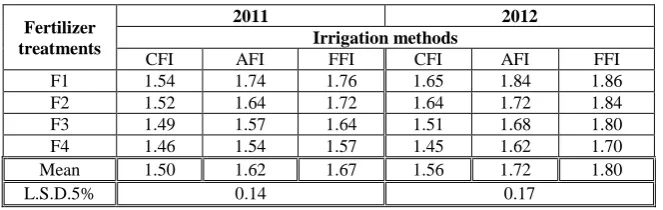
The calculated values of (IWE) for the different irrigation methods and fertilization treatments are shown in Table 4. Generally, a gradual decrease in (IWE) values is shown with the different treatments. (IWE) varied under irrigation methods from 1.50 to 1.69 in the first season and from 1.56 to 1.80 in the second season. The highest (IWE) value were obtained under (FFI) followed by (AFI) and (CFI) respectively. The percentage reduction in (IWE) values under (CFI) was about 11.0% and 13.0% in the first and second seasons, respectively as compared with those obtained under (FFI). These results revealed that (FFI) can promote irrigation efficiency. Data concerning effect of fertilization treatments showed that the highest (IWE) value was recorded under F1 treatment whereas; the lowest value was under F4 treatment. Although, application of both macro and micro nutrients in case of F4, the obtained value of (IWE) was lower than that in case of F1 (macro fertilizers only).
TABLE 4. Irrigation water economy (IWE) of different fertilization treatments under studied irrigation methods.
Fertilizer treatments
2011 2012
Irrigation methods
CFI AFI FFI CFI AFI FFI
F1 1.54 1.74 1.76 1.65 1.84 1.86
F2 1.52 1.64 1.72 1.64 1.72 1.84
F3 1.49 1.57 1.64 1.51 1.68 1.80
F4 1.46 1.54 1.57 1.45 1.62 1.70
Mean 1.50 1.62 1.67 1.56 1.72 1.80
L.S.D.5% 0.14 0.17
Water consumptive use (WCU)
Data of water consumptive use determined for the control treatments (F1) of the studied irrigation methods is presented in Fig. 3. The data showed that (WCU) was reduced with (FFI) and increased with (CFI) followed by (AFI). Increasing (WCU) values under (CFI) may be due to the higher soil moisture content through increasing irrigation water, which gave a chance for more consumption of water. It was explained by Kang et al. (2000) that the reduction in irrigation water amount supplied to the alternate furrow irrigation method reduces the amount of surface wetted leading to less evapotranspiration and less deep percolation.
0 100 200 300 400 500 600
2011 2012
Irrigation methods
W
C
U
(m
m
)
CFIAFI FFI
Fig. 3. Water consumptive use (WCU) as affected by the different irrigation methods.
Water use efficiency (WUE)
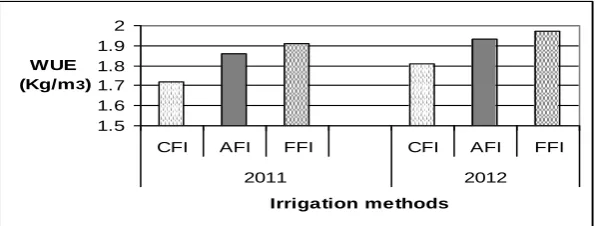
Water use efficiency of corn as affected by irrigation methods of the control treatments in both seasons is shown in Fig. 4. The highest (WUE) value was achieved under irrigation method (FFI) followed by (AFI). However, the lowest value was obtained with (CFI). These results show the superiority of (FFI) and (AFI) in increasing water use efficiency of corn since consumed less water than furrow irrigation. These results are in agreement with Sepaskhah and Kamgar-Haghighi (1997) who reported that alternate furrow irrigation can improve agricultural water use efficiency. Although, the highest grain yield of corn was achieved with (CFI), (WUE) as well as (IWUE), decreased. The decrease in (WUE) under (CFI) may be due to the increase in irrigation water.
1.5 1.6 1.7 1.8 1.9 2
CFI AFI FFI CFI AFI FFI
2011 2012
Irrigation methods WUE
(Kg/m3)
Conclusions
In the present study grain yield and its components influenced by the irrigation method and the combination between macro and micro fertilization. Significantly, lower yield and magnitudes of yield components were obtained when lower amount of water was supplied during the growth. The results showed that (CFI) followed by (AFI) increased grain yield and yield contributing characters, in respect to (FFI). However, the highest (IWE) was obtained with (FFI) and (AFI) methods which save about 24% and 13% of irrigation water in the first season and about 15% and 26% in the second season, respectively. Under studied irrigation methods, combination of macro and micro nutrients (F4) treatments significantly increased grain yield and its components compared with macronutrient only (F1) treatment. It is recommended that alternate furrow irrigation can be used as a simple and efficient method for corn production as it enables the production of as much corn yield as those offered by all furrow method. Also, optimum fertilization must be added and more attention should be paid to micronutrients nutrition for corn plants so that plant growth and yields are not limited by nutrient deficiencies occurred as a result of small amount of irrigation water.
References
Amin, M.A.A., Baza, M.S.M. and El-Gendy, F.H. (1988) Effect of the number of spraying of some micronutrients on the growth, yield and mineral composition of broad been plants. Annals Agric. Sci., Moshtohor 26 (3), 2007.
Azer, S.A., Osman, A.O. and Ghaly, S. (1992) Effect of applying Mn through coating method on the growth of some leguminous crops. Egypt. J. Agric. Res. 70 (4), 989.
Barker, D.M., Raine, S.R. and Robertson, M.J. (1997) A preliminary investigation of alternate furrow irrigation for sugar cane production. Proc. Aust. Soc. Sugar Cane Tech. 20: 302-309.
Baybordi, M., Malakouti, M.J., Amirmokri, H. and Nafisi, M. (2000) “Optimal Chemical Fertilizer Production and Use Towards The Objectives of Sustained Agriculture”. 1st
ed., Agricultural Education Publishing, Iran.
Benjamin, J.G., Porter, L.K., Duke, H.R. and Ahyja, L.R. (1997) Corn growth and Nitrogen uptake with furrow irrigation and fertilizer bands. Agron. J. 89: 609-612.
Earl, H.G. and Davis, R.F. (2007) Effect of drought stress on leaf and whole canopy radiation use efficiency and yield of maize. Agron. J. 95: 688-698.
El-Hariri, D.M., Kabesh, M.O., Bahairy, T.G. and Nour, T.A. (1988) Growth and yield response of sesame to foliar nutrition with some micronutrients. Egypt. J. Agron. 13 (12): 115-124.
El-Noemani, A.A., El-Halim, A.K.A. and El-Zeiny, H.A. (1990) Response of maize (Zea may L.) to irrigation intervals under different levels of nitrogen fertilization. Egyptian. J. Agron. 15: 147-158.
Fageria, N.K., Baligar, C. and Clark, R.B. (2002) Micronutrients in crop production. Advances in Agronomy 77: 185-268.
Giriappa, S. (1983) "Water Use Efficiency in Agriculture", Oxford & IBH Publishing C.O., New Delhi.
Goldberg, S. (1997) Reaction of Boron with soils. Plant and Soil 193: 35-48
Graterol, Y.E., Eisenhauer, D.E. and Elmore, R.W. (1993) Alternate–furrow irrigation for soybean production. Agric. Water Manage. 24: 133-145.
Hansen, V.W., Israelsen, D.W. and Stringharm, Q.E. (1979) "Irrigation Principle and Practices", 4th ed., John Wiley & Sons., New York.
Howard, S., Hanson, J.D. and Benyamine J.G. (1999) Nitrogen uptake and partitioning under alternate and every furrow irrigation. Plant Soil 210: 11-20.
James, L.G. (1988) "Principles of Farm Irrigation System Design", p. 543, Jone Willey & Sons, New York, USA.
Kang, S.Z., liang, Z.S., Pan, Y.H., Shi, P.Z. and Zhang, J.H. (2000) Alternate furrow irrigation for maize production in an arid area. Agric. Water Manage. 45 (3): 267-274.
Khanda, C. and Dixit, L. (1995) Effect of zinc and nitrogen fertilization on summer rice. Ind. J. Agron. 40 (4): 695-697.
Klute, A. (1986) "Methods of Soil Analysis, Part 1: Physical and Mineralogical Methods", 2nd ed., Amer. Soc. of Agron., Madison, Wiscansin, USA.
Lauer, J. (2006) What happen with in the corn plant when drought occurs?. Wisconsin Crop Manager 10 (22): 225-228.
Mailhol, J.C., Ruelle P. and Nemeth, I. (2001) Impact of fertilization practices on nitrogen leaching under irrigation. Irrig. Sci. 20: 139-147.
Mansouri-Far, C., Ali, M.S., Sanavy, M. and Saberali, S.F. (2010) Maize yield response to deficit irrigation during low- sensitive growth stages and nitrogen rate under semi-arid climatic conditions. Agric. Water Manage. 97: 12-22.
Marschner, H. (1999)"Mineral Nutrition of Higher Plants", Academic Press, San Diego.
Nagy, J. (1997) The effect of fertilization on the yield of maize (Zea mays L.) in unirrigated and irrigated cultivation. Agrokemia es Talajtan 46 : 275-288.
Nagy, J. (1999) Evaluation of interaction between irrigation and soil cultivation in maize production. Acta Agronomica 47 (2): 181-190.
Norwood, C.A. (2000) Water use and yield of limited-irrigated and dryland corn. Soil Sci. Soc. Am. J. 64: 365-370.
O'Neill, P.M., Shanahan, J.F., Schepers, J.S. and Caldwell, B. (2004) Agronomic responses of corn hybrids from different areas to deficit and adequate level of water and Nitrogen. Agron. J. 96: 1660-1667.
Osman, A.O., Hegazy, M.H. and Ghaly, S. (1991) The effect of seed coating with certain micronutrients on the yield of faba bean. J. Agric. Res. 69 (2): 351.
Page, A. L., Miller, R.H. and Keeney, D.R. (1982) "Methods of Soil Analysis. Part 2: Chemical and Microbiological Properties", 2nd ed., Amer. Soc. Agron., Madison, Wisconsin, USA.
Parasad, R. and Power, J.F. (2002) "Soil Fertility for Sustainable Agriculture", CRC Press LTC, Australia.
Pritchard, F.M., Norton, R.M., Eagles H.A. and Nicolas, M. (1999) The Effect of Environment on Victorian Canola Quality, 10th International Oil Seed Crops.
Rehem, G.W., Fendter, W.E. and Overdahi, C.J. (1998) Boron for Minnesota Soils. University of Minnesota Extension Service.
Sathya, S., James , G.P. and Indirani, R. (2009) Boron nutrition of crops in relation to yield and quality. Review Agric. Rev. 30 (2):139-144.
Sawan, Z.M., Mahmoud, M.H. and El-Guibali, A.H. (2008) Influence of potassium fertilization and foliar application of zinc and phosphorus on growth, yield components, yield and fiber properties of Egyptian cotton. J. Plant Ecol. 1 (4): 259-270.
Sepaskhah, A.R. and Ghasemi, M. (2008) Every- other- furrow irrigation with different intervals for sorghum. Pak. J. Biol. Sci. 11 (9): 1234-1239.
Sepaskhah, A.R. and Kamgar-Haghighi, A.A. (1997) Water use and yields of sugarbeet grown under every-other-furrow irrigation with different irrigation intervals. Agric. Water Manage. 34: 71-79.
Sepaskhah, A.R. and Parand, A. (2006) Effects of alternate furrow irrigation with supplemental every-furrow irrigation at different growth stages on the yield of maize. Plant Prod. Sci. 9 (4): 415-421.
Song, F.B. and Dia, J.y. (2000) Effect of drought stress on growth and development of female inflorescence and yield of maize. J. Jillian Agric. Univ. 22 (1): 17-22.
Steel, R.G.D. and Torrie, J.H. (1980) "Principles and Procedures of Statistics", 2nd ed., Mc Graw-Hill, New York.
Yonts, C.D., Eisenhauer, D.E. and Varner, D. (2007) Managing Furrow Irrigation Systems. Institute of Agriculture and Natural Resources, University of Nebraska. Vahedi, A. (2011) The effects of micronutrient application on soybean seed yield and on
seed oil and protein content. J. Am. Sci. 7 (6).
ط ضعبل ةيماشلا ةرذلا ةباجتسإ
ـــ
لا قر
ــــ
رصانعلاب ديمستلا و ىر
ىرغصلا و ىربكلا
ىدانلا ىطاعملا وبأ لانم*
و الله دبع دمحم ىنامأ
* * * لع مسق ــ ـ و ىضارلأا مو * * يصاحملا مسق ــ ل – ةعارزلا ةيلك – ج ــ ةرهاقلا ةعما – ةزيجلا – رصم .
ثوحبلا ةطحم يف ةيلقحلا ةبرجتلا تيرجأ ةيعارزلا
ةعارزلا ةيلكل ةعباتلا –
ةعماج
مسوم للاخ ةرهاقلا ى
ومنلا 1122 و 1121 يرلل ةفلتخم قرط ثلاث ريثأت ةساردل
لا نم ةفلتخم تلاماعم ةعبرأو لوصحم يلع يرغصلاو يربكلا رصانعلاب ديمست
هتانوكمو ةيماشلا ةرذلا .
ىف يرلا قرط ثيح ةقشنم عطق ةبرجتلا ميمصت ناكو
يه ةيسيئرلا عطقلا : طوطخلاب يرلا (CFI) – يلدابتلا يرلا (AFI) تباثلا يرلاو
طقف دحاو طخل (FFI)
يه ةقشنملا عطقلا يف ديمستلا تلاماعم و :
-1. (F1), NPK. 2. (F2), NPK Zn. 3. (F3), NPK Zn B. 4. (F4), NPK Zn B Fe.
يلي ام جئاتنلا تحضوأو :
-2 . ةيماشلا ةرذلا لوصحم رثأت يلإ ةمدختسملا يرلا ةقيرط فلاتخإ يدأ
ةقيرط مادختسا دنع هتانوكمو بوبحلا لوصحم داز ثيح ، هتانوكمو (CFI) ةقيرط اهيلي (AFI) مث (FFI) بيترتلا يلع . 1 . نم لك نيب بوبحلا لوصحم ىف ىونعم قرف دجوي مل (CFI)
و (AFI)
نم لك نيب يونعم قرف لجس نكلو (FFI), (CFI)
نيب ًاضيأو (FFI),
(AFI) .
3 . لا يتقيرط مادختسا يدأ ـــ
ير (FFI), (AFI) لا هايم ريفوت يلإ
ـــ ةبسنب ير
23 ٪ ، 12 ٪ ملا ىف و لولأا مسو 21
٪ و 12 ٪ بيترتلا يلع ىناثلا مسوملا ىف
ةقيرطب ةنراقملاب (CFI)
.
2 . ءاملل ريفوت يلعأ ناك (IWE)
يرلا هايم مادختسلا ةءافك ىلعأ و (WUE)
ىرلا ةقيرط مادختسا دنع وه (FFI)
اهيلي (AFI) ـب ةنراقملاب كلذو (CFI)
.
1 . م يرغصلاو يربكلا رصانعلاب لماكلا ديمستلا يدأ ةيونعم ةدايز ثودح يلإ ًاع
ـلا نزوو زوكلا نزو نم لك يف 211
فصلا يف بوبحلا ددعو ةبح
بوبحلا لوصحمو .
2 . يربكلا رصانعلاب ديمستلا ةلماعم نيب يونعم قرف كانه ناك (F1)
نيبو
ًاعم يرغصلاو يربكلا رصانعلاب لماكلا ديمستلا ةلماعم (F4)
قرط تحت
ةمدختسملا يرلا .
7 . ساردلا جئاتن نم ديمستلاب مامتهلإا عم يلدابتلا يرلا ةقيرط مادختسإ نأ حضتي ة