ISSN 0975-928X
Research Article
Study of gene effects for yield and its component traits in bitter gourd
(
Momordica charantia
L.) by generation mean analysis
K. Radha Rani1*, K. Ravinder Reddy2 and Ch. Surrender Raju3 1
College of Horticulture, Rajendranagar, Hyderabad
2
College of Horticulture, Rajendranagar, Hyderabad
3
Rice Section, ARI, Rajendranagar, Hyderabad *Email: [email protected]
(Received: 10 Sep 2013; Accepted: 17 Sep 2013)
Abstract
The experiment was carried out to study the nature and magnitude of gene effects for yield and yield attributing traits in bitter gourd by generation mean analysis involving six generations (P1, P2, F1, F2, BC1 and BC2) at Model orchard, College
of Horticulture, Rajendranagar, Hyderabad during summer 2011. The results revealed the presence of additive, dominance gene effects and epistatic interactions for all the characters except for vine length in cross IC-470550 × IC-470558 indicating the importance of both additive and non-additive gene actions in the expression of the characters. The greater magnitude of dominance gene effect as compare to additive effect for most of the traits suggest that heterosis breeding may be more useful. Biparental mating which could exploit both additive and non-additive type of gene effects is also suggested for the improvement of the traits in bitter gourd.
Key words
Bitter gourd, generation mean analysis, gene effects, non-allelic interactions.
Introduction
Bitter gourd (Momordica charantia L.) is an important cucurbitaceous vegetable grown throughout India for its tender fruits. It is a prized vegetable because of its nutritive value and therapeutic properties. The estimation of gene effects involved in the inheritance of yield attributing traits is helpful in planning correct breeding programme for improvement of this crop. Determination of the most important suitable breeding method and selection strategy for improvement of a trait would depend on the knowledge of gene action operating in the breeding population, especially about the components of genetic variation viz., additive, dominance and epistasis. Generation mean analysis is an efficient tool to understand the nature of gene effects involved in the expression of the characters. Though gene effects for yield and its related characters have been estimated in bitter gourd, information on epistatic gene effects is limited. Thus, the present study was carried out to estimate different kinds of gene effects in the inheritance of yield and its related traits through generation mean analysis.
Material and Methods
The experimental material consist of six generations i.e., parents (P1, P2), F1, F2, BC1 (F1 ×
P1) and BC2 (F1×P2) of two crosses viz., IC-033227
× IC-470550 and IC-470550 × IC-470558. The parents wre maintained by selfing for many seasons. The crosses were made during kharif,
2009 and their F2, BC1 and BC2 were developed
during summer, 2010. Six generations of the two crosses were evaluated at Model Orchard, College of Horticulture, Rajendranagar, Hyderabad during
summer, 2011 in a randomized block design with three replications. The vines were spaced at 2.0 m between rows and 0.5 m within a row. All the recommended package of practices was adopted to raise healthy crop. Data were recorded on five randomly selected plants in each parental line and its F1 cross, 20 plants in F2 and 15 plants in each
BC1 and BC2 from each replication. Observations
were recorded on nine quantitative characters viz., vine length (m), number of laterals/vine, days to 1st female flower appearance, node number at 1st female flower appearance, number of fruits/vine, average fruit weight (g), fruit length (cm), fruit girth (cm) and yield/vine (kg). The data were subjected to A, B, C and D scaling tests of Mather (1949) for testing the adequacy of additive and dominance model. The gene effects (additive and dominance) and interactions (additive × additive, additive × dominance and dominance × dominance) for each character were estimated according to Hayman (1958) and Jinks and Jones (1958).
Results and Discussion
ISSN 0975-928X
http://sites.google.com/site/ejplantbreeding 1238
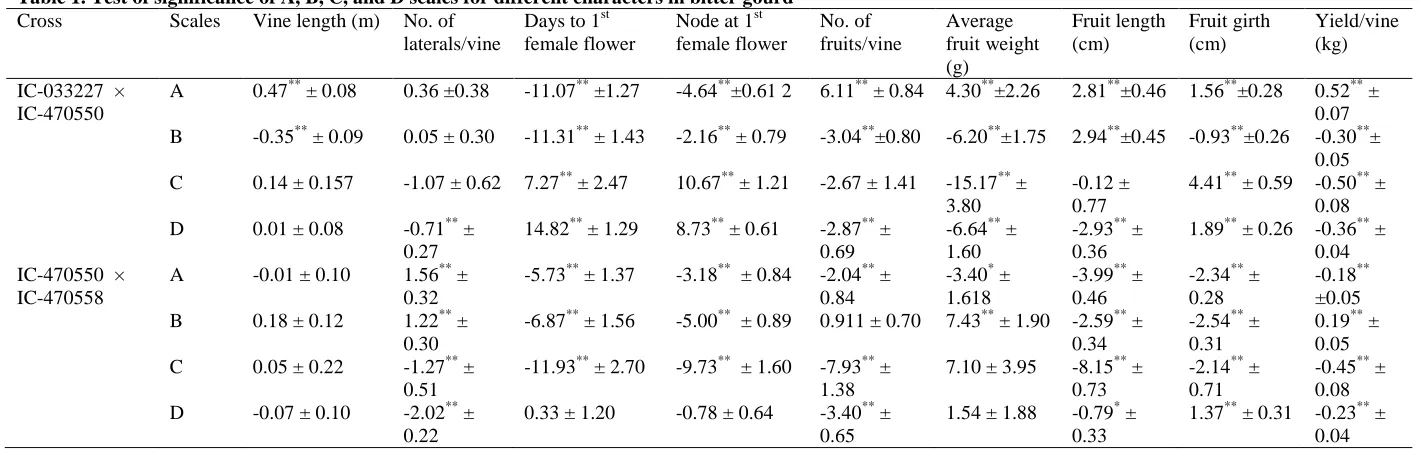
tests, at least two were significant for all the characters studied except for vine length in cross IC-470550 × IC-470558 in which none of the scales was significant and for number of laterals/vine in the cross IC-033227 × IC-470550 in which only D scale was significant. These results indicated the presence of non-allelic interactions in inheritance of these characters (Dalamu et al., 2012).
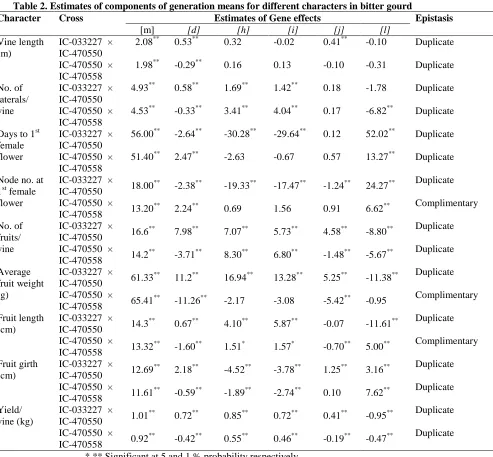
Estimates of components of generation means for different characters in bitter gourd are presented in Table 2. The results showed that for vine length, only additive effect was significant in the two crosses. Regarding interaction effects, additive × dominance (j) was found to be significant in cross IC-033227 × IC-470550 while simple additive model was adequate in inheritance of vine length in cross IC-470550 × IC-470558. Therefore, improvement in this cross can be achieved through simple pedigree selection. The epistasis for vine length was observed to be duplicate type confirming the complex nature of inheritance of this character. Similar results were reported by Sirohi and Chaudhury (1980). For number of laterals/vine, additive and dominance gene effects were found to be important for the cross IC-033227 × IC-470550 where as dominance gene effect was predominant in cross 470550 × IC-470558. Among the interaction effects, additive × additive (i) type of gene effect was significant in desired direction in both the crosses. The predominant role of dominance gene action and additive × additive (i) interaction gene effects, suggests that simple selection procedures can be adopted for improvement of this trait. Both crosses showed duplicate epistasis as the signs of dominance [h] and dominance × dominance [l] effects were in opposite direction (Sirohi and Chaudhury 1979).
Additive and dominance gene effect was found to be relatively more important in cross IC-033227 × IC-470550 for earliness in terms of days to 1st female flower and node number at 1st female flower appearance whereas only additive gene effect was predominant in cross 470550 × IC-470558. Further, partitioning of genetic components indicated that additive × additive and additive × dominance type of interaction effects were in desired direction for these traits in IC-033227 × IC-470550. Preponderance of duplicate epistasis suggested that inheritance of these traits might pose problems in their genetic improvement but one can expect some progress in selection programme due to presence of substantial amount of non-allelic interactions. These results are in agreement with the earlier reports of (Tewari et al. 1998).
Both additive and dominance gene effects were highly significant in two crosses but the dominance
gene effects were higher in magnitude for number of fruits/vine. Among interaction effects, additive × additive gene effect was in desired direction (Singh and Ram 2003). For average fruit weight, among the main effects, dominance gene effect was highly significant. Similarly additive × additive interaction effect was found to be highly significant in desired direction. The predominant role of dominance gene action and additive × additive interaction gene effects, suggests that simple selection procedures can be adopted for improvement of this trait.
Greater importance of dominance gene effect was observed for fruit length in both crosses. Among interaction effects, additive × additive gene effect was predominant in cross IC-033227 × IC-470550 while dominance × dominance has major role in inheritance of this trait in case of 047550 × IC-470558. The preponderance of dominance [h] and dominance × dominance [l] along with complimentary epistasis in cross 470550 × IC-470558 indicated that biparental mating would be a good approach for improvement of this trait (Patel
et al. 2005). Additive [d] and dominance × dominance [l] gene effects were predominant in inheriting fruit girth. Duplicate type of gene action was exhibited for this trait (Akhtar et al. 2010).
Dominance gene effect played major role and it was higher in magnitude compared to additive gene effect for yield/vine in the present study. Among the interaction effects, additive × additive [i] and additive × dominance [j] were predominant. These results suggested that this character can be fixed through progeny selection by following proper selection methods as well as by hybridization (Celine and Sirohi 1998). The presence of duplicate epistasis would be detrimental for rapid progress, making it difficult to fix genotypes with increased level of character manifestation because the positive effect of one parameter would be cancelled out by the negative effect of another. Hence, early generation intermating besides accumulating the favourable genes and maintaining heterozygosity in the population are likely to throw out desirable recombinants.
In the present study, greater magnitude of dominance gene effect as compare to additive gene effect for most of the traits studied suggest that heterosis breeding may be more useful. At the same time significant additive effects will be beneficial for the improvement through selection procedures.
References
ISSN 0975-928X
Celine, V. A. and Sirohi, P. S. 1998. Generation mean analysis for earliness and yield in bitter gourd
(Momordica charantia L.). Veg. Sci., 25(1):
51-54.
Dalamu, Behera, T. K., Satyavati, C. and Pal, A. 2012. Generation mean analysis of yield related traits and inheritance of fruit colour and surface in bitter gourd. Indian J. Hort.,
69(1):65-69
Hayman, B. I. 1958. The separation of epistasis from additive and dominance variation in generation means. Heridity,12: 371-390.
Jinks, J. L. and Jones, R. M. 1958. Estimation of the components of heterosis. Genet., 43: 223-234. Mather, K. 1949. Biometrical genetics. First edition
Dover publication Inc, New York.
Patel, N. B., Patel, J. B., Solanki, S. D. and Patel, J. J. 2005. Gene action study in bitter gourd
(Momordica charantia L.) through generation
mean analysis. Internat. J. Biosci., Reporter, 3(2): 260 - 264.
Singh, D. K. and Ram, H. H. 2003. Genetics of quantitative traits in bitter gourd (Momordica
charantia L.). Prog. Horti.,35(2): 189-191.
Sirohi, P. S. and Chaudhury, B.1979. Gene effects in bitter gourd (Momordica charantia L.). Veg. Sci., 7(2):102-107.
Sirohi, P. S. and Chaudhury, B. 1980. Inheritance of quantities fruit characters in bitter gourd
(Momordica charantia L.). Veg. Sci.,
7:102-106.
Tewari, D., Ram, H. H. and Jaiswal, H. R. 1998. Gene effects for various horticultural traits in bitter gourd (Momordica charantia L.). Veg. Sci.,
ISSN 0975-928X
http://sites.google.com/site/ejplantbreeding 1240
Table 1. Test of significance of A, B, C, and D scales for different characters in bitter gourd
Cross Scales Vine length (m) No. of laterals/vine
Days to 1st female flower
Node at 1st female flower
No. of fruits/vine
Average fruit weight (g)
Fruit length (cm)
Fruit girth (cm)
Yield/vine (kg)
IC-033227 × IC-470550
A 0.47** ± 0.08 0.36 ±0.38 -11.07** ±1.27 -4.64**±0.61 2 6.11** ± 0.84 4.30**±2.26 2.81**±0.46 1.56**±0.28 0.52** ± 0.07 B -0.35** ± 0.09 0.05 ± 0.30 -11.31** ± 1.43 -2.16** ± 0.79 -3.04**±0.80 -6.20**±1.75 2.94**±0.45 -0.93**±0.26 -0.30**±
0.05 C 0.14 ± 0.157 -1.07 ± 0.62 7.27** ± 2.47 10.67** ± 1.21 -2.67 ± 1.41 -15.17** ±
3.80
-0.12 ± 0.77
4.41** ± 0.59 -0.50** ± 0.08 D 0.01 ± 0.08 -0.71** ±
0.27
14.82** ± 1.29 8.73** ± 0.61 -2.87** ± 0.69
-6.64** ± 1.60
-2.93** ± 0.36
1.89** ± 0.26 -0.36** ± 0.04 IC-470550 ×
IC-470558
A -0.01 ± 0.10 1.56** ± 0.32
-5.73** ± 1.37 -3.18** ± 0.84 -2.04** ± 0.84
-3.40* ± 1.618
-3.99** ± 0.46
-2.34** ± 0.28
-0.18** ±0.05 B 0.18 ± 0.12 1.22** ±
0.30
-6.87** ± 1.56 -5.00** ± 0.89 0.911 ± 0.70 7.43** ± 1.90 -2.59** ± 0.34
-2.54** ± 0.31
0.19** ± 0.05 C 0.05 ± 0.22 -1.27** ±
0.51
-11.93** ± 2.70 -9.73** ± 1.60 -7.93** ± 1.38
7.10 ± 3.95 -8.15** ± 0.73
-2.14** ± 0.71
-0.45** ± 0.08 D -0.07 ± 0.10 -2.02** ±
0.22
0.33 ± 1.20 -0.78 ± 0.64 -3.40** ± 0.65
1.54 ± 1.88 -0.79* ± 0.33
ISSN 0975-928X
Table 2. Estimates of components of generation means for different characters in bitter gourd
Character Cross Estimates of Gene effects Epistasis
[m] [d] [h] [i] [j] [l]
Vine length (m)
IC-033227 × IC-470550
2.08** 0.53** 0.32 -0.02 0.41** -0.10 Duplicate
IC-470550 × IC-470558
1.98** -0.29** 0.16 0.13 -0.10 -0.31 Duplicate
No. of laterals/ vine
IC-033227 × IC-470550
4.93** 0.58** 1.69** 1.42** 0.18 -1.78 Duplicate
IC-470550 × IC-470558
4.53** -0.33** 3.41** 4.04** 0.17 -6.82** Duplicate
Days to 1st female flower
IC-033227 × IC-470550
56.00** -2.64** -30.28** -29.64** 0.12 52.02** Duplicate
IC-470550 × IC-470558
51.40** 2.47** -2.63 -0.67 0.57 13.27** Duplicate
Node no. at 1st female flower
IC-033227 ×
IC-470550 18.00
** -2.38** -19.33** -17.47** -1.24** 24.27** Duplicate
IC-470550 ×
IC-470558 13.20
** 2.24** 0.69 1.56 0.91 6.62** Complimentary
No. of fruits/ vine
IC-033227 × IC-470550 16.6
** 7.98** 7.07** 5.73** 4.58** -8.80** Duplicate
IC-470550 × IC-470558 14.2
**
-3.71** 8.30** 6.80** -1.48** -5.67** Duplicate Average
fruit weight (g)
IC-033227 ×
IC-470550 61.33
** 11.2** 16.94** 13.28** 5.25** -11.38** Duplicate
IC-470550 ×
IC-470558 65.41
** -11.26** -2.17 -3.08 -5.42** -0.95 Complimentary
Fruit length (cm)
IC-033227 × IC-470550 14.3
** 0.67** 4.10** 5.87** -0.07 -11.61** Duplicate
IC-470550 ×
IC-470558 13.32
** -1.60** 1.51* 1.57* -0.70** 5.00** Complimentary
Fruit girth (cm)
IC-033227 ×
IC-470550 12.69
** 2.18** -4.52** -3.78** 1.25** 3.16** Duplicate
IC-470550 ×
IC-470558 11.61
**
-0.59** -1.89** -2.74** 0.10 7.62** Duplicate Yield/
vine (kg)
IC-033227 × IC-470550 1.01
** 0.72** 0.85** 0.72** 0.41** -0.95** Duplicate
IC-470550 × IC-470558 0.92
** -0.42** 0.55** 0.46** -0.19** -0.47** Duplicate