Open Access
Review
Are animal models predictive for humans?
Niall Shanks
1, Ray Greek*
2and Jean Greek
2Address: 1Wichita State University, Department of History, 1845 N Fairmont, Fiske Hall, Wichita KS 67260, USA and 2Americans For Medical Advancement, 2251 Refugio Rd Goleta, CA 93117, USA
Email: Niall Shanks - [email protected]; Ray Greek* - [email protected]; Jean Greek - [email protected] * Corresponding author
Abstract
It is one of the central aims of the philosophy of science to elucidate the meanings of scientific terms and also to think critically about their application. The focus of this essay is the scientific term predict and whether there is credible evidence that animal models, especially in toxicology and pathophysiology, can be used to predict human outcomes. Whether animals can be used to predict human response to drugs and other chemicals is apparently a contentious issue. However, when one empirically analyzes animal models using scientific tools they fall far short of being able to predict human responses. This is not surprising considering what we have learned from fields such evolutionary and developmental biology, gene regulation and expression, epigenetics, complexity theory, and comparative genomics.
Review
"When I use a word,' Humpty Dumpty said in rather a scornful tone, 'it means just what I choose it to mean – neither more nor less." "The question is," said Alice, "whether you can make words mean so many different things."
Lewis Carroll in Through the Looking Glass 1871.
There is a serious scientific controversy concerning the predictive power of animal models. In this article we will use the phrase animal model to mean, or the word animal
in the context of, the use of a nonhuman animal, usually a mammal or vertebrate to predict human response to drugs and disease. We enthusiastically acknowledge that animals can be successfully used in many areas of science, such as in basic research, as a source for replacement parts for humans, as bioreactors and so forth. These uses are not included in our definition or critique as there is no claim made for their predictive power. This article focuses solely
on using animals/animal models to predict human responses in light of what the word predict means in sci-ence.
Philosophy of science
The meaning of words is very important in all areas of study but especially science.
Philosophers of science including Quine, Hempel and others have argued that words must have meaning in sci-ence and in fact these meanings separate scisci-ence from pseudoscience. Take for example the word prediction. A research method need not be predictive to be used but if one claims predictive ability for the test or project, then one means something very specific.
This paper addresses the use of the word predict as applied to animal models. It is our position that the meaning of the word has been corrupted and hence the concept behind the word is in danger as well as everything the con-Published: 15 January 2009
Philosophy, Ethics, and Humanities in Medicine 2009, 4:2 doi:10.1186/1747-5341-4-2
Received: 23 July 2008 Accepted: 15 January 2009
This article is available from: http://www.peh-med.com/content/4/1/2
© 2009 Shanks et al; licensee BioMed Central Ltd.
cept implies. Predict is not so much a word as a concept and is closely related to hypothesis. Hypothesis can be defined as a proposed explanation for a phenomenon, either observed or thought, that needs to be tested for validity. According to Sarewitz and Pielke:
In modern society, prediction serves two important goals. First, prediction is a test of scientific understand-ing, and as such has come to occupy a position of authority and legitimacy. Scientific hypotheses are tested by comparing what is expected to occur with what actually
occurs. When expectations coincide with events, it
lends support to the power of scientific understanding to explain how things work. " [Being] predictive of unknown facts is essential to the process of empirical testing of hypotheses, the most distinctive feature of the scientific enterprise," observes biologist Francisco Ayala (Ayala, F. 1996. The candle and the darkness
Sci-ence 273:442.)[1] (Emphasis added.)
In the case of animal models what actually occurs is what happens in humans. If the purpose of the test, be it a test on an animal or in silico, is to predict human response then the tests must be evaluated by how well it conforms to human response. We again acknowledge that not all tests and studies involving animals are done with predic-tion in mind. Nevertheless, those tests promoted as being predictive must be judged by how well they predict human response.
Sarewitz and Pielke continue:
Second, prediction is also a potential guide for deci-sion making. We may seek to know the future in the belief that such knowledge will stimulate and enable beneficial action in the present [1].
We will return to decision making.
The philosopher W.V.O. Quine has remarked:
A prediction may turn out true or false, but either way it is diction: it has to be spoken or, to stretch a point, written. Etymology and the dictionary agree on this point. The nearest synonyms "foresight," "foreknowl-edge," and "precognition" are free of that limitation, but subject to others. Foreknowledge has to be true, indeed infallible. Foresight is limited to the visual when taken etymologically, and is vague otherwise. "Precognition" connotes clairvoyance ... Prediction is rooted in a general tendency among higher vertebrates to expect that similar experiences will have sequels similar to
each other [[2]159] ... (Emphasis added.)
Predictions, generated from hypotheses, are not always correct. But if a modality or test or method is said to be predictive then it should get the right answer a very high percentage of the time in the biological sciences and all the time in the physical sciences. (We will discuss this as it applies to the biological sciences momentarily.)
If a modality consistently fails to make accurate predic-tions then the modality cannot be said to be predictive simply because it occasionally forecasts a correct answer. The above separates the scientific use of the word predict
from the layperson's use of the word, which more closely resembles the words forecast, guess, conjecture, project and so forth. We will return to these points shortly
Many philosophers of science think a theory (and we add, a modality) could be confirmed or denied by testing the predictions it made. Unlike the physical sciences, the bio-logical sciences, which study complex systems, must rely on statistics and probability when assessing what the response to a stimulus will be or in discussing the likeli-hood a phenomenon will occur. There is an assumption that has taken on the trappings of a theory or perhaps an overarching hypothesis in the animal model community that results from experiments on animals can be directly applied to humans; that animal models are predictive. This has resulted in an unquestioned methodological approach; using animals as surrogate humans. Ironically, this hypothesis has not been questioned as hypotheses should be questioned in science, hence our calling it an
overarching hypothesis. Whether or not the animal model
per se can be used to predict human response can be tested and if the results have a high enough sensitivity, specifi-city, positive and negative predictive value then the hypothesis that animals can predict human response would be verified. If verified, then one could say that ani-mal models are predictive for humans and if refuted then one could say animal models are not predictive for humans.
hypoth-esis have animals been assumed predictive. LaFollette and Shanks have referred to the practice of using animals in this fashion as heuristic or hypothetical animal models (HAMs) [3,4].
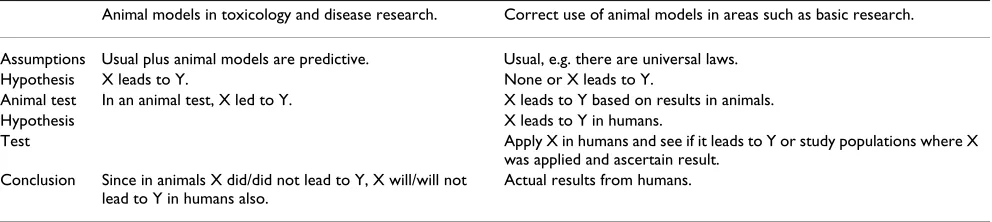
This is in contrast to the hypothesis that some scientists start with, namely that animals are predictive for humans. (See table 1.) By assuming this, these scientists make the claim that drugs and chemicals that would have harmed humans have been kept off the market secondary to results from animal tests. This is disingenuous unless we have a priori reason to assume animal models are predic-tive. The hypothesis was, in these cases, never tested. It would in many cases be unethical to conduct on humans the sorts of carefully controlled laboratory studies that are regularly conducted on, say, rodents. However, there are other, ethical ways to gain human data in the context of epidemiology (for example retrospective and prospective epidemiological studies), in vitro research using human tissue, in silico research, and the recent technological breakthrough of microdosing [5]. Further, it must never be forgotten that when industrial chemicals find their way into the environment, or drugs are marketed to the gen-eral population, human experiments have already taken place. Moreover, as Altman [6] has observed, there are many examples, both ancient and modern, where researchers, doubting the applicability or relevance of ani-mal models to the human situation, have experimented on themselves – a practice that Altman points out contin-ues to the present (recent Nobel laureate Barry Marshal being but one example). In any event, at the very least a track record of success (vis-à-vis positive and negative pre-dictive values) using specific animal models should be evident if society is to accept hypotheses from animal test-ing as predictive for humans.
Therefore, we must emphasize that when discussing ani-mals as predictive models we are discussing the overarch-ing hypothesis that animals are predictive, not the use of animals to generate a hypothesis such as occurs in basic research.
Now is an appropriate time to discuss the concept of proof and where the burden of proof lies in science. As in law, it lies on the claimant. The null hypothesis demands that we assume there is no connection between events until such causation is proven. Thus, those claiming animal models are predictive of human responses in the context of bio-medical research must show that what they are claiming is true. The burden is not on us to prove that animal models of, say carcinogenesis or toxicity, are not predictive. It is the job of those advocating animal models as predictive to demonstrate they are. This will require a consideration of what the evidence actually shows.
While physics deals with simple systems upon which reductionism can be practiced, biology does not always have that luxury. There are areas in biology – for example comparative anatomy – where the use of scaling princi-ples have had genuine applicability. But biology is not physics, and there are other places – for example in some branches of predictive toxicology – where the use of such scaling factors (such as body weight2/3) have been less
than useful for reasons we will explore below. Biological systems are certainly consistent with the laws of physics, but they have properties consequent upon internal organ-ization, ultimately rooted in evolutionary history, not found in physics. This means that even when the same stimulus is applied, end results can differ markedly. The response of different humans to the same drug or disease is a well-known example of this phenomenon [7-13]. There are however, ways to judge the predictive nature of tests even in biological complex systems. Values such as positive predictive value, sensitivity, specificity, and nega-tive predicnega-tive value (we will discuss these values momen-tarily) can be calculated to confirm or refute hypotheses. Values from tests seeking to predict a response that approach what would be expected from random chance would obviously not fall into the category predictive.
Claims about the predictive nature of animal models
According to Salmon there are at least three reasons for making predictions:
Table 1: Hypothesis
Animal models in toxicology and disease research. Correct use of animal models in areas such as basic research.
Assumptions Usual plus animal models are predictive. Usual, e.g. there are universal laws. Hypothesis X leads to Y. None or X leads to Y.
Animal test In an animal test, X led to Y. X leads to Y based on results in animals. Hypothesis X leads to Y in humans.
Test Apply X in humans and see if it leads to Y or study populations where X was applied and ascertain result.
Conclusion Since in animals X did/did not lead to Y, X will/will not lead to Y in humans also.
1. because we want to know what will happen in the future;
2. to test a theory;
3. an action is required and the best way to choose which action is to predict the future [14].
In the case of carcinogenesis we want to know: (1) what will happen in the future (will the chemical cause cancer in humans?); and (3) an action is required (allow the chemical on the market or not?) and the best way to choose which action is to be able to predict the future. Neither (1) nor (3) is subtle. We want a correct answer to the question, "Is this chemical carcinogenic to humans?" or to similar questions such as, "What will this drug do to humans?" and "Is this drug a teratogen?" and "Is this the receptor used by HIV to enter the human cell?" But guess-ing correctly or findguess-ing correlations are not, as we have seen the same as predicting the answer. Neither is a high degree of sensitivity alone, as we shall see, the same as pre-diction.
The following will help the reader gain a feel for the con-tours of this scientific debate.
Butcher [15], Horrobin [16], Pound et al. [17] and others [3,4,18-24] have questioned the value of using animals to predict human response. Regardless, prediction is a prob-lem. U.S. Secretary of Health and Human Services Mike Leavitt stated in 2007:
Currently, nine out of ten experimental drugs fail in clinical studies because we cannot accurately predict how they will behave in people based on laboratory and animal studies" [24].
This is a very damaging statement for those who assert that animals are predictive. For some, the facts behind this statement would, without further support, answer the pre-diction question. But we will continue.
This debate has recently expanded to Philosophy, Ethics,
and Humanities in Medicine. Knight [25] recently
ques-tioned the use of chimpanzees in biomedical research cit-ing among other reasons their lack of predictability. Shanks and Pyles [26] questioned the ability of animals to predict human response resulting in Vineis and Melnick [27] responding that animals can be used to predict human response to chemicals with reference to carcino-genesis and that epidemics of cancer could have been pre-vented if animal data had been used to reduce human exposure or ban the chemical entirely. This claim, of ani-mals predicting human response, is not unique [28,29].
Gad wrote in Animal Models in Toxicology 2007:
Biomedical sciences' use of animals as models to help understand and predict responses in humans, in toxi-cology and pharmatoxi-cology in particular, remains both the major tool for biomedical advances and a source of significant controversy ...
At the same time, although there are elements of poor practice that are real, by and large animals have worked exceptionally well as predictive models for humans-when properly used ...
Whether serving as a source of isolated organelles, cells or tissues, a disease model, or as a prediction for drug or other xenobiotic action or transformation in man, experiments in animals have provided the neces-sary building blocks that have permitted the explosive growth of medical and biological knowledge in the later half of the 20th century and into the 21st century ...
Animals have been used as models for centuries to
pre-dict what chemicals and environmental factors would
do to humans ... The use of animals as predictors of potential ill effects has grown since that time [the year 1792].
Current testing procedures (or even those at the time in the United States, where the drug [thalidomide] was never approved for human use) would have identified
the hazard and prevented this tragedy [29]. (Emphasis
added.)
Fomchenko and Holland observe:
GEMs [genetically engineered mice] closely recapitu-late the human disease and are used to predict human response to a therapy, treatment or radiation schedule [30]. (Emphasis added.)
Hau, editor of an influential handbook on animal-based research notes:
A third important group of animal models is employed as predictive models. These models are used with the aim of discovering and quantifying the impact of a treatment, whether this is to cure a disease or to assess toxicity of a chemical compound [31].
The prediction claim is also strong when the word predic-tion is not actually used but is implied or linked to causal-ity. Fomchenko and Holland continue:
Using in vitro systems and in vivo xenograft brain tumor modeling provides a quick and efficient way of testing novel therapeutic agents and targets, knowl-edge from which can be translated and tested in more sophisticated GEMs that faithfully recapitulate human brain tumors and will likely result in high-quality clinical trials with satisfactory treatment outcomes and reduced
drug toxicities. Additional use of GEMs to establish
causal links between the presence of various genetic
alterations and brain tumor initiation or determining their necessity for tumor maintenance and/or progres-sion provide us with a glimpse into other important aspects of brain tumor biology [30]. (Emphasis added.)
Fomchenko and Holland are here clearly saying what hap-pens in animals will happen in humans; that animals are predictive. Akkina is saying the same:
A major advantage with this in vivo system [geneti-cally modified SCID mice] is that any data you get from SCID-hu mice is directly applicable to a human situation [32].
This use of prediction is not confined to the scientific lit-erature. It is, if anything even more widespread when sci-entists are speaking to the nonscientist public.
The above examples could be multiplied without effort. Due to the ubiquitous nature of comments like the above, we can safely deduce that many in the scientific commu-nity use the word predict to mean that what happens in animal models will translate directly to humans. But is this a factual interpretation of reality?
Prediction in biological complex systems
What does constitute prediction in biological complex systems? Many justify the use of animals as predictive models by stating that animals are predictive but may not be reliably predictive. This seems to be oxymoronic.
Reli-ably predictive would be a tautology and a method cannot
be predictive, in science, if it is not reliably so. However, we acknowledge that biology is not physics so perhaps some leniency is needed when discussing prediction in biological complex systems. How then should we think of prediction in the context of toxicology, pathophysiology, and pharmacology? The 2 × 2 table for calculating sensi-tivity, specificity, positive predictive value and negative predictive value is how predictability is assessed in these contexts (see table 2).
In biology many concepts are best evaluated by using sim-ple statistical methods involving probability. For exam-ple, in medicine we can use a blood test to determine whether someone has liver disease. In order to ascertain how well this test actually determines the health of the liver we calculate the sensitivity and specificity of the test along with the positive predictive value (PPV) and nega-tive predicnega-tive value (NPV). The sensitivity of a test is the probability (measured on a scale from 0.0 to 1.0) of a pos-itive test among people whose test should be pospos-itive – those who do in fact suffer from liver disease. Specificity is the probability of a negative test among people whose test should be negative – those without liver disease. The pos-itive predictive value of a test is the proportion of people with positive test results who are actually positive. The negative predictive value is the proportion of people with negative test results who are actually negative. This is all quite straightforward. Very few tests have a sensitivity or specificity of 1.0 or a PPV and NPV of 1.0 but in order for a test to be useful given the demanding standards of med-ical practice, in this case tell us if the patient actually has liver disease, it needs to be have PPV and NPV in at least the .95 to 1.0 range.
By definition, when we speak of animals predicting human response in drug testing and disease research we are addressing the risks of wrong predictions and how much risk society is willing to tolerate. Troglitazone (Rezulin™) is a good example of the margin of error for medical practice tolerated in society today. Troglitazone was taken by well over 1 million people with less 1% suf-fering liver failure, yet the drug was withdrawn because of this side effect [33]. (Interestingly, animal studies failed to reproduce liver failure from troglitazone [34].) Rofecoxib (Vioxx™) is another example of the small percentage of morbidity or mortality tolerated in the practice of medi-cine vis-à-vis introducing a new drug. Figures vary, and are controversial, but it now appears that apparently less than 1% of people who took rofecoxib experienced a heart attack or stroke as a result, yet it was also withdrawn [35]. This means that even if a test with a PPV of .99 had assured
Table 2: Statistics used in analysis of prediction.
Gold Standard
+
-Test + TP FP
- FN TN
TP = True positive TN = True negative TN = True negative FN = False negative Sensitivity = TP/TP+FN Specificity = TN/FP+TN
industry that rofecoxib and troglitazone were safe, the test would not have been accurate enough for society's stand-ards. This is an important point. Medical practice does not tolerate risks (probability of being wrong) acceptable in some experiments conducted in labs. In basic research we might proceed with a study based on the outcome being more likely than not. For basic research this is acceptable. However, getting the answer wrong in medical practice has consequences; people die. Societal standards for med-ical practice today demand very high sensitivity, specifi-city, PPV and NPV from its tests. We will apply the above to animal models shortly.
These standards of prediction, described above, should not be confused with those of other activities in society such as gambling in Las Vegas. If we worked out a method to be correct 51% of the time, we would gladly take that predictive ability to the blackjack table, the roulette wheel, and the craps table and leave with a fortune. Sometimes being correct 51% of the time is great!
In light of the above, it is common to use multiple tests when attempting to determine a patient's condition or evaluate a drug. If someone suggests that an animal, say a mouse, can predict human response to chemicals vis-à-vis carcinogenesis, he would need to provide data consistent with that needed for table 2. Perhaps not one animal alone is capable of predicting human response but when the same result occurs in two species, say and mouse and a monkey, then perhaps the results are predictive. Or per-haps animal data combined with other data translates into a high predictive value. Again, if this were the case the person making the claim should be able to provide data amenable to evaluation by the gold standard laid out in table 2. To the best of our knowledge no such data exists.
Predicting human response
We will now discuss the actual data that does exist. The data from testing six drugs on animals was compared with the data from humans [36]. The animal tests were shown to have a sensitivity of 0.52 and the positive predictive value was 0.31. The sensitivity is about what one would expect from a coin toss and the PPV less. Not what is con-sidered predictive in the scientific sense of the word. Val-ues of this nature are more appropriately referred to as guesses. Because of data like this, animal modelers will occasionally use the phrase concordance rate or true positive
concordance rate when judging animal tests. These terms
are not in the normal prediction-relevant lexicon and are usually used to mean correlation, which has nothing to do with prediction, as we will see.
Two studies from the 1990s revealed that: (1) in only 4 of 24 toxicities were found in animal data first [36]; and (2) in only 6 of 114 cases did clinical toxicities have animal
correlates [37]. The sensitivity, specificity, PPV and NPV of animal models based on these studies are obviously sub-optimal.
A 1994 study of 64 marketed drugs conducted by the Jap-anese Pharmaceutical Manufacturers Association found that 39/91 (43%) clinical toxicities were not forecast from animal studies [38]. (This study, as do many others, counted as a positive prediction when any animal corre-lated with the human response. This is disingenuous as it is cherry picking the data.) Without knowing the raw data it is impossible to calculate a true PPV and NPV but even taken at face value, 43% wrong/57% correct is not predic-tive.
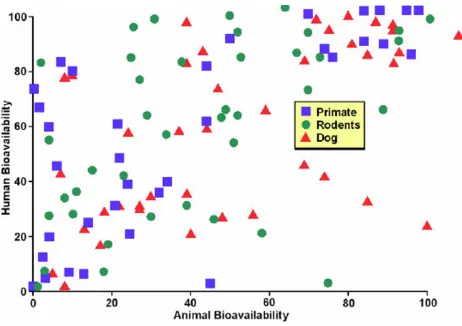
Figures 1 and 2 illustrate graphically our contention that animals are not predictive. Both figures chart bioavailabil-ity data from three species of animals and compare it to data from humans. (Bioavailability is usually defined as the fraction of a drug that reaches the systemic circulation and reflects a number of different variables. Regardless of the correlation or lack thereof of the variables, the bioa-vailability of the drug is the final determinant of how much drug presents to the receptor or active site.) Figure 1 was compiled by Harris from a paper by Grass and Sinko
in Advanced Drug Delivery Reviews. As the reader can see
the bioavailability of various drugs is measured in humans and three species of animals (representing pri-mates, rodents and dogs) and the results plotted. Some of the drugs that showed high levels of bioavailability in dogs had very low levels in humans and vice-versa. This was true regardless of drug or species. Some levels did cor-relate between species but as a whole there was no corre-lation between what a drug did in humans and what it did in any given animal species or any combination thereof.
Figure 2 was complied by Harris from a book section by Mandagere and Jones in the book Drug Bioavailability: Esti-mation of Solubility, Permeability, Absorption and
Bioavaila-bility (Methods and Principles in Medicinal Chemistry) and
made the same measurements and reached the same con-clusions as did Grass and Sinko.
The above illustrates why eliminating drugs in develop-ment based on animal tests presents problems. Sankar in
The Scientist 2005:
The typical compound entering a Phase I clinical trial has been through roughly a decade of rigorous pre-clinical testing, but still only has an 8% chance of reaching the market. Some of this high attrition rate is due to toxicity that shows up only in late-stage clinical trials, or worse, after a drug is approved. Part of the problem is that the toxicity is assessed in the later stages of drug development, after large numbers of compounds have been screened for activity and solu-bility, and the best produced in sufficient quantities for animal studies.
Howard Jacob notes that rats and humans are 90% identical at the genetic level. However, the majority of the drugs shown to be safe in animals end up failing in clinical trials. "There is only 10% predictive power, since 90% of drugs fail in the human trials" in the tra-ditional toxicology tests involving rats. Conversely, some lead compounds may be eliminated due to their toxic-ity in rats or dogs, but might actually have an acceptable
risk profile in humans [39]. (Emphasis added.)
Again, for some this alone would settle the prediction question. But we continue.
Sensitivity is not the same prediction. While it is true that that all known human carcinogens that have been
ade-Human vs animal bioavailability 1
Figure 1
Human vs animal bioavailability 1. Graph generously provided by James Harris PhD, who presented it at the Center for Business Intelligence conference titled 6th Forum on Predictive ADME/Tox held in Washington, DC September 27–29, 2006 and is
quately studied have been shown to be carcinogenic in at least one animal species [40-42], it is also true that an irreverent aphorism in biology known as Morton's Law states: "If rats are experimented upon, they will develop cancer." Morton's law is similar to Karnofsky's law in ter-atology, which states that any compound can be tera-togenic if given to the right species at the right dosage at the right time in the pregnancy. The point being that it is very easy to find positive results for carcinogenicity and teratogenicity; a high sensitivity. Nonetheless, this is meaningless without also knowing specificity, positive predictive value, and negative predictive value.
Carcinogenesis
How well do animal models predict carcinogenesis? Pos-sible carcinogens are listed in the Integrated Risk
Informa-tion System (IRIS) chemicals database managed by the Environmental Protection Agency (EPA). According to Knight et al. [43] as of 1 January 2004, IRIS was unable to classify the carcinogenic status of 93 out of 160 chemicals that had been evaluated only by animal tests. The World Health Organisation also classifies chemicals according to carcinogenicity via the International Agency for Research on Cancer (IARC).
Knight et al. wrote in 2006:
For the 128 chemicals with human or animal data also assessed by the human carcinogenicity classifications were compatible with EPA classifications only for those 17 having at least limited human data (p = 0.5896). For those 111 primarily reliant on animal
Human vs animal bioavailability 2
Figure 2
Human vs animal bioavailability 2. Graph generously provided by James Harris PhD, who presented it at the Center for Business Intelligence conference titled 6th Forum on Predictive ADME/Tox held in Washington, DC September 27–29, 2006 and is
data, the EPA was much more likely than the IARC to assign carcinogenicity classifications indicative of greater human risk (p < 0.0001) [43].
This discrepancy is troublesome. Knight et al. discussed a study in 1993 by Tomatis and Wilbourn [44]. Tomatis and Wilbourn surveyed the 780 chemical agents or expo-sure circumstances listed within Volumes 1–55 of the IARC monograph series [45]. They found that "502 (64.4%) were classified as having definite or limited evi-dence of animal carcinogenicity, and 104 (13.3%) as def-inite or probable human carcinogens ... around 398 animal carcinogens were considered not to be definite or probable human carcinogens."
Knight et al. continue:
... based on these IARC figures, the positive predictiv-ity of the animal bioassay for definite probable human carcinogens was only around 7% (104/502), while the false positive rate was a disturbing 79.3% (398/502) [43].
More-recent IARC classifications indicate little movement in the positive predictivity of the animal bioassay for human carcinogens. By January 2004, a decade later, only 105 additional agents had been added to the 1993 figure, yielding a total of 885 agents or exposure circumstances listed in the IARC Monographs [46]. Not surprisingly the proportion of definite or probable human carcinogens resembled the 1993 figure of 13.3%. By 2004, only 9.9% of these 885 were classified as definite human carcino-gens, and only 7.2% as probable human carcinocarcino-gens, yielding total of 17.1%.
Haseman [47] published a study in 2000 in which he revealed that 250 (53.1%) of chemicals in the NTP carci-nogenicity database were carcinogenic in at least one sex-species group. He concluded that the actual number pos-ing a significant carcinogenic risk to humans was proba-bly far lower. Approximately half of all chemicals tested on animals and included in the comprehensive Berkeley-based potency carcinogenic database (CPDB) were carci-nogenic [48].
Knight et al. conclude:
If a risk-avoidance interpretation is used, in which any positive result in male or female mice or rats is consid-ered positive, then nine of the 10 known human car-cinogens among the hundreds of chemicals tested by the NTP are positive, but so are an implausible 22% of all chemicals tested. If a less risk-sensitive interpreta-tion is used, whereby only chemicals positive in both mice and rats are considered positive, then only three
of the six known human carcinogens tested in both species are positive. The former interpretation could result in the needless denial of potentially useful chemicals to society, while the latter could result in widespread human exposure to undetected human carcinogens [43].
At this point in the debate, some will state that animal models can be useful in science and scientific research and attempt to conflate the word predict with the word useful. This is disingenuous for many reasons. First, useful is too ambiguous to mean anything. Useful to whom? Useful how? Almost anything can be useful in some sense of the word. If someone gets paid to engage in fortune telling then fortune telling is very useful to that person. Whether it can be used to predict the future is an entirely different question. We do not deny animal models can be quite use-ful in certain circumstances but this has nothing to do with whether they are predictive. Second, this is an exam-ple of bait and switch; sell animal models as predictive for humans then justify their use, since they are not predic-tive, because they are useful. Freeman and St Johnston illustrate this type of disingenuousness when they state:
Many scientists who work on model organisms, including both of us, have been known to contrive a connection to human disease to boost a grant or paper. It's fair: after all, the parallels are genuine, but the connection is often rather indirect. More examples will be discussed in later chapters [49].
Third, predict has a very specific meaning in science, indeed the concept of prediction is one thing that separate science from pseudoscience. By conflating useful and
pre-dict we diminish the respectability of science in general
putting it more on the level of selling used cars. Finally, we again acknowledge that studying animals can lead to new knowledge. This point is not in dispute.
Thalidomide
In approximately10 strains of rats, 15 strains of mice, 11 breeds of rabbits, 2 breeds of dogs, 3 strains of hamsters, 8 species of primates and in other such var-ied species as cats, armadillos, guinea pigs, swine and ferrets in which thalidomide has been tested, tera-togenic effects have been induced only occasionally [50].
We remind the reader that these results, and those below were from tests performed after thalidomide's affects had been observed in humans. Schardein also observes:
It is the actual results of teratogenicity testing in pri-mates which have been most disappointing in consid-eration of these animals' possible use as a predictive model. While some nine subhuman primates (all but the bushbaby) have demonstrated the characteristic limb defects observed in humans when administered thalidomide, the results with 83 other agents with which primates have been tested are less than perfect. Of the 15 listed putative human teratogens tested in nonhuman primates, only eight were also teratogenic in one or more of the various species [51].
Manson and Wise summarized the thalidomide testing as follows:
An unexpected finding was that the mouse and rat were resistant, the rabbit and hamster variably respon-sive, and certain strains of primates were sensitive to thalidomide developmental toxicity. Different strains of the same species of animals were also found to have highly variable sensitivity to thalidomide. Factors such as differences in absorption, distribution, biotransfor-mation, and placental transfer have been ruled out as causes of the variability in species and strain sensitivity [52].
Could the use of animal models have predicted thalido-mide's adverse affects? Even if all the animals mentioned above were studied the answer is no. Different species showed a wide variety of responses to thalidomide. Once again, if you bet on enough horses you will probably find a winner or if you cherry pick the data you will find a win-ner. In the present case of thalidomide, human effects were already known so cherry picking is easy. The animal models for thalidomide discussed above were aimed at retroactively simulating known human effects. Even then not many animal models succeeded. If the human effects were unknown, what would the case have looked like from the standpoint of prediction? In this case, to pursue the horse racing analogy, we would have numerous horses to bet on without any idea which one would win. Certainly one will win (which is not a given when testing on ani-mals in hopes of reproducing or guessing human
response), but which one? We cannot know that until after the fact so how do we judge prospectively which horse to wager on or which animal model to choose? Which model species were relevant to the human case in advance of the gathering of human data? This is by no means a triv-ial question as evolutionary closeness does not increase the predictive value of the model. Caldwell points out that relatively small biological differences between test sub-jects can lead to very different outcomes:
It has been obvious for some time that there is gener-ally no evolutionary basis behind the particular drug metabolizing ability of a particular species. Indeed, among rodents and primates, zoologically closely related species exhibit markedly different patterns of metabolism [53].
The thalidomide case illustrates why the overarching hypothesis that animals are predictive for humans is wrong. Again, this overarching hypothesis is in contrast to using animals as heuristic devices where the hypotheses drawn from them must be tested.
Even if we retrospectively picked all the animals that reacted to thalidomide as humans did, we still could not say these animals predicted human response as their his-tory of agreeing with human response to other drugs var-ied considerably. Prediction vis-à-vis drug testing and disease research implies a track record. Single correct guesses are not predictions. Nonhuman primates are a good example of this. They more or less reacted to thalid-omide as humans did (so we will give them the benefit of the doubt as corresponding to humans in this case). How-ever, when tested with other drugs they predicted human response about as well as a coin toss. Add to all this the fact that all the animals whose offspring exhibited phoc-omelia consequent to the administration of thalidomide did so only after being given doses 25–150 times the human dose [54-56] and it does not appear that any ani-mal, group of animals, or the animal model per se could have been used to predict thalidomide's teratogenicity in humans. (Ironically, it was the thalidomide tragedy that ushered in many of the regulatory requirements for using animals.)
the drug or not would not have been informed by animal tests. Karnofsky's law is relevant here. Any drug is tera-togenic if given to the right animal at the right time. Given thalidomide's profile today, physicians would advise pregnant women not to take the drug, which is what phy-sicians advise every pregnant woman about almost every nonlife-saving drug anyway, regardless of the results of animal tests.
The claim that thalidomide's affects were or could have been predicted by animals is an example of cherry picking the data.
The quantitative/qualitative controversy
We now move on to the quantitative/qualitative contro-versy. There is a tendency on the part of some researchers to see all differences between species as mere quantitative differences – presumably differences that can be compen-sated for in the context of prediction. Vineis and Melnick:
However, we disagree with Shanks and Pyles about the usefulness of animal experiments in predicting human hazards. Based on the darwinian observation of inter-species and inter-individual variation in all biological functions, Shanks and Pyles suggest that animal exper-iments cannot be used to identify hazards to human health. We claim that while the activity of enzymes may vary among individuals and among species, this does not indicate that critical events in disease proc-esses occurring after exposure to hazardous agents dif-fer qualitatively between animal models and humans.... For the most part, differences in how labo-ratory animals and humans metabolize environmen-tal agents, or in the interactions of these agents with molecular targets (e.g., DNA, enzymes, or nuclear receptors), are quantitative in nature [27].
This is very much a Newtonian way of thinking and it ignores the effects of biological evolution and the fact that animals are complex systems.
Toxicologists have known for a long time that species dif-ferences may be quantitative or qualitative [53,57]. Con-sider a model substrate such as phenol. Humans and rats excrete phenol through two pathways, sulfate conjugation and glucuronic acid conjugation. There is a quantitative difference between humans and rats since the ratios of sul-fate conjugation to glucuronic acid conjugation are differ-ent in each species. But there are qualitative differences too. Cats are incapable of glucuronic acid conjugation, and must excrete phenol via the sulfate pathway. For pigs the reverse is true, they cannot use the sulfate pathway, and must rely on glucuronic acid conjugation. (It is worth noting that there are at least seven metabolic pathways
that are unique to primates – for example the aromatiza-tion of quinic acid [57].)
One lesson to be drawn from this example is that even if the same function is achieved by two species (e.g., excre-tion of phenol), it does not follow that they are doing so by the exact same underlying causal mechanisms. In the context of toxicology or pharmacology, these mechanistic differences can be important in assessing safety as well as pharmacological utility.
Other voices
We are not the only ones concerned about the predictive power of animal models. The scientific community itself is not marching in lock step when it comes to the predic-tive utility of animal models. We will take a moment to examine what some of these scientists actually say about the power of animal models to predict human responses. The following quotes from scientists (and the above quotes from Leavitt and Sankar), of course, prove nothing in the sense of mathematical proof, they nevertheless pro-vide a window into the thinking of people well versed in the field and as such a reasonable person should take them seriously. They should give pause to those who think that the prediction issue is one where there is no rea-sonable controversy.
R.J. Wall and M. Shani observe:
The vast majority of animals used as models are used in biomedical preclinical trials. The predictive value of those animal studies is carefully monitored, thus pro-viding an ideal dataset for evaluating the efficacy of animal models. On average, the extrapolated results from studies using tens of millions of animals fail to accurately predict human responses ... We conclude that it is probably safer to use animal models to develop speculations, rather than using them to extrapolate [58].
Curry points out:
The failure, in the clinic, of at least fourteen potential neuroprotective agents expected to aid in recovery from stroke, after studies in animal models had pre-dicted that they would be successful, is examined in relation to principles of extrapolation of data from animals to humans [59].
Discrepancies between animal-human studies and even animal-animal studies date back centuries. Percival Pott showed coal tar was carcinogenic to humans in 1776. Yamagiwa and Ichikawa showed it was carcinogenic in some animals in 1915. But even then, rabbits did not respond as mice [60]. In 1980 there were roughly sixteen-hundred known chemicals that caused cancer in mice and rodents, but only approximately fifteen known to cause cancer in humans [61]. The Council on Scientific Affairs publishing in the Journal of the American Medical Associa-tion in 1981 stated:
The Council's consultants agree that to identify carcino-genicity in animal tests does not per se predict either risk or
outcome in human experience ... the Council is
con-cerned about the hundreds of millions of dollars that are spent each year (both in the public and private sec-tors) for the carcinogenicity testing of chemical sub-stances. The concern is particularly grave in view of the questionable scientific value of the tests when used to predict human experience [62]. (Emphasis added.)
David Salsburg of Pfizer wrote in 1983 that a report by the National Cancer Institute that examined 170 chemicals concluded that lifetime feeding studies using rodents lacked sensitivity and specificity. He stated:
If we restrict attention to long term feeding studies with mice or rats, only seven of the 19 human non-inhalation carcinogens (36.8%) have been shown to cause cancer. If we consider long term feeding or inha-lation studies and examine all 26, only 12 (46.2%) have been shown to cause cancer in rats or mice after chronic exposure by feeding or inhalation. Thus the lifetime feeding study in mice and rats appears to have less than a 50% probability of finding known human carcinogens.On the basis of probability theory, we would
have been better off to toss a coin [63]. (Emphasis
added.)
Should we discard every drug that causes cancer in ani-mals? Acetaminophen, chloramphenicol, and metronida-zole are known carcinogens in some animal species [64,65]. Phenobarbital and isoniazid are carcinogens in rodents[60,66,67]. Does this mean they never should have been released to the market? Diphenylhydantoin (phenytoin) is carcinogenic to humans but not rats and mice [68-70]. Occupational exposure to 2-naphthylamine appears to cause bladder cancer in humans. Dogs and monkeys also suffer bladder cancer if exposed to 2-naph-thylamine orally and mice suffer from hepatomas. It does not appear to have carcinogenic properties in rats and rab-bits. These are qualitative differences due to differences in metabolism of aromatic amines [71]. It also appears that fewer genetic, epigenetic, or gene expression events are
needed to induce cancer in rodents than are needed to induce cancer in humans [72-74]. (A good review of spe-cies differences in relation to carcinogenesis and why they exist is Anisimov et al. [72].)
Intraspecies differences also exist. Clofibrate, nafenopin, phenobarbital, and reserpine cause cancer in old but not young rats [68,75].
Should the above drugs that caused cancer in some ani-mal have been banned? If the null hypothesis is that there is no association between animal carcinogens and human carcinogens strong enough so the animal model can be said to be predictive, then we see much evidence to sup-port the null hypothesis but very little if any to refute it.
The point to be made here is that there are scientists (rather more than we have space to mention) who ques-tion the predictive and/or clinical value of animal-based research and history is on their side. As noted above, the opinions of scientists prove nothing in and of itself. Fur-ther, some of what we have presented could be dismissed as anecdotes but this would be a mistake. First, the studies referenced in the previous section are just that, scientific studies not anecdotes. Second, the examples presented are referenced, anecdotes are not (unless they are case reports and we must remember that thalidomide's downfall started as a series of case reports). But again we must ask where the burden of proof lies? We believe the second law of thermodynamics because there has never been an example of where it was wrong. Just one such example would falsify the law. If the animal model community claims the animal model is predictive, then they must explain the examples and studies that reveal it was not. Examples such as case reports count when disproving an assertion, especially when they are then supported with studies, but cannot be used by those making the claim as proof for their overarching hypothesis. That is how sci-ence works. We did not make the rules. In summary there is ample evidence to question, if not disprove entirely, the overarching hypothesis that animal models are predictive for humans.
To take the argument one step further, we must ask what conditions ought to be satisfied if animals are to serve as predictors of human biomedical phenomena. This is a question concerning theory and come under the heading of philosophy of science.
Theory
Models or a modality claiming predictability assumes identical causal properties. As researchers Carroll and Overmier explain in their recent book Animal Research and
Human Health [76], and as LaFollette and Shanks also do
in Brute Science[3], animals in biomedical research are fre-quently used as causal analogical models (CAMs). If the heart pumps blood in a chimpanzee, then we reason by analogy it will pump blood in humans also. If fen-phen is safe for the hearts of animals we reason by analogy it will be safe for human hearts as well [77]. Carroll and Over-mier state:
When the experimenter devises challenges to the ani-mal and studies a causal chain that, through analogy, can be seen to parallel the challenges to humans, the experimenter is using an animal model [76].
These are examples of using animals as CAMs or predic-tive models according to the traditionally used definition of the word prediction and as used by us in this article. We will discuss CAMs more fully in the section on theory.
Animal models in this sense involve causal analogical rea-soning. First, what is a causal analogical model (CAM) and how does it involve causal analogical reasoning? The first condition that must be met in order for a thing to be considered a CAM is this: "X (the model) is similar to Y (the object being modelled) in respects {a...e}." If "X has additional property f, then while f has not been observed directly in Y, likely Y also has property f [3]." This latter claim is something that needs to be tested. In the present case it means the gathering of human data.
This first condition is not enough. For instance chimpan-zees and humans have (a) an immune system, (b) have 99% of their DNA in common with humans, (c) contract viruses, etc. HIV reproduces very slowly in chimpanzees. We therefore expect HIV to reproduce slowly in humans. [3]. So if HIV replicates slowly in chimpanzees, animal experimenters reason by analogy that it will do the same in humans. This turns out to be false.
CAMs must satisfy two further conditions: (1) the com-mon properties (a, ..., e) must be causal properties which (2) are causally connected with the property (f) we wish to project – specifically, (f) should stand as the cause(s) or effect(s) of the features (a, ..., e) in the model. When ani-mals are used as causal analogical models the reasoning process taking us from results in the model to the system modelled is called causal analogical reasoning [3].
But it is not enough simply to point to similarities to jus-tify cross-species extrapolation in the context of causal analogical reasoning. In complex, interactive systems such as organisms, we need to know whether there are relevant
causal differences, i.e., causal disanalogies (with respect to mechanisms and pathways) that compromise the useful-ness of the analogical reasoning. In other words, for a CAM to be predictive, there should be no causally-rele-vant disanalogies between the model and the thing being modeled. For example, there must be no properties {g, h, i} unique to either the model or the object modelled that causally interact with the common properties {a...e}, since such properties will likely compromise the predic-tive utility of the model.
The idea here is an old one. It concerns causal determinism
– a concept that has played a fundamental role in the development of modern science. Causal determinism rests on two basic principles: (1) The Principle of Causality, according to which all events have causes; and (2) The
Principle of Uniformity, according to which, for
qualita-tively identical system, all other things being equal, same cause is always followed by same effect.
These ideas played a role in our earlier discussion of New-tonian mechanics at the beginning of this essay. In a way, the whole issue of prediction comes down to the principle of uniformity. Are the animals used to make predictions about humans qualitatively identical to humans once allowances have been made for difference in body weight or surface area? No reasonable person who understands evolutionary biology, and who knows, for example, that rodents and humans have taken very different evolution-ary trajectories since the lineages leading to modern humans and rodents, respectively, diverged over seventy million years ago, will expect qualitative identity. But per-haps qualitative identity is an ideal that can only be approximated. Are humans and their animal models suf-ficiently similar for approximate predictions to be made? The numerous studies referenced above, say no. Why is this the case?
suffi-cient for some to conclude that animal models cannot be predictive for human; that transspecies extrapolation is impossible vis-à-vis drug response and disease research especially when analyzed in lights of the standards society today demands. (And the standards not set too high. If you think they are ask yourself if, had you taken rofecoxib and been harmed, would you have accepted a .99 PPV as acceptable?)
In biomedicine we do not have the mathematician's lux-ury of modeling humans and rodents by beginning, "let humans and rodents be spheres." If only it were that sim-ple. Instead, what we do have are a lot of theoretical grounds for questioning the predictive utility of animal models. But of course, such theoretical reasoning may be dismissed as being just that. The real question is one of evidence. We have examined the evidence against and found it compelling but we should now examine the evi-dence cited as supporting the predictive nature of animals. We will now turn our attention to the famous Olson study, which many suppose to have settled the matters at hand firmly on the side of animal model being predictive for humans.
The Famous Olson Study
The Olson study [78] purports (and has certainly been cited in this regard) to provide evidence of the vast predic-tive utility of animal models in assessing human toxicity. In response to an article by Shanks et al. [79] Conn and Parker quoted the Olson study stating:
The authors have simply overlooked the classic study (Olson, Harry, et al.., 2000. "Concordance of the Tox-icity of Pharmaceuticals in Humans and in Animals."
Regul Toxicol Pharmacol32, 56–67) that summarizes
the results from 12 international pharmaceutical com-panies on the predictivity of animal tests in human toxicity. While the study is not perfect, the overall con-clusion from 150 compounds and 221 human toxicity events was that animal testing has significant predic-tive power to detect most – but not all – areas of human toxicity [80]. (Emphasis theirs.)
We encourage the reader to examine the Olson Study in its entirety. Here we include some important representative paragraphs from the Olson study and our commentary will follow. We apologize for the length of the quote but due to the importance many place on the paper, we believe a thorough examination is justified.
This report summarizes the results of a multinational pharmaceutical company survey and the outcome of an International Life Sciences Institute (ILSI) Work-shop (April 1999), which served to better understand
concordance of the toxicity of pharmaceuticals observed
in humans with that observed in experimental ani-mals. The Workshop included representatives from academia, the multinational pharmaceutical industry, and international regulatory scientists.The main aim of this project was to examine the strengths and weaknesses of animal studies to predict human toxicity (HT). The data-base was developed from a survey which covered only those compounds where HTs were identified during clinical
development of new pharmaceuticals, determining
whether animal toxicity studies identified concordant target organ toxicities in humans ...
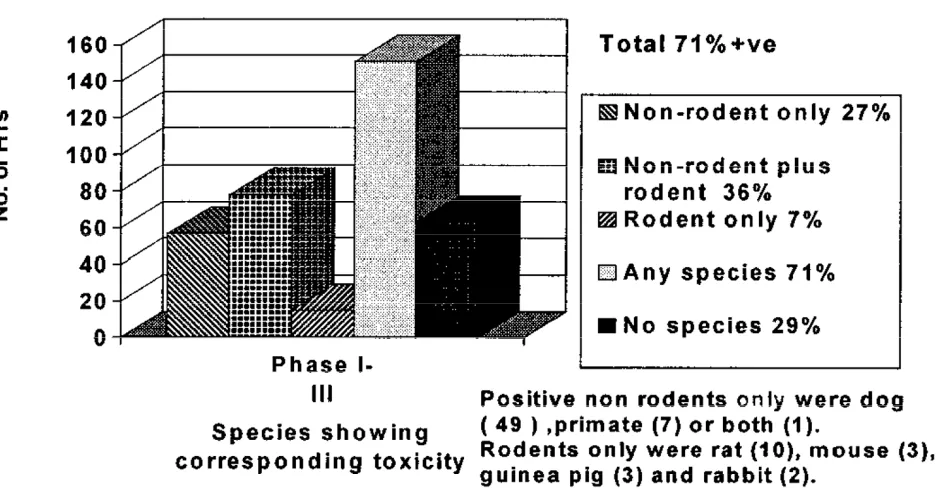
The results showed the true positive HT concordance rate
of 71% for rodent and nonrodent species, with
nonro-dents alone being predictive for 63% of HTs and rodents alone for 43%. The highest incidence of over-all concordance was seen in hematological, gastroin-testinal, and cardiovascular HTs, and the least was seen in cutaneous HT. Where animal models, in one or more species, identified concordant HT, 94% were first observed in studies of 1 month or less in duration. These survey results support the value of in vivo toxicology studies to predict for many significant HTs associated with pharmaceuticals and have helped to identify HT categories that may benefit from improved methods ...
The primary objective was to examine how well toxicities seen in preclinical animal studies would predict actual human toxicities for a number of specific target organs using a database of existing information ...
Although a considerable effort was made to collect data that would enable a direct comparison of animal and human toxicity, it was recognized from the outset that the data could not answer completely the question of how well ani-mal studies predict overall the responses of humans. To achieve this would require information on all four boxes in Fig. 1, and this was not practicable at this stage. The mag-nitude of the data collection effort that this would require was considered impractical at this stage. The present analysis is a first step, in which data have been col-lected pertaining only to the left column of Fig. 1: true pos-itives and false negatives. [See figure 3.] By definition, therefore the database only contains compounds stud-ied in humans (and not on those that never reached humans because they were considered too toxic in ani-mals or were withdrawn for reasons unrelated to tox-icity). Despite this limitation, it was deemed useful to proceed in the expectation that any conclusions that emerged would address some of the key questions and focus attention on some of the strengths and weak-nesses of animal studies ...
Olsen figure 1
Figure 3 Olsen figure 1.
Olsen figure 3
included in the analysis. For inclusion a HT (a) had to be responsible for termination of development, (b) had to have resulted in a limitation of the dosage, (c) had to have required drug level monitoring and per-haps dose adjustment, or (d) had to have restricted the target patient population. The HT threshold of severity could be modulated by the compound's therapeutic class (e.g., anticancer vs anti-inflammatory drugs). In this way, the myriad of lesser "side effects" that always accompany new drug development but are not sufficient to
restrict development were excluded. The judgments of the
contributing industrial clinicians were final as to the validity of including a compound. The clinical trial phase when the HT was first detected and whether HT was considered to be pharmacology-related was recorded. HTs were categorized by organ system and detailed symptoms according to standard nomencla-ture (COSTART, National Technical Information Serv-ice, 1999) ...
Concordance by one or more species: Overall and by HT. Overall, the true positive concordance rate (sensitivity) was 70% for one or more preclinical animal model species (either in safety pharmacology or in safety toxicology) showing target organ toxicity in the same organ system as the HT [Fig. 4].
This study did not attempt to assess the predictability of
pre-clinical experimental data to humans. What it evaluated
was the concordance between adverse findings in clin-ical data with data which had been generated in exper-imental animals (preclinical toxicology) [78]. (Emphasis added.)
The Olson Study, as noted above, has been employed by researchers to justify claims about the predictive utility of animal models. However we think there is much less here than meets the eye. Here's why:
1. The study was primarily conducted and published by the pharmaceutical industry. This does not, in and of itself, invalidate the study. However, one should never lose sight of the fact that the study was put together by par-ties with a vested interest in the outcome. If this was the only concern, perhaps it could be ignored, however, as we will now show, there are some rather more serious flaws.
2. The study says at the outset that it is aimed at measuring the predictive reliability of animal models. Later the authors concede that their methods are not, as a matter of fact, up to this task. This makes us wonder how many of those who cite the study have actually read it in its entirety.
3. The authors of the study invented new statistical termi-nology to describe the results. The crucial term here is "true positive concordance rate" which sounds similar to "true predictive value" (which is what should have been measured, but was not). A Google search on "true positive concordance rate" yielded twelve results (counting repeats), all of which referred to the Olson Study (see fig-ure 5). At least seven of the twelve Google hits qualified the term "true positive concordance rate" with the term "sensitivity" – a well-known statistical concept. In effect, these two terms are synonyms. Presumably the authors of the study must have known that "sensitivity" does not measure "true predictive value." In addition you would need information on "specificity" and so on, to nail down this latter quantity. If all the Olson Study measured was sensitivity, its conclusions are largely irrelevant to the great prediction debate.
4. Any animals giving the same response as a human was counted as a positive result. So if six species were tested and one of the six mimicked humans that was counted as a positive. The Olson Study was concerned primarily not with prediction, but with retroactive simulation of ante-cedently know human results.
5. Only drugs in clinical trials were studied. Many drugs tested do not actually get that far because they fail in ani-mal studies.
6. "...the myriad of lesser "side effects" that always accom-pany new drug development but are not sufficient to restrict development were excluded." A lesser side effect is one that affects someone else. While hepatotoxicity is a major side effect, lesser side effects (which actually matter to patients) concern profound nausea, tinnitus, pleuritis, headaches and so forth. We are also left wondering whether there was any independent scientific validity for the criteria used to divide side effects into major side effects and lesser side effects.
7. Even if all the data is good – and it may well be – sensi-tivity (i.e. true positive concordance rate) of 70% does not settle the prediction question. Sensitivity is not synony-mous with prediction and even if a 70% positive predic-tion value rate is assumed, when predicting human response 70% is inadequate. In carcinogenicity studies, the sensitivity using rodents may well be 100%, the specif-icity, however, is another story. That is the reason rodents cannot be said to predict human outcomes in that partic-ular biomedical context.
Google results
Figure 5 Google results.
! """##$%&'(!!)))(!!*$'+*'* ' *' *'* '
Web Images Maps News Shopping Gmail more Sign in
Advanced SearchPreferences
Web Books Results 1 - 12 of 12 for "truepositiveconcordance rate" . (0.30 seconds) Concordance of the Toxicity of Pharmaceuticals in Humans and in ...
Overall, the true positive concordance rate (sen-. sitivity) was 70% for one or more preclinical animal. TABLE 2. Distribution of Compounds by Therapeutic ...
linkinghub.elsevier.com/retrieve/pii/S0273230000913990 - Similar pages
European Journal of Pharmaceutical Sciences : Early microdose drug ... There was a true positive concordance rate of 71% for comparable target organs in rodent plus non-rodent studies and identified human toxicities for 150 ...
linkinghub.elsevier.com/retrieve/pii/S092809870300040X - Similar pages
Histopathology of Preclinical Toxicity Studies: Interpretation and ... - Google Books Result
by Peter Greaves - 2007 - Medical - 953 pages
Overall, the true positive concordance rate (sensitivity) is of the order of 70% with 30% of human toxicities not predicted by safety pharmacology or ...
books.google.com/books?isbn=0444527710...
First dose of potential new medicines to humans: how animals help ...
Overall, the true positive concordance rate (sensitivity) of the data derived from conventional studies is of the order of 70%, with 30% of human toxicities ...
www.nature.com/nrd/journal/v3/n3/full/nrd1329.html - Similar pages
First dose of potential new medicines to humans: how animals help ... Overall, the true positive concordance rate (sensitivity) of the data derived from conventional studies is of the order of 70%, with 30% of human toxicities ...
www.nature.com/nrd/journal/v3/n3/full/
nrd1329.html;jsessionid=AC7F28279806834829F7F100EEEE4E6E - Similar pages
7100048a 440..447
showed the true positive concordance rate of 70%. for rodent and non-rodent species, with non-rodents. alone being predictive for 63% of HTs and rodents ...
www.ingentaconnect.com/content/sage/ het/2000/00000019/00000008/7100048a? crawler=true - Similar pages
7100048a 440..447
showed the true positive concordance rate of 70%. for rodent and non-rodent species, with non-rodents. alone being predictive for 63% of HTs and rodents ...
! ! """##$%&'(!!)))(!!*$'+*'* ' *' *'* '
www.ingentaconnect.com/content/ arn/het/2000/00000019/00000008/7100048a
-Similar pages
First dose of potential new medicines to humans: how animals help ... Overall, the true positive concordance rate (sensitivity) of the data derived from conventional studies is of the order of 70%, with 30% of human toxicities ...
www.naturereprints.com/ nrd/journal/v3/n3/full/nrd1329.html - Similar pages
"Pre-clinical Safety Evaluation". In: Pharmacovigilance
Overall, the true positive concordance rate was. 70% for the pre-clinical animal species to show. target organ toxicity in the same organ system as ...
doi.wiley.com/10.1002/0470853093.ch5 - Similar pages
First dose of potential new medicines to humans: how animals help ... Overall, the true positive concordance rate (sensitivity) of the data derived from conventional studies is of the order of 70%, with 30% of human toxicities ...
www.emboj.org/nrd/journal/v3/n3/full/nrd1329.html - Similar pages
First dose of potential new medicines to humans: how animals help ... Overall, the true positive concordance rate (sensitivity) of the data derived from conventional studies is of the order of 70%, with 30% of human toxicities ...
intl.emboj.org/nrd/journal/v3/n3/full/nrd1329.html - Similar pages
[PDF]FIRST DOSE OF POTENTIAL NEW MEDICINES TO HUMANS: HOW ANIMALS HELP
File Format: PDF/Adobe Acrobat - View as HTML
true positive concordance rate (sensitivity) of the data. derived from conventional studies is of the order of. 70%, with 30% of human toxicities not ...
npg.nature.com/nrd/journal/v3/n3/pdf/nrd1329.pdf - Similar pages
Search within results | Language Tools | Search Tips | Dissatisfied? Help us improve |
Try Google Experimental
Google Home - Advertising Programs - Business Solutions - Privacy - About Google
Google on 7/23/08) led us to 114 citations for the Olson paper. We question whether caution is being used in all these citations.
Conclusion
Mark Kac stated, "A proof is that which convinces a rea-sonable man." Even though the burden of proof is not on us to prove animal models are not predictive, we believe we have presented a proof that would convince a reason-able man.
There are both quantitative and qualitative differences between species. This is not surprising considering our current level of knowledge vis-à-vis evo devo, gene regula-tion and expression, epigenetics, complexity theory, and comparative genomics. Hypotheses generate predictions, which can be then proven true or false. Predict has a very distinct meaning in science and according to some is the foundation of science itself. Prediction does not mean ret-rospectively finding one animal that responded to stimuli like humans and therefore saying that the animal pre-dicted human response nor does it mean cherry picking data nor does it mean occasionally getting the right answer.
When a concept such as "Animal models can predict human response" is accepted as true, it is not functioning as a hypothesis. We have referred to this as an overarching hypothesis but could have easily referred to it as an unfounded assumption. An assumption or overarching hypothesis might in fact be true but its truth must be proven. If a modality such as animal testing or using ani-mals to predict pathophysiology in human disease is said to be a predictive modality, then any data generated from said modality should have a very high probability of being true in humans. Animal models of disease and drug response fail this criterion.
In medicine, even positive predictive values of .99 may be inadequate for some tests and animal models do not even roughly approximate that. Therefore, animal models are not predictors of human response. Some animals do occa-sionally respond to stimuli as do humans. However, how are we to know prospectively which animal will mimic humans? Advocates who maintain animals are predictive confuse sensitivity with prediction. Animals as a group are extremely sensitive for carcinogenicity or other biological phenomena. Test one hundred different strains or species and one is very likely to react like humans. But the specif-icity is very low; likewise the positive and negative predic-tive values. (Even if science did decide to abandon the historically correct use of the word predict, every time an animal-model advocate said animal species × predicted human response Y, she would also have to admit that ani-mal species A, B, C, D, E and so forth predicted incorrectly.
Thus justifying the use of animals because animal models
per se to make our drug supply safer or predict facts about
human disease would not be true.)
Some have suggested we should not criticize animal mod-els unless we have better suggestions for research and test-ing [27]. It is not incumbent upon us to postpone criticizing animal models as not being predictive until predictive models such as in silico, in vitro or in vivo are available. Nor is it incumbent upon us to invent such modalities. Astrology is not predictive for foretelling the future therefore we criticize such use even though we have no notion of how to go about inventing such a future-tell-ing device.
Some have also suggested that animal models may some-day be predictive and that we should so acknowledge. While this is true in the sense that anything is possible it seems very unlikely, as genetically modified organisms have been seen to suffer the same prediction problems we have addressed [16,81-87] and, as mentioned different humans have very different responses to drugs and dis-ease. Considering our current understanding of complex systems and evolution it would be surprising if one spe-cies could be used to predict outcomes in another at the fine-grained level where our study of disease and drug response is today and to the accuracy that society demands from medical science.
There are direct and indirect consequences to this misun-derstanding of what prediction means. If we did not allow on the market any chemical or drug that causes cancer, or is teratogenic, or causes severe side effects in any species, then we would have no chemicals or drugs at all. Further-more, there is a cost to keeping otherwise good chemicals off the market. We lose: treatments perhaps even cures; the income that could have been generated; and new knowledge that could have been gained from learning more about the chemical. These are not insignificant downsides. Since we now understand vis-à-vis personal-ized medicine that even humans differ in their response to drugs and disease and hence one human cannot predict what a drug will do to another human, it seems illogical to find models that are predictive using completely differ-ent species from humans. If we truly want predictive tests and research methods (and we do), it would seem logical to start looking intraspecies not interspecies.
Competing interests
The authors declare that they have no competing interests.