O R I G I N A L A R T I C L E
Open Access
Effects of cues to event segmentation on
subsequent memory
David A. Gold
1*, Jeffrey M. Zacks
2and Shaney Flores
2Abstract
To remember everyday activity it is important to encode it effectively, and one important component of everyday activity is that it consists of events. People who segment activity into events more adaptively have better subsequent memory for that activity, and event boundaries are remembered better than event middles. The current study asked whether intervening to improve segmentation by cuing effective event boundaries would enhance subsequent memory for events. We selected a set of movies that had previously been segmented by a large sample of observers and edited them to provide visual and auditory cues to encourage segmentation. For each movie, cues were placed either at event boundaries or event middles, or the movie was left unedited. To further support the encoding of our everyday event movies, we also included post-viewing summaries of the movies. We hypothesized that cuing at event boundaries would improve memory, and that this might reduce age differences in memory. For both younger and older adults, we found that cuing event boundaries improved memory—particularly for the boundaries that were cued. Cuing event middles also improved memory, though to a lesser degree; this suggests that imposing a segmental structure on activity may facilitate memory encoding, even when segmentation is not optimal. These results provide evidence that structural cuing can improve memory for everyday events in younger and older adults.
Keywords:Event cognition, Cognitive aging, Event segmentation theory, Event horizon model
Significance
Many of us would like to be able to remember events better, and memory problems are a particular concern of older adults. For structured materials such as shopping lists and colleagues’names one can use techniques such as the method of loci or spaced retrieval practice. How-ever, often what we want to remember is not structured lists of words or pictures but everyday events. This sort of memory allows us to answer questions such as“How was the party last night?”or“What happened in the last episode of that TV show?”How can we improve it?
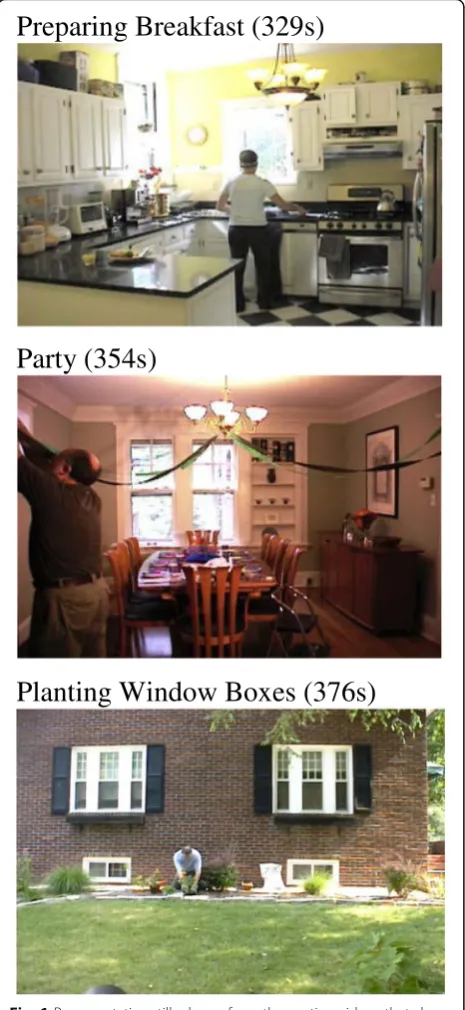
Here, we describe a theory-driven intervention moti-vated by this problem. The intervention targets event encoding by inserting pauses and visual signals into a movie (see Fig. 1). These cues are placed at natural event boundaries, as determined by an empirically validated theory of event segmentation. In two experiments, this intervention improved memory for events for both
younger and older adults. Interestingly, adding cues to the movies helped memory even when they were mis-timed relative to the boundaries—though not as much as cues at event boundaries.
Together, these results support two implications for potential memory aids: first, using cues to guide event segmentation facilitates memory. Second, encouraging even a suboptimal segmentation is somewhat beneficial.
At the moment, this technique requires editing of vid-eos prior to presentation. However, it should be possible to adapt it for use with televised events or instructional videos to encourage effective encoding, much like closed captioning facilitates comprehension for those with hear-ing deficits.
Background
Memory problems are a frequent complaint of aging (Reid & MacLullich, 2006; Smith, Petersen, Ivnik, Malec, & Tangalos, 1996). These include “trouble remembering things that have happened recently,” “remembering where belongings are kept,” and “remembering things that have happened recently” (Jorm et al., 1997). * Correspondence:[email protected]
1Krembil Neuroscience Centre, University Health Network, Toronto Western
Hospital, Neuropsychology Clinic, 4F-409, 399 Bathurst St., Toronto, ON M5T 2S8, Canada
Full list of author information is available at the end of the article
However, there is a gap between the memory errors that are reported as concerns and the memory errors typic-ally measured in the laboratory. Most previous studies of age-related differences in memory have depended on simple verbal or pictorial materials (Zacks, Hasher, & Li, 2000). As a result, interventions to improve memory in older adults have largely focused on techniques that are effective for remembering such simple materials. These
include visual imagery, the method of loci, and semantic organization (Ball et al., 2002; Belleville et al., 2006). While such techniques may be helpful for tasks such as memorizing a shopping list or learning the names of new acquaintances, they offer limited opportunity to im-prove one’s ability to remember a complex naturalistic sequence of events. This sort of memory is important for performing everyday activities such as preparing meals, managing medications, and running errands.
In order to remember events well, one needs to en-code them effectively. Studies of narrative comprehen-sion and memory show that online measures of comprehension strongly predict subsequent memory for stories and movies. For example, van den Broek and colleagues developed a computational model of narra-tive reading that describes how concepts mentioned in a text fluctuate in activation over time, and how a con-cept’s history of activation is related to subsequent memory (van den Broek, Young, Tzeng, & Linderholm, 1999). They compared the model’s predictions to data from participants who were probed while reading about how much they were thinking of the concepts. The model nicely predicted the participants’ ratings. Fur-ther, the participants’subsequent memory was related to these readings just as predicted by the model. An-other example used a television comedy as the stimu-lus, and tracked brain activity over time as the assay of online processing (Hasson, Furman, Clark, Dudai, & Davachi, 2008). Effective online encoding was defined as brain activity that was consistent across viewers. During periods when brain activity was synchronized between two viewers, both tended to recall more.
Both comprehension and memory can be affected by aging (Madden & Dijkstra, 2009; Radvansky, 1999; Zacks, 1989). Four relevant observations emerge from the literature on the effects of age on comprehension and memory for naturalistic materials. First, whereas memory for simple ar-bitrary materials is almost always worse in older adults than in younger adults, memory for meaningful materials is often excellent in older adults. Second, older adults often have comprehension that is as good as that of younger adults, sometimes better. Third, comprehension in older adults benefits from being able to use previous knowledge to scaf-fold, constructing an online representation of a sequence of events. Finally, older adults benefit from using embodied perceptual-motor features of activity during comprehension. These findings can be nicely accounted for by distin-guishing between representations of incidental details of a set of materials and event models that represent the meaningful and salient aspects of situations described by those materials (Kintsch & van Dijk, 1978; Radvansky & Zacks, 2014). Older adults may preferentially favor event model representations at the expense of incidental details. These considerations suggest that comprehension and
Preparing Breakfast (329s)
Party (354s)
Planting Window Boxes (376s)
memory for activity by older adults could be facilitated by supporting construction of an effective representation of events as they are experienced.
One particularly important aspect of events is that they have parts that are systematically related to each other (Byrne, 2002; Cohen, 2000; Zacks & Tversky, 2001). For example, the everyday activity of making a bed includes parts such as “removing the dirty sheets” and “putting on the pillow cases.” In order to effectively remember everyday activities, it is important to effectively track this structure during encoding. In the laboratory, people’s ability to segment ongoing activity into events can be studied using a simple task in which they are asked to mark off boundaries between events while watching a movie (Newtson, 1976). Boundaries identified in this way tend to be hierarchically organized, such that boundaries of coarser-grained events line up with boundaries of finer-grained events (Zacks, Tversky, & Iyer, 2001) and tend to enclose those finer-grained boundaries (Hard, Recchia, & Tversky, 2011). Across observers, there is good agreement about the locations of event boundaries (Hanson & Hirst, 1989; Newtson, 1976). The boundaries of the largest units that individuals identify tend to align with the boundaries of smaller units, and healthy younger adults show remark-able agreement about where they believe an event bound-ary occurs (Kurby & Zacks, 2011). Event boundaries are associated with substantial transient changes in brain activity as measured with functional magnetic resonance imaging (MRI), whether or not individuals are actively parsing the activity with a segmentation paradigm or passively viewing the video (Zacks et al., 2001). The be-havioral reliability and concomitant brain activity associ-ated with segmentation suggest that normal perception of activity tracks event boundaries.
Previous studies have found that the ability to segment an ongoing activity into meaningful events is associated with subsequent memory for the activity (Bailey et al., 2013; Sargent et al., 2013). In these studies, event segmentation ability has been measured by comparing each individual’s segmentation with a normative sample of segmentation, a measure called segmentation agree-ment (Kurby & Zacks, 2011). Segagree-mentation agreeagree-ment also is associated with the ability to perform everyday actions effectively (Bailey, Kurby, Giovannetti, & Zacks, 2013). Segmentation agreement sometimes is found to be impaired in healthy older adults (Zacks, Speer, Vettel, & Jacoby, 2006; but see Sargent et al., 2013), and is impaired in early Alzheimer’s disease (Bailey, Zacks, et al., 2013; Zacks et al., 2006).
One potential mechanism for the effect of segmenta-tion ability on subsequent memory is provided by the event horizon model (Radvansky, 2012; Radvansky & Zacks, 2014). The event horizon model is defined by five principles, of which two are relevant here. Principle 1
states that “continuous ongoing activity is segmented into discrete events, and an event model is constructed for each event.” The segmentation mechanism adopted by the event horizon model is event segmentation theory (EST; Zacks, Speer, Swallow, Braver, & Reynolds, 2007). EST proposes that comprehenders make predictions about the near future, guided by their event models. The accuracy of these predictions is monitored by the event comprehension system, and when a transient spike in prediction error occurs the event model is updated.
The second principle of the event horizon model that is relevant here is principle 5:“When several events are similar accessing any specific event model is difficult.”In naturalistic activity, effective event boundaries tend to correspond to points in time when many features of the situation are changing (Newtson, Engquist, & Bois, 1977; Zacks, Kumar, Abrams, & Mehta, 2009; Zacks, Speer, & Reynolds, 2009). Effective segmentation reduces compe-tition during memory retrieval by binding together intervals with similar feature values, and establishing boundaries when feature values are changing. Ineffective segmentation leads to event boundaries with similar feature values on either side of the boundary, exacerbating retrieval competition.
If people who segment activity more effectively have better subsequent memory for that activity, is it possible to improve memory by intervening to improve segmen-tation? A very small number of previous studies hint that this may be effective. For example, one study added commercial breaks to a detective television program, either at event boundaries or at the middles of events (Boltz, 1992). When commercials were placed at event boundaries they improved memory, but when they were placed at event middles they impaired memory. In an-other study, participants learned how to perform assem-bly tasks using computer interfaces that either reinforced effective event segmentation or worked against effective segmentation (Zacks & Tversky, 2003). For example, in one experiment participants learned to assemble a tenor saxophone using an interface that either broke down the activity into events based on experts’segmentation judg-ments, or simply presented the video. Compared to simply watching a video demonstration, interfaces based on effective segmentation facilitated memory and learning, whereas interfaces based on ineffective segmentation im-paired performance. More recently, researchers have created customized instructional manuals based on an individual’s own event segmentation pattern to create a unique guide for the learner (Mura, Petersen, Huff, & Ghose, 2013).
The current study
we have reviewed suggest that segmentation is an attractive target for intervention to improve adult mem-ory, for three reasons. First, segmentation predicts subsequent memory. Second, both segmentation and memory are inefficient in older adults. Third, the limited extant data indicate that in younger adults, improving segmentation can improve memory and learning.
Therefore, in the two experiments reported here, we designed an intervention to scaffold event segmentation during encoding and tested it in younger and older adults. The basic intervention was to provide visual and auditory cues as to when the event boundaries occurred. To further support adaptive encoding, this condition also included post-viewing summaries of the videos that reviewed the event boundaries. In each experiment we compared this event boundary condition to two other conditions: an unedited condition in which the movies were provided without any cues, and an event middle condition in which cues were provided in the middle of events rather than at boundaries and the event middles were reviewed in the post-viewing summary.
We hypothesized that younger adults would show better recognition and recall memory for the unedited movies than older adults (Sargent et al., 2013). If the structural cues at event boundaries are able to modify the encoding of event structure, then older adults should show benefits in their memory in the event boundary condition. We anticipated that in the event middle condition, cues at midpoints of the video might improve memory for midpoint information in older adults, but that it would impair memory for event boundary infor-mation. To preview an unexpected result, we found that cuing event middles generally improved memory, though not as much as cuing event boundaries. One possibility is that providing even a maladaptive structure to guide encoding can be helpful in forming an integrated, dur-able representation (Craik & Lockhart, 1972). We will return to this issue in“General Discussion”.
Experiment 1
Young and older adults viewed videos of everyday events with visual and auditory cues at either the event boundaries or event middles, followed by highlights of the cued segments to reinforce the structure. We examined whether structural cues at event boundaries or event middles influ-enced memory for the activities relative to the control condition of an unedited presentation of the video.
Method Participants
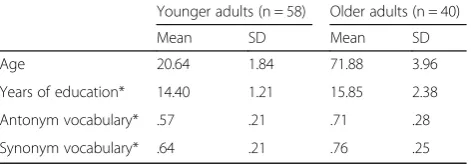
Demographic information for the sample is summarized in Table 1. We recruited 71 older adults (65% female; ages 65−85 years) through community advertisements and a department volunteer pool of older adults, and 61
younger adults (53% female; ages 18−25 years) from a university undergraduate volunteer pool. To screen for the presence of dementia, older adults were required to score less than 5 on the Short Blessed Test (Katzman et al., 1983) and less than 2 on the Ascertain Dementia 8-item questionnaire (AD-8) (Galvin et al., 2005). Additionally, older adults could not have any health conditions known to have deleterious effects on cognition, including: general anesthesia within the last year; recent head injury with loss of consciousness; a lifetime history of moderate traumatic brain injury; vascular events; untreated hypertension; neurological conditions; metabolic disorders; current or previous alcohol or substance misuse; psychiatric illness; or current use of psychotropic medications (including sleep-ing pills). In the older adult group, 71 individuals com-pleted phone screening, and 41 met the criteria for and participated in the experiment. Younger adults were not screened for health conditions. Participants received $10 per hour or course credit (younger adults only) for their time and effort.
Event movie stimuli
Participants watched movies depicting a single actor performing an everyday activity: preparing breakfast (329 s), setting up for a party (354 s), and planting window boxes (376 s). A practice movie depicting a man building a boat out of Duplos blocks (371 s) also was included. All movies were filmed in a single continuous shot at a fixed camera angle (see Sargent et al., 2013 for details). Movies were counterbalanced in three presenta-tion condipresenta-tions: (1) unedited: a continuous shot of an actor performing an everyday action; (2) event boundary: boundaries between meaningful events were marked by a bell sound, a brief slowing of the movie, and the pres-entation of an arrow pointing toward the object being used at the boundary; and (3) event middle: points at the temporal midpoint of meaningful events were marked using the same three cues. Examples and the full stimulus set can be viewed at https://pages.wus- tl.edu/dcl/stimuli-effects-cues-event-segmentation-sub-sequent-memory.
Event boundaries were identified based on the coarse-grained segmentation data from Sargent et al. (2013).
Table 1Demographic information for experiment 1
Younger adults (n = 58) Older adults (n = 40)
Mean SD Mean SD
Age 20.64 1.84 71.88 3.96
Years of education* 14.40 1.21 15.85 2.38
Antonym vocabulary* .57 .21 .71 .28
Synonym vocabulary* .64 .21 .76 .25
*
For that experiment, participants viewed the movies and pressed a button to indicate when they judged a large meaningful event to end and another to begin. The par-ticipants’ (n= 208) button presses were aggregated into the probability density of identifying a coarse boundary with Gaussian kernel density estimation (3-s bandwidth) as outlined in Kurby and Zacks (2011). The peaks in the distribution of button presses for the duration of the video represent points of maximal agreement between raters about the temporal location of event boundaries.
The mean time between event boundaries was 16.74 s (SD = 5.73 s) for the 19 event boundaries extracted from preparing breakfast, 27.21 s (SD = 20.55 s) for the 12 event boundaries for setting up for a party, and 19.69 s (SD = 6.21 s) for the 17 event boundaries for planting window boxes. The first and last coarse boundary units were removed from the analysis because participants universally identify the entrance and exit of the actor in the video as event boundaries. Still pictures of the event boundaries and event midpoints were extracted for pre-paring breakfast (n= 19), setting up for a party (n= 12), and planting window boxes (n= 17) movies. The mid-points were identified as the temporal midpoint between successive event boundaries. In the one second preced-ing each boundary, the movie was slowed to 50% speed in order to provide a graceful transition to the freezing of the movie frame, followed by a one-second still frame at the event boundary. Concurrent with the still frame, a bell rang and the object that the actor was interacting with was cued with a red arrow. The movie resumed with another second of 50% speed and then continued at the normal rate. In some cases, the object could not be cued precisely when the event boundary was identified due to occlusion of objects (e.g., a refrigerator door blocking the view of the object to be cued). In these cases (n= 16 or 33% of the objects cued), the time point closest to the boundary where the target object could be seen was selected (none of the objects were cued more than 2.5 seconds from the prescribed event boundary or midpoint). The same procedure was used to cue event middles, except that editing was done at the temporal midpoint between two event boundaries.
For the event boundary and event middle conditions, summary movies (highlights) were created from the still frames drawn from either the event boundary or event middle. The frames were individually presented on the screen for 3 seconds at a time, with a 250-ms faded tran-sition before and after the still was presented, to make the transitions between frames more natural.
To select still pictures for recognition testing, we re-cruited a separate sample of Amazon Mechanical Turk participants (n= 80) to watch the unedited movies and complete a 20-item, two-alternative forced-choice recog-nition task with the event boundary and event middle
images following each movie. These target images were matched to lures drawn from movies depicting the same actor in the same setting but had substantial differences in the activity; for example, for the breakfast movie, items were prepared in a different order using different tech-niques (see Sargent et al., 2013). Lures were additionally matched to targets for visual properties such as luminance and contrast. For each movie, we selected 10 frames drawn from event boundaries (hereafter called boundary information) and 10 frames drawn from event middles (hereafter called midpoint information) for which responses were near 75% correct, so as to provide max-imal sensitivity to the experimental manipulations.
Memory measures
Directly following presentation of each movie, memory for the movie was assessed using three measures from Zacks et al. (2006): recall, recognition and order mem-ory. For recall, participants were instructed to type or describe in detail, the activity in the movie in the order that it occurred. Participants typed their responses on a laptop, but, if the participant preferred, the experimenter was allowed to transcribe the participant’s response for them (four older adults and one younger adult elected to do this). A maximum of 7 minutes was given to complete this task, and the time to complete the task was recorded. Participant responses were scored for ac-curacy by comparing them to a protocol of the precise actions that the actor in the movie performed, using the Sargent et al. (2013) adaption of the Action Coding Sys-tem (Schwartz, Reed, Montgomery, Palmer, & Mayer, 1991). The protocol coded for whether each action came from a part of the movie that was never cued (uncued), cued in the event boundary condition (boundary) or cued in the event middle condition (midpoint). Recall memory was scored as the proportion of correct uncued, boundary, and midpoint information (inter-rater Kappa score = .89 (p< .0001), 95% CI .80, .98).
meant better performance. Time to complete the task was also recorded.
Vocabulary test
A vocabulary test was administered to compare younger and older adults on their general verbal abilities. Vo-cabulary was measured by having participants complete a computerized synonym and antonym vocabulary test (Salthouse, 1993). For this task, a vocabulary word was presented along with four other word choice options. For synonyms, participants were instructed to select the word that was closest in meaning to the vocabulary word. For antonyms, participants selected the word opposite in meaning. Both the antonym and synonym tasks consisted of ten trials.
Procedure
All participants provided informed consent consistent with the Institutional Review Board (IRB) standards at Washington University in St. Louis. After participants provided their consent, we assessed visual acuity by having participants read lines of letters from a Snellen eye chart to the experimenter to verify participants had sufficient visual acuity to view the movies. Participants were then accompanied into a quiet testing chamber with the experimenter. They were comfortably seated approximately 66 cm from the computer screen (2009 iMac with a 20 inch-wide screen, and 1690 × 1050 reso-lution). All movies were presented at a 720 × 480 aspect ratio. The movies, instructions, and recognition tasks were all presented using E-Prime software (Schneider, Eschman, & Zuccolotto, 2002).
To practice the primary experimental tasks, participants watched the practice movie. The movie was modified to present the cuing in the same manner as either the edited event boundary or event middle presentations. Partici-pants were always given the standard prompt before view-ing movies edited at the event boundary or event middle: “The video has been modified to draw attention to important parts of the video with an arrow, bell, and slowed-down at certain times.” Participants were always told to “pay close attention because afterwards, your memory for the video will be tested.”Following presenta-tion of the practice movie, participants viewed the movie displaying the summary of the cued frames. Participants were given the standard prompt to:“pay close attention to the summary videos as an opportunity to review import-ant parts of the movie that you watched.” Participants then completed a practice recall trial for the movie.
After completing the practice recall task, participants were presented with an example of an “ideal” recall response, drawing attention to the level of detail and type of information that could be noted such as descrip-tions of the color of items or the way that that actor
interacted with the objects. Participants then completed a practice recognition test.
After the practice session, participants proceeded to the experimental movies. For the unedited condition, participants were told that they would be watching a movie without a summary presented afterwards. For the event boundary and event middle conditions, partici-pants were given the standard prompts for the editing and the summary movie that followed. Participants always completed the recall task, followed by the recog-nition, and the order memory.
Following these experimental tasks, participants com-pleted a familiarity questionnaire about the frequency that they prepare breakfast, set up for a party, and plant flowers in a garden. Participants were debriefed and asked to provide feedback about the experiment. Participants were asked: (1) how helpful he or she found the modifica-tions to the movie, and the utility of the summary movies, (2) which condition he or she found the most impactful, and (3) whether he or she employed any particular strategies when trying to remember the movies.
Data processing and exclusion
Outliers in recognition response time were identified as those responses faster than 500 ms or more than 3 SD slower than each participant’s mean response time; these were discarded (1.54% of observations for older adults, 1.22% for younger adults). Four participants with mean recognition accuracy below .60 were identified as out-liers on accuracy and excluded (one older, three younger participants), yielding a final sample of 40 older and 58 younger adults.
The experiment was adequately powered to detect small main effects, and small to medium interactions. The primary dependent variables met assumptions for analysis of variance (ANOVA), and were approximately normally distributed (|skewness| <2.0, |kurtosis| <2.0). We used R (R Core Team, 2013) and the lme4 package (Bates, Mächler, Bolker, & Walker, 2015) to estimate lin-ear mixed effects analyses with reduced maximum likeli-hood. Linear mixed models included random effects of subjects and movies, and fixed effects of age group (youn-ger adult, older adult), presentation condition (unedited, event middle, event boundary), and information type (midpoint, boundary). To test the statistical significance of the main effects and to perform post hoc tests of pairwise differences, we used the lmerTest package (Kuznetsova, Brockhoff, & Christensen, 2015), using Satterthwaite's approximation for degrees of freedom.
Results and discussion Recall memory
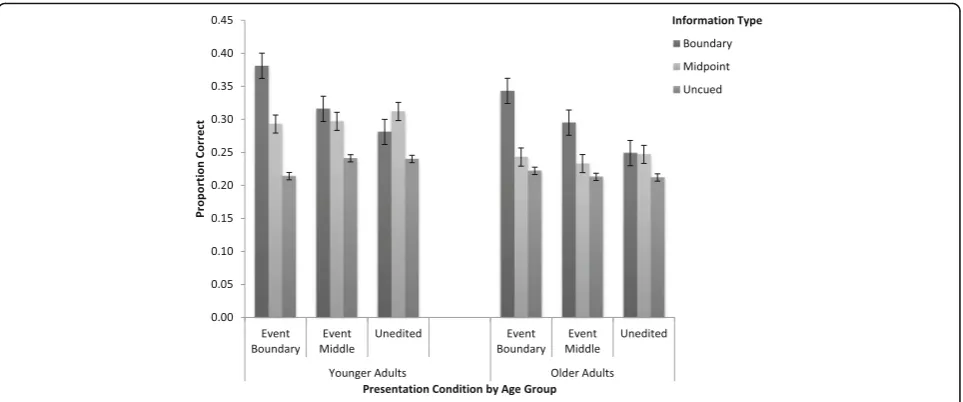
SD = 0.14), resulting in a significant fixed effect of group, F(1, 96) = 5.16,p= .025,d= 0.25. There was also a fixed effect of presentation condition, F (2, 765) = 3.47, p = .031, indicating that recall accuracy was better in the event boundary condition (M = 0.29, SD = 0.16) com-pared to the unedited presentation (M = 0.26, SD = 0.13), t (765) = -2.58, p= .01, d= 0.17, and marginally better than the event middle condition (M = 0.27, SD = 0.14),t (765) = -1.71, p= .09, d= 0.11. The event middle and unedited conditions did not differ, t (765) = -0.87, p = .38,d= 0.07. There was a significant fixed effect of in-formation type, F (2, 768) = 39.75, p< .001. Recall accuracy was better for boundary information (M = 0.31, SD = 0.18) than uncued information (M = 0.23, SD = 0.08), t (766) = 8.95, p< .001, d= 0.65, and mid-point information (M = 0.28, SD = 0.14), t (768) = 4.12, p< .001, d= 0.23. Recall accuracy for midpoint infor-mation was better than for uncued inforinfor-mation, t (768) = 4.83, p< .001, d= 0.45.
We did not find significant interactions between group and presentation condition, F (2, 765) = 0.24,p= .78, or group and information type, F (2, 768) = 2.67, p= .07. There was a significant interaction between presentation condition and information type, F (4, 765) = 6.86, p < .001. We followed up this effect separately for each in-formation type, and only boundary inin-formation was recalled differently between presentation conditions, F (2, 190) = 14.03, p< .001. Consistent with our hypoth-eses, boundary recall accuracy was better in the event boundary condition (M = 0.37, SD = 0.18) relative to the unedited condition, (M = 0.27, SE = 0.16),t(190) = -5.26, p< .001, d= 0.58, and compared to the event middle condition (M = 0.31, SE = 0.18), t (190) = -3.19, p= .002, d= 0.33. Boundary recall was also better in the event
middle condition compared to the unedited condition,t (190) = -2.06,p= .04,d= 0.23.
Recognition memory
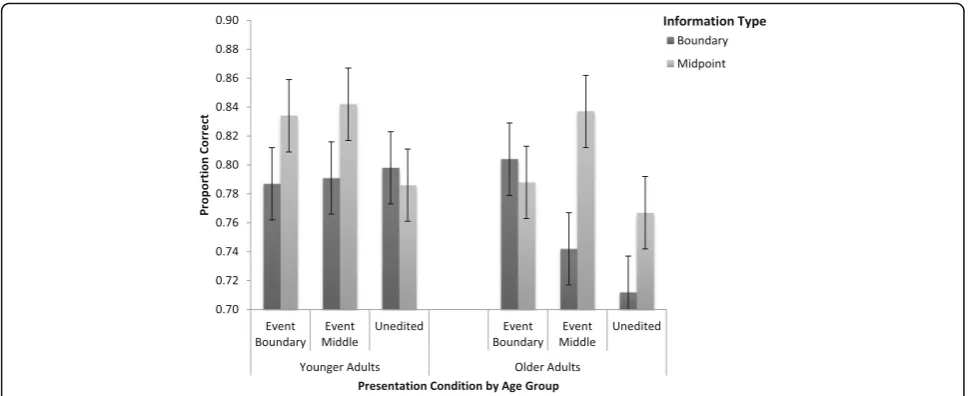
As shown in Fig. 3, younger adults (M = 0.81, SD = 0.15) had better recognition performance than older adults (M = 0.78, SD = 0.16), resulting in a significant fixed ef-fect of group, F (1, 96) = 4.05, p= .047, d= 0.20. The fixed effect of presentation condition was significant, F (2, 478) = 4.93, p= .008. Cuing at the event boundary (M = 0.80, SD = 0.15) improved recognition memory compared to the unedited presentation (M = 0.77, SD = 0.16), t (478) = -2.68, p= .008, d= 0.22, as did cuing at the event middle (M = 0.81, SD = 0.16) compared to the unedited presentation, t (478) = -2.76, p= .006, d= 0.22. Contrary to predictions, the event boundary and event middle conditions did not differ significantly, t (478) = 0.07,p= .94,d= 0.01.
Midpoint information (M = 0.81, SD = 0.15) was recog-nized better than boundary information (M = 0.78, SD = 0.16), resulting in a significant fixed effect of information type,F(1, 478) = 11.06,p< .001,d= 0.23. There were no significant interactions between group and presentation condition, F(2, 478) = 0.94, p= .39, or group and infor-mation type, F (1, 478) = 0.52, p= .477. The interaction between presentation condition and information type approached significance,F(2, 478) = 2.71,p= .067.
type was significant,F(2, 193) = 3.49,p= .032. For older adults, cuing the event boundaries enhanced recognition of boundary information (M = 0.80, SD = 0.16) relative to boundary information in the unedited condition (M = 0.71, SD = 0.18),t(76) = 2.68,p= .009,d= 0.53, and mar-ginally better than boundary recognition when cuing at event middles (M = 0.74, SD = 0.16), t(76) = 1.92, p = .059, d= 0.38, whereas boundary information was not improved by event middle cuing alone relative to the unedited condition, t (76) = 0.77, p= .45, d= 0.17. By contrast, cuing at event middle (M = 0.84, SD = 0.15) im-proved older adults’recognition of midpoint information compared to the unedited condition (M = 0.77, SD = 0.16),t(76) = 2.51,p= .01,d= 0.46, and marginally com-pared to the event boundary condition (M = 0.79, SD = 0.15),t(76) = -1.78,p= .08,d= 0.32. The random effects of subjects,χ2(1) = 22.0,p< .001, and movie type,χ2(1) = 98.9,p< .001, were significant.
The order memory task was not included in the ana-lyses because performance on this measure was uni-formly excellent, with minimal variability. For both older and younger adults, the modal order error rate was 0 (older adults: M = 0.76, SD = 0.93; younger adults: M = 0.23, SD = 0.47).
Discussion
We hypothesized that cuing at event boundaries would improve memory, and that this might reduce age differ-ences in memory. In both recognition and recall, cuing at event boundaries improved memory over the control condition, as predicted. For recall memory, cuing at the event boundary enhanced boundary accuracy more so than the other conditions. This supports the idea that intervening with event encoding can selectively affect
how an activity is encoded for memory. It also is consist-ent with the proposal from EST that evconsist-ent boundaries anchor one’s organization of events in memory. How-ever, we found that cuing at event middles also im-proved recognition memory somewhat, and for neither recognition nor recall was there a striking advantage for the boundary cuing condition over the middle cuing condition. One possibility is that because both cuing conditions involved visual cuing of the target object, rec-ognition represented lower-level familiarity with target objects as opposed to facilitating a richer memory repre-sentation for the activity. Another possibility is that pausing the video and giving participants the time to re-flect was beneficial independent of when the pauses were taken. Finally, it could have been that the cuing conditions were most efficacious because they both contained summary videos that provided multiple expo-sures to the target objects. We addressed these possibil-ities in experiment 2.
overcame any general advantage for recognition of boundary items, and perhaps through unlucky selection converged on items that ran strictly counter to it.
As expected, younger adults had better recognition accuracy and recall memory than older adults. Both groups benefited from the cuing manipulations; that is, the intervention did not rescue the older adults’ poorer performance.
Experiment 2
In experiment 2, we first sought to replicate the benefits of cuing at event boundaries for subsequent memory in younger and older adults. Second, we modified the cuing procedure to reduce the incidental advantages for the cuing conditions over the control condition, by eliminat-ing the arrows cueliminat-ing task-relevant objects and by addeliminat-ing to the control condition an opportunity for participants to review the activity after encoding. By doing so, we aimed to better answer whether cuing event structure per sebenefited memory encoding.
Method Participants
Demographic information is summarized in Table 2. The recruitment procedures were identical to those in experiment 1. In the older adult group (ages 65–85 years), 74 individuals completed phone screening, and 43 met the criteria for and participated in the experi-ment; 41 younger adults participated in the experiment.
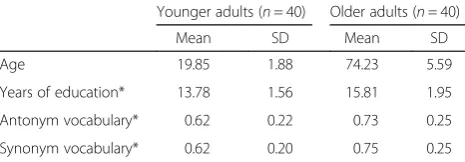
Younger adults (70% female) had fewer years of educa-tion, and performed more poorly on measures of vocabu-lary than older adults (66% female). A comparison of Tables 1 and 2 indicates that participants from Experiment 1 and 2 were similar in age, education, and vocabulary.
Design, materials and procedure
The design, materials, and procedure were identical to those in experiment 1 except for two changes to the stimulus materials, which were designed to make the three conditions as similar as possible except for the event structure manipulation. First, in the movies in experiment 1, the event boundary and event middle con-ditions included arrows cuing task-relevant objects.
Calling attention to relevant objects could improve event encoding via mechanisms other than segmentation, and therefore, these were removed. Second, in experiment 1 the event boundary and event middle conditions in-cluded post-viewing summaries, but the control condi-tion did not. For experiment 2, post-viewing summaries were created for the control condition by making sped-up versions of the movies. Presentation speed of each control summary movie was set to match the duration of the corresponding highlight movies for the event boundary and event middle conditions (e.g., breakfast summary = 68 s, full movie = 328 s, summary movie pre-sented at an increased speed of 450%). Participants were oriented to the different presentation styles using the same practice movie from experiment 1, followed by the highlight movie and the summary movie presented at a faster speed.
As in experiment 1, participants viewed a movie edited at the event boundary, the event middle, and unedited, in counterbalanced order. Prior to viewing each movie in the experiment, participants were always informed of the type of movie that they would be viewing (edited or unedited) and the type of post-viewing summary movie that they would be viewing (highlights or sped-up pres-entation). Movies edited at the event boundary or event middle were always followed by the corresponding high-light movies, and the unedited movies were always followed by the corresponding sped-up presentation. The same procedure from experiment 1 was followed for investigating memory for the movies. As before, par-ticipants were offered the option of typing their recall protocols themselves or dictating to the experimenter. Two older adults opted to have the experimenter type for them; all younger adults typed for themselves.
Data processing and exclusion
Recognition trials were trimmed of outliers in the same way as in experiment 1, resulting in the exclusion of 0.91% of trials in the older adults and 1.54% of trials in the younger adults. One older participant’s data were not recorded due to experimenter error. Two older adults and one younger adult with mean recognition ac-curacy below .60 were excluded from analyses, yielding a final sample of 40 older and 40 younger participants.
The experiment was adequately powered to detect small main effects, and small to medium interactions. The primary dependent variables met assumptions for ANOVA, and were approximately normally distributed (|skewness| < 2.0, |kurtosis| < 2.0).
Results Recall memory
Unlike experiment 1, younger adults (M = 0.28, SD = 0.13) did not recall significantly more than older adults
Table 2Demographic information for experiment 2
Younger adults (n= 40) Older adults (n= 40)
Mean SD Mean SD
Age 19.85 1.88 74.23 5.59
Years of education* 13.78 1.56 15.81 1.95
Antonym vocabulary* 0.62 0.22 0.73 0.25
Synonym vocabulary* 0.62 0.20 0.75 0.25
*
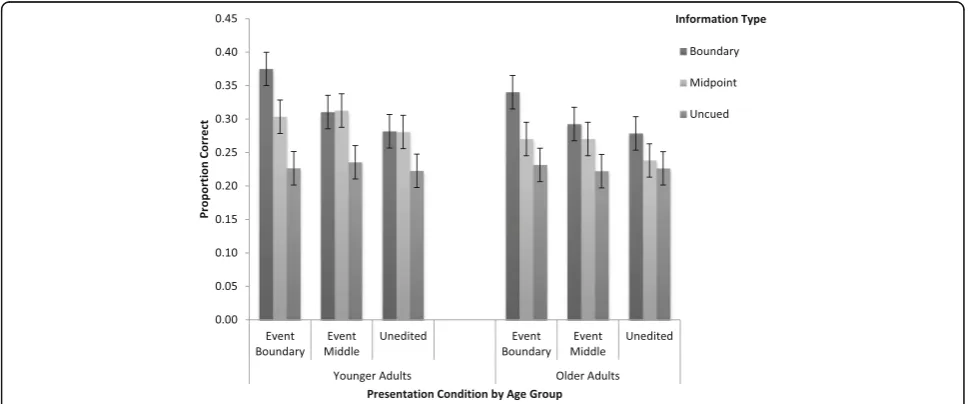
(M = 0.26, SD = 0.13), F (1, 78) = 1.94, p= .17, d= 0.15 (see Fig. 4). As in experiment 1, there was a fixed effect of presentation condition, F (2, 622) = 6.01, p= .003, such that recall accuracy was better in the event bound-ary condition (M = 0.29, SD = 0.14) compared to the un-edited presentation (M = 0.25, SD = 0.11), t (622) = 3.47, p< .001, d= 0.29. Event boundary recall accuracy was marginally better than the event middle condition (M = 0.27, SD = 0.14), t (621) = 1.68, p= .09,d= 0.12, and the event middle condition was marginally better than the unedited condition,t(622) = 1.79,p= .07,d= 0.15. As in experiment 1, there was a significant fixed effect of in-formation type,F(2, 622) = 37.99,p< .001. Recall accur-acy was better for boundary information (M = 0.31, SD = 0.16) than uncued information (M = 0.23, SD = 0.07),t (621) = 8.45,p< .001,d= 0.68, and midpoint information (M = 0.28, SD = 0.12), t (621) = 3.42, p< .001, d= 0.23. Recall accuracy for midpoint information was also better than uncued information,t(621) = 5.24,p< .001,d= 0.52.
As in experiment 1, we did not find significant interac-tions between group and presentation condition, F (2, 622) = 0.09,p= .92, or group and information type,F(2, 622) = 1.84, p= .16. (Fig. 4). There was a significant interaction between presentation condition and informa-tion type, F(4, 622) = 3.10, p= .015, that we investigated separately for each information type, as in experiment 1. The interaction was driven by the differential recall of boundary information between presentation conditions, F (2, 154) = 8.69, p< .001, relative to the recall of mid-point, F (2, 154) = 2.97, p= .054, and uncued informa-tion, F (2, 154) = 0.16, p= .86. Consistent with the hypotheses, boundary recall accuracy was better in the event boundary condition (M = 0.36, SD = 0.17) relative
to the unedited condition, (M = 0.28, SE = 0.14), t(154) = 4.01, p< .001, d= 0.49, and compared to the event middle condition (M = 0.30, SE = 0.17), t (154) = 2.99, p = .003, d= 0.33. Boundary recall did not differ between the event middle condition compared to the unedited condition, t (154) = 1.02, p= .31, d= 0.13. The random effects of subjects, χ2 (1) = 59.6, p< .001, and movie,χ2 (1) = 37.8,p< .001 were significant.
Recognition memory
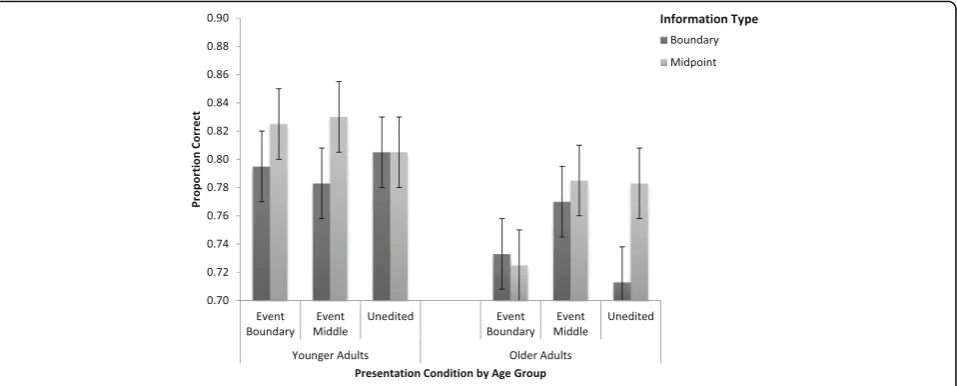
As shown in Fig. 5, younger adults (M = 0.81, SD = 0.14) had better recognition accuracy than older adults, (M = 0.75, SD = 0.17), resulting in a significant fixed effect of group, F (1, 78) = 10.32, p= .002, d= 0.36. Contrary to hypotheses and to the findings of Experiment 1, the fixed effect of presentation condition was not significant, F (2, 388) = 1.11,p= 0.33, indicating that the cuing ma-nipulation did not have a reliable overall influence on recognition memory. Midpoint pictures (M = 0.79, SD = 0.15) were once again recognized significantly better than boundary pictures (M = 0.77, SD = 0.16), F(1, 388) = 4.56, p= .03,d= 0.17. There were no significant inter-actions between group and presentation condition,F(2, 388) = 1.49, p= 0.22, or group and information type, F (1, 388) = 0.00,p= .99, or the three-way interaction,F(2, 388) = 2.11, p= .12. The random effects of subjects, χ2 (1) = 20.0,p< .001, and movie,χ2(1) = 67.0,p< .001 were significant.
As in experiment 1, performance in the order memory task was excellent and not sufficiently variable to permit further analysis. For both older and younger adults, the modal order error rate was 0 (older adults: M = 0.87, SD = 0.94; younger adults: M = 0.25, SD = 0.51).
Discussion
The recall results of experiment 2 replicated and clari-fied the patterns observed in experiment 1. The cuing manipulation affected recall memory performance, and the pattern was similar to experiment 1: recall was sig-nificantly better for the boundary cuing condition than the control condition, and the middle cuing condition was in between. This suggests that not all of the benefits of the boundary cuing condition are due to the visual cuing of task-relevant objects, nor to the post-viewing review, because in this experiment no visual cues were present and a post-viewing review was added to the con-trol condition. We did not observe significant effects of cuing on recognition memory, unlike in experiment 1. We do not see a ready explanation for this difference; it could simply be a false negative, or possibly reflects that the recognition test is a less sensitive measure than the recall test.
Younger adults again remembered more than older adults, but this was significant only for recognition memory. As in experiment 2, we found that midpoint pictures were better recognized than boundary pictures, suggesting that whatever factors led to this surprising pattern are stable for these materials. Also, as in experi-ment 1, boundary information was better recalled than midpoint information. Finally, experiment 2 replicated the finding of experiment 1 that cuing at event boundar-ies selectively enhanced recall of information from those event boundaries.
In summary, the results of experiment 2 replicated those of experiment 1 with some minor differences. They thus help to rule out incidental explanations for the benefits of cuing event boundaries, and support the proposal that scaffolding event structure during encod-ing improves memory. The fact that recall memory after
the event middle condition was again intermediate between the event boundary condition and the control condition, and was not significantly different from either, is a little vexing. This pattern is most consistent with the possibility that the event cuing manipulation was effect-ive for two reasons: first, for the reason just stated, that scaffolding event structure facilitates memory; and second, because pauses during encoding are beneficial wherever they occur. From the point of view of practical implications, either mechanism supports the use of the event boundary cuing procedure to improve memory. From the point of view of psychological mechanisms, more work is needed to tease apart these two potential contributions.
General discussion
In both of these experiments, we found that cuing event boundaries facilitated subsequent memory compared to a standard intentional encoding control. The benefits accrued particularly to the cued boundaries but also generalized to information from other time points. This finding supports views of event memory that propose that the segmentation of ongoing activity into events determine the structure of subsequent episodic memory (Ezzyat & Davachi, 2011; Radvansky & Zacks, 2014). It also has potential practical significance for the design of information interfaces.
control condition and for the most part was not statisti-cally significantly different from either. This suggests that giving an opportunity to pause and take stock of an ongoing activity benefits event encoding even when the pause is not time-locked to the event structure. This could give an opportunity to process event structure as such, but just as easily could benefit memory by allowing one to process other aspects of the activity such as objects or goals.
These findings are consistent with a recent study that examined memory for word lists and narrative texts in and around the introduction of shifts in the event structure (Pettijohn, Thompson, Tamplin, Krawietz, & Radvansky, 2016). In that study, event structure was manipulated by asking participants to walk through a doorway midway through learning a word list, or view the second half of a word list on a different computer screen window. Relative to the control condition, structuring the event encoding improved memory for the word list overall, though it did not selectively improve memory for the words around the event boundary.
Potential mechanisms
As described in“Introduction”, the event horizon model proposes a mechanism for these effects (Radvansky & Zacks, 2014). In the present experiments, the cuing con-ditions introduced salient feature changes at event boundaries or event middles: visual slowing, a tone, and—in experiment 1—an arrow cuing an object. This is proposed to induce a transient spike in prediction error, resulting in segmentation at the point of the cue (Zacks et al., 2007). In the boundary condition, induction of a cue at a natural event boundary should facilitate effective encoding by inducing long-term memory representa-tions that optimally reflect the underlying structure of the activity. Such representations reduce retrieval com-petition by grouping together intervals with similar rele-vant feature values, and separating intervals with differences in relevant features. In the event middle con-dition, inducing prediction errors in the middle of what would naturally be an event conflicts with effective seg-mentation, resulting in memory representations that compete more in long-term memory.
Other mechanisms could potentially contribute to these effects. Cuing event structure may also have fa-cilitated the use of top-down knowledge and the infer-ence of goals and causation. For example, prior knowledge about the kinds of goals and intentions enacted in a kitchen leads to expectations about meaningful units of activity. In the video of an actor preparing breakfast, our participants likely had a range of expectations about what would occur when an egg was cracked and placed into a frying pan. Expert
dancers use their prior knowledge to parse ongoing dance movements differently to novice observers (Bläsing, 2015). Viewers also incorporate features such as goal-directed changes in behavior such as the shift in intentions when footballers switch from offensive schemes to defensive postures (Huff, Papenmeier, & Zacks, 2012). Therefore, reinforcing the event struc-ture may help to consolidate the inherent causality and goal structure of ongoing activity and allow indi-viduals to efficiently parse ongoing activity.
The strategy used here has clear limitations that should be explored in further research. First, from a practical perspective it would be helpful to test add-itional control conditions to investigate which features of cuing led to benefits in the event middle condition. One possibility we have already noted is that simply en-couraging viewers to pause and consolidate their on-going comprehension is adaptive for memory encoding. To explore this possibility, it would be of interest to test a condition in which cues are placed randomly, or in which viewers are encouraged to pause the video at times of their choosing. Another possibility is that the post-viewing slide show is a particularly effective way to rehearse a sequence of events. In experiment 1, the un-edited condition had no post-viewing review; in experi-ment 2, we added a fast-motion video review to that condition. This had the advantage of not selecting some moments in time for rehearsal, but fast-motion video differs from slide shows on several dimensions. A slide show of randomly selected still pictures would be a welcome addition for future research.
Second, there are stable individual differences in seg-mentation (Speer, Swallow, & Zacks, 2003), which could reflect differences in what would best function as effect-ive segmentation for each individual. Geffect-iven the differing knowledge and interests of individuals, it is possible that there is no single segmentation that will be best for all viewers. And finally, if a viewer is experiencing difficulty segmenting due to disruptions in perceptual processing, error monitoring, or event model maintenance, then the intervention may not be able to fully rescue their per-formance. Such disruptions may be present in age-related neurodegenerative diseases including Alzheimer’s disease (Bailey, Zacks, et al., 2013; Zacks et al., 2006) and Parkinson’s disease (Fernandino et al., 2013; Zalla et al., 1998; but see Schiffer et al., 2015).
they parsed an activity at initial viewing with still images and instructions. This type of approach may be able to minimize the variability in event perception and com-prehension to maximize memory for the activity. It may have also been the case that simply pausing, in and of it-self, encourages integration that is effective. As discussed earlier, working memory is related to event segmenta-tion, and perhaps simply pausing the video at regular intervals allows for better segmentation through indirect mechanisms related to processing speed.
Addressing complaints of aging
Encouragingly, our modifications to the presentation of everyday videos were effective for both younger and older adults, and this suggests that both groups have the necessary cognitive resources at encoding to benefit from the scaffolding manipulation. In this regard, our findings align with an investigation of event processing in a recent study with similar age groups (Radvansky, Pettijohn, & Kim, 2015). As younger and older adults passed through a virtual doorway with an object in their hand, they were equally likely to forget the name of the object. An event-specific explanation is that working memory is updated at this boundary and the prior event model with the object is discarded in favor of the up-dated model that is ready to encode new information. In many instances aside from event segmentation, age differences in event processing can be minimal (e.g., Magliano, Kopp, McNerney, Radvansky, & Zacks, 2012). Rather, processes known to decline with age, such as source monitoring and managing interference, may contribute to age-related differences when older adults have to retrieve multiple event models from long-term memory (Radvansky, 2005). Given that work-ing memory is reliably associated with event segmenta-tion ability, targeting these executive funcsegmenta-tion skills may improve event memory.
In the present sample the younger and older adults were both highly educated, and it may have been the case that older adults with less cognitive reserve would have benefited more from our intervention. Older adults were carefully screened for health-related conditions that could impact cognition, such as diabetes or poorly con-trolled hypertension (Waldstein & Elias, 2015). These vascular risk factors impact the majority of older adults in North America, and so our sample may not have been representative of the population, which could have medi-ated age-relmedi-ated differences in cognition.
Another issue to consider is that we may have ob-served larger effects of our experimental condition if we had investigated older adults with cognitive impair-ments who have true differences in their identification of normative event boundaries and subsequent memory (Bailey, Kurby, et al. 2013). The older adults in our
study did not have cognitive complaints that lead indi-viduals to pursue medical investigation, and so we speculate that those who are truly in need of structural support at encoding may benefit even more.
Future research may also extend the cuing paradigm to videos that are less familiar and require even more scaffolding of the inherent structure, such as novel nat-uralistic actions (Gold & Park, 2009). A final question surrounds the nature of the memory representation over a delay, a question we are currently testing (Flores, Bailey, Eisenberg, & Zacks, in press). Previous findings indicate that boundary information is psychologically privileged, and better remembered than other elements of an event. Thus, it is possible that the advantages of cuing event boundaries grow with delay.
Conclusion
People who suffer memory impairments due to age, disease, or injury tend to present to clinics with concerns such as trouble in learning how to use new tools or gad-gets, and concerns about forgetting appointments. These are concerns about memory, to be sure, but more funda-mentally they are concerns about memory for events. Many aspects of event memory are shared with memory for other sorts of materials, but some aspects of event memory reflect the unique structure of a sequence that unfolds within a spatiotemporal framework (Rad-vansky & Zacks, 2014). The present findings suggest that scaffolding the encoding of event structure may facilitate event memory. This speaks to the unique features of event memory, and may be of practical use in providing a means to improve memory of the sort that people find most salient in their daily lives.
Abbreviations
ANOVA:analysis of variance; EST: event segmentation theory
Acknowledgements
The authors acknowledge Jessica Hawkins and Jared Selsberg for testing participants and scoring recall protocols.
Funding
This research was supported by grant R01 AG031150-01 from the National Institute of Aging.
Authors' contributions
DAG contributed to the conceptualization, research design, testing of participants, and submission of the manuscript for publication. JMZ was involved with design of the study and collection, analysis, and interpretation of data and in writing the manuscript. SF was involved with data collection and preparation of the manuscript for publication. All authors read and approved the final manuscript.
Competing interests
The authors declare that they have no competing interests.
Author details 1
Received: 23 June 2016 Accepted: 15 December 2016
References
Bailey, H. R., Kurby, C. A., Giovannetti, T., & Zacks, J. M. (2013). Action perception predicts action performance.Neuropsychologia, 51(11), 2294–2304. http://doi. org/10.1016/j.neuropsychologia.2013.06.022.
Bailey, H. R., Zacks, J. M., Hambrick, D. Z., Zacks, R. T., Head, D., Kurby, C. A., et al. (2013). Medial temporal lobe volume predicts elders’everyday memory.
Psychological Science, 24(7), 1113–1122. http://doi.org/10.1177/ 0956797612466676.
Baldwin, D. A., & Baird, J. (2001). Discerning intentions in dynamic human action.
Trends in Cognitive Sciences, 5(4), 171–178.
Ball, K., Berch, D. B., Helmers, K. F., Jobe, J. B., Leveck, M. D., Marsiske, M., et al. (2002). Advanced Cognitive Training for Independent and Vital Elderly Study Group. Effects of cognitive training interventions with older adults: a randomized controlled tria.JAMA, 288(18), 2271–2281. Bates, D., Maechler, M., Bolker, B., & Walker, S. (2015).Fitting Linear Mixed-Effects
Models Using lme4. Journal of Statistical Software, 67(1), 1–48. https://doi.org/10. 18637/jss.v067.i01
Belleville, S., Gilbert, B., Fontaine, F., Gagnon, L., Ménard, É., & Gauthier, S. (2006). Improvement of episodic memory in persons with mild cognitive impairment and healthy older adults: evidence from a cognitive intervention program.Dementia and Geriatric Cognitive Disorders, 22(5-6), 486–499.
Bläsing, B. E. (2015). Segmentation of dance movement: effects of expertise, visual familiarity, motor experience and music.Cognition, 5, 1500. http:// doi.org/10.3389/fpsyg.2014.01500.
Boltz, M. (1992). Temporal accent structure and the remembering of filmed narratives.Journal of Experimental Psychology: Human Perception & Performance, 18(1), 90–105.
Byrne, R. W. (2002). Seeing actions as hierarchically organized structures: Great ape manual skills. In R. J. Sternberg & J. C. Kaufman (Eds.),The imitative mind: development, evolution, and brain bases(pp. 122–142). New York: Cambridge University Press.
Cohen, G. (2000). Hierarchical models in cognition: do they have psychological reality?European Journal of Cognitive Psychology, 12(1), 1–36.
Craik, F. I. M., & Lockhart, R. S. (1972). Levels of processing: a framework for memory research.Journal of Verbal Learning and Verbal Behavior, 11(6), 671–684. http://doi.org/10.1016/S0022-5371(72)80001-X.
Ezzyat, Y., & Davachi, L. (2011). What constitutes an episode in episodic memory?
Psychological Science, 22(2), 243–252. https://doi.org/10.1177/ 0956797610393742.
Fernandino, L., Conant, L. L., Binder, J. R., Blindauer, K., Hiner, B., Spangler, K., et al. (2013). Where is the action? Action sentence processing in Parkinson’s disease.Neuropsychologia, 51(8), 1510–1517. http://doi.org/10.1016/j. neuropsychologia.2013.04.008.
Flores, S., Bailey, H.R., Eisenberg, M.L., Zacks, J.M. (in press). Event segmentation improves event memory up to one month later.Journal of Experimental Psychology: Learning, Memory, and Cognition.
Galvin, J. E., Roe, C. M., Powlishta, K. K., Coats, M. A., Muich, S. J., Grant, E., et al. (2005). The AD8: a brief informant interview to detect dementia.Neurology, 65(4), 559–564. http://doi.org/10.1212/01.wnl.0000172958.95282.2a. Gold, D. A., & Park, N. W. (2009). The effects of dividing attention on the
encoding and performance of novel naturalistic actions.Psychological Research, 73(3), 336–49. http://doi.org/10.1007/s00426-008-0148-4. Hanson, C., & Hirst, W. (1989). On the representation of events: a study of
orientation, recall, and recognition.Journal of Experimental Psychology. General, 118(2), 136–147.
Hard, B. M., Recchia, G., & Tversky, B. (2011). The shape of action.Journal of Experimental Psychology. General, 140(4), 586–604. http://doi.org/ 10.1037/a0024310.
Hasson, U., Furman, O., Clark, D., Dudai, Y., & Davachi, L. (2008). Enhanced intersubject correlations during movie viewing correlate with successful episodic encoding.Neuron, 57(3), 452–462.
Huff, M., Papenmeier, F., & Zacks, J. M. (2012). Visual target detection is impaired at event boundaries.Visual Cognition, 20(7), 848–864. http://doi.org/10.1080/ 13506285.2012.705359.
Jorm, A. F., Christensen, H., Korten, A. E., Henderson, A. S., Jacomb, P. A., & Mackinnon, A. (1997). Do cognitive complaints either predict future cognitive decline or reflect past cognitive decline? A longitudinal study of an elderly
community sample.Psychological Medicine, 27(01), 91–98. http://dx.doi.org/ 10.1017/S0033291796003923.
Katzman, R., Brown, T., Fuld, P., Peck, A., Schechter, R., & Schimmel, H. (1983). Validation of a short orientation-memory-concentration test of cognitive impairment.The American Journal of Psychiatry, 140(6), 734–739. http://doi. org/10.1176/ajp.140.6.734.
Kintsch, W., & van Dijk, T. A. (1978). Toward a model of text comprehension and production.Psychological Review, 85, 363–394.
Kurby, C. A., & Zacks, J. M. (2011). Age differences in the perception of hierarchical structure in events.Memory & Cognition, 39(1), 75–91. Kuznetsova, A., Brockhoff, P.B., Christensen, R.H.B. (2015).lmerTest: Tests in Linear Mixed
Effects Models. Retrieved from http://CRAN.R-project.org/package=lmerTest. Madden, C.J., & Dijkstra, K. (2009). Contextual constraints in situation model
construction: an investigation of age and reading span.Aging,
Neuropsychology, and Cognition. http://doi.org/10.1080/13825580902927604. Magliano, J., Kopp, K., McNerney, M. W., Radvansky, G. A., & Zacks, J. M. (2012).
Aging and perceived event structure as a function of modality.Aging, Neuropsychology, and Cognition, 19(1-2), 264–282. http://doi.org/10.1080/ 13825585.2011.633159.
Mura, K., Petersen, N., Huff, M., Ghose, T. (2013). IBES: a tool for creating instructions based on event segmentation.Frontiers in Psychology,4. http:// doi.org/10.3389/fpsyg.2013.00994.
Newtson, D. (1976). Foundations of attribution: the perception of ongoing behavior. In J. H. Harvey, W. J. Ickes, & R. F. Kidd (Eds.),New directions in attribution research
(pp. 223–248). Hillsdale, New Jersey: Lawrence Erlbaum Associates. Newtson, D., & Engquist, G. (1976). The perceptual organization of ongoing
behavior.Journal of Experimental Social Psychology, 12(5), 436–450. http://doi. org/10.1016/0022-1031(76)90076-7.
Newtson, D., Engquist, G., & Bois, J. (1977). The objective basis of behavior units.
Journal of Personality and Social Psychology, 35(12), 847–862.
Pettijohn, K. A., Thompson, A. N., Tamplin, A. K., Krawietz, S. A., & Radvansky, G. A. (2016). Event boundaries and memory improvement.Cognition, 148, 136–144. http://doi.org/10.1016/j.cognition.2015.12.013.
R Core Team, (2013).R: A language and environment for statistical computing. Vienna, Austria: R Foundation for Statistical Computing.
Radvansky, G. A. (1999). Aging, memory, and comprehension.Current Directions in Psychological Science, 8(2), 49–53. http://doi.org/10.1111/ 1467-8721.00012.
Radvansky, G. A. (2005). Situation models, propositions, and the fan effect.Psychonomic Bulletin & Review, 12(3), 478–483. http://doi.org/10.3758/BF03193791.
Radvansky, G. A. (2012). Across the event horizon.Current Directions in Psychological Science, 21(4), 269–272.
Radvansky, G. A., Pettijohn, K. A., & Kim, J. (2015). Walking through doorways causes forgetting: Younger and older adults.Psychology and Aging, 30(2), 259–265. http://doi.org/10.1037/a0039259.
Radvansky, G. A., & Zacks, J. M. (2014).Event Cognition. New York: Oxford University Press. Reid, L. M., & MacLullich, A. M. J. (2006). Subjective memory complaints and
cognitive impairment in older people.Dementia and Geriatric Cognitive Disorders, 22(5-6), 471–485. http://doi.org/10.1159/000096295. Salthouse, T. A. (1993). Speed and knowledge as determinants of adult age
differences in verbal tasks.Journal of Gerontology, 48(1), 29–36.
Sargent, J. Q., Zacks, J. M., Hambrick, D. Z., Zacks, R. T., Kurby, C. A., Bailey, H. R., et al. (2013). Event segmentation ability uniquely predicts event memory.Cognition, 129(2), 241–255. http://doi.org/10.1016/j.cognition. 2013.07.002.
Schiffer, A. M., Nevado-Holgado, A. J., Johnen, A., Schönberger, A. R., Fink, G. R., & Schubotz, R. I. (2015). Intact action segmentation in Parkinson’s disease: hypothesis testing using a novel computational approach.Neuropsychologia, 78, 29–40. http://doi.org/10.1016/j.neuropsychologia.2015.09.034.
Schneider, W., Eschman, A., Zuccolotto, A. (2002).E-Prime: User’s guide. Psychology Software Incorporated.
Schwan, S., & Garsoffky, B. (2004). The cognitive representation of filmic event summaries.Applied Cognitive Psychology, 18(1), 37–55. http:// doi.org/10.1002/acp.940.
Schwartz, M. F., Reed, E. S., Montgomery, M., Palmer, C., & Mayer, N. H. (1991). The quantitative description of action disorganisation brain damage: a case study.
Cognitive Neuropsychology, 8(5), 381–414.
Speer, N. K., Swallow, K. M., & Zacks, J. M. (2003). Activation of human motion processing areas during event perception.Cognitive, Affective, & Behavioral Neuroscience, 3(4), 335–345.
Swallow, K. M., Zacks, J. M., & Abrams, R. A. (2009). Event boundaries in perception affect memory encoding and updating.Journal of Experimental Psychology. General, 138(2), 236–257. http://doi.org/10.1037/a0015631. van den Broek, P., Young, M., Tzeng, Y., & Linderholm, T. (1999). The landscape
model of reading: inferences and the online construction of a memory representation. In H. van Oostendorp & S. R. Goldman (Eds.),The construction of mental representations during reading(pp. 71–98). Mahwah, NJ: Lawrence Erlbaum Associates.
Waldstein, S., & Elias, M. (2015).Neuropsychology of Cardiovascular Disease. New York: Routledge, Taylor & Francis Group.
Zacks, J. M., Kumar, S., Abrams, R. A., & Mehta, R. (2009). Using movement and intentions to understand human activity.Cognition, 112, 201–216. Zacks, J. M., Speer, N. K., Swallow, K. M., Braver, T. S., & Reynolds, J. R. (2007). Event
perception: a mind/brain perspective.Psychological Bulletin, 133(2), 273–293. Zacks, J. M., Speer, N. K., Vettel, J. M., & Jacoby, L. L. (2006). Event understanding
and memory in healthy aging and dementia of the Alzheimer type.
Psychology & Aging, 21(3), 466–482.
Zacks, J. M., Speer, N. K., & Reynolds, J. R. (2009). Segmentation in reading and film comprehension.Journal of Experimental Psychology. General, 138(2), 307–327.
Zacks, J. M., & Tversky, B. (2003). Structuring information interfaces for procedural learning.Journal of Experimental Psychology: Applied, 9(2), 88–100. Zacks, J. M., & Tversky, B. (2001). Event structure in perception and conception.
Psychological Bulletin, 127(1), 3–21.
Zacks, J. M., Tversky, B., & Iyer, G. (2001). Perceiving, remembering, and communicating structure in events.Journal of Experimental Psychology. General, 130(1), 29–58.
Zacks, R. T. (1989). Working memory, comprehension, and aging: a review and a new view.Psychology of Learning & Motivation, 22, 193–225.
Zacks, R. T., Hasher, L., & Li, K. Z. H. (2000). Human memory. In T. A. Salthouse & F. I. M. Craik (Eds.),Handbook of aging and cognition(2nd ed., pp. 293–357). Mahwah, NJ: Lawrence Erlbaum Associates.
Zalla, T., Sirigu, A., Pillon, B., Dubois, B., Grafman, J., & Agid, Y. (1998). Deficit in evaluating pre-determined sequences of script events in patients with Parkinson’s disease.Cortex, 34(4), 621–627.
Submit your manuscript to a
journal and benefi t from:
7Convenient online submission 7Rigorous peer review
7Immediate publication on acceptance 7Open access: articles freely available online 7High visibility within the fi eld
7Retaining the copyright to your article