Issues
ISSN: 2146-4138
available at http: www.econjournals.com
International Journal of Economics and Financial Issues, 2016, 6(3), 1014-1018.
Application of Basel Committee’s New Standards of Internal
Audit Function: A Road Map towards Banks’ Performance
Yahya Ali Al-Matari
1, Sallahuddin Hassan
2, Hassan Alaaraj
3*
1School of Economics, Finance and Banking, University Utara Malaysia, Kedah, Malaysia, 2School of Economics, Finance and
Banking, University Utara Malaysia, Kedah, Malaysia, 3School of Economics, Finance and Banking, University Utara Malaysia,
Kedah, Malaysia. *Email: [email protected]
ABSTRACT
The high level of completion along with deceitful financial reporting has recently pointed the increasing consideration of researchers and
academicians on the internal controls and internal audit functions (IAF). IAF in banks has several principles that are essential to be adhered.
The bank’s management bears the final responsibility to apply these principles properly and effectively to avoid such corporate scandals that would shake the confidence of investors and make it hard for organizations to enhance equity within the stock market. Thereby, they would need to understand the internal factors which influence their profitability performance. The main purpose of this paper is to developthe relationship
between new standards of IAF issued by Basel Committee (2012) and banks’ performance. In addition, it presents a theoretical research framework
to understand this relationship supported by literature review from recent studies. The literature review indicates that practicing IAF creates discipline and enhances effectiveness of control and governance practices which are necessary to promote performance in the banks. Due to limitations of literature in bank sector, future studies are suggested to broaden the research empirically and highlight more on the effective IAF that can lead to better banks’ performance.
Keywords: Internal Audit Function, Basel Committee, Corporate Governance, Agency Theory, Institutional Theory, Bank Performance
JEL Classifications: G2, M42
1. INTRODUCTION
As a consequence of the wide spreading corporate scandals such
as Global Crossing, Enron, World Com and Tyco, the investors’
confidence have been rigorously affected and it becomes more difficult for companies to set equity within the stock market (Agrawal, 2005). It is believed that such scandals resulted from
the lack of board and committees’ supervision on the management
as the case of Enron which used off-balance sheet financing to manipulate its financial statements. And because the senior
executives dominate the board, the last was unable to disclose such
distorted statements (Deakin and Konzelmann, 2004).
Moreover, World Com considerably overstated its revenues till it reached bankruptcy where investigations showed the failure of the audit committee in overseeing the mangers duties effectively
(Weiss, 2005). Collectively with the 1997 Asian financial crisis,
these corporate scandals have emphasized the significance of
practicing good corporate governance for the long-term endurance
of firms (Mokhtar et al., 2009).
Based on the premises of the agency theory and institutional theory,
many studies pointed out that principal-agent conflicts are more
probably to occur when the duties of management are separated from ownership and joined with the available asymmetric
information (Jensen and Meckling, 1976; Shleifer and Vishny, 1986). They declare that the inappropriate use of corporate assets is causing such conflicts. Therefore, corporate governance through
its internal and external procedures is being considered to reduce
costs and prevent agency conflicts.
As for the institutional theory, it is suggested that appropriate
the stress of external parties when the internal operating procedures are loosely attached with the observable structures to perform the
actual work at the organization (Meyer and Rowan, 1977).
According to many studies (Alwala and Biraori, 2015; Drogalas et al., 2012), internal audit is regarded as one of the main corporate governance mechanisms that make the financial reporting process
credible through diminishing agency problems and reducing information asymmetry between stakeholders and managers. Thus, it is essential to support the board and the audit committees through strengthening their abilities in monitoring the managers’ performance.
In view of that, the Basel Committee on Banking Supervision (June,
2012) has published the “internal audit function (IAF) in banks” as a revised supervisory guidance to improve its 2001 documents in response to the financial crises and thus, to evaluate the efficacy of IAF in banks. The main objective of this revision is to emphasize
the importance of IAF and recommend the audit committees and boards of directors some appendices to apply it effectively.
Based on the presented above, the objective of this study is to propose a theoretical framework through reviewing previous literature related to the implementation of IFA and its effect on bank’s performance in terms of the new Basel Committee
principles on Banking Supervision (2012).
2. BACKGROUND OF THE STUDY
The Institute of Internal Auditors (IIA) described the main functionof internal auditing as “it helps an organization accomplish its
objectives by bringing a systematic, disciplined approach to evaluate and improve the effectiveness of risk management,
control and governance processes” (KPMG, 2014). There are
many revised publications that highlight the importance of internal
auditing and necessitates listed organizations to comprise IAF such as the NASDAQ requirements and the New York stock exchange
which are issued by the Exchange Commission and United
States Securities (2003). In addition, the internal audit guidance committee in the United Kingdom which assesses the financial services has suggested on July 2013 how to improve the general effectiveness of internal audit and its influence on organizations that operate in financial service sector (KPMG, 2014).
In June 1999, the board of directors of IIA described internal audit as: “Internal audit is an independent, material and consultancy
activity, which adds value and improves the functioning of
an organization. It helps the organization achieve its aims by
means of a systematic, disciplined approach to evaluating and improving the effectiveness of risk management, control and the
management process.” While, Sawyer (2003) defines internal audit as “a systematic, objective appraisal by internal auditors of the diverse operations and controls within an organization
to determine whether (1) Financial and operating information
is accurate and reliable, (2) risks to the enterprise are identified and minimized, (3) external regulations and acceptable internal policies and procedures are followed, (4) satisfactory operating
criteria are met, (5) resources are used efficiently and economically
and (6) the organization ’s objectives are effectively achieved - all
for the purpose of consulting with management and for assisting
members of the organization in the effective discharge of their governance responsibilities.”
From the definitions above, there are many essential principals
that internal auditors have to adhere and apply in banks. The IAF
supports banks’ board of directors in doing their duties and final
responsibilities through an effective system of internal control
(Dumitrescu, 2004). This means that banks can realize the
importance of internal audit in improving management of assets
and consequently the banks’ financial performance as well.
Majority of professional internal auditors argue that effective IAF are
correlated with enhancing the financial performance and reducing overhead. According to Alwala and Biraori (2015), it is essential
for every bank to have an internal audit department to enhance accountability in checking all businesses processes within the bank.
As for the Basel Committee, it was established in 1974 by
13 members from countries. Mainly, it relies on the members’
commitment and it has no official authority. The objective of
the Basel Committee is to promote and advance the principals and standards for banking supervision. Three categories were
presented in the 2012 Basel Committee’s IAF Principles. The first category related to supervisory expectations is relevant to
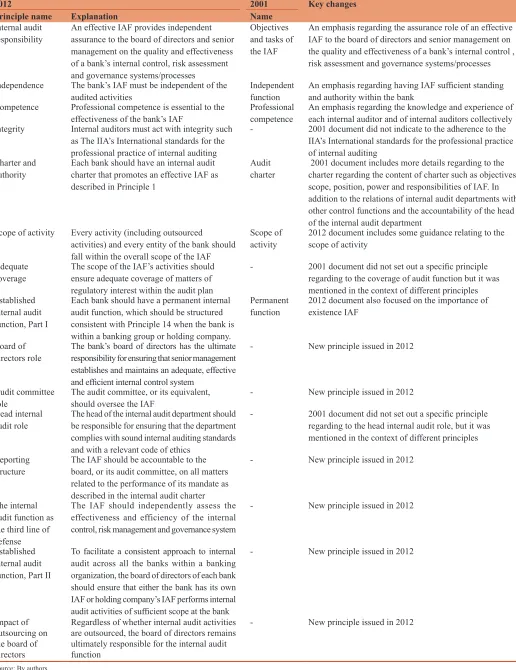
the IAF. The second category highlights the relationship of the supervisory authority with the IAF and third category presents the supervisory assessment of the IAF. The following Table 1
summarizes the principles of the first category that is related to this research (Basel Committee, 2012).
Overall, the key changes between the new standards of 2012 and the previous standards of 2001 is presented by the increased
emphasis on the importance of IAF independence in terms of directors’ board and the direct audit committee’s supervisory role.
In addition, 2012 standards emphasize on compliance with the
IIA international standards for practicing internal auditing in a professional manner. Moreover, it expanded guidance in assuring the communication between the supervisors and the IAF. Finally, internal audit is considered as third line of defense that support
processes created in the first and second lines; management and
business units and support functions respectively.
3. LITERATURE REVIEW
The significance of the internal audit drew the attention of the
academicians and researchers over the past two decades. However, few academic studies have examined the effectiveness of internal
audit empirically (Al-Matari et al., 2014). Going through the
existing literature related to internal audit independence and
objectivity, Stewart and Subramaniam (2010) have identified
the gaps where additional investigation is needed. Eulerich and
Zipfel (2016) analyzed the impact of the IAF on the governance structure in the banking sector utilizing structural equation model.
They observed a positive relationship between a strong IAF and effective governance processes. Likewise, Alwala and Biraori
Table 1: Summary of the Basel committee’s internal audit function principles 2012 and the key changes from 2001 standards
2012 2001 Key changes
Principle name Explanation Name
Internal audit
responsibility An effective IAF provides independent assurance to the board of directors and senior
management on the quality and effectiveness
of a bank’s internal control, risk assessment and governance systems/processes
Objectives and tasks of the IAF
An emphasis regarding the assurance role of an effective IAF to the board of directors and senior management on
the quality and effectiveness of a bank’s internal control ,
risk assessment and governance systems/processes
Independence The bank’s IAF must be independent of the
audited activities Independent function An emphasis regarding having IAF sufficient standing and authority within the bank Competence Professional competence is essential to the
effectiveness of the bank’s IAF Professional competence An emphasis regarding the knowledge and experience of each internal auditor and of internal auditors collectively Integrity Internal auditors must act with integrity such
as The IIA’s International standards for the professional practice of internal auditing
- 2001 document did not indicate to the adherence to the
IIA’s International standards for the professional practice of internal auditing
Charter and
authority Each bank should have an internal audit charter that promotes an effective IAF as described in Principle 1
Audit
charter 2001 document includes more details regarding to the charter regarding the content of charter such as objectives, scope, position, power and responsibilities of IAF. In addition to the relations of internal audit departments with other control functions and the accountability of the head of the internal audit department
Scope of activity Every activity (including outsourced activities) and every entity of the bank should fall within the overall scope of the IAF
Scope of
activity 2012 document includes some guidance relating to the scope of activity
Adequate
coverage The scope of the IAF’s activities should ensure adequate coverage of matters of
regulatory interest within the audit plan
- 2001 document did not set out a specific principle
regarding to the coverage of audit function but it was mentioned in the context of different principles Established
internal audit function, Part I
Each bank should have a permanent internal audit function, which should be structured consistent with Principle 14 when the bank is within a banking group or holding company.
Permanent
function 2012 document also focused on the importance of existence IAF
Board of
directors role The bank’s board of directors has the ultimate responsibility for ensuring that senior management
establishes and maintains an adequate, effective and efficient internal control system
- New principle issued in 2012
Audit committee
role The audit committee, or its equivalent, should oversee the IAF - New principle issued in 2012 Head internal
audit role The head of the internal audit department should be responsible for ensuring that the department complies with sound internal auditing standards and with a relevant code of ethics
- 2001 document did not set out a specific principle
regarding to the head internal audit role, but it was mentioned in the context of different principles
Reporting
structure The IAF should be accountable to the board, or its audit committee, on all matters related to the performance of its mandate as described in the internal audit charter
- New principle issued in 2012
The internal audit function as the third line of defense
The IAF should independently assess the effectiveness and efficiency of the internal control, risk management and governance system
- New principle issued in 2012
Established internal audit function, Part II
To facilitate a consistent approach to internal audit across all the banks within a banking
organization, the board of directors of each bank
should ensure that either the bank has its own IAF or holding company’s IAF performs internal
audit activities of sufficient scope at the bank
- New principle issued in 2012
Impact of outsourcing on the board of directors
Regardless of whether internal audit activities
are outsourced, the board of directors remains ultimately responsible for the internal audit function
- New principle issued in 2012
audit independence and share performance among 60 firms listed
in the Nairobi stock exchange.
Moreover, Awdat (2015) identified the impact of IAF in advancing the financial performance of the Jordanian commercial banks. In the same context, Gras-Gil et al. (2012) found that banks with
strong cooperation between their internal and external auditors
during the annual audit possess high quality financial reporting.
Furthermore, the relationship between the internal auditing
practices and the financial performance of government-owned companies (GOCs) in Nigeria was examined by Kiable (2012)
taking in consideration the effect of political factors on this
relationship. The findings indicate a significant positive effect of IAF on the financial performance of GOCs.
Similarly, a study by Ebaid (2011) found that a lot of the Egyptian listed firms have IAF that focus on internal controls fulfillment and financial audit however, they are still not implementing the IIA new roles and definitions. In the same context, Christopher et al. (2009) critically analyzed the IAF independence and its
relationship with management and audit committee. Findings
revealed significant threats at the level of audit committee and
the chief auditors executive (CAEs). For instance, CAEs are not functionally reporting to the audit committee. Also, the audit
committee does not have qualified members for accounting
and they do not have exclusive responsibility for appointing, discharging and evaluating the CAE.
From the Malaysian context, Hutchinson and Zain (2009) found that internal audit quality would have a strong relationship with performance of organizations that acquire high growth opportunities however; such relationship is reduced as the audit committee
becomes more independent. Moreover, they found a positive
relationship between the experience and accounting qualification of internal auditors and firm performance in association with
other characteristics such as information asymmetry, growth opportunities or uncertainty and audit committee effectiveness
through governance controls. These findings reveal the conflicting
roles of internal auditors and put the firms in a position of accountability especially that governance recommend audit committee members to be non-executive directors.
In addition, Eden and Moriah (1996) found that there is significant
improved bank performance after six months from launching internal auditing in experimental branches. On the contrary, a
study conducted by Ejoh and Ejom (2014) among Nigerian Tertiary Institutions have shown that IAF has no significant influence on the financial performance. Therefore, it is obvious that most of literature emphasize the importance of IFA in enhancing the overall performance of organizations and banks in particular although
there is lack of studies in the banking sector. However, the level of effectiveness may vary due to many internal and external factors
that are mainly related to organizational structure of banks and
the principals implemented by the board and audit committees. Hence, the objective of this study is to highlight the application of Basel committee’s new standards of IAF and develop a theoretical framework that would draw the road map towards better banks’ performance.
3.1. Theoretical Framework
This study is theoretically founded on two main theories; namely the agency theory and institutional theory. By definition, the
agency theory describes the relationship among contract parties
under which “one or more persons (principal) who is the economic
resources owner engage another person (agent) who is charged with using and controlling these resources to perform some service on their behalf, which involves delegating some decision-making
authority to the agent” (Jensen and Meckling, 1976).
However, this theory proposes that such kind of relationship
between the principal or manager and the agent is not very firm
for many reasons. First, the agents may not be trusted to take the best action because they can act for their own interests and they usually have more information than managers leading to information asymmetry. Thus, different internal and external corporate governance mechanisms have been suggested to limit agency costs and make an approach between the manager’s interest
and agent’s interest simultaneously (Haniffa and Huduib, 2006; Adams, 1994). Moreover, separating ownership from management
functions such as controlling corporate resources can cause lot
of conflicts. Mainly, the manager could misuse the company’s
resources and go through risk investments. In addition, separating
tasks and information asymmetry may influence the managers’
ability to observe whether their interest is accurately supplied by
the agents (Jensen, 1986; Shleifer and Vishny, 1986; Fama and Jensen, 1983). Accordingly, IAF assists the board of directors and audit committee to reduce agency conflicts through monitoring and
supervising both, the top managements and the internal control
system. Also, it guarantees production of high quality financial
reports that certainly would lead to better bank performance (Fama
and Jensen, 1983).
On the other hand, the institutional theory highlights the
importance of organizational structures in terms of conformity to rules and social accountability (Meyer and Rowan, 1977).
However, being committed to regulations does not necessarily
guarantee the organizations to operate effectively where other
administrative roles should be also involved (DiMaggio and
Powell, 1983; Meyer and Rowan, 1977). Practically, the board of directors plays two primary roles in developing the organizational
structure and performance of banks. First, the board of directors establishes linkage between the company and the external environment. Secondly, it assists IAF to oversee the management and administrative procedures that lead to the bank performance
(Stedham and Beekun, 2000).
Respectively, the combination of these two theories would be
helpful to better understanding of board functions and bank performance. As the agency theory encourages boards to improve banks performance through corporate governance and monitoring
principals, the institutional theory emphasizes the significance of
administrative practices and adherence to regulations to improve
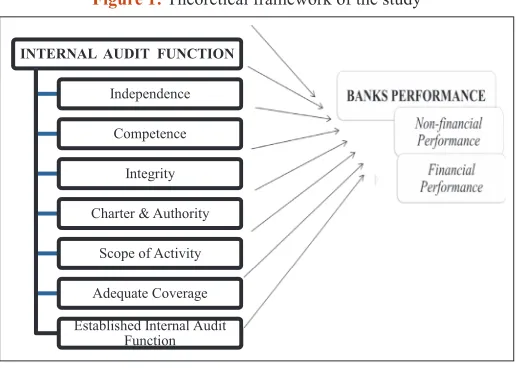
the organizational effectiveness. Based on the above discussion, a theoretical framework is developed to study the direct influence of the IAF on the bank performance in terms of the 2012 Basel
4. CONCLUSION
Based on Basel committee standards of 2012, this paper has developed a theoretical framework to study the direct influence of
implementing IAF on bank performance. It is obvious that internal
audit is considered as a significant part of the bank corporate governance structure and IAF aims to advance its efficiency which directly improves bank performance and ensure credible financial
reporting process. The limitation of this study is related to the conceptual literature and selected IAF principals. Thus, future studies are suggested to extend the research empirically and study the level of implementing these principles in the banking sector.
REFERENCES
Adams, M.B. (1994), Agency theory and internal audit. Managerial Auditing Journal, 9(8), 8-12.
Agrawal, A. (2005), Corporate governance and accounting scandals. Journal Law and Economics, 48, 371-709.
Al-Matari, E.M., Al-Swidi, A., Fadzil, F.H.B. (2014), The effect of the internal audit and firm performance: A proposed research framework. International Review of Management and Marketing, 4(1), 34-41. Alwala, O.L., Biraori, O.E. (2015), Internal audit independence and
share performance of firms listed in the Nairobi stock exchange. International Journal of Recent Research in Interdisciplinary Sciences (IJRRIS), 2(1), 17-23.
Awdat, A. (2015), The impact of the internal audit function to improve the financial performance of commercial banks in Jordan. Research Journal of Finance and Accounting, 6(3), 217-225.
Basel Committee. (2012), The Internal Audit Function in Bank-Basel
Committee on Banking Supervision. Bank for International Settlements.
2012. Available from: http://www.bis.org/publ/bcbs223.pdf.
Christopher, J., Sarens, G., Leung, P. (2009), A critical analysis of the
independence of the internal audit function: Evidence from Australia.
Accounting, Auditing and Accountability Journal, 22(2), 200-220. Deakin, S., Konzelman, S. (2004), Learning from Enron. Corporate
Governance, 12(2), 134-142.
DiMaggio, P.J., Powell, W.W. (1983), The iron cage revisited-institutional isomorphism and collective rationality in organizational fields. American Sociological Review, 48(2), 147-160.
Drogalas, G., Pantelidis, P., Zlatinski, P., Paschaloudis, D. (2012), The role of internal audit in Bank’s M & As. Global Review of Business and Economic Research, 8(1), 147-155.
Dumitrescu, M.I.B. (2004), Internal audit in banking organisations. Biatec, 12(7), 16-19.
Ebaid, I. (2011), Internal audit function: An exploratory study from Egyptian listed firms. International Journal of Law and Management, 53(2), 108-128.
Eden, D., Moriah, L. (1996), Impact of internal auditing on branch bank performance: A field experiment. Organizational Behavior and Human Decision Performance, 68(3), 262-271.
Ejoh, N.O., Ejom, P.E. (2014), The effect of internal audit function on the financial performance of tertiary institutions in Nigeria.
International Journal of Economics, Commerce and Management,
2(10), 1-14.
Eulerich, M., Zipfel, S. (2016), The Effects of a Well-Working Internal
Audit Function on Corporate Governance: An Empirical Analysis for the Banking Industry. Working Paper at Mercator School of Management: University of Duisburg-Essen. Available from:
https://www.ircg.msm.uni-due.de/en/research/fields-of-research/
the-effects-of-a-well-working-internal-audit-function-on-corporate-governance-an-empirical-analysis-for-the-banking-industry/.
Fama, E., Jensen, M. (1983), Separation of ownership and control. Journal of Law and Economics, 7, 301-325.
Gras-Gil, E., Marin-Hernandez, S., Garcia-Perez de Lema, D. (2012), Internal audit and financial reporting in the Spanish banking industry. Managerial Auditing Journal, 27(8), 728-753.
Haniffa, R., Hudaib, M. (2006), Corporate governance structure and
performance of Malaysian listed companies. Journal of Business
Finance and Accounting, 33(78), 1034-1062.
Hutchinson, M.R., Zain, M.M. (2009), Internal audit quality, audit committee independence, growth opportunities and firm performance. Corporate Ownership and Control, 7(2), 50-63.
Jensen, M., Meckling, W. (1976), Theory of the firm: Managerial
behavior, agency costs and ownership structure. Journal of Financial
Economics, 3(4), 305-360.
Jensen, M.C. (1986), Agency costs of free cash flow, corporate finance and takeovers. American Economic Review, 76(2), 323-329. Kiable, B.D. (2012), Internal auditing and performance of government
enterprises: A Nigerian study. Global Journal of Management and
Business Research, 12(6), 5-20.
KPMG. (2014), The Internal Audit Function in Banks: Comparison of the BIS, FRB and IIA (UK) Papers. Australia: KPMG. Available from:
http://www.kpmg.com/au/en/issuesandinsights/articlespublications/
documents/internal-audit-function-banks-bis-frb-iia-comparison-march-2014.pdf.
Meyer, J.W., Rowan, B. (1977), Institutionalized organizations: Formal
structure as myth and ceremony. The American Journal of Sociology,
83(2), 340-363.
Mokhtar, S.M., Sori, Z.M., Hamid, M.A., Abidin, Z.Z., Nasir, A.M., Yaacob, A.S., Mustafa, H., Daud, Z.M., Muhamad, S. (2009), Corporate governance practices and firms performance: The Malaysian case. Journal of Money, Investment and Banking, 11, 45-59.
Sawyer, B.L. (2003), Sawyer’s Internal Auditing: The Practice of Modern Internal Auditing. 5th ed. New York: The Institute of Internal Auditors.
p120-121.
Shleifer, A., Vishny, R. (1986), Large stockholders and corporate control. Journal of Political Economy, 94(3), 461-488.
Stedham, Y., Beekun, R. (2000), Board of directors and the adaptation
of CEO performance evaluation process: Agency-and institutional
theory perspective. Journal Management Studies, 37(2), 277-297. Stewart, J., Subramaniam, N. (2010), Internal audit independence and
objectivity: Emerging research opportunities. Managerial Auditing
Journal, 25(4), 328-360.
Weiss, R. (2005), Audit Committee Characteristics and Monitoring Effectiveness. Doctoral Dissertation. City University of New York.