doi:10.3926/jiem.2011.v4n2.p361-386 JIEM, 2011 – 4(2): 361-386 – Online ISSN: 2013-0953 Print ISSN: 2013-8423
Evaluation of customer oriented success factors in mobile
commerce using fuzzy AHP
Golam Kabir, M. Ahsan Akhtar Hasin
Bangladesh University of Engineering and Technology (BANGLADESH)
;
Received September 2010 Accepted May 2011
Abstract:
Purpose: With the development of information technology, ordinary commercial
activities are evolving into e-commerce. In e-commerce, users can access services
from any place as long as information technology is available. Currently,
e-commerce is moving toward mobile e-commerce that allows users to do commercial
activities while they are moving. This study aims to elucidate the factors that affect
success in mobile commerce, and then evaluate and rate these factors by analyzing
components of commercial activity in the mobile internet environment and give an
evaluation method for mobile commerce in order to help researches and managers
to determine the drawbacks and opportunities.
Design/methodology/approach: A consumer survey was conducted through a
structured undisguised questionnaire towards meeting the objectives of the study.
An online questionnaire constituted the data collection instrument, while only
internet users participated in the sample. The main goal of the questionnaire is to
identify the success factors or criteria and sub-criteria for mobile commerce from
the viewpoint of users' perception and to assess the decision-making executives for
pair-wise comparisons using the fuzzy analytic hierarchical process (FAHP).
doi:10.3926/jiem.2011.v4n2.p361-386 JIEM, 2011 – 4(2): 361-386 – Online ISSN: 2013-0953 Print ISSN: 2013-8423
viewpoint of users' perception. The main attractive factors for the customer are the
trust and mobility factors. In addition, content quality, system quality, use, support,
personalization factors are also important.
Research limitations/implications: Sampling is a major limitation in this study.
Since the survey was conducted based on a sample in Bangladesh, the prudent
reader may need to interpret the results of the study with caution, particularly with
respect to the generalization of research findings to Bangladesh mobile commerce
customers as a whole.
Practical implications: The principal practical implication is to identify the
success factors or criteria and sub-criteria for mobile commerce from the
viewpoint of users' perception. The criteria and decision alternatives or sub-criteria
that are applied in this evaluation were selected based on the feedback from the
questionnaire and literature review. On the other hand, from a professional point
of view, future research should make several extensions to measure users'
satisfaction with mobile commerce using user satisfaction index and evaluate
commercial activities in ubiquitous environment, which is a process in the
transition of commerce, using the success factors and alternatives of mobile
commerce.
Originality/value: There are no comparative studies about evaluation of
customer oriented success factors for Bangladeshi mobile commerce users. A
structured analysis of such customer-oriented factors provides good insights, and
will help business managers to time the launch of mobile commerce businesses. It
will become a useful assessment model for predicting and evaluating market
tendencies.
doi:10.3926/jiem.2011.v4n2.p361-386 JIEM, 2011 – 4(2): 361-386 – Online ISSN: 2013-0953 Print ISSN: 2013-8423
1 Introduction
The Internet has been evolved from a basic tool of communications into a vast and interactive market of products and services involving over 240 million users worldwide (Guo & Shao, 2005). The Internet has the potential to market products and services to customers, to communicate information to a global community, to provide an electronic forum for communications and to process business transactions such as orders and payments. Naturally many enterprises across the world attempt to embrace the digital revolution and place a wide range of materials on the web, from infrastructure to databases to actual services online for the convenience of customers. E-commerce is no longer just an option now but a necessity for enterprises aiming for better performance (Hsieh, Jones, & Lin, 2008).
In the 1990s, mobile commerce was recognized as a part of e-commerce. With the increase of mobile devices, the use of mobile commerce, which accesses and use desired information at any time while moving (Anywhere, Anytime), was popularized. In the late 1990s, over 3.5 million devices were used, but entering the 2000s, the number exceeded a trillion (Varshney & Vetter, 2002).
The advance in information technology from wire-connected Internet to mobile Internet access is radically affecting customer needs and purchasing patterns. Based on a study by the Wireless Data and Computing Service, a division of Strategy Analytics, the annual mobile commerce market may rise to $200 billion by 2004 (Strategy Analytics, 2000) and by 2006, 325 million people will generate mobile commerce revenues of $230 billion (Information Superhighways Newsletter, 2011). Information acquisition pattern desired by customers in mobile commerce involves processes such as identification, information search, alternative evaluation, purchase and delivery, and evaluation after purchase. Such a series of processes is an important factor for companies that intend to engage in mobile commerce (Turban, King, Lee, Warkentin, & Chung, 2002).
doi:10.3926/jiem.2011.v4n2.p361-386 JIEM, 2011 – 4(2): 361-386 – Online ISSN: 2013-0953 Print ISSN: 2013-8423
important to know what the important success factors or decision alternatives in mobile commerce. If the limitations of mobile commerce are understood in advance and overcome and factors for maximizing its advantages are analyzed and utilized, changes in the market can be coped with more actively. As mobile commerce is different from e-commerce in many aspect, it is very useful to examine the success factors of mobile commerce from the user aspect, the developer and contents provider aspect and the system aspect and furthermore from the functional aspect, the technological aspect and the market aspect.
Previous researches have been based on a limited part, but in this study, the components of mobile commerce environment have been analyzed by stage. According to theses that emphasized the various aspects of mobile commerce, Tarasewich, Nickerson and Warkentin (2002) explained differences in mobile customers, the substructure of communication, and mobile application system, and (Delone & Maclean, 1992) distinguished in terms of system quality, contents quality, users and user satisfaction (Muller-Veerse, 1999) analyzed the social and technology aspect of mobile commerce, the partially used environmental aspect, and the mobile commerce market in Western Europe. These aspects are quite important factors for businesses that intend to enter the mobile commerce market.
doi:10.3926/jiem.2011.v4n2.p361-386 JIEM, 2011 – 4(2): 361-386 – Online ISSN: 2013-0953 Print ISSN: 2013-8423
natural approach to this kind of problems. The MCDM methods can also be integrated with fuzzy methods to tackle uncertainties in the data. Chiu, Shyu, and Tzeng (2004) used fuzzy MCDM for evaluating the e-commerce strategy.
This study aims to elucidate the factors that affect success in mobile commerce, and then evaluate and rate these factors by analyzing components of commercial activity in the mobile Internet environment, using the Fuzzy Analytic Hierarchy Process (FAHP). In the proposed methodology, the AHP with its fuzzy extension, namely fuzzy AHP, is applied to obtain more decisive judgments by substituting membership scales for Saaty's 1-9 scales and weighting them in the presence of vagueness. There are various fuzzy AHP applications in the literature that propose systematic approaches for selection of alternatives and justification of problem by using fuzzy set theory and hierarchical structure analysis (Anand, Selvaraj, Kumanan, & Johnny, 2008; Bozbura & Beskese, 2007; Çakir, Tozan, & Vayvay, 2009; Kahraman, Cebeci, & Ruan, 2004; Tang & Beynon, 2005; Xia & Wu, 2007). Büyüközkan (2009) proposed a fuzzy analytic approach to determine the mobile commerce user requirements. Decision makers usually find it more convenient to express interval judgments than fixed value judgments due to the fuzzy nature of the comparison process (Bozdag, Kahraman, & Ruan, 2003).
The remainder of this paper is organized as follows. The success factors and alternatives that affect mobile commerce have been described in the next section. After that, an overview of the fuzzy set theory and fuzzy AHP technique is presented. To evaluate the success factors, this technique has been applied in next section and outlined the findings in this respect. Finally, the last section contains some conclusions reached in this paper.
2 Criteria affecting commerce with mobile access
m-doi:10.3926/jiem.2011.v4n2.p361-386 JIEM, 2011 – 4(2): 361-386 – Online ISSN: 2013-0953 Print ISSN: 2013-8423
commerce covers an emerging set of applications and services that people can access from their Web-enabled mobile devices (Venkatesh et al., 2003) using the “wireless Web. M-commerce inherits many attributes from e-commerce, and some e-commerce characteristics from the e-commerce success model (Molla & Licker, 2001) have employed.
In the mobile Internet environment, people can use a mobile application with a wireless connection anywhere and at anytime. Mobility of devices and applications raises the issue of the appropriateness of their use under certain circumstances (Tarasewich, 2003), that is, mobility is a strategic consideration for m-commerce to utilize in aiming for success. The electronic commerce success factors (Molla & Licker, 2001) can find and extract the major aspects of m-commerce (Gunasekaran & McGaughey, 2009; Tarasewich, 2003). The major m-commerce success factors are: System Quality, Content Quality, Use, Trust, Support, Mobility and Personalization. More detailed information on these categories can be found in references (Molla & Licker, 2001; Sarker & Wells, 2003; Tarasewich, 2003; Venkatesh et al., 2003).
A. System Quality
This is the principal criterion for judging whether site performance is sufficiently smooth and seamless in m-commerce. Earlier MIS works investigated the reliability of the system, online response time, and so on (Varshney & Vetter, 2002). Recent works (Guo & Shao, 2005) focusing on e-commerce have suggested additional variables: online response time, 24-hour availability, page loading speed, visual appearance.
B. Content Quality
Content quality is very important in attracting customers to m-commerce. Content quality includes the attributes of the content that are presented directly on mobile devices. Information systems’ literature has emphasized the importance of information quality as one of the determinants of user satisfaction, and has identified a number of attributes: up-to-datedness, understandability, timeliness, and preciseness (Delone & Maclean, 1992).
doi:10.3926/jiem.2011.v4n2.p361-386 JIEM, 2011 – 4(2): 361-386 – Online ISSN: 2013-0953 Print ISSN: 2013-8423
The extent to which a system is used is one of the measures that are widely used to define the success of a business. Considering the purposes of e-commerce systems suggested by (Venkatesh et al., 2003), the use of an e-commerce system can be divided into informational and transactional components. Such attributes are applied in exactly the same way to m-commerce. The informational use logged by a customer can be described as requesting and obtaining information. These terms are often shortened to information and transaction.
D. Trust
Trust is another significant challenge in the m-commerce environment. Customers are concerned about the level of security when providing sensitive information online (Warrington, Abgrab, & Caldwell, 2000). Also, they expect that personal information will be protected from external access; there are two alterative - security and privacy. There are potential benefits in storing data, including personal and financial information, on mobile devices for use in m-commerce applications (Andreou et al., 2005).
E. Support
If m-commerce services provide customer satisfaction, customers will return to the service after their initial experience. Support is a customer-oriented criterion and includes the following components: trucking order status, account maintenance, payment alternatives, Frequently Asked Question (FAQ), etc (Tarasewich, Nickerson, & Warkentin, 2002).
F. Mobility
The customer can employ mobile services and transactions from anywhere, at anytime; m-commerce must support this customer mobility. Mobility of device and application raises the issue of their suitability for the user under some circumstances (Tarasewich, 2003).
G. Personalization
doi:10.3926/jiem.2011.v4n2.p361-386 JIEM, 2011 – 4(2): 361-386 – Online ISSN: 2013-0953 Print ISSN: 2013-8423
(Tarasewich et al., 2002). Its significance is conveyed in a quote from Muller-Veerse (1999), “personalization will be absolutely crucial in the m-commerce arena, where every additional click required from the user reduces the transaction probability by 50%”. Since mobile devices have particular limitations, e.g., low battery capacity, and small memory and screen size, personalization is needed to increase their usability.
3 Fuzzy set theory and fuzzy analytic hierarchy process
Nevertheless, there is an extensive literature which addresses the situation in the real world where the comparison ratios are imprecise judgments. In the conventional AHP, the pair wise comparisons for each level with respect to the goal of the best alternative selection are conducted using a nine-point scale. So, the application of Saaty's AHP has some shortcomings as follows (Saaty, 1998); (1) The AHP method is mainly used in nearly crisp decision applications, (2) The AHP method creates and deals with a very unbalanced scale of judgment, (3) The AHP method does not take into account the uncertainty associated with the mapping of one's judgment to a number, (4) Ranking of the AHP method is rather imprecise, (5) The subjective judgment, selection and preference of decision-makers have great influence on the AHP results. In addition, a decision-maker's requirements on evaluating alternatives always contain ambiguity and multiplicity of meaning. Furthermore, it is also recognized that human assessment on qualitative attributes is always subjective and thus imprecise. Therefore, conventional AHP seems inadequate to capture decision-maker's requirements explicitly. In order to model this kind of uncertainty in human preference, fuzzy sets could be incorporated with the pairwise comparison as an extension of AHP. The fuzzy AHP approach allows a more accurate description of the decision making process.
3.1 Fuzzy set theory
doi:10.3926/jiem.2011.v4n2.p361-386 JIEM, 2011 – 4(2): 361-386 – Online ISSN: 2013-0953 Print ISSN: 2013-8423
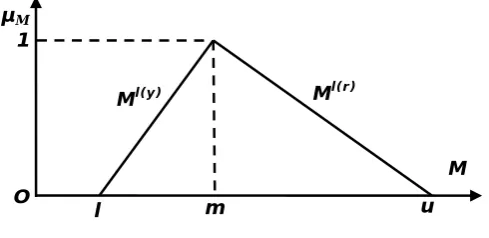
Figure 1. “Triangular fuzzy number M”.
A TFN is denoted simply as (l/m, m/u) or (l, m, u), represents the smallest possible value, the most promising value and the largest possible value respectively. The TFN having linear representation on left and right side can be defined in terms of its membership function as:
3.2 Fuzzy analytic hierarchy process
In this paper fuzzy-AHP methodology has been discussed for the mobile commerce success factors evaluation. Basically fuzzy-AHP is the fuzzy modified form of AHP. It has the ability to extract the merits of both approaches to efficiently and effectively tackle the multi-attribute decision making problems like mobile commerce success factors evaluation.
The following section outlines the extent analysis method on FAHP. Let X = {x1, x2,…, xn} be an object set and U = {u1,u2 ,….,um} be a goal set. As per Chang (1992, 1996) each object is taken and analysis for each goal, gi, is performed, respectively. Therefore m extent analysis values for each object can be obtained, as under:
𝑀𝑔1𝑖 ,𝑀𝑔2𝑖 ,….., 𝑀𝑔𝑚𝑖 , i = 1, 2, 3,…..,n O
1
l m u
Ml(r)
Ml(y)
µM
M
µ (x\M) =
0,
(x-l)/(m-l), (u-x)/(u-m),
0,
x < l, l ≤ x ≤ m ≤ x ≤
doi:10.3926/jiem.2011.v4n2.p361-386 JIEM, 2011 – 4(2): 361-386 – Online ISSN: 2013-0953 Print ISSN: 2013-8423
where all the 𝑀𝑔𝑖
𝑚 ( j = 1, 2,….,m ) are TFNs whose parameters are, depicting least,
most and largest possible values respectively and represented as (a, b, c). The steps of Chang’s extent analysis are discussed in the Appendices.
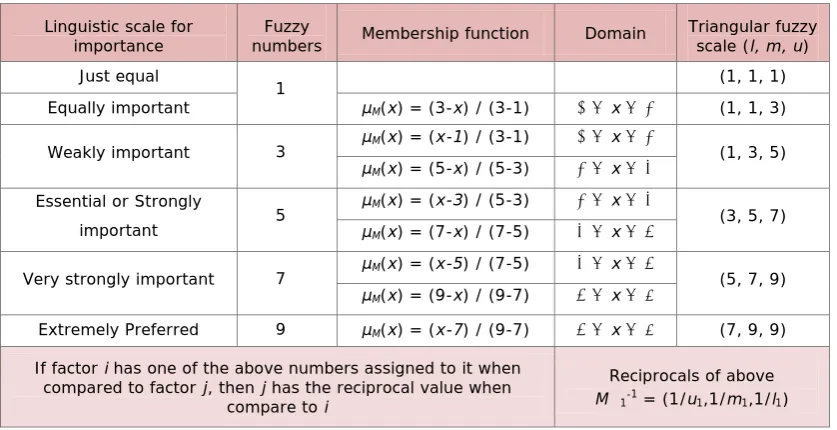
Figure 2 and Table 1, shows the linguistics scale along with corresponding triangular fuzzy scale.
Figure 2. “Linguistic variables for the importance weight of each criterion”.
Linguistic scale for
importance numbers Fuzzy Membership function Domain Triangular fuzzy scale (l, m, u) Just equal
1 (1, 1, 1)
Equally important µM(x) = (3-x) / (3-1) 1 ≤ x ≤ 3 (1, 1, 3)
Weakly important 3 µM(x) = (x-1) / (3-1) 1 ≤ x ≤ 3 (1, 3, 5)
µM(x) = (5-x) / (5-3) 3 ≤ x ≤ 5 Essential or Strongly
important 5
µM(x) = (x-3) / (5-3) 3 ≤ x ≤ 5
(3, 5, 7)
µM(x) = (7-x) / (7-5) 5 ≤ x ≤ 7
Very strongly important 7 µM(x) = (x-5) / (7-5) 5 ≤ x ≤ 7 (5, 7, 9)
µM(x) = (9-x) / (9-7) 7 ≤ x ≤ 9
Extremely Preferred 9 µM(x) = (x-7) / (9-7) 7 ≤ x ≤ 9 (7, 9, 9)
If factor i has one of the above numbers assigned to it when compared to factor j, then j has the reciprocal value when
compare to i
Reciprocals of above
M1-1 = (1/u1,1/m1,1/l1)
Table 1. “Linguistic variables describing weights of the criteria and values of ratings”. Source: Bozbura & Beskese, (2007)
4 Evaluation of the success factors through fuzzy AHP
The Fuzzy AHP model was formulated and data were collected through a structured undisguised questionnaire. A consumer survey was conducted towards meeting the
1
0.5
0
µ
1 3 5 7 9
doi:10.3926/jiem.2011.v4n2.p361-386 JIEM, 2011 – 4(2): 361-386 – Online ISSN: 2013-0953 Print ISSN: 2013-8423
objectives of the present study. An online questionnaire constituted the data collection instrument, while only Internet users participated in the sample. The questionnaire was sent to a random sample of the mobile commerce service providers, users, academic experts and professional executives of about 353 contacts on March 23rd 2010 and 281 respondents completed the questionnaire, a response rate of 79.6%.
For the actual survey, individuals from the sample were invited by e-mail to participate in the Web survey. The e-mail invitation letter described the purpose of the study and assured the confidentiality of information provided by respondents. Participants were asked to continue the survey only if they currently use the mobile phone. Then, participants were directed to a Web site by clicking on a URL in the email to reach the survey webpage. About a week later, a second reminder e-mail was sent to the people who did not respond to the Web survey. Two week after, a third reminder e-mail was sent to the people who had not responded to the Web survey.
doi:10.3926/jiem.2011.v4n2.p361-386 JIEM, 2011 – 4(2): 361-386 – Online ISSN: 2013-0953 Print ISSN: 2013-8423
4.1 Break down decision problems
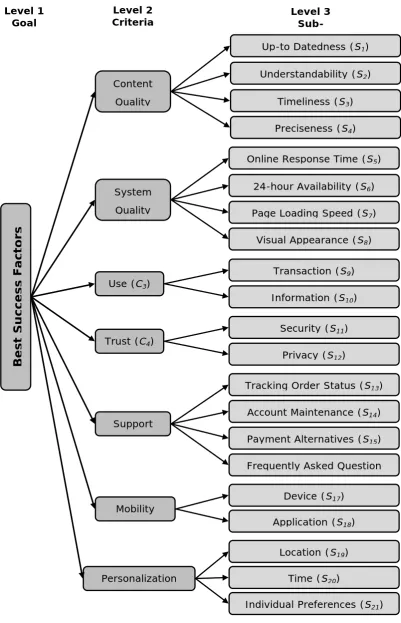
In this step, a decision hierarchy has been constructed by breaking a general problem into individual criteria. The success factors based on the feedback from the questionnaire and described in Section 2 are shown in Figure 3 in the form of a hierarchical diagram. The top of the hierarchy is the overall objective or goal, the middle nodes are the relevant attributes (criteria) and the last level are the decision alternatives or sub-criteria’s of the decision problem.
4.2 Pair-wise comparison
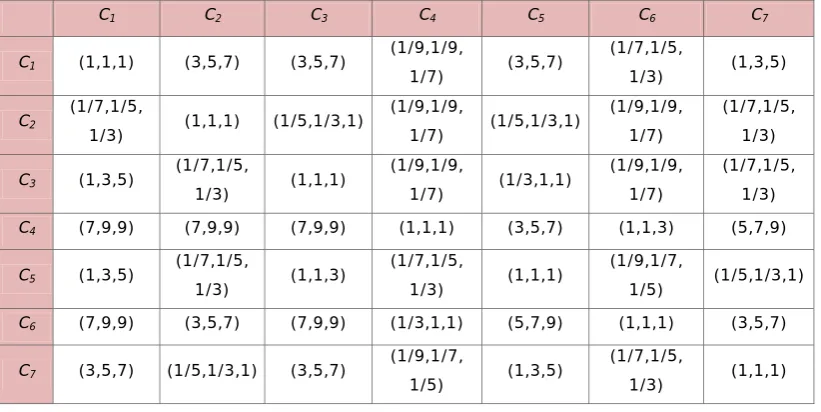
The use of ratings enables DMs to analyze each criterion with respect to other criterion for their subsequent ranking relative to each other. A decision matrix ‘D’ as shown in Table 2 may be constructed to measure the relative degree of importance for each success factors or criteria, based on the proposed methodology. The decision matrix consist 7×7 elements.
C1 C2 C3 C4 C5 C6 C7
C1 (1,1,1) (3,5,7) (3,5,7)
(1/9,1/9,
1/7) (3,5,7)
(1/7,1/5,
1/3) (1,3,5)
C2
(1/7,1/5,
1/3) (1,1,1) (1/5,1/3,1)
(1/9,1/9,
1/7) (1/5,1/3,1)
(1/9,1/9, 1/7)
(1/7,1/5, 1/3)
C3 (1,3,5)
(1/7,1/5,
1/3) (1,1,1)
(1/9,1/9,
1/7) (1/3,1,1)
(1/9,1/9, 1/7)
(1/7,1/5, 1/3)
C4 (7,9,9) (7,9,9) (7,9,9) (1,1,1) (3,5,7) (1,1,3) (5,7,9)
C5 (1,3,5)
(1/7,1/5,
1/3) (1,1,3)
(1/7,1/5,
1/3) (1,1,1)
(1/9,1/7,
1/5) (1/5,1/3,1)
C6 (7,9,9) (3,5,7) (7,9,9) (1/3,1,1) (5,7,9) (1,1,1) (3,5,7)
C7 (3,5,7) (1/5,1/3,1) (3,5,7)
(1/9,1/7,
1/5) (1,3,5)
(1/7,1/5,
1/3) (1,1,1)
Table 2. “Fuzzy comparison matrix of criteria with respect to the overall objective”.
doi:10.3926/jiem.2011.v4n2.p361-386 JIEM, 2011 – 4(2): 361-386 – Online ISSN: 2013-0953 Print ISSN: 2013-8423
Figure 3. “Objective hierarchies for the evaluation of mobile commerce success factors”.
Be
st
S
u
cc
es
s F
act
o
rs
Content Quality
System Quality
Trust (C4)
Support Use (C3)
Personalization Mobility
Up-to Datedness (S1)
Understandability (S2)
Timeliness (S3)
Preciseness (S4)
Online Response Time (S5)
24-hour Availability (S6)
Page Loading Speed (S7)
Visual Appearance (S8)
Transaction (S9)
Information (S10)
Security (S11)
Privacy (S12)
Tracking Order Status (S13)
Account Maintenance (S14)
Payment Alternatives (S15)
Frequently Asked Question
Device (S17)
Application (S18)
Location (S19)
Time (S20)
Individual Preferences (S21)
Level 1
Sub-doi:10.3926/jiem.2011.v4n2.p361-386 JIEM, 2011 – 4(2): 361-386 – Online ISSN: 2013-0953 Print ISSN: 2013-8423
SC1 = (11.26, 19.31, 27.41) ⊗ (1/161.783, 1/125.77, 1/85.4) = (0.07, 0.153, 0.321)
SC2 = (1.91, 2.28, 3.95) ⊗ (1/161.783, 1/125.77, 1/85.4) = (0.011, 0.018, 0.046)
SC3 = (2.84, 5.62, 7.95) ⊗ (1/161.783, 1/125.77, 1/85.4) = (0.018, 0.045, 0.093)
SC4 = (31, 41, 47) ⊗ (1/161.783, 1/125.77, 1/85.4) = (0.191, 0.326, 0.550)
SC5 = (3.60, 5.88, 10.87) ⊗ (1/161.783, 1/125.77, 1/85.4) = (0.022, 0.047, 0.127)
SC6 = (26.33, 37, 43) ⊗ (1/161.783, 1/125.77, 1/85.4) = (0.163, 0.294, 0.504)
SC7 = (8.46, 14.68, 21.53) ⊗ (1/161.783, 1/125.77, 1/85.4) = (0.052, 0.117, 0.252)
The degrees of possibility of superiority of SC1 can be calculated is denoted by V (SC1 ≥ SC2). Therefore, the degree of possibility of superiority for the first requirement- the values are calculated as
V (SC1 ≥ SC2) = 1, V (SC1 ≥ SC3) = 1,
V (SC1 ≥ S4) = (0.191 - 0.321) / (0.153 - 0.321) - (0.326 - 0.191) = 0.13) / (-0.303) = 0.43
V (SC1 ≥ SC2) = 1, V (SC1 ≥ SC2) = 0.528, V (SC1 ≥ SC2) = 1
For the second requirement- the values are calculated as
V (SC2 ≥ SC1) = 0.216, V (SC2 ≥ SC3) = 0.51, V (SC2 ≥ SC4) = 0.89
V (SC2 ≥ SC5) = 0.453, V (SC2 ≥ SC6) = 0.736, V (SC2 ≥ SC7) = 0.0645
For the third requirement- the values are calculated as
V (SC3 ≥ SC1) = 1, V (SC3 ≥ SC2) = 0.176, V (SC3 ≥ SC4) = 0.536
doi:10.3926/jiem.2011.v4n2.p361-386 JIEM, 2011 – 4(2): 361-386 – Online ISSN: 2013-0953 Print ISSN: 2013-8423
For the fourth requirement- the values are calculated as
V (SC4 ≥ SC1) = 1, V (SC4 ≥ SC2) = 1, V (SC4 ≥ SC4) = 1
V (SC4 ≥ SC5) = 1, V (SC4 ≥ SC6) = 1, V (SC4 ≥ SC7) = 1
For the fifth requirement- the values are calculated as
V (SC5 ≥ SC1) = 1, V (SC5 ≥ SC2) = 0.35, V (SC5 ≥ SC3) = 1
V (SC5 ≥ SC4) = 0.303, V (SC5 ≥ SC6) = 0.171, V (SC5 ≥ SC7) = 0.517
For the sixth requirement- the values are calculated as
V (SC6 ≥ SC1) = 1, V (SC6 ≥ SC2) = 1, V (SC6 ≥ SC3) = 1
V (SC6 ≥ SC4) = 0.907, V (SC6 ≥ SC5) = 1, V (SC6 ≥ SC7) = 1
For the seventh requirement- the values are calculated as
V (SC7 ≥ SC1) = 1, V (SC7 ≥ SC2) = 0.835, V (SC7 ≥ SC3) = 1
V (SC7 ≥ SC4) = 0.226, V (SC7 ≥ SC5) = 1, V (SC7 ≥ SC6) = 0.335
The minimum degree of possibility of superiority of each criterion over another is obtained. This further decides the weight vectors of the criteria.
Therefore, the weight vector is given as
W' = (0.43, 0.0645, 0.176, 1, 0.171, 0.907, 0.226)
The normalized value of this vector decides the priority weights of each criterion over another. The normalized weight vectors are calculated as
W = (0.144, 0.022, 0.06, 0.336, 0.056, 0.304, 0.078)
doi:10.3926/jiem.2011.v4n2.p361-386 JIEM, 2011 – 4(2): 361-386 – Online ISSN: 2013-0953 Print ISSN: 2013-8423
Figure 4. “Contribution of criteria in percentage for the evaluation of m-commerce”.
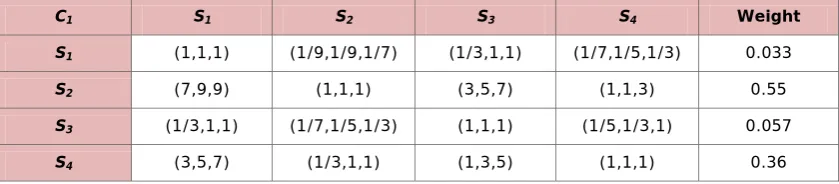
Now the different sub-criteria are compared under each of the criterion separately by following the same procedure discussed above. The fuzzy comparison matrices and the weight vectors of each sub-criterion are shown in Tables 3-9. The priority weight of each sub-criterion has been determined following the similar procedure discussed above.
C1 S1 S2 S3 S4 Weight
S1 (1,1,1) (1/9,1/9,1/7) (1/3,1,1) (1/7,1/5,1/3) 0.033
S2 (7,9,9) (1,1,1) (3,5,7) (1,1,3) 0.55
S3 (1/3,1,1) (1/7,1/5,1/3) (1,1,1) (1/5,1/3,1) 0.057
S4 (3,5,7) (1/3,1,1) (1,3,5) (1,1,1) 0.36
Table 3. “Fuzzy comparison matrix of the sub-criteria with respect to content quality”.
C2 S5 S6 S7 S8 Weight
S5 (1,1,1) (1/7,1/5,1/3) (1,1,3) (1/3,1,1) 0.157
S6 (3,5,7) (1,1,1) (7,9,9) (5,7,9) 0.453
S7 (1/3,1,1) (1/9,1/9,1/7) (1,1,1) (1/3,1,1) 0.324
S8 (1,1,3) (1/9,1/7,1/5) (1,1,3) (1,1,1) 0.066
Table 4. “Fuzzy comparison matrix of the sub-criteria with respect to system quality”.
0 10 20 30 40
Content Quality… System Quality… Use (C3) Trust (C4) Support (C5) Mobility (C6) Personalization…
doi:10.3926/jiem.2011.v4n2.p361-386 JIEM, 2011 – 4(2): 361-386 – Online ISSN: 2013-0953 Print ISSN: 2013-8423
C3 S9 S10 Weight
S9 (1,1,1) (1/5,1/3,1) 0.30
S10 (1,3,5) (1,1,1) 0.70
Table 5. “Fuzzy comparison matrix of the sub-criteria with respect to use”.
C4 S11 S12 Weight
S11 (1,1,1) (1,1,3) 0.50
S12 (1/3,1,1) (1,1,1) 0.50
Table 6. “Fuzzy comparison matrix of the sub-criteria with respect to trust”.
C5 S13 S14 S15 S16 Weight
S13 (1,1,1) (5,7,9) (3,5,7) (1,3,5) 0.463
S14 (1/9,1/7,1/5) (1,1,1) (1/7,1/5,1/3) (1/7,1/5,1/3) 0.006
S15 (1/7,1/5,1/3) (3,5,7) (1,1,1) (1/5,1/3,1) 0.21
S16 (1/5,1/3,1) (3,5,7) (1,3,5) (1,1,1) 0.321
Table 7. “Fuzzy comparison matrix of the sub-criteria with respect to support”.
C6 S17 S18 Weight
S17 (1,1,1) (5,7,9) 0.50
S18 (1/9,1/7,1/5) (1,1,1) 0.50
Table 8. “Fuzzy comparison matrix of the sub-criteria with respect to Mobility”.
C7 S19 S20 S21 Weight
S19 (1,1,1) (1/7,1/5,1/3) (1,1,3) 0.086
S20 (3,5,7) (1,1,1) (3,5,7) 0.781
S21 (1/3,1,1) (1/7,1/5,1/3) (1,1,1) 0.133
Table 9. “Fuzzy comparison matrix of the sub-criteria with respect to personalization”.
doi:10.3926/jiem.2011.v4n2.p361-386 JIEM, 2011 – 4(2): 361-386 – Online ISSN: 2013-0953 Print ISSN: 2013-8423
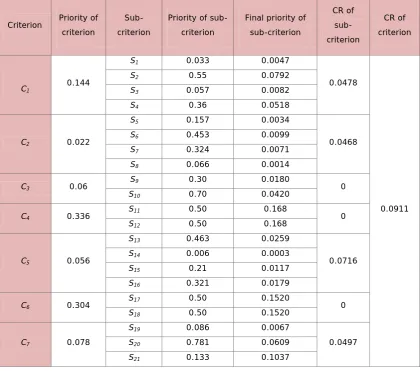
Criterion Priority of criterion
Sub-criterion
Priority of sub-criterion
Final priority of sub-criterion CR of sub-criterion CR of criterion
C1 0.144
S1 0.033 0.0047
0.0478
0.0911
S2 0.55 0.0792
S3 0.057 0.0082
S4 0.36 0.0518
C2 0.022
S5 0.157 0.0034
0.0468
S6 0.453 0.0099
S7 0.324 0.0071
S8 0.066 0.0014
C3 0.06
S9 0.30 0.0180
0
S10 0.70 0.0420
C4 0.336
S11 0.50 0.168
0
S12 0.50 0.168
C5 0.056
S13 0.463 0.0259
0.0716
S14 0.006 0.0003
S15 0.21 0.0117
S16 0.321 0.0179
C6 0.304
S17 0.50 0.1520
0
S18 0.50 0.1520
C7 0.078
S19 0.086 0.0067
0.0497
S20 0.781 0.0609
S21 0.133 0.1037
Table 10. “Priority and consistency ratios for the evaluation of m-commerce”.
Figure 5. “Importance of sub-criterion for the evaluation of m-commerce”.
0 0,02 0,04 0,06 0,08 0,1 0,12 0,14 0,16 0,18
S1 S2 S3 S4 S5 S6 S7 S8 S9 S10 S11 S12 13S S14 S15 S16 17S S18 S19 S20 S21
doi:10.3926/jiem.2011.v4n2.p361-386 JIEM, 2011 – 4(2): 361-386 – Online ISSN: 2013-0953 Print ISSN: 2013-8423
5 Discussions
The present study extracted success factors and decision alternatives in consideration of users, systems, developers and suppliers involved in mobile commerce, and were selected from the functional, technological and market aspect. Figure 5 shows the importance of decision alternatives or sub-criteria calculated based on the importance of the success factors of mobile commerce. Table 10 shows that the trust (C4) and mobility (C6) have higher priority than the other success factors. As a result, trust and mobility are the essential factors affecting the success of mobile commerce, while security (S11) and privacy (S12) are the most critical factors within trust criteria and device (S17) and application (S18) are the most critical factors within mobility criteria (Figure 5). Through the calculation of importance in Table 10, individual preferences (S2) in personalization and understandability (S21) of content quality are also important for users to understand and use contents without difficulty. Personal satisfaction should be enhanced through easy acquisition of desired contents, and the number of transactions should be minimized. Mobile commerce users are more active than e-commerce users, and sites are visited more frequently when their contents are updated with latest data. In addition, preciseness (S4), timeliness (S20) and information (S10) were also found important. Since the consistency of all the level is less than 1.0, this set of priorities is considered acceptable.
6 Conclusions
With mobile and internet technologies, customers can have unlimited access to the information they require and may enjoy a wider range of choices in selecting products and services with highly competitive prices. Therefore, it is generally not easy for enterprises to gain and sustain competitive advantages based solely on a cost leadership strategy in rival-driven market. Rather, the subtle “differentiating” service quality levels of the enterprises have increasingly become a key driving force in enhancing customers’ satisfaction and in turn in expanding their customer bases.
doi:10.3926/jiem.2011.v4n2.p361-386 JIEM, 2011 – 4(2): 361-386 – Online ISSN: 2013-0953 Print ISSN: 2013-8423
pointers to business success and application of the Fuzzy AHP technique provides a customer-oriented success strategy. The Fuzzy AHP technique has application in providing a structured approach to finding the best decision-making strategy in the area of Multi Criteria Decision Making. A subjective and objective integrated approach has been put forward to determine attributes weights in Fuzzy AHP problems. The main attractive factors for the customer are the trust and mobility factors. In addition, content quality, system quality, use, support, personalization factors are also important. If application of these criteria is extended to marketing in the new ubiquitous computing environment, it will become a useful assessment model for predicting and evaluating market tendencies.
Sampling is a major limitation in this study. Since the survey was conducted based on a sample in Bangladesh, the prudent reader may need to interpret the results of the study with caution, particularly with respect to the generalization of research findings to Bangladesh mobile commerce customers as a whole.
Future research should make several extensions of the current study. For future study, it is needed to measure users' satisfaction with mobile commerce using user satisfaction index and evaluate commercial activities in ubiquitous environment, which is a process in the transition of commerce, using the success factors and alternatives of mobile commerce.
Appendices
The steps of Chang’s extent analysis (Chang, 1992) can be detailed as follows (Bozbura, Beskese, & Kahraman, 2007; (Kahraman, Cebeci, & Ulukan, 2003; Kahraman, Cebeci, & Ruan, 2004):
Step 1: The value of fuzzy synthetic extent with respect to i th object is defined as
𝑆𝑖= ∑ 𝑀𝑔𝑖
𝑗 ⊗[∑ ∑ 𝑀
𝑔𝑖 𝑗 𝑚 𝑗=1 𝑛
𝑖=1 ]−1
𝑚 𝑗=1
To obtain ∑mj=1M gji perform the fuzzy addition operation of m extent analysis values for a particular matrix such that
∑mj=1Mgji= �∑mj=1aj, ∑mj=1bj, ∑mj=1cj� And to obtain �∑ ∑ 𝑀𝑔𝑖
𝑗 𝑚 𝑗=1 𝑛
𝑖=1 �-1 perform the fuzzy addition operation of 𝑀𝑔𝑚𝑖 ( j = 1,
doi:10.3926/jiem.2011.v4n2.p361-386 JIEM, 2011 – 4(2): 361-386 – Online ISSN: 2013-0953 Print ISSN: 2013-8423
∑ ∑ 𝑀𝑔𝑖 𝑗 𝑚 𝑗=1 𝑛
𝑖=1 = (∑ 𝑎𝑛𝑖=1 𝑖,∑ 𝑏𝑖=1𝑛 𝑖,∑𝑛𝑖=1𝑐𝑖)
And then compute the inverse of the vector such that
[∑ ∑ 𝑀𝑔𝑖
𝑗 𝑚 𝑗=1 𝑛
𝑖=1 ]−1= �∑𝑛1𝑐𝑖 𝑖=1 ,
1 ∑𝑛𝑖=1𝑏𝑖,
1
∑𝑛𝑖=1𝑎𝑖�
Step 2: The degree of possibility of M2 = (a2, b2, c2) ≥ M1 = (a1, b1, c1) is defined as
V (M2 ≥ M1) = sup [min (µM1(𝑥) , µM2(x))]
And can be equivalently expressed as follows:
where d is the ordinate of the highest intersection point D between µM1and µM2as shown in Figure 6.
Figure 6. “The intersection between M1 and M2”
To compare M1 and M2, both the values of V (M1 ≥ M2) and V (M2 ≥ M1).
Step 3: The degree of possibility for a convex fuzzy number to be greater than k
convex fuzzy numbers Mi (i = 1,2,….., k ) can be defined by
V (M ≥ M1, M2,…., Mk) = V[(M ≥ M1) and (M ≥ M2 ) and … (M ≥ Mk)]
V (M2 ≥ M1 )= hgt
(M1 ∩ M2)
1
𝑎1− 𝑐2 (𝑏2− 𝑐2)−(𝑏1− 𝑎1)
0
if b2 ≥ b1
otherwise if a1 ≥ c2
, =
M2 M1
a2 b2 a1 d c2 b1 c1
V (M2 ≥ M1)
O 1
doi:10.3926/jiem.2011.v4n2.p361-386 JIEM, 2011 – 4(2): 361-386 – Online ISSN: 2013-0953 Print ISSN: 2013-8423
= min V (M ≥ Mi), (i = 1, 2, 3 ,…., k)
Assuming that
d' (Ai) = min V (Si ≥ Sk)
for k = 1, 2, 3,…., n; k ≠ i. Then the weight vector is given by
W' = (d' (A1), d' (A2),….., d' (An))T
where Ai =(i = 1,2,3,…, n) are n elements
Step 4: By normalizing, the normalized weight vectors are
W = (d (A1), d (A2),….., d (An))T
where W is a non-fuzzy number.
References
Anand, D. M., Selvaraj, T., Kumanan, S., & Johnny, M. A. (2008). Application of multicriteria decision making for selection of robotic system using fuzzy analytic hierarchy process. International Journal of Management and Decision Making, 9(1), 75-98.
doi:10.1504/IJMDM.2008.016043
Andreou, A. S., Leonidou, C., Chrysostomou, C., Pitsillides, A., Samaras, G., Schizas, C. N., & Mavromous, S. M. (2005). Key issues for the design and development of mobile commerce services and applications. International Journal
of Mobile Communications, 3(3), 303-323. doi:10.1504/IJMC.2005.006586
Bozbura, F. T., & Beskese, A. (2007). Prioritization of organizational capital measurement indicators using fuzzy AHP. International Journal of Approximate
Reasoning, 44(2), 124-147. doi:10.1016/j.ijar.2006.07.005
doi:10.3926/jiem.2011.v4n2.p361-386 JIEM, 2011 – 4(2): 361-386 – Online ISSN: 2013-0953 Print ISSN: 2013-8423
32(4), 1100-1112.
doi:10.1016/j.eswa.2006.02.006
Bozdag, C. E., Kahraman, C., & Ruan, D. (2003). Fuzzy group decision making for selection among computer integrated manufacturing systems. Computers in
Industry, 51(1), 13–29.
doi:10.1016/S0166-3615(03)00029-0
Büyüközkan, G. (2009). Determining the mobile commerce user requirements using an analytic approach. Computer Standards & Interfaces, 31(1), 1144-152.
Çakir, E., Tozan, H., & Vayvay, O. (2009). A Method for Selecting Third Party Logistic Service Provider Using Fuzzy AHP. Journal of Naval Science and
Engineering, 5(3), 38-54.
Chang, D. Y. (1992). Extent analysis and synthetic decision. Optimization
Techniques and Applications, 1, 352-355.
Chang, D. Y. (1996). Applications of the extent analysis method on fuzzy AHP.
European Journal of Operational Research, 95(3), 649-655. doi:10.1016/0377-2217(95)00300-2
Chiu, Y. C., Shyu, J. Z., & Tzeng, G. H. (2004). Fuzzy MCDM for evaluating the e-commerce strategy. International Journal of Computer Applications in Technology, 19(1), 12-22.
doi:10.1504/IJCAT.2004.003656
Delone, W. H., & Maclean, E. R. (1992). Information systems success: The quest for the dependent variable. Information Systems Research, 3(1), 60-95.
doi:10.1287/isre.3.1.60
Gunasekaran, A., & McGaughey, R. E. (2009). Mobile commerce: issues and obstacles. International Journal of Business Information Systems, 4(2), 245-261.
doi:10.1504/IJBIS.2009.022826
Guo, S., & Shao, B. (2005, June). Quantitative Evaluation of E-Commercial
Websites of Foreign Trade Enterprises in Chongquing. Proceedings of international
doi:10.3926/jiem.2011.v4n2.p361-386 JIEM, 2011 – 4(2): 361-386 – Online ISSN: 2013-0953 Print ISSN: 2013-8423
Hsieh, C. T., Jones, C., & Lin, B. (2008). The new business potential with mobile commerce. International Journal of Mobile Communications, 6(4), 436 - 455.
doi:10.1504/IJMC.2008.018052
Information Superhighways Newsletter (2011). Strategy Analytics Forecasts $230
Billion Mobile Commerce Market by 2006 - Brief Article. Retrieved January 14th, 2011, from http://findarticles.com/p/articles/mim 0IGM/is48/ai73554018/.
Kahraman, C., Cebeci, U., & Ulukan, Z. (2003). Multi-criteria Supplier Selection Using Fuzzy AHP. Logistics Information Management, 16(6), 382-394.
doi:10.1108/09576050310503367
Kahraman, C., Cebeci, U., & Ruan, D. (2004). Multi-attribute comparison of catering service companies using fuzzy AHP: the case of Turkey. International
Journal of Production Economics, 87(2), 171–184. doi:10.1016/S0925-5273(03)00099-9
Kim, J., & Hwang, C. S. (2005, June). Applying the analytic hierarchy process to the
evaluation of customer-oriented success factors in mobile commerce. Proceedings
of International Conference on Services Systems and Services Management, Chongquing, China, 1, 69-74.
Molla, A., & Licker, P. S. (2001). E-Commerce Systems Success: An Attempt to Extend and Respecify the Delone and Maclean Model of its Success. Journal of
Electronic Commerce Research, 2(4), 131-141.
Muller-Veerse, F. (1999). Mobile commerce report. London: Durlacher Corporation. Retrieved from http://www.durlacher.com/downloads/mcomreport.pdf.
Oh, G. O., Kim, D., & Rhew, S. (2006). Selection of the Success Factors of Mobile Commerce and Evaluation using AHP. International Journal of Computer Science
and Network Security, 6(7B), 127-134.
Saaty, T. L. (1998). The Analytic Hierarchy Process: Planning, Priority Setting,
Resource Allocation. Pittsburgh, PA: RWS Publications.
Sarker, S., & Wells, J. D. (2003). Understanding Mobile Handheld Device Use and Adaption. Communications of the ACM, 46(12), 35-40.
doi:10.3926/jiem.2011.v4n2.p361-386 JIEM, 2011 – 4(2): 361-386 – Online ISSN: 2013-0953 Print ISSN: 2013-8423
Strategy Analytics (2000). Strategy Analytics forecasts $200 billion mobile
commerce market by 2004. Retrieved January 10th, 2000, from
http://www.wowcom.com/newsline/press_release.cfm? press_i d=826. Wowcompany, USA.
Tang, Y. C., & Beynon, M. J. (2005). Application and Development of a Fuzzy Analytic Hierarchy Process within a Capital Investment Study. Journal of
Economics and Management, 1(2), 207-230.
Tarasewich, P. (2003). Designing Mobile Commerce Applications. Communications
of the ACM, 46(12), 57-60. doi:10.1145/953460.953489
Tarasewich, P., Nickerson, R. C., & Warkentin, M. (2002). Issues in mobile e-commerce. CAIS, 8, 41-64.
Topcu, Y. I., & Burnaz, S. (2006, June). A multiple criteria decision making
approach for the evaluation of retail location. Paper presented at the 18th
International Conference on Multiple Criteria Decision Making, Chania, Greece.
Turban, E., King, D., Lee, J. K., Warkentin, M., & Chung, H. M. (2002). Electronic
Commerce 2002 - A Managerial perspective (2nd ed.). New Jersey: Prentice Hall.
Varshney, U., & Vetter, R. (2002). Mobile Commerce: Framework, Applications and Networking Support. Mobile Networks and Applications, 7(3), 185-198.
doi:10.1023/A:1014570512129
Venkatesh, V., Ramesh, V., & Massey, A. P. (2003). Understanding Usability in Mobile Commerce. Communications of the ACM, 46(12), 53-56.
doi:10.1145/953460.953488
Warrington, T. B., Abgrab, N. J., & Caldwell, H. M. (2000). Building trust to develop competitive advantage in e-business relationships. Competitiveness Review, 10(2), 160-168.
Xia, W., & Wu, Z. (2007). Supplier Selection with Multiple Criteria in Volume Discount Environments. Omega, 35, 494-504.
doi:10.3926/jiem.2011.v4n2.p361-386 JIEM, 2011 – 4(2): 361-386 – Online ISSN: 2013-0953 Print ISSN: 2013-8423
Zadeh, L. A. (1965). Fuzzy sets. Information and Control, 8, 338-353.
doi:10.1016/S0019-9958(65)90241-X
Journal of Industrial Engineering and Management, 2011 (www.jiem.org)
Article's contents are provided on a Attribution-Non Commercial 3.0 Creative commons license. Readers are allowed to copy, distribute and communicate article's contents, provided the author's and Journal of Industrial Engineering and Management's names are included. It must not be used for commercial purposes. To see the complete