Mr. Rakesh B Patel
Department of Pharmacology, Zydus Research Centre,
Ahmedabad 382 213, Gujarat, India. E-mail:[email protected] Address for correspondence
Access this article online www.japer.in
Anti-cytokine and anti-hyperalgesic effects of aliskiren in
experimental models of inflammation
INTRODUCTION
The involvement of the renin-angiotensin system
(RAS) in pathogenesis and progression of
inflammatory responses has received much attention
recently. Angiotensin II (Ang II), the main peptide of
the RAS, is considered as a pro-inflammatory
mediator that participates in the inflammatory
response in several pathological processes.1-3 It
modulates the production of adhesion molecules,
cytokines (IL-6 and TNF-α), chemokines and the
responses of immune and inflammatory cells, such as
chemotaxis, proliferation and differentiation.4-6
Moreover, renin upregulates cytokines production
acting on pro-renin receptor and independent of
angiotensin II.7 In double transgenic (dTG) (harboring
human renin and human angiotensinogen, R+/A+)
mice, there was overexpression of human renin and
human angiotensinogen, showed high levels of plasma
Ang-II.8
Aliskiren inhibits the renin angiotensin system by
directly inhibiting renin and subsequently decreases
the production of angiotensin II. Aliskiren has been
found to be beneficial in hypertension, chronic kidney
disease, cardiac hypertrophy, atherosclerosis and
vascular inflammation.9-11 . Various studies have also
shown anti-inflammatory and antioxidant activities of
aliskiren.9;12-15 Moreover, in our previous study we
demonstrated analgesic activity of aliskiren in various
pain models.16 Furthermore, in our previous study,
analgesic activity of aliskiren was attributed to
anti-cytokine activity in formalin induced pain model.16
Based on mentioned evidences we decided to
investigate the role of renin in LPS induced
inflammation in ICR, C57 and double transgenic (dTG)
(harboring human renin and human angiotensinogen,
R+/A+) mice and inflammatory pain in rats.
Therefore, the present study was designed to explore
the anti-cytokine and anti-hyperalgesic potential of
aliskiren in experimental models of inflammation.
Research Research Research
Research ArticleArticleArticleArticle
The renin‐angiotensin system is involved in pathogenesis and progression of inflammatory responses. In present study, we investigated the anti-cytokine and anti-hyperalgesic potential of aliskiren in LPS (lipopolysaccharide) and CFA (complete Freund’s adjuvant) induced inflammation in rodents. After aliskiren treatment, plasma cytokines (TNF-α, IL-6) and plasma renin activity (PRA) were estimated in LPS treated mice. In CFA induced inflammatory pain model, rats were treated with aliskiren and thermal hyperalgesia was evaluated and TNF-α and IL-6 were estimated in paw. In LPS treated ICR mice, elevated TNF-α and IL-6 levels and PRA were attenuated by aliskiren. In LPS treated double transgenic mice (dTG), harboring human renin and human angiotensinogen and C57BL/6J mice, elevated TNF-α level was inhibited by aliskiren. Moreover after LPS treatment, TNF-α level was high (2.16 fold) in dTG mice than C57BL/6J. These data indicates that renin overexpression system in dTG mice is responsible for higher TNF-α level suggests role of renin in inflammation. Moreover, Aliskiren showed anti-hyperalgesic activity in CFA induced inflammatory hyperalgesia in rats, which might be due to inhibition TNF-α and IL-6 levels, suggests the role of local renin in inflammation. Our results indicate the role of renin in experimental inflammation which is inhibited by aliskiren.
Key words: Aliskiren; renin; CFA; LPS; inflammation; cytokine ABSTRACT
ABSTRACT ABSTRACT ABSTRACT Rakesh B. Patel*, Kanaiyalal D.
Prajapati, Bhavin M. Sonara, Manoranjan M. Sharma, Vishwanath D. Pawar, Mukul R. Jain Department of Pharmacology, Zydus Research Centre,
Sarkhej-Bavla National Highway-8A, Moraiya, Ahmedabad 382 213, Gujarat, India.
MATERIALS AND METHODS
Animals
Eight to ten weeks old of healthy ICR, C57BL/6 and
double transgenic (dTG)(harboring human renin and
human angiotensinogen, R+/A+) mice (21-25 g) and
Sprague Dawley rats (190-250 g) of either sex were
employed in the study. Mice harboring human renin
(R+) and human angiotensinogen (A+) were procured
from Jackson laboratory, USA. Double transgenic
(dTG) (harboring human renin and human
angiotensinogen, R+/A+) mice inhouse bred at Zydus
Research Center by using R+ and A+ strains. Mice
(ICR, C57BL/6) and rats were bred in-house at Zydus
Research Center, Ahmedabad, India and housed in
individually ventilated cages under controlled
temperature (18-25°C), humidity (30-70 % RH) and
normal light/dark (12h/12h) cycle conditions. Food
and water were provided ad libitum. Institutional
Animal Ethics Committee (IAEC) approved
experimental protocol and animal care was taken as
per the guidance of Committee for the Purpose of
Control and Supervision of Experiments on Animals
(CPCSEA), Ministry of Environment and Forests,
Government of India. At the end of experiments, all
animals were euthanized by CO2.
Drugs and Chemicals
Aliskiren was (Zhejiang Apeloa Jiayuan Pharma. Ltd.,
China) dissolved in normal saline (HPLC purity of
aliskiren: 99.40%). Lipopolysaccharide (Sigma, USA)
and tramadol (Cadila Healthcare Ltd, Ahmedabad)
was dissolved in normal saline. TNF-α and IL-6 ELISA
kits (BD OptEIA) were procured from BD Biosciences,
USA. PRA (plasma renin activity) kits were procured
from Diasorin, Inc., USA. CFA
(complete Freund’s adjuvant) was procured from
Sigma, USA. Analytical grade chemicals/reagents were
used in the study.
Effect of aliskiren on Lipopolysaccharide (LPS)
induced cytokines (TNF-α and IL-6) levels.
ICR mice were treated with vehicle, aliskiren (3, 10
and 30 mg/kg, i.p) thirty min before LPS (10
µg/mouse, i.p.) treatment and naïve mice were
injected with the equivalent volume of normal saline.
Blood was collected by retro-orbital puncture under
isoflurane anaesthesia at 2 hrs after LPS treatment in
EDTA containing tubes for cytokines estimation.
Plasma was separated by centrifugation at 2000 g for
15 min at 4ºC and stored at-80 ºC until analysis.
TNF-α and IL-6 were estimated in plasma by
enzyme-linked immuno-sorbent assay (ELISA) kits according
to the manufacturer's instructions (BD Biosciences,
USA). In C57BL/6 and double transgenic (R+/A+)
mice, aliskiren (10 mg/kg, i.p.) was injected thirty min
before LPS (10 µg/mouse, i.p.) treatment and TNF-α
was measured in plasma as mentioned above.
Effect of aliskiren on LPS induced PRA
ICR mice were treated with vehicle or aliskiren (3, 10
and 30 mg/kg, i.p) thirty min before LPS (10
µg/mouse, i.p.) treatment and naïve mice were
injected with the equivalent volume of normal saline.
Blood was collected by retro-orbital puncture under
isoflurane anaesthesia at 2hrs after LPS treatment in
EDTA containing tubes for PRA estimation. PRA was
estimated by radioimmunoassay (RIA) kits according
to the manufacturer's instructions (Diasorin, Inc.,
USA).
PRA was expressed as Angiotensin-I (ng/ml/hr)
generation.
Effect of Aliskiren on CFA induced thermal
hyperalgesia in rats
Rats were treated with CFA (100 µg/rat, i.pl.). Rats
were evaluated for thermal hyperalgesia 24 hrs after
CFA treatment. Analgesiometer (IITC Life Sciences,
USA) was used to measure paw withdrawal latency.
The light beam was focused on the ipsilateral paw and
paw withdrawal latency was recorded at active
intensity (Active Intensity: 35 %). The cut-off time
was fixed at 20 sec to avoid paw damage. Paw
withdrawal latency was recorded at 0 and 60 min
after vehicle, tramadol (30 mg/kg, i.p.) and aliskiren
(25, 50 and 75 mg/kg, i.p.) treatment. Paw withdrawal
latency was also recorded in naïve rats. Maximum
anti-hyperalgesic activity, was calculated using following
formula:
% MPE = 100*{(Posttreatment latency– Pretreatment latency}
(Cut off time-Pretreatment latency)
After completion of experiment, animals were
sacrificed by using CO2 and right hind paws were
collected in dry ice. Paw was homogenized in
phosphate buffer saline buffer (pH 7.4) containing 1
mM phenylmethylsulfonyl fluoride and homogenates
were centrifuged at 5000 g at 4ºC for 15 min.
Supernatants were stored at -80 ºC until analysis.
TNF-α and IL-6 were estimated in supernatants using
ELISA kits. Protein was estimated in supernatants by
method described by Lowry et al17.
Statistical analysis
Data were expressed as mean ± SEM. Data were
analysed by one way ANOVA (analysis of variance)
followed by Dunnett’s posttest. The P< 0.05 was
considered statistically significant.
RESULTS
Effect of aliskiren on LPS induced cytokines
(TNF-α and IL-6) levels in ICR mice
In ICR mice, TNF-α levels, IL-6 levels and PRA were
elevated which were significantly attenuated dose
dependently by aliskiren treatment (3, 10 and 30
mg/kg, i.p) (Fig. 1. and 2.).The levels of TNF-α (2.99 ±
2.52 pg/ml) and IL-6 (5.25 ± 2.98 pg/ml) were very
less in mice (naïve) not receiving LPS (Fig. 1. and 2.).
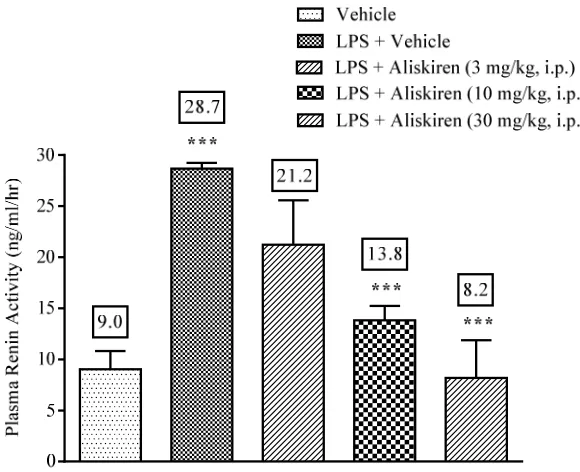
Effect of aliskiren on LPS induced PRA in ICR mice In ICR mice, after LPS treatment, PRA was increased
as compared to mice receiving vehicle of aliskiren
(Fig. 3.). Aliskiren treatment (3, 10 and 30 mg/kg, i.p)
dose dependently reduced increased PRA in ICR mice
(Fig. 3.).
Effect of aliskiren on LPS induced TNF-α level in C57BL/6 and double transgenic (R+/A+) mice In dTG and C57BL/6J, (background strain for dTG)
mice after LPS treatment, TNF-α level were enhanced.
Moreover after LPS treatment, TNF-α levels were high
(2.16 fold) in dTG mice than C57BL/6J (Fig. 4.). In
both mice strains, elevated TNF-α level was inhibited
by 10 mg/kg, i.p aliskiren (Fig. 4.). The levels of TNF-α
(6.29 ± 3.22 pg/ml in dTG, 3.29 ± 2.36 pg/ml in
C57BL/6J) were very less in (naïve) mice not
receiving LPS (Fig. 4.).
Effect of aliskiren on CFA induced thermal
hyperalgesia in rats
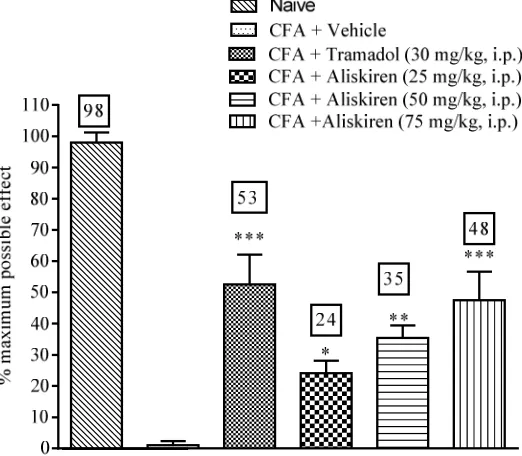
Aliskiren produced dose dependent attenuation of
CFA induced thermal hyperalgesia (Fig. 5.).
Tramadol (30 mg/kg, i.p.) which was taken as positive
control, also showed significant anti-hyperalgesic
activity as compared to vehicle (Fig. 5.).
CFA injection in paw caused significant increase in
local TNF-α level (22.80 ± 1.46 pg/mg of protein) as
compared to naive animals (5.45 ± 0.49 pg/mg of
protein). In CFA-injected rats, aliskiren treatment (50
and 75 mg/kg, i.p.) produced dose-dependent
reduction in TNF-α (14.61 ± 0.78 and 8.61 ± 0.96
pg/mg of protein) levels in paw homogenate (Table
1) as compared to vehicle treatment.
Similarly, CFA injection in paw caused significant
increase in local IL-6 level (19.82 ± 1.02 pg/mg of
protein) as compared naive animal (56.68 ± 3.95
pg/mg of protein). Aliskiren (50 and 75 mg/kg, i.p.)
dose dependently reduced the IL-6 levels (38.78 ±
2.112 and 29.82 ± 3.41 pg/mg of protein) in paw
(Table 1) after CFA injection as compared to vehicle
treatment.
DISCUSSION
In present study, we for the first time investigated
effect of aliskiren in LPS and CFA induced
inflammation in rodents. We evaluated anti-cytokine
activity of aliskiren in normal ICR mice. Aliskiren dose
dependently suppressed LPS induced PRA, TNF-α and
IL6 levels in ICR mice. Further, to evaluate role of RAS
and anti-cytokine activity of aliskiren in LPS induced
inflammation, RAS overexpressed (dTG) mice were
used. In dTG mice, severity of inflammation (cytokines
levels) is more as compared to normal mice, which
indicates role of RAS in LPS induced inflammation.
cytokines levels in LPS induced inflammation in dTG
mice. It is reported that CFA induced hyperalgesia in
rats enhances production of tissue cytokines.18-20 In
our results, aliskiren has antihyperalgesic activity in
CFA induced hyperalgesia in rats that might be due to
inhibition of TNF-α and IL6 levels in rat paw. In rats
the dose of aliskiren was higher than those used in
mice due to species specific differences in potency
(IC50) for renin inhibition in rat (80 nM) against mice
(6.2 nM).10 Reported data showed that aliskiren (25
mg/kg, ip & 50 mg/kg, sc) for 4 weeks treatment had
slight effect blood pressure in normal rodents.10;21 So
in present study, selected doses of aliskiren may not
have hypotensive effect in normal rodents.
LPS induces an innate immune response with a major
upregulation of pro-inflammatory factors including
enhanced pro-inflammatory cytokines production.22
In our study, TNF-α IL-6 and PRA were elevated in ICR
mice, which were significantly attenuated dose
dependently by aliskiren treatment (3, 10 and 30
mg/kg, i.p). Moreover, in double transgenic (R+/A+)
mice, LPS administration significantly increased (2.16
fold) cytokine (TNF-α) level as compared to C57BL/6J
mice, indicating role of RAS in activation of
proinflammatory cytokines. In double transgenic
(R+/A+) mice, there was overexpression of human
renin and human angiotensinogen, showed high levels
of plasma Ang-II.8 ANG II and LPS promote
inflammation; activating similar transcriptional and
posttranscriptional mechanisms interrelated in
complex intracellular cross-talk mechanisms. These
include 1) activation of phospholipase C and protein
kinase C, leading to NAD(P)H oxidase stimulation and
enhanced reactive oxygen species (ROS) formation; 2)
activation of transcription factors, such as NF-κB, and
production of proinflammatory cytokines; 3)
cyclooxygenase-2 (COX-2) activation with enhanced
proinflammatory prostaglandin E2 (PGE2) formation;
and 4) inducible nitric oxide synthase (iNOS)
induction with increased nitric oxide production.23-27
So aliskiren by inhibiting renin, subsequently Ang-II
production, might be inhibited LPS induced
inflammation.
It can be concluded that overexpressed RAS in dTG
mice might contributes to higher LPS induced TNF-α
levels. Cytokines are important mediators of
inflammation and elevated levels of pro-inflammatory
cytokines are observed in the inflammatory
conditions in human and animals.28-31
Anti-inflammatory and anti-cytokines activity of aliskiren is
well reported in various studies.12-15 Our results are in
agreement with our previous work, in which
anti-cytokine activity of aliskiren is reported in
formalin-induced pain.16 Together, these data supports
anti-cytokine activity of aliskiren in LPS induced
inflammation by inhibiting renin.
In our study, aliskiren showed cytokine and
anti-hyperalgesic activity dose dependently in CFA induced
hyperalgesia and paw cytokines (TNF- α and IL-6)
level. It is reported that proinflammatory cytokines
like TNF-α and interleukin-1 beta (IL-1β) induce and
facilitate neuropathic as well as inflammatory pain.
32-34 Further, it has been shown that CFA injection
resulted in a significant elevation of TNF-α and IL-1β
gene expression in the inflamed plantar skin, which is
in accordance with the change of TNF-α and IL-1β at
the protein level in the same tissue.32-34
Pro-inflammatory cytokines, such as TNF-α and IL-1β,
reduced thermal or mechanical pain thresholds upon
intraplantar application.32;33 Moreover, renin
upregulates cytokines production acting on pro-renin
receptor and independent of angiotensin II.7 There are
few reports that have shown beneficial effects of
aliskiren by direct inhibition of pro-renin receptors
and an anti-inflammatory effect independent of
angiotensin II.35;36 Pro-inflammatory cytokine
antagonists were further able to reduce hyperalgesia
in inflammation models, indicating that the activation
of pro-inflammatory cytokines is an important step in
the generation of inflammatory pain.37 Our results
demonstrate that the aliskiren may have
anti-inflammatory effect to suppress CFA induced
observation that aliskiren reduced TNF-α and IL-6
levels after CFA injection in rat paw. Our observations
are corroborated by other reports indicating
anti-inflammatory potential of aliskiren.9;12;13 Therefore,
aliskiren by inhibiting renin may inhibit cytokines and
produce antihyperalgesic activity. However further
study is required for molecular mechanism for role of
renin in LPS and CFA induced inflammation.
CONCLUSION
In conclusion, our study demonstrates that blockade
of renin ameliorates inflammation, reaffirming the
critical role of the RAS in the inflammation. The
protective actions of aliskiren might be dependent on
both the Ang II-dependent pathway and the (pro)
renin receptor-mediated pathway. This study also
suggests the anti-inflammatory and antihyperalgesic
effects of aliskiren in inflammatory models, which are
mediated via the inhibition of renin and
pro-inflammatory mediator production.
ACKNOWLEDGMENTS
The authors are grateful to Zydus Research Centre,
Ahmedabad, India for supporting this study and
providing facilities for the work.
CONFLICT OF INTEREST
There is no conflict of interest associated with this
manuscript.
Treatment TNF-α (pg/mg of
protein)
IL-6 (pg/mg of protein)
Naïve 5.45 ± 0.49 19.82 ± 1.02
CFA + Vehicle 22.80 ± 1.46+ 56.68 ± 3.95+
CFA + Aliskiren (25
mg/kg, i.p.) 19.33 ± 1.17 46.81 ± 2.92
CFA + Aliskiren (50
mg/kg, i.p.) 14.61 ± 0.78* 38.78 ± 2.11*
CFA + Aliskiren (75
mg/kg, i.p.) 8.61 ± 0.96** 29.82 ± 3.41**
Table 1: Effect of aliskiren on TNF-α and IL-6 levels in
CFA (100 µg/paw, i.pl.) injected rats. Data are expressed as mean ± S.E.M. for 6 rats in each group. +P< 0.01vs Naive, *P< 0.05, **P< 0.01 vs CFA + vehicle,
one-way ANOVA followed by Dunnett’s test.
Figure 1: Effect of aliskiren on TNF-α in LPS (10 µg/mouse, i.p.) injected mice. Data are expressed as mean ± S.E.M.
Figure 2: Effect of aliskiren on IL-6 in LPS (10 µg/mouse, i.p.) injected mice. Data are expressed as mean ± S.E.M. for 6-8 mice in each group. *P< 0.05,**P< 0.01,***P< 0.001 vs LPS + vehicle, one-way ANOVA followed by Dunnett’s
test. Values are shown above column in box are group mean.
Figure 3: Effect of aliskiren on PRA in LPS (10 µg/mouse, i.p.) injected mice. Data are expressed as mean ± S.E.M.
Figure 4: Effect of aliskiren on TNF-α in LPS (10 µg/mouse, i.p.) injected dTG and C57BL/6J mice. Data are expressed as mean ± S.E.M. for 6 mice in each group. *** P<0.001 vs vehicle (C57BL/6J).* P<0.05 vs vehicle (C57BL/6J), **P< 0.01 vs vehicle (dTG), one-way ANOVA followed by Dunnett’s test. Values are shown above
column in box are group mean.
Figure 5: Effect of aliskiren on CFA induced hyperalgesia in rats. Data are expressed as mean ± S.E.M. for 6 rats in
REFERENCES
1. Bregonzio C., Armando I., Ando H., Jezova M., Baiardi
G., Saavedra J.M. Anti-inflammatory effects of
angiotensin II AT1 receptor antagonism prevent
stress-induced gastric injury. Am J Physiol
Gastrointest Liver Physiol 2003; 285:G414-G423.
2. Jaszewski R., Tolia V., Ehrinpreis M.N. et al. Increased
colonic mucosal angiotensin I and II concentrations
in Crohn's colitis. Gastroenterology 1990;
98:1543-1548.
3. Ruiz-Ortega M., Lorenzo O., Suzuki Y., Ruperez M.,
Egido J. Proinflammatory actions of angiotensins.
Curr Opin Nephrol Hypertens 2001; 10:321-329.
4. Ferreri N.R., Escalante B.A., Zhao Y., An S.J., McGiff J.C.
Angiotensin II induces TNF production by the thick
ascending limb: functional implications. Am J Physiol
1998; 274:F148-F155.
5. Moriyama T., Fujibayashi M., Fujiwara Y. et al.
Angiotensin II stimulates interleukin-6 release from
cultured mouse mesangial cells. J Am Soc Nephrol
1995; 6:95-101.
6. Nakamura A., Johns E.J., Imaizumi A., Yanagawa Y.,
Kohsaka T. Effect of beta(2)-adrenoceptor activation
and angiotensin II on tumour necrosis factor and
interleukin 6 gene transcription in the rat renal
resident macrophage cells. Cytokine 1999;
11:759-765.
7. Kaneshiro Y., Ichihara A., Sakoda M. et al. Slowly
progressive, angiotensin II-independent
glomerulosclerosis in human (pro)renin
receptor-transgenic rats. J Am Soc Nephrol 2007;
18:1789-1795.
8. Lavoie J.L., Bianco R.A., Sakai K., Keen H.L., Ryan M.J.,
Sigmund C.D. Transgenic mice for studies of the
renin-angiotensin system in hypertension. Acta
Physiol Scand 2004; 181:571-577.
9. Ino J., Kojima C., Osaka M., Nitta K., Yoshida M.
Dynamic observation of mechanically-injured mouse
femoral artery reveals an antiinflammatory effect of
renin inhibitor. Arterioscler Thromb Vasc Biol 2009;
29:1858-1863.
10. Lu H., Rateri D.L., Feldman D.L. et al. Renin inhibition
reduces hypercholesterolemia-induced
atherosclerosis in mice. J Clin Invest 2008;
118:984-993.
11. Wood J.M., Cumin F., Maibaum J. Pharmacology of
renin inhibitors and their application to the
treatment of hypertension. Pharmacol Ther 1994;
61:325-344.
12. Del F.A., Cianchetti S., Celi A., Pedrinelli R. Aliskiren, a
renin inhibitor, downregulates TNF-alpha-induced
tissue factor expression in HUVECS. J Renin
Angiotensin Aldosterone Syst 2010; 11:243-247.
13. Higashikuni Y., Takaoka M., Iwata H. et al. Aliskiren
in combination with valsartan exerts synergistic
protective effects against ventricular remodeling
after myocardial infarction in mice. Hypertens Res
2012; 35:62-69.
14. Schmerbach K., Pfab T., Zhao Y. et al. Effects of
aliskiren on stroke in rats expressing human renin
and angiotensinogen genes. PLoS One 2010;
5:e15052.
15. Tang S.C., Lin M., Tam S. et al. Aliskiren combined
with losartan in immunoglobulin A nephropathy: an
open-labeled pilot study. Nephrol Dial Transplant
2012; 27:613-618.
16. Patel R.B., Pawar V.D., Prajapati K.D. et al.
Anti-nociceptive and anti-allodynic activity of aliskiren in
various pain models. Eur J Pharmacol 2013;
708:80-87.
17. Lowry O.H., Rosebrough N.J., Farr A.L., Randall R.J.
Protein measurement with the Folin phenol reagent.
J Biol Chem 1951; 193:265-275.
18. Schafers M., Svensson C.I., Sommer C., Sorkin L.S.
Tumor necrosis factor-alpha induces mechanical
allodynia after spinal nerve ligation by activation of
p38 MAPK in primary sensory neurons. J Neurosci
2003; 23:2517-2521.
19. Woolf C.J., Allchorne A., Safieh-Garabedian B., Poole
S. Cytokines, nerve growth factor and inflammatory
hyperalgesia: the contribution of tumour necrosis
factor alpha. Br J Pharmacol 1997; 121:417-424.
20. Zelenka M., Schafers M., Sommer C. Intraneural
injection of interleukin-1beta and tumor necrosis
factor-alpha into rat sciatic nerve at physiological
doses induces signs of neuropathic pain. Pain 2005;
116:257-263.
21. Zhang Y., Wang, Y., Chen, Y., Deb, D.K, Sun, T, Zhao, Q.,
Li, Y.C. Inhibition of renin activity by aliskiren
ameliorates diabetic nephropathy in type 1 diabetes
mouse model. J Diabetes Mellitus 2012; 2
22. Han J., Ulevitch R.J. Limiting inflammatory responses
during activation of innate immunity. Nat Immunol
2005; 6:1198-1205.
23. Feng L., Xia Y., Garcia G.E., Hwang D., Wilson C.B.
Involvement of reactive oxygen intermediates in
cyclooxygenase-2 expression induced by
interleukin-1, tumor necrosis factor-alpha, and
lipopolysaccharide. J Clin Invest 1995;
95:1669-1675.
24. Griendling K.K., Ushio-Fukai M. Reactive oxygen
species as mediators of angiotensin II signaling.
Regul Pept 2000; 91:21-27.
25. Jaimes E.A., Tian R.X., Pearse D., Raij L. Up-regulation
of glomerular COX-2 by angiotensin II: role of
reactive oxygen species. Kidney Int 2005;
68:2143-2153.
26. Lu Y.C., Yeh W.C., Ohashi P.S. LPS/TLR4 signal
transduction pathway. Cytokine 2008; 42:145-151.
27. Lund D.D., Brooks R.M., Faraci F.M., Heistad D.D. Role
of angiotensin II in endothelial dysfunction induced
by lipopolysaccharide in mice. Am J Physiol Heart
Circ Physiol 2007; 293:H3726-H3731.
28. Atreya R., Mudter J., Finotto S. et al. Blockade of
interleukin 6 trans signaling suppresses T-cell
resistance against apoptosis in chronic intestinal
inflammation: evidence in crohn disease and
experimental colitis in vivo. Nat Med 2000;
6:583-588.
29. Dieleman L.A., Palmen M.J., Akol H. et al. Chronic
experimental colitis induced by dextran sulphate
sodium (DSS) is characterized by Th1 and Th2
cytokines. Clin Exp Immunol 1998; 114:385-391.
30. Pullman W.E., Elsbury S., Kobayashi M., Hapel A.J.,
Doe W.F. Enhanced mucosal cytokine production in
inflammatory bowel disease. Gastroenterology 1992;
102:529-537.
31. Yamamoto M., Yoshizaki K., Kishimoto T., Ito H. IL-6
is required for the development of Th1 cell-mediated
murine colitis. J Immunol 2000; 164:4878-4882.
32. Cunha F.Q., Poole S., Lorenzetti B.B., Ferreira S.H. The
pivotal role of tumour necrosis factor alpha in the
development of inflammatory hyperalgesia. Br J
Pharmacol 1992; 107:660-664.
33. Ferreira S.H., Lorenzetti B.B., Bristow A.F., Poole S.
Interleukin-1 beta as a potent hyperalgesic agent
antagonized by a tripeptide analogue. Nature 1988;
334:698-700.
34. Safieh-Garabedian B., Poole S., Allchorne A., Winter J.,
Woolf C.J. Contribution of interleukin-1 beta to the
inflammation-induced increase in nerve growth
factor levels and inflammatory hyperalgesia. Br J
Pharmacol 1995; 115:1265-1275.
35. Feldman D.L., Jin L., Xuan H. et al. Effects of aliskiren
on blood pressure, albuminuria, and (pro)renin
receptor expression in diabetic TG(mRen-2)27 rats.
Hypertension 2008; 52:130-136.
36. Matavelli L.C., Huang J., Siragy H.M. (Pro)renin
receptor contributes to diabetic nephropathy by
enhancing renal inflammation. Clin Exp Pharmacol
Physiol 2010; 37:277-282.
37. Verri W.A., Jr., Cunha T.M., Parada C.A., Poole S.,
Cunha F.Q., Ferreira S.H. Hypernociceptive role of
cytokines and chemokines: targets for analgesic drug
development? Pharmacol Ther 2006; 112:116-138.
How to cite this article: Rakesh B. Patel*, Kanaiyalal D.
Prajapati, Bhavin M. Sonara, Manoranjan M. Sharma, Vishwanath D. Pawar, Mukul R. Jain.; Rakesh B Patel et al.: Anti-cytokine and anti-hyperalgesic effects of aliskiren in experimental models of inflammation; J. Adv. Pharm. Edu. & Res. 2014: 4(1): 125-133.