This is an open access journal, and articles are distributed under the terms of the Creative Commons Attribution-Non Commercial-ShareAlike 4.0 License, which allows others to remix, tweak, and build upon the work non-commercially, as long as appropriate credit is given and the new creations are licensed under the identical terms.
© 2019 Journal of Advanced Pharmacy Education & Research | Published by SPER Publication
41
Risk factors of Lung Cancer in Indonesia: a qualitative study
Mally Ghinan Sholih
1*, Dyah Aryani Perwitasari
2, Rini Hendriani
1, Hardyana Sukandar
3, Melisa
Intan Barliana
4,5, Auliya Suwantika
1, Ia Nurmantya
1, Ajeng Diantini
1,51Department of Pharmacology and Clinical Pharmacy, Faculty of Pharmacy, Universitas Padjadjaran, Jl. Bandung Sumedang KM.21, Jatinangor Sumedang
45363.2Faculty of Pharmacy, Ahmad Dahlan University, Indonesia. 3Faculty of Medicine, Universitas Padjadjaran, Indonesia. 4Department of Biological Pharmacy,
Faculty of Pharmacy, Universitas Padjadjaran. 5Center of Excellence in Higher Education for Pharmaceutical Care Innovation, Universitas Padjadjaran, Indonesia
Correspondence:Mally Ghinan Sholih.Department of Pharmacology and Clinical Pharmacy, Faculty of Pharmacy, Universitas Padjadjaran, Jl. Bandung Sumedang KM.21, Jatinangor Sumedang 45363. E-mail: [email protected]
ABSTRACT
Lung cancer management has to be committed systematically starting from prevention, early detection, and treatment. Lung cancer
prevention can be carried out by minimizing lung cancer risk factors through providing education about them. Using a descriptive
design, this study utilized the descriptions of lung cancer risk factors by the respondents of H. A. Rotinsulu Bandung Lung Hospital who had been diagnosed with lung cancer. The collected data were primary data taken by interviewing 30 lung cancer patients as respondents at the inpatient wards of H. A. Rotinsulu Bandung Lung Hospital. The number of respondents was taken based on the level of data saturation. When the obtained data from the interviews were the same, or the same answers recurred, data retrieval was stopped. The data were collected by the triangulation technique. The data obtained then underwent collection, reduction, category and theme determination. The results showed the description of symptoms, risk factors, and levels (cognitive, affective and psychomotor) of the respondents. From the study, it was found that the main risk factors for lung cancer were: cigarettes, air pollution, unhealthy foods, chemical substances, occupation, family history of cancer, lack of physical activities, alcohol consumption, and the patients’ history of lung disease. This study concluded that the most common lung cancer risk factors were smoking and exposure to the air pollution.
Keywords: lung cancer, lung cancer symptom, lung cancer risk factors.
Introduction
Cancer has been one of the causes of morbidity and mortality worldwide. More than 30% of cancer deaths have been caused by five risk factors i.e high body mass index, lack of the intake of fruits and vegetables intake, lack of physical activities, tobacco smoking, and excessive alcohol consumption. The World Health Organization (WHO) has estimated that in 2030 a surge of cancer incidents is predicted to be approximately 300% in the world, and 70% of the cancer incidents has been estimated to happen in
developing countries including Indonesia.[1, 2] Lung cancer is a
malignant disease in the lung which malignancy originates from the lungs themselves (primary). Clinically, the definition of primary lung cancer is a malignant tumor originating from the bronchial epithelium (bronchial
carcinoma = bronchogenic carcinoma). [3]
Smoking is a major cause of lung cancer as approximately 80% of the deaths have been caused by lung cancer. Cigarette smoke contains some substances i.e, tumor promoters,
carcinogens, and co-carcinogens. Smoking cessation can reduce
the risk of lung cancer. [3] An increased risk of lung cancer can
also happen in people who have a family history of lung cancer. This is associated with polymorphisms that affect the expression and function of enzymes that regulate the metabolism of tobacco carcinogens, DNA repair or inflammation;, history of another lung diseases such as
tuberculosis, pulmonary fibrosis, chronic bronchitis etc.[3];
Alcohol consumption of, at least 30 Gr/day can increase the
risk of lung cancer.[4] Air pollution, such as emissions that are
rich in various polycyclic aromatic hydrocarbons, can lead to oxidative stress, inflammation, induction of pro-coagulatory Access this article online
Website: www.japer.in E-ISSN: 2249-3379
How to cite this article: Mally Ghinan Sholih, Dyah Aryani Perwitasari,
Rini Hendriani, Hardyana Sukandar, Melisa Intan Barliana, Auliya Suwantika et al. Risk factors of Lung Cancer in Indonesia: a qualitative study. J Adv Pharm Edu Res 2019;9(2):41-45.
state, dysfunction of nerve, and lung cancer when it is
accumulated continuously.[4]
Fruits and vegetables can prevent lung cancer, as foods containing vitamin C, vitamin E, carotenoids, lutein,
zeaxanthin, lycopene, and α-carotene, ß-cryptoxanthin are
expected to be able to reduce the risk of lung cancer.[4]
Physical activity can also help reduce the risk of lung cancer. Physically, active individuals have a lower risk of lung cancer,
of approximately 13% - 30%.[4]
Other factors such as district and education also affect greater knowledge of the cancer’s risk factors, where society with the higher education level has a better knowledge about the
cancer’s risk factors [5] Although the level of education affects
the knowledge about the dangers of cigarettes causing lung cancer, the awareness of smoking cessation is very low. Government programs are therefore required to provide information or counseling to the society.
Method
The study was conducted after obtaining the ethical clearance from Padjadjaran University with Number: 981 / UN6.C.10 / PN / 2017 and a clinical study permission at H.A Rotinsulu Bandung Lung Hospital with Number: LB.02.01 / XXXVI.1.1 / 4270.1 / 2017. The study was conducted on December 2017 at H.A Rotinsulu Bandung Lung Hospital. The inclusion criteria in this study were patients with a diagnosis of lung cancer who were willing to sign the informed consent forms. The exclusion criteria were lung cancer patients who were unwilling to sign the informed consent forms. The data were collected from the primary data by interviewing with 30 respondents of lung cancer patients in the inpatient wards of H.A Rotinsulu Bandung Lung Hospital. The number of respondents were taken based on the level of data saturation. When the result data obtained were the same or the same answers recurred, data retrieval was stopped. Data collection was carried out by the triangulation technique, carried out by combining observation, interview and documentation. The tools used in this study were notebooks, tape recorders and a list of questions. For getting solid answers, the researchers compiled a list of questions with an open ended question model. The interview was conducted within an intimate condition, having empathy and passive participation so it did
not affect the respondents’ answers. The data obtained
underwent collections, reduction, category, and theme
determination. Qualitative studies were conducted to more thoroughly explore the description of lung cancer risk factors in patients before they had been diagnosed with lung cancer.
Result and Discussion
Based on the characteristics of lung cancer patients, the study result showed that considering age, it was dominated by those
of the age of 35-54 year (about 60%); regarding gender, it was dominated by men (76,7%); considering marital status, it was dominated by those who were married (about 83,3%); regarding education level, it was dominated by elementary school graduates (about 40%) which was followed by Senior High School graduates (about 30%), Junior High School graduates (about 20%), and Higher Education graduates(about 10%); considering economic status of the respondents, it was dominated by patients coming from earnings below the 2016 Regional Minimum Wage (UMR) of West Java Province (IDR 2.250.000) (about 76.7%) ( see Table 1).
Table 1: Demographic Characteristcs of Lung Cancer Respondents
Demographical Respondents
N %
Age
18-24 0 0,0
25-34 1 3,3
35-44 3 10,0
45-54 9 30,0
55-64 9 30,0
> 64 8 26,7
Gender
Men 23 76,7
Women 7 23,3
Marital Status
Married 25 83,3
Single/Divorced/Widow 5 16,7
Education
Primary School 12 40,0
Junior High School 6 20,0
Senior High School 9 30,0
College 3 10,0
Income
< UMR 23 76,7
> UMR 7 23,3
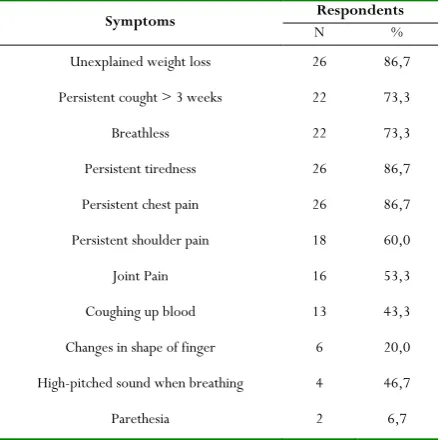
The data obtained from the interviews with the lung cancer patients underwent collection, reduction, categorization, and themes determination. The themes were as follows:
1. Symptoms
breath, sore shoulder, joint pain, producing a voice during breath, bleeding cough, swellings on the fingers, and paresthesia (See table 2).
Table 2: Symptoms Prior to Lung Cancer Diagnosis
Symptoms N Respondents %
Unexplained weight loss 26 86,7
Persistent cought > 3 weeks 22 73,3
Breathless 22 73,3
Persistent tiredness 26 86,7
Persistent chest pain 26 86,7
Persistent shoulder pain 18 60,0
Joint Pain 16 53,3
Coughing up blood 13 43,3
Changes in shape of finger 6 20,0
High-pitched sound when breathing 4 46,7
Parethesia 2 6,7
2. Risk Factors
The following is the explanation of lung cancer risk factors from the largest to the smallest (See Table 3), i.e.:
A. Cigarettes
Cigarette smoking was dominated by men compared to women. The age of early smoking was about 14 and 17 years old. The duration of smoking was for 6 -55 years. Smoking cessation was about less than 1 year at the time of diagnosis of lung cancer. The kinds of smoked cigarettes were predominantly filter cigarettes and clove cigarettes, and a small number of rolled cigarettes. The number of cigarettes smoked ranged around 2 cigarettes to 3 packs of cigarettes per week or about 3 cigarettes daily. Active smokers and passive smokers came from the environment of smokers
B. Air pollution
Exposure to the air pollution included cigarette smoke, exhaust fumes or vehicle emission, smoke of garbage burning, and fiber/dust. All patients had been exposed to the cigarette smoke at home, workplace and other polluted places. Pollution was obtained from: smoking family members, close distance between house and the highway, textile industry, furniture industry, wood factory, close-ranged rice milling and automotive repair shop (about 5 meters-5 kilometers), vehicle emission and fiber/dust pollution, and houses with asbestos roof (fiber pollution). Pollution at workplace came from: coworkers who smoked, worksite location which was on the roadside and near the convection industry that produced dust/fiber pollution, asbestos roof, and kinds of jobs such as: worker at convection industry, worker at laboratory analysis, driver, mechanic at automotive repair shop, construction worker (exposed to the air pollution such
as exhaust fumes/vehicle emission, chemicals, and fiber/dust).
C. Food and beverage
The frequency of unhealthy food consumed by most patients was 1-2 times per week, i.e. the kinds of foods containing preservatives, dyes, and MSG (Monosodium Glutamate) such as meatball noodles, satay (chicken, lamb, beef), salted fish, sardines, junk food, sausage, and nugget. Examples of healthy foods often consumed were vegetables, fruit, and multivitamin supplements. The kinds of vegetables often consumed were kale, carrot, spinach, cabbage, beans, cai sin, potato, and broccoli with daily intake frequency or once or twice weekly. The kinds of fruit often consumed were orange, banana, papaya, mango, apple, star fruit, cashew, avocado, salak, and cantalope with daily intake frequency or once or twice weekly.
D. Chemical substances
Most patients had been exposed to chemical pollution i.e. radon derived from rocks, ground water and humid houses that caused short of breath, asbestos originating from roofs that produced fibers/dust and chemical wastes, and dyes on walls/car paints.
E. Job /Occupation
Kinds of jobs/occupations also determined the kinds of pollution exposed to the respondents. Types of work experience had the potential to cause lung cancer such as being a construction worker, a construction painter, a driver, a mechanic, a tailor, a teacher (who used chalk for teaching), a chemical analyst, and a laundry worker.
F. Family history of lung disease and cancer
A number of patients had a history of diseases derived from the father or mother such as lung disease (asthma) with symptoms of congestion and cough, cancer and lung cancer with unknown symptoms.
G. Lack of sport activity / exercise
Most of the respondents didn’t do sports activities such as running/walking, playing badminton, cycling, playing tennis, doing gymnastics, doing cardiovascular exercises, and playing football once a day to twice weekly.
H. Consumption of alcohol
The reason patients consumed alcohol was to celebrate a special moment, and for enhancing stamina. The frequency of alcohol consumption was 1 cup in a day to once or twice in a week. But after being diagnosed with lung cancer, the respondents stopped drinking alcohol.
Table 3: Lung Cancer Risk Factors
Risk Factor Respondens
N %
Cigarettes 25 83,3
Air Polution 25 83,3
Unhealthy Foods 24 80,0
Occupation 23 76,7
Cancer Family History 9 30,0
Lack of Activities 8 26,7
Alcohol 7 23,3
Lung Disease History 4 13,3
I. History of lung disease
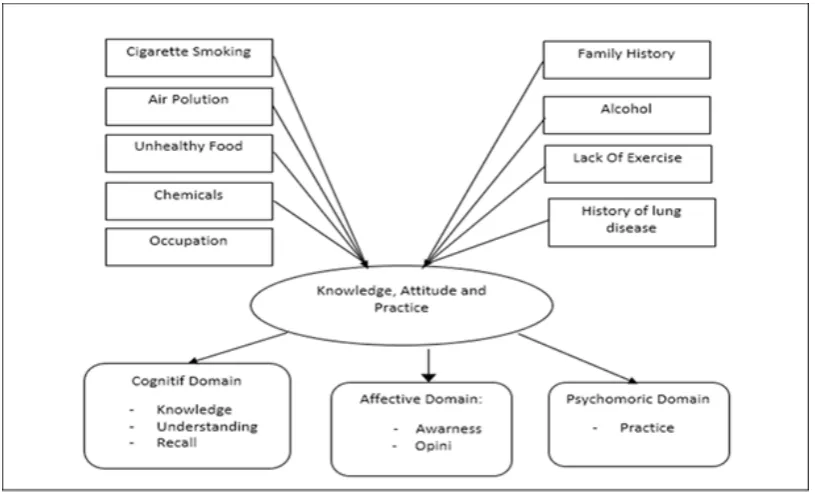
A small percentage of the respondents had a history of TB disease and asthma prior being diagnosed with lung cancer diagnosis (See Figure 1).
3. Knowledge, Attitude and Behavior
Regarding Risk Factors of Lung Cancer
The resluts of the interviews gave the description of cognitive domains such as knowledge, understanding, and information recall; affective (awareness and opinion); and psychomotor
domains (behavior or implementation). Based on the cognitive domains, most patients were not aware of information about lung cancer and its risk factors. Only few patients were aware, understood and could recall risk factors of lung cancer such as cigarette, pollution, alcohol, chemical substances, occupation, lack of sports activity, family history, and history of patients’ disease.
The affective domain included the awareness on the danger of alcohol, chemicals, food, air pollution, cigarette, kinds of occupations, family disease history, and lack of exercise. The psychomotor domains included the respondents’ behavior that they had before they were diagnosed of having lung cancer, and knew about the risk factors of lung cancer i.e. fairly often getting exposure to the air pollution, cigarettes, unhealthy food, jobs which had a risk of getting lung cancer, alcohol drinking/consumption, exposure to chemicals, family history of lung disease, the respondents’ history of lung cancer, and the lack of sport activities (See Figure 1).
Figure 1. The Concept of Lung Cancer Risk Factors on Knowledge, Attitude and Action
Based on the results of the above study, the major lung cancer risk factors were smoking and air pollution. Cigarette-smoking and air pollution were the most dominant factors in lung cancer risk. These results supported a prior study conducted by Patricia et al. (2012) indicating that "men with the of age>50 years old (over 50 years old) were dominated by lung cancer disease, while lung cancer risk factors were
dominated by cigarettes and pollutants" [6]. A study by
Jonathan et al. (2009) showed that for active smokers, cigarettes were a major risk factor for lung cancer. On the other hand, for non-smokers, the risk factors of lung cancer were exposure to chemicals (radon, asbestos), being passive
smokers, and pollutants.[7] A research by Julian et al. (2008)
also stated that “in North America, the cause of cancer was dominated by someone with a history of smoking and who is
still smoking.[4] A research by Shannon, et al. (2010) stated
that tobacco was the cause of carcinogenesis that leads to cancer. Lung cancer patients who had a history of smoking
also got a poor prognosis”.[8]
A research by Norman, et al. (2012) stated that” smoking is the risk factor for all kinds of cancer, especially lung cancer. An early age factor of cigarette-smoking might increase the prevalence of lung cancer due to the increasing duration of cigarette use. The prevention of cigarette smoking at the
early age is able to inhibit lung cancer by pandemic”.[9] A
required to raise the awareness of risk factors and emphasize the importance of seeking medical attention or information
for the early detection of symptoms”.[10] Other major risk
factors were exposure to excessive air pollution, as a study by Nikiæ and Stankoviæ (2005) stated that “the exposure to
pollution of at least 10 μg/m3 of particles increased the risk
of lung cancer by 8% -14%”.[11]
One of the ways to improve the awareness and behavior to avoid the risk factors of lung cancer is by giving education, as a study conducted by Xiu et al. (2014) showed that “low awareness about the danger of smoking and low awareness on smoking cessation increased death to 9 fold in men and women in China with the result that a non-smoking policy in
all public places has to be applied in public places in China”.[12]
These studies supported the results of this study that cigarette was the biggest lung cancer risk factor.
Limitations in this study were the subjectivity of the researchers in the interpretation and making a conclusion. In addition, the condition of the patients that got into the stage of lung cancer level III-IV was weak, and they were not likely to be interviewed in a long time; therefore, the results of the respondents’ interviews might not be explored properly well as it should be. Hence, it is recommended to use the qualitative data analysis software and to interview with the family members of lung cancer patients to get detailed data.
Conclusion
It could be concluded from the study that the most common lung cancer risk factors have been smoking and exposure to the air pollution. Lung cancer prevention can be carried out by minimizing the lung cancer risk factors.
Acknowledgement
The authors would like to express their gratitude for the participation and assistance of the health staff of R. S. Paru H. A. Rotinsulu Bandung, especially inpatient Dahlia’s room, Garut district and Universitas Padjadjaran. This article’s publication was supported by the United States Agency for International Development (USAID) through the Sustainable Higher Education Research Alliance (SHERA) Program for Universitas Indonesia’s Scientific Modeling, Application, Research and Training for City-centered Innovation and Technology (SMART CITY) Project, Grant #AID-497-A-1600004, Sub Grant #IIE-00000078-UI-1.
Conflict of Interest
The authors stated that there was no potential conflict of interest about the research, authorship, and / or publication of this article.
References
1. World Health Organization. Cancer Fact Sheet
[downloaded 12 May 2017]. Available at http://www.who.int/mediacentre/factsheets/fs297 /en
2. KEMENKES RI. Incident Report. [downloaded 13
May 2017]. Available at http://kanker.kemkes.go.id/incident.php#
3. Indonesian Lung Doctors Association. (2003):
Guidelines for Diagnosis and Management of Indonesian Lung Cancer. Indonesian Lung Doctors Association, 2,3.
4. Julian R. M, M.D., Ping Y, Stephen D. C, Steven E.
S. (2008). Non–Small Cell Lung Cancer: Epidemiology, Risk Factors, Treatment, and Survivorship. Mayo Foundation for Medical Education and Research, 83(5), 584–594.
5. Karima E.R, et al. Public Awareness of Cancer Risk
Factors In The Moroccan Population: a population-based cross-sectional study. BMC Cancer. 2014; 14(95): 1-7.
6. Patricia de Groot, M.D., Reginald F. Munden. Lung
Cancer Epidemiology, Risk Factors, and Prevention. Radiol Clin N Am Elsevier. 2012: 863–876.
7. Jonathan M. Samet, Erika Avila-Tang, Paolo Boffetta,
Lindsay M. Hannan, Susan Olivo-Marston, Michael J. Thun, and Charles M. Rudin. Lung Cancer in Never Smokers: Clinical Epidemiology and Environmental Risk Factors. Clin Cancer Res. 2009; 15(18): 5626– 5645.
8. Shannon L Walker MD FRCPC, David L Saltman MD
PhD FRCPC, Rosemary Colucci BA, Lesli Martin BA4. (2010). Awareness of risk factors among persons at risk for lung cancer, chronic obstructive pulmonary disease and sleep apnea: A Canadian population-based study. Canadian Respiratory Journal, 17(6):287-294.
9. Norman H. Review Article Cigarette Smoking and
Lung Cancer: Pediatric Roots. Hindawi Publishing Corporation Lung Cancer International 2012: 1-7.
10. Melanie C. (2016): Knowledge of the signs and
symptoms and risk factors of lung cancer in Australia: mixed methods study. Biomed central, 2016; 1-12.
11. Dragana Nikiæ, Aleksandra Stankoviæ (2005). Air
pollution as a risk factor for lung cancer. Institute of Oncology Sremska Kamenica, Serbia & montenegro, 13(2):79-82.
12. Xiu-Y. Z, Xiao-Nong Z, Mu Hu, Yuan J, You-lin Q.