This is an open access journal, and articles are distributed under the terms of the Creative Commons Attribution-Non Commercial-ShareAlike 4.0 License, which allows others to remix, tweak, and build upon the work non-commercially, as long as appropriate credit is given and the new creations are licensed under the identical terms.
© 2018 Journal of Advanced Pharmacy Education & Research | Published by SPER Publication
43
Assessment of knowledge, attitude and practice (KAP) of
osteoporosis and its predictors among university students: cross
sectional study, UAE
Sabaa Saleh Al-Hemyari
1, Ammar Abdulrahman Jairoun
2, Maimona Abdulrahman Jairoun
3, Zakia
Metwali
3, Nazneen Maymoun
41 Pharmacy Department, Clinical Pharmacy section, Ministry of Health and Prevention, UAE, 2 Public Health and Safety Department, Consumer Product Safety Section,
Dubai Municipality, UAE, 3 Clinical Pharmacy Department, Ajman University; Ajman, UAE, 4 Director Technical Projects Office Preventive Medicine, Sharjah, UAE.
Correspondence: Ammar Abdulrahman Jairoun, Public Health and Safety Department, Consumer Product Safety Section, Dubai Municipality, UAE,
E-mail: dr_Ammar_91_@ hotmail.com
ABSTRACT
Background: Osteoporosis is a chronic disease and its clinical consequences which take place are detected late, it progresses silently and its signs and symptoms are mostly discovered after a fracture has already occurred. Aim: to evaluate the knowledge, attitude and practice (KAP) of university students towards osteoporosis, and identify the set of key demographic and socio-economic factors that jointly influence the KAP of osteoporosis in the United Arabs Emirates (UAE). Design and Setting: This was a descriptive cross sectional study conducted amongst a random sample of medical and nonmedical students from Ajman university, united Arab Emiratis (UAE). The study was carried out by a self-administered questionnaire. It was composed of demographic, knowledge, attitude and practice information on osteoporosis. Results: A total of 400 subjects participated in the study, and completed the whole questionnaire. Among these participants, 50 % were male, 90.5% were single, 17% had UAE nationality, and 10.8% complained about a bone disease. The average KAP score was 69% with a 95% confidence interval (CI) [68%, 71%]. This meant that on an awareness scale of 0 to 100, the participants scored the average of 69 points in KAP towards osteoporosis. The results of the statistical modeling showed that the gender is a strong determinant of knowledge, attitude and practice of osteoporosis among university students. Conclusion: This study showed a satisfactory level of knowledge, attitude, and practice regarding osteoporosis. There was a poor scoring for some individual KAP items. It has been important to organize educational program to properly address these items that were under scored.
Keywords: Osteoporosis, knowledge, attitude, practice, medical students.
Introduction
Osteoporosis can be defined as a systematic continuous progressive skeletal disease that results in low bone mass, and deterioration of the small structures of the bones, which makes the bones fragile and more prone to fractures [1]. Classification
system of Osteoporosis has been mainly based on measuring the bone mineral density. Those whose bone mineral density score fell between 1- 2 SD below the mean have been classified as having low bone mass or osteopenia, a condition in which the bone loss is not too severe to classify the individual as an osteoporosis patient [2]. The highest prevalence of fractures was
found in Europe, followed by Western Pacific (Japan, New Zealand and Australia), and countries of South East Asia (India, Pakistan, Nepal, Afghanistan, Maldives, Bangladesh, and Bhutan)
[3]. It has been anticipated that by the year 2050, there would be
around 6.3 million hip fractures over the world [4]. Osteoporosis
is relevantly expensive to screen for, diagnose and to be treated. Moreover, surgical procedures have been even more budget consuming in cases where complications occurred. As a result, the patients and their family members had to make certain lifestyle adjustments because of the osteoporosis financial and Access this article online
Website: www.japer.in E-ISSN: 2249-3379
How to cite this article: Sabaa Saleh Al-Hemyari, Ammar Abdulrahman
Jairoun, Maimona Abdulrahman Jairoun, Zakia Metwali, Nazneen Maymoun, Assessment of knowledge, attitude and practice (KAP) of osteoporosis and its predictors among university students: cross sectional study, UAE . J Adv Pharm Edu Res 2018;8(3):43-48.
psychological influences [5]. Genetic factors control around 80%
of the bone tissue mass, bone remodeling and osteoporotic bone fractures. Having a positive family history of hip fractures after the age of fifty years boosts the risk of getting fractured [6].
Females are considerably at higher risk of osteoporosis than males. This was explained by the fact that women have smaller bones [7]. Previous fracture history, as per mentioned by [8],
indicated that females who have had a fragile bone tissue or a fracture are at greater risk of upcoming fractures regardless of their bone mineral density. Adults, who have experienced a fracture, have more than 50% higher risk to get another fracture in different skeleton areas [9]. Smoking causes lower bone healing
rates, higher risk for fractures, and lower bone tissue formation rate. In addition, smoking decreases the bone tissue mineralization in areas like forearms, hip and heels. Weight represents another modifiable osteoporosis risk factor. If the body mass index is less than 19, this indicates a low bone mineral density [7]. Health education can decrease the fear of the unknown
future. If a person is equipped with knowledge about osteoporosis, he will be able to make proper choices and changes regarding his health related behaviors [10]. The most effective
method to prevent this disease has been taking the correct steps during childhood and adolescence. One of the key areas in controlling osteoporosis is examining and evaluating students’ knowledge, beliefs and behaviors about osteoporosis. As a result, many osteoporosis studies have been focused on this aspect. A study conducted on the assessment of knowledge, attitude and behavior regarding osteoporosis in Iran found that 15 to 30% of participants didn’t know what osteoporosis is [11].
Another study assessed patients’ knowledge of osteoporosis showed that only 31.2% of participants had very good knowledge towards osteoporosis, moreover low proportion of the participants (17.4%) were able to identify that thin women are at greater risk of osteoporoses [12]. Similar response was observed
in Indian study among fifty premenopausal women and fifty post-menopausal women, where the study participants scored an average level of knowledge about osteoporosis [13]. Another study
among female adolescents aged 15–18 years in one secondary school in Egypt, reported the lack of awareness about the concept of osteoporosis [14].
With the increased prevalence of osteoporosis in Gulf countries, it has been important to assess the osteoporosis knowledge, attitude and practice among the university students to discover the areas where students had gaps or insufficient information about the disease and health related practices, and implement an in-depth osteoporosis education during early college years. Thus, this study aimed to assess the knowledge, attitude and practice of osteoporosis among university students, and identify the set of key demographic and socio-economic factors that jointly influence the KAP of osteoporosis in the United Arabs Emirates (UAE).
Methods
Study design/ setting
A cross-sectional study design was used to determine the knowledge, attitude and practice (KAP) of university students towards osteoporosis. The survey was carried out in Ajman University (AU) in UAE in 2015.
Study participants/population
This study included both nationals and non-nationals from different majors and study years. Admission and Registration Department of Ajman University provided the necessary information on students’ Name, University ID number, major, Age, gender, nationality and contact numbers that have been updated regularly. Data collection took place between 1st May
2015 and 1st July 2015.
Sampling
The directory of Admission and Registration Department of Ajman University was used as a sampling frame. This directory was considered as a pre-existing frame, officially recognized, listing information on students’ Name, University ID number, major, Age, gender, nationality and contact numbers that have been updated regularly. From excel sheet of the sampling frame of Ajman university, 200 students from faculty of pharmacy and 200 from faculty of dentistry were enrolled in this study. “Simple random sample selection” was the method followed for the sampling. In this method, the individuals were selected randomly, and not more than once to avoid bias that could negatively affect the validity of the results.
Sample Size
The prevalence rate was expected to be around 20%. The alpha level was set to 5% so that there was a 95% confidence interval. The precision (D) of the 95% confidence interval was fixed to be 5%, so that the width of the 95% CI would be at maximum of 10%. According to the assumptions above, the minimum required sample size was n = 352 participants if a non-response rate was assumed around 30%. The final chosen sample size was 400 students.
Measurement Instruments
A self-administered questionnaire was used as a tool to collect the data from the participants. The questionnaire was consisted of two sections; demographic information and twenty questions covering knowledge, attitude and practice towards osteoporosis.
Validation and Pre-testing of Questionnaire
Ethical Principles
The study was approved by University Research Ethical Committees, and an approval letter was obtained to allow the researcher to distribute and collect the questionnaires among AU students. The participation of the students in this study was entirely voluntary and without compensation. Before data collection, the purpose of the survey was explained, and they were also informed that the completion and submission of the questioner would be taken on their consent, and all the students signed the informed consents.
Statistical Analysis
The data was analyzed using the SPSS software version 23. The qualitative variables were summarized using frequencies and percentages, while the quantitative variables were summarized using mean ± Standard Deviation (±SD). Unpaired Student t-tests and their non-parametric versions were used to test the average differences in quantitative variables across groups. KAP score was created to measure the knowledge, attitude and practice of the students towards osteoporosis. The score was defined as the proportion of questions for which the answers were correct. The score ranged from 0% to 100%, and might be used as good approximation of the overall KAP. To investigate the association between KAP of the students towards osteoporosis and other significant risk factors, the derived score was used as the dependent variable in regression models. In this model, the KAP score was considered as a quantitative variable, and simple and multiple linear regressions were fitted. A p value < 0.05 was chosen as the criteria to make decisions regarding statistical significance.
Results
Demographic and socio-economic
characteristics
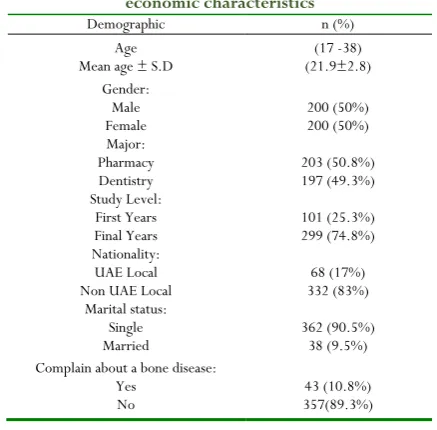
A total of 400 subjects participated in the study and completed the whole questionnaire. Among these participants, 50 % were male, 90.5% were single, 17% had UAE nationality, and 10.8% complained about a bone disease. Regarding the major, 50.8% were pharmacy students, and 49.3% were dentistry students. Over 70% of the participants belonged to the first year’s grade. For more details, see Table 1.
Knowledge, Attitude and Practice towards
osteoporosis: Analysis of overall KAP scores
The average KAP score was 69% with a 95% confidence interval (CI) [68%, 71%]. This meant that on an awareness scale of 0 to 100, the participants scored an average of 69 points in KAP towards osteoporosis, and it could be claimed that the overall level of KAP was satisfactory for osteoporosis (see Figure 1). Table 2 shows the distribution of KAP score according to demographic and socio-economic status. The table also provides the 95% confidence interval for the estimates along with p-values. These p-values were provided from the results of the unpaired sample t test for testing the assumption that the average KAP score was the same between the groups. The female students scored relatively higher than the male students in KAP towards osteoporosis. Their average KAP score was 74% compared to 65% in nonmedical. However, there was no significant association between KAP score and other demographic and socio-economic factors. For more details, comparing the two scores according to the demographic and socio-economic factors, see table 3.
Figure 1. Histogram of KAP score
Table 2. Knowledge, attitude and practice score by demographic and socio-economic variables.
Knowledge, attitude and practice (KAP) score Demographic Variables Mean (in %) 95% CI P. value
Gender < 0.001
Female 74.12 72 76
Male 64.65 62 67
Study level 0.812
First Years 69.1 66 72
Last Years 69.5 68 71
Major 0.097
Dentistry 68 66 70
Pharmacy 71 69 73
Nationality 0.149
Emirati 67 63 71
Table 1. Frequency table for demographic and socio-economic characteristics
Demographic n (%)
Age
Mean age ± S.D (21.9±2.8) (17 -38) Gender:
Male
Female 200 (50%) 200 (50%) Major:
Pharmacy
Dentistry 203 (50.8%) 197 (49.3%) Study Level:
First Years
Final Years 101 (25.3%) 299 (74.8%) Nationality:
UAE Local
Non UAE Local 332 (83%) 68 (17%) Marital status:
Single
Married 362 (90.5%) 38 (9.5%) Complain about a bone disease:
Yes
Non Emirati 70 68 72
Marital status 0.106
Single 70 68 71
Married 65 59 72
Monthly income 0.283
Below 10000 DHS 68 64 71
Above 10000 DHS 70 68 72
Knowledge, Attitude and Practice towards
osteoporosis score: Analysis of individual
questions
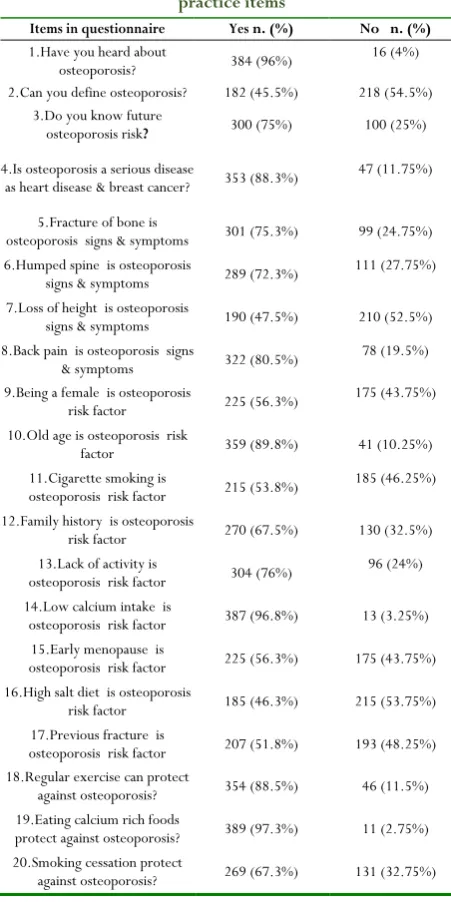
Table 3 presents the results of each of the questions related to knowledge, attitude and practice of osteoporosis among the participants.
Table 3: Frequency table for Knowledge, attitude and practice items
Items in questionnaire Yes n. (%) No n. (%)
1.Have you heard about
osteoporosis? 384 (96%) 16 (4%) 2.Can you define osteoporosis? 182 (45.5%) 218 (54.5%)
3.Do you know future
osteoporosis risk? 300 (75%) 100 (25%)
4.Is osteoporosis a serious disease
as heart disease & breast cancer? 353 (88.3%) 47 (11.75%)
5.Fracture of bone is
osteoporosis signs & symptoms 301 (75.3%) 99 (24.75%) 6.Humped spine is osteoporosis
signs & symptoms 289 (72.3%) 111 (27.75%) 7.Loss of height is osteoporosis
signs & symptoms 190 (47.5%) 210 (52.5%) 8.Back pain is osteoporosis signs
& symptoms 322 (80.5%) 78 (19.5%) 9.Being a female is osteoporosis
risk factor 225 (56.3%) 175 (43.75%) 10.Old age is osteoporosis risk
factor 359 (89.8%) 41 (10.25%) 11.Cigarette smoking is
osteoporosis risk factor 215 (53.8%) 185 (46.25%) 12.Family history is osteoporosis
risk factor 270 (67.5%) 130 (32.5%) 13.Lack of activity is
osteoporosis risk factor 304 (76%) 96 (24%) 14.Low calcium intake is
osteoporosis risk factor 387 (96.8%) 13 (3.25%) 15.Early menopause is
osteoporosis risk factor 225 (56.3%) 175 (43.75%) 16.High salt diet is osteoporosis
risk factor 185 (46.3%) 215 (53.75%) 17.Previous fracture is
osteoporosis risk factor 207 (51.8%) 193 (48.25%) 18.Regular exercise can protect
against osteoporosis? 354 (88.5%) 46 (11.5%) 19.Eating calcium rich foods
protect against osteoporosis? 389 (97.3%) 11 (2.75%) 20.Smoking cessation protect
against osteoporosis? 269 (67.3%) 131 (32.75%)
Factors influencing the KAP score
Table 4 displays the results of the simple linear regression model applied to each demographic and socio-economic variable,
separately. The table shows the results for knowledge, attitude, and practice (KAP) scores. The coefficients (B) in this table showed the magnitude of the association, and their corresponding p-values indicated whether the association was statistically significant or not.
Table 4. Simple linear regression model applied to each demographic and socio-economic separately.
Knowledge and attitude and practice (KAP) of osteoporosis Un-standardized
Coefficients Standardized Coefficients P.val
95 % Confidence Interval for B B Error Std. Beta Lower Bound Upper Bound
Major (Ref. Male)
Female 9.47 1.53 0.297 < 0.001 6.46 12.48
Study level (Ref. final Years)
First Years -0.439 1.84 -0.012 0.812 -4.06 3.18
Gender (Ref. Dentistry)
Pharmacy 2.65 1.59 0.083 0.097 -0.480 5.79
Nationality (Ref. non Emirati )
Emirati -3.07 2.13 -0.072 0.149 -7.25 1.11
Marital status(Ref. married )
Single 4.41 2.59 0.081 0.106 -0.938 9.76
Age -0.020 0.289 -0.003 0.946 -0.587 0.547
Monthly income(Ref. above 10000 DHS)
Below
10000 DHS -2.08 1.94 -0.054 0.283 -5.89 1.73
To select the set of factors that jointly influenced knowledge, attitude and practice of osteoporosis, the stepwise procedure was applied to the multiple linear regression model. The results of this procedure showed that gender only was associated with knowledge, attitude, and practice of osteoporosis.
Discussion
Osteoporosis is a global health problem, which has an impact not only on patients, but on the overall healthcare system increasing the burden on health care services. The present study was designed to assess the KAP of Ajman University students towards the concept of osteoporosis, signs/symptoms, risk factors and preventive measures, and investigate a set of key demographic and socio-economic factors that jointly influenced the KAP of osteoporosis. This study showed a satisfactory level of knowledge, attitude and practice regarding osteoporosis. A similar response was observed by one American study conducted among 792 males and females’ college students, who reported poor knowledge regarding the risks of osteoporosis in white women, the risks that came with the removal of ovaries, and the benefits which were given to big-boned individuals [15]. Previous
studies have likewise obtained results consistent with this vie [14, 16]. Similar findings were reported by another study among 302
young women in southeastern state university in USA, in which only 50% could correctly identify 6 out of the 16 osteoporosis risk factors, and the mean risk factor knowledge score was 9.41 out of 20 [17]. Another study carried out among 817 college
benefits of exercise and calcium intake than Chinese students [18].
Moreover, in one Taiwanese study among young adult women aged between 30–45 years, the participants believed that osteoporosis is not serious, and that taking preventative measures would not be beneficial [19].Further study among 86 participants
from the University of Colombo, and 100 participants from the University of Kelaniya reported the modest level of knowledge about osteoporosis; however, the knowledge on risk factors and preventive practices was poor [20].
A good proportion of participants showed good KAP regarding all the 20 items except seven items. One of these items was related to the definition of osteoporosis, and the rest of items were related to the osteoporosis risk factors such as: loss of height, being a female, cigarette smoking, early menopause, high salt diet, and previous fracture. An efficient educational and awareness programs regarding osteoporosis might be very useful to properly address some of these items that were under scored. Female students performed relatively well compared to Male students in knowledge, attitude and practice towards osteoporosis. The average KAP score was 74% for female students compared to 65% for male students. There was no difference in KAP score according to the study level, gender, nationality, marital status and monthly income.
Conclusion
This study showed a satisfactory level of knowledge, attitude and practice regarding osteoporosis. There was a poor scoring for some individual KAP items. These results suggested the need to implement proper health education programs to raise the awareness on osteoporosis, motivate healthy practices about osteoporosis, and screen for the early signs and symptom of osteoporosis.
References
1. World Health Organization. Assessment of fracture risk and its application to screening for postmenopausal osteoporosis. Technical Report Series, vol. 843. Geneva: WHO; 1994.
2. Gueldner, S.; & Sarah, H. Osteoporosis: Clinical Guidelines for Prevention, Diagnosis, and Management. 2007; Vol. 11, 9. Springer Publishing Company, New York.
3. Johnell, O. & Kanis, J. A. An estimate of the worldwide prevalence and disability associated with osteoporotic fractures. Osteoporosis International. 2006; 17, 1726-1733.
4. Delmas, P. D. & Fraser, M. Strong bones in later life: luxury or necessity? Bulletin of the World Health Organization. 1999; 77 (5), 416-422.
5. World Health Organization (WHO. Prevention and management of osteoporosis. World Heath Organ Tech Rep Ser. 2003; 221; 1: 164.
6. Kanis, A.; Johnell, 0.; & De Laet, C. A meta alysis of previous fracture and subsequent fracture risk. Official Journal of the International Bone and Mineral Society.2004; Vol. 35, 376-382.
7. Marshall D, Johnell O, Wedel H. Meta-analysis of how well measures of bone mineral density predict occurrence of osteoporotic fractures. Br Med J 1996; 312:1254–9. 8. Nelson, M. E., Fisher, E. C., Dilmanian, F. A., Dallal, G.
E. & Evans, W. J. A 1-y walking program and increased dietary calcium in postmenopausal women: effects on bone. American Journal of Clinical Nutrition 1991, 53, 1304-1311.
9. Cosman, F. Beur, S.J. LeBoff, M.C. Lewiecki, E. Tanner, B. Randall, S. & Lindsay, R. Clinician’s guide to prevention and treatment of osteoporosis, Osteoporosis International, 2014, Volume 25, Issue 10, pp 2359–2381.
10. Laslett, L., McNeil, J. & Lynch, J. Patient education-the forgotten link in managing osteoporosis. Australian Family Physician 2004; 33 (3), 122-124.
11. Eslamian L, Jamshidi A, Kaghaz kanani R. Knowledge, attitude and behavior regarding osteoporosis among women in three age groups: Shariati hospital, Tehran. Tehran University Medical Journal. 2007;65(2):16-21. 12. Aylin Ozturk, Merdiye Sendir Evaluation of knowledge of
osteoporosis and self-efficacy perception of female orthopaedic patients in Turkey, Journal of Nursing and Healthcare of Chronic Illness Volume 3, Issue 3, pages 319–328, September 2011
13. Fatima D’Silva, Cleeta Anline Pinto. Knowledge Level of Pre- and Post Menopausal Women on Osteoporosis: A Cross-Sectional Study. Journal of Nursing and Health Science (IOSR-JNHS) e-ISSN: 2320–1959.p- ISSN: 2320– 1940 Volume 6, Issue 3 Ver. I (May. June. 2017), PP -70-75
14. Yosria Said Hossien, Hanan M. M. Tork, Amirat Ali El-Sabeely. Osteoporosis knowledge among female adolescents in Egypt. American Journal of Nursing Science 2014; 3(2): 13-17
15. Edmonds E, Lori W. Turner, Stuart L. Usdan. Osteoporosis knowledge, beliefs, and calcium intake of college students: Utilization of the health belief model. Open Journal of Preventive Medicine, 2012; 2(1): 27-34. 16. Tayel Dalia Ibrahim, Ali Khamis Amine, Amina Klifa
Elzawi. Dietary Intake of Nutrients Related to Bone Health among Alexandria University Female Students, Egypt. Food and Public Health 2013; 3(6): 329-335.
17. Kasper Mark J, Michele Garber, and Kristie Walsdorf. Young Women’s Knowledge and Beliefs about Osteoporosis: Results from a Cross-Sectional Survey of College Females. American Journal of Health Education 2007; 38 (4): 342-347.
Access to Research Journal of Osteoporosis 2011; Article ID 729219, 8 pages.
19. Chang MF. Osteoporosis prevention education programme for women. Journal of Advanced Nursing, 2006; 54(2): 159-170.