University of New Orleans University of New Orleans
ScholarWorks@UNO
ScholarWorks@UNO
University of New Orleans Theses and
Dissertations Dissertations and Theses
Fall 12-16-2016
“Down to the Last:” An experiment in comedy, stunts, and visual
“Down to the Last:” An experiment in comedy, stunts, and visual
effects
effects
Margaret Ann Broach
University of New Orleans, [email protected]
Follow this and additional works at: https://scholarworks.uno.edu/td
Part of the Film Production Commons
Recommended Citation Recommended Citation
Broach, Margaret Ann, "“Down to the Last:” An experiment in comedy, stunts, and visual effects" (2016). University of New Orleans Theses and Dissertations. 2246.
https://scholarworks.uno.edu/td/2246
This Thesis is protected by copyright and/or related rights. It has been brought to you by ScholarWorks@UNO with permission from the rights-holder(s). You are free to use this Thesis in any way that is permitted by the copyright and related rights legislation that applies to your use. For other uses you need to obtain permission from the rights-holder(s) directly, unless additional rights are indicated by a Creative Commons license in the record and/or on the work itself.
“Down to the Last:” An experiment in comedy, stunts, and visual effects A Thesis
Submitted to the Graduate Faculty of the University of New Orleans
In partial fulfillment of the Requirements of the degree of
Master of Fine Arts In
Film and Theatre
With a concentration in Film Production
By
Margaret Broach
B.F.A. The University of South Alabama, 2003
December 16, 2016
Table of Contents
List of Illustrations: ... v
List of Abbreviations: ... vi
Abstract: ... vii
Chapter 1: Introduction ... 1
Chapter 2: Inspiration ... 2
Chapter 3: Script Development ... 4
Characters ... 4
Symbolism ... 8
Narration ... 8
Chapter 4: The Visual Portfolio, A Guide for Preproduction ... 9
Theme ... 9
Cinematography ... 11
Art and Costume ... 14
Casting ... 15
Chapter 5: Major Challenges in Preproduction ... 17
Casting ... 17
Flashback to ‘Nam ... 19
Recreating Photography ... 20
Making an Amputee ... 21
Window Stunt & VFX ... 22
Grandeur ... 26
Chapter 7: Principal Photography ... 30
Flashback ... 30
Weather ... 31
Stunts ... 31
Improvising ... 32
Chapter 8: Postproduction ... 34
Chapter 9: Outcome ... 37
Film Reference ... 39
Works Cited ... 40
Appendix A: The Script ... 41
Appendix B: Casting Call ... 59
Appendix C: Shooting Schedule ... 60
Appendix D: Stripboard ... 65
Appendix E: SAG Paperwork ... 67
Appendix F: Talent Contracts ... 94
Appendix G: Location Contracts ... 103
Appendix H: Artwork Releases ... 111
Appendix I: Test Screening Questionnaire ... 114
Vita ... 116
List of Illustrations
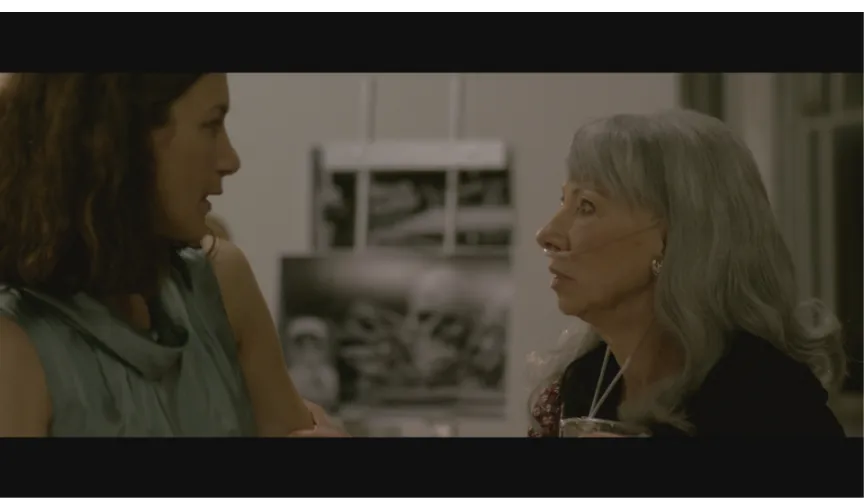
Figure 1. Matilda confronts Marcie in Scene 6.
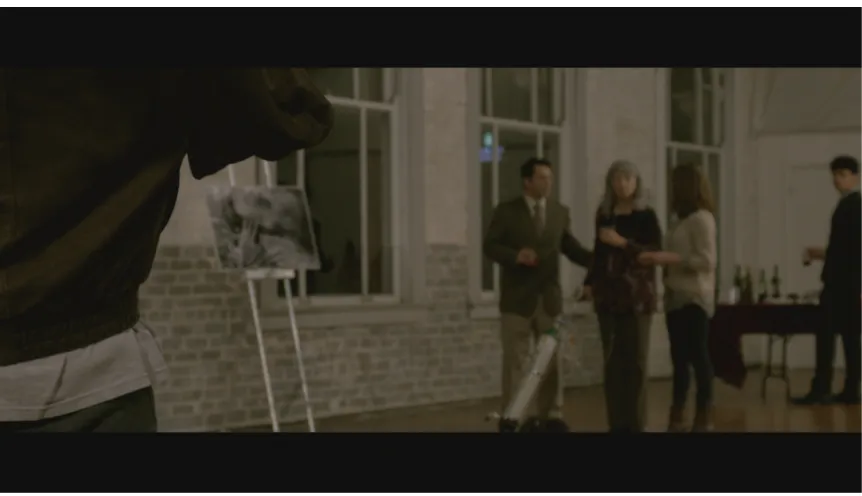
Figure 2. This is the final position of a dolly shot that backs up to reveal Derrick’s folded jacket sleeve.
Figure 3. A dolly shot reveals Derrick’s foot propped on a table.
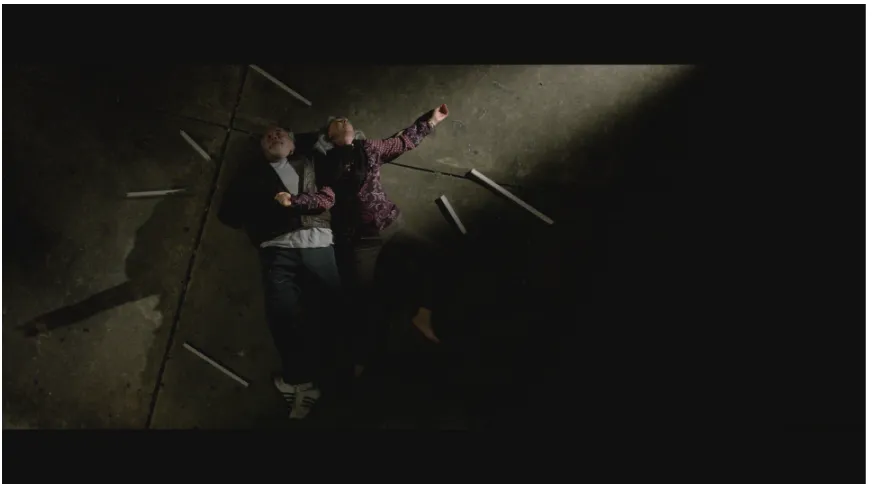
Figure 4. Matilda and Derrick after falling from a window.
Figure 5. Color palette presented in the visual portfolio.
Figure 6. Character illustration of Matilda McKenzie.
Figure 7. Matilda’s famous photograph created in Photoshop with the help of special effects makeup artist Daniel Jouet, and photographer Victor Nguyen.
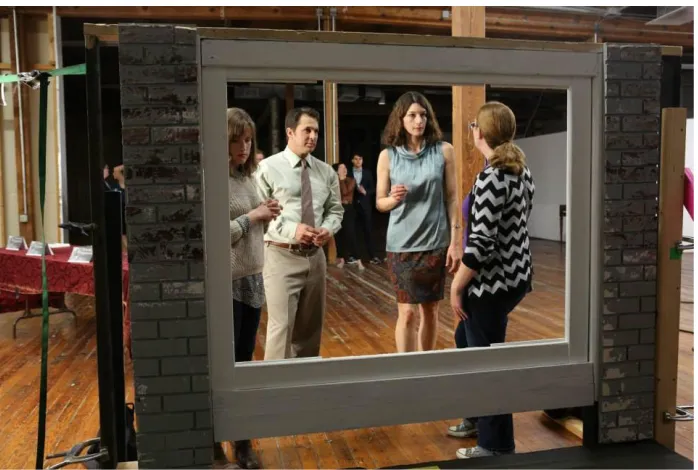
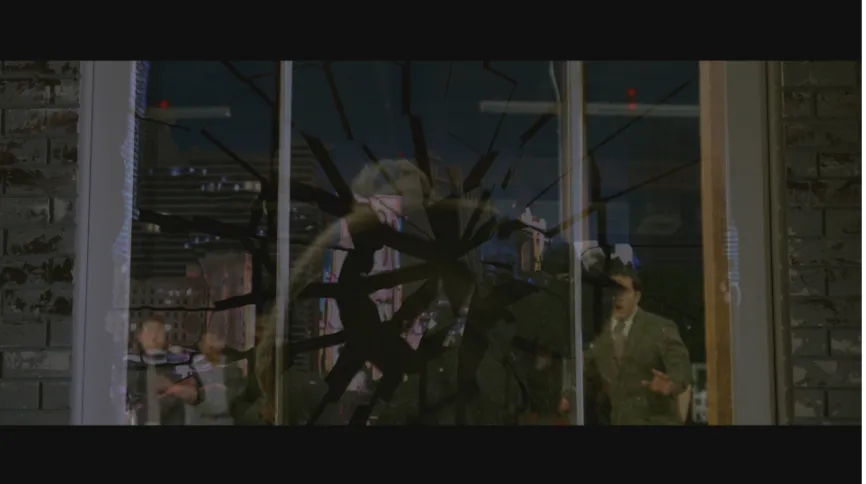
Figure 8. The window, built by the art team, seen here in the upright position without the sugar glass or window panes.
Figure 9. Instead of using real sugar glass, I created a glass-‐breaking effect in postproduction.
List of Abbreviations
UNO: The University of New Orleans
CAC: The Contemporary Arts Center
1st AD: First Assistant Director
2nd AD: Second Assistant Director
DP: Director of Photography
VFX: Visual Effects
CGI: Computer-‐generated Imagery
Abstract
This paper will cover the creation of my thesis film, “Down to the Last,” from concept to
completion, with a special focus on writing a dark comedy with a strong female lead, and
the desire to incorporate visual effects and stunts to enhance the overall story. Details of
how my crew and I decided to approach the challenges of my script and vision will be
fleshed out along with solutions to problems we faced during preproduction, principle
photography, and postproduction. The outcome of the project is a combination of minute
deviations from my initial vision and a minimization of visual effects in order to preserve
the tone and humor of the story.
Chapter 1: Introduction
As a fan of films like Seven Psychopaths (McDonagh, 2012), and Very Bad
Things (Berg, 1998), my ambition is to create a short film with an elaborate
storyline, numerous characters, stunts, and visual effects (VFX). In the University of
New Orleans (UNO) Film and Theatre (FTA) course Writing the Thesis Screenplay,
UNO artist in residence Erik Hansen recommends that students stick to simple
stories with a strong protagonist to avoid confusing the audience and to reduce
production costs. Although I valued this advice and attempted to write
uncomplicated ideas in this class, I kept coming back to my favorite genre and
eventually wrote my thesis script, “Down to the Last.”
Besides providing the freedom to experiment with stunts and VFX, this
project is an opportunity to better myself in an art that relies on the efforts of a large
team. Before coming to the University of New Orleans (UNO), I was a graphic
designer who made short films with a small group of friends and we were
unfamiliar with the hierarchy and structure of a film crew. I knew that if I wanted to
better myself as a filmmaker, I would have to learn how to work with a crew larger
than five people.
Chapter 2: Inspiration
My obsession with films that have outlandish storylines and snappy special
effects goes back to the first time my father took me to see E.T. The Extra-‐Terrestrial
(Spielberg, 1982). Soon after, I was watching Star Wars (Lucas, 1977), Raiders of the
Lost Ark (Spielberg, 1981), and The Dark Crystal (Henson, 1982). I was hooked, but
it wasn’t just because of the copious amounts of VFX and action sequences. I also
liked the characters and their stories. The VFX were only there to enhance the world
of the story, making it an immersive experience for a five-‐year-‐old girl. In his book
about screenwriting, Story, Robert McKee argues against the overt use of visual
effects or computer-‐generated imagery (CGI) for pure spectacle. However, McKee
notes that when “CGIs are motivated by a strong story… The effect vanishes behind
the story it’s telling, enriching the moment without calling attention to itself.” (25)
In the case of the science fiction and fantasy films I liked, there was normally some
type of special effect to sell the movie’s world or its creatures.
By my senior year in high school, I was exposed to the over-‐the-‐top, slapstick
comedies of Mel Brooks—Spaceballs (1987), Blazing Saddles (1974), Young
Frankenstein (1974)—and the movies of the British comedy troupe, Monty Python.
These films had outrageous plots like my childhood favorites, but the action became
part of the comedy, and the special effects and makeup were overemphasized to add
humor. By the time I hit college, I began to watch genre-‐benders like The Evil Dead
(Raimi, 1981) and Dead Alive (Jackson, 1992). Categorized as horror films, I found it
interesting that these movies used an overabundance of gore and melodrama
In the late 1990s, I finally discovered my favorite genre: dark comedy. I decided
to watch a satirical movie that I heard little about, Very Bad Things (Berg, 1998).
This movie made me feel uncomfortable and a little guilty laughing at certain scenes
and situations—murder, chopping up bodies, marrying psychopaths. Yet, when the
movie ended, the film’s use of morbid or crude humor to highlight societal problems
and human folly stuck with me, and I knew that one day, I would make this type of
picture.
Chapter 3: Script Development
Script development began in UNO artist in residence Erik Hansen’s Writing the
Thesis Screenplay FTA course. I wound up writing a couple of scripts in the class in
an attempt to incorporate my peers’ feedback, but I was not satisfied with the
results. I went back to the drawing board a few times and revisited my favorite
comedies that dealt with death and extreme, comical action sequences: Throw
Momma From the Train (DeVito, 1987), Seven Psychopaths, War of the Roses (DeVito,
1989), and Death Becomes Her (Zemeckis, 1992). Each movie dealt with death and
murder in various ways, but all these films reminded me of how much I loved the
consequences of unpredictable and shocking behavior that highlighted human
indiscretion and absurdity.
CHARACTERS
When thinking about my protagonist, I knew straight off that I wanted to write a
strong, mature female lead that had psychopathic tendencies. I wanted someone
who was tough and had lived a long successful life, but was also selfish and
sociopathic. Vince Gilligan’s character, Walter White, from the television show
Breaking Bad (2008-‐2013), kept popping up in my mind. I loved this psychotic
chemistry teacher who gets into selling meth to pay his medical bills, but I
remember thinking one thing: why not a woman?
One difference between my character and Walter White is that Gilligan initially
justifies his main character’s bad behavior with worthy intentions. I debated on
more likeable like Walter, but then another character crossed my mind: Patrick
Bateman, the serial killer from American Psycho (Harron, 2000). Under pressure to
be the alpha male of his consumerist business peers, Bateman’s urge to kill begins to
spiral out of control. Although I do not agree with the actions of the character, he is
used in the story as a way to make a comment about consumerist society in the
1980s. I like these characters and think they’re well-‐written, but I rarely see
females—especially older women—in these controversial roles.
I sought to preserve the original idea of my initial script written in Hansen’s
class—a woman endeavors to control and preserve her integrity before death—
while maintaining a low production cost. It was suggested that the protagonist be a
war correspondent, someone who might either be vain or delusional about their
work and appearance. Maybe she could seem like Walter Cronkite, an American
broadcast journalist dubbed the “most trusted man in America,” or maybe like
Arthur Kent, nicknamed the “Scud Stud” during the Persian Gulf War. These were
great ideas, but I was concerned that I would run into a scheduling problem by
reinventing news footage. Instead of a war correspondent, my anti-‐hero would be a
war photographer. Only one flashback and a couple of photos to recreate meant less
work for the art department and less stress for me to schedule, manage and shoot.
By changing the job position of my protagonist, my interest in journalism and
ethics began to emerge, and I felt this could add dimension to my main character,
providing a good foundation for her arc. She would be viewed respectfully as an
important war photographer, but her methods in capturing award-‐winning
end to her career, therefore, vanity and delusions of grandeur drive her to make
sure the truth is never discovered.
In the end, my anti-‐hero, Matilda McKenzie, is too deluded to positively turn her
life around. Writing anything to the contrary would give a weak ending to a story
that needed to rely on her intensely erratic disposition. Instead, I wrote the script
with constantly rising action that led to a spectacularly ridiculous ending where the
protagonist and antagonist would pay for their misdeeds.
By fleshing out Matilda’s bone structure, as studied in Henry Griffin’s Concept,
Conflict, and Character class, and from our selected reading The Art Of Dramatic
Writing by Lajos Egri, I was able to create a list of physiological and psychological
traits to help me further develop her behavior and motivation. Using this method
allowed me to map out behavior, come up with dialogue, and provided me with
backstory to help my actors learn more about their characters.
Out of this work, I came up with my anti-‐hero, Matilda McKenzie, a deluded war
photographer, who tries to protect her good reputation before she dies. She’s fierce,
determined, and obsessed with immortality. It is this compulsion that causes her
demise. If she can’t be remembered as an authentic and honest war photographer,
then she will leave her audience with an image that will burn in their memories for a
lifetime.
Similar methods were used with the rest of my characters, but to a greater
extent with my antagonist, Derrick Hacker, a Vietnam Veteran who awakens from a
forty-‐year coma. I wanted to make sure that Matilda had someone who equaled her
as bright and manipulating as Matilda, but he attempts to resort to the same type of
scheming.
The three other characters in “Down to the Last” augment Matilda’s personality
and allow the audience to make comparisons to how she chooses to behave and how
she handles relationships. Jeffrey, her loyal assistant, is a parallel to Derrick. Matilda
is a manipulator and will use the relationships to get what she wants. Derrick is
used as a stepping-‐stone to fame, and Jeffrey is employed with preserving her
legacy.
Jackie, the sarcastic photojournalist, appears to be Matilda’s moral opposite as
she constantly questions the war photographer’s relationship to Derrick and brings
up theories of unethical practices. Jackie’s motive is to find the truth, but her flaw is
the enjoyment of ridiculing and confronting the morally abject. This is turn, allows
her to take a horrific photograph of the dying Matilda in the concluding scene of the
film, and perhaps a chance to boost her own career.
Gallery curator, Marcie, is a firm believer in the phrase “There is no such thing as
bad publicity.” Her preoccupation ultimately invites trouble to Matilda’s event, yet
she is not as adept at dodging blame from controversy. Her appearance in “Down to
the Last” is brief, but she plays a key role in Matilda’ unraveling.
SYMBOLISM
The use of cigarettes in the story represents the dissipation of truth and
Matilda’s addiction to death, which eventually leads to her demise. “The Lucky,” a
cigarette turned filter-‐side down for good luck, correlates to the time Matilda has
left to live. Once this cigarette is lit and extinguished, it will be the end of the film
and the end of Matilda’s life. Additionally, it cues the audience to think about luck
and chance.
NARRATION
The use of voice over narration (V.O.) establishes Matilda’s deranged nature. For
example, in the first and second scene of the film, she reflects on the importance of
image and reputation, but we see her attempt to kill a man in the hospital. This gap
between logic and action makes her narration unreliable, and it is used again when
she defends the authenticity of famous photograph taken in 1970, “The Unknown
Soldier with Arm Blown Off.”
CHAPTER 4: The Visual Portfolio, A Guide for Preproduction
After ten rewrites, I was relatively satisfied with the script, and, because I
had time to think about the look of my characters and locations while I was writing,
it was easy for me to design an inspirational portfolio to keep my crew on track
visually. This visual portfolio—combined with a detailed script breakdown—was
given to my team during an initial preproduction meeting. It included the theme of
the story, the synopsis, and images and descriptions of how I wanted the costumes,
art, locations, photography, and cinematography to appear. My breakdown was
more straightforward and listed elements needed for each scene by department.
Providing my team with these two things, I was able to give my crew a basis on
which they could make judgments on simple decisions and purchases.
THEME
The theme of “Down to the Last” is reflected within the progression of action
and the cause and effect of Matilda’s choices. All the same, I provide visual elements
within the film that aid the viewer in discovering the point of the story, which is:
Integrity and authenticity trump a person’s reputation. If one maintains their
perceived status by endangering other people, they will end up paying for their
misdeeds.
“Delusions of grandeur,” “authenticity,” and “death” were ideals I verbalized
frequently when describing the story and visual components of the film to the crew.
As mentioned in the chapter about script development, I decided to use the image of
departure from life and truth, I had other elements within the set dressing that
hinted at mortality. The photographs on display, for instance, had visual significance
within the frame. When Matilda was feeling threatened, we framed the shot to
include photographs in the background that had human remains in them. For
instance, in the sequence where Matilda confronts Marcie, we see a skull within the
picture displayed in the background (figure 1). The same photograph is used when
Derrick enters the gallery for the first time to confront Matilda.
Figure 1. Matilda confronts Marcie in Scene 6.
When dealing with “authenticity,” it was important for us to create
believability in Matilda’s talent as a photographer, accuracy within our Vietnam
flashback scene, and legitimacy in the replication of Matilda’s famous photograph
taken in 1970. At first, I was going to recreate my protagonist’s photographs myself,
and used the work of local photographer Jason Afforder. His pictures looked like
they were taken in war zones in Northern Africa and would allow the audience to
draw the conclusion—along with the Vietnam war photo I would recreate—that
Matilda had been taking photos for nearly forty years. Jacob Hoyson, my art director,
and Anthonyka Ferdinand, my assistant art director, helped pick out photos of
rubble, poverty, men wielding guns, and skeletal remains of foreign soldiers. These
images were printed on 18” by 24” posters and displayed in our gallery scene.
Due to a limited budget, it was difficult to achieve the idea of grandeur.
Nevertheless, I was able to lock down the Contemporary Arts Center (CAC) as our
location for the gallery. The space was big enough to suggest that this was a large-‐
scale event, it could hold my crew and a group of thirty background actors, and it
looked similar to the inspirational images I had included in the visual portfolio. The
CAC also had large windows that showed the New Orleans cityscape, and provided
the windows out of which Matilda and Derrick would fall.
With the location handled, my art department took care of hanging and
displaying Afforder’s photographs. Matilda’s famous war photo had to be large and
looming, so I had a five-‐by-‐seven foot banner created and strung above the podium
where Matilda gives her speech.
CINEMATOGRAPHY
With the intention of making this film look like a comedic film noir, most of
the visual choices were based off of the lighting and depth presented in films such as
the director of photography (DP), Trenton Mynatt, with photos and videos that
showed low to mid key lighting, were mainly wide and establishing, and presented
an abundance of motion from dolly and jib shots. The high contrast in light and dark
would help build an ominous feeling, the wide shots would help to capture our
physical comedy, and the movement would reveal characters. For instance, the
scene in which Derrick is revealed for the first time at the gallery, we used a dolly to
move back from the sudden turning of Matilda’s head and the camera stops when a
close up of Derrick’s folded up jacket-‐sleeve enters the frame (figure 2). The same
technique is used in scene eight, when his foot is revealed, propped up on a table
(figure 3).
Figure 2. This is the final position of a dolly shot that backs up to reveal Derrick’s
folded jacket sleeve.
Figure 3. A dolly shot reveals Derrick’s foot propped on a table.
The jib was limited to one shot in the death scene, a bird’s-‐eye-‐view of Matilda
and Derrick laying on the concrete below the busted window (figure 4). This image
embodies their dysfunctional relationship and reflects the idea of lovers dying in
each other’s arms. Even Matilda’s final drag on her cigarette suggests a moment of
pleasure.
Figure 4. Matilda and Derrick after falling from a window.
ART AND COSTUME
The visual portfolio detailed several reference images for my art department,
and a color palette to help them select items that fit within the range of hues seen
within the film (figure 5). There are photographs of how I wanted the locations to
appear, what I hoped the props would look like, and Vietnam War photographs
depicting soldiers and their military gear.
Figure 5. Color palette presented in the visual portfolio.
Owing to my own lack of fashion sense, I did not have many samples of
costume examples for my designer, Megan Coates. There were photographs of
American and Vietnamese soldiers, but I wasn’t set on the style of present day
clothing. I wanted Matilda to seem rough and worldly and Derrick to be disheveled.
Megan took this into consideration, presented a few ideas, and created her own
visual bible for the characters.
CASTING
There was a considerable amount of time to reflect on my protagonist during
script development and I came into the casting process with a clear idea of how
Matilda should look. I drew out a visual representation of how I imagined her (figure
6)—tough, cold, and authoritative. Although I had drawn her as an older version of
myself, I wanted to keep the ethnicity open and the age range between 60 and 70.
Another stipulation was that they would have a considerable amount of acting
experience.
Figure 6. Character illustration of Matilda McKenzie.
I did not have sketches for the other characters, but did a breakdown of
characteristics and found pictures of other actors I felt could physically fit the roles.
On the Casting Call sheet, I shortened the descriptions and tried to make them more
story-‐like (Appendix B). This was distributed on casting websites such as Actors
Access, The Holding Tent, and some social media pages. It was brief and entertaining
enough to entice actors to audition. The plan worked so well I was inundated with
emails, but only for the female roles. As detailed in the next chapter, this provided
some problems casting for the role of Derrick.
CHAPTER 5: Major Challenges in Preproduction
How to recreate Vietnam, make a man appear to be an amputee, and direct
talent and stunt performers to look like they are jumping out of a fifth floor gallery
window were just a few of the problems my crew and I would solve during
preproduction. During multiple meetings with the art, costume, and camera
departments, we identified the obstacles presented to us in the screenplay and came
up with a plan to tackle each issue.
CASTING
There were several mature actresses who submitted for the lead, but Judy
Durning immediately stood out. I called her back to make sure she had chemistry
with the actors who played Jeffrey and Derrick, and I wanted to make sure that she
took direction well. During callbacks, I called in women who submitted for Young
Matilda and picked out actors who looked similar to Judy. Fortunately, I was able to
find someone who looked almost like her and was talented to boot: Haylee Clark.
Casting for Derrick’s role was more difficult. Like Matilda’s role, we needed to find a
younger actor who looked similar to the person we chose for Derrick, but there
weren’t as many submissions. This made it harder to find actors who looked similar
and met the requirements of the position in the length of time we had to cast.
Despite these complications, we were able to find Roger Magendi and Russell
Giacontiere. Roger never acted for film but he came in with a good deal of theatre
experience, looked like a former military man, sounded gruff, and took direction
believe that these two could have had a relationship in the past, and I felt that
Roger’s theatrical background could also help sell the over-‐the-‐top acting I wanted
to go for.
Again, because submissions for Derrick’s role were low, we did not
immediately find a younger actor with a stocky build like Roger. Thankfully, I had
mentioned this predicament to Haylee, and she recommended a friend of hers who
had some acting experience, Russell Giacontiere. He wound up having a similar build
to Roger and did great in the auditions.
Casting Jackie, Marcie, and Jeffrey was overwhelming because there were so
many submissions. This is where having a casting director really would have helped.
I was only able to respond to and book half of the people who submitted for the role
and was thankful that I had a few talented people to choose from. Emily Russell is
our snarky journalist, Jackie; Mary Pavlov plays the schmoozing gallery curator; and
David Cole plays Matilda’s stuffy assistant.
Last, but not least, Phi Vu and Hoang Nguyen were cast as the civilian
soldiers in the flashback scene, and despite their brief appearance in the film, they
were able to contribute to the authenticity of the story. Phi had actually submitted
for the role of Young Derrick, but because I did not have any older Vietnamese men
to submit for the older Derrick role, I could not cast him in that part. Instead, I
wound up casting him and his friend Hoang as the soldiers and with their help, came
up with dialogue that was true to their characters.
FLASHBACK TO ‘NAM
Recreating the Vietnam flashback was tricky. We needed a location that
looked similar to a jungle in Vietnam, costumes that looked authentic, and two
Vietnamese actors. With the guidance of UNO’s Film and Theatre Department’s
artist in residence and Vietnam veteran Danny Retz, and the research of my art and
costume departments, we were able to come up with a look that, according to Retz,
could pass.
I went to three state parks looking for the perfect spot to film the Vietnam
flashback and, after showing photos from the scout to Danny Retz, settled on
Fontainebleau State Park in Mandeville, La. There was a thicket of palm-‐like plants
called palmettos that surrounded a small stream and a large fallen tree. It was a
perfect spot to mimic the landscape but also provide protection for my characters
during the short gunfire exchange. The art department brought in more palmettos
to help fill any gaps within the thicket, but as for the burning village that was
supposed to be “smoldering” in the background, I wound up cutting that in order to
save time and money. There was not enough manpower to build and paint the
rubble, and no transportation to haul it over.
Through our combined research, costume designer Megan Coates and
production designer Jacob Hoyson were able to find original Vietnam War
photographs online and websites dedicated to the war. This allowed us to determine
which uniforms and patches we needed, and which weapons were used. With the
smoldering village cut, that left us more money in the budget to purchase these
civilian soldiers. We also came across photographs of a female war photographer,
Catherine Leroy, who documented the Vietnam War and we based Matilda’s
costume, hair, and props on some of those photos.
RECREATING PHOTOGRAPHY
After resolving the majority of our Vietnam flashback issues, there was only
one more thing we had to worry about: The recreation of Matilda’s famous
photograph of a soldier getting his arm blown off. If the soldier is unknown, his face
must be hidden, which creates a small problem for me. The authentic war photos
that I saw and thought were compelling, showed the misery and fear on the subject’s
face. If I couldn’t show his face, then how was I going to make this image fascinating
to the audience? Because of this, the injury to Derrick’s arm needed to look
gruesome and it had to seem like the grenade was just going off. After discussions
with production designer Jacob Hoyson, we hired a professional special effects
artist, Daniel Jouet, to create the bloody, blown off arm. This allowed me to combine
a realistic makeup effect with a Photoshop effect of the grenade blast to produce a
convincing war photograph (figure 6). To add to the legitimacy of the image, we
photographed the actor wearing the fake arm the day we shot the flashback scene.
As a result of using these practical effects, I was able to cut down time spent creating
the photograph and increased the believability. It was decided that we would not
show the injury happening on camera. I felt it would be best to leave that moment to
my audience’s imagination, and save money.
Figure 7. Matilda’s famous photograph I created in Photoshop with the help of
special effects makeup artist Daniel Jouet, and photographer Victor Nguyen.
MAKING AN AMPUTEE
Before I cast Roger as Derrick, I made efforts to find an actor who is also an
amputee. There is a database of actors who have served in the military, but I could
not find anyone in Derrick’s age range with the specific arm amputation. Costs for
flying out an actor were not in the budget either. We would have to find another
way.
One solution was to have Roger wear a green glove with the jacket tied in a
knot above his bicep. I would key out the green color of the glove in a motion
disappear. This method was used in Forrest Gump (Zemeckis, 1994) to make Captain
Dan appear legless. The motion of Captain Dan’s limbs looks natural and I hoped to
obtain the same effect for my antagonist. The only problem I saw was that most of
our shots would have to be still so I could easily replicate the background behind
Roger’s arm. Also, it’s another expense to purchase the glove and it would add more
VFX to my list. We decided to use a medical abdominal wrap to pin Roger’s arm
underneath his jacket so it wouldn’t move. During the shoot, we positioned the
camera and Roger’s arm appropriately to lessen visibility of the limb. If the camera
faced the back of the actor, we would pin the arm around his stomach and vice
versa. This was tricky and the jacket we used was a little baggy, but it was a cheap
and effective way of solving the issue.
WINDOW STUNT & VFX
At one point in the film, two of my actors fall through a glass window a few
stories above the ground. This was a similar problem I had in my second year film,
but felt that this time, the stunt needed to be more cinematic and we would actually
see the actors crashing through the glass. I came up with a couple of sketches of how
I wanted to set up this visual effect shot and presented it to the art and camera
departments. In this plan, I would use a method called compositing. In AfterEffects, I
would combine shots taken on location with shots filmed in UNO’s green screen
room. A fake wall and window would be built in the green screen room that the
actors could jump out of safely. The camera would be positioned on a dolly
and through the window at 120 fps, just stopping the camera movement when the
stunt performers fall out of frame onto safety pads.
For our next layer, we would film the background actors reacting to the
action and composite those characters in the final shot. The camera would have to
stay at the same height, pace and shutter speed as the scene shot in the green screen
room. Using tape or blocks that are a distinctive color from the wood floor or white
wall of the gallery would help to track and stabilize the shots. Breakaway glass
would be used in the window, or I could create VFX of glass breaking. My hope was
that all these shots put together would look like one seamless, convincing sequence.
After presenting the idea to my department heads, they voiced a couple of
concerns. First, they had never done a VFX shot like this before and were concerned
about the quality of the finished sequence. Second, the art department would have
to spend a considerable amount of time building the window, wall, and platform in
the green screen room. After hearing their concerns, I began to think of another
problem. I already knew that we would have to spend a whole day on the Vietnam
flashback scene and the photo-‐shoot for the recreation of “The Unknown Soldier
with Arm Blown Off” photograph. To do this green screen stunt and effects shot
would use up a full day of shooting. Scheduling the flashback scene and this special
effect sequence would be taking up two of my eight days that are allowed by the
UNO Film and Theatre Department for shooting a thesis film. If I scheduled this
shoot, I would be looking at only one day for reshoots.
The alternative we came up with was to build the window on the soundstage,
did a good job of building the window and transporting it to set (figure 8). They also
tried to make sugar glass, but the batch was too thick and wasn’t given plenty of
time to dry. When trying to put the glass in before the stunt, it drooped like pulled
candy on a taffy maker and took on a yellowish hue. I waited to see if it had a
cracking effect but knew that it would be best to pull the sugar glass from the
window.
Figure 8. The window, built by the art team, is seen here in the upright position
without the sugar glass or window panes.
Figure 9. Instead of using real sugar glass, I created a glass-‐breaking effect in
postproduction.
Simplified for the art department, this alternative plan was additionally
easier to accomplish for camera and stunts. There would not be a company move to
the green screen room, the camera would not have to track the action and the stunt
performers would not have to fall further than three feet from the fake window. As a
matter of fact, the distance from the floor to the fake windowsill was so short, we
could see the stunt performers legs pop back up into frame as they bounced off the
padding in the first take. Ashley Hudson, Judy’s stunt double, and Tony Donno,
Roger’s stunt double, figured out a way to land with their bodies flatter against each
other, allowing us to capture the action perfectly in take two.
GRANDEUR
Achieving an opulent look for the gallery while showing Matilda’s
prominence within the photography world was a little harder to accomplish due to
budget and resource issues. Combined with the high cost of our costumes and props
for the Vietnam flashback, and the decreasing availability of crew due to other
obligations, the gallery scene took on more of a rough and unfinished appeal.
Packing the gallery with patrons was also problematic and took coordinating
with my second assistant director (2nd AD), Sydney Viard. I made a flyer with the
color palette and pictures of acceptable attire for background actors and forwarded
it to the 2nd AD, who then forwarded it to casting agencies online and through social
media groups dedicated to posting jobs for background actors. She was able to get a
few people to sign up, but without any incentive except for movie credit, and the fact
these were night shoots, we only had two background actors show up. We also had
competition. Two other productions that provided paying gigs for background
actors were filming the same weekend. Knowing this would be a possibility, I had
Sydney and Rashada Fortier, the first assistant director (1st AD), send out my flyer to
our crew, asking them to prepare to fill in as extras.
With all the challenges of the script and some problems that arose during
filming, I feel that the crew and I made the best decisions for the film based on my
budget and the resources available to us. As pointed out, there were a few things
that didn’t go according to plan and there were a few timing issues, but we were still
able to get the principal photography completed with only a few compromises.
CHAPTER 6: Preparing with actors and stunt performers
With a cast of nine characters, scheduling rehearsals was demanding but
necessary due to the complexity of the script. There is a copious amount of dialogue,
a fight scene, an action sequence with gunfire, and comedic stunts. With only two
months to rehearse and prepare after casting—less than that for actors in the
flashback scene—I immediately dove in and scheduled rehearsals to fully prepare
the talent.
Starting rehearsals with a table read resolved most of the actors’ questions. I
went over each scene and explained the goal of every character, their backstories,
and answered questions concerning dialogue and action. The cast knew that this
was not a story about nice people and we were making a dark comedy. With the
exception of Matilda’s assistant and young admirer, Jeffrey, the other characters in
the film have selfish goals. Jeffrey, blinded by Matilda’s impressive career and work,
has trouble accepting that maybe she did some bad things to climb the ladder. Even
Jackie—the person who questions the legitimacy of Matilda’s photos—winds up like
young Matilda at the end. She’s there to take advantage and profit from an
unfortunate or sensational event. Marcie, the curator at the American Wartime
Gallery, is only interested in boosting their presence by taking advantage of
Derrick’s claims. Derrick just wants revenge. As his life has been captured and
viewed by millions because of Matilda’s photo, so should she receive a similar fate.
Judy Durning took to the part of Matilda McKenzie because it was something
different than what she’s done before. It included some combat acting, which she
selfish, unpredictable, and a sociopathic liar. She did have questions about motives
every now and then, but the most important thing I told her to remember was that
it’s her image she’s fighting for and that obsession can often blind her.
To enhance Matilda’s illness, Judy had incorporated heavy breathing and
slow movement whenever she exerted herself or experienced stress. I didn’t want
her to appear too sick at the expense of the audience feeling sorry for her, so we
made sure to limit the frequency of these actions. As soon as we got the oxygen tank
and carrier, we gave them to Judy so she could practice moving with those props. Of
course, I didn’t want her getting too used to them because they were supposed to be
cumbersome and something she would occasionally forget about.
Local stuntwoman and actress, Ashley Hudson, worked with Judy and Roger.
Her sister Heather Hudson, a medic, was at the shoot to make sure the fight
choreography was safe and no one was hurt. Our plan was to shoot Judy and Roger
doing most of the choreography because I wanted the audience to feel they were
watching the same people throughout the sequence. I only used our doubles, Ashley
Hudson and Tony Donno, when a character had to fall, was punched, yanked back,
or had to fly out a window. This plan called for a lot of practice because Roger and
Judy did not have a lot of combat acting experience, plus I had to be mindful of what
they could do physically. Their age and immobility adds to the humor in the film, but
we were really careful when rehearsing with them.
I rehearsed with Phi and Hoang, our Vietnam soldiers, separately from Young
Matilda and Young Derrick due to scheduling conflicts. Haylee and Russell were able
and Vu in a UNO classroom. Individually, these rehearsals worked very well, but
because we all could not practice together, I had to make adjustments to their action
on the shoot day.
Chapter 7: Principal Photography
Principal photography began in late March of 2015, and with preproduction
that started in November of 2014, we were relatively prepared for the shoot. With
that being said, no matter how well one prepares, there will inevitably be issues that
arise either from unpredictable situations, miscommunication, or lack in
preparation. This was true on our set, but through troubleshooting and compromise,
the production kept moving forward.
FLASHBACK
As a consequence of weekly meetings with my art and costume departments,
we were well-‐prepared when it came to dressing the actors and giving them
necessary props. Megan had aged and distressed the uniforms, Stephanie Jennings,
our makeup artist, brought dirt and water to make actors look like they’ve been
outside in a hot environment, and Jacob and assistant art director Anthonyka
Ferdinand brought in the non-‐firing weapons and greenery. At the end of the day,
Daniel attached the arm to Russell and Victor took photographs while I directed him
as to how he should react.
The only issue arose from not rehearsing all my actors together so that the
action was clear in the gunfire exchange. This led to confusion on set about timing
but with a little effort and patience, we established the beats and blocking for each
actor during the shoot-‐out sequence.
WEATHER
Judy, Roger, and I had hoped to work out the final scene where their
characters are laying on the concrete, injured and dying. That scene was supposed
to be sexualized to further expose Matilda’s psychopathic tendencies. We still were
not there with our rehearsals. Thinking we’d have time to fit in practice on set,
weather suddenly became an issue, which caused us to wrap early so the equipment
would not get wet.
Our indoor hospital scene was also compromised due to the location’s leaky
roof. When we showed up to shoot, the hospital beds and floor were wet, but we
found fans and a mop and worked to clean up the water. It took a chunk out of our
day and we had to make cuts from the shotlist so we wouldn’t go over time, but we
were able to get all necessary coverage.
STUNTS
My friend Ashley Hudson, Judy’s stunt-‐double, helped choreograph our fight
scene, gave us recommendations for some of our comedic stunts, and found Tony
Donno to double for Roger during preproduction. We determined where Ashley
would have to stand-‐in for Judy and where we should position the camera whenever
Matilda would have to take a punch or fall to the floor. By dressing Ashley in a
similar costume and wig and placing her with her back turned to the camera, we
were able cut together the fight sequence in such a way that it looked like Judy was
Nearing the end of the scene in Marcie’s office, Matilda hits Derrick with her
oxygen tank. The actual tank is heavy and would be hard for Judy to lift up and
swing. Not to mention that it would be a safety issue to swing it so close to Roger’s
face. Ashley’s recommendation was to have a rubber or foam stunt prop made. I
contacted Daniel Jouet who was able to take a mold of the tank and recreate a foam
version. It was light enough for Judy to swing and if she came too close to Roger’s
face, the impact would not harm him. Again, like the fight scene, I was able to sell the
shot by showing Judy unhook the tubing from the real tank, then immediately
following it up with a shot of Judy swinging the foam tank across Roger’s face. Sound
effects also helped here to sell that the tank was metal and quite heavy.
In the first scene, Matilda gets out of her car but forgets to take off her nasal
cannula and get caught in the car door, snapping her back against her vehicle. We
didn’t want Judy to hurt herself, so we switch her out with Ashley once she opens
the door to step out of the car.
IMPROVISING
Overall, the shoot went well. As expected, there were things that I had to
compromise on, and there were good solutions that happened through patient
troubleshooting. For instance, Judy is supposed to toss a glass of punch in Roger’s
face, but we didn’t think of continuity and the punch until we got to set. Once we
started blocking and rehearsing the scene, we began to question not only continuity,
but possible damage to Roger’s jacket. I decided that instead of tossing it in his face,
her glass of punch was poisoned by Roger’s character, Derrick. This insinuates that
she doesn’t care for him or the poor people who may drink the punch later. It also
takes care of having to dry off Roger each time he’s doused with red punch.
In another scene, Emily bites into a tomato and the seeds spray out onto
Judy’s costume. The accident fit so well with the character that it looks like Jackie
does it on purpose while saying her line “With as much success as you’ve had,
Matilda, one does wonder if some of your pictures were staged.” I decided to use it
and we tried to replicate the action within the other takes.
The crew also did a good job of keeping things moving and we never went
over our time on set. We had a well-‐planned shooting schedule and shot list
assembled, and everyone seemed to get along which made the shoot pleasant.