VOLUME 38, ARTICLE 10, PAGES 233
,
246
PUBLISHED 17 JANUARY 2018
http://www.demographic-research.org/Volumes/Vol38/10/ DOI: 10.4054/DemRes.2018.38.10
Editorial
Interdisciplinary Research on Healthy Aging:
Introduction
Frans Willekens
James R. Carey
Li Qiang
This publication is part of the Special Collection on “Biodemography and Multistate Event History Analysis on Healthy Aging,” organized by Guest Editors Frans Willekens, James Carey, and Li Qiang.
©2018 Frans Willekens, James R. Carey & Li Qiang.
This open-access work is published under the terms of the Creative Commons Attribution 3.0 Germany (CC BY 3.0 DE), which permits use, reproduction, and distribution in any medium, provided the original author(s) and source are given credit.
1 Introduction 233
2 The papers in the Special Collection 235
3 A methodological note on the modeling of causal processes 237
4 Conclusion 242
5 Acknowledgement 242
Interdisciplinary Research on Healthy Aging: Introduction
Frans Willekens1
James R. Carey2
Li Qiang3
Abstract
BACKGROUND
This is an introduction to a Special Collection of Demographic Research on Interdisciplinary Research on Healthy Aging. The collection is an outcome of an international conference in China on biodemography and multistate modeling in healthy aging research. Causal analysis is the common theme of the papers. Healthy aging is an outcome of pathways of causally related distant and proximate determinants and intervening factors that mediate the effects of the determinants.
OBJECTIVE
The objective is to introduce the papers in this SC and to highlight the place of multistate modeling in causal analysis.
METHODS
We adopt the common distinction between structural causal modeling and dynamic causal modeling. The papers in the SC concentrate on structural causal modeling. Multistate models (and, more particularly, the continuous-time Markov process model) are oriented more toward dynamic causal modeling. In dynamic causal modeling the causal dependencies are defined in terms of events (outcomes), exposure time, and transition rates that relate exposures to events.
RESULTS
The contributions to the SC illustrate the progress made in structural causal modeling in the study of healthy aging. Dynamic causal analysis, however, has progressed comparatively slowly.
1 Netherlands Interdisciplinary Demographic Institute (NIDI), The Hague, The Netherlands. Email:[email protected].
CONTRIBUTION
The papers in the SC and the brief introduction to multistate modeling in causal analysis pave the way to enhanced causal analysis in the study of healthy aging and in demography.
1. Introduction
Growing old in good health while actively participating in society is an outcome of an interplay between genetic factors, lifestyle, living conditions, life history, and social support. The preface by Yi Zeng (2018) and the three papers in this Special Collection ofDemographic Research demonstrate that significant progress has been made in the understanding of the complex mechanisms that underlie successful aging. The papers represent a small selection of papers presented at an international conference on healthy aging, held in October 2012 in Beijing and Hangzhou, China. The first part of the conference, in Beijing, focused on the biodemography of healthy aging and the discovery and quantification of the effects of biological, personal, and social factors on the health status at old age. The second part of the conference, in Hangzhou, focused on multistate event history analysis of life paths connecting risk factors and experiences early in life or at adult age and health status at advanced age.
In this brief introduction to the Special Collection, we introduce the papers and highlight their contribution to the exploration of successful aging. The authors of the three papers emphasize the mechanisms that link the determinants of healthy aging to health outcomes at advanced ages. In demography and other social sciences, mechanism-based explanations and causal analysis gain significance (see, e.g., Hedström and Ylikoski 2010; Billari 2015). The established scientific approach of identifying statistical associations between determinants and outcomes often hints at the existence of a mechanism explaining the observed association but rarely reveals the mechanism. A first step to uncovering underlying mechanisms is to dissect the statistical association between determinants and outcomes by identifying (a) intervening or intermediate factors or processes and (b) mutual or two-way dependencies (including reverse causality). The papers in this collection make significant contributions to mechanism-based explanations.
mainstream journal in their profession. The conference illustrated that the integration of biodemography and multistate analysis is progressing, but slowly. In the preface to this collection, Yi Zeng observes that in demography progress is slower than in other disciplines that study aging and healthy aging. The increased interest in viewing healthy aging as an outcome of pathways of causally related distant and proximate determinants and intervening factors that mediate the effects of the determinants may stimulate the interest in process models, including multistate models. Motivated by Yi Zeng’s preface, the title of the conference (Biodemography and Multistate Event History Analysis on Healthy Aging), and the objective of the conference, we added a section on the possible contribution of multistate analysis to the common theme of the papers in this SC: causal analysis. Multistate analysis is included in the introduction because it relates to future directions in an emerging subfield of dynamic causal modeling rather than to the collected papers.
The papers in this collection are introduced in section 2. In section 3 we discuss multistate modeling in mechanism-based explanations and causal analysis. In that section our aim is to contribute to an effective interface between biodemography and multistate analysis. Section 4 concludes this introduction.
2. The papers in the Special Collection
It is widely acknowledged that the presence of social support contributes to healthy aging. The main providers of support to the elderly are children. Caring for elderly parents frequently complicates individuals’ work–life balance, leading to an accumulation of stress, in particular when small children require care too. In that situation some women may decide to leave the labor force. That is precisely what happened in China. Ke Shen, Ping Yan, and Yi Zeng (2016) observe that women’s labor force participation rate in China declined significantly over the past two decades. They also note that women with young children who live with their parents or live nearby (same neighborhood or village) have a higher labor force participation rate and work more hours, on average. The authors use longitudinal data on pairs of adult women and their elderly parents to explore the causal mechanism explaining the observed association between proximity to elderly parents and female labor force participation. Instrumental variables are introduced to tackle the two-way dependency between living arrangement and female labor supply. The authors found a positive effect of coresidence and residence nearby on female labor supply, both in terms of participation and hours worked. Women who live with their parents or live nearby spend less time on housework than women who live further away because the elderly parents do part of the housework and help taking care of the children. Women who do not participate in the labor force cite as the main reason that they are taking care of housework. Since the study focuses on elderly parents, i.e., those aged over 65, the women in the sample were not young (mean age 48) and did not have small children to take care of. The residence effect is likely to be much larger for mothers with small children. To enable women in China to more fully participate in the labor force, the help of elderly parents in running a household may be necessary, but it is not sufficient. The authors argue that formal care, a flexible labor market (e.g., flexible work schedules), and gender equality in sharing the burden of household work are important too. As the study shows, burden sharing (mutual support) benefits the recipient and the provider of care.
funds and are at risk of losing entitlements and benefits. Urban migrants without an urban household registration record (urban residence permit) are particularly vulnerable. The authors report that pension coverage is substantially lower among urban migrant workers than among the local population with urban household registration. Rural‒urban migrants within provinces are more likely to participate than interprovincial migrants. Participation differs by occupation, economic status (measured by consumption), and region. The authors conclude that migration has a significant effect on participation in old age pension schemes. They call for migrant-friendly pension reforms.
The contributions to this Special Collection offer clear messages. First, healthy aging does not start at old age. It is already partly determined by genetic factors and lifestyle and living conditions throughout the life course. Second, successful aging is both a personal project and a collective responsibility. Formal and informal social support are essential at old age and at all ages to reduce the stress that builds up when people do not have the support they need to fully participate in economic and social activities and to prevent the physiological dysregulation produced by accumulated stress. Third, to disentangle the contribution of different factors to healthy aging, conventional statistical models are inadequate. Relevant factors affect variables of interest directly but generally also indirectly through intervening factors or mediators such as accumulated stress (in the effect of reproductive histories on old-age health), household burden sharing (in the effect of living arrangement on employment), or migration (in the effect of place of residence on participation in public pension schemes). Statistical techniques that exist to quantify the effects of factors/variables in the causal pathway are illustrated in the papers in this Special Collection.
3. A methodological note on the modeling of causal processes
later than the action. Changes in sets of variables are described by systems of differential equations. The parameters are rates of change in continuous time. Note that currently structural causal models and dynamic causal models treat time differently. Some structural models consider exposure and outcome time-varying. In these models, time is explicit and discrete (see, e.g., Bijlsma and Wilson 2017). In dynamic causal models, time is always explicit and is continuous. Discrete time, and more particularly observations of a continuous process in discrete intervals, obscures the conditional dependencies (Aalen et al. 2016). Counterfactual analysis, which is a significant part of causal analysis, is used in both schools.
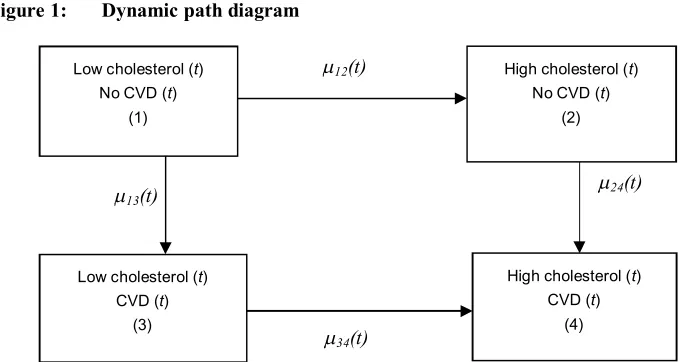
Multistate models are used regularly in causal analysis. The continuous-time Markov process, which is the stochastic process underlying multistate models, is a system of linear differential equations. In the multistate perspective, the variables of interest are categorical variables. Their dynamics (time series or sequence) are determined by an initial condition and transitions between categories. The dynamics are described by a counting process, which is a particular type of stochastic process (Aalen, Borgan, and Gjessing 2008; Willekens 2014). To illustrate the use of multistate models in causal analysis, suppose we want to determine whether high cholesterol increases the risk of cardiovascular disease (CVD). Consider two categorical variables with two levels each: cholesterol level (low and high) and CVD (absent and present). The first event (event A), is a change in cholesterol level from low to high. The second event, (event B), is a change in CVD from absent to present. Figure 1 shows the dynamic path diagram, with ( ) the instantaneous rate of transition between state i and statej at timet.
Figure 1: Dynamic path diagram
High cholesterol changes the rate of developing CVD from ( ) to ( ). Cholesterol level is an intervening variable or mediator. The changes in CVD and cholesterol level are two interdependent parallel processes. Blossfeld (2009) asserts that the study of parallel or interdependent processes with transition rate models is one of the most important advances of event history analysis. The coevolution of parallel processes and their interaction represent the generative mechanism through which cholesterol level influences CVD. Aalen, Røysland, and Gran (2012) argue that it is natural to think of mediation as a generative mechanism, described by two stochastic processes: the cholesterol process and the CVD process. The multistate model incorporates the two processes. The processes are locally independent if the transition intensity governing one process at time t does not include information on the other process (for details, see Aalen, Røysland, and Gran 2012: 845ff.; Courgeau and Lelièvre 1992: Chapters 5 and 6). Notice that the independence applies to transition rates, but not to transition probabilities. For an explanation, the reader is referred to the theory of competing risks. Blossfeld (2009) offers an extensive discussion of types of dependencies in parallel processes.
If the transition from state 3 to state 4 is not relevant, states 3 and 4 may be merged, leaving three states. That is the case when the cholesterol level of persons with CVD is not of interest in the study or when the third state is an absorbing state (e.g., the person is dead). Notice also that the transition rate relates transitions to exposures. The adequate measurement of exposure is a key challenge in causal analysis. If the appropriate statistical methods are used to estimate the transition rates from data, then
Low cholesterol (t) No CVD (t)
(1)
Low cholesterol (t) CVD (t)
(3)
High cholesterol (t) No CVD (t)
(2)
λ13(t)
λ12(t)
λ24(t)
λ34(t)
High cholesterol (t) CVD (t)
exposure is measured adequately. That is the case in the counting process approach (Aalen, Borgan, and Gjessing 2008), which is the dominant approach to event history analysis and multistate modeling today.
The transition rate measures the risk level. The risk level is affected by an intervention, e.g., a change in lifestyle, living condition, medication, etc. For instance, statins (lipid-lowering medications) lower the cholesterol level and reduce the risk of cardiovascular disease (see, e.g., Bonneux 2011). Antihypertensive treatment reduces the blood pressure and the incidence of dementia. In fertility, contraceptives reduce the risk of conception; the reduction depends on the effectiveness of the contraceptives. Postponement of pregnancy beyond age 30 also reduces the risk of conception and the decline accelerates at ages over 35. These causal mechanisms are well established. Interventions often have multiple effects, making it more difficult to quantify the effects of the intervention. Multistate models are used to address that problem. They are fully consistent with outcome-wide epidemiologic studies, advocated by VanderWeele (2017). In multistate models, states represent variables and rates of transition between states (hazard rates) measure associations between variables.
Commenges (2016) illustrates the power of multistate models to quantify the causal effect of antihypertensive treatment on dementia. High blood pressure increases the risk of dementia but also the risk of heart failure and the risk of death due to heart failure. Dementia generally occurs at advanced ages. People with high blood pressure who go untreated may die before developing dementia. Death and developing dementia are competing risks. The reduction of heart failures adds years of life and increases the exposure to the risk of dementia. As a consequence, antihypertensive treatment may increase the incidence of dementia in a population, although the treatment lowers the individual risk. The selection effect that explains that constant individual risks may be accompanied by increasing or declining aggregate risk is well known in demography (Vaupel, Manton, and Stallard 1979). In causal analysis, selection effects are omnipresent. To determine the causal influence of high blood pressure on dementia, one should first determine the causal influence on heart failure and death. Causal analysis involves the study of three interdependent processes with outcomes death, heart failure, and dementia. The three processes are influenced by blood pressure and other personal characteristics.
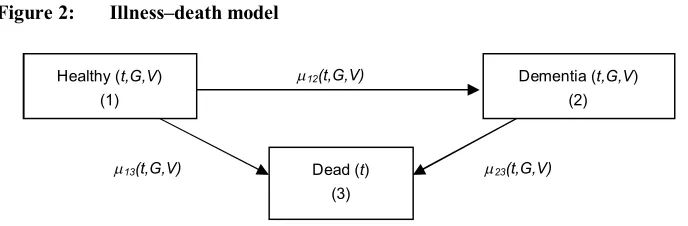
Commenges (2016) approaches this problem by distinguishing two interacting counting processes. The bivariate counting process is described by a multistate model with three states: healthy, having dementia, and dead. All covariates of individuals that are known to have an effect on the incidence of dementia or the incidence of death, except blood pressure, are collected in G. The blood pressure is represented by V. Figure 2 shows the path model, withλij(t,G,V) the instantaneous rate of transition from
Antihypertensive treatment reduces the blood pressureV and therefore the incidence of dementia but also the incidence of death. People with dementia have a higher death rate (λ23(t, G,V) > (λ13(t, G,V)). The death rate may also be affected by V. Some research
shows that antihypertensive medication could be harmful for people with dementia, increasing the incidence of death (Harrison et al. 2016).
Figure 2: Illness–death model
Figure 2 may also be approached as a causal diagram. The states represent the nodes (variables) and the the transition rates represent the associations between variables. The direct effect ofG andV on death is measured by the rate at which healthy people die, λ13(t, G,V). Dementia is an intervening factor that affects the death rate.
Persons without dementia die at a rateλ13(t, G,V), but people with dementia die at the
elevated rate λ23(t, G,V). Whether an individual gets dementia is determined by the
incidence of dementia,λ12(t, G,V). The figure shows the pathway or the mechanism that
links healthy individuals and the absorbing state, which is the end state. Dementia is a mediator since the path passes through this node. The indirect effect passes though the mediator, whereas the direct effect does not. The figure shows the mechanism through whichG and V produce the end state. In other words, it is the generative mechanism through which the independent variables influence the dependent variable.
Gran et al. (2015) consider three approaches to estimating causal effects of interventions in multistate models. The first is to artificially manipulate transition intensities. The difference between the new and the old transition intensity represents the effect of the intervention on the transition intensity. The effects of an intervention on transition and state probabilities, and on the expected years with and without impairment such as dementia, are obtained by computing these measures with the old and the new transition intensities. This method is commonly used in demography to compute the impact of different demographic regimes on populations. In the second and third approach, the presence or absence of intervention is represented by an indicator variable I (0/1), which is treated as a covariate. In the second approach, the transition
Healthy (t,G,V) (1)
Dead (t) (3)
Dementia (t,G,V) (2)
λ13(t,G,V)
λ12(t,G,V)
intensities are weighted estimates, the weights being the inverse probabilities of being included in the treatment group (control group) at baseline. It is equivalent to randomization at baseline. The third approach is G-computation, which involves the estimation of the transition intensities withG,V, andI as covariates. The effect of the treatment on an individual is the difference in values of the effect indicators (state probability or life expectancy with and without dementia) with I = 1 and I = 0.
4. Conclusion
In the preface Yi Zeng reports on his research among the Chinese Han population, in which he found that people with a particular genotype (FOX01A-209) have a higher mortality at advanced ages but that the effect is reversed when carriers of that genotype exercise regularly or drink tea regularly. The biological mechanism at the cell level is not known yet, but the finding that the genotype effects are mediated by lifestyle factors is important for understanding healthy aging and for designing intervention programs. The authors of the papers in this Special Collection identify important effect modifiers and significantly advance our understanding of processes that determine longevity and healthy aging.
We adopt the common distinction between structural causal modeling and dynamic causal modeling. Structural causal analysis emphasizes functional relations between variables or events, while dynamic causal analysis emphasizes temporal relations. The papers in this SC concentrate on structural causal modeling. In this introduction, we reported on research that shows that multistate models provide a natural framework for dynamic causal analysis and for determining causality in terms of the ability to predict (Granger causality). We hope that this Special Collection of Demographic Research further stimulates causal analysis in demography.
5. Acknowledgement
References
Aalen, O.O. (2012). Armitage lecture 2010: Understanding treatment effects: the value of integrating longitudinal data and survival analysis. Statistics in Medicine 31: 1903‒1917.doi:10.1002/sim.5324.
Aalen, O.O., Borgan, Ø., and Gjessing, H.K. (2008). Survival and event history analysis. A process point of view. New York: Springer. doi:10.1007/978-0-387-68560-1.
Aalen, O.O., Røysland, K., and Gran, J.M. (2012). Causality, mediation and time: A dynamic viewpoint.Journal of the Royal Statistical Society A 175(4): 831‒861.
doi:10.1111/j.1467-985X.2011.01030.x.
Aalen, O.O., Røysland, K., Gran, J.M., Kouyos, R., and Lange, T. (2016). Can we believe the DAGs? A comment on the relationship between causal DAGs and mechanisms. Statistical Methods in Medical Research 25(5): 2294‒2314.
doi:10.1177/0962280213520436.
Bijlsma, M. and B. Wilson (2017). A new approach to understanding the socio-economic determinants of fertility over the life course. Rostock: Max Planck Institute for Demographic Research (MPIDR Working paper 2017-013).
https://www.demogr.mpg.de/en/projects_publications/publications_1904/mpidr_ working_papers/a_new_approach_to_understanding_the_socio_economic_deter minants_of_fertility_over_the_life_course_5840.htm.
Billari, F.C. (2015). Integrating micro- and macro-level approaches in the explanation of population change. Population Studies 69(S1): S11‒S20. doi:10.1080/003 24728.2015.1009712.
Blossfeld, H.-P. (2009). Causation as a generative process. The elaboration of an idea for the social sciences and an application to an analysis of an interdependent dynamic social system. In: Engelhardt, H., Kohler, H.-P., and Fürnkranz-Prskawetz (eds.). Causal analysis in population studies. Dordrecht: Springer: 83‒109.
Commenges, D. (2016). Dealing with death when studying disease or physiological marker: The stochastic system approach to causality. arXiv:1610.01869v1 [stat.ME].
Courgeau, D. and Lelièvre, E. (1992).Event history analysis in demography. Oxford: Clarendon Press.
Friston, K.J. (2011). Functional and effective connectivity: A review. Brain Connectivity 1(1): 13‒36.doi:10.1089/brain.2011.0008.
Gran, J.M., Lie, S.A., Øyeflaten, I., Borgan, Ø., and Aalen, O.O. (2015). Causal inference in multi-state models: Sickness absence and work for 1145 participants after work rehabilitation. BMC Public Health 15(108): 1‒16. doi:10.1186/s128 89-015-2408-8.
Granger, C.W.J. (1969). Investigating causal relations by econometric models and cross-spectral methods.Econometrica 37: 424–438.doi:10.2307/1912791. Grundy, E. and Read, S. (2015). Pathways from fertility history to later life health:
Results from analyses of the English Longitudinal Study of Ageing. Demographic Research 32(4): 107−146.doi:10.4054/DemRes.2015.32.4. Harrison, J.K., Van Der Wardt, V., Conroy, S.P., Stott, D.J., Dening, T., Gordon, A.L.,
Logan, P., Welsh, T.J., Taggar, J., Harwood, R., and Gladman, J.R.F. (2016). New horizons: the management of hypertension in people with dementia. Age and Ageing 45(6): 740‒746.doi:10.1093/ageing/afw155.
Hedström, P. and Ylikoski, P. (2010). Causal mechanisms in the social sciences. Annual Review of Sociology 36: 49‒67. doi:10.1146/annurev.soc.012809.1026 32.
Pearl, J. (2000). Causality: Models, reasoning and inference. Cambridge: Cambridge University Press.
Qin, M., Zhuang, Y., and Liu, H. (2015). Old age insurance participation among
rural-urban migrants in China. Demographic Research 33(37): 1047–1066.
doi:10.4054/DemRes.2015.33.37.
Schweder T. (1970). Composable Markov processes. Journal of Applied Probability 7(2): 400–410. doi:10.1017/S0021900200034963.
Valdes-Sosa, P.A., Roebroeck, A., Daunizeau, J., and Friston, K.J. (2011). Effective connectivity: Influence, causality and biophysical modeling.NeuroImage 58(2): 339‒361.doi:10.1016/j.neuroimage.2011.03.058.
VanderWeele, T.J. (2017). Outcome-wide epidemiology. Epidemiology 28(3): 399‒ 402.doi:10.1097/EDE.0000000000000641.
Vaupel, J., Manton, K.G., and Stallard, E. (1979). The impact of heterogeneity in individual frailty on the dynamics of mortality. Demography 16(3): 439–454.
doi:10.2307/2061224.
Willekens, F. (2014).Multistate analysis of life histories with R. Dordrecht: Springer.