
Public Library based Web-enabled Community Information System for Rural Development in India: Designing A FLOSS based Multilingual Prototype
10
0
0
Full text
(2) Parthasarathi Mukhopadhyay. Leech (1999) has a user- and use-oriented view of community information, which is divided into two categories: • •. Survival information Citizens’ action information. Survival information is defined as information necessary for a citizen to work on a problem. e.g. looking for a solicitor or a place to go for advice. Citizens’ action information is defined as information that enables people to participate in local political and democratic processes. This means that people are looking for information either about a particular subject or about a particular area, or a combination of these. This view is related to the organisation and presentation or mediation of community information services (CISs). 3. Web-enabled Community Information Services. The advent of the Internet, Web and other technological advances may change the definition of "community". It is now possible to remain a member of one community whilst physically living in another. An example of this is a person who lives in Kolkata, who organizes the Nadia district Farmer’s Information Web site on the Internet, thus remaining a part of that community. Perhaps CISs may be used by people who have emotional links to a community as well as those who are resident there. Librarians may need to include, and allow for, the impact of this "virtual" community when assessing the usage of CISs and when performing community profiles. Public libraries had long been a free information space in the community, which welcomed people from different walks of life. It is the public library that must meet the challenge of poverty and deprivation. Public library system in Indian states could provide the much-required institutional mechanism for CISs. Public libraries require following an integrated approach in the design and delivery of community information services to the rural masses of India. A closer analysis of ICTs reveals that there is a tremendous scope of ICTs application in the design of community information system and dissemination of community information services in anywhere to anyone at anytime. Obviously, to meet the demand of virtual community, community information services over the Web is the best technological route for public libraries in India (Mukhopadhyay, 2004, 2006). However, requirements for such services in India may be listed as below: • • • • • •. CIS should be an integral part of library management software CIS should support effective community communication system such as discussion forum and bulletin board services It should support standard metadata schema System must allow single point data entry facility with different frameworks (such bibliographic, community and authority frameworks) System must have provision for Unicode compliant regional language based user interface supplemented by searching and browsing the resources (community information and library materials) through local language CIS user interface must be organized under the categories identified through community information demand survey. XXII IASLIC National Seminar / IIT Roorkee / 2006 / pp. 251-258.
(3) Parthasarathi Mukhopadhyay. • • • • • •. 4. System must allow easy management of various modules related to CIS and library management including user access and privileges System should be infinitely hospitable to accommodate various categories and sub-categories of community information CIS should support direct hyper linking with online community information resources along with links to local and global learning objects Community Information System should be based on open standards and open source software for obvious reasons Services should be accessible in stand-alone mode as well as over the Intranet and Internet CIS should allow integration of standard code lists and domain specific vocabulary control list FLOSS based Software Framework. Web-enabled community information must be built around accommodative software architecture to satisfy the requirements framed in section 3. Till date there is no software solution available either from commercial or open source domain to implement public library led Web-enabled community information services. This paper is an attempt to utilize an array of open source software and open standards in developing the required software framework for Web-enabled community information services. 4.1. Open Source Software. The software framework uses following open source software in developing the application environment: Domain of Application. Open Source Software. Web server. Apache version 2.0.54 (http://httpd.apache.org/). Programming environment. PERL (Version 5.0.84), PHP (Version 4.0) and Java Run time Environment (Version 1.5.0) (http://www.activestate.com; http://www.php.net; and http://java.sun.com/). Application software (DL software). Greenstone Digital Library Software (GSDL), Version 2.70 (http://greenstone.org/). Virtual Keyboard (for Bengali script). Avro Virtual Keyboard (http://www.omicronlab.com). Rendering engine and Open type fonts USP10.dll; Likhan, Bangla and Ekushey fonts (for Bengali script) (http://www.ekushey.org/). All these software are open source software and may be downloaded freely from respective URLs. These are available against GPL (GNU Public License) and can be customized extensively as per the requirement of libraries.. XXII IASLIC National Seminar / IIT Roorkee / 2006 / pp. 251-258.
(4) Parthasarathi Mukhopadhyay. 4.2. Open Standards. Open standards are transparent, open ended and freely implementable and accessible over open forum. Open standards facilitate use of the products in new areas and in new ways for the benefit of society. Such a standard puts the current technology to full use. The purpose of open standards is to ensure interoperability so that different systems can interact without problems. The said software framework uses following open standards –. Domain of Application. Open Standards. Character/Text encoding. Universal character set – Unicode version 4.1 (http://www.unicode.org/). Metadata schema. SeamlessUK Application Profile Version 2.0 (http://www.seamlessuk.info/). Metadata encoding. RFC 2731 (W3C standard) (http://www.w3c.org/). Communication protocols. HTTP and other Web standards (http://www.w3c.org). 5. Community Information Resources for Rural Development. India is a Union of 28 States/Provinces and 7 Union Territories. Each state is further divided into districts. There are approximately 600 districts in the country. Each district is further divided into smaller administrative units called development Blocks or Talukas. There are about 6000 Blocks in the country. A block may have urban as well as rural areas. While the urban areas consist of towns, the rural areas consist of villages. There are more than 6,00,000 villages in India. There are three levels of government: the central government, the state or provincial government and the local government. The people at the national, state and local level elect each of these governments. The central or union government, head-quartered at New Delhi has the mandate to administer subjects listed in the central list. The central list includes subjects that cut across state boundaries and cover the interests of the entire nation such as defense, foreign affairs etc. The central government is also responsible for administering the 7 Union Territories. Each state or province is administered by a state government, which is headquartered at the state capital. The state governments are empowered to take decisions on subjects listed in the state list. The state list includes subjects that cut across boundaries of local governments and also other statelevel issues. The local government, also called local self-governing bodies or Panchayati Raj Institutions, is of two types - urban local bodies and rural local bodies. The rural local bodies consist of a three-tier Panchayat system: District Panchayat or Zilla Parishad, Block Panchayat and Village Panchayats. The successful implementation of development strategies of the central and state governments demands strong information support system. The welfare schemes and projects of the government should specify where the required information will be. XXII IASLIC National Seminar / IIT Roorkee / 2006 / pp. 251-258.
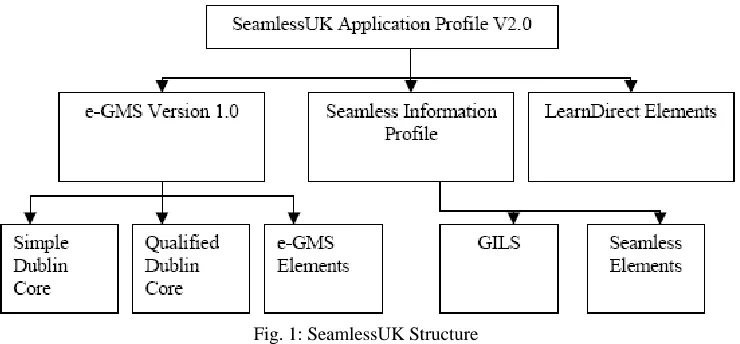
(5) Parthasarathi Mukhopadhyay. available and who will be the target consumers of such information. Citizen action information generated by central and state governments in different sectors varies in terms of type of information, levels of its details, the source at which it is generated and the point of utilization (India, NIC, CRISP, 2003). For example, the flow of citizen action information in rural development sector may be illustrated as below: MoRD (1) Consolidated Progress Reports (2) Consolidated Annual Plans. (1) Details of fund allocations, sanctions, scheme guidelines by GoI SRD (1) Details of Fund Allocations, sanctions, scheme guidelines by State Govewrnment (2) Details of distribution of funds allocated/sanctioned by GOI, GOI scheme guidelines. (1) Consolidated Progress Reports (2) Consolidated Annual Plans ZP/DRDA (1) Consolidated Progress Reports (2) Consolidated Annual Plans. Details of distribution of funds allocated/sanctioned by GOI/ State Govt. , scheme guidelines. Block Panchayat/ BDO (1) Progress Reports (Physical & financial) (2) Annual Plans. Details of distribution of funds allocated/sanctioned by GOI/ State Govt. , scheme guidelines etc. Village Panchayat. (1) Details of loan/subsidy utilized, , details of achievement of intended benefits (infrastructure, housing, income generated etc.) (2) Needs/Requirements etc.. Details of beneficiaries (village, group, family, individual) selected, benefits (employment, houses, roads etc.) funds (loan, subsidy etc.) available etc. Rural Beneficiaries. (Source: CRISP group, NIC, India) (MoRD – Ministry of Rural Development, GOI; SRD – State Government Rural Development Department; ZP – Zilla Parishad; DRDA – District Rural Development Agency). The information flow pattern in other sectors e.g. health & family welfare, education, finance, agriculture etc. are also to some extent similar in nature. 6. Organization of Community Information Resources. This framework proposes SeamlessUK Application Profile (Version 2.0) as metadata schema and RFC 2731 as standard for metadata encoding. SeamlessUK, developed by Essex County Council for UK-wide public library led distributed community information services is the only available open standard metadata schema in the domain. The version 2.0 is mainly derived from the e-Government Metadata Standard (e-GMS), Version 1.0 (Published in April 2002) and the original Seamless Information profile. The full profile includes 18 main elements of which 7 are mandatory (Rowlatt, 1999) and must be applied to all kind of data. The remaining elements are optional and naturally their application will depend on the type of community information resources. SeamlessUK Application Profile (V2.0) follows RFC-2731 (the W3C standard for encoding metadata elements in HTML formatted. XXII IASLIC National Seminar / IIT Roorkee / 2006 / pp. 251-258.
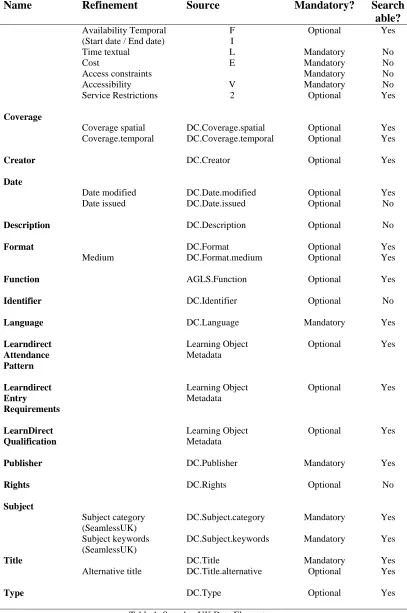
(6) Parthasarathi Mukhopadhyay. documents or document-like objects). It means that data elements should be encoded as name-value pair in META tag within <head> to </head> area of HTML formatted objects (Kunze, 1999). Data elements of the SeamlessUK profile have three source metadata elements sets namely Seamless Information Profile, e-GMS Version 1.0 (Government of UK, 2002; 2004), and LearnDirect Elements. The e-GMS elements set version 1.0 comprises two primary element sets Dublin Core (Simple and Qualified) and e-GMS schema. Seamless Information Profile, on the other hand, is a combination of GILS and Seamless Elements. Therefore, SeamlessUK may be termed as a hybrid metadata schema and it is quite clear from Figure 1.. Fig. 1: SeamlessUK Structure. All the data elements of SeamlessUK Application Profile are listed here (Table 1) in the following format – name of the element, refinement of it (if any), source of the element, level of obligation (mandatory/ optional) for the element and indication whether the element is searchable or not. A detail description of each SeamlessUK element is available in the project website (SeamlessUK, 2002).. Name. Refinement. Audience. Source. Mandatory?. Search able?. DC.Audience. Optional. Yes. S E A M L E S S U K. Mandatory Mandatory Mandatory Mandatory Mandatory Mandatory Mandatory Mandatory Mandatory Mandatory Mandatory Mandatory Mandatory Optional. Yes Yes No No No Yes Yes Yes Yes No No No No Yes. Availability Personal name Corporate name Building Number Building Name Street Address Post Town County Postcode Alternate Postcode Telephone Number Fax Number Web address Email Address Availability Coverage. P R O. XXII IASLIC National Seminar / IIT Roorkee / 2006 / pp. 251-258.
(7) Parthasarathi Mukhopadhyay. Name. Refinement. Source. Mandatory?. Search able?. Optional. Yes. V 2. Mandatory Mandatory Mandatory Mandatory Optional. No No No No Yes. DC.Coverage.spatial DC.Coverage.temporal. Optional Optional. Yes Yes. DC.Creator. Optional. Yes. DC.Date.modified DC.Date.issued. Optional Optional. Yes No. DC.Description. Optional. No. DC.Format DC.Format.medium. Optional Optional. Yes Yes. Function. AGLS.Function. Optional. Yes. Identifier. DC.Identifier. Optional. No. Language. DC.Language. Mandatory. Yes. Learndirect Attendance Pattern. Learning Object Metadata. Optional. Yes. Learndirect Entry Requirements. Learning Object Metadata. Optional. Yes. LearnDirect Qualification. Learning Object Metadata. Optional. Yes. Publisher. DC.Publisher. Mandatory. Yes. Rights. DC.Rights. Optional. No. DC.Subject.category. Mandatory. Yes. DC.Subject.keywords. Mandatory. Yes. DC.Title DC.Title.alternative. Mandatory Optional. Yes Yes. Optional. Yes. Availability Temporal (Start date / End date) Time textual Cost Access constraints Accessibility Service Restrictions. F I L E. Coverage Coverage spatial Coverage.temporal Creator Date Date modified Date issued Description Format Medium. Subject Subject category (SeamlessUK) Subject keywords (SeamlessUK) Title Alternative title Type. DC.Type Table 1: SeamlessUK Data Elements. XXII IASLIC National Seminar / IIT Roorkee / 2006 / pp. 251-258.
(8) Parthasarathi Mukhopadhyay. 7. Processing of Community Information Resources. Greenstone Librarian Interface (GLI), a Java based interface, allows library professionals easy enriching of community information resources through selected metadata schema. SeamlessUK Application profile added as metadata schema to the GSDL software suite to support the use of the schema as metadata standard. Fig. 2 shows enriching of a Bengali script based community information resource in the software framework.. Fig.2: Multilingual Processing of Community Information Resources. 8. Search and Retrieval. The software allows browsing of digital objects and both simple and advance searches. Fig. 3 exhibits the main user interface of the CIS software framework.. Fig.3: Main User Interface. XXII IASLIC National Seminar / IIT Roorkee / 2006 / pp. 251-258.
(9) Parthasarathi Mukhopadhyay. This framework has been utilized to develop Web-enabled community information system on health services in Midnapore Town, West Bengal. Search facility (Fig. 4) of the software framework allows free text search, Boolean search (AND, OR, NOT), truncated search (only right truncation), field-level search (each metadata element along with provision of single search for all fields) and weight term searching option.. Fig.4: Multilingual Searching. Each successful search (which generates hits) displays number of hits and brief display of retrieved records. Each record is hyperlinked and full text digital object may easily be displayed by simply clicking the appropriate hyperlink (Fig. 5).. Fig.5: Retrieval of Full-text Community Information Resources. XXII IASLIC National Seminar / IIT Roorkee / 2006 / pp. 251-258.
(10) Parthasarathi Mukhopadhyay. 9. Conclusion. Development of community information services with maximum human support is crucial for users’ access to and use of information in daily life situations and their political participation. Public libraries have the potential to develop and provide these services by utilizing this FLOSS based multilingual software framework. A strategy for web-based community information services is needed. This has to be based on research and reports on the role of public libraries in the information society, in particular the role in the local community. Public libraries should be proactive and enter into partnerships with public, private and voluntary organisations in order to be the leading community information provider.. References Government of UK, Office of the e-Envoy, Technology Policy Team (2004). E-Government metadata standard version 3.0. Retrieved August 28, 2004, from http://www.govtalk.gov.uk/schemasstandards/metadata.asp Government of UK, Office of the e-Envoy, Technology Policy Team (2002). E-Government interoperability framework (e-GIF). Retrieved August 28, 2004, from http://www.govtalk.gov.uk/interoperability/gel.asp India, National Informatics Centre (NIC), CRISP Group. (2003). Information needs assessment for rural communities: An Indian case study. Retrieved March 23, 2004, from http://www.ruralinformatics.nic.in Kunze, J. (1999). Encoding Dublin core metadata in HTML (RFC: 2731). Retrieved November 12, 2002, from http://www.w3.org/TR/ Leech, H. (1999). Better communities through better information: Project CIRCE and community information. Vine, 109, 68-72. Mukhopadhyay, P.S. (2004). Community information services through web and CDROM: An open source framework for public libraries in India. Information support for rural development: Proceedings of the XXI National Seminar of IASLIC (December 31, 2004 - January 3, 2005, Kolkata.) (pp. 171-186). Kolkata: IASLIC. Mukhopadhyay, P.S. (2006). Designing Web-enabled multilingual community information services: A FLOSS based framework for public libraries in West Bengal. Community information service – challenges and opportunities for libraries: Proceedings of the National Seminar of Department of Library and Information Science, Banaras Hindu University (March 20-22, 2006, Varanasi) (pp. 124-134). Varanasi: BHU. Pettigrew, K. E. (1996). Nurses’ perceptions of their needs for community information: Results of an exploratory study in southwestern Ontario. Journal of Education for Library & Information Science, 37, 351–360. Rowlatt, M., et al. (1999). A new profile for citizens’ (or community ) information? Ariadne, 19, 1-10. Retrieved August 13, 2002, from http://www.ariadne. ac.uk/ ssue19/rowlatt.html SeamlessUK Project (2002). SeamlessUK application profile: Final version. Retrieved August 13, 2004, from http://www.seamlessuk.org Cite this paper as:. Mukhopadhyay, Parthasarathi. (2006). Public Library based Web-enabled Community Information System for Rural Development in India: Designing A FLOSS based Multilingual Prototype. Proceedings of the National Seminar on Open Source Movement – Asian Perspective, XXII, Roorkee, 2006. IASLIC, Kolkata. 2006. p. 251-258.. XXII IASLIC National Seminar / IIT Roorkee / 2006 / pp. 251-258.
(11)
Figure
Related documents
An analysis of existing competition legislation 20 3.1 Introduction 20 3.2 An overview of the Maintenance and Promotion of Competition Act No.96 of 1979 20 3.3 Critical appraisal of
Each PCIe standard defines its overall transfer function, parameters (e.g. loop bandwidth), and jitter limits. Using these parameters, we are able to estimate the contribution of
Tumor cell HER2 molecule Fcγ receptor Trastuzumab Cytotoxicity Growth inhibition signal ADCC (Antibody- dependent tumor cytotoxicity) NK cell. Trastuzumab: Structure and Mechanism
Primary colours, the plane and line are considered by Mondrian as independent picture elements that have no direct relationship with reality, apart from their own materiality and
Determina=on of
The George Washington University’s program for police professionals includes fundamental standards supporting focused law enforcement, strategic procedures
Demnach werden ver- schiedene Märkte (USA, China, Katar) unterschiedlich intensiv bearbeitet. Die Wasser- fallstrategie wird m.E. nicht durchgeführt, da der FCB sich nicht
XING AG has one division subject to reporting requirements, with the divisions Network (core XING platform features and Enterprise Groups), Premium Club (paid memberships, display
