World Maritime University
The Maritime Commons: Digital Repository of the World
Maritime University
World Maritime University Dissertations
Dissertations
1999
An introduction of port state control in Vietnam
Minh Duc Tran
World Maritime University
Follow this and additional works at:
http://commons.wmu.se/all_dissertations
Part of the
Admiralty Commons
This Dissertation is brought to you courtesy of Maritime Commons. Open Access items may be downloaded for non-commercial, fair use academic purposes. No items may be hosted on another server or web site without express written permission from the World Maritime University. For more
Recommended Citation
WORLD MARITIME UNIVERSITY
Malmö, SwedenAN INTRODUCTION OF
PORT STATE CONTROL IN VIETNAM
By
TRAN MINH DUC
Socialist Republic of VietnamA dissertation submitted to the World Maritime University in partial fulfilment of the requirements for the award of the degree of
MASTER OF SCIENCE
in
MARITIME SAFETY AND ENVIRONMENTAL PROTECTION Administration Specialisation
1999
DECLARATION
I certify that all the material in this dissertation that is not my own work has been identified, and that no material is included for which a degree has previously been conferred on me.
The contents of this dissertation reflect my own personal views, and are not necessarily endorsed by the University.
... 20 August 1999
...
Supervised by: Mr Jan Åke Jönsson Associate Professor
Maritime Safety and Environmental Protection Course World Maritime University
Assessed by: Mr Dick Hodgson Associate Professor
Maritime Safety and Environmental Protection Course World Maritime University
Co-Assessed by: Mr Tom Evers
Senior Ship Surveyor
ACKNOWLEDGEMENT
This dissertation is prepared during the two-year study at WMU, which is the result of the personal effort and the limitless support of various organisations and individuals. I would like to take this opportunity to express appreciation to these organisations and individuals for their contributions.
My deepest gratitude goes to
The Global Foundation for Research and Scholarship (GFRS) for granting me the two-year scholarship, without which my dream of studying in the World Maritime University (WMU) would not come true
Mr Nguyen Bao Son, Director General of Vietnam Marine Petroleum Transport and Supply Company (MAPETRANSCO) for his nomination for the course
Mr Nguyen Kim Viet, Deputy Manager of the Department for ISM Certification, Vietnam Register (VR), for his co-nomination, and his advice and encouragement during the two years in the WMU
My parents, my brother, my wife and Thuy Duong--my little daughter--for their endless love and encouragement
I also want to express my special thank to
Mr Jan Åke Jönsson, Associate Professor, Maritime Safety and Environmental Protection Course, World Maritime University for his supervising this dissertation
Mr. Tom Evers, Senior Ship Surveyor of Swedish Maritime Administration, for his co-assessing this dissertation
Ms. Jeanne Ott, English Instructor, for her assistance during IELP program and her correction of this dissertation
People who work at WMU for their effort in organising lectures, field studies, and providing the enjoyable stay in Malmö
ABSTRACT
Title of Dissertation: An Introduction of Port State Control in Vietnam
Degree: MSc
This dissertation is a study of the port State control mechanism and performance of the Vietnamese maritime administration in respect of port State control implementation.
By various methodologies the port State control mechanism is reviewed in a transparent way. The dissertation examines the characteristics of port State jurisdiction and examines the responsibilities of each party involved in implementation of port State control procedures. A brief look of regional MOUs is presented. The study further compares two MOUs--the Paris MOU and the Tokyo MOU--to give readers a more specific picture of the Tokyo MOU.
The Vietnamese maritime administration is reviewed from overall framework to performance of some specific bodies, like the VINAMARINE and the VR. Some analyses are also made in certain important areas. Then the study points out the problem areas in the Vietnamese maritime administration which are not only affecting port State control implementation but also flag State exercises.
The Chapter 5, Conclusions and Recommendations, examines the results of the study. Recommendations are made toward improving the effectiveness of the Vietnamese maritime administration and in particular improving port State control implementation which has started recently.
TABLE OF CONTENTS
Declaration ii
Acknowledgements iii
Abstract v
Table of Contents vi
List of Tables ix
List of Figures x
Glossary of Terms xi
1 Introduction 1
1.1 Necessity of Dissertation 1
1.2 Objectives 3
1.3 Scope 3
1.4 Methodology 4
1.5 Difficulties 5
2 Background to Port State Control 6
2.1 General 6
2.1.1 What is Port State Control? 6
2.1.2 Why Port State Control needs to be Introduced and Expanded? 7
2.1.3 Port State Enforcement Regime 8
2.1.4 Port State Control Framework 11
2.1.4.1 Responsibilities and Obligations of Flag State 12 2.1.4.2 Responsibilities and Obligations of Port State 13 2.1.4.3 Identification of Substandard Ships
14
2.1.4.4 No More Favourable Treatment 14
2.1.5 Regional PSC Agreements 15
2.2.1.1 Why Vietnam Not a Member of 18 Tokyo MOU PSCC from Beginning?
2.2.2 Tokyo MOU in Comparison with Paris MOU 19
2.3 Conclusions 20
3 Vietnam Maritime Industry 25
3.1 Maritime Administration 25
3.1.1 Government Organisation 25
3.1.1.1 Overall Responsibility for Transport 25 3.1.1.2 Role of Vietnam National Maritime Bureau 29 3.1.1.3 Co-operation between Coastal Shipping and 32
Inland Waterways
3.1.1.4 Role of Vietnam Register (VR) 36
3.1.2 Rules and Regulations 37
3.1.2.1 Maritime Code 37
3.1.2.2 International Conventions 38
3.1.2.3 Other Decrees 39
3.1.3 Inspection System 39
3.1.3.1 General 39
3.1.3.2 Law and Regulations 39
3.1.3.3 Ship Inspection 40
3.1.3.4 Training 42
3.2 Vietnamese Fleet 42
3.3 Conclusions 44
4 Port State Control Implementation: a Vietnamese Approach 46
4.1 General 46
4.2 Legislation 46
4.3 Administrative Structure 48
4.4 Training 51
4.4.1 Minimum Criteria for a PSCO 51
4.4.2 Training Program 52
4.6 Procedure of Inspection, Rectification and Detention 53
4.7 Conclusions 57
5 Conclusions and Recommendations 58
5.1 Conclusions 58
5.2 Recommendations 59
5.2.1 Legislation 60
5.2.2 Maritime Administration 62
5.2.3 Classification Society 63
5.2.4 Operators 64
Bibliography 66
Appendices
Appendix 1: Laws and Regulations Concerned with 68
Maritime Transport
Appendix 2: Memorandum of Understanding on Port State Control 74 in the Asia Pacific region
LIST OF TABLES
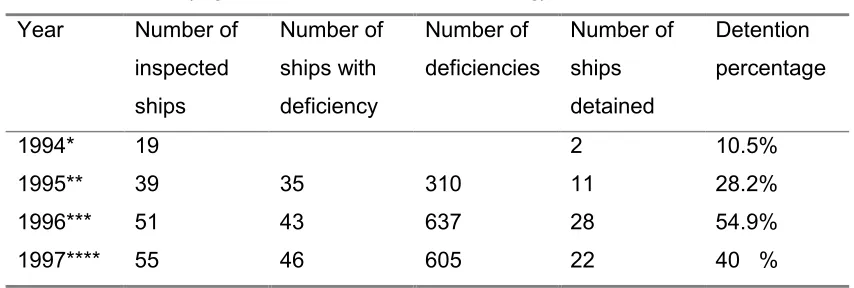
Table 1.1: Statistics of PSC Inspections within Tokyo MOU 2 Table 2.1: Comparison of Agreements of Port State Control 22
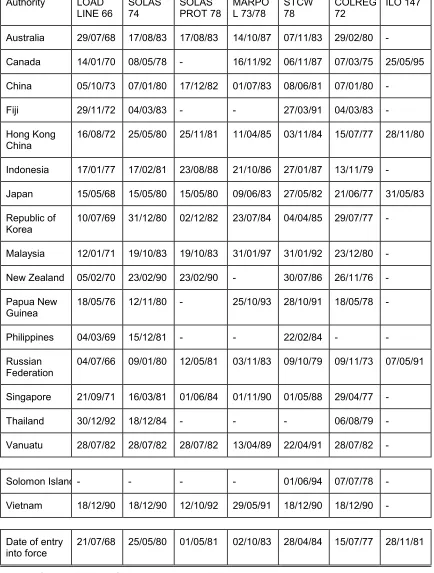
Table 2.2: Status of Relevant Instruments 23
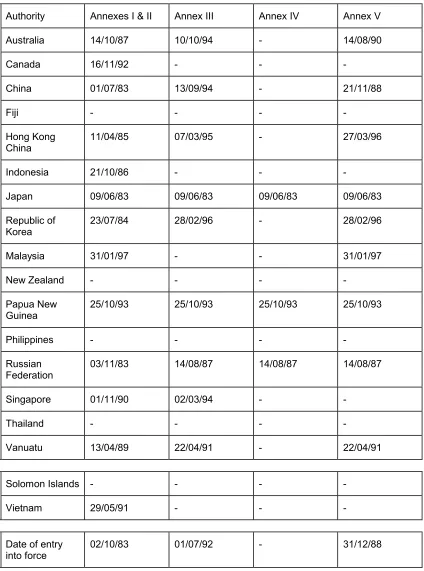
Table 2.3: Status of MARPOL 73/78 24
Table 3.1: Number of Ships Registered under VR 41
Table 3.2: Vietnamese Fleet Size Distribution by Types of Ships 42
LIST OF FIGURES
Figure 3.1: Organisation Chart of Ministry of Transport 27
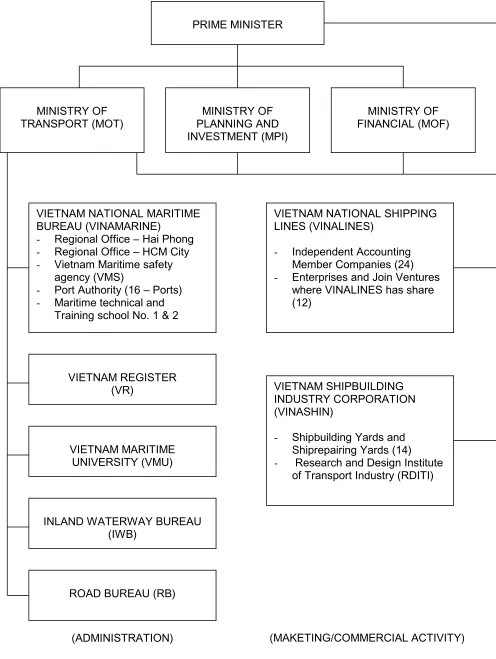
Figure 3.2: Maritime Administration Framework 28
Figure 3.3: Organisation Chart of VINAMARINE 30
Figure 3.4: Organisation Chart of Inland Waterway Bureau 33 Figure 3.5: Organisation Chart of Vietnam Register (VR) 35
Figure 4.1 Proposed Structure of VMSI 50
Figure 4.2: Flow Chart of Port State Control 54
GLOSSARY OF TERMS
ADB Asian Development Bank
ATN Aid to Navigation
COLREG Convention on the International Regulations for Preventing Collisions at Sea
EEZ Exclusive Economic Zone
ESCAP Economic and Social Commission for Asia and the Pacific
EU European Union
FOB Flag of Convenient
GFRS Global Foundation for Research and Scholarship
GT Gross Tonnage
GMDSS Global Maritime Distress and Safety system IMO International Maritime Organisation
ILO International Labour Organisation
ILO No. 174 Merchant Shipping (Minimum Standards) Convention, 1976 ISM Code International Safety Management
IWB Vietnam Inland Waterway Bureau
LOADLINES International Convention for the Safety of Life at Sea MAPETRANSCO Maritime Petroleum Transport and Supply Company
MARPOL International Convention for the Prevention of Pollution from Ships
MOT Ministry of Transport
MOU Memorandum of Understanding
MOP Ministry of Finance
MPI Ministry of Planning and Investment
PMU Project Management Unit
PSC Port State Control
PSCC Port State Control Committee PSCO Port State Control Officer
ROCRAM Operative net of Regional collaboration among Maritime Authorities of South America, Mexico and Panama SMA Swedish Maritime administration
SOLAS International Convention for the Safety of Life at Sea
STCW International Convention on Standards for Training, Certification and Watchkeeping for Seafarers
TEDI Transport Engineering Design Institute TESI Transport Economic Science Institute
TONNAGE International Convention on Tonnage Measurement
TS Territorial Sea
UNCLOS United Nations convention on the Law of the Sea VINALINES Vietnam National Shipping Lines
VINAMARINE Vietnam National Maritime Bureau
VINASHIN Vietnam Shipbuilding Industry Corporation VMS Vietnam Maritime Safety Agency
VMSI Vietnam Maritime Safety Inspectorate VMU Vietnam Maritime University
VNR Vietnam National Railways
VR Vietnam Register
VRA Vietnam Road Administration Bureau
WATCO Waterways Transport Company
Chapter 1
INTRODUCTION
1.1 Necessity of Dissertation
Vietnam is a country which traditionally has a very closed relationship with maritime transport due to the fact that it has a long coastline--3620 km--embracing the eastern part of the Indochina peninsula. The maritime industry was appeared very early in its history and has experienced many up and down periods. In modern times the maritime industry always is an important sector in Vietnam. However there are still a great number of things which must be done to improve the maritime industry in Vietnam.
control properly to really maintain standards of shipping and unification of sanction to violations to conventions. This dissertation will partially propose the approach to solve this matter in Vietnam.
Table 1.1: Port State Control Inspections within Tokyo MOU (Figures relevant to Vietnamese flag)
Year Number of
inspected ships
Number of ships with deficiency
Number of deficiencies
Number of ships detained
Detention percentage
1994* 19 2 10.5%
1995** 39 35 310 11 28.2%
1996*** 51 43 637 28 54.9%
1997**** 55 46 605 22 40 %
Source: (*) Cong Duc, 1998.
(**) Tokyo MOU, Annual Report 1995 (***) Tokyo MOU, Annual Report 1996 (****) Tokyo MOU, Annual Report 1997
is a need to clearly define the responsibilities of each organisation to deal with port State control implementation. This is what this dissertation is written for.
In addition, fifteen previous dissertations of Vietnamese graduates from WMU have not dealt with port State control matters. Therefore, the author feels there is a need to help his colleagues and people who work in the maritime sector in his country to be aware of the importance of port State control procedures and understand the port State control mechanism, or at least draw more attention to matters of port State control implementation, which is more and more crucial to eliminating substandard ships, improving the effectiveness of the Vietnamese maritime industry.
1.2 Objectives
It is important to make clear to readers that this dissertation does not intend to build up a comprehensive plan to set up port State control systems in Vietnam. The dissertation focuses on three main objectives:
(1) To provide basic knowledge and principles of the port State control mechanism in a transparent way;
(2) To identify difficulties in the process of setting up port State control in Vietnam, and to propose a Vietnamese approach to implement the PSC procedure; (3) To draw some recommendations for improving the efficiency and effectiveness
of the Vietnamese maritime administration and improving the port State control procedure implementation in Vietnam.
1.3 Scope
This Dissertation consists of five chapters that can be summarised as follows:
Chapter 2 gives background knowledge on port State control in principle and explains how the port State control mechanism works and what the responsibilities of each party involved are. The chapter also gives some information about Tokyo MOU in comparison with Paris MOU.
Chapter 3 presents the current situation of the Vietnamese maritime industry. Furthermore, it analyses some weaknesses in the maritime administration, legislation, and operation.
Chapter 4 presents an approach for Vietnam to implement port State control procedures, taking into account the facts and analysis in Chapter 3. The chapter suggests a practical procedure for port State control and gives an administrative structure of Vietnam Maritime Safety Inspectorate (VMSI) to conduct port State control inspections.
Chapter 5 gives some conclusions and recommendations to improve the effectiveness of the maritime administration and port State control procedure implementation.
1.4 Methodology
This study is entirely based on the following:
• reference materials available at the World Maritime University library;
• studies on the profiles of other countries’ port State control procedures undertaken and delivered by various resourceful persons;
• reference materials collected from the MOT, VINAMARINE, VR;
• field studies to a number of maritime administrations, including field studies to Japan, Germany and the Nordic countries;
• describing the existing situation of the Vietnamese maritime administration;
• analysing problems and causes;
• discussing with and interviewing experts on port State control and persons in charge from the Vietnamese maritime administration;
• generating personal arguments.
1.5 Difficulties
The dissertation has been prepared during the two years studies at WMU. It, therefore, has been a great difficulty to access updated information in Vietnam. In addition, the author himself is not an administrator or a civil servant. Hence, his opinion is the view of a customer of the Administration and he has difficulty to interview people at high rank of organisations, such as Chairman of the VINAMARINE, or Director General of the VR. Furthermore, this dissertation is written in English, which is not the mother language or working language of the author. Therefore, there are possibly some points that are not properly expressed or may be misleading.
Chapter 2
BACKGROUND TO PORT STATE CONTROL
2.1 General
2.1.1 What is Port State Control?
There are numbers of definitions of port State control in many maritime books, theses, and periodical issues. Among them, the definition given by Mr John Hare in his article, which first appeared in Volume 26, Issue 3 of the Geogia Journal of International and Comparative Law--Special Admiralty Issue, 1997, is one that best describes the Port State Control concept:
"Port State Control" as a concept, involves the powers and concomitant obligations vested in, exercised by, and imposed upon a national maritime by international convention or domestic statute or both, to board, inspect and where appropriate detain, a merchant ship flying a flag foreign to that state in order to ensure compliance by that ship with all applicable international safety at sea and environmental protection instruments and with relevant domestic legislative maritime safety requirements.
(John Hare, 1997)
Before going to further discussion, it is also important to know what ‘port State’ means. Like ‘flag State’ and ‘coastal State’, ‘port State’ is contextual definition vis à
− ‘coastal State’ is the state within whose maritime zone a foreign ship is for the time being.
− ‘port State’ is the state in whose port or off-shore terminal a foreign ship is for the time being.
2.1.2 Why Port State Control needs to be Introduced and Expanded?
Primarily, only the flag State has exclusive jurisdiction over ships holding its nationality. However, shipping is a very international industry. A ship flying the flag of one country trades in many other countries’ waters. This characteristic makes it very difficult for flag State to exercise its control fully and effectively over its ships. In addition, the introduction of “Flag of Convenience” (FOC) leads many states to turn a blind eye to the condition of the vessels. In practise, no maritime administration has sufficient resources to maintain control over its ships, especially ships engaged in international voyages. Consequently, the technical condition of ships may go out of the hand of flag States. This ultimately endangers the safety of the ships themselves and the environment of the waters and the ports or the off-shore terminals they call at. To compensate, many flag States use the international network of qualified surveyors maintained by classification societies. With the assistance of classification societies, flag States are more confident, but again, many casualty reports show the causes of these casualties are deficiencies in technical condition of the ships or the lacks of skills or qualifications of the masters or crew.
The IMO Resolution A.466 (XII)--Procedure for the Control of Ships--and resolution A.787 (19)--Procedure of Port State Control--formed the basis of port State control. The idea of port State control is to maintain ship control in respect of ship safety and environmental protection and to unify sanctions against violations of international conventions. At the same time, port State control is a follow-up activity of flag State control. Furthermore, the memoranda of understanding (MOUs) provide guidelines for harmonisation of port State control inspections, promotion of surveyor training exchange and strengthening of communication between maritime authorities within regions and world-wide.
Mr William O' Neil the current Secretary General of IMO, who deeply understood the need of introduction and expansion of PSC implementation, had emphasised in the World Maritime day 1996
Shipping is an international industry which is proud of its tradition of freedom of the seas, but that does not mean that ships can sail wherever they like regardless of their condition. The maritime world has the right to expect that ships of all nations meet the levels of safety and environmental protection which have been internationally agreed upon. It is up to shipowners to make sure that their ships are safe, properly manned and do not pollute the seas. And it is the duty of governments to make sure that ships which fly their flag comply with the standards laid down in the IMO treaties which they have ratified. If they fail to do so, then IMO -- which has the stewardship of these standards -- has not only the right but also the obligation to take further action.
(William O' Neil, 1996)
2.1.3 Port State Enforcement Regime
was laid down in the United Nations Convention on the Law of the Sea (UNCLOS), is now included in a number of maritime conventions, such as the 1966 Load Lines Convention (LL 66), the MARPOL 73/78, the SOLAS 74/78, the ILO Convention No. 147, the STCW 95, the Dumping Conventions, the 1969 Convention on Civil Liability and the 1986 United Nations Convention on Condition for Registration of Ships.
In those conventions, the port State has enforcement authority over the ship as it enters the port in question, regardless whose flag it is flying, in respect of control of ships and their equipment (SOLAS 74/78, Load Lines, MARPOL 73/78), control of discharges at sea (OILPOL, MARPOL, Dumping Conventions), control of crew competence and working conditions (ILO No. 147, STCW) and other requirements. On the other hand, port State jurisdiction meant that:
a state may exercise enforcement jurisdiction over foreign ships in its ports in respect of offences against international rules and standards even if committed in sea areas beyond its coastal jurisdiction . . . even if the violations were committed on the high seas (or foreign waters) and they did not in any way affect the port State the latter would be entitled to take enforcement action against the vessel concerned
(Kasoulides, 1993,111).
The main characteristics of the port State enforcement regime can be summarised as follows:
(1) Voluntaryness: This is an essential element of the new regime. A port State can not compel a vessel on the high seas, or even in its own territorial waters or EEZ, to proceed to one of its ports and face proceeding.
(2) Port and offshore terminals: The exercise of this power is restricted to these areas and does not include the functional internal waters area.
the enforcement prerogative, therefore, is primarily investigative and only secondarily adjudicative.
(4) Discharge and pollution: The enforcement power is restricted to discharges from ships. These include accidental and intentional discharges of oil, noxious and hazardous substances in bulk or packaged form, sewage and garbage, i.e. discharges such as re-ballasting, tank cleaning activities and leaking from engines.
(5) International waters: This procedure is to be followed only in the case of an incident with no “territorial link” to the port state.
(6) Applicable international standards: The port State may only enforce standards that are either part of customary international law or laid down in maritime conventions on the related issue, e.g. MARPOL 73/78 discharge standards. This provision excludes resolutions, guidelines and codes that are not already incorporated in customary international law.
(7) Competent international organisations: This is generally accepted to be the IMO;
(8) A right to enforce: The port State has only a discretionary power to enforce and may decline to do so.
(9) Discharge in foreign waters: No investigation may be undertaken except if the port State is so requested by another interested UNCLOS party. Even then, the port State must comply as far as practicable with a request. The coastal State could also ask for the suspension of such proceedings.
(10) The role of the flag State: It may request the investigation of discharge violations by its vessels on the high seas or foreign waters. It may also decide to pursue legal proceedings in its national courts. The port State must interrupt its own proceedings if a flag State decides to do so (Art. 228 UNCLOS).
2.1.4 Port State Control Framework
Ensuring and improving safety on board ships and environmental protection require a comprehensive framework. Several parties are involved in these matters, namely national administrations, classification societies, owners and crew. Each party has different kinds of responsibility.
(1) National administrations are responsible for taking the necessary measures to ensure ships flying their states' flag comply with provisions of the relevant conventions and to ensure the availability of reception and treatment facilities. Surveying and issuing certificates under international conventions are also responsibilities of national administrations. The national administrations also have to control foreign ships entering its port in respect of safety and environmental protection. In other words, national administrations must fulfil the obligations and responsibilities of flag states over ships flying their flags, and the obligations and responsibilities of port states over ships calling at their ports (to be further discussed in 2.1.4.1 and 2.1.4.2)
(2) Classification societies are the recognised organisations, which are authorised by most of the national administrations to inspect ship designs, to carry out class surveys during and after construction of ships and to issue certificates under the international conventions. Classification societies act on behalf of national administrations.
(3) The owners are responsible for
a) ensuring their ships and crew comply with requirements of international conventions,
b) providing sufficient financial support for the activities aiming at improving safety on board their ships,
e) operating proper safety management systems as required in the ISM Code within their organisation, and
f) collecting and presenting proofs and evidences in the case of an unduly detained ship.
(4) The crew on board ships must be qualified, hold certificates of competence required under international conventions and by national administration (if any), and have enough skills and knowledge to fulfil the tasks that they have been assigned. They should always be looking for improvement of their skills through training and drilling.
2.1.4.1 Responsibilities and Obligations of Flag State
Regarding flag State matters, the national administration is obliged and responsible
(1) to enforce the international maritime standards which have been set in international conventions over all ships flying its flag;
(2) to communicate with IMO about the list of non-governmental agencies which are authorised to act on its behalf, the text of law and regulations within the scope of conventions, and sufficient number of specimens of its certificates issued under international conventions;
(3) to carry out ship surveys including initial, annual, intermediate and renewal surveys, and to issue certificates under international conventions;
(4) to provide proper training for seafarers and issue certificates of competence; (5) to undertake the necessary arrangements for receiving reports from port states
relating to ships flying its flag, and immediately replying to port states and to states whose interests are affected;
(6) to instruct ships flying its flag to report incidents to its own national administration and to other state(s) concerned;
2.1.4.2 Responsibilities and Obligations of Port State
The responsibilities and obligations of the national administration when acting as a port state are
(1) to verify the certificates on board ships are valid and sufficient to the provisions of the international conventions, which are currently in force in the port State; (2) to accept all the valid certificates issued by flag State unless there are clear
grounds to identify that the ship is a substandard ship (to be discussed in 2.1.4.3);
(3) to take a further step to ensure the ship does not sail until it can proceed to sea without presenting a danger to the ship or persons on board, or without presenting an unreasonable threat of harm to the marine environment;
(4) to report without delay to flag State about any action that has been taken related to ships flying its flag, and notice to IMO, to states whose interests are affected, and also to ILO in case of violation to ILO 147;
(5) to ensure that no more favourable treatment is given to ships flying the flag of a non-party to an international convention;
(6) to provide experienced and qualified port State control officers (PSCO) and all necessary arrangements to carry out port State control inspections; and
(7) not to unduly detain or delay ships in its port otherwise port State will be liable for this.
2.1.4.3 Identification of Substandard Ships
According to Resolution A.787(19) the basis for detaining a ship is that the ship is a substandard ship. A port state control officer can judge a ship as a substandard ship when he goes on board the ship and finds one or more of the items listed below:
(2) non-compliance of equipment or arrangements with relevant specifications of the convention
(3) substantial deterioration of the ship or its equipment because of, for example, poor maintenance
(4) insufficiency of operational proficiency, or unfamiliarity of essential operational procedures by the crew
(5) insufficiency of manning or insufficiency of certification of seafarers
(6) any evident factor making the ship unseaworthy, or putting risk to the safety of the ship or lives of persons on board, or presenting a threat to the marine environment
(7) the lack of valid certificates required by international conventions
2.1.4.4 No More Favourable Treatment
The “No More Favourable Treatment” clause affects ships flying flags of non-parties and ships that are below convention size. The “No More Favourable Treatment” clause requires that
(1) the flag State administration of a non-party must carry out surveys on and issue certificates to ships flying its flag at the equivalent level as ship surveys and certificates under international conventions;
(2) all States must carry out measures to ensure ship safety and environmental protection over their ships below convention size;
(3) a port State, when carrying out port State control inspections on ships calling at its ports or offshore terminals, must apply the port State control procedures set in the IMO resolution A.787(19), regardless of whether ships are entitled to flying the flag of a non-party or a party to international conventions. Furthermore, a port State must carry out equivalent inspections onboard ships below convention size.
A Memorandum of Understanding (MOU) is an instrument of a less formal kind than a treaty and in the maritime context usually details operational arrangements or requirements dealing with technical matters. It relates to conduct or intention and is not legally binding, but it has a political and/or a moral force (Kasoulides, 1993). Practical experience shows that implementation of the PSC procedure is best done on a regional basis. There are some advantages to the concept of regional co-operation on PSC. These can be summarised as follows:
(1) Maximum commitment is obtained from participating countries that share common safety and environmental interests.
(2) The use of information available regionally is done more effectively.
(3) Ships remain under surveillance as long as they operate in the region, thereby reducing the possibilities for sub-standard operations.
(4) Operational costs are shared by all participating port States.
(5) A harmonised approach to procedures lowers the burden on ship’s staff and permits effective deployment of available resources of participating States. (6) Harmonised procedures prevent distortion of competition between regional
ports.
The first regional PSC agreement, covering Europe and the North Atlantic, was signed in 1982 and is known as the Paris Memorandum of Understanding (Paris MOU). The Latin American Agreement (Acuerdo de Viña del Mar) was signed in 1992; the Tokyo Memorandum of Understanding (Tokyo MOU), covering Asia and the Pacific, in 1993; the Caribbean Memorandum of Understanding (Caribbean MOU) in 1996; the Mediterranean Memorandum of Understanding (Mediterranean MO) in 1997; and the Indian Ocean Memorandum of Understanding (Indian Ocean MOU) in 1998.
Sooner or later, it is expected that the world will be covered by regional agreements, perhaps leading to the creation of a global system which will make it virtually impossible for sub-standard ships to escape detection.
2.2 Tokyo MOU
The Memorandum was adopted in Tokyo on 1 December 1993 by the following maritime Authorities in the Asia-Pacific region: Australia, Canada, China, Fiji, Hong Kong, Indonesia, Japan, Republic of Korea, Malaysia, New Zealand, Papua New Guinea, the Philippines, the Russian Federation, Singapore, Solomon, Thailand, Vanuatu and Vietnam. The Memorandum came into effect on 1 April 1994.
The main objective of the Memorandum is to establish an effective port State control regime in the Asia-Pacific region, through co-operation and harmonisation, to eliminate substandard ships so as to promote maritime safety, to protect the marine environment and to safeguard working and living conditions on board.
A Port State Control Committee was established to monitor and control the implementation and on-going operation of the Memorandum. The Committee consists of representatives of the maritime Authorities, representatives from the International Maritime Organisation (IMO), the International Labour Organisation (ILO), the Economic and Social Commission for Asia and the Pacific (ESCAP), the Paris MOU and the United States. A permanent secretariat of the Memorandum was formed in Tokyo, Japan.
For the purpose of the Memorandum, the following are provided as relevant instruments:
(1) the International Convention on Load Lines 1966
(2) the International Convention for the Safety of Life at Sea, 1974 as amended (3) the Protocol of 1978 relating to the International Convention for the Safety of
(4) the International Convention for the Prevention of Pollution from Ships 1973, as modified by the Protocol of 1978 relating thereto
(5) the International Convention on Standards for Training, Certification and Watchkeeping for Seafarers, 1978, as amended
(6) the Convention on the International Regulations for Preventing Collisions at Sea, 1972
(7) the International Convention on Tonnage Measurement of Ships, 1969
(8) the Merchant Shipping (Minimum Standards) Convention, 1976 (ILO Convention No. 147)
2.2.1 Development of the Tokyo MOU
In the 80s and beginning of the 90s, in the Asia Pacific regions, port State control was conducted in several countries and territory like the Philippines, Japan, Australia, Canada, China and Hong Kong, but there was no regional co-operation between the maritime administrations of these countries. In 1982, the Paris Memorandum of Understanding on port State control was signed and implemented, attempting to reduce and eliminate operation of substandard ships in European waters and to ensure the safety of life at sea and the prevention of pollution. In 1991, the 17th Assembly of the International Maritime Organisation adopted resolution A.682, which, among other things,
(1) recognised the contribution by port State control to maritime safety and pollution prevention made through regional co-operation under the European MOU, (2) urged members to form regional co-operation on port State control in other
regions to contribute to the elimination of substandard ships and
(3) invited governments to consider regional arrangements on port State control.
As a result, in December 1993, the Asia Pacific Memorandum of Understanding on port State control, also called the Tokyo MOU, was signed by eighteen participating maritime authorities in the region. It is agreed to establish the Secretariat of the Tokyo MOU which will locate in Tokyo. The Memorandum came into effect on 1 April 1994.
2.2.1.1 Why Vietnam not a Member of Tokyo MOU PSCC from Beginning?
In 1993 the Vietnamese Government representatives signed the Tokyo MOU, but Vietnam still had an observer status to the Tokyo MOU until 1999. The reasons for this may rest on the lack of attention of the Vietnamese government to the maritime sector, the lack of consciousness of the impact of the MOU and the inefficient bureaucratic administration with the heavy burden of documentation work. One of the most active people who is anxious to convince the Vietnamese government to join the Tokyo MOU is Mr Nguyen Cong Duc – the current Director of the Hai Phong Port Authority. He has made the proposal to VINAMARINE and has also been giving a number of speeches about this matter.
In Chapters 3, shortcomings in the organisation and framework of the Vietnamese maritime administration will be further discussed.
2.2.2 Tokyo MOU in Comparison with Paris MOU
The Paris MOU members comprise European countries whose inspection capabilities and infrastructures are already in place for carrying out effective port State control. In addition, most of the European countries, particularly those participating in Paris MOU, are in the same level of economic development, which is categorised as industrialised. The maritime administrations of these countries also have high efficiency and effectiveness. Besides that, they possess large fleets of merchant ships with well-trained personnel. Finally, for countries who are members of the EU, the Paris MOU is made mandatory under a European Commission Directive (Ulstrup, 1999).
In contrast, the Tokyo MOU participants are in very different levels of economic development and include developed countries (Japan, Canada), developing countries (Vietnam, China) and low level of development countries (Fiji, Solomon Islands). Therefore, the level of resources availability is not equal for all these countries. The highly developed countries own the very modern fleets, which can meet all the requirements of international conventions, while the fleets of the other countries have rather high average ages. This is almost impossible for those fleets, or they have to try very hard, to reach the technical standards stipulated by international conventions.
Another feature comes from maritime administration. The capabilities of maritime administrations vary from country to country. Some of them have very good inspection systems and have already port State control in place, while many other do not. For instance, at the time of Tokyo MOU signature in 1993, in some of these countries, port State control had not been set up, even in the preparatory stages like Vietnam and Solomon Islands.
This situation, obviously, leads the disunification of implementation of international conventions.
The variation in stages of development, capabilities of the maritime administration and status of ratification put more difficulties toward the introduction of the Tokyo MOU in the region. On the other hand, it also gives more pressure to the harmonisation of implementing port State control procedures through unification of education and training for surveyors and the development of the regional manual for inspectors.
2.3 Conclusion
It is universally acknowledged that once a ship voluntarily enters a port it becomes fully subject to the laws and regulations prescribed by the officials of that and that all types of vessels are obliged to comply with the coastal regulations about proper procedures to be employed and permissible activities within internal waters.
Six memoranda of understanding on port State control have been signed in the world, aiming to help the flag State continuously control ships flying its flag by harmonising inspection procedures and unifying sanction against violations to the international conventions. Furthermore, they encourage states to ratify and implement international conventions. The memoranda also promote regional co-operation and training exchanges.
Paris MOU Latin America
agreement Asia Pacific MOU
Participating countries and associate members Belgium, Denmark, Finland, France, Germany, Greece, Iceland, Italy, Netherlands, Spain, Norway, Poland, Portugal, Sweden, UK
Argentina, Brazil, Chilli, Colombia, Ecuador, Mexico, Peru, Venezuela, Panama, Uruguay
Australia, Canada, China Indonesia, Japan, Malaysia New Zealand, Fiji, Papua new Guinea, Philippine Russia, Vanuatu, Hong Kong, Thailand, Vietnam Solomon Island
Co-operation
country Canada, Croatia,Japan, Russia, USA None None
Target inspection
rate 25% annual inspectionrate per country within 3 year from entry into force
15% annual inspection rate per country within 3 year from entry into force
25% annual inspection rate per country by the year 2000
Relevant
instrument LL 1966LL Prot 1988
SOLAS 1974 SOLAS Prot 78, 88 MARPOL 73/78 STCW 78 COLREG 72 TONNAGE 69 ILO No. 147
LL 1966 SOLAS 1974 SOLAS Prot 78 MARPOL 73/78 STCW 78 COLREG 72
LL 1966 SOLAS 1974 SOLAS Prot 78 MARPOL 73/78 STCW 78 COLREG 72 TONNAGE 69* ILO No. 147
Special attention Passenger ships, Ro-ro ships, Bulk carriers, Ships may present a special hazard, Ships which have had several recent deficiencies, Ships flying the flag of a state appearing in 3 years rolling average table of delays and detention
Passenger ships, Ro-ro ships, Bulk carriers, Ships may present a special hazard, Ships which have had several recent deficiencies
Passenger ships, Ro-ro ships, Bulk carriers, Ships may present a special hazard, Ships which have had several recent deficiencies, Ships flying the flag of a state appearing in 3 years rolling average table of delays and detention, Ships which haven’t been inspected by an Authority within 6 months
Amendments Will take effect 60 days
after acceptance Will take effect 60 daysafter acceptance Will take effect 60 daysafter acceptance Information
Centre Saint Mallow, France Buenos Aires, Argentina Canada
Committee a representative of each
of the authorities and of the commission of the EU
a representative of each of the authorities
a representative of each of the authorities
Observers
secretariat IMO, ILO IMO, ROCRAM IMO, ILO, ESCAP
signed 2 March 1978 5 November 1992 2 December 1993
Official language English, French Spanish, Portuguese English
Table 2.1: Comparison of Agreements of Port State Control
Source: IMO news February 1994
Authority LOAD
LINE 66 SOLAS74 SOLASPROT 78 MARPOL 73/78 STCW78 COLREG72 ILO 147
Australia 29/07/68 17/08/83 17/08/83 14/10/87 07/11/83 29/02/80
-Canada 14/01/70 08/05/78 - 16/11/92 06/11/87 07/03/75 25/05/95
China 05/10/73 07/01/80 17/12/82 01/07/83 08/06/81 07/01/80
-Fiji 29/11/72 04/03/83 - - 27/03/91 04/03/83
-Hong Kong
China 16/08/72 25/05/80 25/11/81 11/04/85 03/11/84 15/07/77 28/11/80
Indonesia 17/01/77 17/02/81 23/08/88 21/10/86 27/01/87 13/11/79
-Japan 15/05/68 15/05/80 15/05/80 09/06/83 27/05/82 21/06/77 31/05/83
Republic of
Korea 10/07/69 31/12/80 02/12/82 23/07/84 04/04/85 29/07/77
-Malaysia 12/01/71 19/10/83 19/10/83 31/01/97 31/01/92 23/12/80
-New Zealand 05/02/70 23/02/90 23/02/90 - 30/07/86 26/11/76
-Papua New
Guinea 18/05/76 12/11/80 - 25/10/93 28/10/91 18/05/78
-Philippines 04/03/69 15/12/81 - - 22/02/84 -
-Russian
Federation 04/07/66 09/01/80 12/05/81 03/11/83 09/10/79 09/11/73 07/05/91
Singapore 21/09/71 16/03/81 01/06/84 01/11/90 01/05/88 29/04/77
-Thailand 30/12/92 18/12/84 - - - 06/08/79
-Vanuatu 28/07/82 28/07/82 28/07/82 13/04/89 22/04/91 28/07/82
-Solomon Island - - - - 01/06/94 07/07/78
-Vietnam 18/12/90 18/12/90 12/10/92 29/05/91 18/12/90 18/12/90
-Date of entry
into force 21/07/68 25/05/80 01/05/81 02/10/83 28/04/84 15/07/77 28/11/81
Table 2.2: Status of Relevant Instruments
Authority Annexes I & II Annex III Annex IV Annex V
Australia 14/10/87 10/10/94 - 14/08/90
Canada 16/11/92 - -
-China 01/07/83 13/09/94 - 21/11/88
Fiji - - -
-Hong Kong
China 11/04/85 07/03/95 - 27/03/96
Indonesia 21/10/86 - -
-Japan 09/06/83 09/06/83 09/06/83 09/06/83
Republic of
Korea 23/07/84 28/02/96 - 28/02/96
Malaysia 31/01/97 - - 31/01/97
New Zealand - - -
-Papua New
Guinea 25/10/93 25/10/93 25/10/93 25/10/93
Philippines - - -
-Russian
Federation 03/11/83 14/08/87 14/08/87 14/08/87
Singapore 01/11/90 02/03/94 -
-Thailand - - -
-Vanuatu 13/04/89 22/04/91 - 22/04/91
Solomon Islands - - -
-Vietnam 29/05/91 - -
-Date of entry
into force 02/10/83 01/07/92 - 31/12/88
Table 2.3: Status of MARPOL 73/78
(As at December 31 1997)
Chapter 3
VIETNAM MARITIME INDUSTRY
This chapter attempts to present the current situation incorporate with some analyses of the Vietnamese maritime industry, which includes two main parts--the maritime administration and Vietnamese fleet. For the purpose of the dissertation, the chapter more concentrates to describe and analyse the maritime administration from the maritime administration framework, to main organisations like VINAMARINE and VR. A brief introduction of maritime rules and regulations applicable in Vietnam are also included in this chapter
3.1 Maritime Administration
3.1.1 Government Organisation
3.1.1.1 Overall Responsibility for Transport
technical standards. In addition, it has specialist support units responsible for particular functions such as Vietnam Register (VR) which classifies and issues technical certificates of sea-going vessels.
Some transport construction organisations report to the MOT. In addition, several project implementation units (PMUs) have been established in recent years to handle the administration of major World Bank and ADB funded highway projects.
A number of institutes are responsible to the MOT. For example, the Transport Economic Science Institute (TESI) conducts traffic forecasts and other studies, the Transport Engineering Design Institute (TEDI) and the Research Institute of Transport Science and Technology (RITST) both have expertise in many technical aspects of maritime transport, and Vietnam Maritime University (VMU) conducts training of seafarers.
MINISTRY OF TRANSPORT OF VIETNAM Vietnam Road Administration Bureau (VRA) Vietnam National Maritime Bureau (VINAMARINE)
Vietnam Inland Waterway
Bureau (IWB) Vietnam National Railway(VNR)
Ministry’s
Office Planning &Investment Dept. International Relation Dept. Personnel & Labour Dept. Financing Accounting Dept. Legal & Transport Dept. Science & Technology Dept. Planning & Investment Dept.
Transport Construction Quality
Control & Maritime Bureau Vietnam Register (VR)
PMU 1 PMU 5 PMU 18 PMU Mythuan PMU 85 PMU Thanglong
PRIME MINISTER
MINISTRY OF TRANSPORT (MOT)
MINISTRY OF PLANNING AND INVESTMENT (MPI)
MINISTRY OF FINANCIAL (MOF)
VIETNAM NATIONAL MARITIME BUREAU (VINAMARINE)
- Regional Office – Hai Phong - Regional Office – HCM City - Vietnam Maritime safety
agency (VMS)
- Port Authority (16 – Ports) - Maritime technical and
Training school No. 1 & 2
VIETNAM REGISTER (VR)
VIETNAM MARITIME UNIVERSITY (VMU)
INLAND WATERWAY BUREAU (IWB)
ROAD BUREAU (RB)
VIETNAM NATIONAL SHIPPING LINES (VINALINES)
- Independent Accounting Member Companies (24) - Enterprises and Join Ventures
where VINALINES has share (12)
VIETNAM SHIPBUILDING INDUSTRY CORPORATION (VINASHIN)
- Shipbuilding Yards and Shiprepairing Yards (14) - Research and Design Institute
of Transport Industry (RDITI)
(ADMINISTRATION) (MAKETING/COMMERCIAL ACTIVITY)
Other ministries have responsibilities in transport, especially the Ministry of Planning and Investment (MPI) and the Ministry of Finance (MOF). The former has responsibility for most major capital investments by government in transport (including infrastructure such as ports and waterways) whereas the latter controls other aspects of expenditure. The Prime Minister’s Office itself administers certain transport operational units such as the Vietnam National Shipping Lines (VINALINES) which is the general corporation administering state operators in the maritime sector, and the Vietnam Shipbuilding Industry Corporation (VINASHIN), see Figure 3.2. Other operational units in shipping are administered by VINAMARINE, by the Ministry of Industry (dedicated sea and river coal ports), by the Ministry of construction (river ports for cement factories), by the ministry of Trade (all oil berths and most oil tanker operations), by the Ministry of Agriculture and Rural Development (river ports) and by the Ministry of Defence (military ports and shipping).
3.1.1.2 Role of Vietnam National Maritime Bureau (VINAMARINE)
Chairman
Vice Chairman
Headquarter Representative Offices Organisation under Direct Control
Port Authorities
Administration Hai Phong Vietnam Search and Rescue Centre
Quang Ning
Investment Planning
Dept. HCM City Hai Phong
Construction Dept. Danang
Vietnam Maritime Safety (VMS)
Le Mo – Thanh Hoa
Finance and Accounts Dept. Liaison Office to IMO Vietnam salvage Corporation Nghe Tinh Maritime Technical and
Training School I
Maritime Technical and Training School II
Maritime Project Management Unit I
Maritime Project Management Unit II
Vietnam Electronic Communications Co.
Maritime Construction Advisory Co.
Pilot Company I
Pilot Company II
Pilot Company III
Cai Lan Port
Nghe Tinh Port Song Hau Pilot Company
Qui Nhon Port
Nha Trang Port
Other Business Units Legal Dept. Maritime Safety Inspectorate (VMSI) Personnel Dept. International Co-operation Dept. Thuan An Da Nang Qui Nhon Nha Trang Vung Tau Sai Gon Dong Thap My Tho
My Thoi – An Giang
Can Tho
Kien Giang
Nam Can – Minh Hai
Dong Nai Science and
Technology Dept.
Figure 3.3: Organisation Chart of VINAMARINE (Source: VINAMARINE, 1998)
Maritime Project Assessment Dept.
STCW Standing Office
The port authorities are delegated to monitor enforcement of maritime rules and regulations, including those covering maritime safety, environmental protection and maritime sanitation in all Vietnamese seaways and seaports. The VMS is an implementation agency responsible for providing Aids to Navigation (ATN) services along the coast and along rivers connecting inland ports designated by the MOT as seaports. The remaining non-regulatory functions of the VINAMARINE include operational management of
• the ports of Cai Lan, Nghe Tinh, Qui Nhon and Nha trang,
• the Pilot Companies I, II, III and Song Hau Pilot company, and
• the Vietnam Maritime Commercial Stock Bank (Maritime Bank).
It is understood that it is the government’s intention, eventually, to divest these operational functions. The Prime Minister Decision No. 31/TTg dated 2 February 1993 defines VINAMARINE’s responsibilities as
(1) to develop plans for the marine industry and acting as owner of state maritime infrastructure
(2) to develop maritime law
(3) to propose policy on international maritime relations and manage international maritime projects and control operation of foreign maritime organisations
(4) to undertake activities to ensure maritime safety
(5) to undertake administration of sea-going vessels and operations, seaport and navigational aids through developing plans, issuing licences, managing infrastructure in accordance with government instruction, and providing search and rescue services
VINALINES there are particular weaknesses in the Investment Planning, Legal and Safety Inspection Departments. The following two examples indicate this problem.
(1) The Maritime Safety Inspectorate (VMSI) in the Maritime Safety Inspection Department is responsible for safety inspections of all sea-going ships in Vietnamese water and is supposed to have inspectors in the head office and the three regional offices. Although it has three staff members in the Hanoi head office and has assigned a Central Marine Safety chief Officer to the Hai Phong regional office, no one is currently assigned to Ho Chi Minh and Da Nang. Administration procedures for VMSI have still to be set up.
(2) Vietnam has agreed in the Memorandum of Understanding on Port State Control in the Asia-Pacific Region, signed on 1 December 1993, to increase inspection activities in its territory, so that sub-standard ships can be prevented from operating in the region. However, the inspectors who are to enforce this undertaking in Vietnam have not been properly prepared to carry out this task.
3.1.1.3 Co-operation between Coastal Shipping and Inland Waterways
Board of Directors Investment Planning Division Transport Legislature Division Science & Technology Division Finance & Accounting Division Inspection Division Administration Navigation Management Division Basic Construction Division Technical Equipment Division Personnel Division Sub-office in Ho Chi Minh
Waterways Management Section (no.1 - No. 14)
State Business Block
Stations
State Management Block
Project Management board
Technical & Professional Navigation Centre No. 1
Technical & Professional Navigation Centre No. 2
WT Technical Vocational School (North) 1) Sub-office in South 2) MR TU PMU-SW Waterways Transport Co.
WATCO No1, WATCO No2
Inland Port
WT Means Overhauling Factory
Produce Buoy & Signal
Waterway Surveying Designing Companies
WT Communications
Navigation Supporting Enterprise
Install Buoy & signal
Business North North I North II South North South 1 - 9 in North
The VINAMARINE used to administer part of the rivers but the IWB is now responsible for provision of infrastructure for all river waters after the issuance of the Government Decree No. 08-CP, dated 30 January 1993. The Union of Inland Waterway Management is the agency responsible to IWB for ATN and dredging along rivers (6,787 km of which are classified as navigable). However, since the VMS, under the control of the VINAMARINE, still manages ATN and dredging along 5 rivers serving inland seaports, the future physical demarcation between the IWB and the VINAMARINE is unclear. A similar problem arises over ports which are classified as either seaports or river ports. There are no consistent criteria applied to distinguish these two types of ports, resulting in both types of ports coexisting along the same stretch of river. Furthermore, inland ports such as Hanoi, which are potentially important for coastal shipping in the north, are still administered by IWB, while the most similar inland ports in the south are administered by VINAMARINE.
Responsibility for regulating vessels is generally rather clear--with VINAMARINE being responsible for larger or sea-going vessels. However, small inland waterway vessels regulated by the IWB are permitted to operate in coastal waters within 12 miles of the coast, and this results in most coastal passenger services being regulated by the IWB even though these are of particular safety concern.
Roadway Vehicle Inspection & management Centre Offshore Dept. International Relation Development Dept. Rules Dept. ISM Certificate Dept. Sea-going Ship Classification Dept. Account, Planning & Investment Dept. Industrial Dept. Training Dept. Administration Dept. Personnel Dept.
VR Journal Computer Dept.
General Director
Deputy G. Director
Deputy G. Director Deputy G. Director
River-going Ship Classification
Dept.
56 Roadway Vehicle Inspection Station under the management
of Local Transport Authorities
9 Roadway Vehicle Inspection Station under the VR direct management located in Hanoi, Hai Phong, Ho Chi Minh and Vinh
Phu Provinces
22 VR National Offices under VR management
Register Offices/Depts under Local Transport
Authorities management
3.1.1.4 Role of Vietnam Register (VR)
The Vietnam Register (VR) was founded in 1964. The head office is in Hanoi (it was in Hai Phong before May 1998) and 22 offices are distributed countrywide. The VR has 380 technical staff, including 200 surveyors specialised on sea-going ships. The organisation chart is shown in Figure 2.5. The VR has newly established two departments (1996)--the Ship Safety Management Department and the Internal Quality Audit Department--due to the fact that Vietnam has to comply with the requirements of the new chapter IX of SOLAS as embodies in the International Safety Management (ISM) Code.
The VR is designed as a ship registration body with responsibilities that include technical supervision, classification, tonnage measurement and issuance of ship certificates. The VR is required to inspect ships and issues technical certificates in compliance with the international conventions which the Vietnamese Government is a party to. This means that the VR functions not only as a governmental body but also as an international recognised authorised classification society in Vietnam.
3.1.2 Rules and Regulations
3.1.2.1 Maritime Code
The legal basis for regulating maritime shipping activities, including coastal shipping, is defined in States Council Decree No. 42-LCT/HDNN8 dated 12 July 1990, and is referred to as the Vietnamese Maritime Code. The Code is mainly intended to cover activities of the Vietnamese ships (excluding those used exclusively for military purposes), and also includes certain provisions for foreign ships. The Code consists of 18 chapters, namely
- Chapter I: General Provisions
- Chapter II: Sea-going Vessel
- Chapter III: Shipcrew
- Chapter IV: Seaport and Port Authority - Chapter V: Contract of Carriage of Cargo
- Chapter VI: Contract of Carriage of Passengers and of Luggage - Chapter VII: Charter Parties
- Chapter VIII: Ship's Agent and Shipbroker - Chapter IX: Maritime Pilotage
- Chapter X: Towage Service on Sea
- Chapter XI: Maritime Salvage
- Chapter XII: Recover of Property from the Sea - Chapter XIII: Collision
- Chapter XIV: General Average
3.1.2.2 International Conventions
The Code enables the safety standard to be based on international practice by allowing international treaties to apply where these do not conflict with the Vietnamese Maritime Code. Vietnam has become IMO member in 1984. Since then, Vietnam has participated in 6 out of 78 effective IMO conventions
(1) International Convention for the Safety of Life at Sea (1960, 1974, Protocol 1978)
SOLAS 60: 26 May 1965
SOLAS 74: 18 Match 1991
SOLAS Protocol 78: 12 January 1993
(2) International Convention for the Prevention of Pollution from Ships 1973 as Modified by Protocol 1978 (Annex I and II)
MARPOL 1973/1978: 29 August 1991 (3) International Convention on Load lines, 1966
LOAD LINES 1966: 18 March 1991
(4) International Convention on Tonnage Measurement of Ships, 1969
TONNAGE 1969: 18 March 1991
(5) International Convention on Standard of Training, Certification and Watchkeeping for Seafarers, 1978
STCW 1978: 18 December 1991
(6) Convention on the International Regulation for Prevention Collisions at Sea, 1972,
COLREG 1972: 18 December 1990
Besides the IMO conventions, Vietnam has ratified one multilateral convention related to the maritime sector, that is the United Nations Convention on the Law of the Sea 1982 (UNCLOS 1982).
In addition to the Vietnamese Maritime Code and the international treaties that Vietnam has ratified, a great amount of decrees and decisions have been produced by the Prime Minister Office, Ministries, the VINAMARINE and the VR to define the roles and functions of the VINAMARINE, the IWB, the VR and others, to instruct local agencies in matters relating to the maritime field.
The list of laws and regulations in the maritime transport sector are given in the Appendix 1.
3.1.3 Inspection System
3.1.3.1 General
Ship Inspection systems are basically related to ship construction processes and quality of equipment to be used on board and also with ship safety operations. The former is deeply concerned with quality management of shipyard and repair facilities, while the latter is depending upon ship owner policy of the quality system of their ship management. Also master’s and his crew‘s recognition of safety of life at sea (SOLAS), prevention of pollution from ship (MARPOL) and other relevant conventions, rules, and regulations are to be applied.
3.1.3.2 Law and Regulations
Maritime Code. Furthermore, the implementing procedure of international conventions that the government has to ratify also does not appear in the Vietnamese Maritime Code.
On December 28, 1992, two government decisions concerning rules for the organisation and sea-going ship registration activities in Vietnam (No. 203 /TTg) and rules for the organisation and activities of Vietnam Maritime Safety Inspectorate (VMSI) (No. 204 /TTg) were enacted. These government decisions authorised VR to carry out the registration activities, i.e. technical supervision, classification, tonnage measurement and issuance of relevant certificates required by the international conventions that the government has ratified. The VMSI, belonging to the VINAMARINE, was authorised to carry out the maritime safety inspection and protection of environment from pollution caused by ships in territorial water (territorial sea and internal water) of Vietnam.
In accordance with article 59 of the Vietnamese Maritime Code, the powers and duties of Port Authorities around the country are “to supervise the fulfilment of the rules and regulations on maritime safety navigation, environmental pollution prevention and maritime sanitation”. Vietnam has signed the Tokyo MOU since December 1, 1993, when MOU was agreed on by the countries concerned, and the government agreed to eliminate all sub-standard ships from Asian-Pacific area. However, a systematic organisation of port state control officers has yet to be set up in Vietnam.
3.1.3.3 Ship Inspection
The classified data according to year of build are shown in Table 3.1 below.
Table 3.1: Number of Ships Registered under VR
Total Registered Ships Ocean-going Ships
Year of Build No. GT. No. GT.
>1960 1961 -1970 1971 -1980 1981 -1985 1986 -1990 1991 -1995 8 51 97 66 189 86 16,396 97,440 136,508 82,140 72,015 33,968 0 8 38 14 5 6 -30,099 80,248 53,474 11,385 8,288
Total 497 438,467 71 183,494
Source: Register of Ships, 1994 - 1995, VR
The VR, as the inspection agency responsible for early establishment of an international recognised maintenance workshop, has the duty to oversee the compliance of rules agreed upon in international conventions, for example, life-raft routine maintenance workshop, radio equipment (including GMDSS equipment) maintenance workshop, and oil reception facilities to prevent marine pollution.
The VR branch offices, which are also duly bound to conduct safety inspection onboard ships, also does not have enough equipment.
3.1.3.4 Training
The training curriculum for qualified VR surveyors is currently undergoing rescheduling. The VMSI and Port Authorities are looking to send the necessary number of staff to the Tokyo MOU PSC Officer Study Seminar.
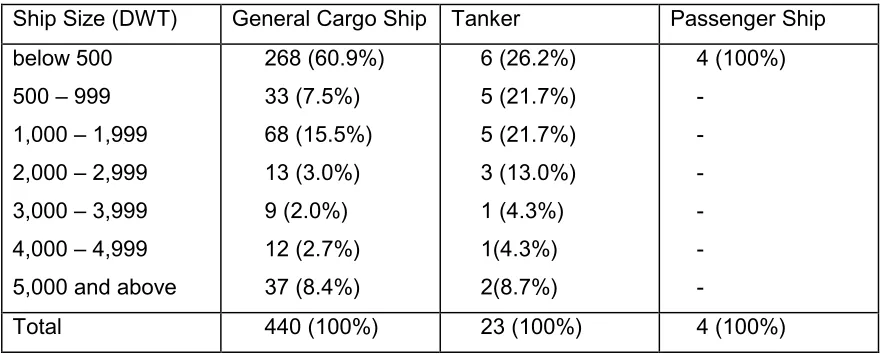
3.2 Vietnamese Fleet
Table 3.2: Vietnamese Fleet Size Distribution by Type of Ships
Ship Size (DWT) General Cargo Ship Tanker Passenger Ship
below 500 500 – 999 1,000 – 1,999 2,000 – 2,999 3,000 – 3,999 4,000 – 4,999 5,000 and above
268 (60.9%) 33 (7.5%) 68 (15.5%) 13 (3.0%) 9 (2.0%) 12 (2.7%) 37 (8.4%)
6 (26.2%) 5 (21.7%) 5 (21.7%) 3 (13.0%) 1 (4.3%) 1(4.3%) 2(8.7%)
4 (100%)
-Total 440 (100%) 23 (100%) 4 (100%)
Source: Register of Ship 1994-1995, VR
The percentage of the specialised ships is very low in the sea going fleet, with only one specialised Ro-Ro ship, 17 small- and medium-size tankers, 2 multi-functional ships for carrying containers and 30 refrigerated ships which are, however, not in such condition that they can carry refrigerating containers.
Table 3.3: Age Distribution of Vietnamese Fleet
Ship Age (years) General Cargo Ship Tanker Passenger Ship
Less than 5 5 – 10 11 – 15 16 – 20 21 – 25 More than 25
79 (18.0%) 175 (39.8%) 66 (15.0%) 49 (11.1%) 57 (13.0%) 14 (3.2%)
3 (13.0%) 4 (17.4%) 1 (4.3%) 6 (26.1%) 6 (26.1%) 3 (13.0%)
-2 (50.0%)
-1 (25.0%) 1 (25.0%)
-Total 440 (100%) 23 (100%) 4 (100%)
Note:
(1) General cargo ships include 18 refrigerated ships.
(2) The average age of general cargo and tanker ships is as follows
Below 500 DWT 8.1 years
500 – 999 DWT 13.0 years
1,000 – 1,999 DWT 13.6 years
2,000 – 2,999 DWT 17.0 years
3,000 – 3,999 DWT 19.9 years
4,000 – 4,999 DWT 22.3 years
5,000 DWT and above 20.0 years
Source: Register of Ships 1994-1995, VR
getting spare parts can result in vessels being laid up or ineffective repair leading to the unreliable service. As shown in Table 3.3, the fleet includes many old vessels--16% of general cargo ships and 39% of tankers are over 20 years old. The average age of the fleet is 11.3 years. But the age is double for the larger vessels which are usually acquired second-hand.
The high degree of obsolescence of the Vietnamese fleet makes it impossible, at present, to reach the technical standards stipulated by international conventions and legal requirements of other countries in the region. At the same time it restricts efficiency and productivity of the maritime industry.
3.3 Conclusion
Generally speaking, Vietnamese maritime administration is quite comprehensive. It covers almost all activities of the Vietnamese fleet and the maritime industry. However, it is far from complete to carry out all the functions that it attempts to due to shortcoming in the organisations and in the co-operation between them which create a number conflicts of interests within one organisation and among organisations. The above review of the Vietnamese maritime industry indicates that there are significant deficiencies that need to be improved in order to establish an effective regulatory system for coastal shipping. The main deficiencies are as follows:
(1) The development of the VINAMARINE from a shipping management body into a regulatory agency is far from complete. This organisation does not have the human, technical or financial resources needed to perform its regulatory role, especially considering its new obligations arising from international agreements (2) The VINAMARINE retains important commercial activities such as port
(3) There is a lack of a clear and logical division of responsibilities between the VINAMARINE and the IWB making it difficult to establish uniform regulatory standards and enforcement systems along rivers
(4) Possibly for the same reason, there is an inadequate financing systems for navigation aids and maintenance of river-ways
(5) The VMS has insufficient human, technical or financial resources to perform its responsibilities for maritime safety
(6) Many implementing regulations in maritime transport have not yet been introduced, especially regarding access by the Vietnamese shipping operators to foreign routes and incorporating international agreement into international law
Chapter 4
PORT STATE CONTROL IMPLEMENTATION:
A VIETNAMESE APPROACH
4.1 General
Very early this year (1999) Vietnam became a member of the Asia Pacific Memorandum of Understanding on Port State Control (Tokyo MOU). Actually, long time before this event, Vietnam had been granted the observer status to the Tokyo MOU and had exercised some control over foreign ships calling at Vietnamese ports, but it had not been done systematically, and without co-operation with other countries in the region. At present, Vietnam is on process of establishing port State control system throughout the country aiming to harmonise with country members of the Tokyo MOU. There are many challenges in front, but Vietnam will have its way of doing.
4.2 Legislation
international conventions affecting Vietnamese and foreign ships that conduct activities in Vietnam. In short, the decisions provides the national legal basis for the VINAMARINE particularly the VMSI under the supervision of the VINAMARINE to carry out flag State monitoring and port State control in Vietnam. However, it is neither said in Vietnam Maritime Code nor in the minister's decisions that the VINAMARINE and VMSI must exercise port State control according to Tokyo MOU and Asia Pacific Port State Control Manual.
At the lower level, there is an agreement related to PSC matters--Agreement between the VINAMARINE and the VR with regard to Co-operation on Port State Control Implementation--signed on 14 August 1998. Among other things, it states that
Port Authority Officers and VR’s surveyors in co-operation carry out PSC:
- Port Authority Officers are responsible to inspect: Registry Document, Manning Document, Competent Certificates of Officers and crew, and other ship’s documents - VR’s surveyors are responsible for inspection of matters related to Technical Specification and Standards issuing by the Government and requirements under international conventions that Vietnam has ratified.
(VINAMARINE, 1998)