AN ENSEMBLES FRAMEWORK FOR BRAIN COMPUTER
INTERFACE
1SANOJ. C. S, 2 S. CHITRA
1Pavendar Bharathidasan Institute of Information Technology, Department of Computer Science
Engineering, Tamilnadu, India
2Er. Perumal Manimekalai College of Engineering, Department of Computer Science Engineering,
Tamilnadu, India
E-mail: 1[email protected]
ABSTRACT
Brain Computer Interface (BCI) is a control and communication system independent of the brain’s neuromuscular output channels. BCIs carry an expectation of the future, as a device connecting the brain to a computer. One can control equipment through thoughts. Though current reality is practical, many accomplishments have been achieved in the last 20 years and BCIs are here to stay. In this study, Brain Computer Interface IIIa dataset is used to test the proposed system. Features are extracted using Discrete Cosine Transform (DCT) and Common Spatial Patterns (CSP). Features are selected using Correlation based Feature Selection (CFS) and classified using meta-classifiers.
Keywords: Brain Computer Interface (BCI), IIIa dataset, Common Spatial Patterns (CSP), Discrete Cosine Transform (DCT), Correlation based Feature Selection (CFS), Rotation Forest Ensemble.
1. INTRODUCTION
Brain computer interface (BCI), also called brain machine interface (BMI), is a software and hardware communication system aiding humans to interact with surroundings, without using peripheral nerves/muscles, through electroencephalographic activity generated control signals. BCI lays a new non-muscular channel to relay a person’s intentions to external devices like computers, assistive appliances, speech synthesizers and neural prostheses.
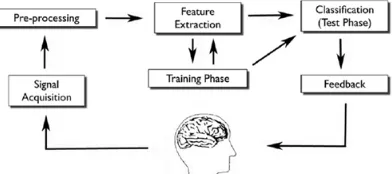
BCI is an artificial intelligence system that recognizes brain signals patterns in five consecutive stages: signal acquisition, preprocessing/signal enhancement, extraction of features, classification and control interface. Signal acquisition captures brain signals and also performs noise reduction/artifact processing. Preprocessing prepares signals in suitable form for more processing. Feature extraction identifies brain signals discriminative information that is recorded. The signal once measured, is mapped to a vector containing discriminant features from observed signals. Extraction of interesting information is challenging. Brain signals are mixed with signals
from other brain activities overlapping in time and space. The signal is also not stationary and may be distorted by artifacts like electromyography (EMG) or electrooculography (EOG) [1].
area unit ready to adapt, the shorter is the coaching to understand management [2].
A BCI system’s main parts are:
• Signal acquisition system: involves electrodes that pick up the brain’s electrical activity, amplifier and analog filters.
• Feature extractor: converts brain signals to relevant feature components. EEG raw signals are first filtered through a digital band pass filter after which amplitude samples are squared to get power samples. The latter is averaged for trials. Finally, signals are smoothed by time samples averaging.
• Feature translator: classifies feature components into logical controls.
• Control interface: converts logical controls into semantic controls.
• Device controller: changes semantic controls to physical device commands that differ from one device to another based on application.
[image:2.595.92.288.427.514.2]• Finally, the device executes the device commands [3].
Figure 1 Brain Computer Interface
There are many BCI types and their basic purpose is to intercept electrical signals passing between the brain’s neurons, translating them to a signal sensed by external devices.
a. Invasive Brain Computer Interfaces Invasive Brain Computer Interface devices are direct brain implants and which have the highest quality signals. These provide functionality to paralyzed people. Invasive BCIs also restore vision connecting the brain with external cameras and restoring limbs use by using brain controlled robotic legs and arms.
b. Partially Invasive Brain Computer Interfaces
Partially invasive BCI devices are skull implants resting outside the brain and not within grey matter. Signal strength in such BCI is slightly weaker compared to Invasive BCI. They produce
better signal resolution than non-invasive BCIs. Partially invasive BCIs have reduced scar tissue formation compared to Invasive BCI.
c. Non Invasive Brain Computer Interfaces Non-invasive BCI has least signal clarity when communicating with the brain but it is the safest compared to other types. This device was successful in giving patients ability to move muscle implants and restore partial movement [4].
Electroencephalography measures brain’s neurophysiologic electrical activity using electrodes on the scalp. Resulting traces are known as electroencephalogram (EEG) representing an electrical signal (postsynaptic potentials) from many neurons. The EEG is a non-invasive brain procedure used for diagnosis. Instead of electrical currents, voltage differences between the brain’s different parts are observed. The EEG includes a multi-channel signals set. Pattern changes in signals reflect large-scale brain activities. The EEG reflects head musculature, eye movements, activation interference from electric devices, and electrodes changing conductivity due to the subject’s movements or physicochemical reactions at electrode sites [5].
Speed is the EEG’s greatest advantage. Complex neural activity patterns occurring within fractions of a second after administration of stimulus can be recorded. As EEG offers less spatial resolution when compared to MRI and PET, EEG images are combined with MRI scans for better allocation in the brain. EEG determines electrical activity’s relative strengths and positions in various brain regions.
According to R. Bickford [6] research and clinical applications of the EEG in humans and animals are used to:
• monitor alertness, brain death and coma; • locate areas of damage following head
injury, tumour, stroke, etc.;
• test afferent pathways (by evoked potentials);
• monitor cognitive engagement (alpha rhythm);
• produce biofeedback situations, alpha, etc.;
• control anesthesia depth (“servo anesthesia”);
• investigate epilepsy and locate seizure origin;
• test epilepsy drug effects;
• assist in experimental cortical excision of epileptic focus;
• test drugs for convulsive effects; • investigate sleep disorder and physiology In this study, Brain Computer Interface IIIa dataset is used to test proposed system. Features are extracted using DCT and common spatial patterns. Features are selected using correlation based feature selection and classified using meta-classifiers. The rest of the study is organized as follows: section 2 literature survey, section 3 Methodology, section 4 results and discussion and section 5 conclusion.
2. RELATED WORK
Islam, et al., [7] suggested optimizing a Common Spatial Pattern (CSP) and feature extraction algorithm for BCI. The work reported a method to acquire and detect EEG signals for extraction of information to differentiate signals related to specific movement. A CSP algorithm was used at preprocessing stage. Logarithmic transform with information theoretic feature extraction was used for feature extraction. KNN, SVM and Artificial Neural Networks were used for classification. The new method was tested on publically available data sets and results were comparable with published approaches.
FBCSP in BCI was proposed by Ang, et al., [8]. This study proposed a BCI based Smart Environmental Control System (BSECS). Many environmental control systems were proposed to improve human life quality. Few researches focused on environment control through direct use of human physiological state. The proposed BSECS was verified in a practical demo room, and is capable of being extended with UPnP home networking for applications.
An improved feature extraction method for Self-paced brain-computer interface was proposed by Guangming, et al., [9]. It revealed improved feature extraction and selection method where features extraction was through stationary wavelet transform, bandpass filtering, and SVM which classified extracted feature vectors. This process selected EEG features and classifier parameters through a genetic algorithm. The methods tested in BCI competition 2008 dataset I, with informal results showing that it was efficient for feature extraction in a self-paced BCI system.
A new design of asynchronous BCI using features knowledge path was proposed by Bashashati, et al., [10]. Features evaluated a modified LF-ASD design with data from both individuals with high-level spinal cord injuries and able-bodied subjects. Modifications were related to
incorporating knowledge about movement attempt into the system. Specifically, extracted features past values from EEG signal related to movement attempts were used. Error characteristics of the new asynchronous brain switch design was better than previous LF-ASD design, with positive rate increases of approximately 8.5% for false positive rates in 1-2% range.
An automated EEG feature selection for BCI was proposed by Schroder, et al., [11] which presented a wrapper method for automated feature selection. The new method combined a GA for feature selection with SVM for evaluation. When the GA-SVM method was applied to data of several subjects and two different experimental paradigms, it revealed that it provided enhanced classification accuracy.
A feature down-selection in BCI was proposed by Dias, et al., [12] which introduced an algorithm for feature down-selection on AGV based subject basis. It was evaluated and compared to three algorithms RFE, GA and RELIEF. Superb dimensionality reduction (as low as 8 out of 118 features) with high discrimination power (as high as 90.4) was seen in AGV's performance.
Feature extraction in BCI development was proposed by Polak and Kostov [13], with the proposed work comparing two spectral estimation methods for feature extraction to develop computer access for EEG signals based communication and control. It compared Power spectrum calculated by fast FFT and autoregressive coefficients calculated by Burg's algorithm that analyzed four surface EEG signals documented above sensory motor areas. This was when the subject attempted to use mental activities alone to modulate EEG signals leading to simple movements of animated object on feedback computer screen. Off-line analysis revealed that overall best classification accuracy achieved by AR exceeded that with FFT.
EEG dataset reduction and feature extraction using Discrete Cosine Transform [DCT] was proposed by Martisius, et al., [14], to apply DCT on EEG signals. DCT took correlated input data and concentrated its energy in first few transform coefficients. This was a feature extraction step which allowed data size reduction without loss of important information. The method would be successful for feature extraction and dataset reduction.
express their wishes to caregivers or operate word processing neuro-prostheses or programs. Current BCIs determine user intent from various electrophysiological signals which include slow cortical potentials, P300 potentials, and mu or beta rhythms from the scalp, and cortical neuronal activity from implanted electrodes. BCI systems could provide an important new communication and control option for people with motor disabilities with adequate recognition and effective engagement of all these issues. It could also provide those without disabilities a supplementary control channel or control channel for use in special circumstances.
Adapting subject specific motor imagery EEG patterns in space time frequency for a BCI was proposed by Ince, et al., [16]; it suggested a technique that extracted subject specific motor imagery related EEG patterns in space time frequency plane for single trial classification. The new approach needed no knowledge of reactive frequency bands, their cortical locations or temporal behavior. Experimental results were provided for 5 subjects of BCI competition 2005 dataset IVa to show the proposed method’s superior performance. It specifically demonstrated that using a linear SVM as a classifier led to the proposed algorithm’s classification accuracy varying between 90.5% and 99.7% averaging 96%.
Sosa, et al., [17] proposed a historical analysis and technology comparison for BCI which evolved over time, and as new technologies and devices appear, BCI suffered the new technologies impact. Though some technologies like MEG or fMRI enhanced BCI capabilities, it had disadvantages and hence a BCI technology comparison was presented to mention each technology’s advantages and disadvantages.
Three feature correlation cases in electrocortico-graphic BCI were proposed by Miller, et al., [18], the result revealing that high correlation between horizontal and vertical control signal initially precluded successful two dimensional cursor controls. Also, a feedback based learning strategy was successfully used by subject to overcome this limitation, progressively de-correlating control signals.
A feature subset selection and feature ranking for multivariate time series was proposed by Yoon, et al., [19] which suggested a family of unsupervised methods for feature subset selection from MTS based on common Principal Component Analysis [PCA], termed Clever. Conventional FSS techniques like RFE and FC were applied to MTS data sets, e.g., BCI data sets. Such techniques could
lose correlation information among features, while suggested techniques used PCA properties to retain information. Experiments showed Clever outperforming RFE, FC, and random selection by a factor of two regarding classification accuracy, while taking 2 orders of magnitude less processing time compared to RFE and FC.
A user-friendly Steady-State Visual Evoked Potential (SSVEP)-based BCI system was introduced by Luo and Sullivan [20]. Single channel EEG was recorded with a low noise dry electrode. Compared to conventional gel based multi sensor EEG systems, a dry sensor was convenient, comfortable and cost effective. A hardware system displaying four LED light panels flashing at different frequencies and synchronizing with EEG acquisition was built. Visual stimuli were carefully designed to reduce potential risk to photosensitive people. This method described a new stimulus locked interracial correlation (SLIC) method for SSVEP classification using EEG time-locked to stimulus onsets was described by this method. It stated how the algorithm’s performance was affected by different parameter selection. Average light detection rate was 75.8% with very low error rates (8.4% false positive rate and a 1.3% misclassification rate) when using SLIC method. SLIC method was more robust (less annoyance to users) and suited irregular stimulus patterns compared to traditional frequency-domain-based method.
3. METHODOLOGY
In this study, Brain Computer Interface IIIa dataset is used to test proposed system. DCT is used to convert the ECG data into frequency domain and CSP is used to extract the features. CFS is applied to reduce the number of features and selected features are classified using Rotation Foret Ensemble. The methods involved are as follows
Dataset III a Format of the data
Data is stored in the GDF format and is loaded into Matlab or Octave with Biosig-toolbox (version 0.81 or higher) using command [s,HDR] = sload(filename). The data can include NaN’s; which indicate breaks in between runs or saturation of analog-to-digital converter. All events are stored according to event codes Table. Each trail’s beginning (t = 0s) is obtained from HDR.TRIG; class labels are stored in HDR. Class label and HDR Artifact Selection indicate trials with visually identified artifacts. HDR Class label has values ‘1’,’2’,’3’,’4’, and ‘NaN’. Values ‘1’,’2’,’3’,’4’ indicate training set labels, NaN indicates test set trials.
Source derivation based on center and four nearest neighbor electrodes (Hjorth, 1975) was calculated for visual artifact processing. For boundary electrodes, an equal calculation was made based on first, second or third nearest neighbor’s single trials which were visually inspected for muscle/ocular artifacts. Trials with artifacts were marked. Boundary electrode artifacts were not considered [25].
Discrete Cosine Transform (DCT):
Discrete Cosine Transform (DCT) and Discrete Sine Transform (DST) are members of the sinusoidal unitary transforms family which are real, orthogonal, and separable with fast algorithms for computation. They are relevant to data compression. DCT is a Fourier-related transform like discrete Fourier transform (DFT), using real numbers. DCTs are equal to DFTs of roughly twice the length, operating on real symmetrical data. The difference between DCT and DFT is that the former uses cosine functions, while the latter uses cosines and sines (as complex exponentials) [22].
The One-Dimensional DCT
The most common DCT definition of a 1-D sequence of length N is
For u = 0,1,2,…,N −1. Similarly, the inverse transformation is defined as,
for x = 0,1,2,…,N −1. In both equations (u) is defined as
The Two-Dimensional DCT
The 2-D DCT is a direct extension of the 1-D case and is given by
for u,v = 0,1,2,…,N −1 and α(u) and α(v) are
defined in (3). The inverse transform is defined as
For x,y = 0,1,2,…,N −1. The 2-D basis functions
can be generated by multiplying the horizontally oriented 1-D basis functions with vertically oriented set of the same functions [23].
A Faster DCT
The 1-D sequence f (x) in (1) can be expressed as a sum of an even and an odd sequence
, Where,
=
And
0
For the inverse transformation, calculate fP2x PP P2x), x PPf x and the odd points can be calculated by noting that
Common Spatial Patterns (CSP)
Common Spatial Patterns (CSP) algorithm is a feature extraction method which can learn spatial filters maximizing the discriminability of two classes. CSP has been demonstrated to be one of the most popular and efficient algorithms for BCI design, notably during BCI competitions.
CSP aims at learning spatial filters which maximize the variance of band-pass filtered EEG signals from one class while diminishing their variance from the other class. The variance of EEG signals filtered in a given frequency band corresponds to the signal power in this band, CSP aims at achieving optimal discrimination for BCI based on band power features. Formally, CSP uses the spatial filters w, which extremize the following function:
where T denotes transpose, is data matrix for class i (with training samples as rows and channels
as columns) and the spatial covariance matrix from class i, assuming a zero mean for EEG signals. This last assumption is met when EEG signals are band-pass filtered. This optimization issue is solved (this is not the only way) by
observing that function remains unchanged if
filter w is rescaled. Indeed with
k a real constant, meaning the rescaling of is arbitrary. So, extremizing J(w) is equivalent to
extremizing subject to the constraint
as it is possible to find rescaling
of w so that . Using Lagrange multiplier process, this constrained optimization problem is equal to extremizing the following function:
- )
The filters extremizing L are such that the derivative of L with respect to w equals 0
2
A standard eigenvalue problem is obtained. Spatial filters extremizing Eq. 1 are the eigenvectors of M
= corresponding to its largest/lowest eigenvalues. When CSP is used, extracted features are the EEG signal variance logarithm after projection onto filters w [24].
Correlation-based feature selection (CFS) CFS is a popular method which searches among features according to the redundancy degree between them to locate a features subset that are correlated with class, yet are uncorrelated with each other. Natural datasets experiments showed that CFS eliminated over half features, and the classification accuracy with reduced feature set was equal to or better than accuracy with a complete feature set [26].
If correlation between each test components and outside variable is known, and inter-correlation between each component pair is given, then correlation between a composite test having summed components and outside variable is predicted from:
where is correlation between summed components and outside variable, k the number of
components, the average of correlations
applied to obtain linearly extracted features. Classifiers are trained using this data. In this study, J48 classifier and Naïve Bayes classifier are used as base classifiers for Rotation forest.
4. EXPERIMENTAL RESULTS
In this study, Brain Computer Interface IIIa dataset is used to test proposed system. Features are extracted using Discrete Cosine Transform and common spatial patterns. Features are selected using correlation based feature selection and classified using forest rotation ensembles. The results obtained are as shown in figure 2- 5. Table 1 tabulates the summary of results of the experiments conducted.
Table 1 Summary of Results Classif
ic--ation Accura cy
RMSE Precisi on
Recall
Rotation forest with
J48 classifier and PCA projection
73.33 0.7345 0.7333 0.7339
Rotation forest with
J48 classifier
and Random
66.67 0.6669 0.6667 0.6668
Rotation forest with
J48 classifier
and Random
68.33 0.6825 0.6833 0.6829
Rotation forest with
Naïve Bayes Tree classifier and PCA projection
76.67 0.7667 0.7667 0.7667
Rotation forest with
Naïve Bayes Tree classifier
and
67.5 0.6747 0.675 0.6748
Rotation forest with
Naïve Bayes Tree classifier
and Random
69.17 0.6899 0.6917 0.6908
Figure 2 Classification Accuracy
[image:7.595.306.508.435.587.2]The Rotation forest with Naïve Bayes Tree classifier and PCA projection achieves Classification Accuracy of 76.67% which is better by 4.55% to 15% when compared to other methods implemented.
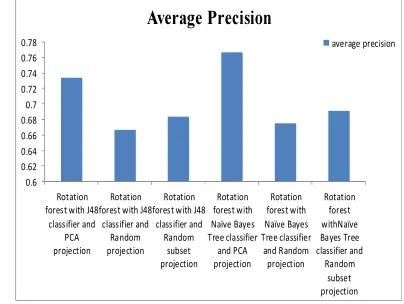
Figure 3 Average Precision
The Rotation forest with Naïve Bayes Tree classifier and PCA projection shows high average precision of 76.67% compared to other methods.
0.6 0.62 0.64 0.66 0.68 0.7 0.72 0.74 0.76 0.78
Rotation forest with J48
classifier and PCA projection
Rotation forest with J48
classifier and Random projection
Rotation forest with J48
classifier and Random
subset projection
Rotation forest with Naïve Bayes Tree classifier
and PCA projection
Rotation forest with Naïve Bayes Tree classifier and Random
projection Rotation
forest withNaïve Bayes Tree classifier and
Random subset projection
Average Precision
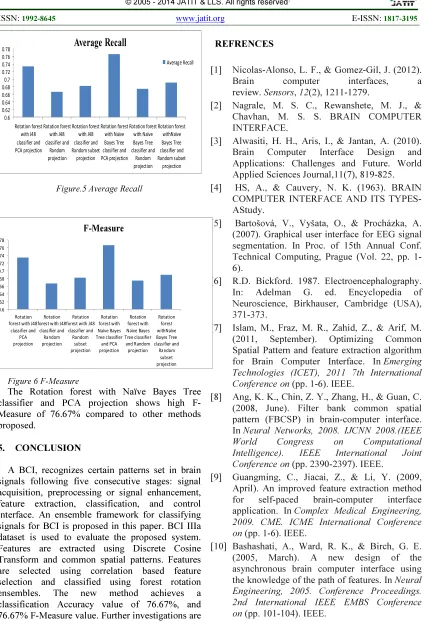
Figure.5 Average Recall
Figure 6 F-Measure
The Rotation forest with Naïve Bayes Tree classifier and PCA projection shows high F-Measure of 76.67% compared to other methods proposed.
5. CONCLUSION
A BCI, recognizes certain patterns set in brain signals following five consecutive stages: signal acquisition, preprocessing or signal enhancement, feature extraction, classification, and control interface. An ensemble framework for classifying signals for BCI is proposed in this paper. BCI IIIa dataset is used to evaluate the proposed system. Features are extracted using Discrete Cosine Transform and common spatial patterns. Features are selected using correlation based feature selection and classified using forest rotation ensembles. The new method achieves a classification Accuracy value of 76.67%, and 76.67% F-Measure value. Further investigations are required to improve the classification accuracy.
REFRENCES
[1] Nicolas-Alonso, L. F., & Gomez-Gil, J. (2012).
Brain computer interfaces, a
review. Sensors, 12(2), 1211-1279.
[2] Nagrale, M. S. C., Rewanshete, M. J., &
Chavhan, M. S. S. BRAIN COMPUTER INTERFACE.
[3] Alwasiti, H. H., Aris, I., & Jantan, A. (2010).
Brain Computer Interface Design and
Applications: Challenges and Future. World Applied Sciences Journal,11(7), 819-825.
[4] HS, A., & Cauvery, N. K. (1963). BRAIN
COMPUTER INTERFACE AND ITS TYPES-AStudy.
[5] Bartošová, V., Vyšata, O., & Procházka, A.
(2007). Graphical user interface for EEG signal segmentation. In Proc. of 15th Annual Conf. Technical Computing, Prague (Vol. 22, pp. 1-6).
[6] R.D. Bickford. 1987. Electroencephalography.
In: Adelman G. ed. Encyclopedia of
Neuroscience, Birkhauser, Cambridge (USA), 371-373.
[7] Islam, M., Fraz, M. R., Zahid, Z., & Arif, M.
(2011, September). Optimizing Common
Spatial Pattern and feature extraction algorithm
for Brain Computer Interface. In Emerging
Technologies (ICET), 2011 7th International Conference on (pp. 1-6). IEEE.
[8] Ang, K. K., Chin, Z. Y., Zhang, H., & Guan, C.
(2008, June). Filter bank common spatial pattern (FBCSP) in brain-computer interface.
In Neural Networks, 2008. IJCNN 2008.(IEEE
World Congress on Computational
Intelligence). IEEE International Joint
Conference on (pp. 2390-2397). IEEE.
[9] Guangming, C., Jiacai, Z., & Li, Y. (2009,
April). An improved feature extraction method
for self-paced brain-computer interface
application. In Complex Medical Engineering,
2009. CME. ICME International Conference
on (pp. 1-6). IEEE.
[10] Bashashati, A., Ward, R. K., & Birch, G. E.
(2005, March). A new design of the asynchronous brain computer interface using
the knowledge of the path of features. In Neural
Engineering, 2005. Conference Proceedings. 2nd International IEEE EMBS Conference
on (pp. 101-104). IEEE.
[11] 0.6 0.62 0.64 0.66 0.68 0.7 0.72 0.74 0.76 0.78 Rotation forest with J48 classifier and PCA projection Rotation forest with J48 classifier and Random projection Rotation forest with J48 classifier and Random subset projection Rotation forest with Naïve Bayes Tree classifier and PCA projection Rotation forest with Naïve Bayes Tree classifier and Random projection Rotation forest withNaïve Bayes Tree classifier and Random subset projection
Average Recall
Average Recall 0.6 0.62 0.64 0.66 0.68 0.7 0.72 0.74 0.76 0.78 Rotation forest with J48classifier and PCA projection
Rotation forest with J48
classifier and Random projection
Rotation forest with J48
[12] Schroder, M., Bogdan, M., Hinterberger, T., & Birbaumer, N. (2003, March). Automated EEG feature selection for brain computer interfaces.
In Neural Engineering, 2003. Conference
Proceedings. First International IEEE EMBS
Conference on (pp. 626-629). IEEE.
[13] Dias, N. S., Jacinto, L. R., Mendes, P. M., &
Correia, J. H. (2009, April). Feature
down-selection in Brain-Computer Interfaces.
In Neural Engineering, 2009. NER'09. 4th
International IEEE/EMBS Conference on (pp.
323-326). IEEE.
[14] Polak, M., & Kostov, A. (1998). Feature
extraction in development of brain-computer
interface: a case study. In Engineering in
Medicine and Biology Society, 1998.
Proceedings of the 20th Annual International
Conference of the IEEE (Vol. 4, pp.
2058-2061). IEEE.
[15] Martisius, I., Birvinskas, D., Damasevicius, R.,
& Jusas, V. (2013). EEG Dataset Reduction and Classification Using Wave Atom Transform.
In Artificial Neural Networks and Machine
Learning–ICANN 2013 (pp. 208-215). Springer
Berlin Heidelberg.
[16] Wolpaw, J. R., Birbaumer, N., Heetderks, W. J.,
McFarland, D. J., Peckham, P. H., Schalk, G., ... & Vaughan, T. M. (2000). Brain-computer interface technology: a review of the first
international meeting. IEEE transactions on
rehabilitation engineering, 8(2), 164-173.
[17] Ince, N. F., Goksu, F., Tewfik, A. H., & Arica,
S. (2009). Adapting subject specific motor imagery EEG patterns in space–time–frequency
for a brain computer interface. Biomedical
signal processing and control, 4(3), 236-246.
[18] Sosa, O. P., Quijano, Y., Doniz, M., &
Chong-Quero, J. E. (2011, March). BCI: A historical
analysis and technology comparison. In Health
Care Exchanges (PAHCE), 2011 Pan
American (pp. 205-209). IEEE.
[19] Miller, K. J., Blakely, T., Schalk, G., den Nijs,
M., Rao, R. P., & Ojemann, J. G. (2008, August). Three cases of feature correlation in an
electrocorticographic BCI. In Engineering in
Medicine and Biology Society, 2008. EMBS 2008. 30th Annual International Conference of
the IEEE (pp. 5318-5321). IEEE.
[20] Yoon, H., Yang, K., & Shahabi, C. (2005).
Feature subset selection and feature ranking for
multivariate time series. Knowledge and Data
Engineering, IEEE Transactions on, 17(9),
1186-1198.
[21] Luo, A., & Sullivan, T. J. (2010). A
user-friendly SSVEP-based brain–computer interface
using a time-domain classifier. Journal of
neural engineering, 7(2), 026010.
[22] Birbaumer, N. (2006). Breaking the silence:
brain–computer interfaces (BCI) for
communication and motor
control. Psychophysiology, 43(6), 517-532.
[23] DISCRETE COSINE TRANSFORMS ~ Jennie
G. Abraham Fall 2009, EE5355
[24] Khayam, S. A. (2003). The discrete cosine
transform (dct): theory and
application. Michigan State University.
[25] Lotte, F., & Guan, C. (2011). Regularizing
common spatial patterns to improve BCI
designs: unified theory and new
algorithms. Biomedical Engineering, IEEE
Transactions on, 58(2), 355-362.
[26] Schlögl, A., & Pfurtscheller, G. (2005). ‘Dataset
IIIa: 4-class EEG data.
[27] Zhu, Q., Lin, L., Shyu, M. L., & Chen, S. C.
(2010, September). Feature selection using correlation and reliability based scoring metric
for video semantic detection. In Semantic
Computing (ICSC), 2010 IEEE Fourth
International Conference on (pp. 462-469).
IEEE.
[28] Hall, M. A. (1999). Correlation-based feature
selection for machine learning(Doctoral
dissertation, The University of Waikato).
[29] Kuncheva, L. I., & Rodríguez, J. J. (2007). An