A REVIEW OF ANT COLONY OPTIMIZATION ROUTING
PROTOCOLS FOR WIRELESS MULTIMEDIA SENSOR
NETWORK
1MOHAMMED ABAZEED, 2NORSHIELA FAISAL,3ADEL ALI,4SULEIMAN ZUBAIR
124Faculty of Electrical Engineering, UTM, Johor, Malaysia 1King Khalid University, Abha , Saudi Arabia
3Faculty of Computing and Information Technology in Rabigh, KAU, Saudi Arabia
E-mail: [email protected], [email protected], [email protected],
ABSTRACT
Multimedia applications have become an essential part of our daily lives, and their use is flourishing day by day. The area of wireless sensor network is not an exception where the multimedia sensors are attracting the attention of the researchers increasingly, and has shifted the focus from traditional scalar sensors to sensors equipped with multimedia devices. The multimedia sensors have the ability to capture video, image, audio as well as scalar sensor data and deliver the multimedia content through sensors network. Due to the resource constraints nature of WSN introducing multimedia will add more challenges, so the protocols designed for multimedia wireless sensor network should be aware of the resource constraints nature of WSN and multimedia transmission requirement. Ant colony optimization is a swarm intelligent algorithm that proved the efficiency to solve many complex optimization problems. Recently many routing protocols proposed based on ant colony optimization for WMSN to take advantages of ACO algorithm. In this paper we outline design challenges and requirements for designing routing protocols for WMSN, and then we review ACO routing protocols proposed for WMSN and discuss their feature and limitations. After that we will present a general comparison between them.
Keywords: Ant Colony Optimization (ACO), Wireless Multimedia Sensor Network (WMSN), Resource
Constraints, Routing Protocols, Quality of Services(QoS).
1. INTRODUCTION
Wireless multimedia sensor networks (WMSN) are a newly developed type of sensor network which have the sensor nodes equipped with cameras, microphones, and other sensors producing multimedia data content. The development towards the wireless multimedia sensor network has been the result of progress in the CMOS technology which leads to development of single chip camera modules that could be easily integrated to senor nodes. This integration between multimedia sources and cheap communication devices motivates the researches in wireless sensor network. WMSN enhances existing WSN applications and enables new large range of applications, like multimedia surveillance, traffic management, automated assistance, environmental monitoring and industrial process control. WMSNs have additional features and requirements than WSN, such as high
According to the direction of current research we can classify the routing protocols into different categories, for example, depending on the type and the number of QoS constraints they consider [2]. In literature there are many surveys and review tackling different issues in routing protocols. In [3] an extensive survey of routing protocols based on swarm are presented, beside the swarm intelligence principles and its application in WSN . Also a novel taxonomy of routing protocol proposed for WSN is introduced. Other survey about swarm intelligence based routing protocols for wireless sensor networks is presented in [4], factors that influence the routing design are explained and comparisons are performed in terms of energy consumption and scalability. In [5] a classical and swarm intelligence based routing protocols are surveyed firstly, then the algorithms are re-simulate from descriptions in published papers to perform the comparison between them in term of energy efficiency , throughput and delay. Still there are many surveys and reviews about routing protocols as in [2, 6, 7], all of them survey different types of routing protocols including ant colony optimization as a category with general point of view. This review concentrates specifically on the proposed routing protocols based on ant colony optimization and designed specifically for multimedia transmission. Furthermore we define the challenges of designing routing protocols in wireless multimedia sensor network followed by the characteristics of ant colony algorithm which make it suitable for multimedia transmission in resource constraints environment like WSN. After that the ant colony based routing protocols which are designed for WMSN are reviewed and comparisons between them are offered along with their features and limitations. Finally, the future directions of using ant colony algorithms in routing protocols for WMSN are explained. The main goal of this paper is to study the suitability and effectiveness of using ant colony optimization for multimedia transmission in WSN.
The rest of this paper is organized as follows: Section 2 describes the design challenges and resource constraints for WMSN, section 3, explains the feature of ant colony optimization. Section 4, ant based routing protocols are discussed, section 5 propose the future direction in routing protocols that use ACO, followed by conclusion in section 6.
2. DESIGN CHALLENGE AND RESOURCE
CONSTRAINTS
WMSN requirements impose more challenges and resource constraints to the routing protocols design. In this section we outline the main challenges we need to deal with to improve the communication efficiency in WMSN.
A. Energy Consumption
Multimedia applications produce high volume of traffic that requires high transmission rate and processing capabilities, which lead to consume more energy than WSN. While energy consumption is one of the most important performance metric in WMSN the routing protocols designed for WMSN should be aware of energy consumption to prolong the network lifetime [8].
B. QoS Requirements
QoS requirements differ according to different types of multimedia applications. QoS Metrics such as Delay, bandwidth, reliability and jitter must be disparately taken into account as needed. For example many multimedia applications are time critical which needs to be reported within a limited time.
C. High Bandwidth Demand
Multimedia traffic demands high bandwidth which requires new transmission techniques to provide the required bandwidth with acceptable energy consumption level to optimize the resource constraints nature of WMSN. Anyhow, using multipath or multi- channel can be a solution to this issue.
D. Resource Constraints
Like scalar sensor, multimedia sensor has constraints in many aspects, like energy consumption, memory size, processing capabilities and data rate. Multimedia sensor generates huge traffic which requires more processing capabilities of encoders that indicate the importance of efficient energy usage. According to this , limited resources of WMSN should be used effectively without any waste[1].
E. Variable Channel Capacity
consumptive, delay intolerable and it is nature bursty, thus the routing techniques designed for WMSN should route the data in a way that optimizes energy under unstable conditions [8]. F. Multimedia Coding Techniques
There are many coding techniques used for multimedia transmission. These techniques should consider the resource constraints nature and limited capabilities of sensors. One of the main objectives of coding techniques is reducing the information amount sent in the network by means of extracting the useful information from the captured images and video streams. This, anyhow, should not be at the expense of keeping the QoS requirements [9].
G. Multimedia In-network Processing
WMSN perform multimedia in-network
processing algorithm on the raw data transmitted from environment. In-network processing requires new network architecture resource constrained processing that makes filtering and extract the useful information at the edge of network. The scalability will increase by reducing redundant data transmission and combined data coming from different sensors. It is important to enhance application independently and self-organizing architecture to flexible performs in-network processing of multimedia[10, 11].
H. Integration with the Internet and other wireless technologies
The base of business in wireless sensor network is to make the information obtained by sensor network available to people by means of access such as internet. The users by internet can inquire about different information[12]. Thus WMSN will be remotely accessible via internet; hence WMSN needs to be integrated with internet architecture. It is recommended to use the application -level gateways or overlay IP networks as the best way for integration between WSNs and the Internet. Also it is necessary to achieve integration with other wireless technologies without sacrificing the efficiency of each individual technology.
3. ANT COLONY OPTIMIZATION
Colony Optimization was proposed first time in 1992 by Marc Dorigo et al to solve several discrete optimization problems and is considered as one of
the swarm intelligent algorithm types. ACO mimics the real ants to find shortest path between source food and their nest, while searching the ant deposit chemical substance called pheromone along the past path. This pheromone value can be used by other ants as indicator to find the shortest path to food places. The path with stronger pheromone value will be preferable for coming ants. The pheromone value changes over the time. If the number of ants decreased in a specific path, the pheromone evaporates with passed time and vice versa. Different ant colony optimization algorithms have been proposed. All of them share the same idea. The original ant colony optimization is known as ANT system, and the two most successful variants max-min Ant system and ant colony system[13]. ACO is iterative algorithm, a number of artificial ants are generated at each time and build a solution to the considered optimization problem and exchange the quality information of these solutions via communication scheme .A distributed heuristic solution like ACO routing algorithm shows many features that makes it particularly suitable for wireless sensor network:
• Algorithm is fully distributed that mean there is no single point of failure.
• The operations done in every node are simple.
• Autonomous interaction of ants, and the algorithm based on agents’ synchronous.
• It is self organizing, thus robust and fault tolerant. There is no need to define path recovery algorithm.
• Intrinsically adapts to traffic without requiring complex, and yet inflexible metrics.
• It inherently adapts to all kinds of variations in topology and traffic demand, which are difficult to be taken into account by deterministic approaches.
4. ACO BASED ROUTING PROTOCOLS
1) ASAR [14] is a QoS routing protocol that selects optimal paths to meet QoS requirements for different types of services. These services are called:
• R
:
event driven service mode; where delay and error are intolerant. This requires less bandwidth and high signal to noise ratio path.• D: query driven service mode; where the error is intolerant, while delay is tolerant. A congestion and high signal to noise ratio path may be used for this service.
• S: stream query service mode; where delay is intolerant but error is tolerant so less traffic and low signal-to-noise ratio path will be better for this service.
The proposed protocol is a cluster based architecture and only addresses the routing scheme between the cluster heads and the sink node. Each cluster head generates ants for each type of service (R/D/S) to find different service aware paths, from source to destination, that meet QoS requirements and is suitable for the traffic type. A probabilistic rule depending on the pheromone value of the paths is defined to determine the moving from current node to next. The pheromone value is calculated based on delay, rate of packet loss, bandwidth and energy consumption. All cluster heads will have three optimal path tables for different services, three pheromone tables for the three kinds of services, and also a real time pheromone value and a transition probability of the next hop. The simulation results show that the effectiveness of the proposed protocol depends on the service type, where some types perform well in some QoS metrics while other types are still suffering specially in delay and energy consumption. There are also some drawbacks like the bottleneck problem of hierarchical model and the optimal path setup due to congestion which requires extra calculations that affect the network performance.
2) Md.abdulrahamn et al [15] exploiting the concept of ant colony optimization to optimize the QoS metrics like delay, jitter, energy consumption and packet survival rate. The protocol doesn't need to maintain the global state of the sensor nodes. The routing decision is based on neighborhood information only. The effects of both the distance from the current node to the next hop and the remaining distance from next hop to sink are considered in the routing decision. The proposed protocol uses two types of ants to find the shortest path with QoS requirements. The forwarding decision to next hop based on probability equation,
the node with high probability is chosen as a forwarding node. At first the source node sends forward ant which uses probability equation to find the probabilities of each neighbor node and forwards the packet to the node with high probability, same steps are repeated till reaching the destination. The forward ant will be killed if it visits more than half of the number of nodes which means that the path has a loop or is non-convergent. When the forward ant reaches the destination successfully, the backward ant is generated to reinforce the visited nodes by increasing the probability value. The proposed protocol can be configured for both acknowledgment-based and non-acknowledgment-based. The backward ant will acknowledge the path which is chosen by forward ant. The source node will send a new forwarding node if the earlier packet is lost or the acknowledgment not reached to source within a certain period of time. The simulation results of the proposed protocol is not compared with related protocols, while it shows good performance in jitter and delay and for the most time it finds the shortest path which leads to consume less energy. The load balancing between nodes is not considered, which causes holes when energy of some nodes depletes earlier than others. The protocol requires accurate geographic information of the node which increases the cost of deployment. In addition while the network scales increase the overhead is also increased making the protocol poor scalability.
from source to destination. In case of node failure the neighbor node will set the pheromone value to zero and send an error message to source node then the source node will stop transmission in this path and enable an alternate path for transmission. The protocol determines the congestion occurred by monitoring the end-to-end delay from source to destination. If it exceeds the threshold, a congestion message will be sent to the source node. When the source node gets this message it will reduce the data amount sent in this path and enable an alternate path which increases the reliability. The simulation results show that the performance of the protocol is better than relevant protocols such as AGRA and MIAR, in delay, nodes life time and also better in scalability and reliability. The draw backs of the proposed work are the hierarchical model which introduces bottleneck problem and the optimal path selection requires extra calculation which may decrease network performance.
4) KE zogwn et al[17] propose a routing protocol using game theory and ant colony algorithm to meet QoS challenge in wireless multimedia sensor network. The standard game theory has three elements; players, payoff and strategies. The authors assume the players try to maximize their payoff with minimum cost. The sensor node uses local information to build a routing path depending on the game result and the residual energy. Ant routing algorithm is used based on[18] .the forward ants sent to explore the path to destination node. The routing decision takes place based on the pheromone trails left by ants. The probability calculation for forward decision uses residual energy, delay and bandwidth. When the forward ants successfully reach the sink, a backward ant is generated and takes the path found by forward ants toward the source.
5) Xiao CAO et al Propose ant colony routing algorithm called IP-ACRA [19] aims to improve the classical ant algorithm which is optimized by the initial pheromone distribution to improve the convergence velocity and optimal path discovery. To enhance the scalability and make the algorithm suitable for large scale sensor networks and prolong the network lifetime, the proposed IP-ACRA is modified to IC-ACRA which is a cluster based algorithm. The performance metrics considered are delay, packet loss rate, bandwidth and energy cost. The objectives function of the feasible path is to integrate and normalize all the mentioned performance metrics. The algorithm aims to find the optimal path in order to maximize the objective function. As we mentioned one goals of proposed
algorithm is to improve the convergence velocity. This is achieved by optimizing the initial pheromone value. The approach of establishing node adjacency is flooding neighbor nodes with hello packets constantly. The Sink node broadcasts hello at the beginning. When the intermediate nodes receive the hello packets they will forward them in the same way and record the precedent node number in their adjacency table. The protocol assumes that the better routing performance metrics which one path has the earlier hello packet. The initial pheromone value set on each link based on the priority of record time stamp. The earlier adjacent node will have higher priority, and more initial pheromone value will be set to the link. Every forward ant has a table save to visited nodes to avoid looping. The probability equation of selecting next node is based on the pheromone value and heuristic function that depends on the remaining energy. Local and global pheromone values are updated. The global pheromone value has more importance because it uses the objective function as an indication. IP-ACRA influence on the network performance is not significant, so the authors modified to IC-ACRA which down size the network scale and divide the sensor nodes into clusters. Each cluster has only one cluster head and at least one multimedia sensor. The cluster head can communicate with sink node, while the other nodes communicate with each other within the cluster. IC-ACRA finds the local optimal path in each cluster. The simulation results show that the number of ants obtain the final solution in IP-ACRA more than classic ant routing algorithm. The convergence velocity of the proposed protocol is better than the classic ant algorithm, especially when the number of nodes exceeds 40. The performance results of routing metrics show that IC-ACRA outperform IP-IC-ACRA and Dijkstra in every aspect. The performance evaluation of real video transmission show the delay in IC-ACRA shorter than IP-ACRA, also has better performance in the real video trace data transmission than IP-ACRA.
pheromone value deposit on the link and the heuristic value given to the link, which calculated based on the cost of the link. At the begriming the initial pheromone value will set equal for all links, the heuristic value of a link is the inverse of link cost. The pheromone value is updated only on the links found by all ants. The updated pheromone value commensurates with the cost function of links. The authors study many parameters that have an impact on ACO performance like the number of ants, the weights for cost function and transition probability and pheromone evaporation rate and their impact on the time to find the optimal path. The results show that doubling the number of ants result in doubling the computation time needed to find the optimal solution. The probability to find the optimal solution from first iteration increased. To find the optimal path, the heuristic value should be given a higher importance than pheromone value. The simulation results show that by increasing transmission rate the queuing delay is reduced and loss percentage will decreased, also the authors study the affect of video encoding rate which show the average queuing delay increase with the increase of video frame encoding rate and large loss percentage increase while increasing frame encoding rate. Increasing event generation rate lead to increasing average queuing delay, which cause to delaying many packets beyond the deadline set and increase loss percentage.
7) BELEGHACHI et al propose routing protocol [21] aimed to find path with least delay, more bandwidth and less number of hops. There are two phases in the proposed protocol; rout discovery phase and rout maintenance phase. When the source node wants to send data will start with rout discovery phase. The data transfer starts when the path is found. Four control messages are used which are: hello packet, route request, route reply and route error. Hello packets are distributed periodically to all the neighbors of the current nodes. The neighbor nodes receive this packet reply by ACK ant. Based on the time of sending hello packets and receiving the acknowledgment the current node will calculate the bandwidth of outgoing links. Route request packet is broadcasted, when the node receives route request to the destination, at each node the hope count will increase and the node ID entered in the memory. The node that receives route request packet will change it to route reply packet, from sending time and rout request packet arrival time end to end delay found and concerted as parameter. The rout reply packet will be unicasted to the original source node. Route error message is sent when the node cannot
reach specific destination, upon receiving this message the intermediate nodes will update their routing table and path preference probability table for the unreachable destination. The objective function use delay, pheromone value, bandwidth and hop count as performance metrics. The bandwidth from one node to next is calculated as a minimum of available bandwidth of all the links along the path. When there is no neighborhood relation the initial pheromone value is set to zero. The initial pheromone value increases by 0.1 when neighbor node is detected through hello messages. If there is no data to send, the pheromone value decreases by evaporation factor. In case the link fails between tow nodes the pheromone value on that link will be set to zero. Increasing load in the optimal path causes delay and exhausting the path energy. In this case the path preference probability automatically decreased and alternate routes can be used. The work is simulated with various scenarios; the results show the proposed protocol more scalable and the cost of routing control better than AODV. The disadvantages of the proposed protocol are the control messages overhead where there are different control messages used in the route discovery phase, and there is no consideration for energy consumption.
destination, it will be killed and the backward ant will be generated and carries source node address, path information and pheromone update value. The energy residual ratio and hop count collected by forward ant will be used by backward ant to calculate the increment of pheromone value. The pheromone update or increment will be in the paths which meet delay and energy requirements. In the route maintenance phase every entry in the routing table has an expiration time. When the expiration time is reached, a new discovery phase will restart. The periodic hello message is used to maintain updated information about the connectivity of neighbor nodes. In case link go down during data transmission the node will deactivate this link by setting the pheromone value to zero and find other node in the neighbor table . To avoid the situation of a dominant path, the proposed work limits the maximum and minimum pheromone value. The work is simulated and the results show that the average delays of proposed protocol are less than the AODV and DSDV protocols. The routing overhead is also less and the path normalizing energy is improved.
9) Adamu murtala et al[23] proposes a routing protocol that is an improved version of EEABR protocol[24]. The available power of node and the energy consumption of each path are considered in the routing decision. The memory usage is improved by reducing the routing table. Memory of each ant is reduced to keep only last two records of the last visited nodes. The routing table of forward ants which are sent directly to sink node only needs to save the neighbor node that are in that direction. Each node keeps in its memory record of every ant that was received and sent. The memory record saves the previous node, forward node, Ant ID and timeout value. The proposed work modifies EEABR protocol to enhance energy consumption and improve protocol performance by: 1) initialize the routing tables of nodes intelligently. 2) Giving priority to neighboring nodes of source or routes which fall to be the destination. 3) Reducing the flooding ability of ants. The proposed algorithm initializes the routing table with uniform probability distribution. Then at regular interval every node forward ant to find optimal path to the destination. The number of ants lunched by every node is limited to k*5, the information of visited nodes is saved onto memory and carried by the ant. At every visited node, a forward ant assigns a greater probability to a destination node which falls to be destination among the neighbor nodes. The forward ants select next hop using the same probabilistic rule
proposed in the ACO meta heuristic. This probabilistic rule calculated based on the pheromone value and visibility function which is calculated based on energy level consumption. As in most of ant routing protocols when the forward ant reaches its destination successfully the backward ant generated to update the pheromone value of the path selected by forward ant. Before backward ant goes back, the destination node calculates the amount of pheromone value the ant will deposit in its way. The pheromone increment depends on the energy consumption and distance. The pheromone value which is calculated by destination node will be divided by hop count number, which given nodes near to destination more pheromone value, to force remote nodes to find better paths. When the backward ant reaches its source it will be eliminated. If it is failed to reach then a loop is detected, immediately the ant itself is destroyed. The proposed protocol simulated by routing modeling simulation environment (RMASE),The metrics of delay, energy efficiency and success rate are evaluated ,the simulation takes place for two situation when the sink is static and when it is dynamic. In the static scenario the results show that the proposed protocol has lowest delay and the success rate has good average reach to 96%.The protocol has good performance for energy consumption and performs better when the network grows higher. In the dynamic scenario still the protocol has high success rate, low energy consumption and is more energy efficient. The proposed protocol outperforms (BABR,SC,FF,FP,EEABR) protocols in both scenarios.
setup phase and steady up phase. In the cluster setup phase the cluster heads are selected and clusters are placed around them. The data transmission between sensors and the sink take place in steady phase. Cluster ants are used to control cluster head election. Only the node that has cluster ant becomes cluster head, where the others choose to join the best cluster head in their range. Each node has clustering pheromone value which determines the ability to become a cluster head. This value depends on the available memory and energy. The sink releases a fixed number of ants into the network and move randomly. Every node has TTL value equal to the number of ants. When the sink releases an ant it chooses one of its neighbor randomly according to the probability function which is defined by clustering pheromone value related to total pheromone value of clusters. The selected node to be cluster head; its pheromone value decreases to avoid being a cluster head for other time. In order to become cluster head the selected node must have received a cluster ant from another cluster head or the sink. Ants TTL indicate the maximum number of hops that it can perform. When a cluster head realizes that there is a node three or more hops away from it. That cluster head select the neighbor on the path to that node as a new CH, to get better CH distribution that covers the whole network area. The proposed protocol introduces packet scheduling policy to consider different priorities of different types of traffic classes. Route discovery is done by three phases: forward ant phase, backward ant phase and route maintenance phase. In the forward ant phase, to find route to the sink; the CH source broadcast forward ant when the next cluster head receives forward ant updates the information field and forwards to the next CH according to probability value which depends on the pheromone value and is calculated as the addition of all QoS metrics collected by ants. These metrics are energy, delay, bandwidth, packet loss rate and memory. Backward ant phase starts when forward ant reaches the sink then the sink evaluates the forward ant information versus QoS metrics. If the path does not fulfill the application requirements the forward Ant is discarded. When an appropriate forward ant is received that meet the application requirements the backward ant is generated and it is sent back using the reverse path of forward ant. The pheromone value is updated in all intermediate cluster head till it reaches back to the sink. The process of routing maintenance phase deals with congestion and lost link problems. Data ants are assigned to transport urgent or real time data. It is processed before all of other traffic classes in every node. The behavior of
data ant is similar to forward ant. AntSensNet offers a mechanism to transport a video stream between source nodes and sink node. This mechanism is based on [26] and uses an efficient multipath video packet scheduling for minimum video distortion. For this video ant is introduced. The behavior in each intermediate node is the same as when discovering single path except that the intermediate node did not discard the duplicate video ants in order to discover multipath. The simulation results show that the proposed protocol achieves more than twice the cluster head lifetime of T-ANT. ASNS shows a comparable average packet delivery ratio with AODV, while AntSensNet Multimedia outperforms these two protocols after a few seconds. ASN and ASNM packets delay are lower than those of AODV. The overhead of proposed protocol is more than AODV due to the number of ants used. Also the simulation results show that the video quality is higher than other multimedia protocol like TPGF and ASAR.
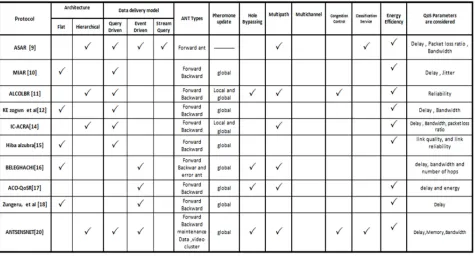
Table 1: shows summary of comparison between aforementioned routing protocols for WMSN.
5. FUTURE DIRECTIONS
Due to the challenges that meet the design of routing protocols for multimedia transmission in resource constraints nature environment, ACO algorithms can be integrated with different techniques to give an efficient solutions. The future directions of ACO with such techniques are mentioned as follows:
- Multipath routing protocols: multipath technique is a promise solution in WMSN for different issues and can be used to handle many shortcomings. The multi path technique can be used to provide security, load balancing, fault tolerant and energy efficiency. Integrate multipath routing technique with ant colony optimization will lead to obtain good results and more efficient routing protocols.
- Multi sink Routing protocols: the network performance greatly improved by involving multiple sinks and increase scalability which give the nodes flexibility to select best sink according to different criteria. The current studies of ant based routing protocols should be studied well for adapting with multiple sink schemes. - Cross layer Design: the traditional layer
layers are required to enhance the routing decision. Ant based routing protocols are supposed to be a part of such solutions.
-
Mobility: mobile nodes currently become main parts of WSN to serve new type of applications or to improve and provide more solution in a resource constraint nature like WSN, features of ant colony optimization like simplicity and adaption to topology variation make it good solution for design mobility aware routing protocols.6. CONCLUSION
Appearing of WMSN enables new large applications in our daily life and many research issues emerged that need different solutions. In this paper we introduce WMSN technologies and outline the challenges and resource constraints. Also we surveyed the routing protocols proposed for multimedia transmission based on ant colony optimization and highlighted the performance issues of each routing protocol. We believe that the researches focus will increase in this area. While developing routing protocols will take more attention since they play the key roles behind the development of WSN.
REFRENCES:
[1] Akyildiz, I.F., T. Melodia, and K.R. Chowdhury, Wireless Multimedia Sensor Networks: Applications and Testbeds.
Proceedings of the IEEE, 2008. 96(10): p. 1588-1605.
[2] Ehsan, S. and B. Hamdaoui, A Survey on Energy-Efficient Routing Techniques with QoS Assurances for Wireless Multimedia
Sensor Networks. Communications
Surveys & Tutorials, IEEE, 2011. PP(99): p. 1-14.
[3] Saleem, M., G.A. Di Caro, and M. Farooq,
Swarm intelligence based routing protocol for wireless sensor networks: Survey and future directions. Information Sciences, 2011. 181(20): p. 4597-4624.
[4] Fatih Çelik, A.Z.a.S.T., A survey on
swarm intelligence based routing
protocols in wireless sensor networks
International Journal of the Physical Sciences, 2010. 5(14): p. 2118-2126. [5] Zungeru, A.M., L.-M. Ang, and K.P. Seng,
Classical and swarm intelligence based
routing protocols for wireless sensor networks: A survey and comparison.
Journal of Network and Computer Applications, 2012. 35(5): p. 1508-1536. [6] Almalkawi, I.T., et al., Wireless
Multimedia Sensor Networks: Current Trends and Future Directions. Sensors, 2010. 10(7): p. 6662-6717.
[7] Abazeed, M., et al., Routing Protocols for Wireless Multimedia Sensor Network: A Survey. Journal of Sensors, 2013. 2013: p. 11.
[8] Akyildiz, I.F., Wireless Sensor Networks,
in AKYILDIZ SERIES IN
COMMUNICATIONS AND
NETWORKING. 2010, A John Wiley and
Sons, Ltd, Publication. 517.
[9] B. Girod, A.A., S. Rane, D. Rebollo-Monedero, Distributed video
coding. Proc. IEEE 93, (2005). 1: p. 71-83.
[10]Heinzelman, S.S.a., A Survey of Visual
Sensor Networks. Hindawi Publishing
Corporation-Advances in Multimedia, 2009: p. 21.
[11]Charfi, Y., N. Wakamiya, and M. Murata,
Challenging issues in visual sensor
networks. Wireless Communications,
IEEE, 2009. 16(2): p. 44-49.
[12]Sharif, A., V. Potdar, and E. Chang.
Wireless multimedia sensor network
technology: A survey. in Industrial
Informatics, 2009. INDIN 2009. 7th IEEE International Conference on. 2009. [13]Dorigo, M., M. Birattari, and T. Stutzle,
Ant colony optimization. Computational Intelligence Magazine, IEEE, 2006. 1(4): p. 28-39.
[14]Sun, Y., et al., ASAR: An ant-based
service-aware routing algorithm for
multimedia sensor networks. Frontiers of Electrical and Electronic Engineering in China, 2008. 3(1): p. 25-33.
[15]Rahman, M.A., et al. M-IAR: Biologically Inspired Routing Protocol for Wireless
Multimedia Sensor Networks. in
Instrumentation and Measurement
Technology Conference Proceedings,
2008. IMTC 2008. IEEE. 2008.
[16]Junlei, B., L. Zhiyuan, and W. Ruchuan.
An Ant Colony Optimization-based Load Balancing Routing Algorithm for Wireless
Multimedia Sensor Networks. in
12th IEEE International Conference on. 2010.
[17]Ke, Z., et al. Ant-Like Game Routing Algorithm for Wireless Multimedia Sensor Networks. in Wireless Communications, Networking and Mobile Computing, 2008. WiCOM '08. 4th International Conference on. 2008.
[18]Gianni Di Caro , M.D., AntNet:
Distributed stigmergetic control for
communications networks. Artificial
Intelligence Research, 1998.
[19]Xiao Cao , H., Huang, W. Ruchuan, and S. Lijuan. A Novel Clustering Ant-Based QoS-aware Routing Algorithm in Large
Scale Wireless Multimedia Sensor
Networks. in Cluster Computing
Workshops (CLUSTER WORKSHOPS), 2012 IEEE International Conference on. 2012.
[20]Hiba Al-Zurba , T.L., Mohamed Hassan, and Fouad Abdelaziz, ON THE SUITABILITY OF USING ANT COLONY
OPTIMIZATION FOR ROUTING
MULTIMEDIA
CONTENT OVER WIRELESS SENSOR
NETWORKS. International journal on
applications of graph theory in wireless ad hoc networks and sensor networks, June 2011. 3(2).
[21]Mohammed, B.M.a.F., QoS Based on Ant
Colony Routing for Wireless
SensorNetworks. International Journal of Computer Science and Telecommunications 2012. 3(1).
[22]Cai, W., et al., ACO Based QoS Routing Algorithm for Wireless Sensor Networks, in Ubiquitous Intelligence and Computing, J. Ma, et al., Editors. 2006, Springer Berlin Heidelberg. p. 419-428.
[23]23. Zungeru, A., et al., Ant Based Routing Protocol for Visual Sensors, in
Informatics Engineering and Information Science, A. Abd Manaf, et al., Editors. 2011, Springer Berlin Heidelberg. p. 250-264.
[24]Camilo, T., et al., An Energy-Efficient Ant-Based Routing Algorithm for Wireless
Sensor Networks, in Ant Colony
Optimization and Swarm Intelligence, M. Dorigo, et al., Editors. 2006, Springer Berlin Heidelberg. p. 49-59.
[25]Cobo, L., A. Quintero, and S. Pierre, Ant-based routing for wireless multimedia sensor networks using multiple QoS
metrics. Computer Networks, 2010.
54(17): p. 2991-3010.
[26]Politis, I., et al., Power Efficient Video Multipath Transmission over Wireless
Multimedia Sensor Networks. Mobile