SRJIS/BIMONTHLY/RAJLAKSHAMY NANDAGOPAL(1587-1599)
JULY-AUGUST, 2014. VOL. II/XIII www.srjis.com Page 1587 Diversification: the Key to Better Livelihood Opportunities
Rajalakshmy Nandagopal, Ph. D.
Principal, Nirmala College of Commerce, Malad East
The agricultural sector in India is facing deceleration in growth and is posing a major challenge which is manifested through food inflation and lack of proper planning of crop management. The two major sources of growth in agriculture are area expansion and increase in productivity. These sources of growth have serious limitations. The scope of area expansion is limited due to the inelastic supply of land. Hence it is necessary to chalk out a strategy to improve production with the available technology and arable land .The traditional wheat paddy system which flourished and thrived during the Green Revolution is facing major roadblocks. Most of the states which adopted the traditional rice or wheat cropping systems are at present facing serious economic, social and ecological problems such as deceleration in productivity growth, fall in agricultural employment, over exploited ground water resources and decline in soil fertility. Intensive cultivation with chemical fertilizers has precipitated the problem of increased costs of cultivation and environmental pollution, and ground water depletion which have undermined the efforts to increase production. A study of the cropping patterns in India clearly brings out the diversification which is taking place in India from food crops to non food crops in certain regions especially in the southern and western states. This trend had been also triggered by the overexploitation of land for food crops under the Green Revolution. Over use of land has precipitated problems lowering of ground water table, overuse of chemical fertilizers and pesticides leading to environmental pollution. Most of the areas which were productive during the Green Revolution are suffering from ‘technology fatigue’ and hence the diversification to
SRJIS/BIMONTHLY/RAJLAKSHAMY NANDAGOPAL(1587-1599)
JULY-AUGUST, 2014. VOL. II/XIII www.srjis.com Page 1588
nonfood crops is justified. The high value non - food crops are a viable option for farmers and are best suited to Indian climatic, soil and social conditions. The areas which are rain fed and where regular irrigation is lacking are engaged in the cultivation of non-food crops like pulses, oil seeds etc. Regularly irrigated farms are devoted to growing rice, wheat and coarse cereals. This is no doubt crucial for food security of our country.
Key Words- Cropping Pattern, Diversification, Food crops, non food crops
Introduction: The agricultural sector in India is facing deceleration in growth and is posing a major challenge which is manifested through food inflation and lack of proper planning of crop management. The two major sources of growth in agriculture are area expansion and increase in productivity. These sources of growth have serious limitations. The scope of area expansion is limited due to the inelastic supply of land. Technological breakthrough is uncertain and is dependent ona number of factors like research and development. Hence it is necessary to chalk out a strategy to improve production with the available technology and arable land .The traditional wheat paddy system which flourished and thrived during the Green Revolution is facing major roadblocks. Most of the states which adopted the traditional rice or wheat cropping systems are at present facing serious economic, social and ecological problems such as deceleration in productivity growth, fall in agricultural employment, over exploited ground water resources and decline in soil fertility. This is especially true of those states which had embraced Green Revolution technology for enhancing productivity of crops. Intensive cultivation with chemical fertilizers has precipitated the problem of increased costs of cultivation and environmental pollution, and ground water depletion which have undermined the efforts to increase production. Due to the serious limitations of overdependence on traditional crops like rice and wheat diversification has become inevitable since it enables the farmer s to spread the risk, earn more and reduce gradually the overdependence on fertilizers. The present study deals with the analysis of the trends in cropping pattern, diversification and sources of agricultural growth including diversification factors and implications of the same for the country in general. Objectives of Study
SRJIS/BIMONTHLY/RAJLAKSHAMY NANDAGOPAL(1587-1599)
JULY-AUGUST, 2014. VOL. II/XIII www.srjis.com Page 1589 1. To analyze the change in the cropping pattern in India of food crops and non food crops 2. To study the causes of change in cropping pattern in India
3. To analyze the factors contributing to the diversification
4. To study the implications of diversification of land to commercial crops and uses 5. To discuss the policies taken with respect to diversification
Hypotheses
1. Cropping pattern changes are inevitable in the context of low profits from traditional crops
2. Judicious and planned diversification will enable earn profits and protect the environment 3. Scientific and pragmatic policies will enable the prevention of food shortages and
increase earnings
4. Changes consumption patterns and increased viability and profitability of shifting to non food and high value crops characterizes the recent trends in agricultural cropping pattern Methodology: Secondary data collection from various sources like Directorate of Agricultural Statistics, Economic Reviews and ICSSR Reports has been analyzed. The growth rates of various categories of crops have been derived and compared to analyze the trend in the growth of various crops.
Changes in the Cropping Systems in India: The cropping system in a country depends on a variety of factors like soil and climatic parameters which determine overall agro-ecological setting for nourishment of crops or a set of crops. At the farmer‟s level, potential productivity and monetary benefits act as a guiding principle while opting for a particular cropping system. Several factors related to infrastructure facilities, socio-economic factors and technological developments also decide the cropping pattern. Multiplicity of cropping systems is a unique feature of Indian agriculture. A number of factors contribute to this.
1. Rain fed agriculture still accounts for more than 93 million hectares or 65% of the cropped area. There are diverse cropping systems under rain fed and dry land areas along with intercropping for risk avoidance.
SRJIS/BIMONTHLY/RAJLAKSHAMY NANDAGOPAL(1587-1599)
JULY-AUGUST, 2014. VOL. II/XIII www.srjis.com Page 1590 small farms between 1 and 2 hectares and 13.25 million semi-medium farms ( 2-4 hectares) making together 90% or 97.15 million operational holdings.
Due to the above reasons crop production in India has remained subsistence rather than a commercial activity. One of the typical characteristics of subsistence farming is thatmost of the farmers resort to growing a number of crops on their farm lands. This is to fulfil their personal requirements. They follow crop rotation by rotating a particular crop combination over a period of 3 -4 years. Due to these factors, cropping systems remained dynamic in time and space. Hence it is difficult to precisely determine their spread with the help of conventional methods. Still it is estimated that there are more than 250 double cropping systems in India.
Rice- wheat system is the most popular cropping system. It is the mainstay of cereal production. The states of U.P, Punjab, Haryana, Bihar, West Bengal and Madhya Pradesh belong to the rice- wheat cropping system with an estimated 10.5 million hectares. In spite of the tremendous growth of this cropping system, the past few years report stagnation in the productivity of these crops. Important issues which have emerged as a threat to the sustainability of rice- wheat system are A. Over mining or overuse of nutrients from the soil. B. Disturbed soil aggregates C. Decreasing response to nutrients D. Declining ground water table. E. Build up of diseases and pests F. Low input efficiency
Rice-rice is another popular cropping system prevalent in irrigated lands in humid and coastal ecosystems of Orissa, Tamil Nadu, Andhra Pradesh, Karnataka, and Kerala. It is spread over 6 million hectares. The major problems in sustaining productivity of rice-rice systems are 1. Deterioration in soil physical condition 2. Micronutrient deficiency 3. Poor efficiency of nitrogen use. 4. Imbalance in use of nutrients 5. Labour shortages 6. Build up of obnoxious weeds and lack of effective control measures
SRJIS/BIMONTHLY/RAJLAKSHAMY NANDAGOPAL(1587-1599)
JULY-AUGUST, 2014. VOL. II/XIII www.srjis.com Page 1591 Diversion of highly productive irrigated land to non agricultural uses such as industry, housing etc is serious factor threatening agricultural growth in the country.
Intensive cropping with fertilizers has led to nutrient removal by crops from the soil. In fact it has led to negative balance of nutrients in soil. If this trend persists there is a serious problem about the sustainability of the major cropping systems in irrigated areas. There is also proof to show a decline in organic carbon, nitrogen etc. in cereal to cereal cropping. Farmers have been resorting to higher doses of nitrogen since it is cheaper which has actually disturbed the chemical balance of the soil.
As a result of crop intensification under high input use, there have been threats of buildup of obnoxious pests and diseases. The sustainability of environment under intensive input use issue. The rice wheat cropping system in north western parts of India has been subjected to heavy infestation of Phalarious Minor
In an attempt to intensify production ,intensive use of fertilizers has created the danger of pollution of natural water bodies and nitrate leaching and spread of phosphates have done irreparable damage to the natural ecosystem. These problems faced in traditional cultivation are a justification for diverting some areas to non-food crops.
Rationale for Diversification of Agriculture: There is no doubt about the fact that India has become more self reliant in food production and tremendous progress has been made in agricultural production since independence. In fact, India has surplus food grains stocks to meet any adverse circumstances. Thanks to a number of policy initiatives like up gradation of rural infrastructure, irrigation, research extension etc. the agricultural situation is far better to meet the challenges on the food front. Still it is grappling with problems of falling productivity, low returns and challenges posed by globalization
SRJIS/BIMONTHLY/RAJLAKSHAMY NANDAGOPAL(1587-1599)
JULY-AUGUST, 2014. VOL. II/XIII www.srjis.com Page 1592 1. Crop diversification helps to widen the choice in the production of a variety of crops in a given area so as to expand product related activities and also to lessen risks. Experience shows that crop diversification takes place as a result of Government policy changes. The creation of Technology Mission on Oilseeds was intended to step up oil seeds production since it was a requirement for the country. De3pendence on imports was costly and risky. 2. Market infrastructure development and special price support measures induce crop diversification. 3. Farmers have been attracted to cultivate low volume, high value crops like spices since the climatic conditions and soil conditions were found suitable and also due to high earning from such crops. 4. Higher profitability and stability in production are strong incentives for crop diversification. A small farm‟s decisions about crops depend on a number of factors like food and fodder self sufficiency, farm size, and investment constraints. Larger farms which have no such resource constraints may be guided by economic considerations like relative crop price 5. Diversification in rain fed areas helps to reduce risks of crop failure since pulses and oilseeds can be easily grown in such areas. 6. Ecological problems, soil fertility issues and ecological factors induce crop substitution and shift.
For the farmers in India, the decisions with regard to the choice of crops are guided by economic factors, the scope for irrigation expansion, infrastructure development, penetration of rural markets, development and spread of short duration and drought resistant crop technologies. The reform initiatives which were taken under the agricultural liberalization and globalization policies have strengthened the role of economic incentives in determining crop composition. At present, the agricultural growth which is taking place is due to productivity improvement rather than area expansion. As result price related earnings which are the incentives determine the choice of a crop. The next source of growth is the value added production
SRJIS/BIMONTHLY/RAJLAKSHAMY NANDAGOPAL(1587-1599)
JULY-AUGUST, 2014. VOL. II/XIII www.srjis.com Page 1593 termed as the “silent revolution” in agricultural diversification. (Joshi -2010)Such diversification also led to increased exports of high value agricultural products. The changing consumption pattern has triggered off a change in farming or cropping pattern. The preference for high value consumption goods in response to a change in the dietary patterns led to a change in the production portfolio of the developing countries.
Diversification to commercial crops and high value products benefitted the farmers by way of higher incomes, high levels of employment spreading of risk and in some cases higher earnings from export.
Table1: % Share of different agricultural sub sectors in Gross Value of Agricultural Output
Items 1981-82 1998-99
Crop 76.3 74.6
Livestock 18.3 23.5
Fishery 1.5 1.0
Forestry 4.0 0.8
*Source- Data fromGOI statistics.
Table2: Share of Agriculture & Livestock Sector in India’s GDP Year Total GDP
( Rs. crores )
Agriculture to GDP % Livestock to GDP% Livestock to Agriculture% 1980-81 798506 38.31 4.83 13.92
1997-98 1957032 27.71 5.89 23.39 2000-01 2342774 25.28 5.67 24.92 2001-02 2470252 25.28 5.70 25.91 2002-03 2570690 23.12 5.70 29.27 2003-04 2777813 23.15 5.40 27.26 *Source- Central Statistical Organization, Department of Statistics, GOI
Table 3: Growth Rate in Gross Domestic Product (in percent) (At 1993-94 Prices)
Year Agriculture
and allied
sector
Livestock Sector
1994-95 5.08 5.49
1995-96 -1.13 4.33
1996-97 10.10 4.19
1997-98 -2.82 2.01
1998-99 6.87 4.61
1999-00 -0.11 3.42
2000-01 -0.40 5.87
2001-02 6.46 6.40
2002-03 -7.99 3.95
SRJIS/BIMONTHLY/RAJLAKSHAMY NANDAGOPAL(1587-1599)
JULY-AUGUST, 2014. VOL. II/XIII www.srjis.com Page 1594 *Source- Central Statistical Organization, Department of Statistics, GOI
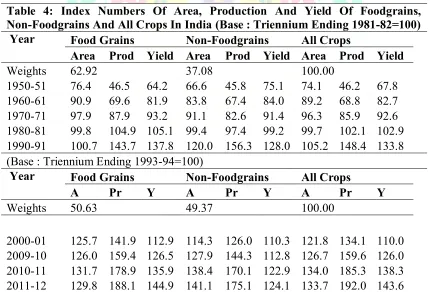
The table makes it clear that there has been a diversification in favour of high value food crops. In a country like India whose agricultural sector is dominated by marginal and small farmers this type of diversification is relevant since the farmers are on the lookout for more lucrative alternatives to traditional farming, which are not giving them the expected returns due to a variety of factors like declining soil fertility, high cost of fertilizers etc. .The agricultural sector consists of the crop sector followed by livestock, fisheries and forestry mainly. Even today, the crop sector is the dominating sector. The table shows a decline in the share of crops. In contrast to this general trend in India in eastern and north eastern regions the share of both crop and livestock sectors increased in the total value of agricultural output. Though the share of fisheries has gone up, its percentage contribution decreased. Increased demand for milk, meat, eggs is the driving factor in increasing the share of the livestock sector.
Table 4: Index Numbers Of Area, Production And Yield Of Foodgrains, Non-Foodgrains And All Crops In India (Base : Triennium Ending 1981-82=100)
Year Food Grains Non-Foodgrains All Crops
Area Prod Yield Area Prod Yield Area Prod Yield
Weights 62.92 37.08 100.00
1950-51 76.4 46.5 64.2 66.6 45.8 75.1 74.1 46.2 67.8 1960-61 90.9 69.6 81.9 83.8 67.4 84.0 89.2 68.8 82.7 1970-71 97.9 87.9 93.2 91.1 82.6 91.4 96.3 85.9 92.6 1980-81 99.8 104.9 105.1 99.4 97.4 99.2 99.7 102.1 102.9 1990-91 100.7 143.7 137.8 120.0 156.3 128.0 105.2 148.4 133.8 (Base : Triennium Ending 1993-94=100)
Year Food Grains Non-Foodgrains All Crops
A Pr Y A Pr Y A Pr Y
Weights 50.63 49.37 100.00
2000-01 125.7 141.9 112.9 114.3 126.0 110.3 121.8 134.1 110.0 2009-10 126.0 159.4 126.5 127.9 144.3 112.8 126.7 159.6 126.0 2010-11 131.7 178.9 135.9 138.4 170.1 122.9 134.0 185.3 138.3 2011-12 129.8 188.1 144.9 141.1 175.1 124.1 133.7 192.0 143.6
Notes: Data for 2011-12 are based on Advance Estimates Source: Ministry of Agriculture, Government of India
[image:8.612.92.522.331.623.2]SRJIS/BIMONTHLY/RAJLAKSHAMY NANDAGOPAL(1587-1599)
JULY-AUGUST, 2014. VOL. II/XIII www.srjis.com Page 1595 Crop Diversification between regions various sectors in India: Within the crop sector, there is a clear diversification from food crops to non food crops. In this category, items like oil seeds, fruits, vegetables, spices and sugarcane became more popular as compared to coarse cereals. This trend was primarily prompted by the higher incomes. Studies of region wise trends in diversification have revealed that the Southern region including Karnataka, Kerala experienced the maximum diversification followed by the western region. These regions are rain fed and hence it was logical for the farmers in this region to choose pulses or oil seeds or plantation crops. In the case of horticulture also these regions showed tremendous progress. The northern region of India had always concentrated on rice and wheat crops. The reasons were favorable Government policies including procurement prices, high yielding technologies and irrigation development. Hence diversification to other crops is less pronounced in this region. In spite of the fact that the northern region had high potential to develop horticultural crops, due to lack of proper linkages horticulture has not developed.
[image:9.612.71.542.225.524.2]The eastern region is mostly underdeveloped with low per capita income and lack of infrastructure etc. .Mostly rice is grown in these parts though climatically it is suitable for horticulture.
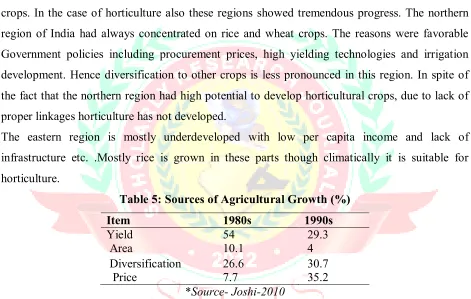
Table 5: Sources of Agricultural Growth (%)
Item 1980s 1990s
Yield 54 29.3
Area 10.1 4
Diversification 26.6 30.7 Price 7.7 35.2
*Source- Joshi-2010
SRJIS/BIMONTHLY/RAJLAKSHAMY NANDAGOPAL(1587-1599)
JULY-AUGUST, 2014. VOL. II/XIII www.srjis.com Page 1596 Prospects of Shifting to High Value Crops: The climatic and soil conditions in India are very favourable for the cultivation of horticulture and commercial crops. Even growing livestock and cultivating the various crops are complimentary. Fruits and vegetables cultivation is found to be more profitable0than cereals. Another reason why diversification is pragmatic in Indian conditions is that growing pulses or oilseeds does not require irrigation as in the case of rice or wheat. It is possible to delineate such areas, plan properly and based on the input and resource needed regional planning is possible. This will help in the best use of available land for various crops without endangering food security since a serious concern in diversification to high value crops is jeopardizing food security by diverting to non food and commercial crops. If larger areas are diversified into the production of commercial and non food crops it lead to food scarcity and dependence on imports which is not desirable
Another justification is the feasibility of cultivating commercial crops especially horticultural crops by small holders who constitute the majority in the Indian context. It has been felt that there is a positive relationship between growth in cultivation of horticultural commodities and the proportion of small holders. It was indicated that crop diversification was more noticeable in areas having a high concentration of small holders. Livestock and horticultural crops are labour intensive and hence are tailor made for small holders. The family labour is in many cases sufficient to carry out these activities which will enable them to supplement their income source. Problems In diversification: Higher profitability is no doubt a strong incentive to diversify into commercial crops and is desirable for better utilization of land, higher incomes for farmers and improved availability of a variety of commodities. The lack of easy access to markets and assured prices are problems which the small farmers encounter. Price volatility creates uncertainty which calls for creating better linkages between production, processing and marketing. Unless the supply chain is strengthened farmers will not venture into these lines of farming. In the absence of appropriate markets and rise in supply the prices of the commodities may get adversely affected and thus chock up the opportunities for earning higher income. Livestock products and horticulture products are perishable by nature and in the absence of proper storage, refrigeration and transporting there can be huge wastages.
Suggestions & Recommendations
SRJIS/BIMONTHLY/RAJLAKSHAMY NANDAGOPAL(1587-1599)
JULY-AUGUST, 2014. VOL. II/XIII www.srjis.com Page 1597 2. Assured markets and distribution channels must be made available to farmers. Ideally co-operative farming or contract farming can help to strengthen the linkages.
3. Methods to Minimize post harvest losses which often occur in the case of perishables need to be set up. The high value products require proper refrigeration and cold storage facilities. Otherwise quality will suffer and wastages will increase.
4. Elimination of commissions, market charges, taxesetc .are essential incentives
5. Steps should be taken to encourage the agro- processing industries. In fact the agro processing units can link up with the farmers which are mutually beneficial. It is essential to reduce the bureaucratic controls and plethora of laws with respect to agro-processing units.
6. Encouragement to organized retailing will help to improve market efficiency and profit sharing with consumers and producers.
SRJIS/BIMONTHLY/RAJLAKSHAMY NANDAGOPAL(1587-1599)
JULY-AUGUST, 2014. VOL. II/XIII www.srjis.com Page 1598 holdings. This is especially relevant in India where more than 80% of the land holdings are marginal and small. Hence diverting to horticulture or growing livestock is feasible. Moreover the changing consumption patterns of the people to high value products increases the scope for the farmers to venture confidently into this area. Hence what is needed is an organized system of enabling the farmers to market their crop so that their products reach the destinations. Unlike rice and wheat there is no floor price for these products. It is necessary to protect the farmers against violent fluctuations in price. The problem of lack of cold storage facilities, transportation and post harvest losses need to be tackled. The Government with the help of experts can delineate the areas fit for non-food crops and have a pragmatic approach to encourage the cultivation of non food crops. To establish farm to firm linkages, contract farming is the plausible solution. Though it has been successfully tried out in India contract farming is yet not widely accepted due to various problems. Strengthening the link between production, processing and marketing and popularizing organized retailing are the much needed steps in this direction. Thus the shifting of cropping pattern to non food crops will enable the best use of available land resources without compromising food security
REFERENCES
Bhalla,G.S. Economic Liberalization and Indian Agriculture, New Delhi ISID ,1994
Dorjee, K.S. Broca and Pingali( 2002), „Diversification in South Asian Agriculture; Trends & Constraints‟ Paper presented at the International Conference on Agricultural Diversification in South Asia, NCAP& IFPRI
GulatiAshok and Tim Kelly (1999), Trade Liberalization and Indian Agriculture, Oxford UniversityPress, New Delhi
Agricultural Statistics at a Glance2012, Department of Agriculture & Co-operation , Ministry of Agriculture, Government of India
Area and Production of principal Crops in India Directorate of Economics & StatisticsMinistry of Agriculture, Government of India, various issues
„Livestock Marks Shift in Agriculture‟ Business Standard Feb1,2012 page 5
SRJIS/BIMONTHLY/RAJLAKSHAMY NANDAGOPAL(1587-1599)
JULY-AUGUST, 2014. VOL. II/XIII www.srjis.com Page 1599 FAO ‟Crop Diversification in the Asia Pacific Region‟, Regional Office for Asia & pacific,
www.fao.org/docrep/003