Editorial
J�ne C. Blake, t'vbna�ing Editor
Helen L. Patterson, Fdiror Karhlct·n M. Srerson, Ediror
Circulation
Catherine M. Phillips, Adminisrr�ror
Production
Christa vV. Jcssico, Production Editor Elizabeth McCrail, Tvpogr•1phcr Pc[(;r R. Woodburv, Illustrator
Advisory Board
Samuel H. hiller, Chairn1an SconE. Curler
Thon1Js F Gannon
Donald Z. Harbert Richard). Hollin�sworrh
)ames E. Kuenzel W illiam A. Lling Richard f. l.;1ry Alan G. t'\cmcrh
Robert M. Supnik
Cover Design
Tunndin� and tirt:walb arc two dh:crive rcchnologit:s t(>r ensuring secure commu nicnions between rhc public Internet and private n<:tworks. Our covet· depicts encap sulated and cryptographically .,ccurcd dara as "unreadable" numbers rr:wcling in <1 protective runnel until reaching rhe tircwall. The tirew;1ll functions as;\ screen rhar
permits only authorizt:d cLna to p�ss into rhe pri,·are network wht:rc· p.1ck<:ts ofdat1 can bt: dt:cryptcd wirh a key rh.n is shared between the sender and rhc receiver. DIGITAL implcmcnrarions of a runnel and � tirewall arc presented in rhis issue.
The cover design is by i.tKinda O'Neill ofrhc DIGITAL lndusrri.ll <lnd (3raphic Design Group.
Tl1e D(�ilul Tccl:ntiwljournalis a refereed journal published quarterly bv Digital
Equipment Corpor,nion, 50 Nagog Park, AK02-3/B3, Acton, MA 01720-9843.
H.1rd-copv subscriptions can be ordered lw sending o check in U.S. funds (made pavable ro Digirol Equipment Corporation) ro rhe published-bv address. General subscription rates ,\re 540.00 (non-U.S. $60) for tour issues
and 575.00 (non-U.S. S!!5) tor eight i"uo.
UniversitY and college protessors and Ph.D.
srudcms in the elecoicol engineering and com purer science tields receive cornplimcnrarv sub
scriptions upon regucsr. DIGITAL customers
lll<ll quolif\' tor giii: subscriptions <Uld are encour aged ro contacr their account represenrati,·es.
Electronic subscriptions are available ar
no charge by accessing URL
hnp://www.digital.com/info/subscription.
This service will send an electronic mail nori�icnion when J ne\v issue is available on the I nrerner.
Single copies and back issues can be ordered
by sending the requested issue's volume and number and a check for $16,00 (non-U.S. Sl8) each ro rhe published-by address. Recent issuts are also avoilable on the lnr.erncr ar http://www.digital.com/info/dtj.
DIG !TAL employees mav order subscrip tions through Readers Choice at URL hrtp://wcbrc.das.dec.com or by entering VTX PROF! LE •H the OpenVM5 system prompr.
Inquiries, address changes, and compli
nu:nt.Hy subscription orders can be sent ro rhc Digilal '{(>cbnica!juurnalar rhe
published-bv address or rhe electronic
mail address, [email protected]. Inquiries can also be made bv c�lling the journal oFfice ar 978-264-7549.
Comments on rhe conrenr ot'anv paper and requests ro conracr ourhors arc \\'clcomed and rn.1y be scnr ro rhe managing editor .H rhc pubJisbcd-ll\' or electronic mail address. C:op,Tighr © 1997 Digital Equipment
Corpor;Hion. Cop,·ing without fee is pcr rnirrcd provided thar such copies arc made
t<n use in educational insrirurions bv !acuitY
members and ue nor distributed for com
mercial .ldV<llH<lge. Absrractins wirh credit of Digiral Equipment Corporation's author ship is permirred.
The inform:�rion in rhejouma/is subject to ch,1ngc \\'ithour notice and should nor be construed as a commirrncnr by Digital Equipmenr Corporation or bv the compan ies herein represented. Digital Equipment Corpor.ltinn assumes no responsibility for
:1ny errors thar may appear in the journal. ISSN 0898-901X
Documentation Number EC-P8429-18 Book production was done by Quant.ic Communications, 1 nc.
The tdlo11 i11� .tre tr.tdem;�rk.s of Digital
Equipment Corpor.uion: :\lph.1SerHT. AlpluSwion, AltaVista, DECner, Dil;rr.\L.,
rhc DIGITAL logo, DIGITAL C:S:JX. and Open VMS
BSME is a tr.1ckm.u-k ofR.'iA 1),1[,1 Sec11rill, Inc. ccM.1il is a rr.ldcm;Hk ol·,·c:Mail, Inc., a wholl,· owned subsidiar�· ot' Lon1s DcYclopmcnr . Corporation.
CRYPTOCard is,\ registered rradenurk of CRYPTOC.ud Corp<;ration.
IBM is .1 registered trademark of International Business 1\'i�chine.s Corpor;1rion.
Intel ;lnd Pentium :\rc rce,i�tcrcd rradenurk-. of In rei C:orporarion. "
i\'lacinto:\h is .1 rq.!,ist�.::rcd rradcm;lrk of' Apple
Computer, Inc
Microsoli:, \\'indows, Windows 95, cmd Windows NT .1n: n:e.istcrcd trJ<.kmJrks oflv1it.:niS()fl C(_)rp();.ltic)Jl.
QuickSwitch is a n.:!-'-i�l'-."ITtl rr.H.kmJrk of Quality .Semi(ondw..:ror, f1K.
R.Hnbus is o trademark ofltunbu, Inc.
Sccur<:t'\er Key is .1 rr.ldem.lrk ofDigir.1l Parhwavs, Inc.
SccuriD is a rcgistncd tr:Hknurk of Security DynamiLs Technologies, Inc
S/Kcv is;\ regi,stcred trademark ot'Bcll Communications R.csc.1rch, lnc.
SPEC is a registered rr.tdern;lfk ot'rhe Srand;ml
Contents
Foreword
ALTAVISTA INTERNET SECURITY AND MAIL
The AltaVista Tunnel: Using the Internet to Extend Corporate Networks
Protecting a Private Network: The AltaVista Firewall
Developing Internet Software: AltaVista Mail
ALPHA-BASED WORKSTATIONS FOR NT AND UNIX
DIGITAL Personal Workstations: The Design of High-performance, Low-cost Alpha Systems
Design of the 21 1 74 Memory Controller for DIGITAL Personal Workstations
Further Readings
Paul J. Cormier
Kenneth F. AJden and Edward P. Wobber
J. Mark Smith, Scan G. Doherty, Oliver J. Leahy,
and Dermot M . Tynan
Nick Shipman
Kenneth M. Weiss and Ken neth A. House
Reinhard C . Schumann
3
5
1 7
33
45
57
7 1
2
Editor's
Introduction
DIGITAL has pioneered many net working developments i.n its 40-year
history. A recent development, Alta Vista, has ctptured the popular imagination, as evidenced by worldwide accesses, averaging 18 million per day, to this Internet search engine. Introduced in 1995, AltaVista indexing of the entire Internet \Vas made possible by 64-bir VLM Alpha technology. The index proceeds today at a pace of more than 6 million pages per day. DIGITAL's Internet developments, however, go well beyond search functions. Business users need greatJy improved security and protection to integrate the power oflnternet connectivity into their businesses. It is this need that is addressed in tl1e papers on tunnels, firewalls, and electronic mail. Additional papers in the issue feature high-performance, low-cost Alpha microprocessor-based workstations with unique design features, such as a single-chip core logic ASIC.
"Tunnel" and "firewall" are strong metaphors rhar developers use to connote rhe kind of security software necessary to prorecr business com munications rransmirted over the Internet. Tunneling protects data as ir travels in the public Internet by providing secure encapsulation within the standard TCP /IP proto col. However, as Ken Alden and Ted Wobber explain, additional security measures arc necessary, specifically, cryptographically secure encapsulated packers. The authors describe how secure network-level routing can be achieved by combining tJ1e well known technologies of tunneling and secure channels. The paper includes
Di1,'.it;ll Technical Journal
their experiences in deploying the AltaVista Tunnel within DIGITAL.
Once data arrives-almost-at irs destination, the firewall is a filtering router that determines whicb data packers will be allowed to pass from rhc public to the private ncrvvork. lv!Jrk Smith, Scan Doherty, Ollie Leahy, and Ocr Tynan compare types of firewalls; describe firewall functions �uch as alarm systems, autJ1cntication, and reporting; and present tJ1c design ofcheAiraVista Firewall tor DIGITAL UNIX. The AltaVista Firewall com prises both application-level and p�Kket-filtering functionality and implements the p1inciplc "that which is not expressly permitted is denied."
The development of the Alta Vista Mail product is presented by Nick Shipman as a case study in the issues being engineers who design products t(Jr business users of the Internet. He relates several of the fundamental assumptions about engineering pro jects that were overturned by the engineering team; tor example, product definition had conventionally started witJ1 tJ1c tcclmical issues to be addressed and now starred instead 11�tl1 a product pw-cbase price . .htrtl1er, in an eftorr ro ensure product sim plicity tor the target customer, they imposed the principle of simplicity throughout tl1e project-simplicity in presentation, in design, in meth ods, ::md in implementation.
A low-cost, high-performance workstation has been designed by DIGITAL's workstation engineering group. In the first of two papers about the DIGITAL Personal \IVorkstarions, Ken Weiss and Kenny
Vol. 9 No. 2 1 997
House discuss the primary reasons f(x initiJting a wholly new design: simul taneously ro take advantage of new, high-performance memory technolo gies and ro implement at a low cosr. A new, low-cost core logic design
was needed ro fimction as rhe CPU to-memory interface. The result, described by Reinhard Schumann, w:ts tl1e 2117 4 single-chip core logic ASIC f()r the Alpha microprocessor. Designers were able to meet tl1eir own aggressive performance go:Ils bv f(xusing on reductions in the main memory latency that was attributable ro rhc memory controller subsystem and by using as much of the raw bandwidth of the Alpha 21164 CPU's data bus as possible.
Subjects tor papers in the next issue of rhe .fou mal inc I ude the par:dlel SCSI technology, shared desktop software, and a high performance debugger.
Jane C. Blake
Foreword
Paul J. Cormier
DirectorofEngineerinl!,, AltaVista
In this issue, we focus on Internet software products that arc part of the Alta Vist:� portfolio. These p:�rticular products arc notable because of the fashion in which they have been developed and brought to market.
With the commercial Internet sofr w:�re industry moving quickly from nonexistence tO the most competitive and fast-moving industry in existence, engineers have recognized the need for innovation at all stages of product lik. To succeed in Internet software, engineers must be innovators both in technology and in product devel opment. Innovation begins with the concept and continues through product development and on to delivery to the end user; and the cvcle continues.
From the beginning of the Internet revolution, DIGITAL h:�s been a significant player in Internet somvare and solutions development. The company's success is attributable to the many diverse and technicallv t::lientcd groups that are f(JCusing their resources on developing soft ware and solutions for Internet users.
The products presented in this issue are good examples of the resuJts that can be achieved in extremely short periods of time-six to nine months-when research, product development, and services groups work together to bring world-class products to market.
In the case of the Firewall product, research rook the lead early, while
the Internet was still used almost exclusively by the scientific and tech nical community. As one of the first Fortune 500 companies to connect to the Internet, DIGITAL quickly saw the threat to the security of its network and, in response, members of its research group developed the initial firewall technology. As with many innov:�t.ions, this technology was recognized by DIGITAL's cus tomers as sratc-ot:the-art and was in turn demanded by tl1em for their own uses. While this complex technology was stiU in its infancy, DIGITAL Services was able ro deliver high-end security solutions to companies that desired to connect to the Internet.
Not surprisingly, these companies also needed to address the same net work security issues that DIGITAL raced as a consequence of collJlecting to the public inti-Jstructure. Starting with the firewall technology, the SEAL Firewall Service was born, and DIGITAL became one of the very first Internet security somvare providers.
As more and more enterprises connected to the Internet and experienced the same security issues DIGITAL had been facing, it became evident that both firewall technology and the market were beginning to
mature. These factors quickly led to the DIGITAL AltaVista Firewall product.
DIGITAL responded to this mar ket demand quickly, initially moving the SEAL technology to a standalone product on DIGITAL UNIX plat forms. The same engineering group that developed the SEAL technology tor tJ1e Services group seamlessly moved to product engineering, first in the Internet Business Group and later to the Alta Vista Group. This smooth transfer of experience a.J lowed
DIGITAL to go to market after a
short, six-momh development cycle and to be one of the first vendors to ofter a st.andalone, commerciJI fire wJII product.
Engineering has .learned ti·om
research and carried that knowledge :�nd experience through services :md directJy to the product engineering community. Moreover, engineering has adapted its process to sr::�y com petitive within the Internet market, enabling DIGITAL to be a technol ogy leader witl1 the Alta Vista Firewall product on DIGITAL UNIX and, more recently, on the \Vindows NT platform.
The AltaVista runnel, or secure '�rtual private network product (VPN), has similar roots to those of the fire wall technology. Tunneling was born in response to a need for visitors at DIGITAL facilities to securely tra verse the trusted internal network with untrusted packets. Again, the research community rook the lead.
With the tllllJleiing concept reversed, that is, access allowed from the untrusted external net\vork (the
4
Internet) to the trusted corporate network and with encryption added, the rudimentary basis tor today's product was put forward.
The newly tonned Internet engi neering group was ready to take the technology and prototype forll'ard, putcing into action a new instance of the research-engineering partnership. As was the case with the firewall, a tal ented engineering group moved the initial product to market within six monrbs. DIGITAL was once again able to lead in the Internet space and dajm the first VPN product to surface in tl1e market, one that currently has many compecirors.
As was also the case with the fire wall, DIGITAL recognized a good
use of this technology to solve one of its own problems. The telecommlllu cacions costs of moving d1e U.S. -based sales force to home offices and con necting it back into the corporate net work were becoming excessive. The information services organization ran a pilot with 2,000 sales people, using local Internet connections and the Internet tunnel to authenticate users to the DIGITAL corporate network. The solution was perfect because the tunnel supplies the encrvption capa bility that ensures the privacy of con fidential business data as it traverses the public network inti·astructure.
The results ofthe pilot were stag gering in terms of the savings in telecommu1ucations costs and keep ing our internal network secure. With this pilot in hand, informacion services moved to ofter the tunneling service to other internal groups as a
Digital Technical journal
way to solve DIGITAL's mobile worker problem.
DIGITAL Services has also begun to ofkr 1 he runnel product, coupled ll'ith int(mnation services' pilot experiences, as a solucion to its cus tomers-the same model used with the initial tirell'all technology.
As DIGITAL and the industrv move f·()rward in using the Internet
JS an efkctive business tool, standards
arc emerging that DIGITAL is help ing to define. Future products arc being dc1·doped based on the stan dards and include fean1res that allo11· other companies, "'ho may have verv different securitv strategies :llld poli cies, to take advantage of the Internet in a secure and productive manner.
The model of research, product development, and services II'Orking together to deliver innovative, cunjng edge products and solutions that use the ubiquity of the Internet to solve rcal-ll'orld customer problems will continue to expand DIGITAL's Internet capabilities and ofkrings.
A cornerstone of the research product-development-services model is the t:-�lent and mind-set of the prod uct engineering group. The advan tage of keeping intact the core of the Internet and AltaVista engineering groups through the entire techno logical cycle that I present here has enabled the engineers to react quickly to changing requirements and market conditjons. The group has consistently responded ll'ith t\\'0 major product releases per year and some minor releases needed to satisf)• J particular, significant demand.
Vol. 9 No.2 1997
As has been proven with these products, the model that is good for the company and t()r the customer is one that includes
• Researchers incubating and piloting the technology in the labs
• Engineering groups t"<lpidlv pro totyping and developing product • Services groups developing a
The AltaVista Tunnel:
Using the Internet to
Extend Corporate
Networks
The public Internet has become a low-cost connection medium for joining remote employ ees or offices to a private intranet and for per mitting impromptu high-speed connections between business partners. This connectivity is offset by a significant loss in security. The AltaVista Tunnel, a DIGITAL product, offers secure network-level routing over Internet connections by combining two well-known networking technologies: tunneling and secure channels. This paper discusses the design and implementation of the AltaVista Tunnel and describes our experience in deploying the product within DIGITAL.
I
Kenneth F. Alden Edward P. Wobber
The public Internet is fast becoming a ubiquitous and inexpensive medium t<x connecting remote employ ees or offices to a private intranet or f(x permitting impromptu high-speed connections between business partners. This gain in connectivity is offset by a signifi cant loss in security, however. The Internet is notori ous tor electronic break-ins and eavesdropping.
The AltaVista Tunnel, a DIGITAL product, otkrs network-layer routing over secure Internet connec tions. This allows , tor example, a mobile user to con nect securely to his or her corporate network using the Internet. Similarly, a corporate network can employ the AltaVista Tunnel to securely link remote offices with Internet connections. Although our product uses the Internet for packet transport, all traffic is encapsu lated within cryptographically secured connections. Because the AltaVista Tunnel is a nct\vork-laycr router, client applications can run without modifica tion. Moreover, our product is firewall independent and therdore can be used in concert with most com mon firewalls. The AltaVista Tunnel supports both static connections to remote oHices and intermittent connections to single-user machines. Currently, imple
mentations exist for the UNIX, Windows 95, and Windows NT platforms.
In this paper, we begin \Vitb an overview of the ben efits and pittalls presented by using the Internet tor private net\vork connectivity. Next, we describe the design of the net\vork protocol used by the Alta Vista Tunnel, with a particular tocus on the security concerns that Jed to this design. We then discuss how we imple mented our design. Finally, we brief1y describe our experiellce deploying the tunnel product in a hu·ge cor porate network, provide performance data, and discuss some of the securiry risks rhis technology entails.
Overview
Before rhe I ntcrnet became pervasive, corporate net works were built ti-om leased and dial-in telephone lines. Such networks carried su bsrantial costs for both communications equipment and telephone service. Usually, security relied on the inaccessibility of rhe physical medium, and over the years, the risk of wiretap has proved to be slight when compared to password
cracking or other higher-level �lttack.
T
he reason for this is th�lt most telephone systems are both proprietary and cemra
lly managed, and they are tbcrdore not easy to subvert in the brge without a subst�lnti:d budget.The Internet brings opportunity J.nd challenge to the modern corporate network designer. Glob:1l con nectivity makes it possible to replace expensive leased lines and communications equipment with Internet connections. However, such connections LKk the physical security of telephone lines. Furthermore, direct connection to the Internet poses numerous, well-documented security problems. Conscquentlv, many organizations find it necessary to isolate their private networks behind firewalls-filtcring routers that place constrJints on packets Jllo\\·ed ro pass between protected and public networks. The policy decisions made in configuring firewalls alwavs im·olve a difficult trade-off between securiry and functionalitv. Cryptography makes it possible to emulate most of
the properties of physically secure wire using Internet connections. When enc1psulated at a suitable protocol
lev
e
l, cryptographically secured data cJ.n be allowed to trJ\'ersc firewalls without substanrialll· weakening security policy. However, the encapsulation protocol must require no implicit trust in the router nodes and links that make up the f�1bric of the insecure nct\\'ork. To solve this problem, the protocol employed by the AltaVista Tunnel uses a symhesis of t\\'O \\'ell understood networking constructs: tunncli ng proto cols' and secure ch:mnels.2Protocol Design
In computer networks, tunneling is the act of cnGlpsu lating one communications protocol within another.
For example, a DECnet-in-IP tunnel might tL1nsporr
D.ECnet daragrams over Jn Internet Protocol ( l P) net work using IP datagrams. In this Jrr:mgemcnt, IP
c
btagrams act only as a transport meci1J.nism-rhere isno need for the active nodes in the IP network to inter pret or ro manipulate the encapsulated DECnet pack ers. A tunnel alone, however, cannot gu�1ranrce rh<lt an
NETWORK X
1
TUNNELEDIP PACKET \
\
-'
-'
\
intermediate node ("man-in-the-middle") will not inrention�11ly read or modin' the data portions of tun neled pJckcts. To prevent such unwanted tampering, we cryptographically secure encapsulated packers for passJge over the public net\\'Ork. Abstractly, data passed over this secure channel appears once Jnd onlv once at the rccei,·er as sent by the sender. furthermore, an attacker observing the public net work cannot read this cbta. Thus, tunnel encapsula tion ensures that private-network daragrams unnot interact with tl1C routing algorithms oft he public net \\'Ork, whereas secure channels guarantee that the tun neled dat�l arri,·c intJct fl·om an authenticated source and that privacy is maintained.
figure L depicts a secure runnel in operJtion. Nodes A and R ::ti"C tunnel endpoints, that is, packet routers
that forw�1rd to �1nd from tunneled routes. Node A processes datagrams in priv
a
te networkX and deter
mines which, if any, should be routed to private net workY.
Node A then enc:1psulatcs all such datagrams and sends them securely across its tunnel connection to node B. Node B checks the integrity of each trans mission and then decapsulatcs and fclrll'ards the cbtagrams ro networkY.
'The process is symmetric, although this is not t1icrurcd.These methods can be used to connect any sort of private network; however, our product is specifically designed to connect TP networks Lw tunneling !P dau
gr<lrns. Given rbc dominance of!P in the network rnJr
kcrplace, the choice of network type is easl'. The choice of protocol from \\'hich ro construct tunnel connec tions is more difficult. There arc three obvious c::tn didares: Ll', User Dar:1gram Protocol (UDP), Jnd
Tr<msmission Control Protocol (TCP).
Since IP is a network protocol, there is no notion of port-IC\'CI Jddressing. This implies that IP-in-IP tun nels must be
t
mplemented very close to the operating system, and anv multiplexing of runnel connections must be explicitly Jddcd. Since our goal \\'as f(Jr our tunneling product to be firewall and operating system independent, we rejected I I' in t:l\·or of �1 higher-lc\·elprotocol.
l
NETWORK Y-'
(
-'
�
<(�
<(�
NODE A
�--�
�f--1
NODE Bf--
1
T
a:
.
a:Figure 1
A Secure Tunnel in Operarion
Di�it�l Technical jounul
)
lLT
1---
I NT E R N ET---1
Vol. 9 0:o. 2 1997
The choice bcrween UDP and TCP depends on whether datagrams or byte streams best apply to tu n
neling. Since our application is i nherently connection oriented, TCP offers a natural fir, while any UDP design must include an explicit means for reliable con nection maintenance . In addition, byte streams elimi nate constraints caused by packet boundaries, so fragmentation and maximum size determination pose few difficulties. Furthermore, byte streams enable forms of cryptography and data compression that wou ld be awkward to implement using datagrams. Of cou rse this flexibility docs not come without cost. TCP adds an extra l ayer of reliable transmission, and per packer headers arc l arge .
The previous discussion lends no clear advantage to ei ther p rotocol option . We chose to impl ement the AltaVista Tu nnel using IP-in -TCP in order to simplif)' firewall security policy. As shown i n Figure 2, a tu nnel connection usually traverses at l east one firewall. I n practice, a runnel virtual connection is composed of several distinct TCP connections laid end-to-end . 'vVhcre TCP connectjons meet, there is a bidirectional relay process that shuffles packets in either direction . Such a relay service is incl uded with most tirewal ls.' We also offer an intell igent relay that participates in the tunnel connection protocol and therefore allows more flexibility i n choosing destination endpoi nts.
By using TC P connections and relays, we min imize the policy changes required to permit tunnel txaversaJ. All that is necessary is to enable TCP connections between the tunnel endpoint, which is on the private network, and the relay, which is j ust outside the fire wall . ( Note that relays are logical ly outside the firewall, al though they might be implemented on the firewa ll machine. ) Whether a generic or an i ntelligent relay is used, fi rewa ll-traversal connections always originate on a locally controlled network. Furthermore, TCP connection requests are i n frequent, and therefore TCP traversals are more tractable to log at the fi rewall than arc datagrams. Although the firewall industry has begun to develop standards for I P-in-IP tunnels,' " our choice of IP-in-TCP gives us the clear advantage
Figure 2
S I N G LE-USER TUNNEL
Tunnel with Intell igent Relay
R ELAY
I
INTERNETI
that tunnel endpoints need not be packaged with or dependent on a specific fi rewall i mplementation . Eventually, the emerging standards wi ll probab.ly pre vail for static tun nels; however, no standards exist for transient (mobile) users and our solution remains quite viable.
Implementation
As with many tunnel implementations,' we provide tunneling by tricki ng the operating system's rout i ng layer i nto forwarding packets to a n emulated network device. This device does not transmit packets directly,
but rather it encapsul ates them as data witrun a h igher
level protocol . The Alt:Nista Tu nnel implementation contains three major components: the tu nnel applica tion, the protocol handler, and the pseudo-device dri ver. The maj n fu nction of the tun nel application is to interact with the user or system administrator and to modif)r the system routing tables to make tunneled routes avajlable. This code also maintaj ns a database of acceptable partner endpoints and matching crypto graphic keys. The protocol handler im plements the tunnel e ncapsulation protocol and all associated cryp tography. The pseudo-device driver is responsible tor redirecting packers tl·om the local IP stack to the encapsulation protocol handler and vice versa.
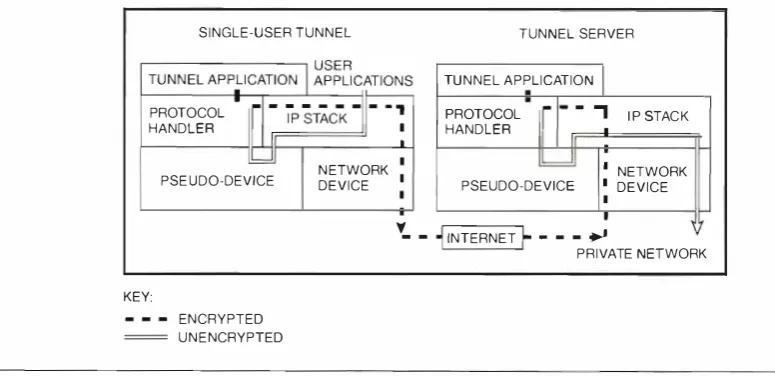
Figure 3 shows how the components of the AltaVista Tunnel cooperate to process tunneled IP packets. The diagram depicts a single-user client and a tunnel server. Although the same basic su-ucture applies to all tunnel endpoi nt software, there are su b stantial differences between single- user and server con figurations, and between the UNIX and Windows implementations. For example, the single-user version usually runs only while the user is actively connected.
On the server side, the tunnel application is a daemon process that continuously wajts for connection requests and services existing connections. The fol lowi n g three sections discuss the individual system components in detail and , where appropriate, point out the djfferences between the VJJ"ious software configurations.
FIREWALL
Digir�l T�ch nical )ourn"l
TUNNEL SERVER
SINGLE-USER TUNNEL
PROTOCOL HANDLER
PSE UDO-DEVICE N ETWORK DEVICE
TUNNEL SERVER
TU NNEL APPLICATION .
PROTOCOL • I'"
r
• ,I P STAC K
HANDLER
II
u
INETWORK PSEUDO-DEVICE 1 DEVICE
I
Y. •
,
INTERNETr
• • • ...PRIVATE NETWORK
[image:10.588.91.479.54.242.2]KEY:
Figure 3
ENCRYPTED UNENCRYPTED
Svstem Components and Data Flow
The Tunnel Application
The primary flmction of rhc tunnel application is to present a user inter face ( U I ) . Although each instantia tion of the user interf1ce is slightly different, the flmc tion of the application remains the S <1 111 C . The AJtaVista Personal Tu nnel '97, a single- user configura
tion, offers a straighttorward graphical user interbce ( G U l ) (see Figure 4) that allows the user ro register a set of target runnel servers, select from this set, and then establish and tear down connections. The emphasis is on simplicity. A tunnel connection may be started from either a command line interface or the GUI. If the G U I is used to start a tunnel, the GUI win dow can be minimized and ignored until the end of the tunnel session. The �lpplication logs all interesting events , reflects current state through the user inter face, and notifies the user ofexceptional events. In this configu ration, only traffic h-om l ocal appl ications is directed over the tunnel, and no i nbound tunnel con nection requests arc accepted.
In the server configuration, rhe tunnel application is significantly more complicated . The primary tl.mction of the server code is to restrict ru nnel access to ;Ju tho rized clients. To achieve this, the server application is �1lso responsible tor issu ing cryptographic credentials and maintaining an authorization database . In add i tion to accepting con nections, a tunnel server is capa ble of initiating them. In the "workgroup" tunnel configuration, two servers cooperate to maintain a permanent connection, for example between a corpo rate network and a remote office local area network ( LAN). A tu nnel server is a tl.IIl-t1edged router-its job is to forward packets from the protected network into the tunnel and vice versa. We offer servers tor both rhe UNIX and the Windows NT environments.
Digit,ll TcchnicJI )ourn,l l Vol . 9 No. 2 1 9 97
Routing
As mentioned in the Implementation section, our tu n nel works by manipulation of the system routing table. In some environments, such as \Vindows 95, there is no fu lly integrated notion of packet routing (some times called IP t(Jrwarding). However, there is support for m u l tiple network devices. Each network device bas a uniquely assigned I P address so that the IP stack can determine which device to use when transmitting packets. The AltaVista Tunnel pseudo-device appears to the operating system as j ust another network device. There is a one-to-one relationship between tunnel connections and pseud o-devices. During con nection establishment, the tunnel application activates a pseudo-device and modifies the routing table to i nclude any newly reachable private network or net \vorks . The application then restores the original state upon termination of the connection.
The tunnel server is implemented in a richer routing environ ment. Each server typically routes an entire IP class-C subnet\vork (254 addresses) but may support partial subnetworks or mu ltiple networks as well. A tunnel server can maintain multiple con nections, and this is accomplished by assigning a different I P add ress to each pseudo-device/tunnel con nection. I P pseudo device add resses :tt both ends of the runnel arc assigned dytumically or statically from a pool of' IP add resses control led by the server. The operating system, com bined with a routing management program such as
gated/ pert<xms all necessary route propagation. As
discussed in the next section, each tunnel user can be restricted to a specific set ofiP addresses. Tbis approach allows net\vork managers to esta blish routing policy based on user class . To obtai n fine-grain control over a given tunnel con nection, the server can also run a packet-filtering program such as screend' to restrict the
:
:=
AltaVista Personal Tunnel - [ crl]
1!!1� 13
file
I
unnels
.E.
dit �iew .hog Window
!i
elp
User Name
IT unneiM gr@digital. comServer Key ld
JeriT unnel Server J
LR L. digital. corn1 st Firewall t
unne
l-firewall
. digital. corn2nd Firewall
Port
I E;E;66
Port j6666
Port j
.C
on
nec
t�Log---,
[0�3/04/97 Ot:: 44: 2J] Looking up ho::) addres::: information
[09/04/97 Ot:: 44:2J] �; tarting tunnel to C:R L. digital.com
..[0�3/04/97
o::::44: 34] Connected . now authorizing
. ..[0�3 /04/97
o:::::44:
35]
.t..uthori
ze
d. loading ps:eudo adapter. .....
-[09/04/97 0:3: 44 35]
Pseudo adapter ini
tiali
zed.[09/04/97 0:3: 44: 35]
T unnel up . client I P addres:::' i�<1 E;_1 1 . 1 60. 63
� J
_j
[image:11.587.53.514.56.438.2]For Help, press F1
I
D isconnected
I
R EAD :
0
Figure 4
The Al taVista Persona l Tu nnel '97 User lnterbce
Key Management and Access Control
In practice, a secure channel protocol is only as strong
as the techniques it employs for naming and key distri bution. In the AltaVista Tunnel system, we must name both tunnel servers and human users. (Tunnel users must be authenticated by name, not by IP address, since many users acquire IP addresses dynamical ly from rl1eir Internet service provider. ) Because no ubiquitous infrastructure exists to support such a namespace, our software currently assumes a flat, server-specific nam ing structure, much in the style of PGP .'' We use RSA
public-key cryptography'0 to establish secure connec tions. Each tunnel endpoint maintains a key file that contains a seq uence of names and matching public
keys-one ( name, key) pair per potential destination. Each key file a.lso contains the password-encrypted pri vate key of its maintainer. The key fi le is signed by this private key to prevent tampering. Note that the com promise of any given (nonscrvcr) key file docs not affect the security of other endpoints. Although we
could have obtained a similar result with symmetric key encryption , we believe that the current design wil l a.llmv our system to scale up gracefully through the addition of public key certification.
When a new user is registered , the tunnel server generates a new RSA. key and key file for that user. The user's public key is inserted into the server's key file, and conversely, the server's key is inserted into the user's key tile. To obtain enough randomness for key generation, we care fu l ly measure tbe elapsed ti me (in mach i ne instructions) to perform each of a seq uence of d isk seeks. These results are then hashed to provide a seed for a pseudorandom number generator. There is substantial evid ence that the air turbu lence between hard-disk heads and platters contri butes sufficient ran
domness for such purposes."
Both single-user and server tunnel applications use key files, and the credentials stored t herein, as a mini mum requirement tor successfu l authentication and authorization. Our server software places additional
[ ()
constraints on i ncoming connection requests. I n :�ddi tion to recording a new user's public key, tunnel servers maintain a sma l l set of tun nel con figuration parameters for each user. These parameters define the range of IP add ress pairs that can be assigned to the server and client pseudo-device, the set of network routing entxies that are passed from server ro client at tu nnel formation, and the minimum level of encryp tion strength permitted for a tunnel con nection .
Creating or initiating J ru nnel connection can be a complex task, considering the network path the tu nnel connection might traverse. This path can include nvo intelligen t relays, any nu mber of generic TCP/I P
relays, and a tina! tunnel endpoi nt. Requiring the user to remember such a path woul d have made the tun nel exceedingly d i fticult to operate. Therefore, the AltaVista Tunnel stores this i n formation i n an external contiguration file. Each new user receives both a con figuration file and a key file to i nitialize a newly installed tunnel application. These tiles provide all the dJta necessary to run the tunnel application-the user need only press the connect button.
The Protocol Handler
The AltaVista Tunnel protocol handler is responsible tor establishing secure virtual connections benveen run nel endpoints and for encapsulating and transmitting redirected IP packets as data. These connections are vir tual in that they are composed of several distinct TCP connections joined by relays. Upon tl1e establishment of each n ew virtual connection, the tunnel endpoints engage in a dialog to :tgree on security parameters for that connection. For our purposes, a secure connection must have at least the tol l owing properties:
• Authenticity-Data received over the channel orig
inates at a known sender.
• I ntegrity-Data received over the channel cannot
be modified in transit.
• Exactly-once dclivcry-E:�ch datum is received once
and only once.
• Privacy-An attacker may not learn the contents of transmitted data by observing the nenvork.
We use cryptography to provide these properties. As d iscussed i n the previous section, key files form the long-term basis for trust benveen tunnel e ndpoints. Prior to transmitting data, the parties must perform mutual authentication and agree on a key length, a set of cryptographic algorithms, and a shared encryption key. It is important that keys be negotiated period i cal ly, since this mini mizes the benefit a n attacker can gai n from breaking a speciftc key. In the current
AltaVista Tunnel , we perform the very simple key exch<mge shown in Figure 5 .'
Digit<ll Technical )ounul Vol. 9 l\!o. 2 J 997
l . A sends to B: A, B,
( P,�> l ,
Kl> ' (S , )2 . B sends to A: B , A,
{ P�>,),
K ' (S�>)A and B compute:
P,
= Best (( P,,l
1\{ P,, l )
A and B compute: S = S, S,
A and B compute: K = Reduce ( Pt, S )
Figure 5
Tu nnel Kev Exclungc Protocol
Figure 5 describes our key exchange protocol; K ' ( ) signifies encryption with the public component of an RSA key pair. Suppose tunnel nodes A and B wish to share an encryption key. Both cJn determi ne their partner's public key from their local key file . As shown i n Figure 5, node A invents a random nu mber S.,, e ncrypts it with node B 's public key, and sends it to node B's n etwork add ress. This message also includes
{P,,l,
a set of proposed cryptographic algorithms and key lengths that node A considers acceptable for com mun icating with node B. Upon receipt of message 1 ,node B simi larly constructs and sends response 2 . Now nodes A and B can choose P,, a negotiated choice of key length and algorith m , by intersecting sets
{ P,,)
and { P,, ,l
and then selecting the best available option using an a priori ranking. Both parries can also compute S, a shared key seed, by decryption and exclusive OR. Finall y, nodes A and B can produce a shared key by red ucing the shared seed to a kev i n a manner specific to P,. For simplicity, this prot;
col is executed for every new connection, a nd by defau lt, a new con nection is established every 30 minutes. This technique gu<lrantees that the active key is updated frequently.O ur protocol succeeds because only node B can decrypt message 1 , and only node A can decrypt mes sage
2.
As a rcsu l t, both parties em bel ieve that K is known only to each other. An intennediJtc node can not control the negotiated key by intercepting mes sage 1 and then retra nsmitting a mod i fied version to n ode B. ( Note that this represents a deniJI -of-service attack. ) Both node A and node B, ho,vever, must take some care in choosing their algorithm proposals. An intermediate node can force the resultant connection parameters P to be the weakest proposal jointl y acceptable to both parties. This problem woul d be elimi nated i f messages l and 2 vvere cryptographical l y signed at thei r origin .
Krawcyzk er aJ . ' !) is a cryptographic h ash of data that incorporates a shared secret. This signature guarantees the authenticity of the data ( more specifically, the signer m ust know K) and ensures that any i n-tr:msit modification will be detected . Once-only delivery is guaranteed by including a monotonically increasing sequence number in the keyed h ash . Since TCP sequence numbers arc not secure, an attacker could otherwise insert previously sent data into the data stream. Final ly, privacy is obtained by applying a sym metric cipher, such as the RC4 algorithm,'' to all tun neled datagrams using K t o initialize the keying material . Note that since our transport is rel iable, hav ing no missing data or out-of-order delivery, it is easy to usc a stream cipher for this purpose. Similarly, com pression state can be maintained over the l ifetime of a connection . This allows for efficient compression of data prior to encryption , although we have yet to implement this.
To implement virtu<ll connection establishment and data encapsulati on, we segment the data stream i nto typed command ffan1es. Using these command fi·ames, we implement a straightforward protocol for relay activation, connection establishment, key exchange, data transmission , failure detection, and connection teardown . Since the data stream is reliable, this proto col is quite simple. Moreover, the data carried by key exchange packets is opaque from the point of view of the connection protocol , and key exchange can encompass m u l tiple roun d-trips. Therefore, the basic mechanism we usc to establish tunnel connections should support other forms of cryptographic creden tials and negotiation as new standards for naming, trust management, and key exchange emerge.
ln the UNJX server, the protocol handler is imple mented as part of the tunnel server daemon, which runs in user space. I n the Windows environment, we found that tunneling cou ld not be implemented in user space. Under certain circumstances, the Windows fi le system can perform remote operations while holding critical system locks. Si nce the tunnel applicatjon can not run wl1ile these Jocks are held , deadlock ensues. Therefore, we implement the Windows protocol han dler in kernel space, alongside the pseudo-device driver. This approach also improves performance by eliminat ing the need to copy data to user space.
The Pseudo-Device Driver
In the Al taVista Tunne l , the pseudo-device d river's sole p urpose is to redirect outgoing IP packets to the tunnel protocol hand lcr and to reintroduce i ncoming packets from the protocol handler to the IP stack. Once the tunnel appl ication has set up and authenti cated a tunnel connection, it activates the pseudo device driver to enable redirection of the tunnel packets into and out of the connection . During activa
-tion, the IP stack recognizes the new network device and updates the routing table to reflect any newly available routes.
Because of d i fferences in networki ng architectures, the implementation of this driver is very simple on the UNIX platform and quite complex on the Windows 95 and Window NT platforms. Our initial attempt to implement the Windows pseudo-device emulated an Ethernet LAN . This design became overly baroque due to the need to emulate LA.l'-J services such as the Address Resolution Protocol (ARP ) . 14 Recently, the pseudo-device in AltaVista Tunnel '97 was redesigned to closely resemble a dial-up network adapter, thereby eliminating the need for LA..t'\1 emu lation. We describe all these implementations in thjs section.
UNIX Pseudo-Device
On the U N I X p latform, the pseudo-device driver is a straightforward emulation of a network device. The back end of this network device communicates with a user-level p rocess through a socket i nterbce. ·rhe sim pJicjty of this design comes from the tact that the UNIX IP stack delivers packets to network devices without additjonal encapsulation. Since the physic1l device layer takes care of Ethernet Media Access Control (MAC) encapsulation, the emulated network device docs not have to deal with complexiti es such as ARP ' 4 process i ng. The U N IX tunnel application uses the
ifconfig
program to activate the pseudo-device, assign an I P address to the device, and i nsert the address into the routing table.Windows Pseudo-Device
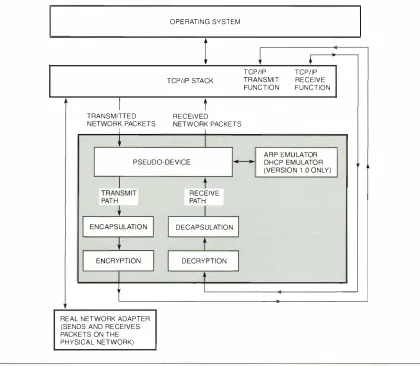
The first release of the vVindows 9 5 tu nnel pseudo device was considerably more complex than its U NI X counterpart. U nder the Windows operating system, most 32-bit network device drivers arc implemented using the Network Device I nterface Spccification . 1 ' This application programming interface (API) i s tai lored to hand le physical devices, not abstract I P i nter faces. In the vVindows environment, the network stack must have considerable knowledge of the p hysical net work. For example, the stack must implement the MAC protocols necessary to transmit a packet on a supported medium. As a result, our initial implemen tation of a network pseudo-device emu lated a com plete Ethernet LAN , including a gateway host that provides AR.P and dynamic add rcssi ng services, as shown in Figure 6.
Every Ethernet device has a unique hardware or MAC address. When IP packets arc sent over the Ethernet, they are transmitted using these hardware addresses. IP packets with a destinatjon address off the local LA.l'-J must be sent to a gateway host router located on the LAN . The tunnel pseudo-device creates an illusion of the complete LAN , including the gate way host, within the device driver and assigns the I P
12
OPE RATING SYSTEM
1
TCP/IP�
+
TCP/IP TCP/IP STACK TRANSMIT RECEIVEFUNCTION FUNCTION
I
t
TRANSMITTED RECEIVED
NETWOR
�
PAC KETS NETWORK PACKETSI
�
I
A R P EMU LATOR
PSEUDO-DEVICE -- DHCP EMU LATO R
' (VERSION 1 . 0 ONLY)
TRA
J
SMIT RECEIVEt
PATH PATH
�
I
I
ENCAPSULATIONI
I
DECAPSULATIONI
t
I
ENCRYPTIONI
I
DECRYPTIONI
REAL NETWORK ADAPTER
(SENDS AND RECEIVES PACKETS ON THE
PHYSICAL NETWORK)
Fig ure 6
Control Flow in the Wind ows Pseudo- Device
address of the remote tunnel server pseudo-device to this emulated host. The IP stack is tooled into believing there are two nodes on the emulated network
LA.J'\1-the tunnel client, vvhich provides LA.J'\1-the local node, and the tunnel server as the gateway host to the r<'al net work or networks on the other side of the tunne l .
When the IP stack prepares t o transmit a packet, it must know the lvlAC add ress of the destination or the gateway host. If the stack does not know the MAC add ress, it transmits an ARP packet to the pseudo device. The pseudo-device responds only to ARP requests tor the gateway host J\llAC add ress. To resolve this A RP req uest, the driver i nc ludes the functional i ty of an ARP server. Note that the MAC add ress must be unique to prevent a conflict with the MAC address
of a real device. Clearly, no Ethernet device wi l l ever contain '' i\tlAC address of
08-00-2B-OO-OO-O l
or08-00-2B-00-00-02 ,
which are the first two Ethernet addresses that Digital Equipment Corporation ever assigned . In the AltaVista Tunnel, the first of these addresses always serves as the pseudo-device 1\1AC address; the second serves as the i\tlAC add ress of rhe gateway host.Dig;ir,d Techn ic1l journal Vol . 9 No . 2 1 997
t
I
The network pseudo-device in AltaVista Tunnel '97 is simple by comp::�rison . With help from Microsoft, our implementation is now able to emulate a Windows dial-up adapter rather than a LA.!'\! . DiaJ-up adapters are treated specially b}' the Windows IP stack . No A RP packets are directed at dial -up devices, only one emu lated address must be maintai ned , and intormation about gateways and dynamic IP addressing can be supplied ojier link establishment. This, of course, perfectly matches the runne l 's operating environment. The control tlow outlined in Figure 6 correctly describes the operation of this new pseudo-device implementation; however, as noted, ARP and dynamic add ress emulation is no longer required .
Dynamic IP Address Binding
[image:14.588.96.516.56.422.2]additional routing com plexity at the tunnel server. By using unique address pairs, the rou ting tables on both the client and server can be maintained easily without platform-specific software . This design also permits conventional packet filtering on the tunnel server. The tunnel address space can be a valid, externally visible or hidden nenvork, thereby supplying an almost unlim ited number of addresses.
To facilitate a very large number of registered users for any given tunnel server, we implement dynamic reuse of address pairs. Since dynamic addresses arc negotiated at connect time, we need to bind I P addresses t o pseudo-devices
after
tunnel connection establishment. For the Windows platform, we usc the Transport D river Interface (TDI ) "' from within the pseudo-device d river to perform both dynamic address assignment and routing table modification.Performance and Experience
Tunneling docs add overhead to data transmission. This overhead fal ls into nvo categories. First, the encapsulating TCP connection adds network overhead by introducing an extra level of framing, plus any acknowledgment and retransmission traffic that is required to support rel iable delivery. Second, cryptog raphy adds to the per-packet processing cost, although this docs not generally become significant at low speeds. More to the point, transmission of encrypted data defeats the compression present in many modems. The most significant performance impact is observed when using the Telnct protocol . Because this protocol sends few characters per packet, the encapsulation over head is quite l1igh. In addition, the overall network path benveen Telnet client and server can be long enough to make character echoing sl uggish . Remember that the round-trip nenvork path may pass through at least two tunnels, a firewall, and potentially several other routers. Thus, to properly support interactive applications, it is essential to choose an Internet path so as to minimize the round-trip latency to the destination network.
The performance is considerably better tor nonin teractive applications such as File Transfer Protocol ( FTP ) or Hypertext Transfer Protocol ( H TTP) where packets are usually tilled to capacity. To p revent I P packet fragmentation, the tunnel pseudo-device reduces the maximum transmission unit size by the amount of the encapsu lation overhead . For fu ll pack cts, the encapsulation overhead is less than 5 percent. We have observed a peak rate tor tunneled FTP file transfers as high as 6.4 megabits per second. This mea surement was performed over an u nloaded switched Ethernet between a 200-megahertz ( M H z ) Pent i u m Pro client running Windows N T version 4 . 0 and a 300-MHz D I GITAL AlphaServer system running D IGITAL
UNIX
version 3 . 2 . In this case, the FTP client and server programs ran on the tunnel endpointmachines. Without using the tunne l , the same config uration produced throughput averaging 8 . 8 megabits per secon d . This translates to a tunnel throughput effi ciency of about 73 percent. In both tests, processor usage never exceeded 50 percent.
In another test, we used t\Vo 1 50-MHz AJphaServer systems running DIGITAL
UNIX
version 3 .2 as tunnel endpoints. This tunnel was used to route between two Pentium 1 66-MHz processors running Windows 95 and LapLink, a popu lar remote access program for portable PCs . 1 7 Tunneled file transfers between these computers ( with L1p Link compression turned off) averaged only 1 5 percent slower than transfers without the tunneJ . Thus, by using the U D P-based LapLink protocol, we were able to achieve a substantially better tunnel throughput efficiency tlun that reported for FTP. As before, processor usage never exceeded 50 percent. From these simple tests we conclude that tun nel performance is not limited by CPU speed but instead by the nenvorking environment and payload protocol. We also believe that TCP /IP window size may play a role in limiting tunnel throughput.The cost of cryptography at the client is not a seri ous performance issue. A 1 33-?viHz Pentium proces sor can compute RC4 at more than 25 megabits per second and keyed hashes at nvice that speed. The cost of server cryptography is mitigated by the fact that most client traffic is bounded by low link speeds and that servers typically run on fast machines.
Digital Equipment Corporation is using the AltaVista Tunnel product to support its mobile work force and telecommuters. Previously, the company used wide-area, dial- u p telephone lines at extremely favorable rates, but more than 30 percent of the I P traffic that used this service had a destination address outside the company. This meant that the company was acting as an I nternet service provider ( ISP) and was doing so at long-distance rates! A short-term eval uation revealed that users who remotely connected to the company network for more than 10 hours per month would achieve substantial cost savings by con necting through a public ISP and using the AltaVista Tunnel. Local calls are still d irectly dialed to remote access servers ( RAS ) located in areas where employee density is highest. In an early pilot, the top 1 00 RA.S users were offered ISP accounts and access using the AltaVista Tunnel . The reduction in month ly tele phone costs was dramatic-enough to fund each of the users' ISP accounts for more than a year! I n addi tion, many of these telecommuters can now use higher-speed options such as cable moderns or Integrated Services D igital Network ( ISDN) to con nect to the p u blic nenvork, yielding an overall higher speed connection into the company than using traditional directly dialed 2 8 . 8 Kbps modem access. At the time of this writing, more than 2 ,000 DIGITAL employees worldwide usc the AltaVista
14
Tunnel in their daily work. vVe have observed t hat a single tunnel server can handle at least 1 2 5 concurrent users, although the average nu mber of active users is much s maller. In fact, the ratio of active to registered users rarely exceeds
l
to1 0 .
Currently, D I GITAL offers its employees three tu nnel access points within the United States and is planning to deploy additional tunnels overseas.Security Risks
Products like the Alta Vista Tunnel are not risk free. The most obvious risks have to do with cryptography. Cryptographic securi ty is never absolute. One can only hope to keep the cost of mounting an attack high when compared to the value of a successfu l attack. Thus, any sensi ble application of cryptography m ust be well ahead of any expected attackers in terms of key length and algorithm strength. Barring fundamental change i n the science of cryptography, prudent engi neering is sufficient to provide this advantage. Since our implementation does not mandate a specific algo rithm or key size, the strength of our product's cryp tography can improve over time.
As d iscussed earlier, the tunnel encapsu lation proto col protects against many common threats such as eavesdropping, i mpersonation, replay, and man-in the-middle attacks. Dcnial-ofservice attacks such as tlooding a tunnel server with connection requests remain a problem, however, especial l y since connec tion request processing is compute intensive. Newer key exchange protocols, tor example, Oaldcy,1' prcbcc such costly operations with exchanges of random val ues that then identify subsequent messages. Thi s tech nique defeats simple flood ing attacks by allowing the server to control the rate at which identi fiers are issued . Our product might benefit from this approach, although the benefit would come at the cost of an add i tional network round-trip.
Attacks on password-protected key files are a greater concern, especially since laptop computers can easily be stolen. If accessed directly, many password-protected containers are subject to dictionary attack, and key files arc no exception. I f an a ttacker succeeds in compromis ing a key file, the attacker can masquerade as the key tile's owner. The fact that users arc often careless i n choosing passwords exacerbates this problem.
Of course, tunnel servers must be carefully protected . A tunnel server not only holds val uable keying infonna tion but also enjoys special privileges tor firewall traver sal. An attacker who can compromise such a machine can compromise an entire nct\vork. Therefore, tunnel servers should be handled as carcfidly as firewalls.
Perhaps the greatest threat posed by I P tunneling is tlut it extends tl1e perimeter ot· any firewall it traverses. Because the tunnel traffics in encrypted IP packets, auditing at the fi rewa l l is d i nicu l t. In add ition , there
Di,;ital Tec h n ical Journal Vol . 9 No. 2 1 997
arc subtle problems that arise ti·om routine use of remotely connected machines . I n the single-user tun nel , we d isal low the forward ing of packets not origi ruting on the local machine, but by definition, this can not be the case for tunnel servers. Consider what happens if a telecommuter uses a tu nnel server on his or her home LAr"! to access a corporate net\>mrk . The home LAN is then automatically part of the corporate network. Now suppose that a housemate simi larly connects to another private nct\vork f!·om a machine on the same home LAN. This configuration could allow unintended routing bet\\'ccn t\vo private net \vorks! Real -time routing is not the only risk. A com puter that is exposed to the raw I nternet or to a hostile corporate network cou ld become infected with a virus or Trojan horse program that becomes active only upon tunnel connection establishment.
All these threats are real; however, the benefits to be gained t!·om tunneling are substant i a l . Any policy that involves the deployment of iP tun nels should careful ly counterbalance these risks �md benefits . At the very least, machines that usc tu nneling, especially if iP for ward ing is e nabled, s hould be more carcfir lly managed than those directly connected to protected nervvorks.
Summary
The AltaVista Tunnel was jointly prototypcd by researchers at t\vo DIGITAL laboratories, the Cambridge Research Laboratory and the Systems Research Center. The prototype effectively demon strated that the I nternet could be used to reduce telecommuting costs, and within a year, it had grown i nto a D I GITAL prod uct. 1'' Since that time, the AltaVista Tunnel product bas evolved to offer support tix a variety of client and server plattorms, as well as improved performance and enhanced cryptography. The AltaVista Tunnel is an effective tool for extend i n g corporate net\vorks. B y combining tunnels and secure channels, i t allows I nternet access to supplant leased telephone lines without substantial Joss of security. Our deployment of this technology within DIGITAL has cut costs dramatically without substan tially afkcting net\vork performance. We expect that secure tunneling will play an important role in servic ing the telecommuters of the future.
Acknowledgments
into presen table sofrware . Our cryptography is imple mented using the BSAFE tool kit tl·om RSA Data Security, Inc. Final ly, Ed Balkovich got us to work on this in the first place.
References and Notes
1 . \V. Cheswick and S. Bcllovin , Firewa/ls a nd Internet Sew rity ( Reading, Mass . : Addison-Wesley, 1 994 ) : 79-80.
2. B. Lampson, M . Abadi, M . Bu rrows, and E. Wobber, "Aurhenrication in Distributed Systems: Theory and Practice ," A CM Transactions on Computer Systems, vol . 10, no. 4 ( N ovember 1 99 2 ) : 265-3 1 0 . This paper is av<lilable a t ftp:/ /ftp.digital .eom/pub/DEC/SRC/ n::se� rch·reports/SRC-083 .ps.Z ( also available in .ps, ps.gz, ps.zip, and .pd f formats) .
3 . Generic relays typically forward TCP byte streams from a specitic port on the ti rewal l to an ( add ress, port) pair on the internal network.
4. R. Atkinson , "Security Architecture for the I nte rnet Protocol," Internet R.FC 1 8 2 5 ( August 1 9 9 5 ) . This docu ment is avaibblc at fi:p:/ /ds . intern ic. net/rfc/ r k l 825 .txt.
5. R . Atkinson, " I P Encapsu l ating Secu ritY Payl o,�d ( ES P ) , " I nternet RFC 1 8 2 7 ( August 1 995 ). This doc· umcnt is :�vail able at fi:p:/ /ds.in terni c. net/rfc/ rk 1 8 27.txt.
6. RSA S/WAN I ni tiative . For more information about the I PSec I n teroperabiliry Forum of RSA Data Secu· rity, Inc., Redwood City, Calif, see http:/ jwww. rsa. com/rsa/SWAN.
7. GateD-Gateway Routing Daemon, Merit Gate · Daemon Consortium, http :/ /www. gated .org.
8. J. Mogu l, " U sing screend to Implement I P/TCP Secu rity Pol icies," Network Note NN - 1 6 ( Palo AJro, Ca lif. : Digital Equipment Corporation, Network Svstcms Laboratory, July 199 1 ). Reissued as NSL Technical Note TN - 2 . This document is avail able at http:/ jwww. research.digital.com/nsljp ublications/ TN · 2 . h tm l .
9 . P. Zimmerma n n , The Ojjlcial PCP User's Gu ide
(Cambridge, Mass . : M IT Press, I 995 ). This book can be ordered at http:/ /www-mitpress.mi t.edu/mi tp/ re..:en t· books/ comp /pgp·user. h tml.
1 0 . R. Rivest, A. Shamir, and L. Adleman, "A Method tor Obtaining Digital Signatures and Public-key Cryp rosystems," Commun ications of the ACM, vol . 2 1 , no. 2 ( rcbruary 1 978): 1 2 0- 1 2 6.
1 1 . D . D;wis, R . l haka, and P. Fenstermacher, "Crypto graphic Randomness from Air Turbulence in Disk Drives, " Advances in Cryptology-CRYPTO 94 Conference Proceedings ( August 1 994 ): 1 1 4- 1 20 . This paper i s available a t http:/ jworld .std . com/ -dtd/r:�ndom/forward .ps.
I 2. H. Krawczyk, M. Bellare, and R. Canetti, "HMAC:
Keyed - Hashing tor Message Authentication," I n ternet
R.FC 2 1 04 ( February 1997) . This document is avail able at ftp:/ /ds.inr ernic. net/rfc/rfC2 104.m.
1 3 . l n tormation about the RC4 algorithm is ava ilable in "Amwers to Freq uently Asked Questions About Today's Cryptography, Version 3.0, Question 87" t'rom RSA Laboratories, Redwood City, CA at http:/ jw\vw.rs:LCom/rsalabs/newt:1q/ q87. htm I.
1 4 . D. Plu m mer, "An Ethernet Add ress Resolution Pro tocol," I n ternet RFC 826 ( N ovember 1 98 2 ) . This document is available at ftp :/ /ds.i nrernic.ne t/rfc/ rfc826.txt.
1 5 . Network Device I nterface Specification, Windows 95 Networking ( Red mond, Wash . : M icrosoft Corpora tion, 1 994). This specitlcation is available at http:/ I www.microsoft .com/organizations/ corpeva I/ doc u ·
ments/( 48 ) .doc .
1 6 . Transport Driver I nterface Specification ( Redmond , Wash . : Microsoft. Corporation, 1 994 ) .
1 7 . Lap Link for Wi ndows 95 software i s available trom Traveling Somvan:: , Inc. at http :/ /W'ww.travsoti:.com.
1 8 . H. Ornu.n, "The OAKLEY Kev Determination Proto· col," l merm:t Draft ( May 1 996 ) . Tl1is draft is avai lable :lt ftp :/ /ds . i nternic.net/i nternet·drafts/drafi:-ic tf- ipse..:· oaklcy-02 .txt.
19. AltaVista TmlJlel product information is available at http:/ /al ta\�Sta.sofi:ware.digital.com/nulneljindcx.htnl.
Biographies
Kenneth F. Alden
Ken Alden is a consulting engineer at DIG ITAL's Cambridge Research L<boratory. Ken's research in terests include novel network appliances, image processing, and digital photography. In previous work, Ken conrri buted to various other software engineering etlorts tor the Open VMS operating system and Open VMS workstations. He was the lead graphical developer for the VAX/TPU workstation toJ iow·on , the technical director for the Europea.n Networki ng/ Workstation Roadshow, and the cua lyst tor Network Services I ntegration Services' I nternet services development. Prior to joining D I GITAL in 1 982, Ken received a B.S. in ind ustrial engineering/somv:�re engi· nccring trom the University of Mich igan in 1 98 1 . He has three patents pending, two related to nmneling technology and one 011 <Ill Internet application that uses :�udio.
16
Edward P. Wobber
Edward "Ted" Wobber is a consLLlting engineer at DIGITAL's Systems Research Center. Ted 's research interests include computer security, d istributed systems, and col labor:uive systems, and he has published extensively in these areas. Prior to joining DIGITAL, Ted worked tor Xerox Corp
oration in Palo Alro, California, where he designed and
impl emented networking protocols d uring the early days ofcliem-server computing. Ted received a B .A fi·om Harvard College in 1 9 7 5 . He holds three patents and
has ten patent appl ications pending.