Practices and Knowledge Management with
Technology-Based Tools Used by the School
Manager
Tânia Regina Corredato Periotto*; Arthur Gualberto Bacelar da Cruz Urpia**; Janacilda Leite Wessellenns***
*,** Management of the Knowledge in the Organizations - UNICESUMAR/ICETI - University Center of Maringá - Brazil
*** Management of the Knowledge in the Organizations - UNICESUMAR University Center of Maringá - Brazil;
DOI: 10.29322/IJSRP.8.11.2018.p8371
http://dx.doi.org/10.29322/IJSRP.8.11.2018.p8371
Abstract-The use of technology-based tools in knowledge management practices is already part of many administrative processes of the school organization. Understood as strategic in the automation of access, diffusion and sharing of knowledge, technology supports information management as a support tool. The manager of a school organization in action, is faced with the dimension of people, process and technology. In this study the objective is to verify the stage of implementation and reach of practices and tools of knowledge management based on technology used by managers of public-school organizations. The methodology adopted was qualitative and quantitative. A total of 98 school managers from a city in the south of Brazil participated in the study, answer a questionnaire with 27 questions. The results showed that managers use of knowledge-based management practices knowledge-based on technology in their daily lives, often intuitively, but already recognize them as facilitators.
Keywords: Knowledge Management Practices; Knowledge Management Tools; Technological Base; School Organization School Management.
I – INTRODUCTION
Understood as a support mechanism, Knowledge Management, this technology can be used as a communication and organizational management resource. With several devices that enable the modeling of tacit knowledge of the individual, it favors its sharing within the organizations [4].
The socialization of knowledge according to [21], generates new knowledge. The need for management of this knowledge is punctuated by [12] and [1] considering that they are conceived in a tacit or implicit way. In tacit knowledge, it derives from the experiences and personal mental elaborations, is not verbalized or; systematize. Whereas the explicit knowledge is easy to share, clear and evident for appropriation.[17].
According to [11], the source of knowledge comes from socialization, roams outsourcing where tacit knowledge is articulated in explicit concepts, favors the combination that is when the new knowledge is added to the existing knowledge, finally the internalization, that is, explicit knowledge is incorporated in the tacit.
For [18], knowledge conversion follows the four types described by [11], based on the synergy of tacit knowledge and explicit knowledge, resulting in the construction of organizational knowledge.
Knowledge management according to [16] aims to achieve the best in the organization. From the point of view of this author, based on [10], it is the involvement of the people that make up the organization and the dissemination of their knowledge, whether implicit or implicit, when incorporated, that will result in a new knowledge.
The value of sharing knowledge is highlighted by “[2] is associate with the ability to”. utilize and develop our collective intelligence, inventiveness, creativity, problem solving, cooperation, flexibility, the ability to develop networks and deal with change, and a commitment to lifelong learning.
According to “[19] the theory of the creation of organizational knowledge is based on the relationship between people at all levels - individual, group, organizational and inter-organizational”. In the field of management, [3] reinforce that the school manager directs his actions under the concept of “co responsibility, partnership, collaboration, interaction, common problem solving, dialogue, approximation of everyone concerned”.
In this perspective, [15] states that this involvement “... provides a better knowledge of the objectives and goals of the school, its organizational structure and its dynamics, of its relations with the community…”
The view of Knowledge Management by “[22] is the process of promoting and managing the generation, sharing, use and measurement of knowledge, experience and expertise in organizations”, especially in the organizational environment, a knowledge management system is indispensable.
According to [20] it recalls what is stated in the 1996 National Education and Guidelines Law (LDB) that “managers must perceive the tendencies of change, learning to investigate, analyze and interpret the new challenges and benefit from their own experience [20]”. According to [14], contemporary school management is built on the based on decisions made in a collective way that are conducted by each sector or participant according to their specificity, aligned with the purpose of the group.
It will only be effective if the processes that are part of the dimensions of the school manager’s performance do not remain centered in his/her power. Being a manager in an organization, regardless of the segment and, in the school context, this is not different, requires participative and shared action.
Organizations, among their procedural aspects, construct and store information that supports knowledge bases. However, technology extends autonomy and facilitates the practice of Knowledge Management, through its resources, which favor the formal or informal sharing of information, favoring the construction of new knowledge. [2].
The domain of technology resources, according to [9], adds value to the process of selecting, combining and recombining information, providing greater fluidity in the construction or sharing of knowledge. In addition to these ideas, [13] emphasizes that the use of new languages, and technology is a great facilitator, contributes to the evolution of individuals. The production of knowledge from the sharing of knowledge requires engagement and interaction.
It is defended here that the contemporary school manager is one that besides the bureaucratic assignments in the pedagogical and administrative area also involves the collective and conscious participation of the other involved ones. This kind of relationship will only be consistent if the communication and information among its peers is clear, and effective in a way that reaches everyone.
In his researches, on Knowledge Management practices and tools [7], [8], structured a division into three categories: human resources management, organizational process structuring and technological base. Practices and technology-based tools support Organizational Knowledge Management and include the automation and management of information that can occur through applications, information technology tools that promote capture, diffusion and sharing.
In this context, the portals/intranets/extranets are defined as practices and technology-based tools; Forums (face-to-face and virtual), Collaboration tools such as portals, intranets and extranets, Workflow systems, Content management, Electronic Document Management (GED), Data Warehouse (DW), Data Mining (DM), Costumer Relationship Management (CRM), Balanced Scorecard (BSC), Decision Suport System (DSS), Enterprise Resource Planning (ERP) and Key Performance Indicator (KPI).
Having as purpose in this study, to verify the stage of implantation and reach of these practices and tools in the school context and to try to understand through the Knowledge Management supported in this list of own possibilities of the technological base, it is intended to understand how the school administrator can benefit or find support for their decision making as manager of the school organization.
II - METHODOLOGY
The methodology adopted for this study, is characterized as exploratory due to its type. It had the direct involvement of the researcher to better approximate the investigated universe and information gathering that subsidized the data interpretation and analysis. Regarding the procedures, it is characterized as a field research where different resources such as action research was used. [5]
According to the objective presented and the public involved, it is classified as qualitative and quantitative. [6] defines in qualitative the study whose purpose is to identify and analyze data and information providing details that may explain certain behaviors and are difficult to measure. [5] on the quantitative format emphasizes the need to present results treated through statistical procedures.
Since the proposal in this study was to verify if the school managers used practices and tools of knowledge management based on technology as support for their actions and at what stage and reach this happened, it was chosen to use a questionnaire with a list of 27 tools and practices of Knowledge Management. This instrument is already validated for its purpose, also subsidized the Institute of Applied Economic Research - Brazil (IPEA) in investigations related to this subject.[8].
A group of 98 school managers from the public education network, from a city in the northwestern part of the state of Paraná, southern Brazil were investigated. The public education network in this city is composed of 110 schools, but at that time, in October 2017 during the continuing education promoted by the Program of Excellence in Basic Education (PEEB), only 98 school managers were present. The PEEB is an institutional extension project promoted by the Higher Education Center of Maringá, Brazil (UNICESUMAR), which has been ongoing since 2013 and currently serves 33 cities. The focus of PEEB’s work is school management and how it can impact the quality of basic education.
To collect information, it was used a questionnaire with 27 Knowledge Management tools and practices, in which managers should indicate as an option in a structured Likert scale a set of four alternatives in which (1) would be the indication of “few isolated initiatives within the organization”; two (2) “some departments use practice”; three (3) “Many departments use practice”; four (4) “widely disseminated within the organization”.
III - RESULTS
In order to analyze the results in relation to the effective level of implementation of the selected tools and practices, only the responses related to levels 3 (the tool has already been implemented) and 4 (the tool is already implemented that present important and relevant results for the organization ). The other levels helped to determine the school organization's intention to implement the tools in the future (level 1), whether the tools are already in the process of being implemented (level 2), or there are no plans to implement the tools (level 0).
To analyze the data, we used the Excel spreadsheets editor version 2010 of Microsoft Office that allowed the calculation of the frequency distribution and weighted average.
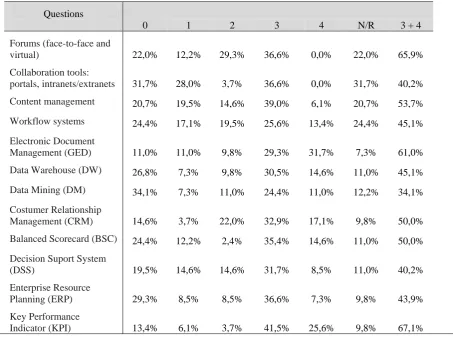
[image:3.595.82.536.392.729.2]Table 1 shows the frequency distribution in percentage, relative to the effective level of implementation of tools and practices based on the technology used by the 82 managers who answered the questionnaire. It should be noted that the column (N / R) refers to questions that for some reason were not answered. The column (3 + 4) represents the sum of the answers that indicated level 3 (the tool is already implemented) and level 4 (the tool is already implemented that presents important and relevant results for the organization).
Table 1- Distribution of frequency in percentage relative to the effective level of implementation of tools and practices based on technology
Questions
0 1 2 3 4 N/R 3 + 4
Forums (face-to-face and
virtual) 22,0% 12,2% 29,3% 36,6% 0,0% 22,0% 65,9%
Collaboration tools:
portals, intranets/extranets 31,7% 28,0% 3,7% 36,6% 0,0% 31,7% 40,2%
Content management 20,7% 19,5% 14,6% 39,0% 6,1% 20,7% 53,7%
Workflow systems 24,4% 17,1% 19,5% 25,6% 13,4% 24,4% 45,1%
Electronic Document
Management (GED) 11,0% 11,0% 9,8% 29,3% 31,7% 7,3% 61,0%
Data Warehouse (DW) 26,8% 7,3% 9,8% 30,5% 14,6% 11,0% 45,1%
Data Mining (DM) 34,1% 7,3% 11,0% 24,4% 11,0% 12,2% 34,1%
Costumer Relationship
Management (CRM) 14,6% 3,7% 22,0% 32,9% 17,1% 9,8% 50,0%
Balanced Scorecard (BSC) 24,4% 12,2% 2,4% 35,4% 14,6% 11,0% 50,0%
Decision Suport System
(DSS) 19,5% 14,6% 14,6% 31,7% 8,5% 11,0% 40,2%
Enterprise Resource
Planning (ERP) 29,3% 8,5% 8,5% 36,6% 7,3% 9,8% 43,9%
Key Performance
Indicator (KPI) 13,4% 6,1% 3,7% 41,5% 25,6% 9,8% 67,1%
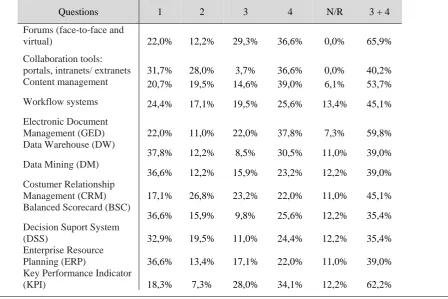
Regarding the breadth of reach of selected tools and practices, only the responses related to levels 3 (many departments use the tool) and 4 (widely disseminated in the organization) of the reach stage scale were analyzed, fact that only the answers of these two levels indicate that the analyzed ferraments have a wide reach.
Table 2 - Distribution of frequency in percentage relative to the level of reach of tools and practices of technological base.
Questions 1 2 3 4 N/R 3 + 4
Forums (face-to-face and
virtual) 22,0% 12,2% 29,3% 36,6% 0,0% 65,9%
Collaboration tools:
portals, intranets/ extranets 31,7% 28,0% 3,7% 36,6% 0,0% 40,2%
Content management 20,7% 19,5% 14,6% 39,0% 6,1% 53,7%
Workflow systems 24,4% 17,1% 19,5% 25,6% 13,4% 45,1%
Electronic Document
Management (GED) 22,0% 11,0% 22,0% 37,8% 7,3% 59,8%
Data Warehouse (DW)
37,8% 12,2% 8,5% 30,5% 11,0% 39,0%
Data Mining (DM)
36,6% 12,2% 15,9% 23,2% 12,2% 39,0%
Costumer Relationship
Management (CRM) 17,1% 26,8% 23,2% 22,0% 11,0% 45,1%
Balanced Scorecard (BSC)
36,6% 15,9% 9,8% 25,6% 12,2% 35,4%
Decision Suport System
(DSS) 32,9% 19,5% 11,0% 24,4% 12,2% 35,4%
Enterprise Resource
Planning (ERP) 36,6% 13,4% 17,1% 22,0% 11,0% 39,0%
Key Performance Indicator
(KPI) 18,3% 7,3% 28,0% 34,1% 12,2% 62,2%
Source: prepared by the authors (2018).
In order to analyze the effective level of implantation and the level of amplitude of the reach of the tools through Table 1 it is possible to observe the scale that was elaborated with the parameters being created of arbitrary form.
Table 1 - Scale for analysis of the results regarding the effective level of implantation and scope of the KM practices.
Effective Level of Implantation
and Range of Scope 3+4
Low level
Between 0 to 39%
Middle level
Between 40% and 60%
High leve
Above 60%
Fonte: Elaborado pelos autores (2018).
The results related to the effective level of implementation of tools and practices based on the analysis scale presented in Table 1 indicate that the Forums (face and virtual) with 65.9%, Electronic Document Management 61.0% and Key Performance Indicator with 67.1% of the indications by the school managers, fall in with a high level, that is, above 60%. In this same line, regarding the scope, the Forums (face-to-face and virtual) appear with the same percentage, that is, 65.9% and Key Performance Indicator with 62.2%. Electronic Document Management with 59.8% passed the middle level.
In comparison with the level of reach, it can be observed that Data Warehouse and Enterprise Resource Planning appear with 39% and, Balanced Scorecard, Decision Suport System both with 35,4% if configured as low level.
The Electronic Document Management that presented with 61.0% of effective level of implantation appeared with 59.8% related to the reach level. Although the difference is very small, it is something that deserves observation since this tool or practice should be part of the routine of the school manager who currently needs to access different systems linked to the secretariat and regional nucleus of education, so that the process of control and execution of the school's commitments. Data Mining, in both situations, shows a 34.1% implementation level and a 39.0% scope level, which is low, ie, between 0% and 39.0%.
IV - CONCLUSIONS
In general, the data showed that the schools surveyed have the tools implanted, but they are not exploited according to their potentialities since the level of reach of the tools is low. This has a number of implications for schools, such as quick access to information or documents that can support a decision that is needed. Rework of activities that have not been stored, shared or received due treatment according to their importance.
It is common in the public network, when at the beginning of a new government mandate the discontinuity of the previous work mainly as regards access to information. Even if they are in some way available, they do not give credibility either by the way they are stored, or by the possibility of access, duplicity, incomplete data among other characteristics that weaken the security of that will use them.
Although each of these technology-based tools or practices presented here are resources of high potential and robustness, they are not explored in their entirety in the context of the schools investigated here. This may even be justified by the lack of increased knowledge on the part of the school manager of how to explore the resources and attributes of each of them, in order to be used as support in their actions of school management.
It is also necessary to consider not only the school manager, but also the teacher team and the pedagogical coordinator, to recognize the importance of Knowledge Management in the context of the school and the impact that it can have if identified as source of construction of knowledge sharing and can be used as an ally in professional practice.
In seeking to answer the goal proposed here, which was structured in verifying the stage of implementation and reach, the practices and tools of knowledge management, based on technology are used by managers of public school school organizations, it is evident that there is still a lot to walk around. It was possible to recognize that the tools and practices of knowledge management based on technology are present in the daily life of the school, however, there is still a front, in which an alert is left for the need for future studies.
This will require a hard work of continuing training in order for them not only school manager, but all education professionals to recognize the convenience in combining the use of systematic processes to create, identify, apply and share knowledge based on tools and practices based technological.
V - REFERENCES
[1] A. S. Ortiz, A. S. “Testing a model of relationships among organizational performance, business alignment, and governance”. 2003. 199 f. Dissertation of PHD (Information Science) - University of North Texas, Texas. 2003.
[2] A. Hargraves. Teaching in the knowledge society: education in the era of insecurity. Porto Alegre: Artmed. 2004.
[3] A. T. Vieira, M. E. B. Almeida, & M. Alonso (Org.). Educational management and technologies. São Paulo: Avercamp. 2004. [4] D. Grotto. “A look at knowledge management. Journal of Management Sciences”. Florianopolis, year 3, n. 6, p. 31-37, September. 2001.
[5] E. M. Lakatos. Methodology of Scientific Work. 8th Ed, Sao Paulo. 2017.
[6] E. R. Turato. Treatise on the Methodology of Clinical-Qualitative Research. Sao Paulo-SP. Editors Vozes. 2013.
[7] F. F. Batista. “The challenge of the administration of knowledge in the administration and planning of the Federal Institutions of Higher Education (IFES)” .Text for Discussion, n ° 1181. IPEA, Brasília. 2006
[8] F. F. Batista. Model of administration of the knowledge for the Brazilian public administration: as it implements the administration of the knowledge to introduce results in benefit to the citizen. Brasília: IPEA. 2012.
[9] G. S. Rosa. “A synthesis study on the use of computer science as a teaching-learning tool.” (Specialization). Federal University of Santa Maria, Center for Arts and Letters, Specialization Course on Information and Communication Technologies Applied to Education, EaD, RS. Available at http://repositorio.ufsm.br/ handle / 1/14560. 2012.
[10] I. Nonaka, & H. Takeuchi .Creation of Knowledge in the company: how Japanese companies generate dynamics of innovation. Rio de Janeiro: Campus. 1997.
[11] I. Nonaka, & H. Takeuchi. “Theory of the creation of organizational knowledge”. In: Takeuchi, H .; Nonaka, I. Knowledge management. Porto Alegre: Bookman, p. 54-90. 2008.
[13] J. Moran, J. Changing education with active methodologies. In: SOUZA, Carlos Alberto de; MORALES, Ofelia Elisa Torres (orgs.). “Contemporary Media Collection”. Media Convergences, Education and Citizenship: young approaches. Vol. II. PG: Foca Foto-PROEX / UEPG, 2015. Available at: <http://www2.eca.usp.br/moran/wp-content/uploads/2013/12/mudando_moran>. Accessed on: 27 Oct. 2018 [14] J. C. Libaneo, J.C. “Degree in Pedagogy: absence of specific contents of elementary education”. In: Gatti, Bernadete Angelina et al. (Org.). For a
National Teacher Training Policy. São Paulo: UNESP, p. 73-94. 2013.
[15] J. C. Libaneo; et. al. “The School Organization and Management System”: theory and practice. In: School Education: policies, structure and organization. São Paulo: Cortez. 2006.
[16] M.; L, D. Hammer, & T. Davenoport. “Why do not we know more about knowledge?” MIT Sloan Management Review, Cambridge, v. 4, n. 45, p. 14-18. 2004.
[17] M. Nissen, M. Kamel, K. Sengupta. “Integrated analysis and design of knowledge systems and processes”. Information Resources Management Journal, Hershey, v. 13, n. 1, p. 24-43, Jan. / Mar.2000.
[18] M. M. Rodrigues, A. R. Graeml. “Tacit or explicit knowledge?” The epistemological dimension of organizational knowledge in Brazilian research on knowledge management. Perspectives in Management & Knowledge. João Pessoa. v. 3, n. 2, p. 131-144, dez. 2013.
[19] R. Magalhães. Fundamentals of organizational knowledge management. Lisbon: Sílabo. 2005.
[20] S. S. Santana, R. S. Gomes, & J. S. Barbosa. “The role of the manager in the elaboration and execution of the pedagogical political project in a democratic vision”. Booklets of Pedagogy, São Carlos, v. 6 n. 11, p. 62-73. 2012.
[21] T. Davenport,. & L. Prusak. Entrepreneurial knowledge: how organizations manage their intellectual capital. 6 ed. Rio de Janeiro: Campus. 1998. [22] T. Davenport,. & L. Prusak. Business knowledge: As organizations manage their / their intellectual capital. 10. Ed. Rio de Janeiro: Campus. 2003.
First Author – Tânia Regina Corredato Periotto. Phd Teacher of the Post-Graduation Program in Management of the Knowledge in the Organizations - UNICESUMAR/ICETI - University Center of Maringá - Brazil -; email:
Second Author: Arthur Gualberto Bacelar da Cruz Urpia. Phd Teacher of the Post-Graduation Program in Management of the Knowledge in the Organizations - UNICESUMAR/ICETI - University Center of Maringá - Brazil -; email:
Third Author: Janacilda Leite Wessellenns, Student of the Post-Graduation Program in Management of the Knowledge in the Organizations - UNICESUMAR University Center of Maringá - Brazil; email: [email protected]