S T U D Y P R O T O C O L
Open Access
The effectiveness of a skin care program
for the prevention of contact dermatitis in
health care workers (the Healthy Hands
Project): study protocol for a cluster
randomized controlled trial
Maryam Soltanipoor
1,2*, Sanja Kezic
2, Judith K. Sluiter
2and Thomas Rustemeyer
1Abstract
Background:Health care workers (HCW) are at high risk for developing occupational hand dermatitis (HD) due to frequent exposure to‘wet work’. Amongst HCWs, nurses are at highest risk, with an estimated point prevalence of HD ranging between 12 and 30%. The burden of disease is high with chronicity, sick leave, risk of unemployment and impaired quality of life. Despite evidence from the medical literature on the risk factors and the importance of skin care in the prevention of HD, in practice, compliance to skin care protocols are below 30%. New preventive strategies are obviously needed.
Methods/design:This is a cluster randomized controlled trial, focusing on nurses performing wet work. In total, 20 wards are recruited to include 504 participating nurses in the study at baseline. The wards will be randomized to an intervention or a control group and followed up for 18 months.
The intervention consists of the facilitation of creams being available at the wards combined with the continuous electronic monitoring of their consumption with regular feedback on skin care performance in teams of HCWs. Both the intervention and the control group receive basic education on skin protection (as‘care as usual’). Every 6 months, participants of both groups will fill in the questionnaires regarding exposure to wet work and skin protective behavior. Furthermore, skin condition will be assessed and samples of the stratum corneum collected. The effect of the intervention will be measured by comparing the change in Hand Eczema Severity Index (HECSI score) from baseline to 12 months. The Natural Moisturizing Factor (NMF) levels, measured in the stratum corneum as an early biomarker of skin barrier damage, and the total consumption of creams per ward will be assessed as a secondary outcome.
Discussion:This trial will assess the clinical effectiveness of an intervention program to prevent hand dermatitis among health care workers
Trial registration:Netherlands Trial Register (NTR), identification number NTR5564. Registered on 2 November 2015.
* Correspondence:[email protected]
1Department of Dermatology, VU University Medical Centre (VUmc), De
Boelelaan 1117, Amsterdam 1081HV, The Netherlands
2Coronel Institute of Occupational Health, Academic Medical Center (AMC),
Meibergdreef 9, Amsterdam 1105 AZ, The Netherlands
Background
Health care workers (HCW) are at high risk for develop-ing occupational hand dermatitis (HD) due to frequent exposure to‘wet work’[1]. Wet work, defined as unpro-tected exposure to humid environments/water; high fre-quency of hand-washing procedures or prolonged glove occlusion, is believed to cause irritant contact dermatitis in a variety of occupations [2]. Despite there being no clear scientific definition for wet work in terms of expos-ure frequency, duration or intensity; most study groups refer to regulatory guidelines. For example, the German guidelines, in which wet work is defined as having wet hands for more than 2 h per regular work day (per shift), hand-cleansing more than 20 times per day or the wear-ing of occlusive gloves for 2 h per day [3].
Amongst HCWs, nurses are particularly at high risk of HD, with an estimated point prevalence of 12–30% [4, 5]. Almost 60% of HCWs are reported to have eczema-related sick leave during the first year after notification of the disease [6]. This makes the burden of disease high for affected individuals as well as in the socioeconomic con-text. The total annual costs for occupational skin diseases for medical care, absenteeism and disability pensions are estimated to be€98 million in The Netherlands [7].
Recently, infection prevention policy in The Netherlands has become stricter, with emphasis on the frequent use of hand alcohol and hand washing with soap to prevent trans-mission of infections. This has led to an increase in expos-ure to irritants and a higher risk of skin barrier damage.
In The Netherlands, the Dutch Society of Occupa-tional Medicine (NvAB) established guidelines for the prevention of occupational hand dermatitis (OHD) in 2006 [8]. The guideline stresses the importance of the maintenance of an uncompromised skin barrier for the prevention of HD and recommends regular use of skin care products such as emollients and ointments. A more recent update of contact dermatitis guidelines from The Netherlands Society of Dermatology and Venereology (NVDV) [9] consistently recommended the use of emol-lients to help prevent irritant contact dermatitis, refer-ring to three studies [10–12]. The findings from one RCT showed that the use of creams decreased occupa-tional hand dermatitis, compared to the control without any intervention [11]. In another RCT, healthy volun-teers washed their hands 15 times a day, after which they used cream. Compared with the control group, skin hydration was significantly higher in the group which used creams [10]. In an experimental study by Kampf et al. [12], a test group comprising 25 subjects applied hand creams after every hand wash. The result was that the use of hydrating creams decreases the symptoms of HD including skin hydration and skin roughness. Several skin care programs have been effectively introduced in the health care setting to help prevent occupational
diseases [13, 14]. The effectiveness of these programs seemed to depend on three factors: (1) the effectiveness of protective measures (i.e. skin care products), (2) the adherence to these measures (i.e. frequency of applica-tion) and (3) the effectiveness of education on preventive behavior (by raising awareness about the risk factors for HE and the importance of protective measures) [15]. Moisturizers belong to the most widely used prepara-tions to decrease dryness and improve skin barrier func-tion. The effects of moisturizers on the skin barrier has mainly been investigated in several experimental irrita-tion studies [16, 17]. A number of different mechanisms behind the barrier-improving effects of various creams have been suggested, but still their mechanisms are not fully understood.
With respect to the effectiveness of education, several intervention studies have shown moderate evidence that education influences behavior, which leads to a reduc-tion in skin symptoms [18]. Regarding the second factor, despite evidence from interventions that consider appro-priate skin care effective, the adherence to these prevent-ive measures in the workplace remains low [19].
Recently, an electronic monitoring system has been developed for the continuous registration of hand cream consumption and data recording. This system enables a detailed feedback to HCWs on the frequency with which the hand cream is used as well as when it is used. In hand hygiene studies, a similar monitoring system was earlier proven to improve compliance by 42% [20]. Mon-itoring and feedback are widely used as a strategy to im-prove professional performance and patient outcomes [21]. The effects are generally moderate and vary based on the way that the intervention is designed and deliv-ered [22]. Feedback is suggested to be more effective to improve performance when: (1) baseline performance is low, (2) when the source is a supervisor, (3) when it is provided more than once and (4) when it is provided both verbally and in written form [22]. Group monitor-ing is widely recognized as bemonitor-ing more effective than other monitoring systems that track individuals’ actions which can be seen by staff as punitive or an invasion of their privacy [23]. Providing group data to units has been shown to encourage group collaboration in a posi-tive manner as staff work together to improve compli-ance, resulting in better and more sustained results.
Objectives
We will investigate whether an intervention program, based on the provision of hand creams and regular feed-back on cream consumption, can improve the skin condi-tion in nurses engaged in wet work, when compared to ‘care as usual’.
Methods/design
Trial design
A two-arm, single-blinded, cluster RCT, based on hospital wards as the unit of randomization. The aim is to recruit wards and then randomly allocate them to an intervention or a control group after stratification on exposure to wet work. The follow-up is 18 months. The primary means of data collection will consist of two assessments (one clin-ical and the other biochemclin-ical), questionnaires and elec-tronic consumption records.
Trial setting
The trial will take place at a large medical academic center in The Netherlands, the VUmc (Free University Medical Center), with a total of 45 departments of which approxi-mately 20 are clinical wards.
The investigators are responsible for the protocol, the conducting of the trial, analysis of the data and all other aspects involved.
Recruitment of participants
The trial includes nurses engaged in wet work activities (e.g. hand washing, use of hand disinfectants, wearing gloves) on clinical wards of the VUmc. The identification of the ‘high-risk wards’ will be based on the consump-tion of soap and disinfectants per ward (normalized for number of HCW/ward). Wards where nurses have an increased risk of HD due to the nature of their work are defined as ‘high risk’. For recruitment, the manager re-sponsible for a ward will receive a letter from the inves-tigators stating the purpose of the study, a short version of the study protocol, and a brief description of the ex-pected burden for the participant during the interven-tion. On the wards which are willing to participate, the researcher will give a short presentation on HD in HCWs and the preventive measures as described in the Dutch guidelines [8, 9]. During the presentation, the re-searcher will also inform the participants about the study and provide leaflets with study outlines. Furthermore, the HCW will be given an application form with contact details in which they can express their interest to partici-pate in the study. The investigator will distribute the pa-tient information letter on the wards and invite the interested participants for a visit. Nurses agree to partici-pate by signing a Consent Form.
Products used in the intervention group
In the electronic dispensers, placed on the intervention wards, Stokoderm® Aqua Sensitive will be used; a white, perfume- and silicone-free soft cream, with no particular pharmacological function. The main ingredients are gly-cerol and urea, which are known to prevent loss of water leading to dry skin.
Inclusion criteria
Willing to give informed written consent
Age 18 to 65 years
Having daily exposure to wet work activities during work
Being employed as nurse or nutrition assistant on the participating wards
Exclusion criteria
Being employed on more than one ward
Description of the study procedures and intervention The flowchart of the study design is shown in (Fig. 1). After inclusion, the participants will fill in the baseline questionnaire and undergo baseline measurements (clin-ical scoring and stratum corneum (SC) collection). The baseline questionnaire includes information on partici-pants’ characteristics (including number of working hours, and years of employment), history of atopic dis-eases, relevant medical history, skin condition and the risk factors/exposures (self-reported average frequency of hand washing, use of hand disinfectants, use of skin care products and gloves during a shift). Filling in the questionnaires will take approximately 3–5 min per participant.
Both the intervention and the control group will re-ceive basic education on skin protection (as ‘care as usual’). These educational courses will be given on each ward every 3 months from baseline to the end of study. Our group education program (as described in Table 1) will comprise basic knowledge about the skin, the devel-opment of eczema and recommendation for skin protec-tion, and care as proposed by the NVAB guidelines for contact dermatitis [8] (Table 2).
At baseline and 12 months after baseline, the participants in both groups will undergo clinical measurements (Hand Eczema Severity Index (HECSI) scoring), SC samples will be collected for Natural Moisturizing Factor (NMF) ana-lysis and the participants will fill in the questionnaire.
Participants in the control group (just as in the inter-vention group) with severe eczema requiring medical treatment will be advised to consult the occupational physician or dermatologist.
After randomization into the intervention group, the hand cream (Stokoderma® Aqua Sensitive) will be pro-vided in electronic dispensers (with monitoring system) on the wards at places which are easily accessible. At least five dispensers per ward will be located at sinks, at the entrance and exit of each ward and other relevant places such as in coffee rooms and toilets. The provided hand cream is commercially available and is widely used in the health care sector.
Each dispenser records continuously each application event, providing information on the timing and fre-quency of use of hand creams during the working shift. The system provides robust and easy to interpret web-based reports on cream use per dispenser. Data on use pattern (frequency, total consumption, moments of use) and trends will enable a structured feedback on hand cream use to the nurses and management to motivate and improve compliance. Feedback sessions on hand
[image:4.595.61.537.88.579.2]cream use will be done every 6 months after baseline during regular meetings of the nursing staff and per-formed by the head nurse.
Outcome measures Primary outcome
The change in disease severity as assessed by the Hand Eczema Severity Index (HECSI) score.
This validated scoring system, the HECSI [24], grades the intensity of erythema, induration, papules, vesicles, fissures, scaling and oedema for five areas of each hand (fingertips, fingers, palms, back of hands, wrists) on a scale from 0 (not present) to 3 (severe). The extent of af-fected skin in each area is graded from 0 to 4. The total index score with a range from 0 to 360 is then found by multiplying the intensity with the extent [24]. The HECSI will be assessed at baseline and after 12 months in both the intervention and the control group.
Secondary outcomes
The change in levels of NMF in the skin as a marker of early signs of barrier damage.
NMFs are mainly composed of the breakdown prod-ucts of epidermal protein filaggrin. NMFs play an im-portant role for the skin barrier function as they contribute to skin hydration, the maintenance of the acidic pH of the skin, and the epidermal inflammatory response [25]. Recently, it has been shown that various skin irritants significantly reduce the levels of NMF [26]. One study showed that during cleansing (and more than 10-min water contact) large quantities of NMF can leach
from the skin surface, leading to dry skin and, by repeti-tive exposures to skin barrier damage, to inflammation [27]. Therefore, the NMF levels might reflect early dam-age of the skin barrier.
The NMF levels will be determined in the uppermost layers of the skin, the stratum corneum (SC). The SC sam-ples will be harvested by using adhesive tape strips, a method which is extensively used in experimental studies [28]. Briefly, round adhesive tape discs (3 × 8 cm2, D-Squame; CuDerm, Dallas, TX, USA) will be attached to the skin of the right hand. Each tape is pressed onto the volar aspect of the hand for 10 s with standardized force, using a disc pressure applicator (CuDerm, Dallas, TX, USA). The first four successive strips from the same skin site will be discarded and for the NMF analysis the fifth to seventh tape strips will be collected. The tape strips are gently removed with tweezers and stored in a closed vial at −20 °C until analysis. For the analysis of NMF in tape strips, NMF con-stituents will be extracted from the tape strips using 40% ammonia and subsequently analysed by HPLC-UV [29]. To compensate for variable amount of SC harvested by a tape, the protein amount will be determined on each tape by measuring optical density (SquameScan, CuDerm, Dallas, TX, USA). NMF concentration on the tape will be normal-ized by the protein amount.
Process outcomes
Individual consumption of hand creams (application fre-quency/per shift) will be assessed by questionnaires at baseline and every 6 months from baseline.
Total consumption of creams in the intervention group will be measured by real-time monitoring per ward as a secondary outcome and compared over time.
Skin exposure to irritants
Individual exposure will be assessed by questionnaires (estimated frequency of soap and alcohol use per shift), completed every 6 months. Furthermore, exposure per ward will be estimated from data on the purchase of soap and disinfectants.
Sample size
This trial is planned to include 544 individuals. The sample size is based on a previous study, in which the Osnabruck Hand Eczema Severity Index score after 12 months’ follow-up in the control group was 0.1 points with a stand-ard deviation of 1.2. A difference in the Osnabruck Hand Eczema Severity Index score of 0.4 points is clinically sig-nificant [30]. Using a two-sided ttest with a significance level of 0.05, we calculated that a study with 17 clusters per treatment group with 16 individuals per cluster would have 81% power to detect a difference of 0.4 in group means when the standard deviation is 1.2 and the intracluster cor-relation is 0.05.
Table 1Educational program
Methods
-Educational courses every 3 months -Booklet on preventive measures Program topics
-What is hand eczema and what are the symptoms? -Risk factors of hand eczema
[image:5.595.56.292.95.212.2]-Consequences of hand eczema -Preventive measures
Table 2Main recommendations for the prevention of hand dermatitis (NVAB guideline, 2006) [8]
1. Use disinfectants instead of water and soap to disinfect the hands, when hands are not visibly dirty
2. Wear gloves when performing wet work
3. Wear cotton under-gloves when you wear gloves for longer than 10 min
4. Use a moisturizer on a daily basis to nurse the skin 5. Creams should be applied over the whole hand, including the
Randomization
The method of fixed-block randomization will be used to carry out randomization with block sizes of 2. The blocks (one high-exposure block and one low-exposure block) will be stratified by exposure to wet work, esti-mated from the purchase of soaps per ward. Two blocks will be randomized at a time to reduce bias and achieve balance in the allocation of participants to the interven-tion or control arm. Randomizainterven-tion will be performed prior to baseline collection.
The investigator, assessing the clinical outcomes, will be blinded with respect to treatment allocation until after analysis.
Statistical methods and data analysis
We will use state-of-the-art methods to deal with missing data and statistical methods to analyse our data and publish a full statistical analysis plan before the researchers are unblinded. When reporting the re-sults of this study, we will adhere to the Consolidated Standards of Reporting Trials (CONSORT) Statement [31] and its extensions on the reporting of
patient-reported outcomes in randomized trials [32] and on cluster randomized trials [33].
Blinding
The investigator, assessing the clinical outcome, will be blinded with respect to treatment allocation. It is not possible to blind the participants.
Participants’withdrawal
Subjects are free to leave the study at any time for any reason if they wish to do so, without any consequences. The investigator can decide to withdraw a subject from the study for urgent medical reasons.
Finance and insurance
The trial is (partly) financed by an unrestricted grant from the company DEB, which covers all expenses related to the study. The participants in the study are covered by their work insurance.
[image:6.595.58.538.364.713.2]Discussion
The overall purpose of the Healthy Hands Project is to change the behavior of HCWs towards hand care and make skin care part of the work culture. We look at HD among nurses, who are known to have an increased risk of occupational hand eczema due to wet work. We focus on the facilitation of cream availability combined with the continuous monitoring of its consumption with regular feedback on skin care performance in HCWs, aimed at improving their preventive behavior. In addition, this trial will provide information on the actual degree of exposure to wet work in HCWs in The Netherlands, which is important for focused prevention.
The intervention is general, straightforward and, there-fore, easy to implement in health care institutions. The results of this study will help to gain insight into the ef-fectiveness of our intervention program on skin condi-tion and, secondarily, on the consumpcondi-tion of hand creams. We will provide relevant data on the current use of moisturizers in practice in health care work environ-ments and the efficacy of an intervention which is rela-tively easy to implement.
Currently, a multicenter intervention RCT, which in-vestigates a range of interventions aimed at the reduc-tion of hand dermatitis among nurses, is running in the UK (the SCIN trial) [34]. In contrast to our study, the SCIN trial focuses on behavioral change to improve hand care, based on the theory of planned behavior and implementation intentions. The impact of the interven-tions will be assessed via questionnaires and standard-ized photographs of hands/wrists, and the primary outcome parameter will be the change in point preva-lence of visible hand dermatitis from baseline to 12 months after the intervention. In the present study, the changes in the skin condition between control and intervention groups are used as the primary outcome. The skin condition will be assessed by clinical scoring (HECSI score) performed by a trained physician. In addition, we include as a secondary outcome the NMF levels, which might be a more sensitive parameter of the skin damage than clinical scoring.
With an RCT design, the risks of selection bias will be reduced, and random and design errors limited [30]. The risk of bias will be further reduced by conducting a central randomization stratified for exposure to soaps as an important prognostic factor. We blinded the outcome assessors to minimize the risk of detection bias. In order to limit contamination, the control group will not re-ceive information about the existence of an intervention group or the purpose of the study [35]. It must be ac-knowledged, however, that a risk of contamination bias cannot entirely be avoided because the participants work in the same medical center and could find out about the intervention group.
Strong points:real-time monitoring of consumption of creams, objective assessment of the skin condition, fa-cilitation of creams, feedback on performance, and de-termining NMF levels to detect early signs of skin barrier damage.
Drawbacks: self-reported hand cream use to assess indi-vidual use of skin care in both the control group and the intervention group. The objective data on cream use in the intervention group are ward-based. Exposure estimates are ward-based and self-reported at the individual level.
Trial status
Recruitment into this trial started in June 2016 and is taking place in the VU Medical Center in Amsterdam. Patient recruitment has not been completed at the time of submission.
Additional file
Additional file 1:Completed SPIRIT Checklist. (DOC 121 kb)
Abbreviations
(O)HD:(Occupational) hand dermatitis; AMC: Academic Medical Center; HCW: Health care worker; HE: Hand eczema; HECSI: Hand Eczema Severity Index; HHP: Healthy Hands Project; METC: Medical Research Ethics Committee (MREC); in Dutch: medisch ethische toetsing commissie (METC); NMF: Natural Moisturizing Factor; NvAB: Netherlands Society for Occupational Health; in Dutch: Nederlandse Vereniging voor Arbeid en Bedrijfsgeneeskunde; NVDV: Netherlands Society of Dermatology and Venereology; in Dutch: Nederlandse Vereniging voor Dermatologie en Venereologie; RCT: Randomized controlled trial; SC: Stratum corneum
Acknowledgements
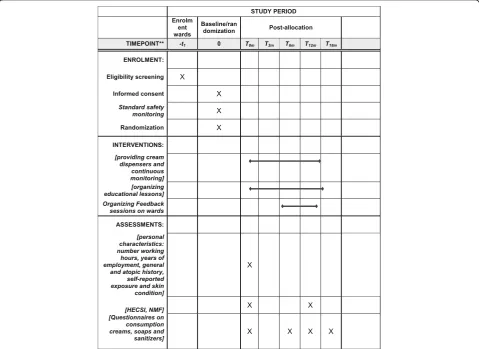
The HHP trial is sponsored by DEB Group Ltd. The sponsor has delegated the study design, management of trial data and writing reports to the researchers. The protocol adheres to the SPIRIT guidelines [36] and an populated checklist is included in Additional file 1. The SPIRIT diagram is included in Fig. 2.
Funding
This study was financially supported by DEB Group Ltd., Denby, UK. DEB Group Ltd. also provided the study creams free of charge. The sponsor has delegated the study design, management of trial data and writing reports to the chief investigator.
The study protocol was developed in accordance with the Standard Protocol Item: Recommendations for Interventional Trials (SPIRIT) 2013 guidelines (Additional file 1). The SPIRIT diagram is included in Fig. 2.
Availability of data and materials No data to publish yet.
Authors’contributions
supervision and critical review of the manuscript. All authors read and approved the final manuscript.
Competing interests
The authors declare that they have no competing interests.
Consent for publication
The study results are the property of the VUmc and AMC and will be published in a peer-reviewed journal. All authors read and approved the final manuscript and gave their consent for publishing this study protocol.
Ethics approval and consent to participate
Ethics approval to conduct the trial has been granted by the Medical Ethics Review Board of the Academic Medical Center (AMC) (reference number NL54372.018.15). Trial registration: NTR 5564, date of registration: 2 November 2015. Informed consent to participate in the trial will be obtained from all participants, as outlined above.
Received: 9 August 2016 Accepted: 18 January 2017
References
1. Ibler KS, Jemec GB, Flyvholm MA. Hand eczema: prevalence and risk factors of hand eczema in a population of 2274 health care workers. Contact Dermatitis. 2012;67:200–7.
2. Fartasch M. Wet work and barrier function. Curr Probl Dermatol. 2016;49:144–51. 3. German Federal Ministry of Labour and Social Affairs.2006. Technical rules
for hazardous substances. Risk resulting from skin contact–determination, evaluation, measures (TRGS 401) [Internet]. Germany.http://www.baua. de/nn_54598/en/Topics-from-A-to-Z/Hazardous-Substances/TRGS/pdf/ TRGS-401.pdf. Accessed 11 Nov 2013.
4. Visser MJ, Verberk MM, van Dijk FJ. Wet work and hand eczema in apprentice nurses: part I. Contact Dermatitis. 2014;70(1):44–55.
5. Smit HA, Burdorf A, Coenraads PJ. Prevalence of hand dermatitis in different occupations. Int J Epidemiol. 1993;22:288–93.
6. Diepgen TL, Agner T, Aberer W. Management of chronic hand eczema. Contact Dermatitis. 2007;57(4):203–10.
7. Van Gils RF, van der Valk PGM, Bruynzeel DJ, Coenraads PJ, Boot CRL, Anema JR. Prevention of occupational hand eczema. A systematic review. Contact Dermatitis. 2011;64(2):63–72.
8. Prevention of contact dermatitis: a national guideline. Dutch Society of Occupational Health (NvAB). 2006.
9. Contact dermatitis: a national guideline. Netherlands Society of Dermatology and Venereology (NVDV). 2013
10. Williams C, Wilkinson SM, McShane P, et al. A double-blind, randomized study to assess the effectiveness of different moisturizers in preventing dermatitis induce by hand washing to stimulate healthcare use. Br J Dermatol. 2009;162:1088–92.
11. Kütting B, Baumeister T, Weistenhöfer W, et al. Effectiveness of skin protection measures in prevention of occupational hand eczema: results of a prospective randomized controlled trial over a follow-up period of 1 year. Br J Dermatol. 2010;162:362–70.
12. van Kampf G, Ennen J. Regular use of a hand cream can attenuate skin dryness and roughness caused by frequent hand washing, vol. 6. 2006. p. 1. 13. Dulon M, Pohrt U, Skudlik C, Nienhaus A. Prevention of occupational skin
disease in geriatric nurses. Br J Dermatol. 2009;161(2):337–44. 14. Ibler KS, Jemec GB, Diepgen TL. Skin care education and individual
counselling versus treatment as usual in healthcare workers with hand eczema: randomised clinical trial. BMJ. 2012;345:e7822.
15. Kütting B, Drexler H. Effectiveness of skin protection creams as a preventive measure in occupational dermatitis: a critical update according to criteria of evidence based medicine. Int Arch Occup Environ Health. 2003;76:253–9. 16. Held E, Lund H, Agner T. Effect of different moisturizers on SLS-irritated
human skin. Contact Dermatitis. 2001;44:229–34.
17. Loden M. Barrier recovery and influence of irritant stimuli in skin treated with a moisturizing cream. Contact Dermatitis. 1997;36:256–60. 18. Held E, Wolff C, Gyntelberg F, Agner T. Prevention of work-related skin
problems in student auxiliary nurses: an intervention study. Contact Dermatitis. 2001;44:297–303.
19. Weisshaar E, Radulescu M. Skin protection and skin disease prevention courses for secondary prevention in healthcare workers: first results after two years of implementation. J Dtsch Dermatol Ges. 2005;3:33–8. 20. J William Kelly, Blackhurst D, McAtee, Steed C. Electronic hand hygiene
monitoring as a tool for reducing healthcare-associated methicillin-resistant Staphylococcus aureus infection. Am J Infect Control. 2016;44(8):956–7. 21. Jamtvedt G, et al. Audit and feedback: effects on professional practice and
health care outcomes. Cochrane Database Syst Rev. 2006;2:CD000259. 22. Ivers N, et al. Audit and feedback: effects on professional practice and healthcare outcomes. Cochrane Database Syst Rev. 2012;6:CD000259. 23. Dubbert PM, et al. Increasing ICU staff handwashing: effects of education
and group feedback. Infect Control Hosp Epidemiol. 1990;11(04):191–3. 24. Held E, Skoet R, Johansen JD. The hand eczema severity index (HECSI): a
scoring system for clinical assessment of hand eczema. A study of inter-and intraobserver reliability. Br J Dermatol. 2005;152(2):302–7.
25. Rawlings AV, Harding CR. Moisturization and skin barrier function. Dermatol Ther. 2004;17 Suppl 1:43–8.
26. Angelova-Fischer I, Stilla TR, Kezic S. Barrier function and natural moisturizing factor levels after cumulative exposure to short-chain aliphatic alcohols and detergents: results of occlusion-modified tandem repeated irritation test. Acta Derm Venereol. 2016;96(7):880–4.
27. Robinson M, et al. Natural moisturizing factors (NMF) in the stratum corneum (SC). I. Effects of lipid extraction and soaking. J Cosmet Sci. 2010;61(1):13. 28. Wang CY, Maibach HI. Why minimally invasive skin sampling techniques? A
bright scientific future. Cutan Ocul Toxicol. 2011;30(1):1–6.
29. Dapic I, Yau N, Kezic S, Kammeyer A. Evaluation of a HPLC method for the determination of natural moisturising factors in the human stratum corneum. Anal Lett. 2013;46:2133–44.
30. Gluud C. The culture of designing hepato-biliary randomised trials. J Hepatol. 2006;44:607–15.
31. Schulz KF, Altman DG, Moher D, for the CONSORT Group. CONSORT 2010 Statement: updated guidelines for reporting parallel group randomised trials. BMJ. 2010;340:c332.
32. Calvert M, Blazeby J, Altman DG, Revicki DA, Moher D, Brundage MD, CONSORT PRO. Group. Reporting of patient-reported outcomes in randomized trials: the CONSORT PRO extension. JAMA. 2013;309(8):814–22. 33. Campbell MK, Piaggio G, Elbourne DR, Altman DG, for the CONSORT Group.
Consort 2010 statement: extension to cluster randomised trials. BMJ. 2012; 345:e5661.
34. Madan I, Parsons V, Cookson B. A behavioural change package to prevent hand dermatitis in nurses working in the national health service (the SCIN trial): study protocol for a cluster randomised controlled trial. Trials. 2016; 17(1):145.
35. Boutron I, Guittet L. Reporting methods of blinding in randomized trials assessing nonpharmacological treatments. PLoS Med. 2007;4(2):e61. 36. Chan AW, Tetzlaff JM, Altman DG, Laupacis A, Gotzsche PC, Krleza-Jeric K, et
al. SPIRIT 2013 statement: defining standard protocol items for clinical trials. Ann Intern Med. 2013;158(3):200–7.
• We accept pre-submission inquiries
• Our selector tool helps you to find the most relevant journal
• We provide round the clock customer support
• Convenient online submission
• Thorough peer review
• Inclusion in PubMed and all major indexing services • Maximum visibility for your research
Submit your manuscript at www.biomedcentral.com/submit

![Table 2 Main recommendations for the prevention of handdermatitis (NVAB guideline, 2006) [8]](https://thumb-us.123doks.com/thumbv2/123dok_us/9017894.972224/5.595.56.292.95.212/table-main-recommendations-prevention-handdermatitis-nvab-guideline.webp)