ISSN 2250-3153
Validity, Effectiveness, and Practicality of Learning
Media Using Advance Organizer to Increase Critical
Thinking on Colloid Material of Senior High School
A Pascalia Lalian1,*,, L Yuanita1, U Azizah1
Science Education, Post Graduate, State Univercity of Surabaya *[email protected]
DOI: 10.29322/IJSRP.10.01.2020.p9714
http://dx.doi.org/10.29322/IJSRP.10.01.2020.p9714
Abstract
The purpose of this study is to determine the validity, effectiveness, and practicality of learning tools to improve student’s critical thinking skills by using an advanced organizer learning model on colloidal material. The test was conducted in grade XI-5 of 7th
Senior High School of Surabaya with 24 students. The learning device development model in this study uses the 4D model from Thiagarajan, but only 3 stages are applied (define, design, develop). The implementation phase of learning in the class uses one group pretest-posttest design. The assessment is carried out by using a validation sheet filled out by the validator, pretest-posttest questions based on the critical thinking skills, and an observation sheet on the implementation of the lesson plan by the observer. Based on the research conducted, it is founded that: (a) the results of the validation of learning devices in general have an average score of 3 to 4 with a reliability of 80 to 100%. (b) the average of critical thinking ability data of students is 63.12 with the categories less critical, critical and very critical. Furthermore, it is also obtained the results of the increment in each indicator of critical thinking ability, namely (i) the indicatorof formulating the problem gets an increase of 31.25, (ii) the indicator of giving an argument gets an increase of 16.06, (iii) the analyzing indicator gets an increase of 6, (iv) the indicator of doing induction or concluding gets an increase of 40.62, and (v) the indicator of applying gets an increase of 39.58, and (c) the observation of the implementation of the lesson plan of three meetings obtain an average score of 3.33 to 4 with reliability of 86 to100 %. Based on the data analysis, it can be concluded that the learning tools developed are valid, effective, and practical to improve student’s critical thinking skills.
Keywords: validity, effectiveness, practicality, advance organizer, student’s critical thinking skills
A. Introduction
According to the Chairman of the National Education Standard Agency, Bambang Suryadi, the procurement of
High Order Thinking Skill (HOTS) questions make Indonesian education standard even higher to catch up with other
countries. Therefore, this question will continue to be held, but with more preparation, namely increased learning both
for students and teachers (Okezone News, 2018). Referring to the standard of National Exam questions, namely
HOTS based questions, the teacher must prepare provisions for students from an early age, where the priority of a
teacher as an educator is to teach students how to learn and how to think HOTS based so that when dealing with
National Exam questions, students do not experience difficulties. The 2013 curriculum was developed with the
completing mindset of the following: teacher center learning into student centers, one-way learning (teacher-student
interaction) into interactive learning (teacher-student-community-environment-source-other media interactions),
passive learning becomes a scientific learning, and individual learning becomes group learning.
The results of the pre-research test by giving questions about colloids to the 12th grade students of Science as
many as 12 students at 7th Senior High School of Surabaya showed that students had difficulty learning when faced
with chemical problems. Students are also lacking in critical thinking seen from the achievement of an average score
ISSN 2250-3153
of 33% or as many as 4 out of 12 students who have achieved the minimum standard, while 66.67% or as many as 8
out of 12 students have not reached the minimum standard.
Students must have good critical thinking skills in order to overcome this problem. And the teacher's job is to
help the students, one of it is to develop devices using an advanced organizer model.
B. Method
1. Learning Tool Validation Analysis
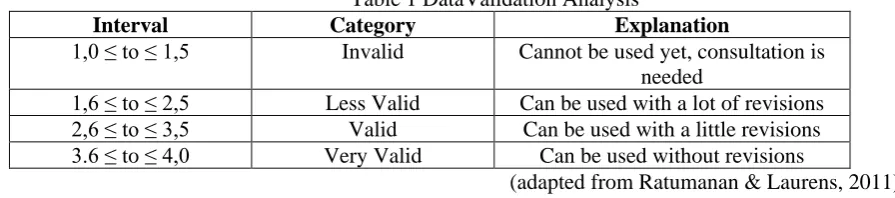
The data analysis which includes the device validation and assessment is done by calculating the average
score of each component obtained from the validator. The average score results are described in the following table.
[image:2.595.68.516.282.381.2]Learning device is said to be valid for use if the average score obtained is at least 2.6.
Table 1 DataValidation Analysis
Interval Category Explanation
1,0 ≤ to ≤ 1,5 Invalid Cannot be used yet, consultation is
needed
1,6 ≤ to ≤ 2,5 Less Valid Can be used with a lot of revisions
2,6 ≤ to ≤ 3,5 Valid Can be used with a little revisions
3.6 ≤ to ≤ 4,0 Very Valid Can be used without revisions
(adapted from Ratumanan & Laurens, 2011)
The reliability of the instrument is determined based on the assessment data from the validator. The level of reliability
can be calculated by using the formula below:
R = (1 – 𝐴−𝐵
A+𝐵) x 100%
(adapted from Borich, 1994)
Explanation:
R = Percentage of instrument reliability
A = Higher average score than the validator
B = Average number of scores lower than the validator
The instrument is said to be reliable if it has a reliability value ≥ 75% (Borich, 1994).
2. The learning tool effectiveness analysis
a. Analysis The ability to think critically
The analysis of student’s critical thinking skill is carried out to determine the increase in student’s
ISSN 2250-3153
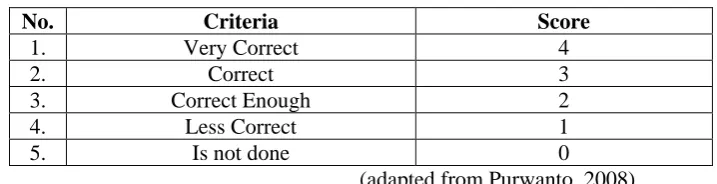
Critical thinking skill rubric used in this study is a multilevel scale, which is a question followed by
[image:3.595.117.476.140.232.2]columns that indicate the level of scoring with a scaling scale in accordance with predetermined criteria as in
Table 2.
Table 2 Categories ofStudent’s Critical Thinking Ability
No. Criteria Score
1. Very Correct 4
2. Correct 3
3. Correct Enough 2
4. Less Correct 1
5. Is not done 0
(adapted from Purwanto, 2008)
The data that has been obtained is analyzed to determine the increase in critical thinking skills.
Level of critical thinking = 𝑆𝑐𝑜𝑟𝑒 𝑜𝑏𝑡𝑎ined by students
𝑇𝑜𝑡𝑎𝑙 𝑠𝑐𝑜𝑟𝑒 𝑥 100
After obtaining the results of student’s critical thinking skill, researchers adjust to the category of student’s
[image:3.595.118.476.373.481.2]critical thinking abilities. The categories of critical thinking skill can be seen in Table 3.
Tabel 3 The Guidelines for Critical Thinking Categories
No. Obtained Scale Category
1. > 81,25 to ≤ 100 Very Critical
2. > 62,50 to ≤ 81,25 Critical
3. > 43,75 to ≤ 62,50 Less Critical
4. ≤ 25,00 to 43,75 Very Less Critical
(Source: Setyowati et al, 2010)
3. Student Response Questionnaire Analysis
The results of the student response questionnaire will be obtained, are analyzed by using the following
formula:
Percentage = 𝑁𝑢𝑚𝑏𝑒𝑟 𝑜𝑓 𝑠𝑡𝑢𝑑𝑒𝑛𝑡𝑠 𝑎𝑛𝑠𝑤𝑒𝑟ing items
𝑛𝑢𝑚𝑏𝑒𝑟 𝑜𝑓 𝑟𝑒𝑠𝑝𝑜𝑛𝑑𝑒𝑛𝑡𝑠 𝑥 100%
The percentage criteria for student responses are presented in the following table:
Table 4 The Criteria for Percentage of Student Responses
No. Scale Obtained Category
1. 0 – 20 % Very Less
2. 21 – 40% Less
3. 41 – 60% Enough
4. 61 – 80% Good
ISSN 2250-3153
4. Learning Device Practical Analysis
The value of the implementation of learning conducted by observers who have understood the observation
sheet correctly, then, the data is processed by calculating using the following equation:
P = 𝑁𝑢𝑚𝑏𝑒𝑟 𝑜𝑓 𝑙𝑒𝑎𝑟𝑛ing stages carried out
𝑡𝑜𝑡𝑎𝑙 𝑛𝑢𝑚𝑏𝑒𝑟 𝑜𝑓 𝑙𝑒𝑎𝑟𝑛ing stages x 100%
The implementation of lesson plan is analyzed descriptive qualitatively, by comparing the average rating
scale given by the two observers with the following evaluation criteria.
Table 5 The Analysis of the Implementation of Lesson Plan
No Interval Score Category
1. 3,60 ≤ score ≤ 4,00 Very Good
2. 2,60 ≤ score ≤ 3,59 Good
3. 1,60 ≤ score 2,59 Less Good
4. 1,00 ≤ score 1,59 Is not Good
(Ratumanan & Laurens, 2011)
The level of data reliability between the two observers was calculated by using an interobserver agreement by
using statistical analysis of percentage of agreement (R). The reliability level is calculated by using the following formula.
R = (1 𝐴−𝐵
𝐴+𝐵) x 100%
Explanation:
R = Percentage of instrument reliability
A = Higher average score than the observer
B = Lower average score than the observer
The instrument is said to be reliable if it has a reliability value ≥ 75% (Borich, 1994).
C. The Result of Research and Discussion
1. Learning Tool Validation Result
The tool developed to be validated are the syllabus, lesson plans, student teaching materials, student
worksheets, and pretest and posttest questions based on the critical thinking skills, and student response
questionnaires. The following summarizes the results of the validation of learning tool developed using the advanced
organizer learning model as presented in Table 6.
ISSN 2250-3153
No. Tool’s Name Score
Obtained
Category Reliability
1. Syllabus 3,33 – 4 V, VV 86 – 100%
2. Lesson Plan 2,67 – 4 V, VV 80 – 100%
3. Student Teaching Material 2,67 – 4 V, VV 80 – 100%
4. Student Worksheet 2,67 – 4 V, VV 80 – 100%
4. Pretest Question 3,33 – 4 V, VV 86 – 100%
6. Posttest Question 3,33 – 4 V, VV 86 – 100%
7. Student Response Questionnaire 3,33 – 4 V, VV 86 – 100%
Explanation: V: Valid; VV: Very Valid
Based on the Table 6, it is known that all devices get an average score that ranges from 2.67 to 4 with a valid
category and is very valid. In addition, each device also has reliability ranging from 80-100%, it means that the
devices developed using the advanced organizer model are appropriate for use in improving critical thinking skills on
colloidal material. Thus, all devices developed can be used in the process of learning colloidal material because it has
met the criteria for proper use, namely valid and appropriate.
2. Learning Tool Effectiveness Result
a. Critical Thinking Ability Assessment Result
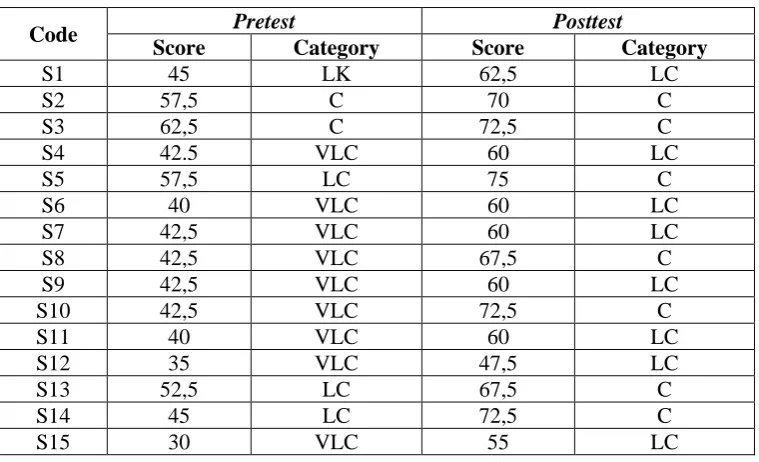
The data of student’s critical thinking skill before learning was obtained based on the pretest scores carried
out before the first meeting, while the student’s critical thinking skill after learning was obtained based on the
posttest scores after the third meeting. The indicators of student’s critical thinking skill is assessed namely
formulating the problem, giving arguments, analyzing, inducing or concluding, and applying those assessed by
using the rubric of critical thinking with a range of 0-4. The results of the student’s critical thinking skill are
[image:5.595.109.489.544.775.2]presented in Table 7.
Table 7 The Score of Student’s Critical Thinking Skill
Code Pretest Posttest
Score Category Score Category
S1 45 LK 62,5 LC
S2 57,5 C 70 C
S3 62,5 C 72,5 C
S4 42.5 VLC 60 LC
S5 57,5 LC 75 C
S6 40 VLC 60 LC
S7 42,5 VLC 60 LC
S8 42,5 VLC 67,5 C
S9 42,5 VLC 60 LC
S10 42,5 VLC 72,5 C
S11 40 VLC 60 LC
S12 35 VLC 47,5 LC
S13 52,5 LC 67,5 C
S14 45 LC 72,5 C
ISSN 2250-3153
Code Pretest Posttest
Score Category Score Category
S16 45 LC 75 C
S17 65 C 80 C
S18 57,5 LC 75 C
S19 60 LC 80 C
S20 52,5 LC 77,5 C
S21 47,5 LC 67,5 C
S22 40 VLC 65 C
S23 45 LC 67,5 C
S24 60 LC 85 VC
Average 47,71 LC 63,12 C
Explanation: VLC = Very Less Critical; LC = Less Critical; C = Critical, VC = Very Critical
Based on Table 7, it is known that before the learning activities there are 3 critical students and 21 less critical
students with grades ranging from 30 – 62,5. After learning the student’s grades have increased, there are still 8 less
critical students, 15 critical students, and 1 very critical student with grades ranging from 47.5 – 85.
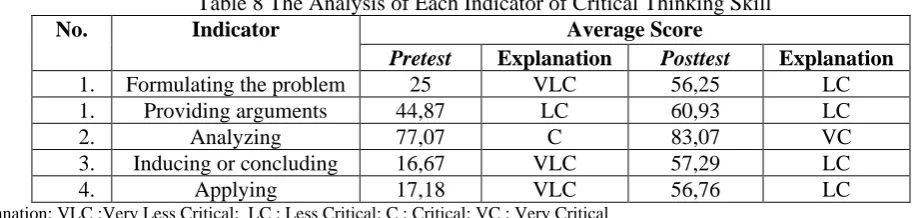
Furthermore, the analysis of each indicator of critical thinking skill that are formulating the problem,
[image:6.595.105.489.53.222.2]providing arguments, analyzing, inducing or concluding, and applying can be seen in Table 8.
Table 8 The Analysis of Each Indicator of Critical Thinking Skill
No. Indicator Average Score
Pretest Explanation Posttest Explanation
1. Formulating the problem 25 VLC 56,25 LC
1. Providing arguments 44,87 LC 60,93 LC
2. Analyzing 77,07 C 83,07 VC
3. Inducing or concluding 16,67 VLC 57,29 LC
4. Applying 17,18 VLC 56,76 LC
Explanation: VLC :Very Less Critical; LC : Less Critical; C : Critical; VC : Very Critical
Based on Table 8, it is known that there is an increase in the five indicators of critical thinking skills after
learning by using an advanced organizer model. The indicator of formulating the problem gets an increase of 31,25,
the indicator of giving an argument gets an increase of 16,06, the analyzing indicator gets an increase of 6, the
indicator of inducing or concluding gets an increase of 40,62, and the indicator of applying gets an increase of 39,58.
The indicator that experienced the highest increase is the indicator of inducing or concluding a value of 40,62,
while the indicator that experienced the lowest increase is analyzing with a value of 6.
b. The Analysis Result of Student Response Questionnaire
The result of the student questionnaire responses to the learning activities that have been carried out and the
learning tools that have been developed by using the advanced organizer learning model presented in Table 9.
Table 9 The Result of Student Response Questionnaire
Goal Declaration Respond
Percentage
Category
Yes No
Interest The design of LKS andcoloid student’s material are interesting
[image:6.595.62.522.353.462.2]ISSN 2250-3153
Based on Table 9, it is known that the device with an advanced organizer learning model gets a positive
response from students. This is shown by the interest in student worksheets and teaching materials ranging from
83.33-100%, it means that most students are interested in the worksheets and teaching materials developed. The
percentage of the content of the material ranges from 66.67 to 95.8%, it means that from the aspect of the content of
the material, students can understand the student worksheet and teaching material developed. While from the aspect of
language, it gets a percentage ranging from 79.16 to 83.33%, it means that the aspects of the language used in the
worksheets and student teaching materials are easy to understand and do not cause multiple meanings.
Based on the description above, it can be concluded that student’s responses to learning devices by using the
advanced organizer model, students give positive responses, which means students can follow the learning activities
carried out by the teacher using learning devices by using the advanced organizer model.
c. Learning Device Practical Result
The learning device practical result is reviewed from the result of the trial of the learning device by using an
advanced organizer learning model conducted with three meetings observed by 3 observers. The following are the This design of LKS
andcoloid student’s material make me more enthusiasm in learning chemistry
100 - Very Good
By using the design of LKS andcoloid
student’s material make learning chemistry fun
83,33 16,67 Very Good
The explanation of student material relates with the daily life
95,8 4,16 Very Good
Material The material in the student’s book can be easily understood
95,8 4,16 Very Good
The material in the student’s book make student doing discussion with their friends
66,67 33,33 Good
The steps of practice in the student’s
book(LKS) are easily understood
79,16 20,83 Good
Language Sentences and paragraphs that have used in the student’s book are easily to understood
83,33 16,67 Very Good
The language that has used in the student’s book is simple and easily to understood
ISSN 2250-3153
practicalities of the learning tools obtained based on trials in 1 class for 3 meetings. The results of observing the
[image:8.595.74.526.134.772.2]implementation of learning observed by 3 observers while conducting the trial are presented in Table 10.
Table 10 The Observation Result of Lesson Plan Implementation
Steps First Meeting Second Meeting Third Meeting
Average Categor
y
R (%)
Average Category R
(%)
Average Category R (%)
First Activity
Teacher gives
greeting 3,33 G 86 3,67 VG 86 3,67 VG 86
Teacher asks one
of the student to
lead the pray
4 VG 100 3,33 G 86 3,67 VG 86
Teacher explains
the advance organizerlearning
model
3,33 VG 86 4 VG 100 4 VG 100
Main Activity
Phase 1 : the
presentation of
advance organizer
a. Explain the
goal of
learning
Teacher
explains the
goal of the
learning and
indicator
3,33 G 86 3,33 G 86 3,67 VG 86
b. The
presentation
ofadvance
organizer
1. Teacher
gives
student’s
worksheet
3,67 VG 86
ISSN 2250-3153
Steps First Meeting Second Meeting Third Meeting
Average Categor
y
R (%)
Average Category R
(%)
Average Category R (%)
gives an
example to
the student
3. Teacher asks
the student to
give
question(stat
ing the
problem)
(asking)
3,33 G 86 3,67 VG 86 3,67 VG 86
4. Teacher asks
one of the
student to
answer
(giving
argument)
3,33 G 86 3,67 VG 86 3,67 VG 86
5. Teacher
explains 3,67 VG 86 4 VG 100 3,67 VG 86
6. Teacher
explains the
technical
term (giving
attention)
4 VG 100 3,67 VG 86 3,33 G 86
c. Reminding the
knowledge or
relevant
experience
Teacher asks
to the student
the material
that they have
learnt before
3 G 100 3,67 VG 86 3,33 G 86
Phase 2 :
Learning
ISSN 2250-3153
Steps First Meeting Second Meeting Third Meeting
Average Categor
y
R (%)
Average Category R
(%)
Average Category R (%)
presentation
a. Give material
1. Teacher asks
the students
to make a
group
3,33 G 86 4 VG 100 3,67 VG 100
2. Teacher gives
LKS 3 G 100 3,33 G 86 3 G 100
3. Teacher gives
instruction to
the student to
do LKS
4 VG 100 3,33 G 86 4 VG 100
4. Students do
the question
from the
teacher
(stating
problem),
(giving
argument),
(analyzing),
(inducting or
concluding),
(applying)
(observing,
asking, trying,
thinking,
communicatin
g)
3,33 G 86 3,67 VG 86 3,67 VG 86
5. Teacher
supervises the
discussion
3,67 SB 86 3,67 B 86 3,67 SB 86
6. Teacher asks
one group to
do
ISSN 2250-3153
Steps First Meeting Second Meeting Third Meeting
Average Categor
y
R (%)
Average Category R
(%)
Average Category R (%)
presentation
about the
discussion
result and
asks another
group to give
attention
7. Another
student give
responses and
questions
3,33 G 86 3,33 G 86 3,67 VG 86
8. Teacher
checks
student’s
understanding
3,67 VG 86 3,33 G 86 3,33 G 86
Phase 3 : strength
cognitive
organization
a. Using
integrative
reconciliation
principal
1. Teacher
reminds the
students about
the main idea
of the
material
3,67 VG 86 3 G 100 3,67 VG 86
2. Teacher asks
the student to
re-state the
definition of
term(giving
argument)
3,67 VG 86 3,67 VG 86 3,33 G 86
3. Teacher asks
ISSN 2250-3153
Steps First Meeting Second Meeting Third Meeting
Average Categor
y
R (%)
Average Category R
(%)
Average Category R (%)
the students
to summary
what they
have learned
4. Teacher gives
student the
assignment
for writing
the
differenceof
each concept
that has
served
(thinking)
3,33 G 86 3,67 VG 86 3,33 G 86
b. Suggest active
reception
learning
Teacher asks
the student to
write another
examples
(thinking)
3,67 VG 86 3,67 VG 86 3,33 G 86
c. Build the
critical
approach to
the learning
material
Teacher asks
the student to
explain again
the main idea
of the material
(giving
argument)
ISSN 2250-3153
Steps First Meeting Second Meeting Third Meeting
Average Categor
y
R (%)
Average Category R
(%)
Average Category R (%)
d. Clarification
Teacher asks
the student in
every group to
ask
question(statin
g problem)
(asking)
4 VG 100 3,33 G 86 3,67 VG 86
Closing
1. Teacher gives
homework 3,33 G 86 3 G 100 3,67 VG 86
2. Teacher closes
the lesson by
praying and
greeting
3 G 100 3,67 VG 86 3,67 VG 86
Class Condition
1. Teacher’s
enthusiasm 3,33 G 86 3,67 VG 86 4 VG 100
2. Student’s
enthusiasm 4 VG 100 3,67 VG 86 3,33 G 86
3. Time
management 3,67 VG 100 3 G 100 3,67 VG 86
Explanation: G: Good; VG: Very Good
Based on Table 10, it is known that the implementation of each aspect in the lesson plan of meetings I, II, III
gets an average score of 3.33 to 4. These results indicate that overall the stages of learning, namely the initial, main,
and closing activities have been carried out with both good and very good categories. In addition, each stage has
reliability ranging from 86 to 100%, it means that all stages in the three meetings are appropriately carried out in
accordance with the stages in the lesson plan.
D. Conclusion
Based on the results of the development and the data collection that is heldat 7th Senior High School of
Surabaya towards 24 students, it can be concluded that the learning device by using the advancedorganizer model has
fulfilled the validity, practicality, and effectiveness requirements so that it is appropriate to be used in the learning
process to improve student’s critical thinking skills, especially at indicators of formulating the problems, analyzing,
ISSN 2250-3153
E. References
Abiansyah, T. (2007). “Advance Organizer untuk Meningkatkan Pemahaman Konsep dan Keterampilan Berpikir Kritis Siswa pada Topik Hidrokarbon”. Tesis PPs UPI. Diakses 3 Februari 2019 dari
http://repository.upi.edu/operator/upload/s_mat_053893_chapter2.pdf.
Agustina, D. (2011). “Penerapan Pengorganisasian Awal (Advance Organizer) dalam Memfasilitasi Kemampuan Berpikir Kritis”. PPs Unesa: Surabaya
Borich, Gary. D. (1994). Observation Skill for Effective Teaching. New York: Mac Millan Publishing Company.
Ennis, R. H. (1996). Critical Thinking. USA: Prentice Hall. Inc
Ivie, S. D. (1998). “Ausubel’s Learning Theory: An Approaching To Teaching Higher Order Thingking Skills. Educational Phyhologist David Paul Ausubel”. High School Journal. Vol. 82 (1): 1-40
Joyce, B. & Weil, M (1992). Model of Theaching. Prentice Hall. Inc
Kardi, S. (2003). Advance Organizer. PPs Unesa: Surabaya
Purwanto. (2008). Evaluasi Hasil Belajar. Yogyakarta: Pustaka Pelajar
Ratumanan, T. G. & Laurens, T. (2011). Penilaian Hasil Belajar Siswa pada Tingkat Satuan Pendidikan Edisi 2. Surabaya: Unesa University Press