Decoupled HVAC System via Non-Linear Decoupling
Algorithm to Control the Parameters of Humidity and
Temperature through the Adaptive Controller
Seyed Mohammad Attaran
1, Rubiyah Yusof
2*, Hazlina Selamat
31,3
Center for Artificial Intelligence & Robotics, Electrical Engineering Faculty, Universiti Teknologi Malaysia, 54100 Kuala Lumpur, Malaysia
2*
Universiti Teknologi Malaysia Jalan Semarak 54100, Bangunan-Malaysia Japan International Institute of Technology (MJIIT)
Abstract- Control methodologies could achieve better comfort conditions of heating, ventilating and air conditioning (HVAC) systems, however, the application of classical controllers is unsatisfactory as HVAC systems are non-linear and the control variables such as temperature and relative humidity (RH) inside the thermal zone are coupled. The objective of this study is to implement and simulate adaptive control for decoupled HVAC to control temperature and RH. A non-linear decoupling algorithm is used to decouple the HVAC system and an adaptive controller is applied to control the temperature and RH, and improve the transient response of system. The simulation results show that the adaptive controller performance is superior, as compared with classical PID controller. In addition, the steady state set points for temperature and RH are better reached in a shorter period of time
Index Terms-
HVAC components, HVAC systems, nonlinear decoupling, adaptive controller
I. INTRODUCTION
(thermostats) and PID controllers are still very popular, due to their low cost and ease of tuning and operation [13, 14]. Thus, he most widely used control algorithms for HVAC systems are based on PIDs. However, it must be noted that the PID control methodology as a linear controller, is suitable for linear systems and HVAC system is inherently non-linear [10]. The assumption of linear behavior of the system, including the building envelope components and those of the equipment is usually valid and satisfactory control action may result. However, with the advent of the digital technology and high speed computing hardware that can be imbedded in controllers, it is possible to address the non-linear behavior of HVAC systems by means of more sophisticated control algorithms [15].
Nomenclature
AR area of the roof=9 m2
Aw1 area of the wall (East, West)=9 m2 Aw2 area of the wall (South, North)=12 m2
Cah overall thermal capacitance of the air handling unit=4.5 kJ/C Cd specific heat of the duct material=0.4187 kJ/kg ◦C
Ch overall thermal capacitance of the humidifier=0.63 kJ/◦C Cpa specific heat of air=1.005 kJ/kg ◦C
Cpw specific heat of water=4.1868 kJ/kg ◦C
CR overall thermal capacitance of the roof=80 kJ/C
Cw1 overall thermal capacitance of the wall (East, West)=70 kJ/C Cw2 overall thermal capacitance of the wall (South, North)=60 kJ/C Cz overall thermal capacitance of the zone=47.1 kJ/C
e(t) error
fsa volume flow rate of the supply air=0.192 m3/s fsw water flow rate=8.02*10-5 m3/s
h(t) rate of moisture air produced in the humidifier hi heat transfer coefficient inside duct=8.33 W/m2◦c ho heat transfer coefficient in the ambient=16.6 W/m2◦C Md mass of the duct model=6.404 kg/m
ms mass flow rate of the air stream=0.24 kg/s mm total mass flow rate of the mixing air=0.24 kg/s mo mass flow rate of the outdoor air=0.12 kg/s mr mass flow rate of the recalculated air=0.12 kg/s mt mass of tube material kg/m
p(t) evaporation rate of the occupants=0.08 kg/h q(t) heat gains from occupants, and light (W) Tco temperature of the air out from the coil (◦C) Th supply air temperature (in humidifier) in (◦C) Tin temperature in to the duct
Tm temperature of the air out of the mixing box (◦C) Tme temperature measured (◦C)
To temperature outside=32 ◦C (Summer)=5 ◦C (Winter) Tout temperature out from the duct
Tr temperature of the recalculated air (◦C) Ts supply temperature from the Heating coil Tsa supply air temperature (◦C)
Tse temperature output from the sensor (◦C)
Tsi temperature of supply air (to the humidifier) (◦C) Tt,o tube surface temperature (◦C)
Temperature and RH controls, on an individual basis, have counter effects on each other [16, 17]. In a numerical study, Cui et al. [16] the simultaneous and separate control of temperature and RH in a thermal zone were investigated. Moreover, in the simultaneous control, setting the controller parameters is difficult and, due to thermal coupling between RH and temperature, the response of the system oscillates. As a result of that study, the coupling effects of RH and temperature should be considered, when it is desired to control such parameters simultaneously. There are two approaches to address the decoupling of temperature and RH. First, the coupling behavior between temperature and RH can be overcome by utilizing a decoupling algorithm, when a control law is developed. For that purpose, control methodologies such as multivariable or intelligent control methods can be used. Becker et al. [18] designed a fuzzy controller to regulate the temperature and RH in a cold store by studying the coupling behavior of temperature and RH in fuzzy controller actions. The rule-based control methodology solved the coupling problem of temperature and RH directly, and the proposed fuzzy controller could control the system under disturbances and changes in setpoints efficiently. To avoid interaction
Tw1 temperature of the wall (East, West) (◦C) Tw1 temperature of the wall (South, North) (◦C) Tz temperature of the zone (◦C)
Uw1 overall heat transfer coefficient of (East, West) walls=2W/m2 ◦C Uw2 overall heat transfer coefficient of (South, North) walls=2W/m2 ◦C UR overall heat transfer coefficient of the roof= W/m2◦C
(UA)ah overall transmittance area factor of the air handling unit=0.04 kJ/sC Va volume of the air handling unit=0.88 m3
Vh volume of humidifier=0.44 m3 Vz volume of the zoneZ36 m3
Wco humidity ratio of the air out from the coil (kg/kg dry air) Wh supply air humidity ratio (in humidifier) in kg/kg(dry air) Wm humidity ratio of the air out the mixing box (kg/kg dry air)
Wo humidity ratio outside=0.02744 kg/kg (dry air) (Summer)=0.002 kg/kg(dryair)(Winter) Wsa humidity ratio of the supply air in kg/kg (dry air)
Wsi humidity ratio of the supply air (to the humidifier) in kg/kg (dry air) Wz humidity ratio of the zone in kg/kg (dry air)
Subscripts
a air
ah air handling unit
ai air in
ao air out
co out from the coil
d duct
h humidifier
in in
m mixed
me measured
o out
R roof
r recirculated
s supply
sa supply air
se sensor
sw supply water
w water
W1 East, and West walls W2 North, South walls
wi water in
wo water out
z zone
Greek letters
ah (UA)h overall transmittance area factor of the humidifierZ0.0183 kJ/s ◦C tse time constant of the sensor (seconds)
between temperature and moisture content responses, an experimental study Qi and Deng [19] which temperature and moisture content have been controlled simultaneously by varying the speeds of both compressor and supply fan in a direct expansion air conditioning system was carried out. In that study, the controller was constructed by using the linearized model of the direct expansion air conditioning system, and LQG method was used to design the controller. Although the method in that study appeared to ge straightforward for solving the problem, but when the setpoint of temperature in the thermal zone changed, the moisture content of the thermal zone experienced some fluctuations and it nearly settled at setpoint after 3000 s. In the second approach for decoupling, distinct channels for controlling the temperature and RH are developed where they are controlled individually through single input single output (SISO) channels. In addition, non-linear decoupling control algorithm can control the temperature and RH individually [17]. In that study, the error between thermal zone temperature and the setpoint was input to a PD controller for determination of the control law that is used in conjunction with the same for RH by the decoupling algorithm for computing the final values of the controlled variables, namely, flow rate of air (fa) and flow rate of water (fw) in each time step. The controlled variables are then used to solve the differential equations for finding the thermal zone temperature and RH responses. The aim of this study is to apply the adaptive control methodology for the HVAC system introduced by Parvaresh et al. [10] which will be decoupled via decoupling method. The next sections will present the methodology section which includes system model, the non-interactive method, step response and adaptive control is presented. The simulation results and conclusions are provided in sections 3 and section 4 respectively.
II. METHODOLOGY AND CONTROL ALGORITHMS
2.1. System modeling
The system modeled in this study is simply referred to as HVAC system, serving a single thermal zone as shown in Figure1 [10]. The new and complete mathematical dynamic model of HVAC components such as heating/cooling coil, humidifier, mixing box, ducts and sensors is described by Bourhan et al. [20]. All of these components are proposed and simulated in Matlab/Simulink platform are given by Parvaresh et al. [10]. The proposed model is presented in terms of energy mass balance equations for each HVAC component. Two control loops for this model, namely, temperature control loop and humidity ratio control loop are considered. Initially, fresh air enters the system and mixes with 50% of the return air, while the remaining air is passed through the heating coil and humidifier. Next, the mixed air is delivered to a heating coil where it is conditioned according to a desired setpoint by a draw-through fan. After that, the air supplied passes draw-through the humidifier and condition according to desired setpoint draw-through t he duct. The system controller simultaneously varies fsa and fsw according to load changes, so that the desired setpoints in temperature and RH, as control variables, are maintained. The variables are defined in the nomenclature. The differential equations formulated based on energy and mass balances for the system of Figure 1 are given by bourhan et al. [20].
co
ah sw w pw wi wo a o co sa a pa m co dT
c = f ρ c (T - T ) + (UA) (T - T ) + f ρ c (T - T )
dt (1)
h
h sa pa si h h o h
dT
c f c (T T ) (T T )
dt (2)
h
h sa si h
a
dw h(t)
v f (w w )
dt (3)
Figure1: HVAC system [10]
In equation (3), h(t) is the rate of humid air that the humidifier can produce and it is a function of humidity ratio. The revised differential equations in the system can be expressed in the state space form [17] as follows:
.
1 11 1 21 2
x g (x).u g (x).u (4)
.
2 12 1
x g (x).u (5)
.
3 3 13 1
x f (x) g (x).u (6)
Where
u
1
f
sa,u
2
f
sw, g (x)11 ( ca a/ c )(Tah mx )1 , g (x)21 ( w w / c )(Tc ah wiT )wo , g (x)13 (wsix ) / v3 h,12 m 2 ah
g (x)(w x ) / v , f (x)3 h(t) /avh, x1=T, x2=ψ1, x3=ψ2
11 21
.
12 1 2
3 13
g (x) g (x) 0
x 0 g (x) u 0 u f (x) g (x) 0
1 1 1
y h (x)x
1 2 3
y h (x)x
(7)
Note that, the HVAC system model described by [10] is nonlinear as the multiplication of control and controlled variables are presented.
2.2. Non-interactive method
Different methods such as pole placement, linear quadratic, linear quadratic gaussian (LQG), and decoupling or non-interactive method can be used to control the multi-input multi-output (MIMO) systems. In the non-interactive control method, the feedback is used in order to transform the MIMO system, from an input–output point of view to an aggregate of independent single input SISO channels. It is observed from the equations (4)–(6)that when it becomes necessary to make a change in one control variable, namely ψ2, by means of modulating a controlled variable, namely fa, the other control variables, namely ψ1 and T, are also forced to change. As a result, achieving desired setpoints for both control variables becomes impossible and implementing a non-linear decoupling procedure is necessary. The non-interacting control law is obtained by non-linear decoupling theory resulting in the following expression [17]. The first step to apply the nonlinear decoupling theory is to determine the vector relative degree:
11 21
13 g g A(x)
g 0
(8)
1 1
V A (x)B(x) A (x) V
(9)
1
V A (x) V B(x)
(10)
2
1 f 1
2
2 f 2
B (x) L h (x) 0 B(x)
B (x) L h (x) 0
(11)
1 13 11 13
21 11 2 V 0 -g V (1 / g g )
g g V (12)
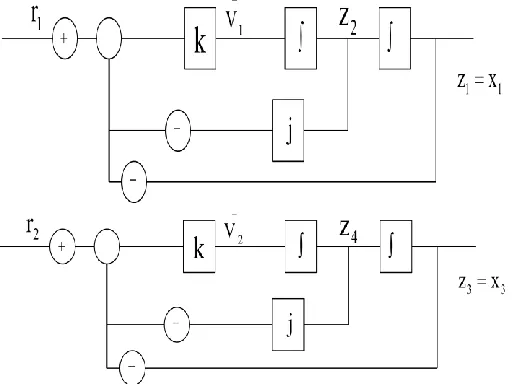
The application of the previous control law system in equation (7)results in a closed-loop system with a new set of coordinates set z(x)ϵR4 as follows:
. 1 2
z z (13)
. 2 1 z v (14) 1
g 1 11
L h (x)g
1
g 2 13
L h (x)g
2
g 2 L h (x)0
2
g 1 21
. 3 4
z z (15)
. 4 2
z v
(16)
Where the revised controlled variables
v
1
and
v
2
are capable of controlling ψ1, and T, respectively, on individual basis, the new states are described below:
1 1 1
z h (x)x (17)
2 11
z g (18)
3 2 3
z h (x)x (19)
4 13
z g (20)
[image:6.612.180.438.220.412.2]The closed-loop system resulting from the application of the decoupling HVAC system is shown in Figure 2.
Figure 2: Closed-loop of the linearized decoupled system
2.3. Step response method
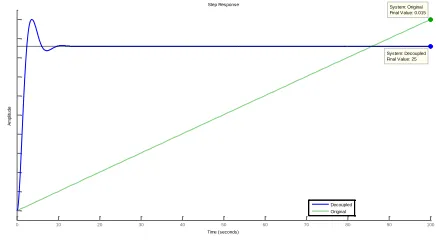
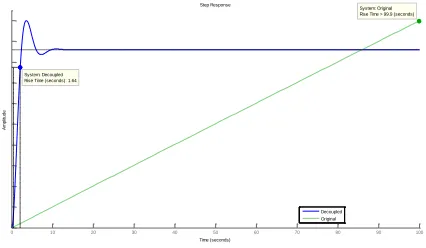
The step response of linearized decoupled system and original model of HVAC system is considered in Figures 3 (a-d) and Figures 4 (a-d) below.
Figure 3(a): Final value of decoupled and original system
Step Response
Time (seconds)
Am
pl
itu
de
0 10 20 30 40 50 60 70 80 90 100
System: Decoupled Final Value: 0.4 System: Original Final Value: -3.68e-009
[image:6.612.204.416.491.600.2]Figure 3(b): Rise time of decoupled and original system
Figure 3(c): Setting time of Original and decoupled system
Figure 3(d): Peak time of Original and decoupled system
Figure 4(a): Final value of decoupled and original system
Step Response
Time (seconds)
Am
pl
itu
de
0 10 20 30 40 50 60 70 80 90 100
System: Decoupled Rise Time (seconds): 1.64
System: Original Rise Time > 99.9 (seconds)
Decoupled Original
Step Response
Time (seconds)
A
m
pl
itu
de
0 10 20 30 40 50 60 70 80 90 100
System: Decoupled Settling Time (seconds): 8.08
Decoupled Original
Step Response
Time (seconds)
Am
pli
tud
e
0 50 100 150 200 250
System: Decoupled Peak amplitude: 0.465 Overshoot (%): 16.3 A t time (seconds): 3.67
System: Original Peak amplitude: 0.0038 Overshoot (%): 0 A t time (seconds): 215
Decoupled Original
Step Response
Time (seconds)
A
m
p
lit
u
d
e
0 10 20 30 40 50 60 70 80 90 100
System: Decoupled Final Value: 25
System: Original Final Value: 0.015
[image:7.612.203.417.66.176.2] [image:7.612.201.420.213.329.2] [image:7.612.200.426.360.472.2] [image:7.612.200.419.510.630.2]Figure 4(b): Rise time of decoupled and original system
Figure 4(c): Settling time of original and decoupled system
Figure 4(d): Peak time of original and decoupled system
[image:8.612.204.417.67.191.2]Some characteristics of the normalized step response of humidity and temperature for decoupled and original HVAC system are tabulated in Table I and Table II.
Table I. Step response characteristics of decoupled and original system for humidity
Model Peak
time/amplitude
Rise time Settling time Final value IEA
Original 215/0.003 99.9 --- -3.6-e009 127.6
Decoupled 3.6/0.46 1.64 8.08 0.4 0.66
Table II. Step response characteristics of decoupled and original system for temperature
Model Peak
time/amplitude
Rise time Settling time Final value IEA
Original 100/0.001 99.9 ---- 0.015 1.20e004
Decoupled 29.1/3.67 1.64 8.08 25 39.09
By comparing the original and decoupled system, it is clear that the decoupled system is a better option than the use of the original system. In addition it is found that the decoupled system has a better response to the step response which means the decoupled system
Step Response
Time (seconds)
A
m
p
lit
ud
e
0 10 20 30 40 50 60 70 80 90 100
System: Original Rise Time > 99.9 (seconds)
System: Decoupled Rise Time (seconds): 1.64
Decoupled Original
Step Response
Time (seconds)
A
m
p
lit
ud
e
0 10 20 30 40 50 60 70 80 90 100
System: Decoupled Settling Time (seconds): 8.08
Decoupled Original
Step Response
Time (seconds)
A
m
plit
ud
e
0 10 20 30 40 50 60 70 80 90 100
System: Original Peak amplitude: 0.00116 Overshoot (%): 0 At time (seconds): 100 System: Decoupled
Peak amplitude: 29.1 Overshoot (%): 16.3 At time (seconds): 3.67
[image:8.612.204.418.231.352.2] [image:8.612.201.418.384.514.2] [image:8.612.72.538.578.709.2]could be used instead of the original system. A comparison of PID controller for temperature and humidity of decoupled and original HVAC system are illustrated in Figure 5 and Figure 6.
Figure 5: PID comparison of humidity for decoupled and original HVAC system
Figure 6: PID comparison of original and decoupled HVAC system
In the control system, the tracking of the system is very important. By checking the step response of original and decoupled system, it is noted that the decoupled system can be used instead of the original one. As discussed in Beghi and Cecchinato [21], adaptive controllers are best suited to meet the challenge of reducing the overall energy consumption heating and cooling of buildings; therefore, adaptive control is used to improve the transient response of the system as well as decrease the amount of error. In the following sections, the adaptive control algorithm is used to control the parameter of the HVAC system.
2.4. Adaptive control algorithm
Advanced control systems that are able to efficiently track the actual cooling/heating power requests from the plant, such as predictive or adaptive controllers, are best suited to meet the challenge of reducing the overall energy consumption for building heating and cooling [21]. One of the earliest works by Farris and McDonald [22] apply adaptive control for HVAC&R systems focused on DDC for solar-heated buildings, with a single-zone air space and room air temperature as the output of the system. In one of the studies, an adaptive optimal control (AOC) strategy was designed using a linearized model of the original nonlinear HVAC&R system and closed-loop optimal obtained via the matrix Riccati equation in [23]. Cao et al. [24] described an adaptive control as a type of controller that has the ability to adjust itself to any parameter variations occurring in a control system. Beghi and Cecchinato [21] has mentioned that predictive or adaptive controllers are best suited to meet the challenge of reducing the overall energy consumption for building heating and cooling. Using zone temperature and hot water temperature as the two state variables, and heat pump input as the control variable, an adaptive control strategy [25] was applied to a discharge air temperature model [26] for the discharge air temperature to track the optimal reference temperature in the presence of disturbances. Temperature and RH controls, on individual basis, have counter effects on each other [16, 17]. Another class of adaptive systems, known as model-following or model-reference adaptive control (MRAC) was applied to a VAV system with zone, coil, and water temperatures as the three state variables; mass flow rate of supply air, mass flow rate of chilled water, and input energy to the chiller as the three control variables; and a second-order model as the reference model for the VAV system. The simulations showed good adaptability of the actual zone temperature with its reference value. Figure7, presents a schematic of the MRAC used in the model. The MIT rule is used to control the parameters of the HVAC system because it is relatively simple and easy to use. The enhancement in efficiency of the HVAC system is accomplished
0 500 1000 1500 2000 2500 3000
0 0.1 0.2 0.3 0.4 0.5 0.6 0.7
Tme(seconds)
H
u
m
id
it
y
Decoupled Original Set point
0 500 1000 1500 2000 2500 3000
0 5 10 15 20 25 30 35
Time(seconds)
T
e
m
p
e
ra
tu
re
due to improvement of transient response, when the MRAC is used to control the decupled HVAC system. The goal is to minimize the error (e = y - ym) by designing a controller that has one or more adjustable parameters to minimize certain cost functions [j (θ) =1/2e2]. Therefore the output of the closed-loop system (y) followed the output of the reference model (ym).
Figure 7: Diagram of MRAC[27]
2.4.1. Adaptive mechanism
The first step is to extract Yr. The next step is to find the error between Y and Yr. The controller is described using equation 21:
2
1
u r y (21)
The cost function is determined using the following equations:
/ ( ) * /
t j (22)
2 ( ) 1/ 2*
j
e (23)The parameter
is adjusted to enable the loss function to be minimized. Therefore, it is reasonable to change the parameter in the direction of the negative gradient of j, i.e./ ( )* / * / ( )* * /
t j e e e e (24)
– Change in
is proportional to negative gradient of JThe second order system is calculated using equation (24): 2
/ [ / ]
p p
G y u k s as b u (25)
When the first equation (21) is replaced by equation (25): 2
1 2
[ / ]*( )
p
y k s as b
r
y (26)Then,
2 2
2 1 2 1 1 2
[1 ( p) / ] ( p/ )
y
k s a s a
r k s a s a (27)2
1( ) / 1 ( 2 2 )
p p
y
k r s a s a
k (28)MRAC tries to reduce the error between the model and plant as shown in equations 29 to 37:
r
e y y
(29)
2
1( ) / 1 2 2
p p m
e
k r s a s a
k G r (30)2
1 1 2 2
/ ( ) /
e
kp r s a s a
kp (31)2 2 2
2 1 1 2 2
/ ( ) / [ ]
e
kp r s a s a
kp (32)2 2
1 ( 2 2 ) 1 2
p
2
1 1 2
/ [( / ) *( )] / ( )
e
kp km km r s A sA (34)2
2 1 2
/ ( [( / ) *( )] / ) *
e
kp km km s A sA y (35)2 2 p 2 2 2/ p
a k A A a k (36)
2 2
1 2 1 1 2 2
/ ( ) /
m m p p
y y k r s A s A
k r s a s a
k (37)Controller parameters are chosen as k rm 1(kp)r 1 km/kp
a22kp A22A2a2/kp
Using MIT rule
So 2
1/ ( ) * * / 1 ( ) * *[( / ) *( )] / ( 1 2)
t
e e
e kp km km r s A sA' 1/ ( ) * *( / ) * * *
t
e kp km yr
e yr (38)Where
'( ) *(
kp/km) =Adaptation gian (39)2/ ( ) * * [( / )]* / *
t e kp km yr r y (40)
' 2
2/ * *( ) / 1 2*
t e km s A sA y (41)
Considering a =1, b = 1 and A1=1, A2= 1
2.4.2. Adaptive control of decoupled HVAC system
[image:11.612.110.501.407.717.2]The decoupled HVAC system, described by the differential equations in formulation (13) – (16), is controlled by adaptive controller. The adaptive mechanism-1 and adaptive mechanism-2 with training procedure discussed in the previous section are used to control the temperature and humidity of the system respectively. According to the block diagram shown in Figure 8, the decoupled HVAC system is controlled by two distinct adaptive controllers. The adaptive mechanism1 is responsible for ψ and the adaptive mechanism-2 is responsible for T.
III. SIMULATION RESULT
Figure 9 and Figure 10 show the simulation results for the transient behavior of the temperature and RH in the thermal zone, when classical PID controller and adaptive controller are used. According to the simulation results, adaptive controller provides smooth and fast responses without any large overshoots and undershoots. The target values for the humidity and temperature are 0.4 and 25 C , respectively.
[image:12.612.183.436.333.483.2]Figure 9: Comparison of PID and adaptive control for temperature
Figure 10: Comparison of PID and adaptive control for humidity
[image:12.612.79.534.573.642.2]Table III shows the IAE amounts for temperature and humidity of the original and decoupled HVAC system. The amount of IAE indicated that the decoupled model can reach target values and follow them very well. In addition, the enhancement in efficiency of the decoupled HVAC system is accomplished due to improvement of transient operation.
Table III Amount of IAE of humidity and temperature of the simplified and original HVAC system
IV. CONCLUSION
In this study, a procedure for deriving a dynamic model to control the parameters of HVAC system is investigated. Even though the behavior of the HVAC system is nonlinear, in this study, the use of nonlinear decoupling method for decoupling of the HVAC system is used. It is expected that the decoupled system could improve the humidity and temperature of the HVAC system because it reduces the complexity of the system. The step response of decoupled models was compared with the original system and it is found that the decoupled model could be used to control the parameters of the HVAC system very well. It is clear that the transient response of the
0 500 1000 1500 2000 2500 3000
0 5 10 15 20 25 30 35
Time(seconds)
T
e
m
p
e
ra
tu
re
Original Decoupled Setpoint
0 500 1000 1500 2000 2500 3000
0 0.1 0.2 0.3 0.4 0.5 0.6 0.7
Tme(seconds)
H
u
m
id
it
y
Decoupled Original Set point
Controller IAE of humidity IAE of Temperature
PID 127.6 1.205+e004
decoupled system with the original system is reduced and the amount of error is decreased. For tracking of the setpoint, model reference adaptive controllers have been used to improve the transient behavior of the system. The results obtained show that the system is capable of following the setpoints effectively with minimal error and within a shorter time. The comparison between the reference, existing, and adaptive solutions for the real HVAC system yielded significant improvement of transient behavior of the system. It is concluded that decoupling control law works satisfactorily and as a result, the performance of the decoupled HVAC system is enhanced. Two cases are considered in this study. In case 1, decoupling method is implemented in HVAC system and classical PID controllers are applied compare the parameters of original and decoupled HVAC system. In case 2, for improving the transient response and track the target values MRAC is used and compare with PID controller.
REFERENCES
[1] Y.W.WANG,W.J.CAI,Y.C.SOH,S.S.LI,L.LU, AND L.XIE,"A SIMPLIFIED MODELING OF COOLING COILS FOR CONTROL AND OPTIMIZATION OF HVAC SYSTEMS,"ENERGY CONVERSION AND MANAGEMENT VOL.45(18–19) PP.2915–2930,2004.
[2] R.SALAZAR,I.LÓPEZ, AND A.ROJANO,"A NEURAL NETWORK MODEL TO PREDICT TEMPERATURE AND RELATIVE HUMIDITY IN A GREENHOUSE,"ISHS, VOL. 801, PP.539–46.,2008.
[3] PEI-HUNG CHI,FANG-BOR WENG, AND S.-H.C.AY SU,"NUMERICAL MODELING OF PROTON EXCHANGE MEMBRANE FUEL CELL WITH CONSIDERING THERMAL AND RELATIVE HUMIDITY EFFECTS ON THE CELL PERFORMANCE,"ASMEJFUEL CELL SCI TECHNOL, VOL.3, PP.292–303.,2006.
[4] D.R.CLARK,C.W.HURLEY, AND C.R.HILL,"DYNAMIC MODELS FOR HVAC SYSTEM COMPONENTS,"ASHRAE TRANS., VOL.91(1), PP.737–51,1985. [5] D.M.UNDERWOOD AND R.R.CRAWFORD,"DYNAMIC NONLINEAR MODELING OF A HOT-WATER-TO-AIR HEAT EXCHANGER FOR CONTROL APPLICATIONS,"
ASHRAETRANS, VOL.96, PP.149–55,1990.
[6] G.M.MAXWELL,H.N.SHAPIRO, AND D.G.WESTRA,"DYNAMICS AND CONTROL OF A CHILLED WATER COIL,"ASHRAETRANSACTIONS, VOL.95 PP.1243–55, 1989.
[7] M.KASAHARA,Y.KUZUU,MATSUBA T,Y.HASHIMOTO,K.KAMIMURA, AND S.KUROSU,"STABILITY ANALYSIS AND TUNING OF PID CONTROLLER IN VAV SYSTEMS,"ASHREA TRANS., VOL.106PART 2, PP.285–96,2000.
[8] P.RIEDERER,D.MARCHIO,J.C.VISIER,A.HUSAUNNDEE, AND R.LAHRECH,"ROOM THERMAL MODELLING ADAPTED TO THE TEST OF HVAC CONTROL SYSTEMS,"ENERGY BUILDING TRANS., VOL.37, PP.777–90,2002.
[9] X.PENG AND A.PAASSEN,"STATE SPACE MODEL FOR PREDICTING AND CONTROLLING THE TEMPERATURE RESPONSE OF INDOOR AIR ZONES,"ENERGY BUILDING TRANS., VOL.28, PP.197–203,1998.
[10] A.PARVARESH,S.M.ALI MOHAMMADI, AND A.PARVARESH,"A NEW MATHEMATICAL DYNAMIC MODEL FOR HVAC SYSTEM COMPONENTS BASED ON MATLAB/SIMULINK,"INTERNATIONAL JOURNAL OF INNOVATIVE TECHNOLOGY AND EXPLORING ENGINEERING, VOL.1, PP.1-6.,2012.
[11] M. KASAHARA, T. MATSUBA, Y. KUZUU, T. YAMAZAKI, Y.HASHIMOTO, K. KAMIMURA, AND S. KUROSU, "DESIGN AND TUNING OF ROBUST PID CONTROLLERFOR HVACSYSTEMS,"ASHRAE TRANS., VOL.105, PP.154–166,JUNE 1999.
[12] J.BENITEZ,J.CASSILAS, AND O.C.NAND,"FUZZY CONTROL OF HVAC SYSTEMS OPTIMIZED BY GENETIC ALGORITHMS,"APPL INTELL, VOL.18,2003. [13] K.J.ASTROM AND T.HAGGLUND,PID CONTROLLERS: THEORY, DESIGN, AND TUNING.USA:INSTRUMENT SOCIETY OF AMERICA, RESEARCH TRIANGLE PARK,
1995.
[14] AMERICAN SOCIETY OF HEATING,2003ASHRAE HANDBOOK : HEATING, VENTILATING, AND AIR-CONDITIONING APPLICATIONS : INCH-POUND EDITION AMER SOCIETY OF HEATING 2003.
[15] M.M.ARDEHALI,T.F.SMITH,J.M.HOUSE, AND C.J.KLAASSEN,"ASSESSMENT OF CONTROLS-RELATED ENERGY-INEFFICIENCY,"ASHRAETRANS, VOL.109, PP.111–21,2003.
[16] J. CUI, T. WATANABE, Y. RYU, Y. AKASHI, AND N. NISHIYAMA, "NUMERICAL SIMULATION ON SIMULTANEOUS CONTROL PROCESS OF INDOOR AIR TEMPERATURE AND HUMIDITY," IN IN:SIXTH INTERNATIONAL IBPSA CONFERENCE, PROCEEDINGS,1999, PP.1005–12.
[17] C.RENTEL-GOMEZ AND M.VELEZ-REYES,"DECOUPLED CONTROL OF TEMPERATURE AND RELATIVE HUMIDITY USING A VARIABLE AIR VOLUME HVAC SYSTEM AND NONINTERACTING CONTROL," PRESENTED AT THE IN:PROCEEDING OF THE IEEE INTERNATIONAL CONFERENCE ON CONTROL APPLICATIONS,2001. [18] M.BECKER,D.OESTREICH,H.HASSE, AND L.LITZ,"FUZZY CONTROL FOR TEMPERATURE AND HUMIDITY IN REFRIGERATION SYSTEM," IN THIRD IEEE
CONFERENCE ON CONTROL APPLICATIONS,1994, PP.1607–12.
[19] QQI AND S.DENG,"MULTIVARIABLE CONTROL OF INDOOR AIR TEMPERATURE AND HUMIDITY IN A DIRECT EXPANSION (DX) AIR CONDITIONING (A/C) SYSTEM.,"BUILD ENVIRON, VOL.44, PP.1659–67,2009.
[20] T.BOURHAN,M.TASHTOUSH,M.MOLHIM, AND M.AL-ROUSAN,"DYNAMIC MODEL OF AN HVAC SYSTEM FOR CONTROL ANALYSIS,"ENERGY VOL.30 PP. 1729–1745,2005.
[21] A.BEGHI AND L.CECCHINATO,"MODELLING AND ADAPTIVE CONTROL OF SMALL CAPACITY CHILLERS FOR HVACAPPLICATIONS,"APPLIED THERMAL ENGINEERING, VOL.31, PP.1125-1134,MAY 2011.
[22] D.FARRIS AND T.MCDONALD,"ADAPTIVE OPTIMAL CONTROL-AN ALGORITHM FOR DIRECT DIGITAL CONTROL,"TRANSACTIONS OF THE ASHRAE VOL.86, PP. 880–93,1980.
[23] M.ZELIKIN,CONTROL THEORY AND OPTIMIZATION I:HOMOGENEOUS SPACES AND THE RICCATI EQUATION IN THE CALCULUS OF VARIATIONS:BERLIN, GERMANY:SPRINGER-VERLAG,2000.
[24] C.CAO,L.MA, AND Y.XU,"ADAPTIVE CONTROL THEORY AND APPLICATIONS,"JOURNAL OF CONTROL SCIENCE AND ENGINEERING, VOL.2012, P.2,2012. [25] K.ASTROM AND B.WITTENMARK,ADAPTIVE CONTROL READING:MA:ADDISON-WESLEY PUBLISHING COMPANY,INC.,1989.
[26] M.ZAHEER-UDDIN,R.V.PATEL, AND S.A.K.AL-ASSADI,"DESIGN OF DECENTRALIZED ROBUST CONTROLLERS FOR MULTIZONE SPACE HEATING SYSTEMS," CONTROL SYSTEMS TECHNOLOGY,IEEETRANSACTIONS ON, VOL.1, PP.246-261,1993.
[27] H.WANG,G.P.LIU,C.J.HARRIS, AND M.BROWN,ADVANCED ADAPTIVE CONTROL.U.K.:PERGAMON 1995.
First Author- Seyed Mohammad Attaran obtained his engineering degree in Electrical in 2006 from the Azad
University of Fasa and his M.E. degree in Mechatronic and automatic control in 2010 from Universiti Teknologi Malaysia. Currently he is a PhD. Student of Mechatronic and automatic control at the Universiti Teknologi Malaysia. His research interests are in adaptive control, system identification and neural network.
Second Author- RUBIYAH YUSOF is currently the Director of Malaysia - Japan International Institute of Technology (MJIIT), Universiti Teknologi Malaysia (UTM), Kuala Lumpur. She received her BSc. (Hons.) in Electrical and Electronics Engineering from University of Loughborough, United Kingdom in 1983 and Masters Degree in Control Systems from Cranfield Inst. Of Tech., United Kingdom in 1986. She obtained her PhD in Control Systems from the University of Tokushima, Japan in 1994. Throughout her career as senior lecturer and researcher in UTM Professor Dr Rubiyah Yusof has been acknowledged for her many contributions in Artificial Intelligence, Process Control and Instrumentation design. (Email: [email protected])
Third Author- HAZLINA BINTI SELAMAT obtained her first degree in Electrical & Electronics Engineering
at Imperial College of Science, Technology and Medicine, University of London (1995-1998) and obtained her PhD and MEng. in Electrical Engineering from Universiti Teknologi Malaysia in 2007 and 2000 respectively. Her research interests are in adaptive control, online system identification and application of control to the high-order and nonlinear systems such as the high-speed railway vehicle suspension system. She also published many papers in journals & conferences. (Email: [email protected])
![Figure 7: Diagram of MRAC[27]](https://thumb-us.123doks.com/thumbv2/123dok_us/9101564.983359/10.612.171.440.121.264/figure-diagram-of-mrac.webp)