Munich Personal RePEc Archive
Trade Liberalization Sequence for
Sustained Economic Growth
Mo, Pak Hung
January 2011
Trade Liberalization Sequence for Sustained Economic Growth1
Mo Pak-Hung
Hong Kong Baptist University School of Business Department of Economics
This version: Jan. 2011
Abstract
This paper delivers a simple model to generalize the successful trade liberalization experiences
in East Asian countries as a strategy for attaining inclusive and sustained economic growth.
The sequential approach, based on preserving existing production units while liberalizing
export-oriented sectors, can be understood as a way to promote international interactions and
learning by practice, to extend the limit of market and to introduce market incentive and
pressure on all related agents for attaining dynamic efficiency. It provides a regular
liberalization sequence to ignite and sustain economic growth for most lagged economies.
Key Words: Trade liberalization, Sustained economic growth
JEL classification: F3, O1, F4, O4.
1 An earlier version of this paper was presented at the Sixth Annual Conference APEA 2010, Hong Kong Baptist
1. Introduction
‘Theories should be able to explain and predict phenomena. If not, the theories must have some fundamental flaws.’ <Milton Friedman (1953), Essays in Positive Economics, Chicago: University of Chicago Press.>
Since early 1980s, the diverse economic performance among developing countries
that have undertaken trade liberalization and structural reforms has raised numerous
discussions and investigations on related issues. For instance, Rodrik (2005) observed:
‘Countries such as Mexico, Argentina, Brazil, Colombia, Bolivia, and Peru did more
liberalization, deregulation and privatization in the course of a few years than East Asian
countries have done in four decades. Latin America’s growth rate has remained significantly
below its pre-1980 level. A similar puzzle, perhaps of a smaller magnitude, arises with respect
to Africa, where economic decline persists despite an overall (if less marked) “improvement”
in the policy environment.’ Moreover, the experience with development during the last half
century reveals another striking fact: the best performing countries are those that liberalized
partially and gradually. Similarly, in analyzing a sample of developing countries, Shafaeddin
(2005b) concludes that only a minority of these countries, mostly East Asian, experience in
rapid export growth accompanied with fast expansion of industrial supply capacity and
upgrading. By contrast, the majority of the sample countries, mostly in Africa and Latin
America, has not been satisfactory. About half of the sample, most of them low income
countries, have faced de-industrialization. Even in some cases where manufactured exports
grew extremely fast like Mexico, the upgrading of the industrial base did not take place.
Shafaeddin (2005b) further observed that a major difference between the ‘minority’ and the
‘majority’ groups is that in the case of the former, i.e. the East Asian NIEs, trade liberalization
has taken place gradually and selectively as part of a long-term industrial policy. By contrast,
the ‘majority group’ embarked a process of rapid structural reform including uniform and
across-the-board liberalization. Shafaeddin (2005b) argues that no doubt trade liberalization is
essential for development. Nevertheless, the way recommended under the Washington
Consensus is more likely to lead to the destruction of the existing industries without leading to
the emergence of new ones, particularly of those sectors that are at their early stages of infancy.
Further, any new industry that emerges would be in line with static, rather than dynamic,
comparative advantage. The low income countries, in particular, will be locked in production
and exports of primary commodities, simple processing and at best assembly operation or
In recent decades, substantial efforts have been made to derive general strategic
lessons about the key to successful liberalization from those diverse experiences among the
lagged economies. We deliver a simple model to generalize the successful trade liberalization
experiences in some East Asian countries for attaining inclusive and sustained economic
growth and, inversely, to provide reasons for the failures of their peers in the Latin American
economies. The sequential approach, based on preserving existing production units while
liberalizing export-oriented FDI and production sectors, can be understood as a way to
promote international interactions and learning by practice, to extend the limit of market and
sources of capital, to create additional demand for domestic resources and to introduce price
mechanism, market incentive and pressure on all related agents for attaining dynamic
efficiency. The model concludes that the ‘first-order’ economic principles proposed in
neoclassical economic analysis — private property rights, free trade and competition etc. —
are the effects of successful liberalization policy, rather than the cause of economic growth
among lagged economies. We find a regular sequence to ignite and sustain economic growth.
Following the sequence, the miraculous transformation of the East Asian economies can be
reproduced in most lagged economies.
The rest of the paper is organized as follow. Section 2 formulates a
Schumpeterian Cobb-Douglas production function in the firm level to understand the source of
sustained economic growth. It is followed by a model to contrast the effects of free trade
liberalization in comparing to sequential liberalization adopted in most East Asian economies.
The last section is the summary conclusion.
2. Entrepreneurs, Innovations, Tools Variety and Average Cost
‘the carrying out new combinations can no more be a vocation than the making and execution of strategical decisions…the entrepreneur’s essential function must always appear mixed up with other kinds of activity…everyone is an entrepreneur only when he actually “carries out new combinations,” …’ < Schumpeter, 1934 >
In this section, we extend the Cobb-Douglas Production Function (CDOPF) by
incorporating the insights of Schumpeter (1934) relating to the nature of innovations and the
role of entrepreneurs in production process in order to understand the necessary and sufficient
condition for technical progress. Innovations are defined as the activities that can carry any
improvement into effects. The most common type of innovations is the introduction of new
train, and the computer that generate new mix of tools for mining, transportation, education,
industries and finance. They substantially lower the costs for satisfying certain needs and
wants. Of course, most innovations are just marginal improvements based on the old
production methods rather than as revolutionary as the examples. In the production process,
entrepreneurs select an optimal combination of tools to minimize/maximize cost/profit. This
innovative activity is a routine job of entrepreneurs. With the same cost, curious, persevering
and/or talented entrepreneurs can find better combination of the existing tools or invent new
tools to generate higher level of capital service than their competitors. In a competitive
environment with imitation lag, entrepreneurs are induced and supported to innovate by the
quasi-rent and/or are pressed to innovate for survival as suggested in Shell (1973).
There are two inputs, labor and a set of tools that generate capital service.2
Behind the production scene is entrepreneur who is responsible for decision-making,
risk-taking and most importantly, conducting innovative activities. A representative firm’s
output level (Yj ) depends on the amount of capital service (Kj) and labor (Lj) employed by the
firm j, such that:
; β α
j j
j K L
Y = with α + β = 1 , and 0 < α < 1 . (E1)
In order to introduce the contribution of innovations in the production process, we follow the
product/input variety literature attributed to Dixit and Stiglitz (1977). A set of tools variety is
aggregated by the CES function to provide the capital service which gives a positive value to
an increase in tools variety in generating capital service, such that:
∑
=
i ij
j X
K ( θ)1/θ ; with 0 <θ < 1 and, i = 1 to vj .3 (E2) The parameter θ governing the elasticity of substitution between tools (Xij) is greater than zero
and less than one. A higher value of θ indicates that the tools can be more easily substituted for
each other in the production of capital services while lower values of θ correspond to greater
differentiation among the tools. The set up is analogous to the ways in which Dixit-Stiglitz
(1977), Krugman (1979), among others, in their measure of utility obtained from a bundle of
2 Man-made tools for enhancing production include simple tools, machines and new materials. Each variety
provides differentiated services that are combined to generate specific ‘capital service’ in the production process. 3
differentiated consumer goods.4
The measurement unit of each tool is normalized so that the unit price of each tool
equals to r. For all output level, profit-maximizing entrepreneur in firm j chooses an optimal
level of each tool, Xij*, i = 1…h…vj, to maximize the value of capital
service =
∑
i ij
j X
K θ 1/θ
)
( subject to a given k
j
C allocated for capital service with Ckj
=
∑
i ij
rX . The symmetry implies that each tool is employed with equal quantity, such that for
all i, Xij*= Xhj* = X*j (r , Ckj , Vj), with 0
* < ∂ ∂ r Xj
; 0
* > ∂ ∂ k j j C X
; 0
* < ∂ ∂ j j V X
; where Vj is the number
of tools variety exogenously given to firm j. Therefore, for all output level,
∑
=i ij
j X
K * [ *θ ]1/θ = 1/ *
j
j X
V θ , (E3)
(E3) indicates that the Dixit-Stiglitz capital service function can be decomposed into the
technology component, Vj and the tools component Xj. Capital service now has an exact
definition. It is an aggregation of a basket of tools. Moreover, the higher the Vj, the lower the
average cost of production due to the lower average cost of capital service ( k j
C / *
j
K ) for all
output level. Substituting K*j into the production function, we have:
5 β α θ α j j j
j V X L
Y = = Aj Xjα Ljβ; where Aj equals θ
α
j
V . (E4)
After incorporating the insights of Schumpeter (1934), the ‘Aj’ in the CDOPF has observable
and transparent definition. The technology/productivity level of a firm is directly proportional
to the Vj employed and technical progress is therefore driven by the growth rate of tools
variety adopted in the production process. Liberalization for sustained economic growth
should therefore target at raising the growth rate of tools and its variety adopted by
entrepreneurs through international exchanges and interactions.
4 The conventional Cobb-Douglas production function treats all man-made tools for enhancing production are
perfect substitutes that is equivalent to considering θ equals one. In Romer (1990), the model considers capital service is the outcome of the additively separable aggregation of tools. The tools variety is driven by R&D sector.
5 For simplicity, we drop the star in denoting X
j *
3. Liberalization Policy in the Price-taking Sticky Competitive Market
‘Development in our sense is then defined by the carrying out of new combinations….new good…new quality of a good…new method of production…new way of handling a commodity…new market…new sources of supply of raw materials…new organization of any industry…new combinations should be carried out by the same people who control the productive or commercial process which is to be displaced by the new…new combinations are, as a rule, embodied, as it were, in new firms which generally do not arise out of the old ones but start producing beside them.’ <Schumpeter, 1934, p. 66. Italics mine>
In this section, we sketch the mechanism of catch-up process, the change in
profitability among firms and the industry supply curve under the price-taking sticky
competitive market structure. The framework is then used to understand the successful
liberalization experiences of the East Asian economies.
In a perfect competitive market, entrepreneur-innovators have no incentive to
innovate since innovation requires extra effort and the innovative firms can capture no benefits
under the frictionless conditions. In order to make our model having the least divergence from
the benchmark model of perfect competitive market that have generated numerous insightful
and useful conclusions, we only release the frictionless assumption to allow positive
adjustment costs in production that is commonly observed in the real world. The positive
adjustment costs suggest that small leading firms with the highest V and therefore have the
lowest average cost of production in the market cannot expand their production immediately to
capture the whole market demand. At the same time, the lagged firms take time to imitate and
adopt the production method of the leading firms.6 Under this sticky competitive market
structure, small leading firms gradually expand their production by setting up small new
production units, continues to be a price-taker while enjoying the quasi-rent from their
innovations before their competitors finally catch up. Innovative activities are therefore
motivated and supported by the expected innovative quasi-rent generated from successful
innovative ventures of the entrepreneurs. Schumpeter (1934) attributes the unmatched
production and growth performances of free enterprise economies are mainly due to the
competition for the innovative quasi-rent that constantly reduces the cost of production for
6 Among many other possibilities, Alexander Gerschenkron (1968) describes the possible sources of stickiness:
satisfying the needs and wants of the societies. Shell (1973) formulates a model that describes
the process of competition through innovations. Under the sticky competition framework, the
level of technology may differ over firms. The reasons can be due to the high transmission
costs of technology among firms. Firms with advanced technologies have incentives for not
revealing their technologies, and employ secrecy to achieve this end. Patents can also give
some limited legal protection to the advanced firm and therefore an increase in the stickiness
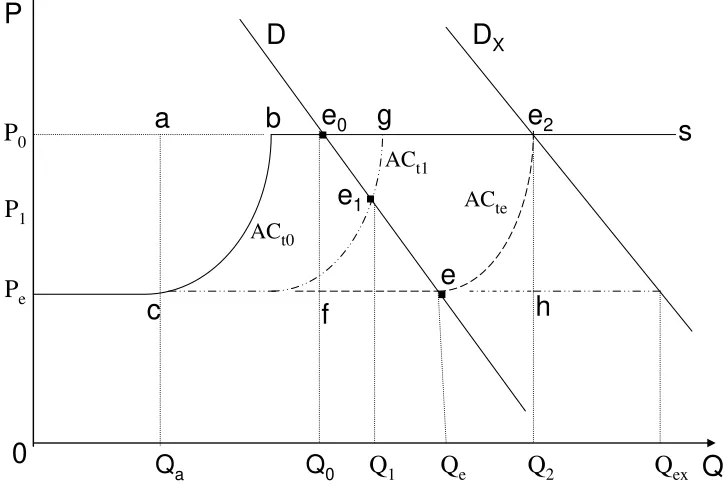
of competition. The key ideas in Shell (1973) are captured in Figure 1 that will be used to
[image:8.595.111.473.316.558.2]contrast the effects between sequential and ‘big bang’ trade liberalization strategies.
Figure 1:
Price-taking Sticky Competitive Market and Competition through Innovation
ACt0
P
0P
1P
e.
.
Q
0Q
1Q
eACt1
ACte
a
b
e
0c
e
e
10
P
Q
D
g
s
Q
af
D
Xe
2Note: ACt0has three sections: Pec is the AC of the advanced firms, cb belongs to the catching-up firms and bs is the AC of the lagged firms. ACt1of Pee1gs shows the effects on the AC curves when more firms caught-up while ACteof Pees corresponds to the long-run equilibrium where all firms produce with the same technique in the market when the market demand is D.
Q
2h
.
Q
exAssume a single product economy, a developing/lagged economy has three types of firm with
different V and therefore average cost of production (AC) in producing product Q: the leading
intermediate firms have less V with AC ranging from c to b while the lagged firms have the
lowest V with AC of P0. Since firms can always use the well-known traditional production
method, there is unlimited supply at P0. The ACt0 is the supply curve of the product at t0.
Given the market demand curve D, in a closed economy or with the import tariff equals to or
higher than (P0 - Pe), the equilibrium market price equals P0 and the output produced equals Q0.
The leading and intermediate firms are earning the total innovative quasi-rent (IR) amounting
to P0abcPe. At t , the real income earned by local resources equals to total output Q0 0. The
existence of IR implies that e will not be in equilibrium. Besides the leading firms will 0 expand their production units, all other firms will try to capture the IR by imitating the
production method of the leading firms such that the supply curve moves to ACt1 with
equilibrium e1 and finally to ACte with the long-run equilibrium e given the demand curve D.
In all equilibriums, real income earned by domestic resources always equals to the value of
total output and the problem of aggregate demand deficiency does not exist. In the transition
towards the long-run equilibrium, technical and production capacity, real income, output,
employment level and consumer surplus expand while the IR diminishes. These phenomena
are commonly observed in the liberalization process among the East Asian economies.
Now, suppose that the economy adopts a ‘big bang’ free trade policy at t with 0
the domestic product price equals to the international price Pe. The mechanism of the
‘de-industrialization’ documented in Shafaeddin (2005b) can be observed in Figure 1.
Theoretically, the total purchase will be equal to Qe at the international price Pe. However,
with the market price, only Qa will be produced by the domestic firms in the long-run. The
local economy experiences ‘de-industrialization’ when the intermediate and lagged firms
become bankrupt and exit the market as their AC is higher than the international price. The
rents from their sunken inputs and/or their IR along with the employment opportunities of the
local resources are destroyed. In the long-run equilibrium, the real income and output in the
economy shrinks to Qa and the domestic purchasing power and fiscal bases shrink accordingly.
Another terrible thing is that the catch-up process under the scenario of closed economy or
tariff protection stops as the IR to the leading and catching-up firms disappears after the
liberalization. As a result, rapid and indiscriminate opening up the domestic market to foreign
economies results in drastic destructions of domestic firms and employment opportunities as
An important characteristic of the East Asian economies liberalization process is
their sequential export-oriented strategy under which they set up Export Processing Zone,
promote assembly industries and invite FDI targeted for exports. At the same time, the
domestic market is under strict protection in their initial stage of liberalization. The
liberalization of export-oriented sectors raises the technical capability of domestic
entrepreneurs through learning by watching, imitation and international interactions.7
Moreover, the existence of IR and the international competitive pressure generate strong
motivations to upgrade their technical level among all entrepreneurs. In addition, the
export-oriented sectors raise the demand of domestic non-tradable resources and create more
job opportunities for surplus labor in the lagged economies.8 The resulting higher
employment level and income raise aggregate demand that generate additional incentive to
domestic entrepreneurs to expand through creative destruction. As illustrated in Figure 1,
without export-oriented policy, the demand curve for Q is D. Given P0, the potential IR to be
captured is bcfe0 when the supply curve is ACt0. Under the export-oriented policy, the demand
for Q expands substantially, for instance, to DX. As a result, the potential IR to each firm
becomes cbe h that is much larger than that of the closed economy under the same initial 2
condition. This induces more active investment and entrepreneurial activities that speed up the
overall growth rate of tools and its variety. Developing economies with surplus resources
therefore gain in the short-run from the higher utilization rate of domestic resources, and in the
long-run, through speeding up the improvements in production and technical capability if they
adopt the export-oriented strategy. The time required to approach the long-run equilibrium will
therefore be shortened relative to the closed economy scenario. This explains the successful
experiences in most economies adopting the sequential liberalization strategy. The policies not
only avoid the destructions to the domestic lagged firms and catch-up motivation, they also
raise the utilization rate of domestic resources, the income level and therefore aggregate
demand in the economies. More importantly, they make advance tools, organization method
7 Suppose a successful FDI brings in a new variety of tool with the market value of r so that the average quantity
of each tools variety remains unchanged. The marginal effect of the FDI equals: j j j j
Y V V
Y 1
θ α = ∂ ∂
. The marginal
benefit of a new tool to a domestic firm is greater than zero, inversely related to the stock of tools variety and proportional to the output level. If the economy has n firms, the benefit of the additional tools variety will spillover to n firms in the long-run equilibrium through imitation.
8 The findings in Mo (2007, 2010), among others, suggest that aggregate demand deficiency is common among
and international networks available to domestic entrepreneurs. Under the process, the
economies will experience rapid economic growth as the aggregate demand and supply
expand rapidly over time.
Neoclassical economics assumes that all firms existing in the market are the same.
Under the framework, the reform advice like eliminating the distortions, regulations and
interventions as proposed in the Washington Consensus can attain static and dynamic
efficiency through trade and competition. However, without appropriately addressing the
problems of lagged firms, unemployment, fiscal bases and therefore the social and
macro-stability problems in the developing countries under transition, eliminating those
necessary ‘distortions’ or regulations may result in deteriorating economic performance after
liberalization. The unconstrained liberalization will cause the lagged firms and the associated
sunken rents to be eliminated and therefore results in widespread unemployment and poverty.
Even those intermediate and leading firms under substantial financial burden may bankrupt
immediately. The resulting unemployment, poverty, reduction in tax bases and socio-political
instability destroy any hopes for sustained economic growth. The economy will be trapped in
the static comparative advantage in international competition as noted and documented in
Rodrik (2005) and Shafaeddin (2005b), among many others.
Most developing countries inherit a large number of lagged firms and sectors in
a protected environment before they start economic reforms. The direct implementation of
many policy reforms based on the existing neoclassical economics is therefore not appropriate.
Our framework provides a systemic explanation for the divergent economic performance
among the lagged economies in their liberalization process as observed and documented in
Rodrik (2005) and Shafaeddin (2005b), among many others. More recently, it helps us to
understand the success of the incremental reforms in China in contrast to the failure of the
‘big-bang’ reforms in Russia. The incremental reform preserves the operation of existing
production units, tools combinations and the established division of labor in the old system
while allowing rapid proliferation of existing and modern tools variety by encouraging
export-oriented sectors like FDI, assembly industry and export processing zones. The
liberation is Pareto-improving to all parties that include the advanced multinational
corporations and international communities. Under the liberalization sequence, East Asian
economies have been able to develop their own industrial and technical capacities while at the
market forces. Another nice thing is that under this export-oriented liberalization sequence
(EXOLS), the potential IR induces and supports new investors and lagged firms to make
necessary investments for modernization with minimal requirement of government financial
supports while the fiscal strength of the governments becomes stronger as the tax-base
expands. With the real-world experiments and the theoretical model, the commonly observed
trade policies adopted in developing countries which include providing favorable terms to
export-oriented FDI of multinational corporations, infant industry protection, setting up
special economic zones and assembly sector while import tariffs only gradually adjust
downward over time are therefore desirable to most lagged economies in their initial stage of
liberalization.
4. The EXOLS Strategy: Discussion and Conclusion
There is increasing consensus that some kind of government interventions is
necessary for the lagged economies to catch up. The question is what kind of interventions.
Our model suggests that in the trade liberalization process, all interventions should target at
reducing the initial drastic displacement effects on domestic lagged firms while maximizing
the growth rate of tools and its variety available to and adopted by domestic entrepreneurs in
order to build up the industrial and technical capacity for sustained growth. Most lagged
economies have substantial lagged industrial and service sectors. Based on the successful
liberalization experiences of the East Asian economies and the theoretical understandings in
this model, we conclude that the lagged economies should adopt the EXOLS strategy as
follows:
1. in the initial stage, liberalize the export-oriented sectors that include FDI,
export-processing zones and assembly industry targeted at international markets only. At
the same time, the lagged sectors developed under protected environment remains closed
to international competition in order to reduce the drastic displacement effects on
employment opportunities and existing tools variety caused by unconstrained international
competitions.
2. support and enrich the adoption of tools and its varieties by entrepreneurs in order to raise
the industrial capacity and technical level up to the international level.
economy has attained the technical level and industrial capacity comparable to
international level.
The EXOLS is beneficial to the lagged economies as well as to the advanced multinational
corporations and economies. It generates many desirable effects to the global economy and to
most lagged economies. Moreover, the liberalization process is self-sustaining due to its
‘incentive compatible’ and Pareto-improving characteristics:
1. A good distribution of political and economic powers in the sense that the interests of the
powers are coincided with liberalization policies and economic growth is essential for
sustainable liberalization. The EXOLS strategy allows Adam Smith's ‘invisible hand’ to be
directed by international market forces in a nation-wide scale. At each stage of
development, all parties that include multinational and domestic investors, governments,
workers and consumers, in pursuing their own self-interest, are also maximizing common
well-being. The policies in the initial stage allows international market in picking winners,
creating job opportunities, raising aggregate demand, generating new sources of fiscal
revenue and trade surplus while the lagged production units and labors are temporary
sheltered by protective policies. As a result, it is a reform without loser as in the case
suggested in Lau, Qian and Roland (2000) when all parties involved gain under the
strategy. Moreover, in the growth process, it creates winners who are contributive under
the export-oriented policy and losers who fail to adjust according to international market
forces. The economic and political powers of the export-oriented groups therefore become
relative stronger while the opposite groups become weaker over time even though
everyone is improving in comparing to the initial situation. The public sector is also forced
by the international competitive pressure to adopt efficient measures, to cope with
international rules and to provide quality infrastructures that include human capital. The
dynamics of the favorable power distribution and supports for liberalization under the
EXOLS is just opposite to the import substitution strategy that generates a power structure
unfavorable to liberalization and growth. (for instance, Lin, 2003 & 2005) The gradual and
inclusive reform under EXOLS therefore does not require strong pre-conditions for the
reform to take place. It can be applied to most lagged economies without any requirement
of political and social reforms.
competition in the international market constraint the rent seeking behavior of regulators
as well as directing the export-oriented sectors toward efficiency.
3. The EXOLS closes the international productivity gap between the advanced and lagged
economies along two dimensions. The first is raising the employment rate of domestic
resources, particularly the surplus labor resides in rural area and the other is closing the
international technical gap in the industrial and other sectors over time. The process
generates rapid inclusive and sustained economic growth in the lagged economies while
providing additional profitable investment opportunities to multinational investors.
4. The EXOLS will upgrade the structure of exports and accelerate the exports of
country-specific innovative manufactures with increasing value-added through syntheses
and learning by practice in the process of international division of labor. The process
contributes to the advances of the global economy by enriching the global stock of tools,
its variety, human capital as well as product variety.
5. Initially, most lagged economies face many constraints including foreign exchange, fiscal
revenue and human capital. The EXOLS can relieve these constraints for modernization
process and therefore strengthen macroeconomic fundamentals for development such as
low inflation, fiscal and exchange rate stability.
To summarize, the model provides concrete policy prescriptions and sequence of trade
liberalization for sustained economic growth which is Pareto-improving to the lagged
economies and the advanced economies at each stage of liberalization. There are no good
policies that apply to all countries with different initial conditions and stages of development;
there are only ‘appropriate policies’ that can promote and support entrepreneurial activities for
enhancing the growth of tools and its variety given various country-specific constraints. Our
model suggests that there is no exact relationship between policy-induced trade barriers and
economic growth across countries. The key is whether the trade barriers have positive or
negative effects on entrepreneurial activities and technical progress in the country. Moreover,
to the economies with substantial traditional and lagged sectors, free trade will result in
de-industrialization and stagnation in the long-run due to the destruction of the dynamics in
building up industrial capacity as documented in Rodrik (2005) and Shafaeddin (2005b),
among many others. Our model also suggests that there is no substantial difference between
mechanism at any time. Moreover, the larger the technical gap between the lagged economy
and the leading economies, the larger the potential IR and therefore the higher the potential
growth rate under the EXOLS strategy will be. The sequence aligns the short-term interests of
the economic and political powers with sustained economic growth at each stage such that
governments and market agents work cooperatively for mutual gains and prosperity instead of
acting as predators and rent-seekers for production surplus as assumed in public choice theory.
Our paper opens the possibility that efficiency, poverty reduction, technical progress and
favorable powers distribution can develop at the same time in the trade liberalization process.
The advanced economies can also gain in the short-run by capturing the
technology difference between the economies through FDI and investments in assembly
sectors during the liberalization process of the export-oriented sectors in lagged countries;
while in the longer-run, can enjoy the increase in the demand for their advanced products
when the purchasing power of the developing countries increase. The additional
entrepreneurial activities in the lagged economies raise the global standard of living by
enriching the global stock of tools and product varieties that are non-rival in nature. The
EXOLS is therefore Pareto-improving to international communities. As Wade (2003) observes,
the East Asian experience shows that trade policy restrictions on some imports need not stop
the fast growth of other imports when appropriate trade policy results in raising the total
demand for imports when their GDP, standard of living and technical level improve. The
general adoption of EXOLS policies in the lagged economies will initiate a widespread
emergence of global-wide newly industrialized nations following the steps of the East Asian
economies that will contribute to a surge in global economic performance by speeding up
innovations, enhancing rivalry and creating competition. The Economist, September 16, 2006
also suggests that: ‘Emerging economies are driving global growth and having a big impact on
developed countries...As these newcomers become more integrated into the global economy
and their incomes catch up with the rich countries, they will provide the biggest boost to the
world economy since the industrial revolution.’ Our model provides some theoretical supports
References
Aghion, P., and P. Howitt (1992), “A Model of Growth through Creative Destruction,”
Econometrica 60, 323-351.
Baldwin, J. and W. Gu (2000) “Trade Liberalization: Export-market Participation, Productivity Growth, and Innovation,” Oxford Review of Economic Policy 20 (3), 372-392.
Barro, R., and X. Sala-i-Martin (1995), “Technological Diffusion, Convergence, and Growth,” Journal of Economic Growth 2, 1-26.
Bessant, J., J. Tidd (2007) Innovation and Entrepreneurship, John Wiley & Sons.
Brezis, E., P. Krugman, and D. Tsiddon (1993), “Leapfrogging in International Competition: A Theory of Cycles in National Technological Leadership,” American Economic Review
83, 1211-1219.
Cobb C.W. and P.H. Douglas (1928) "A Theory of Production", American Economic Review, 18, 139-65.
Crafts, N.F.R. (1995), “Exogenous or Endogenous Growth? The Industrial Revolution Reconsidered,” Journal of Economic History 55(4), 745-772.
Dasgupta, P. and J. Stiglitz (1988) “Learning-by-Doing, Market Structure and Industrial and Trade Policies,” Oxford Economic Papers 40: 246-268.
Dixit, A. and J. Stiglitz (1977) “Monopolistic Competition and Optimum Product Diversity”
The American Economic Review 67(3), 297-308.
Easterly, William (2002) The Elusive Quest for Growth. Cambridge: MIT Press.
Ethier, Wilfred J. (1982) “National and International Returns to Scale in the Modern Theory of International Trade,” American Economic Review 72, 389-405.
Fishlow, A., C. Gwin, S. Haggard, D. Rodrik, and R. Wade (1994) “Miracle or Design?
Lessons from the East Asian Experience.” Washington, D.C.: Overseas Development
Council.
Green, John H. (1964) Aggregation in Economic Analysis, Princeton.
Grossman, G. and E. Helpman (1991), Innovation and Growth in the Global Economy. The MIT Press, Cambridge, MA..
Hausmann, R. and D. Rodrik (2003) “Economic Development as Self-Discovery,” Journal of
Development Economics 72, 603-33.
Jones, Charles (1995), “R&D-Based Models of Economic Growth,” Journal of Political
Economy 103, 759-784.
Krueger, Ann (1997) “Trade Policy and Economic Development: How We Learn,” The
American Economic Review 87(1), 1-22.
Krugman, Paul (1979), “A Model of Innovation, Technology Transfer, and the World Distribution of Income,” Journal of Political Economy 87, 253-266.
Lall, Sanjaya. (2004) “Reinventing Industrial Strategy: The Role of Government Policy in Building Industrial Competitiveness.” G-24 Discussion Paper series. Geneva: UNCTAD.
Lau, L., Y. Qian, and G. Roland (2000) “Reform without Losers: An Interpretation of China's Dual-Track Approach to Transition,” Journal of Political Economy 108(1), 120-43.
Lin, Justin (2003) “Development Strategy, Viability and Economic Convergence,” Economic
Development and Cultural Change 53(2), 277-308.
____ (2005) “Viability, Economic Transition and Reflection on Neoclassical Economics,”
Kyklos 58 (2), 239-264.
Mo, Pak-Hung (2007) “Government Expenditures and Economic Growth: the Supply-side and the Demand-side,” Fiscal Studies 28: 4, 497-522.
____ (2010) “Trade Intensity, Net Export and Economic Growth,” Review of Development
Economics 14, 563–576.
Nelson, R. and S. Winter (1982) An Evolutionary Theory of Economic Change. Cambridge, MA and London: Harvard University Press.
Noland, M. and H. Pack (2003) “Industrial Policy in an Era of Globalization: Lessons from Asia,” Washington, DC: Institute for International Economics.
North, Douglass (1990) Institutions, Institutional Change, and Economic Performance.
Cambridge: Cambridge University Press, 1990.
Pack, Howard (1994) “Endogenous Growth Theory: Intellectual Appeal and Empirical Shortcomings,” Journal of Economic Perspectives 8, 55-72.
Rodrik, Dani (2004) “Industrial Policy for the Twenty-First Century,” Discussion Paper Series No. 4767. London: Centre for Economic Policy Research.
____ (2005) "Growth Strategies," in: Philippe Aghion & Steven Durlauf (ed.), Handbook of
Economic Growth, volume 1, chapter 14, 967-1014, Elsevier.
____ (2010) "Making Room for China in the World Economy," American Economic Review
100(2), 89–93.
Roland, Gerard (2000) Transition and Economics: Politics, Markets, and Firms, Cambridge, MA.: MIT Press.
Romer, Paul (1986), “Increasing Returns and Long-Run Growth,” Journal of Political
Economy 94, S1002-S1037.
____ (1990) "Endogenous Technological Change," Journal of Political Economy, 98 (5), S71-S102.
Rosenberg, Nathan (1963) “Technology Change in the Machine Tool Industry, 1840-1920,”
The Journal of Economic History 23(4), 414-443.
Samuelson, Paul (1947) Foundations of Economic Analysis. Cambridge, Mass: Harvard University Press.
Schumpeter, J. (1949) The Theory of Economic Development, translated by R. Opie, Cambridge, Mass.: Harvard University Press. First German edition in 1912.
Shafaeddin, M. (2005a) Trade Policy at the Crossroads: The Recent Experience of
Developing Countries. Basingstoke and New York: Palgrave Macmillan.
____ (2005b) “Trade Liberalization and Economic Reform in Developing Countries: Structural Change or De-Industrialization,” Discussion Papers No. 179, United Nations Conference on Trade and Development.
Shell, K. (1973) “Inventive Activity, Industrial Organisation and Economic Growth.” In:
Models of Economic Growth, edited by James A. Mirrlees and Nicholas H. Stern. New
York: Wiley.
Stiglitz, Joseph (1996) “Some Lessons from the East Asian Miracle,” The World Bank
Research Observer 11(2),151-77.
Temple, Jonathan (1999) The New Growth Evidence, Journal of Economic Literature, 37(1), 112-156.
Wade, R. (1990) Governing the Market: Economic Theory and the Role of Government in
Weiss, John (2005) “Export Growth and Industrial Policy: Lessons from the East Asian Miracle experience,” ADB Institute Discussion Paper No. 26.
World Bank (1993) The Asian Miracle: Economic Growth and Public Policy. Washington,