Middle and Secondary Education Dissertations Department of Middle and Secondary Education
1-8-2016
Looking at the past: Eighth grade social studies
teachers and historical visual texts
Jearl Nix
Follow this and additional works at:https://scholarworks.gsu.edu/mse_diss
This Dissertation is brought to you for free and open access by the Department of Middle and Secondary Education at ScholarWorks @ Georgia State University. It has been accepted for inclusion in Middle and Secondary Education Dissertations by an authorized administrator of ScholarWorks @ Georgia State University. For more information, please [email protected].
Recommended Citation
Nix, Jearl, "Looking at the past: Eighth grade social studies teachers and historical visual texts." Dissertation, Georgia State University, 2016.
This dissertation, LOOKING AT THE PAST: EIGHTH GRADE SOCIAL STUDIES
TEACHERS AND HISTORICAL VISUAL TEXTS, by JEARL NIX, was prepared under the
direction of the candidate’s Dissertation Advisory Committee. It is accepted by the committee
members in partial fulfillment of the requirements for the degree, Doctor of Philosophy, in the
College of Education and Human Development, Georgia State University.
The Dissertation Advisory Committee and the student’s Department Chairperson, as
representatives of the faculty, certify that this dissertation has met all standards of excellence and
scholarship as determined by the faculty.
_________________________________ Chara H. Bohan, Ph.D.
Committee Chair
_________________________________ Peggy Albers, Ph.D.
Committee Member
_________________________________ Beverly Armento, Ph.D.
Committee Member
_________________________________ Joseph Feinberg, Ph.D.
Committee Member
_________________________________ John K. Lee, Ph.D.
Committee Member
_________________________________
Date
_________________________________ Gertrude Tinker Sachs, Ph.D.
Chairperson, Department of Middle and Secondary
Education
_________________________________
Paul Alberto, Ph.D.
By presenting this dissertation as a partial fulfillment of the requirements for the advanced
degree from Georgia State University, I agree that the library of Georgia State University shall
make it available for inspection and circulation in accordance with its regulations governing
materials of this type. I agree that permission to quote, to copy from, or to publish this
dissertation may be granted by the professor under whose direction it was written, by the College
of Education and Human Development’s Director of Graduate Studies, or by me. Such quoting,
copying, or publishing must be solely for scholarly purposes and will not involve potential
financial gain. It is understood that any copying from or publication of this dissertation which
involves potential financial gain will not be allowed without my written permission.
All dissertations deposited in the Georgia State University library must be used in accordance
with the stipulations prescribed by the author in the preceding statement. The author of this
dissertation is:
Jearl Wayne Nix 948 Paoli Avenue Atlanta, GA 30316
The director of this dissertation is:
Chara H. Bohan, Ph.D.
Department of Middle and Secondary Education College of Education and Human Development
JEARL NIX
ADDRESS: 948 Paoli Avenue
Atlanta, GA 30316
EDUCATION:
Ph.D. 2015 Georgia State University, Atlanta, GA
Teaching and Learning; Social Studies Education
Ed.S. 2009 Piedmont College, Demorest, GA
Teaching and Learning
M.Ed. 2004 Georgia State University, Atlanta, GA
Social Studies Education
B.A. 2000 Georgia Southern University, Statesboro, GA
History
PROFESSIONAL EXPERIENCE:
2002 – Present Hull Middle School, Duluth, Georgia Gwinnett County Public Schools 8th Grade Social Studies Teacher
PUBLICATIONS:
Nix, J.& Bohan, C. (2014). Looking at the past for help in the present: The role of his- torical photos in middle and secondary history classes. Ohio Social Studies Re-view, 51(2), 13–22.
Nix, J.& Bohan, C. (2013). Reaching across the color line: Margaret Mitchell and Benjamin Mays, an uncommon friendship. Social Education, 77(3), 127–131.
PRESENTATIONS:
Nix, J., Ferenczy, J., & Southall, A. (2015, November). Like a Polaroid picture: Shaking up your classroom with visuals. Presentation at the National Council for Social Studies (NCSS) annual conference. New Orleans, LA.
(SHOES). Macon, GA.
Southall, A. & Nix, J. (2015, February). Visual literacy in social studies for ESOL stu dents. Presentation at the 2015 ESOL Conference at Kennesaw State University. Kennesaw, GA.
Nix, J.(2014, November). Picture this: Using visuals to engage middle school learners. Presentation at the National Council for Social Studies (NCSS) annual confer-ence. Boston, MA.
Nix, J.(2014, October). Looking to the past: How eighth grade history teachers utilize visual texts. Paper presentation at the American Association for Teaching and Curriculum (AATC), Tampa, FL.
Southall, A. & Nix, J.(2014, October). Using visual literacy in social studies education to empower ESOL students. Presentation at the Georgia Teachers of English to Speakers of Other Languages (GATESOL) conference. Athens, GA.
Nix, J. (2014, October). Fifty visual texts for Georgia studies: Using visuals to enhance student learning. Presentation at the Georgia Council for Social Studies (GCSS) annual conference. Athens, GA.
Napoleon, K. & Nix, J. (2012, October). Achieving student engagement through film in social studies classes. Presentation at the Georgia Council for Social Studies Conference (GCSS). Athens, GA.
Nix, J., Caldwell, T., & House, C. (2007, August). How to identify quality plus teaching strategies: observation methods for administrators. Presentation at the 2007 Gwinnett County Leadership Conference. Athens, GA.
Nix, J. & House, C. (2006, October). The good life: Research based strategies to improve student achievement in 8th grade social studies. Presentation at the Geor-gia Council for Social Studies Conference. Athens, GeorGeor-gia.
Current Professional and Academic Memberships National Council for Social Studies (NCSS) College and University Faculty Assembly (CUFA)
American Association of Teaching and Curriculum (AATC) Georgia Council for Social Studies (GCSS)
Georgia Historical Society (GHS)
HISTORICAL VISUAL TEXTS
by
JEARL NIX
Under the Direction of Dr. Chara H. Bohan
ABSTRACT
LOOKING AT THE PAST: EIGHTH GRADE SOCIAL STUDIES TEACHERS AND
HISTORICAL VISUAL TEXTS
by
Jearl Nix
Teachers in the 21st century are confronted with students who are mass consumers of
vis-ual texts via social apps on smart devices, media on television, and information in textbooks.
Teaching students to analyze and question visual texts may help them construct meaning and
cri-tique what they see. Yet, very little is known about teachers’ pedagogical decisions when
plan-ning and teaching with visual texts. This study attempted to fill that gap. The purpose of this
study was to explore how eighth grade history teachers utilize historical visual texts in their
video recorded lessons, and teacher reflections. Data obtained in this study addressed the
follow-ing questions: How do teachers analyze a historical visual text for use in the classroom? What
previous experiences do teachers utilize when planning to teach with a historical visual text?
What do teachers’ reflections of a video recorded lesson reveal about the teachers’ instructional
experiences with historical visual texts? What do video analyses of teachers utilizing historical
visual texts reveal about teachers’ historical thinking and visual literacy pedagogical decisions?
The results of this study indicated that the participants lack formal pedagogical content
knowledge and prior experiences in teaching with historical visual texts. Yet, the participants
reported that their lessons in this study were engaging and meaningful for students. Findings
from this study suggest that historical visual texts can be effective in the teaching and learning of
history.
INDEX WORDS: Historical visual texts, Visual literacy, Historical thinking, Social studies,
HISTORICAL VISUAL TEXTS
by
Jearl Nix
A Dissertation
Presented in Partial Fulfillment of Requirements for the
Degree of
Doctor of Philosophy
in
Teaching and Learning Social Studies Education
in
Middle and Secondary Education
in the
College of Education and Human Development Georgia State University
DEDICATION
This dissertation is dedicated to the memory of my father, Jerry Nix, who taught me how
ACKNOWLEDGMENTS
I would like to thank the members of my dissertation committee for all of their patience,
guidance, advice, and support during this entire process. Dr. Albers, Dr. Armento, Dr. Feinberg,
and Dr. Lee: Thank you from the bottom of my heart for the coffee sessions, long talks, and
even longer email exchanges. I would like to offer a special thank you to my dissertation
com-mittee chair, Dr. Chara Bohan, who is a dependable co-author, mentor, and friend.
I also owe a great deal of gratitude to the following: Jennifer Ulbrich for her willingness
to give of her time and assistance whenever I asked for it, Dr. Christopher Moore whose humor,
support sessions, and words of encouragement were always timely and appreciated., and Aubrey
Southall whose contagious passion has made me a better human being.
I would also like to thank members of my family: Bill Shoemaker for his unyielding and
unconditional support, Louise Nix for her patience and love, Chris Nix for demonstrating that
hard work does pay off, and my mother, Jacque Nix, who believes I am perfect and can achieve
Table of Contents
LIST OF TABLES ... vii
LIST OF FIGURES ... viii
CHAPTER 1 ... 1
THE PROBLEM ... 1
Problem Statement ... 5
Purpose of the Study ... 8
Theoretical Framework ... 11
Purpose Statement and Research Questions ... 17
Research Design ... 18
Significance of the Study ... 20
Organization of the Study ... 23
CHAPTER 2 ... 25
REVIEW OF THE LITERATURE ... 25
Definitions of Terms ... 27
Definitions of Visual Literacy ... 28
The Educational Importance of Visual Texts ... 30
Research on Visual Literacy ... 41
Historical Thinking ... 45
Defining Historical Thinking ... 46
Importance of Historical Thinking ... 48
Conclusion ... 53
CHAPTER 3 ... 56
THE METHODOLOGY ... 56
Research Design ... 58
Sampling and Participants ... 62
Subjectivities ... 64
Data Collection Methods ... 65
Data Analysis ... 66
Teacher Document Analysis ... 68
Video Recorded Lessons ... 70
Teacher Video Analysis and Reflection ... 72
Researcher Video Analysis for Historical Thinking and Visual Literacy ... 75
Limitations of the Study ... 83
Summary ... 85
CHAPTER 4 ... 86
SETTINGS, PARTICIPANTS, AND TEACHER LESSON SUMMARIES ... 86
Amanda ... 87
Amanda’s Historical Visual Text ... 88
Amanda’s Lesson with a Historical Visual Text ... 90
George ... 92
George’s Historical Visual Text ... 94
George’s Lesson with a Historical Visual Text ... 96
Anderson’s Historical Visual Text ... 98
Anderson’s Lesson with a Historical Visual Text ... 100
Summary ... 101
CHAPTER 5 ... 103
CROSS-CASE ANALYSIS ... 103
Uneven analysis of historical sources and impact on instruction. ... 104
Limited prior experiences and disjointed lesson plans of teachers ... 108
Teachers reflect on missteps, successes, and areas of growth ... 115
CHAPTER 6 ... 130
HISTORICAL THINKING AND VISUAL LITERACY ANALYSIS ... 130
Shulman’s Teacher Content Knowledge ... 130
Evidence of Historical Thinking ... 131
Evidence of Visual Literacy ... 139
Community ... 140
Opportunity/Capacity ... 141
CHAPTER 7 ... 147
CONCLUSIONS ... 147
Discussion of Results ... 150
Implications for Action ... 158
Further Research ... 160
Conclusion ... 161
APPENDICES ... 177
LIST OF TABLES
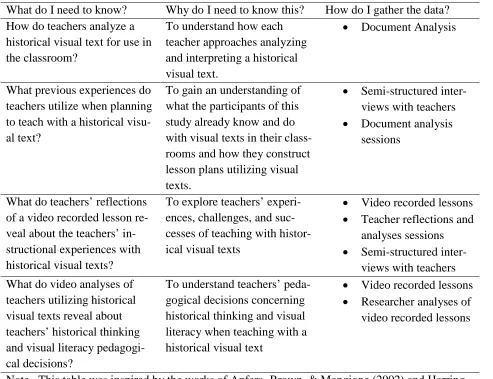
Table 1 Research Questions Overview ….………58
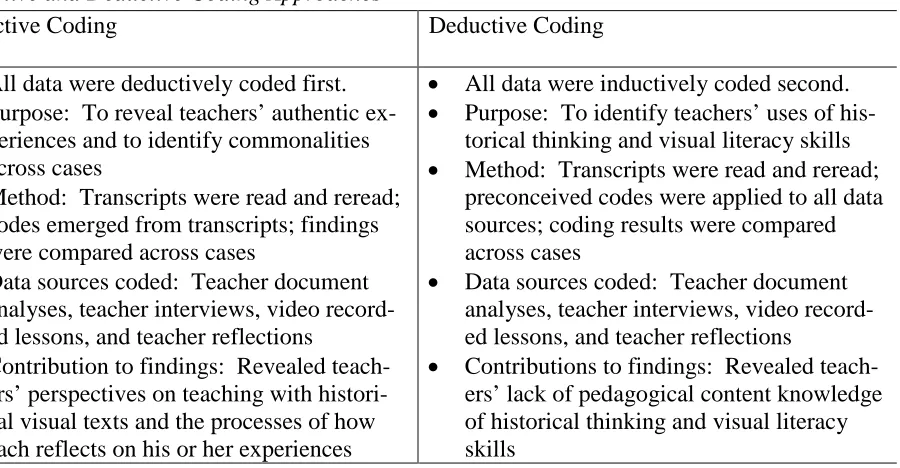
Table 2 Inductive and Deductive Coding Approaches………..67
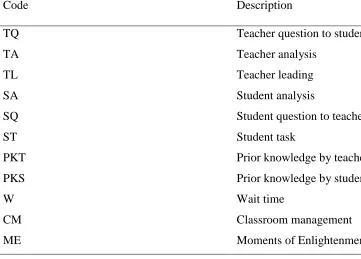
Table 3 Video Recorded Lesson Inductive Codes……….73
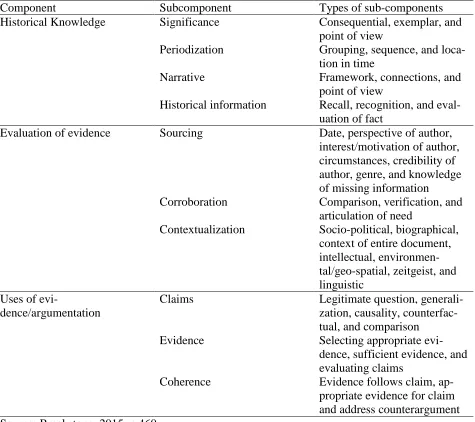
Table 4 Domain of Historical Thinking for the Secondary Classroom……….77
Table 5 Deductive Codes for Pedagogical Content Knowledge ………..79
Table 6 Visual Literacy Analysis Deductive Codes.………..83
Table 7 Emerging Patterns and Trends from Cross Case Analysis………117
LIST OF FIGURES
Figure 1. The political cartoon used by Amanda in her lesson. Unknown Artist (1870). XVth
Amendment ………...……..89
Fiture 2. The political cartoon used by George in his lesson. Waud, A. (1868). The Freedmen’s
Bureau. ...………..94
Figure 3. The political cartoon used by Anderson in his lesson. Nast, T. (1874). The Union as it
CHAPTER 1
THE PROBLEM
Before the invention of formal writing, around 16,000 B.C., humans memorialized hunts
and cultural events by engraving scenes on rocks or painting the insides of caves (Staley, 2006).
In the caves of Lascaux and Chauvet in France, Paleolithic humans used readily available
mate-rials to colorfully draw large depictions of animals seen in daily life. Ubirr, situated in the
Arn-hem Lands of northern Australia, houses rock paintings by the Aborigines that show prominent
societal members as stick figures donning elaborate attire (Kjellgren, 2000). At Pachmari Hills
in India, there are cave drawings and etchings showing the plant life and hunting practices of the
area (Tedesco, 2000). Thus, humans have created visual images as a means to convey history for
thousands of years.
The Ancient Greece and the Roman Empires embraced visuals by erecting monuments to
gods and former leaders, adorning buildings with engravings of culturally significant events, and
painting scenes of their cultural heritage on vases (Rutter & Sparkes, 2000). The Romans
deco-rated walls, floors, and passages with mosaics. These displays of colorful stones set in mortar
illustrated historic events such as chariot races, gladiator battles, and other cultural celebrations.
In China, artists sculpted replicas of Buddha, memorialized rural landscapes through paintings on
hand scrolls, and artists with steady hands incorporated calligraphy into symbolic paintings of
Chinese military strength and power (Delbanco, 2008; Hearn, 2008; Leidy, 2010).
During the Middle Ages, European painters depicted religious scenes in churches through
stained glass windows and in sculptures constructed from wood, bronze, and stone (Moss, 2008).
Books became works of art with lavish and vivid illustrations hand drawn by artists. Italian
songs and assist the singers’ performances (Boehm & Nogueira, 2009). In the Renaissance and
early modern periods, rulers, influential families, and religious leaders commissioned artisans to
honor important historical figures with monuments, paintings, and sculptures (Staley, 2006).
Michelangelo’s sculpture David and his work on the ceiling of the Sistine Chapel are two
exam-ples of commissioned works of historical art. Leonardo de Vinci was also commissioned to
commemorate historical events through his paintings such as The Last Supper at the Santa Maria
delle Grazie in Milan (Bambach, 2002). For centuries, political rulers, religious principles, and
political ideologies dictated how history was depicted through visual arts in Asia. During the
Joseon dynasty in the 1400s, Korean artists were commissioned to paint Neo-Confusists leaders
on white porcelain (Lee, 2004).
Paintings of historical events dominated the 1700s and early 1800s. Wars and
revolu-tions were memorialized as well as daily social life. The Industrial Revolution quickly advanced
the ways sketches could be printed in newspapers, journals, magazines, and books. Lithography,
the process of easily duplicating drawings for print, opened the door for mass production of
visu-al texts. During the American Civil War, magazines hired photographers and illustrators such as
Mathew Brady and Alfred Waud, to produce sketches and images of battles that would then be
published for readers to analyze and journalists to refer to in articles (Ives, 2004).
Not all of the visual images of the 1800s were war themed. Many painters of the era,
par-ticularly American artists, chose to paint scenes of everyday life of the rapidly growing nation.
Paintings by artists like William Sidney Mount capture families, community life in rural areas,
children at play, and life in the home during the 19th century (Weinberg & Barratt, 2009).
Land-scapes were also captured on canvas to preserve their natural beauty, yet undisturbed by humans
called Ukiyo-e. In this inexpensive art form, woodblock prints, previously reserved for written
text, now contained portraits of urban life, landscapes, and famous actors (Department of Asian
Art, 2004) .
In the 1830s, Louis-Jaques-Mande Daguerre revealed that he was able to capture still
im-ages on sliver colored copper plates in a process he called daguerreotype. People were now able
to capture an image of themselves, their property, and their families for a fraction of the costs
and in a shorter amount of time than through a painted portrait. The era of the Daguerreotype
ended in the 1850s when artists begin to produce photos on glass instead of the silver colored
copper plates (Daniel, 2004).
During the transition from the 19th into the 20th century, improvements in making and
de-veloping photographs advanced swiftly. Cameras became smaller thus increasing their mobility
and their uses. Pictures were printed on paper and not glass. Photojournalists were able to take
pictures of historic events for news sources. Families used cameras to memorialize family
events. During the first decades of the twentieth century, photography quickly became the main
source of visual texts for America’s democratic society. Photographs of America’s dark issues
such as immigration, child labor, overcrowded urban centers, and lynching spurred citizens to
call for progressive reforms. Photographs were not only capturing America’s history, but they
was also showing citizens of the time what words alone could not (Moss, 2008).
Around the same time that photography was gaining popularity, the first uses of film
be-gan to emerge. Film provided a way to give action and eventually voice to images of historical
events. The popularity and expansion of film into an industry provided a format that allowed
In the late 1940s, a new way to visualize history was introduced through the invention of
television. First thought of as a fad, television has arguably had the biggest impact on how
peo-ple visualize history (Moss, 2008). Live events like the funeral of President Kennedy, the first
man on the moon, and the terrorist attacks of September 11th, allow people to see history as it
happens. Television viewers also develop their historical understandings through documentaries
like Alex Haley’s Roots and Ken Burns’ Civil War.
As each decade passed from the twentieth into the twenty first century, film, television,
and photography became increasingly accessible to more people. Cameras used to capture
vide-os and photographs shrank and eventually became standard parts of devices such as laptops,
tab-lets, and mobile phones. Movies, television shows, and pictures graduated from black and white
into colorful displays and eventually into digital files. The time required for developing videos
and photographs shrunk so that development became instantaneous on these new devices. With
photography and filming tools so readily available, the ability to visually capture historical
events is no longer left to photojournalists or those who could afford expensive equipment.
Us-ing a mobile device, anyone could capture an historical moment and instantly distribute the
im-age to thousands of people via social media.
The ways that humans develop visualizations of history have evolved from large cave
paintings into digitized snapshots captured on tiny devices. The enormous amount of visuals and
the speed at which they reach viewers calls for a focus on literary skills that viewers can employ
when attempting to read, interpret, and construct meanings of images of historical events.
To-day’s students in particular need tools to assist them in interpreting the large amount of visuals
they interact with on a daily basis. Visual texts (Werner, 2002), a term used in instructional
political cartoons, billboards, advertisements, charts, graphs, and maps. Werner (2002) argues
that visual texts should no longer be viewed as filler that enhances the look of a written text.
In-stead, visual texts “…are the social world and need to be treated as subject matter in the
class-room” (p. 401). Werner calls on social studies teachers to teach students how to be critical
read-ers of visual texts allowing learnread-ers to be interpretread-ers instead of just consumread-ers of some fixed
meaning. Teaching students to be visually literate can be considered a part of social studies’ role
in teaching students to be informed citizens who think and act from knowledge.
Texts of all kinds are a critical part of social studies and history education. Textbooks,
movies, maps, and written documents are texts used to teach students historical thinking and
rea-soning skills. Seixas (2001) calls for a shift in what social studies educators consider texts and
how teachers use them in the classroom. He argues that all sources of information such as
pho-tographs, political cartoons, sketches, paintings, and monuments be treated as documents that
students must learn to read. Visual texts, according to Seixas, need to be recognized as
docu-ments created by authors who have a perspective into the subject of the texts. Interrogating the
creator’s positionality and the context in which a text was created “…brings classroom, school,
students, teachers-and researchers-into a new, self-conscious interplay with the world outside”
(Seixas, 2001, p. 559).
Problem Statement
The lives of today’s students are inundated with visual texts through advertising, the
me-dia, video games, movies, popular culture, social media websites, the classroom, and the internet.
Students are living in an era where they have instant access to image-rich sources through
graph-ically enhanced devices like smart phones and tablets. Researchers are finding that even many
2013). Three fourths of American students from infants to eight have access to mobile devices,
and the amount of time students spend on these devices is increasing drastically each year
(Rideout, Foehr, & Roberts, 2010). Students are arriving at school having already consumed
many thousands of visual messages through mobile devices.
Although the access to so much visual information can be exciting for students, the
ex-cess of visual texts can be overwhelming if students are not taught how to be visually literate
(Metros, 2008). Visual literacy, a term that first appeared in academia in the late 1960s, is the
“ability to understand, interpret and evaluate visual messages” (Bristor & Drake, 1994).
Accord-ing to Braden and Hortin (1982) visual literacy is “the ability to understand and use images,
in-cluding the ability to think, learn and express oneself in terms of images” (p. 38). The sheer
number of visual texts students come in contact with each day helps them develop basic visual
literacy skills. Yet, looking at visual texts is not the same as being critical viewers. As Felten
(2008) notes, “living in an image-rich world, however, does not mean students…naturally
pos-sess sophisticated visual literacy skills…” (p. 60). Berger (1972) argues that every time one
views a visual text they see something different. Critical viewership means to be in constant flux
between what they know and what they actually see.
We never look at just one thing; we are always looking at the relation between things and
ourselves. Our vision is continually active, continually moving, continually holding
things in a circle around itself, constituting what is present to us as we are. (Berger,
1972, p. 9).
Little, Felten, and Berry (2010) agree in that visual texts “…are different from [written]
texts, and developing visual literacy will require deliberate and reiterative practice…” (p. 46) for
Text-based verbal instruction is still the main form of content delivery in today’s schools
(Burns, 2006). An academic value exists in teaching students how to be good readers and writers
in the traditional literary sense. But, as society changes, students also need visual literacy skills
that are transferable from the classroom to the world outside of school (Callow, 2005; Marcus,
Paxton, & Meyerson, 2006). According to Waters and Russell (2012) “as contemporary media
continues to use images in an effort to influence society, educators need to spend time explaining
and instructing in the visual realm” (p. 209).
The K – 12 social studies curriculum provides an ideal space where teachers and students
can develop and practice techniques that will enhance students’ visual literacy skills. Already
many educators in the field are using various types of visual texts in their classrooms: graphic
organizers, historical photographs, monuments and memorials, artwork, political cartoons, films,
maps, charts, and graphs (Flynt & Brozo, 2010; Waters & Russell, 2012). Unfortunately, many
of the classroom uses of visual texts do not call on viewers to engage critically with the text.
Many textbooks, for example, still only use visual texts such as photographs, paintings, and
po-litical cartoons as space holders on pages full of verbal text rather than documents to be analyzed
or critiqued. And, when visuals exist, students’ only resource into making meaning of the visual
texts are the captions containing the textbook author’s interpretation of the image, thus, denying
the viewer the opportunity to construct their own interpretation (LaSpina, 1998; Werner, 2002).
Some social studies teachers have reservations about utilizing visual texts in their
class-rooms (Metros, 2008). This lack of confidence may be attributed to their own lack of knowledge
and understanding of visual literacy. During their time as preservice students, the use of
tradi-tional texts was probably emphasized more than visuals as the best resources to teach social
uni-versities, just like K – 12 schools, are slowly increasing their acceptance of visual texts as
legiti-mate resources for the teaching and learning of social studies (Coventry, M., Felten, P., Jaffee,
D., O’Leary, C., & Weis, T., 2006; Felten, 2008; Metros, 2008; Staley, 2007).
Purpose of the Study
The purpose of this study was to explore how eighth grade history teachers utilize
histori-cal visual texts in their classrooms. Multiple data collection methods such as teacher interviews,
analyses of documents, and video recorded lessons were used to learn how three-eighth grade
history teachers utilize historical visual texts. Many visual texts exist that can be used as the
main form of delivering social studies content to students. Graphs and charts can teach
quantita-tive data in a format that is easy to read. Maps teach students about locations, politics, and
hu-man geography. An examination of monuments of prominent individuals and events provide
learners with a look at the people and events past cultures deemed important. Youtube videos
bring historical concepts to life via live action. Advertisements visualize current and previous
trends in consumerism. Photographs and paintings are also visual texts that provide insight into
the past. Instagram and Twitter accounts of historical homes and museums offer followers a
glimpse into the past by releasing archived visuals and art on social media outlets. Political
car-toons call on viewers to develop opinions and then question the viewpoints of others, the artist,
and sometimes themselves.
Visual texts are everywhere in contemporary American society. Students can look at
pa-per photographs at home in albums or digital images on computers and mobile devices. Not only
are visuals available for viewing, but in many cases, students are asked to interact with images
by commenting on them, liking them, or even sharing them with other people. In today’s digital
minutes. Students are more than just consumers of visuals. They are image creators making
edi-torial decisions such as choosing the subjects, adding aging filters, deciding on the best angles,
and selecting when and where to post the pictures for public display. The smart devices students
operate today make it easier than ever to constantly capture moments in one’s life.
Even with the prevalence of visual texts in today’s culture, however, historians and
edu-cators in general have been slow to shift from a verbal text-based curriculum to one that
empha-sizes visual texts (Martinez, 2009). Written sources are and have always been essential to the
research of history. Challenging the status quo, as visual texts can appear to do, takes time to be
recognized as legitimate and beneficial to teaching and scholarly work. According to Staley
(2006), past historians only viewed images as sources of information for illiterate or uneducated
people who could not read the “legitimate” written sources.
The delayed acceptance of visual text as documents worthy of historical inquiry by
histo-rians, teacher educators, and social studies teachers may be due to their reputation as unreliable
due to their ability to be edited, manipulated, or falsified (Coventry, et al., 2006). One of the
most famous examples of manipulating history through photography is Mathew Brady’s moving
and propping up of dead soldiers for photographs of the Civil War. According to Martinez
(2009), the notion that images are unreliable sources of historical information was the school of
thought in academic historical research for many years.
Yet, the acceptance of visual texts as legitimate sources for historical inquiry has slowly
taken shape over the past few decades. W. J. T. Mitchell (1995) used the term “the pictorial
turn” (p. 2) to describe the shift in our culture from a society based on text to one engulfed in
im-agery and symbols. Modern historians have acknowledged this turn and are beginning to see the
re-searchers provide good arguments for incorporating visuals into the practice of historical inquiry.
Staley (2006) defends visual texts as legitimate sources for historical inquiry. He states that
“be-cause they can depict simultaneity, multidimensionality, and whole/part relationships.” He
con-tinues that “images are an excellent medium for representing thought and ideas, including our
representations of the past” (p. 393).
Martinez (1995) calls out historians who believe that written sources are less subjective
and therefore more reliable than visual texts. She argues that the authors of past documents as
well as the historians who have analyzed them did so through their own personal biases and
sub-jectivities. Just as a photographer, artist, or sculptor injects his or her own subjectivities on his
photograph, painting, or monument, so too does the writer of a diary, letter, or any other written
source of historical prominence.
According to Trachtenberg (1989), the ability to interpret images in so many ways
“...frees [historians] from the tyranny of any fixed version [of history], permitting critical
histori-cal judgment” (p. 70). Historians who ignore visual texts miss opportunities for expanding their
inquiry into their topics.
Modern historians, according to Martinez (2009), no longer cling to the ideology of
ob-jective historical research. The new historian, believing that history itself is interpretative, is less
rigid in his research; there is freedom to express one’s thoughts, opinions, and subjectivities
within one’s own scholarly work. This new approach allows photographs to be considered
legit-imate sources in conducting historical research and in the teaching and learning of history.
Researchers are discovering benefits for learners when historically based images are
uti-lized in teaching and learning environments (Berry, Schmeid, & Schrock, 2008; Bolgatz, 2007;
that visual texts are more compelling and visually pleasing and therefore leave a more lasting
impression on viewers. Visual imagery is also important because of its impacts on the long term
memory of viewers (Gagne, 1985). Burke (1994) points out that a visual text can provide
read-ers with information and experiences that a written text cannot. An example is that the
question-able authorship and truthfulness of photographs make them prime sources for historical research.
Contextualizing and sourcing edited photos are challenging tasks that call on both visual literacy
and historical thinking skills. Furthermore, teaching students to constantly question photos may
benefit learners in their visually saturated lives outside of school.
The purpose of this research is to explore how eighth grade history teachers utilize
histor-ical visual texts in their classrooms. Research exists on the uses of visual texts in the college
history classroom (Coventry et al., 2006; Felten, 2005; Jaffee, 2009; Wineburg, 2001) and some
studies on their uses in elementary and secondary history classes (Foster, Hoge, & Rosch, 1999;
Levstik & Barton, 1994; VanSledright, 2002; Wineburg, 1999). Little to no research explores
middle level teachers’ attempts at utilizing historical photographs in their classrooms. This
re-search attempts to fill that gap.
Theoretical Framework
The epistemology for this study is based in constructionism. The purpose of this study is
to explore how eighth grade history teachers utilize historical visual texts in their classrooms.
According to Crotty (1998), constructionism claims “that meanings are constructed by human
beings as they engage with the world they are interpreting” (p. 43). For meaning to be generated
or constructed, there must be a social interaction “between human beings and their world, and
developed and transmitted within an essentially social context” (p. 42). Constructionism by its
history teachers constructed meaning with objects, specifically historical visual texts in an effort
to create lessons in which students constructed understandings of the same texts and their
histori-cal contexts. Visual texts may include politihistori-cal cartoons, movies, television shows, monuments,
paintings, graphs, charts, maps, and historical photographs. All of these visuals have different
values or meanings when separated from the context of the classroom or learning experience.
However, when situated within the curriculum or potential lesson the visual texts become objects
of educational value and importance that need to be understood.
This study of how eighth grade history teachers utilize visual texts in their classrooms is
also influenced and situated in two fields of study: visual literacy and historical thinking. These
two fields provide crucial and necessary components in the study of history. Historical thinking
skills provide students with the cognitive tools necessary to make meaning of documents from
the past. Visual literacy skills allow students to better analyze and interpret visual texts that they
encounter. These two fields of study coexist in this study because historical visual texts were
components of the data collection process. What follows is a summary of these fields, visual
lit-eracy and historical thinking, as they relate to this study. First, the following section on visual
literacy will include: (1) definitions of visual literacy, (2) common components of visual
litera-cy, and (3) the impact of visual literacy on student learning.
Visual Literacy
Visual literacy is a term that first emerged in the 1960s. John Debes (1969) coined the
phrase and defined it as a person’s ability to critique, interpret, analyze, and make meaning of
visual texts. Since that first definition, more definitions have appeared (Dondis, 1973; Francesky
& Debes, 1971; Petterson, 1993). Although a singular definition does not exist, there are
through visual texts (Avgerinou & Pettersson, 2011; Braden & Hortin, 1982; Ravas & Stark,
2012).
Researchers agree that another common component of visual literacy is that students
learn to read and interpret visual texts and are provided opportunities to practice these skills.
Werner (2002) believes that the presence of three conditions in a social studies classroom can
help students develop visual literacy skills. First, is that students are given the authority to
inter-pret, challenge, and question a visual in order to develop their own interpretation. The meanings
of visual texts are not fixed. Rather, the meanings emerge as the students interact with a text.
Werner (2002) argues that both the text and the reader share authority over the meaning of the
text. He points out that it is rare that an author’s intentions are revealed by simply looking at
visual text. Instead, students must have the authority to interact and interpret the text in order to
understand that multiple interpretations and meanings are possible for a visual text.
Second, is that students are given many opportunities to work with visual texts in
mean-ingful and educative ways. Werner (2002) suggests that teachers incorporate readings of visual
texts along a closed-open continuum of authority. On the closed end, the viewer is only using
the visual text as a source for information from which to extract facts. Often these are
accompa-nied by captions or descriptive narratives. In the middle of the continuum, the readings of visual
texts move away from informational fact finding and toward implying meanings and the authors’
intended meanings. Finally, on the open end of the continuum, readers are given the authority to
contextualize texts and to reflect on personal and cultural biases in interpreting visual texts.
Werner points out that this continuum of open and closed authority for viewing visual texts
should be treated as a variety of approaches and not a hierarchy or scale of importance where the
The third condition for a social studies classroom to facilitate visual literacy growth
among student is for the classroom to be a space for communal sharing and reflection. Werner
(2002) insists that classroom discussions are a key component of fostering students’ abilities to
read visual texts. Discussions, he points out, help students gain background knowledge, learn
about multiple interpretations of the same text, gain new ideas and insights into a text, and
reevaluate their own interpretation and readings of a text. The classroom setting must be a place
where students feel safe to openly share without the fear of criticism or rejection by peers or the
teacher.
The incorporation of visual literacy in the social studies classroom can have
last-ing outcomes on students’ learnlast-ing and on the classroom environment. Three of these outcomes
include: (1) motivating students, (2) providing students with life skills, and (3) influencing
stu-dents’ construction of historical knowledge.
Motivating students to learn about the past can be a difficult task for teachers. In
research conducted over a span of many years (Chido & Byford, 2006; Russell & Waters, 2010;
Schug, Todd, & Beery, 1982; Shaughnessy & Haladyna, 1985), middle level and secondary
so-cials studies students pointed out social studies as their least favorite class. Students state that
they struggle to apply what happened in the past to their lives today. Students also cite teaching
methods such as lecture and textbook work as boring and disengaging. Incorporating visual
lit-eracy skills such as analyzing photographs, interpreting political cartoons, and contextualizing
advertisements into the social studies curriculum could increase student engagement and
motiva-tion. Critically viewing visual texts can break up the typically written text-heavy-subject of
his-tory. Teaching visual literacy skills may provide students with skills to traverse today’s visually
students to critically analyze all visual texts such as advertisements, videos, propaganda, and
im-ages produced by the media. The ability to read and interpret visual texts is an important life
skill for students. To be engaged citizens, students need to learn how to read a variety of
sources. Gee (2003) identifies the approach of using a variety of texts as the “multimodal
prin-ciple of learning”. He explains that “…meaning and knowledge are built up through various
modalities (images, texts, symbols, interactions, abstract design, sound, etc.), not just words” (p.
210).
Finally, visual literacy skills are important for students in making sense of history.
Stu-dents construct historical knowledge through a wide range of visual texts outside of school:
tel-evision, movies, social media, religious ceremonies, and even family photo albums (Moss,
2008). Felten (2006) points out that history teachers need to understand the “rich but
problemat-ic visual knowledge, beliefs, and habits that students bring to the history classroom” (p. 1386).
Teachers can build upon students’ prior knowledge to develop a history curriculum based around
visual texts that promote challenging students’ concepts of history.
Historical Thinking
Historical thinking is the second field of study influencing this research study into how
eighth grade history teachers utilize visual texts in their classrooms. The following section will
include information on historical thinking. The topics in this section include: (1) a definition of
historical thinking, (2) the role of historical thinking in visual literacy, and (3) the importance of
historical thinking skills on student learning.
Historical thinking, as a method of research for historians and students, has experienced
tremendous growth in the last few decades of the twentieth century. Historical thinking is the
2008; Bolgatz, 2007; Martin & Wineburg, 2008; Seixas & Clark, 2004; VanSledright, 2004;
Wineburg, 1991; Wineburg, 2001). A variety of approaches exist in conducting historical
think-ing. However, like visual literacy, a set of common components of historical thinking exist.
These include criticizing sources, working with a variety of sources on one topic, questioning the
authorship of a source, contextualizing the source, and making inferences to its meaning.
Historical thinking skills do not just pertain to text-based documents. Martinez (2009)
provides a definition of historical thinking from a visual literacy point of view. Her definition is
as follows:
[T]he ability to understand the subject and meaning of an image within the context of the
culture that produced it, the ability to understand the compositional and stylistic
charac-teristics of a work and why these characcharac-teristics matter, and the ability to interpret, use,
appreciate, and create images” (p. 11)
Learning how to think historically provides students with a number of vital skills in
inter-preting the past. First, learning historical thinking skills and applying them to historical
docu-ments help students increase their understanding of the past. Students learn history from a
varie-ty of sources outside of the classroom. Students bring that prior knowledge, correct or
inaccu-rate, to their learning of history and even try to apply preconceived ideas to their analysis of
his-torical documents. Learning hishis-torical thinking skills can help overturn possible misconceptions
of history.
In research conducted on students’ knowledge and understanding of history, historical
thinking compounded year after year helps students to identify the chronology of and temporal
settings of historical events (Foster Hoge, and Rosch, 1999; Levstik & Barton, 2008). Learning
of history. In their early years, students tend to narrate history in short, inaccurate tales filled
with misinformation and imaginative details. According to research conducted by Barton
(2008), learning historical thinking skills as they progress through grades, students tend to form
more cohesive narratives of past events with correct facts and the correct chronology.
Second, students who learn how to analyze historical documents gain skills that are
trans-ferable to their lives outside of school. Questioning and analyzing the purpose of a historical
document, for example, can lead a student to question and analyze the authorship of documents
in everyday life. Third, applying historical thinking skills to primary documents help students
learn to form and support opinions based on research and cognitive reasoning. This skill can be
helpful to students as they grow into active members of a democratic citizenry. As they begin to
participate in civic responsibilities and duties, students who learn to critique, analyze, and
ques-tion documents of the past, should be able to be more informed citizens than others who lack
these skills (Barton, 2008).
Purpose Statement and Research Questions
The combination of historical thinking and visual literacy may provide students with a
knowledge base that can assist them in their current education as well as in their lives outside of
school today and in their future. The goal of this research study is to explore how eighth grade
history teachers utilize visual texts. The following questions guided this research:
1. How do teachers analyze a historical visual text for use in the classroom?
2. What previous experiences do teachers utilize when planning to teach with a historical visual text?
4. What do video analyses of teachers utilizing historical visual texts reveal about teachers’ historical thinking and visual literacy pedagogical decisions?
Research Design
A qualitative case study method was used to explore how eighth grade history teachers
utilize historical visual texts. The participants of this study were three teachers in the same
eighth grade social studies department at a suburban middle school located in the southeastern
United States. The research period for this study took place while the participants were teaching
about the Reconstruction Era of American history. Each participant signed a consent form prior
to the collection of any data.
Once the participants agreed to take part in this study, they requested that I, as the
re-searcher, provide them with resources in locating and identifying appropriate visual texts to use
in planning for and teaching about the Reconstruction Era. I sent an email to the participants that
contained a link to the harpweek.com website which contains political cartoons from the
histori-cal news publication Harper’s Weekly. I also emailed links to two articles from the Georgia
En-cyclopedia website. One article entitled Freedmen’s Education during Reconstruction (Butchart,
2002) contains photographs and sketches. The second article, Sharecropping (Giesesn, 2007),
includes photographs from the Reconstruction Era. All three participants selected political
car-toons to use in their video recorded lessons. There were three data collection methods in this
study: (1) teacher interviews and document analysis, (2) video recorded lessons, and (3) teacher
reflections of their lessons and interviews.
The first data collection method was a visual text analysis session and interview with
each of the three participants. Each participant conducted a thinkaloud analysis of the visual text
he or she selected to use in this study. The purpose of this activity was to learn how teachers
Teachers were asked to share any historical background knowledge they knew concerning the
visuals as well as their interpretation of the visuals’ meanings and context. Following the
analy-sis session, I asked each teacher to describe his or her lesson plan utilizing the visual. Teachers
shared their objectives and goals of what they hoped students would learn during the lessons. I
voice recorded each session, wrote field notes, and transcribed the recordings to ensure that I
captured accurate and descriptive data.
The second data collection method was a video recorded lesson of each participant’s
im-plementation of his or her historical visual text. The purpose of the video recordings was to
cap-ture the pedagogical methods of teachers as well as the student responses when utilizing a
histor-ical visual text. Participants were directed to capture moments of intense meaning making
utiliz-ing the visuals in their lessons. In the transcripts, I included the teachers’ voices and actions.
The third data collection method was teacher participants’ analyses and reflections of the
video recorded lessons. The purpose of the teacher analysis was to allow the teachers to reflect
on their pedagogical methods of utilizing a historical visual text. In these sessions, teachers
watched the videos of their lessons and reflected aloud on their successes, missteps, students’
responses, and possible improvements. I also conducted semi-structured interviews of the
partic-ipants. The questions were a combination of closed and open with probing questions asked for
clarification and to enhance the data collection. I asked teachers about their experiences
partici-pating in this study, their definitions of historical thinking and visual literacy, and the
improve-ments they could make going forward.
For this study of how eighth grade history teachers utilize historical visual texts, I applied
both inductive and deductive coding to the full body of data. An inductive coding was applied
visu-al texts. Inductive coding visu-also visu-allowed trends and patterns to emerge from the data that were
then analyzed across cases to compare teachers’ experiences. Next, deductive coding was
ap-plied to all data sources to identify teacher’s pedagogical content knowledge of historical
think-ing skills and teachers’ applications of visual literacy includthink-ing the types of readthink-ings teachers
assigned to the visual texts. The deductive codes were generated from prior research on
histori-cal thinking (Breakstone, 2015; VanSledright, 2004; Wineburg, 1991) and visual literacy skills
(Werner, 2002).
Significance of the Study
The results from this study of how eighth grade history teachers utilize historical visual
texts in their classrooms are significant to several groups. This section will identify those groups
and the significance of this research for each one. The groups are as follows: (1) classroom
teachers, (2) education professional development program designers, (3) textbook publishers, (4)
teacher educators, and (5) researchers.
First, this study informs classroom teachers. By examining how a set of eighth grade
his-tory teachers plan and teach with historical visual texts, other middle level teachers who read the
study may also learn new methods and approaches on how to incorporate visual texts into their
history curriculum. Many teachers are hesitant to use visual texts due to time constraints and a
lack of historical background knowledge and visual literacy skills. This study can ease teachers’
concerns and give them confidence by addressing issues that arise when planning with and
im-plementing visual texts in a history classroom. An examination of this study by practicing
teach-ers may provide them with insights into new ways of engaging students who find social studies
boring and insignificant in their daily lives. Students live in a culture where they are inundated
his-tory classrooms and yearn for more interactive involvement in constructing historical knowledge
(Chido & Byford, 2006; Russell & Waters, 2010; Schug, Todd, & Beery, 1982; Shaughnessy &
Haladyna, 1985). By examining teachers’ uses of visual texts in teaching history, new methods
of making learning meaningful and engaging for students can emerge.
Second, educators responsible for designing and implementing professional development
workshops and in-service learning opportunities will find this study significant. As a teacher and
researcher, I have had the opportunity to share teaching strategies using historical visual texts in
social studies at the local, state, and national level. The participants in these in-service sessions
were eager and excited to try, what to them are new approaches. State and national standards
continue to call on social studies teachers to incorporate literacy skills such as close readings,
text dependent analysis, and constructed responses into their curriculum. The implementation of
historical visual texts may help teachers achieve these new literacy based goals without
sacrific-ing necessary content for students. The results of this study explorsacrific-ing how eighth grade history
teachers utilize historical visual texts provide education professional development instructors
with data they can use to create meaningful staff development and in-service learning
opportuni-ties.
Third, textbook publishers will find the results of this study significant. By examining
how teachers used visual texts and the responses from students, textbook creators can learn how
to improve the use of visual texts in their resources. A turning point in social studies textbook
design was 1989’s publication of a set of social studies textbooks for first – eighth grades
pub-lished by the Houghton Mifflin Company and visually designed by Ligature Incorporated
(Ar-mento, Nash, Salter, & Wixson, 1989; LaSpina, 1998). These textbooks, identified as
xiv) are structured so that the graphics “…don’t just explain the text, they are the text”
(Rein-hold, 1991). Throughout the textbooks and teacher editions, the authors provide students and
teachers with instructions on how to read visual texts and opportunities to practice the skills.
Since the publication of the Houghton Mifflin series, other textbook creators now
incor-porate more visuals in their textbooks (Werner, 2002). Yet, the collages and captioned images
do not allow the visuals to serve as sources of inquiry or content. Rather, the images typically
only serve as filler to break up the monotony of text with few if any opportunities for students to
actively engage with visual texts except through passive viewership (Felton & Allen, 1990;
Ma-sur, 1998; Werner, 2002). With textbooks shifting from print to e-book formats, editors could
use the results of this study to improve their uses of visual texts in classroom resources for
stu-dents and teachers.
Fourth, teacher educators at the university level will find this study significant. By
exam-ining the struggles and successes that eighth grade teachers experienced while using visual texts
in their classrooms, teacher educators can gain valuable information on how to improve their
ed-ucation of future teachers. Other researchers have found that colleges of eded-ucation are
generat-ing educators who are ill equipped to grasps the vastness of the visualization of modern society,
let alone teach students who are living and learning in the visually saturated society (Metros &
Woolsey, 2006). Metros (2008) calls attention to the need to educate teachers on how to
intro-duce visual literacy skills to their students. She makes the observation that today’s visually
in-undated students at all levels of our education system are being taught by individuals from an era
before visual texts dominated society. Since universities and colleges of education still tend to
rely on text-based literacy rather than visual literacy in their curricula, they are generating K-12
study may bring awareness to the need for teacher educators to focus on what Shulman (1986)
call pedagogical content knowledge. In other words, how teachers teach the content they know
to students. For this study, the focus was on teachers’ pedagogical content knowledge of
histori-cal thinking and visual literacy skills.
Finally, the fifth group that this research will be significant to is education researchers.
The results of this study provide new data that show how eighth grade history teachers use visual
texts in their classrooms that can benefit the scholarly research in both historical inquiry and
vis-ual literacy. A gap exists in the research on how eighth grade history teachers use visvis-ual texts in
their classrooms. Visual literacy and historical thinking studies have mainly focused on
elemen-tary, high school, and college students’ needs and abilities to interpret historical visual texts.
This study places middle level history teachers at the center to explore how they utilize visual
texts. A focus on eighth grade history teachers can influence researchers in education, historical
inquiry, and visual literacy to further inquire into the role of visuals in history education.
Organization of the Study
In this chapter I provided an overview of this study on how eighth grade history teachers
utilize historical visual texts. Included in this chapter was an introduction, a problem statement,
the theoretical framework, the purpose statement, the research questions, the significance of the
study, definition of terms, and an organization of the study. Chapter two consists of an extensive
review of the literature concerning the topics of this study. In chapter three, the methodology for
this study is explained. Chapter four includes an overview of the participants, historical
back-ground of their selected visual texts, and a brief summary of each participant’s video recorded
examines the roles of historical thinking and visual literacy in the participants’ lessons. Finally,
CHAPTER 2
REVIEW OF THE LITERATURE
The purpose of this study is to explore how eighth grade history teachers utilize historical
visual texts in their classrooms. The goal of this chapter is to review the literature on the role
visual texts play in the teaching and learning of social studies, especially in the fostering of
his-torical thinking. This review of the literature includes information on visual literacy, historical
thinking, and research on the uses of visual literacy and historical thinking in the classroom.
Visual texts dominate today’s culture and society. Images are used in advertising, the
media, popular culture, the internet, education, and social networks. The current generation of
students find themselves living in a digital age where they have instant access to visually rich
sources through graphically enhanced devices like smart phones, tablets, and computers. Even
toddlers expertly manipulate tablets and phones to find their favorite games and videos.
Chil-dren come to school digitally-savvy, and having already consumed many thousands of visual
im-ages. Constant interactions with visual texts mean that students enter school possessing a basic
level of visual literacy. However, for many of today’s students, time spent in a classroom may
be the only time of the day when they are not critically engaged with visuals.
As noted earlier, in the mid 1990’s, W. J. T. Mitchell (1995) used the term “the pictorial
turn” (p. 2) to describe the shift in American culture from a society based on text to one engulfed
in imagery and symbols. Mitchell’s observation came as the internet began to creep into schools
and homes across the nation. Almost twenty years later, technology such as email, text
messag-es, mobile devices have created a visually rich environment that students at all levels must
Students’ exposure to large amounts of visual texts does little to help them develop visual
literacy skills. Being passive consumers of visual texts is not the same as being critical viewers.
As Felten (2008) notes, “living in an image-rich world…does not mean students…naturally
pos-sess sophisticated visual literacy skills…” (p. 60). In order for students to be visually literate
members of society, they must learn to be critical consumers of visual texts (Metros, 2008).
Lit-tle, Felten, and Berry (2010) state that “images are different from texts, and developing visual
literacy will require deliberate and reiterative practice…” (p. 46) at all levels of a student’s
edu-cation.
Reading visual texts often require a level of sophistication not utilized when reading print
and narrative texts. Analyzing visual texts call for readers to enact inference skills to determine
what is happening in an image of an event without words or dialogue. Visual texts also require
the application of a large amount of prior knowledge. Finally, the learners need a level and
complexity of abstract thinking to read a visual text for meaning and understanding (Felten,
2008; Little, Felten, & Berry, 2010).
Students’ novice abilities to read visual texts may provide social studies teachers with a
foundation to continue building students’ visual literacy skills. Students and teachers interact
with the visual representation of knowledge in many forms in a typical social studies classroom:
charts, diagrams, graphic organizers, timelines, historic photographs, videos/films, and maps.
Yet, in many cases, such visual formats are often misused as fillers in lessons and readings or as
afterthoughts to text-based sources. Werner (2002) states that visual texts represent “the social
world and need to be treated as subject matter in the classroom” (p. 401) through a curriculum
In this chapter, the following topics are explored: (1) definitions of visual literacy; (2) the
educational importance of visual literacy (3) research on visual literacy; (4) definitions of
histor-ical thinking; (5) the educational role of historhistor-ical thinking; and (6) research on historhistor-ical
think-ing.
Definitions of Terms
The following terms will appear throughout this study.
Visual Literacy: Visual literacy, as described earlier in this chapter, is the ability to read,
analyze, critique, produce, and communicate with visual images. The term visual literacy has
evolved since its first use in the late 1960s. Yet, the basic foundational beliefs that in order to be
visually literate one must learn the skills to analyze and critique an image and constantly practice
those skills in meaningful experiences still exists. In chapter two, I discuss visual literacy and
its role in social studies education.
Visual Texts: I use the term visual texts to refer to visual images. The term visual text,
originated by Werner (2002), demonstrates that visual images can be read utilizing similar
meth-ods as those used to read written texts. Furthermore, the term visual text also infers that visual
images have cultural meanings and implications that should be examined and interpreted. By
using the word text, Werner (2002) wants to emphasize the work required to read and analyze an
image. In chapter two, I expand on the definition of visual texts and Werner’s instructional
set-tings that produce setset-tings conducive for students to read and understand visual texts.
Historical Thinking: Historical thinking skills are the thought processes that expert and
novice historians take in reading and analyzing a historical document. The act of historical
past. Salinas, Bellows, & Liaw (2011) summarize historical thinking as “…the ability to reflect,
synthesize, and construct understandings of history based on evidence” (p. 186).
Definitions of Visual Literacy
The term visual literacy has been around since the 1960s. John Debes (1969), who first
coined the phrase, compares visual literacy to any other language that must be learned. He
de-fines visual literacy as a knowledge base of skills that incorporates all the senses when viewing
and analyzing visual texts. According to Debes, those who can see are innately able to read and
understand visual data within their society. A person’s ability to move beyond passive
viewer-ship to one of critical analysis requires skills that are gained through practice and purposeful
in-teraction with visual texts. Debes states that “when developed, [these skills] enable a visually
literate person to discriminate and interpret the visible actions, objects, symbols, natural or
man-made, that he encounters in his environment” (p. 26). Furthermore, these skills, according to
Debes, will lead one to a more visually enhanced level of communication with others.
Since Debes’ initial definition, others have extended the definition of visual literacy.
Dondis (1973) agrees that most humans can innately read and understand visual texts.
Further-more, those wishing to improve their visual literacy skills have to practice reading and making
meaning of visual texts. To grow and mature past the basic skills level, Dondis calls for learners
to leave their areas of comfort and engage in learning situations that expand one’s visual literacy
skills. Over the past several years, many attempts have been made at forming a single definition
of visual literacy (Braden, 1996; Burns, 2006; Heinich, Molenda & Russell, 1996; Moore &
Dwyer, 1994; Pettersson, 1993).
Through the many attempts at reaching an all-encompassing definition, researchers have




![Figure 3 The political cartoon used by Anderson in his lesson. Nast, T. (1874). The Union as it was The lost cause, worse than Slavery [political cartoon]](https://thumb-us.123doks.com/thumbv2/123dok_us/9113193.984898/117.612.80.509.80.618/figure-political-cartoon-anderson-lesson-slavery-political-cartoon.webp)