Sociology Theses
Department of Sociology
Fall 12-14-2016
A Shift in Gender Representations and Narratives
in Super Bowl Commercials
Ashley M. Rockwell
Georgia State UniversityFollow this and additional works at:
https://scholarworks.gsu.edu/sociology_theses
This Thesis is brought to you for free and open access by the Department of Sociology at ScholarWorks @ Georgia State University. It has been accepted for inclusion in Sociology Theses by an authorized administrator of ScholarWorks @ Georgia State University. For more information, please [email protected].
Recommended Citation
Rockwell, Ashley M., "A Shift in Gender Representations and Narratives in Super Bowl Commercials." Thesis, Georgia State University, 2016.
by
ASHLEY ROCKWELL
Under the Direction of Daniel L. Carlson, PhD
ABSTRACT
Despite the wide, diverse, and captive Super Bowl television audience, there are only a few
studies—none longitudinal—that have examined gender representations in Super Bowl commercials.
Scholars have demonstrated that advertisements influence our behaviors and attitudes and can
reinforce and reflect dominant ideologies (Garst and Bodenhausen 1997; Kilbourne 1999; Smeesters and
Mandel 2006). This study examines how the gender narratives and representations in 665 Super Bowl
advertisements that aired between 2005 and 2016 changed over time. Based on this content analysis,
gender representations and narratives of Super Bowl commercials shifted to become more egalitarian.
While there was a general trajectory toward more gender-egalitarian messaging, there were periods of
more gender-traditional messaging along the way that followed shifts in the United States economy,
with masculinity crisis and correction themes prevalent in the advertisements that aired during the
economic downturn. As the economy recovered, advertisers emphasized fatherhood, caring men, and
tough women.
by
ASHLEY ROCKWELL
A Thesis Submitted in Partial Fulfillment of the Requirements for the Degree of
Master of Arts
in the College of Arts and Sciences
Georgia State University
Copyright by Ashley Marie Rockwell
by
ASHLEY ROCKWELL
Committee Chair: Daniel Carlson
Committee: Donald Reitzes
Mindy Stombler
Electronic Version Approved:
Office of Graduate Studies
College of Arts and Sciences
Georgia State University
DEDICATION
This thesis is dedicated to my best friend of 19 years, Baby. It was wonderful to know that she
would love me even if I never finished this thesis. She also kept me company during the many hours
spent locating Super Bowl commercials online. If I could, I would make this entire page a big picture of
my sweet old lady puppy dog. To answer the age old question “who is a good dog?” – Baby of course.
ACKNOWLEDGEMENTS
I would like to thank Kevin, Baby, Knives, and Leanna for helping to keep me sane during this
endeavor, with many hugs, cuddles, words of encouragement, and chocolate. I would also like to thank
my committee members, Dr. Mindy Stombler and Dr. Don Reitzes for their support and feedback.
TABLE OF CONTENTS
ACKNOWLEDGEMENTS ... v
LIST OF TABLES ... viii
LIST OF FIGURES ... ix
1 Background ...3
1.1 Gender Identity ...3
1.2 Hegemonic Masculinity and Emphasized Femininity ...4
1.3 Representation...5
1.4 Albert Bandura’s Four Subfunctions ...6
1.5 Structuration ...7
2 LITERATURE REVIEW ...7
2.1 Gender and Advertisements ...7
2.2 Super Bowl Commercials and Gender ...8
3 METHODS ... 11
3.1 Design... 11
3.2 Data and Sampling ... 12
3.3 Measurement and Analysis... 13
4 RESULTS ... 15
4.1 Overall Results ... 16
4.2 Results for 2005 through 2007 ... 20
4.4 Results for 2013 through 2016 ... 24
4.5 General Change Over Time ... 27
5 DISCUSSION... 32
6 CONCLUSION ... 38
LIST OF TABLES
Table 3.1 Number of Super Bowl Commercials Analyzed Per Year ... 13
Table 4.1 Character and Voiceover Totals for Each Super Bowl Year ... 17
Table 4.2 Percentage of Commercials that Reinforced or Challenged Gender Stereotypes ... 21
Table 4.3 Correlation of Super Bowl Year and Characters and Voiceovers ... 27
Table 4.4 Correlation of Super Bowl Year and Gendered Roles ... 28
Table 4.5 Correlation of Super Bowl Year and Gender Stereotypes ... 31
LIST OF FIGURES
Figure 4.1 The Ratio of Commercials that Challenged/Reinforced Gender Stereotypes ... 25
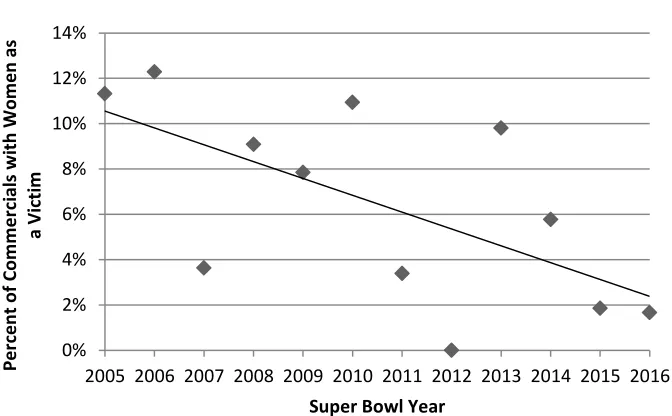
Figure 4.4.2 Percentage of Commercials that Show Women as a Victim Each Year ... 28
Figure 4.3 Percentage of Commercials that Emphasize the Importance of Women’s Beauty Each Year .. 29
Figure 4.4 Percentage of Commercials that Show Women as Powerful Each Year ... 29
Figure 4.5 Percentage of Commercials that Show Men as Fathers Each Year ... 30
Figure 4.6 Percentage of Commercials that Use Stereotypes of Men Each Year ... 31
Figure 4.7 Percentage of Commercials that Use Stereotypes of Women Each Year ... 31
Figure 4.8 Percentage of Commercials that Use No Obvious Gender Stereotypes Each Year ... 32
Figure 5.1 Percentage of Unemployed Men Each Year (Bureau of Labor Statistics 2016) ... 35
The Super Bowl is an unofficial holiday in the United States (Cooper and Tang 2013; Pappas
2014; Wenner 2008, 2015) that frequently sets the highest viewership record for televised programs,
often breaking its own record, year after year (Cooper and Tang 2013; Nielsen 2013, 2014; Pallotta
2015; Pappas 2014; Taibi 2015). While the viewers of the Super Bowl are diverse by race, gender,
region, and age (Nielsen 2010), “television brings virtually everyone into a shared national culture”
(Gerbner et al. 2002:44) and the Super Bowl exemplifies this. In addition to the size and diversity of its
audience, another unique quality of the Super Bowl is its ability to bring together people who are
actually excited to watch commercials (Kim, Cheong, and Kim 2012; McAllister 1999). The football game
itself makes up only one quarter of the televised Super Bowl program; the rest is commercial
programing. It is common for people to claim that they tune in just for the commercials(Pappas 2014).
There is hype and anticipation for Super Bowl advertisements even before they air (Martin and Reeves
2001; Pappas 2014). After the commercials are broadcast, we see discussions of the advertisements
both in the news (McAllister 1999; Messner and Montez de Oca 2005) and on social media (Brand 2015;
Byun et al. 2012; Cooper and Tang 2013; Griner 2015). The conversations continue between people at
home and in the workplace in the days after the game (Kanner 2004; Kelley and Turley 2004).
We know that television commercials influence our learning, memory, mood, body image
satisfaction, and self-esteem (Hargreaves and Tiggemann 2002; Janiszewski et al. 2003; Smeesters and
Mandel 2006). Advertisements can also influence our attitudes toward sexual aggression (MacKay and
Covell 1997) and desensitize us to violent acts (Blackford et al. 2011; Gunter 2008). Advertisements, like
other media, are also a major source of images of ideal gender roles (Garst and Bodenhausen 1997;
Green and Van Oort 2013; Kilbourne 1999). The types of roles that are shown in advertisements are
important because our “sense of self-worth or personal significance” is dependent upon “the roles
available to us” (Becker 1962; Snow and Anderson 1987:1339). Mass media is a key source for educating
expectations of a particular role is the first step in the process of role acquisition (Thornton and Nardi
1975; Turner 1962)
Not only are advertisements reflections of what people in our society idealize, but the more
people view the messages, the more they reproduce those messages in their own lives (Gerbner et al.
2002; Signorielli 2012). Despite Super Bowl advertisements reflecting our society's ideals and having a
potentially large impact on the individuals in our society, there have only been a handful of studies on
Super Bowl advertisements and even fewer that focus on the representations of gender in the
advertisements (Green and Van Oort 2013; King 2005; Messner and Montez de Oca 2005).
It is important to understand if and how the narratives and messages about gender in Super
Bowl commercials have changed throughout the years since advertisements can mirror and reinforce
dominant ideologies, which can then reinforce gender inequality (Bandura 2001; Kilbourne 1999;
McIntosh and Cuklanz 2014). Changes in the content of advertisements can indicate “important shifts in
dominant ideas” (Frost and Elichaoff 2014:267). Depending upon the content, advertisements can
promote social change, represent a shift in attitudes regarding social issues, and reinforce problematic
ideals related to inequality (McQuail 2010). Therefore, advertisements that have more egalitarian
messages can aid in shifting viewer’s perceptions of gender equality. Knowing that advertisements play
a key role in gender socialization and that Super Bowl advertisements have large, diverse, and captive
audiences, it is important to understand the gender messages sent through Super Bowl Commercials.
To date, there is a dearth of longitudinal and gender-focused research on Super Bowl commercials (King
2005).
This study is a content analysis of Super Bowl commercials that aired between 2005 and 2016.
The study focuses on the presence of men and women as central characters; portrayals of men and
women; the gender of the narrators; and the overall gender narrative of the advertisements. Counting
“discovery of patterns that are too subtle to be visible on casual inspection” (Lutz and Collins 1993:89;
Rose 2012). While documenting the presence of women and men is important, I also analyzed gender
narratives in this research because the numerical presence of men and women in Super Bowl
advertisements may remain the same over time though their representations may change (McCullagh
2002). Identifying and recording the representations of gender in Super Bowl commercials helps
determine if these commercials portray and promote hegemonic ideals of masculinity and types of
femininity known to reinforce gender inequality.
1 BACKGROUND
1.1 Gender Identity
Our gender identities are central to our sense of self; our gender “is part of the way we grow up,
the way we conduct family life and sexual relationships, the way we present ourselves in everyday
situations, and the way we see ourselves” (Connell and Pearse 2015:93). Our gender identity can be
thought of as the way we incorporate our gender as part of our self through our perceptions of what it
means to be a man or a woman and the way we adopt certain gender roles or the characteristics and
behaviors that our culture deems suitable for our gender (Adler, Kless, and Adler 1992; Connell 1987;
Howard 2000; Stets and Burke 2014). “[R]oles require specific performances to meet the expectations
associated with the position” while those expectations are both projected from and evaluated by others
in that situation (Stets and Burke 2014:414). The ideals related to gendered characteristics and
behaviors (what is considered masculine or feminine) are flexible because they are determined across
time and place (Schippers 2007), with “local”, “regional” and “global influences” (Charlebois 2011).
A key source for ideal images of roles, and gender roles specifically, is the media, which includes
advertisements (Green and Van Oort 2013; Kilbourne 1999). When a person views a commercial, they
can put themselves in the role of its characters and “test” their different possible selves (Markus and
their gender identity (such as masculinity and femininity) with the idealized images in the advertisement
(Milkie 1999; Zayer and Otnes 2012). This suggests that advertisements allow people to determine
expectations of specific roles and evaluate how well they meet those expectations in comparison to
what they see in the advertisements. This means that advertisements can affect the performance and
behaviors of the people watching them. Some in the advertising field even acknowledge that their work
plays a key part in the reinforcing the acceptance of gender roles, yet they admit that they do not take
that into account when they create their advertisements (Zayer and Coleman 2014).
1.2 Hegemonic Masculinity and Emphasized Femininity
Idealized gender roles can be better understood when viewed alongside hegemonic masculinity
and emphasized femininity. Gramsci used the concept of hegemony to explain a means by which the
ruling class reinforces their power through shaping what is “common sense,” or the accepted worldview
of most people (Gramsci 1971:626). Going beyond “just a set of role expectations or [gender] identity,”
hegemonic masculinity consists of everyday practices “that allow[s] men’s dominance over women to
continue” (Connell and Messerschmidt 2005:832). Modern scholars have applied Antonio Gramsci’s idea
of hegemony to understanding gender inequality and men’s domination over women (Beasley 2008;
Charlebois 2011; Connell and Messerschmidt 2005; Demetriou 2001; Donaldson 1993; Messerschmidt
2012; Schippers 2007). For example, not only are men expected to take on leadership roles, but hiring
practices that favor placing men in leadership positions allow men to continue to maintain their roles as
leaders in our society. Emphasized femininity exists in conjunction with hegemonic masculinity as the
idealized traits of femininity that reinforce gender inequality (Connell and Messerschmidt 2005). For
instance, women who act or feel subservient to men reinforce the idea that men should be the ones in
power. Social institutions, such as the media, can promote hegemonic masculinity and emphasized
femininity (Connell and Messerschmidt 2005; Green and Van Oort 2013), using ideology to maintain the
Many of the stereotypical characteristics of men also represent and reinforce hegemonic ideals
such as the stereotype of men as leaders and aggressors (Bem 1974; Evans 2002; Kimmel, Hearn, and
Connell 2005). Other hegemonic characteristics of men that also make up gendered stereotypes include men as risk takers, breadwinners, athletes, and tough guys (Kimmel et al. 2005). Two other hegemonic
and stereotypical characteristics of men are obsession with sex with women and disgust by sex with—or
even the implied intimacy between—two men (Messerschmidt 2005; Plummer 2005). In the same vein,
many stereotypes of women also reinforce emphasized femininity. For example, women are
stereotyped as caring, sensitive, and timid (Bem 1974; Charlebois 2011; Evans 2002; Schippers 2007)
which are characteristics that combined with the leadership, toughness, and aggression of men, thereby
help men maintain their dominance in our society.
1.3 Representation
Advertisers tend to choose images that represent these hegemonic ideal images of
gender (Hall 1997). For example, in an advertisement for laundry detergent, a mother might work to
remove a stain from her child’s favorite shirt. The mother represents an ideal mom and woman who is
helpful and caring to her children; the detergent helped her reach that ideal. An advertisement for a
pick-up truck might show a truck towing and hauling large and heavy objects, and this image can give
meaning to the man driving the truck; it says that the man is tough and can perform difficult tasks.
Representations of gender in advertisements are influential because advertisers have the power to
circulate meaning, and although individuals can circulate meaning, the media can reach more people at
once and therefore have more power (Hall 1997). According to Stuart Hall, advertising tries to get the
viewer to identify with what is being portrayed in the image (1997). In his talk on Representation and the
Media, Hall says, “No advertising image could work without being associated with it a kind of claim on
identity” (1997). Hall also says that images of gender stereotypes in the media do not just produce
viewer has with the image, the meaning of different roles and identities represented in advertising will
influence how the viewer thinks about those meanings (Hall 1997).
1.4 Albert Bandura’s Four Subfunctions
The concept of social learning can help illuminate the influence of gender representations in
advertising as discussed by Hall. Social learning occurs when a person obtains knowledge from
observing others (Signorielli 2012); Super Bowl commercials can be seen as agents in social learning by
considering Albert Bandura’s four subfunctions of observational learning. First, the viewers need to pay
at least some attention to the model (Bandura 2001), in this case a commercial. As mentioned
previously, the Super Bowl and its advertisements captivate viewers (Lab42 2013; Martin and Reeves
2001; McAllister 1999; Pappas 2014). Second, viewers must retain information from the model and this
retention can be aided by increasing the exposure to the model (Bandura 2001; Signorielli 2012). Super
Bowl commercials offer both repetition and opportunities to retain information from the model because
the advertisements are played multiple times during the game, online, and for the rest of the year
(Blackford et al. 2011). Third, the model must emphasize that the viewer should produce the same
behaviors in their lives (Bandura 2001). The main goal of advertisements is to convince the viewers they
should be engaging in a certain behavior, such as purchasing or using certain products (Petty, Briñol, and
Priester 2009). Lastly, the viewers must be motivated to perform the behaviors (Bandura 2001). In
commercials, people are often rewarded or punished for their gendered behaviors (Signorielli 2012),
especially when it relates to expressions of masculinity (Green and Van Oort 2013; Messner and Montez
de Oca 2005). For example, when men act brave and tough, they are often rewarded with praise or a
kiss from an attractive woman. But if a man does something considered feminine, such as cry while
1.5 Structuration
Through its representations and function as a tool of social learning, media is a social structure
that disseminates information about gender. A social structure is a social organization with “recurring
patterns of social interaction”(Martin 2009:9). Barbara Risman, using Anthony Giddens’s theory of
structuration as a framework, explains that gender can be a social structure in and of itself (Risman
1998, 2009). “Structuration refers to the notion that social structure both constrains behavior and is
created by it” (Risman 2009:83). In the field of communications, the media is often thought of as a
“mirror” of society, although many conclude that it is not always a perfect reflection (Bowman and Eden
2013; Holbrook 1987; McQuail 2010; Shoemaker and Reese 1996). If the media mirrors society, then
society has a role in creating media. Exposure to different types of media, including advertisements, can
influence the behaviors and attitudes of individuals (see Hargreaves and Tiggemann 2002; Lavine,
Sweeney, and Wagner 1999; MacKay and Covell 1997; Pike and Jennings 2005; Smeesters and Mandel
2006). In other words, the gender portrayals we see in advertisements can constrain our behavior and
ideas regarding gender but our ideas about gender also help create the gender depictions in
advertisements. Understanding the messages about gender in Super Bowl commercials is important
because advertisements can be both a reflection of our society’s common views about gender and act as
an agent of socialization.
2 LITERATURE REVIEW
2.1 Gender and Advertisements
Throughout the years, studies that have examined representations of gender in television
commercials have overwhelmingly concluded that gender representations are unequal; men are not
only disproportionately featured in advertisements they are also more likely to take on roles of
authority and leadership when compared to women, who are often only featured in advertisements for
2010; Eisend, Plagemann, and Sollwedel 2014; Ganahl, Prinsen, and Netzley 2003; Gunter 1995;
McArthur and Resko 1975; O’Donnell and O’Donnell 1978; Paek, Nelson, and Vilela 2010; Signorielli,
McLeod, and Healy 1994). While there has been some expansion of roles and representations (especially
for women) since the early 1950s, equal gender representation still lags (Allan and Coltrane 1996; Bretl
and Cantor 1988; Eisend et al. 2014; Ferrante, Haynes, and Kingsley 1988; Ganahl et al. 2003). Women
outnumber men as central characters for commercials selling domestic/household products while men
tend to outnumber women in commercials selling all other types of products (Bartsch et al. 2000;
Ganahl et al. 2003; Gunter 1995; O’Donnell and O’Donnell 1978; Paek et al. 2010; Whipple and Courtney
1980). Men dominate narration and voiceovers for advertisements (Allan and Coltrane 1996; Bartsch et
al. 2000; Bretl and Cantor 1988; Gunter 1995; Paek et al. 2010; Whipple and Courtney 1980) and men
are also more often shown in positions of authority compared to women (Eisend et al. 2014; Gunter
1995; McArthur and Resko 1975; O’Donnell and O’Donnell 1978). Even when it comes to age of
characters in television advertisements, representations are unequal by gender; women who are
depicted in commercials are more likely to be young, while men are depicted across more diverse age
categories (Eisend et al. 2014; Ganahl et al. 2003; Stern and Mastro 2004), emphasizing that youth is an
important characteristic for women while men are important at any age (Kilbourne 1999).
2.2 Super Bowl Commercials and Gender
Beyond some marketing research, there have been very few studies with a specific focus on
Super Bowl advertisements. Barbara King is one of only a handful of researchers who have conducted
in-depth analyses on Super Bowl commercials. King conducted a content analysis of the 65 Super Bowl
commercials that aired during the 2000 Super Bowl (2005). She found that for commercials with
narrators, only 11 percent of the narrators were women (King 2005). Conversely, when the commercials
were broken down by product type, she found that commercials for websites had more than double the
women (King 2005). King also noted a general absence of women, with most advertisements featuring
men as the central characters (2005). In addition, King coded for the allure of characters and was
surprised to find that only one percent of the characters were shown in an alluring way (2005). Despite
expecting to see women represented sexually in beer commercials, which had been shown extensively
in other research on alcohol advertisements (see Chambers 2012; Hall and Crum 1994; Woodruff 1996),
King noted that beer advertisements in the 2005 Super Bowl relied on “furry animals” instead (2005).
Focusing on advertisements targeting men, Michael A. Messner and Jeffrey Montez de Oca
analyzed liquor and beer advertisements that aired during the 2002 and 2003 Super Bowl and the
advertisements in the 2002 and 2003 swimsuit editions of Sports Illustrated (2005). Messner and
Montez de Oca note that the men in the advertisements were not shown working, but rather
participating in recreational activities (2005). Men tended to be shown in the role of “losers” and/or
“buddies” while women are shown as “hotties” or “bitches” (Messner and Montez de Oca 2005:1887).
The authors note that they characterized men in the commercials as “losers” or dopey when the status
of their masculinity was vulnerable (Messner and Montez de Oca 2005). If they were with a group of
other men, their vulnerability could be masked and the commercial instead emphasized “male
friendship” or buddies (Messner and Montez de Oca 2005:1887). Women were either shown as “highly
sexualized fantasy objects” (hotties), or women who prevented men from being able to enjoy “erotic
pleasure” (bitches) (Messner and Montez de Oca 2005:1887). They also noted that women with the
roles of girlfriend or wife were absent from the advertisements and the idea of relationship
commitment was also avoided (Messner and Montez de Oca 2005).
Messner and Montez de Oca stressed that the portrayal of men as dopey in the alcohol
advertisements was done in jest and for comedic effect (2005), but in Kyle Green and Madison Van
Oort’s analysis of Super Bowl commercials from 2010, the authors found that “the male loser becomes
identified a “crisis of masculinity” narrative (2013) through semiotic analysis of select commercials from
the 2009 and 2010 Super Bowls. Citing two Super Bowl commercials from 2009, the authors say the
narrative about masculinity that year was “don’t worry, the men are fine” (Green and Van Oort
2013:701). They discuss a Pepsi Max advertisement that shows men being injured but still responding
with “I’m Good” and a Universal Studios advertisement that shows a man can still be a superhero when
he escapes to the theme park (Green and Van Oort 2013). The authors explain that in 2010, men are
taking back power, with advertisements stressing man’s power has been lost at some point in our recent
history (Green and Van Oort 2013). The authors noted that phrases like “wear the pants” and “man’s
last stand” were used to encourage men to take back their power (Green and Van Oort 2013). Also, men
who violate hegemonic masculine ideals, such as dressing sloppily or not taking charge, are ridiculed and
looked down upon (Green and Van Oort 2013). Green and Van Oort go on to theorize that advertisers
may have invoked the crisis of masculinity narrative in order to pander to men who were
disproportionately affected by job loss during the economic downturn that began in previous years
(2013).
These studies lay the groundwork for understanding gender representations and narratives in
Super Bowl commercials, but are not comprehensive. Messner and Montez de Oca’s research, while
illuminating, is limited because it only focused on alcohol advertisements during 2002 and 2003. Green
and Van Oort were able to compare the commercials from 2009 and 2010, but focused mainly on the
advertisements from 2010 and limited their analysis to masculine gender portrayals. While King’s
research was more in depth and covered all of the commercials from the 2000 Super Bowl, the results of
her study only show a snapshot in time and do not allow us to determine if there has been change in
gender portrayals in Super Bowl commercials across time. King, herself, called for a longitudinal study of
Super Bowl commercials in order to understand how and if gender narratives have changed. The goal of
At least some changes in gender representations and narratives in Super Bowl commercials in the past
decade are expected due to changes within the NFL and broader attention to social issues. For example,
two aspects of the NFL have changed recently which could influence a shift in gender narratives in Super
Bowl commercials. First, women now make up 45 percent of the NFL fan base (Broughton 2013;
Harrison 2013; Harwell 2014) with female viewership increasing by 26 percent between 2009 and 2013
(Chemi 2014). The NFL has started to target this new fan base with NFL branded clothing for women,
including maternity wear, jewelry, and women’s shoes in their fan shops (Ahmed 2012; NFL 2015). In
2010 the NFL even partnered with Victoria’s Secret to create co-branded apparel for Victoria’s Secret’s
PINK collection, which targets young women (Duff 2010). It is expected that sponsors of the Super Bowl
will also shift their advertisements to appeal to this growing and changing fan base. Second, in 2014
there were two high profile cases of family violence: a domestic violence incident with Baltimore Raven
Ray Rice, and a child abuse case with Minnesota Viking Adrian Peterson. Following the family violence
incidents, commentators insisted that the 2015 Super Bowl was the “most feminist” Super Bowl due to
the messages of gender equality in some of the Super Bowl commercials (McDonald 2015; Williams
2015). The NFL’s increased attention to female fans and the media coverage of family violence in the
NFL could lead to different gender narratives in Super Bowl commercials as advertisers try to appear
considerate of those issues. Considering these factors, a progressively more egalitarian message in the
Super Bowl commercials is expected over time.
3 METHODS
3.1 Design
Multiple questions guided this study: What are the gendernarratives of Super Bowl
commercials? Have those narratives change over time? Were women and men featured equally as
central characters and narrators? Did representations of men and women predominately fit hegemonic
analysis of Super Bowl commercials that aired between 2005 and 2016. Because Super Bowl
commercials are a “large and complex dataset,” content analysis is ideal for understanding the messages
in the advertisements (Krippendorff 2012; Rose 2012:85). An in-depth content analysis of gender
representations and gender narratives in Super Bowl commercials also allows a researcher to find
patterns and themes that would be missed with just a “casual inspection” (Lutz and Collins 1993:89). A
systematic look at commercials is essential because of the ubiquitous role of advertisements in our
social world.
3.2 Data and Sampling
I gathered a pool of Super Bowl commercials using the archival advertising websites adland.tv
and superbowlcommercials.tv, as well as YouTube.com. I also cross-referenced the commercials with
the USA TODAY AdMeter Super Bowl commercial list to ensure that the correct commercials were
downloaded and assigned to the year the advertisement aired. I was unable to locate every single
commercial that aired each year due to advertisers actively removing the illegal uploads of their
commercials, but through the use of multiple video upload sites I was able locate all but three ads listed
on the USA Today AdMeter for Super Bowl commercials that aired between 2005 and 2016. The year
range begins at 2005 because of the limited online availability of commercials that aired before 2005,
likely due to the advent of sites that allow video uploading, including YouTube.com, which went online
that year. The relative newness of video uploading could also be why the three commercials I could not
locate were from 2005 (two) and from 2006 (one). I eliminated commercials for network specific
television programs (the network that aired the Super Bowl for that given year) from the pool for two
reasons: because these types of commercials were only available online for two Super Bowl years and
because they are not considered Super Bowl commercials in the USA TODAY AdMeter Super Bowl
commercial rankings. Similarly, I removed commercials that focus on the Super Bowl program itself,
to year, I also eliminated commercials that aired during halftime (totaling 14 commercials) because the
USA TODAY AdMeter did not begin including commercials that aired during halftime until 2013. Since
there is no other complete list of Super Bowl commercials, I could not confirm which commercials aired
during the 2005-2012 halftimes. I cannot attest to the possible impact of halftime commercials, but they
may be less influential than first and last quarter advertising. Advertisers pay a premium for first and
fourth quarter advertisements versus other time slots because more people tune into the first and last
quarter of the Super Bowl (Brady 2015). I included the remaining 665 commercials in the analysis. The
[image:24.612.70.541.305.366.2]number of commercials I analyzed for each year is listed in Table 3.1
.
Table 3.1 Number of Super Bowl Commercials Analyzed Per Year
In the initial stages of the study, I focused on tallying the gendered features of the commercials.
The units of analysis were the actual characters or narrators and voiceovers in the commercials. I only
coded human or human-like characters. I coded fantasy characters or animals if and when these
characters appear to be gendered. For example, I coded a commercial featuring a talking parrot since
the parrot used a male voice. For the latter stages of the study, which focused on the overall gender
narrative of a commercial, the unit of analysis was each individual commercial and individual year of
each commercial.
3.3 Measurement and Analysis
In numerous analyses of advertisements that focus on whether advertisements portray gender
stereotypes and perpetuate hegemonic ideals of masculinity and femininity, gender representation
variables included gender, location, social roles, credibility, and product type featured in the
advertisement (Eisend 2010; Furnham and Paltzer 2010; McArthur and Resko 1975; Prieler 2015). This
Year 2005 2006 2007 2008 2009 2010 2011 2012 2013 2014 2015 2016 Total
Number of
study measured the variable “gender” dichotomously as man or woman. The variable
“location/situation” refers to the main location in which the action of the commercial takes place. I
broke this variable down into five main categories: Home (kitchen, living room, bedroom, etc.), Work
(business office, construction site, factory, etc.), Outdoors (park, bike path, river, etc.), Store/Retail
Facility (grocery store, shopping mall, hardware store, etc.), and Entertainment (movie theater, sporting
event, restaurant, etc.) and noted the specific location. I noted whether the location offered
stereotypical messages. For example, women in a commercial shown in a kitchen or laundry room would
represent the portrayal of a gender stereotype, while a man doing laundry in a commercial would
represent an image that goes against a gender stereotype.
I also noted the categorization of whether a commercial reinforced or challenged a gender
stereotype based on previous gender and advertising research as well as the characteristics included in
the Bem Sex Roles Inventory (BSRI) and examinations of gender hegemony (see Charlebois 2011;
Connell and Messerschmidt 2005; Demetriou 2001; Kimmel et al. 2005; Schippers 2007) . For example, I
considered men as athletic, forceful, risk taking, and taking charge (Bem 1974; Kimmel et al. 2005;
Prentice and Carranza 2002), and men as stupid (Green and Van Oort 2013) as reinforcements of
stereotypes for men. When women acted childlike, nurturing, and sensitive (Bem 1974; Prentice and
Carranza 2002) or when their main role was that of a sex object (Kilbourne 1999; King 2005; Lavine et al.
1999) I noted that those commercials reinforced stereotypes of women. When characters in a
commercial challenged gender stereotypes or hegemonic gender ideals (e.g. men as nurturing or
women as tough), I coded them as such.
Following Leslie Z. McArthur and Beth G. Resko’s example, I based the “social role” of a
character on how the characters are cast in the commercials, such as homemaker, spouse
(wife/husband), parent (mother/father), child, celebrity, athlete, etc. (1975). In addition, I noted when a
had two main sub-categories: product user and authority. In some commercials, a character uses the
product (product user), whereas in others a character acting as a professional recommends or endorses
the product (authority) (Eisend 2010; McArthur and Resko 1975). The “credibility/authority of the
character” can also represent stereotypical gender representations because gender stereotypes assume
that men have more authority than women and are likely to be shown as the person endorsing the
product instead of just using the product (Eisend 2010; McArthur and Resko 1975). The “product type”
variable was categorized based on the type of product being advertised in the commercial and consisted
of these categories: apparel, automotive, technology, banking/investment, food, beverage, alcohol,
entertainment, insurance, etcetera. I included product type categorization in my analysis since past
research on advertisements found gender differences in commercials based on product type (Bartsch et
al. 2000; Ganahl et al. 2003; Gunter 1995; O’Donnell and O’Donnell 1978; Paek et al. 2010; Whipple and
Courtney 1980).
I used the numerical gender representation (the number of women and men represented as
central characters or narrators) and the coding based on location, product type of the commercial, social
roles, and credibility/authority of the central characters to help determine the overall gender narrative
of a commercial.
4 RESULTS
Numerous patterns emerged regarding the gendered representations of men and women in the
Super Bowl advertisements examined. I address those themes first, notably a general trajectory toward
more gender-egalitarian presentations. In addition, over the 12 years of commercials, I identified three
time periods with gender themes that were distinctive from one another. These distinctive themes
correlated with major economic changes in the United States. I found the first distinctive theme during
the period prior to the Great Recession (2005-2007), the second during the economic downturn
4.1 Overall Results
There was a dearth of women characters and voiceovers in the 665 commercials I analyzed.
Women made up only 30.23 percent of total characters (i.e. main characters plus other characters).
Moreover, women were less likely to be main characters (23.28 percent) compared to other characters
(33.79 percent). Women were most underrepresented in voiceovers, with women performing only 4.55
percent of all voiceovers (see Table 4.1). Indeed, four of the 12 Super Bowl years I analyzed had no
commercials that featured women voiceovers. Men dominated the commercials that featured gendered
characters with 75.24 percent of the commercials featuring more men than women, only 10.77 percent
of the commercials featured more women than men, and 13.99 percent of the commercials featuring
Table 4.1 Character and Voiceover Totals for Each Super Bowl Year
The results regarding product type and location of characters in the commercials showed little
differences based on the gender of the characters. There was not a striking difference in product type
based on gender beyond men being more likely to be featured in alcohol commercials than women.
Commercials for household products also tended to feature more women compared to other product
types. The proportion of men and women featured in automotive commercials was almost equal when
the total proportion of men and women in all the commercials was considered. Men were also more
often shown outdoors while women tended to mainly be featured in the home or at bar/party.
The most common social roles for men were that of leaders, risk takers, and saviors (usually
coming to the aid of a woman in need). Men were also more likely than women to be shown as athletes,
cowboys/farmers, criminals, doctors, scientists, and military/police. As for gender themes, men were
most often shown as brave, taking charge, tough, violent, and as having ingenuity or intelligence to
problem solve. Men were also often shown as dopey or stupid for comedic value while women were
instead shown to be sources of antagonism. For example, in a 2006 Outback Steakhouse commercial,
Year Men as Main Characters Women as Main Characters Men as Other Characters Women as Other Characters Total Men Characters (main + other) Total Men Characters (main + other) Men as Voiceover Woman as Voiceover
2005 77.33% 22.67% 66.43% 33.57% 70.18% 29.82% 94.74% 5.26%
2006 80.88% 19.12% 66.97% 33.03% 72.32% 27.68% 89.74% 10.26%
2007 90.14% 9.86% 69.57% 30.43% 75.29% 24.71% 97.37% 2.63%
2008 84.52% 15.48% 72.90% 27.10% 78.01% 21.99% 100.00% 0.00%
2009 80.00% 20.00% 75.18% 24.82% 76.78% 23.22% 100.00% 0.00%
2010 77.55% 22.45% 68.89% 31.11% 71.94% 28.06% 94.59% 5.41%
2011 74.70% 25.30% 65.45% 34.55% 68.55% 31.45% 100.00% 0.00%
2012 70.27% 29.73% 75.59% 24.41% 73.63% 26.37% 90.63% 9.38%
2013 69.32% 30.68% 62.96% 37.04% 64.98% 35.02% 96.67% 3.33%
2014 71.08% 28.92% 63.83% 36.17% 66.52% 33.48% 92.31% 7.69%
2015 65.52% 34.48% 56.69% 43.31% 59.84% 40.16% 87.50% 12.50%
2016 78.82% 21.18% 63.93% 36.07% 68.09% 31.91% 93.55% 6.45%
All
actor Jermaine Clement from the Flight of the Concords explains how his relationship with Outback
Steakhouse is like a boomerang as he accidently breaks a boomerang while trying to pull it off the
restaurant wall and says “both times I was thrown out of Outback, I came back,” implying that he has
made numerous stupid mistakes while at the restaurant (Outback 2006). In a 2005 Budweiser
commercial, Cedric the Entertainer describes the three things he would want with him if he was
stranded on an island: “a beautiful woman, and endless supply of Bud Light, and oh yeah another
beautiful woman” (Budweiser 2005a). The viewer is then transported to Cedric’s fantasy island where he
is shown lounging on the beach drinking his Bud Light (Budweiser 2005a). His enjoyment of this fantasy
is quickly ruined when the two beautiful women start nagging him to do chores around the island
(Budweiser 2005a). Already tired of their antagonism, Cedric changes his three island items to a dog,
barbecue, and Bud Light (Budweiser 2005a). The women in this commercial added comedic value, but
did so through acting as antagonists. This theme of women as antagonists is similar to but broader than
what Messner and Montez de Oca termed women as “bitches” (2005:1887). Messner and Montez de
Oca used that term to describe how women were often shown as the ones who prevented the sexual
pleasure of men (2005). In the commercials I analyzed I noticed that this concept was not only used in
regards to the prevention of sexual pleasure but also the prevention other forms of enjoyment for men.
Throughout the Super Bowl years analyzed, advertisers predominantly showed women in two
social roles: that of the sex object (where the sexual appeal of the character was of key importance to
the narrative of the advertisements and the role of the character) and the victim (where the character
experiences some type of threat or needs to be saved). Other common roles for women included that
of the love interest and partner of a man (i.e. wife or girlfriend). All three of these roles tend to focus on
women solely through the eyes of men and reinforce hegemonic ideals for men. For example, women as
sex objects emphasizes the importance of sexual conquests for men (Charlebois 2011; Plummer 2005).
dominant and women as helpless. Considering the small proportion of woman characters featured in
the Super Bowl advertisements, there was a disproportionate number of girls represented as children
compared to boys. By limiting the roles of worth for women to just those that reinforce the men’s
dominance, the social roles for women in Super Bowl commercials exemplify emphasized femininity and
hegemonic masculinity.
When commercials included authority figures (e.g. expert, scientist, celebrity), 78.87 percent
were men. Both men and women were more likely to be product users than authority figures, but the
gap between product user and authority figure was smaller for men compared to women. Men were
1.43 times more likely to be a product user versus an authority figure, while women were 1.84 times
more likely to be shown as product user versus an authority figure. This reflects past research indicating
that men are more often presented as authority figures in advertising (Eisend 2010; McArthur and Resko
1975) since hegemonic masculinity associates authority with men (Collinson and Hearn 2005) .
For each Super Bowl year analyzed, more commercials reinforced gender stereotypes than
challenged them, for example, showing men more often as tough, violent, and saviors compared to
women (see Table 4.2). For instance, in the commercial for the film Hannibal Rising, numerous men are
shown in positions of authority such as police, doctors, and the main villain, while the only woman
character featured in the trailer takes the role of the victim (Weinstein Co. 2007). A total of 459 (69.02
percent) commercials reinforced gender stereotypes, 160 (24.06 percent) commercials combated
gender stereotypes, and 137 (20.60 percent) commercials did not feature any obvious gender
stereotypes. In 13.53 percent of cases, an advertisement would both reinforce and combat gender
stereotypes such as when a man would be shown as violent but a woman in the same advertisement
would be shown as tough and powerful. Overall, when commercials challenged gender stereotypes they
featured men, 13.99 percent challenged stereotypes for men, but in commercials that featured women,
36.50 percent challenged stereotypes for women).
4.2 Results for 2005 through 2007
During the years leading up to the Great Recession, there is an increase each year in the
proportion of characters that are women. Despite the increase in female representation, stereotypical
gender roles still dominate. Men were primarily shown as workers and saviors. Women on the other
hand were missing in the workplace and mainly seen as sex objects and victims for men to save.
From 2005 through 2007, the gender narrative for men consisted mostly of men as workers,
performing both blue- and white-collar jobs. In office situations, where one would expect to see a more
equal representation of women and men, ads tended to feature only male employees. For example, in
the eight CareerBuilder commercials that aired from 2005 through 2007, all of the office scenes were
dominated by men; even the ones that featured chimpanzees had the chimps dressed up in men’s suits
(Career Builder 2005a, 2005b, 2005c, 2006a, 2006b, 2007a, 2007b, 2007c). During this period, all of the
main characters in the commercials were men. Of the three commercials that had a woman character,
two were secretaries. This absence of women as workers was even more striking because the office
Table 4.2 Percentage of Commercials that Reinforced or Challenged Gender Stereotypes Year Reinforced Stereotypes for Men Reinforced Stereotypes for Women Challenged Stereotypes for Men Challenged Stereotype for Woman No Obvious Gender Stereotypes Reinforces Gender Stereotypes Challenging Gender Stereotypes Challenges per Reinforces
2005 75.47% 39.62% 7.55% 11.32% 13.21% 88.68% 18.87% 21.28%
2006 70.18% 29.82% 10.53% 15.79% 10.53% 84.21% 26.32% 31.25%
2007 76.36% 30.91% 10.91% 16.36% 7.27% 85.45% 27.27% 31.91%
2008 69.09% 27.27% 5.45% 5.45% 12.73% 83.64% 12.73% 15.22%
2009 68.63% 21.57% 1.96% 13.73% 15.69% 76.47% 15.69% 20.51%
2010 75.00% 26.56% 4.69% 10.94% 14.06% 79.69% 14.06% 17.65%
2011 74.58% 38.98% 8.47% 6.78% 15.25% 81.36% 16.95% 20.83%
2012 50.00% 11.11% 7.41% 12.96% 33.33% 55.56% 16.67% 30.00%
2013 56.86% 27.45% 21.57% 19.61% 23.53% 56.86% 37.25% 65.52%
2014 51.92% 19.23% 23.08% 15.38% 21.15% 53.85% 38.46% 71.43%
2015 35.19% 20.37% 11.11% 22.22% 38.89% 42.59% 33.33% 78.26%
2016 38.33% 8.33% 10.00% 23.33% 38.33% 37.70% 32.79% 86.96%
All Years 61.19% 25.11% 10.08% 14.43% 20.30% 69.02% 24.06% 34.86%
Note: These percentages do not total 100 percent because it some incidents, stereotypes were reinforced and combated within the same commercial.
Women’s reoccurring role as the damsel in distress and as sex objects was standard for many of
the commercials that aired during 2005 through 2007. One such victim who needs rescuing is the main
character of a 2005 Budweiser commercial. In the ad, an attractive woman sits by herself at a bar, while
one creepy man after another takes the seat next to her and hits on her (Budweiser 2005b). Each of the
men spouts cheesy pick-up lines as they paw at her hand, arms, and shoulders (Budweiser 2005b). She
tries to turn them down with polite headshakes and “no-thank you’s”, but they do not listen (Budweiser
2005b). Finally, her savior – a male-voiced parrot -- swoops in to her rescue and squawks at the men to
go away (Budweiser 2005b).
The GoDaddy commercials of 2005, 2006, and 2007 exemplify the role of women as sex objects.
Their 2005 commercial featured a woman whose small, thin-strapped tank top starts to come undone
while she is speaking at a committee meeting; the breaking of the shirt’s strap is too exciting for the
men in the room causing one older man to lose his breath, requiring use of his oxygen tank (GoDaddy
GoDaddy model and an older man in an office (GoDaddy 2006). In 2007, GoDaddy references their use
of women as sex objects by showing a man walking through the GoDaddy offices and opening the door
to the marketing department. In the room there are lots of women dressed in what is now GoDaddy’s
signature, tight, white, thin strapped tank top dancing with other GoDaddy employees (all men)
(GoDaddy 2007). As the GoDaddy models dance and jump around, the movement of their breasts are
emphasized while they are sprayed with champagne in the style of a wet t-shirt contest (GoDaddy
2007). The man then ends the commercial by saying, “everybody wants to work in marketing”(GoDaddy
2007). The main purpose for including each of the women featured in these commercials is for their sex
appeal, since none are shown doing any actual office work.
4.3 Results for 2008 through 2012
The Great Recession began in late-2007 and technically ended in mid-2009 (Sommer 2016;
Wingfield 2010), but the housing market crisis and high unemployment continued in the years after, not
markedly improving until late 2012 (Bureau of Labor Statistics 2016; Cornish and Davidson 2013; S&P
Dow Jones Indices 2016). The gender narratives for the commercials that aired during the Super Bowls
of these years were unique compared to the commercials that aired in the pre-recession and recovery
years, as they were characterized by a specific emphasis on masculine risk taking and the need to
correct the emasculated gender displays of men.
One of the first features that distinguished this period of commercials was the uptick in ads
featuring men-as-risk-takers, especially in the 2010 and 2011 years. For example, the 2011 Kia
commercial demonstrates how men are shown as powerful risk takers. It begins with a man stealing a
car from two police officers and then another man swoops in while flying a helicopter and steals the
already stolen car, which is then taken out of the sky by the Greek god Zeus (Kia 2011). After being
Each time the car is stolen, the men perform risky stunts just to possess it. All the main characters who
take drastic measures to steal the Kia are men demonstrating their great power.
In addition to risk-taking, a new narrative of masculinity correction emerged during the years of
the economic downturn. In the commercials, men were encouraged to change their “unmanly”
behavior. While women were still shown as victims and sex objects, they also took on a new role as the
emasculators of men in these masculinity correction commercials. A 2010 Flo TV commercial depicts
sports announcer Jim Nantz giving an “injury report” on a man named Jason who is accompanying his
girlfriend on a Sunday shopping trip to the department store. Nantz says, “As you can see, his girlfriend
has removed his spine, rendering him incapable of watching the game…. Boy that’s hard to watch” (Flo
TV 2010). Jason is then shown with a red bra flung across one of his shoulders, smelling candles with his
girlfriend in a different part of the store. Nantz tells Jason to get a Flo TV, a handheld live mobile
television device, and to “change out of that skirt” (Flo TV 2010). This commercial implies that Jason’s
girlfriend has emasculated him to the point where he is now a woman, as evidenced by Nantz’s
reference to his metaphorical skirt. The advertisement also implies that the Flo TV can be a tool to
correct his gender deviance and return his masculinity.
Another example of the emphasis on masculinity correction and women as emasculators occurs
in a 2010 commercial for the Dodge Charger. The commercial starts out with an image of a man and a
voiceover speaking in first person, listing all of the tasks he will do (presumably directed towards his
female significant other), “I will say ‘yes’ when you want me to say ‘yes’. I will be quiet when you do not
want to hear me say ‘no’. I will take your call. I will listen to your opinions of my friends… I will put the
seat down. I will carry your lip balm” (Dodge 2010). As the list continues, we see images of other men
who are also assumed to identify with the voiceover (Dodge 2010). The voiceover then says that
because he does all of those tasks he will drive the car he wants to drive (Dodge 2010). Another
men who have already given up so much power to their girlfriends or wives that they need to take a
“stand” and show their masculinity by driving a powerful and fast Dodge Charger.
During the years of the economic downturn, men who were engaging in activities that were not
stereotypically masculine were portrayed as stupid. One example is a Doritos commercial from 2011
where a man’s obsession leads to awkward intimacy with other men in his office. In the first scene a
man finishes a bag of Doritos, then the main character turns to the man and informs that he “left the
best part,” right before sucking the Dorito cheese-dust off the man’s finger with his mouth (Doritos
2011). In another scene, a different man wipes his Dorito cheese dust covered hands on his pants and
the main character swoops in and rips off the man’s pants so he can lick off the cheese dust (Doritos
2011). The commercial is exemplifying inappropriate behavior for men; he acted stupid and it resulted in
intimate moments between men. These types of moments go against hegemonic ideals of masculinity
where same-sex touching is considered weak (Evans 2002). The commercial leaves the viewer feeling
that the character is stupid because he could have avoided all of the awkwardness if he would have just
purchased his own bag of Doritos.
4.4 Results for 2013 through 2016
Starting in 2013, there is another gendered shift in the Super Bowl commercials as the start to
become more egalitarian and appear to pick up where the trend of the pre-recession left off. In fact,
Figure 4.1 demonstrates that if it were not for the economic downturn years, the ratio of commercials
that challenge stereotypes versus those that reinforce gender stereotypes would have increased steadily
over time. Instead, there is precipitous drop in the ratio of commercials that challenged versus
Figure 4.1 The Ratio of Commercials that Challenged/Reinforced Gender Stereotypes
During the recovery years, the gender roles of men and women start to broaden. Women are no
longer only sex objects and victims, but are also shown as powerful and tough. This is especially
apparent in the sudden increase in commercials for films that feature women as super heroes and
villains. In the 2016 trailer for X-Men that aired during the Super Bowl, the gender of the characters
shown fighting nearly reaches parity, with five characters that are men and four characters that are
women (20th Century Fox 2016). Also, while men are still more likely to be shown as athletes than
women are, during the recovery years more women are shown as athletic. In the commercial for the
wearable activity tracker -- FitBit -- the advertisers show an equal number of men and women working
out and using the wearable device (FitBit 2016). The commercial also features women performing in
tough sports like martial arts (FitBit 2016).
The men in Super Bowl commercials during the recovery years also gain a new social role as
caring fathers. In Nissan’s commercial titled “With Dad,” scenes cut between a father and his son
spending time together and the father at work as a racecar driver (Nissan 2015). The viewer gets the
sense of the dangers inherent in driving a racecar when the father crashes his car but survives (Nissan
0.0 0.1 0.2 0.3 0.4 0.5 0.6 0.7 0.8 0.9 1.0
2005 2006 2007 2008 2009 2010 2011 2012 2013 2014 2015 2016
R atio o f Co m m e rc ial s t h at Ch al le n ge d ve rsu s R e in for ce d Ge n d e r Ste re o typ e s
2015). The commercial also implies that racing keeps the father away from home. Harry Chapin’s “Cats
in the Cradle” plays throughout the commercial, an emotional song about an absent father (Nissan
2015). This represents the hegemonic ideal that men are the breadwinner and not the one who nurtures
(Marsiglio and Pleck 2005). Despite the commercial beginning with an absent father narrative, it shows
that the father and son have made many memories together and that the father has had a good
relationship with the son’s mother. As the commercial ends, we see the father put his racing helmet
away, appearing to have retired from racing (Nissan 2015). In the last scene the father goes to pick up
his son from school and they both embrace (Nissan 2015). The father in this commercial may still be a
risk taker, but he is also shown as sensitive and loving.
The differences between the advertisements from the economic downturn and more recent
years are striking when one compares commercials for the same product from each of the time periods.
In 2010, a Dove for Men spot told the story that once a man is born he is told to “be good at sports, run
hard, run fast, … lift weights, be strong, know how to fight … be tough, be cool, be full of pride, don’t
show your sensitive side … go check out a noise and never be scared … change a flat tire while they wait
in the car“ (Dove 2010). The commercial says that over time the man will feel comfortable with doing all
those tasks and then “you can take on anything, of course you can, because you are a man” (Dove
2010). The advertisement then implies that if you are comfortable with being a man, your skin should
also be comfortable, so you should use Dove for Men products (Dove 2010). The 2010 Dove
advertisement, while pointing out the absurd amount of pressure on men to be tough and in control,
still puts value on those characteristics and states that it is those actions and traits that make a person a
man. In 2015, Dove for Men portrays different types of behaviors and qualities that make a man strong.
The 2015 commercial shows a series of moments featuring dads interacting with their children (Dove
2015). Then the advertisement has text that asks “What makes a man stronger?” followed by more
ends the spot with a call to action campaign called “Care Makes a Man Stronger” and encourages
viewers to share their stories about how caring makes them stronger by using the hashtag
“#RealStrength” (Dove 2015). The 2015 advertisement is not just showing men in nurturing roles but is
advocating for the redefinition of what makes a man a strong, a direct contrast to how Dove previously
put value on toughness and being in charge in their 2010 Super Bowl advertisement.
4.5 General Change Over Time
Beyond the unique differences between the pre-recession, economic downturn, and
recovery years, there were also fairly consistent changes related to gender throughout the Super Bowl
years analyzed in the study. To examine patterns of change over time, I correlated advertisement year
with the proportion of commercials depicting the following characteristics: men as main characters,
men as other characters, men as total characters, women as main characters, women as other
characters, and women as total characters. There was a significant positive correlation between time
and the proportion of main and total characters that were women. The relationship between time and
women as other characters was not significant (see Table 4.3). There was also no significant relationship
between time and women voiceovers, however, the p-value approached statistical significance (p =
[image:38.612.68.423.535.587.2].057) even with a sample size of 12.
Table 4.3 Correlation of Super Bowl Year and Characters and Voiceovers
Variables
Women as Main Characters
Women as Other Characters
Total Women Characters (main
+ other)
Woman as Voiceover
Year .659* .489 .659* .323†
Note: † p ≤ .10, *p ≤ .05
The roles of women in the commercials also changed throughout the years, with significant
negative relationships between time and women as victims, and time and emphasis on beauty (see
Table 4.4, Figure 4.2 and 4.3). The results also indicate a positive correlation between time and
routinely and repeatedly depicted as sex objects. Indeed, this remains the predominant role for women
in Super Bowl commercials, but the p-value did approach statistical significance (p= .073) despite the
small sample size (see Table 4.4). This indicates that there has been a substantive decrease in the use of
[image:39.612.73.534.221.258.2]women as sex objects in Super Bowl Commercials.
Table 4.4 Correlation of Super Bowl Year and Gendered Roles
Variables
Men as Workers
Men As Risk Takers Men as Savior Men as Father Women as Victim Women as Beauty Women As Sex Object Women as Powerful
Year -.498† .198 -.061 .604* -.626* -.611* -.536† .631*
Note: † p ≤ .10, *p ≤ .05
Figure 4.4.2 Percentage of Commercials that Show Women as a Victim Each Year
0% 2% 4% 6% 8% 10% 12% 14%
2005 2006 2007 2008 2009 2010 2011 2012 2013 2014 2015 2016
Per ce n t o f Co m m e rc ial s w ith Wo m e n as a Vict im
[image:39.612.86.422.294.502.2]Figure 4.3 Percentage of Commercials that Emphasize the Importance of Women’s Beauty Each Year
Figure 4.4 Percentage of Commercials that Show Women as Powerful Each Year
Over the years, the gender representations of men remained mostly static, with the exception
of the recent increase of men being shown as fathers. There is a significant positive correlation between
time and men represented as caring fathers (see Table 4.4 and Figure4.5). There are no significant
correlations between time and men as workers, risk takers, and saviors (see Table 4.4).
0% 5% 10% 15% 20% 25% 30% 35% 40%
2005 2006 2007 2008 2009 2010 2011 2012 2013 2014 2015 2016
Per ce n t o f Co m m e rc ial s w ith E m p h asi s o n Wom e n 's B e au ty
Super Bowl Year
0% 2% 4% 6% 8% 10% 12% 14%
2005 2006 2007 2008 2009 2010 2011 2012 2013 2014 2015 2016
Per ce n t o f Co m m e rc ial s w ith Wo m e n as Po we rful
[image:40.612.90.417.344.544.2]Figure 4.5 Percentage of Commercials that Show Men as Fathers Each Year
Overall, there is also a strong, significant, and negative relationship between time and
percentage of commercials that reinforce gender stereotypes (see Table 4.5 and Figure 4.6). This applies
to both men and women (see Figures 4.6 and 4.7). Following this trend, there was also a positive
correlation between time and the percentage of commercials that did not use any obvious stereotypes
(Table 4.5 and Figure 4.8). No significant relationship exists between time and percentage of
commercials that challenge gender stereotypes and the ratio of challenging versus reinforcing gender
stereotypes is also not significant at conventional levels, but both have a p-value of .057 and sample size
of 12; these results can be interpreted as demonstrating a substantive increase over time in the number
of commercials challenging stereotypes relative to reinforcing them. Specifically, commercials that
challenge stereotypes of woman have substantively increased but are not significant at conventional
levels (p= .056).
0% 2% 4% 6% 8% 10% 12% 14% 16% 18%
2005 2006 2007 2008 2009 2010 2011 2012 2013 2014 2015 2016
Per ce n t o f Co m m e rc ial s w ith E m p h asi s o n M e n as Fath e rs
Table 4.5 Correlation of Super Bowl Year and Gender Stereotypes Variables Reinforces Gender Stereotypes Challenging Gender Stereotypes Ratio of Challenging versus Reinforces Stereotypes of Men Stereotypes of Woman Challenges Stereotypes of Men Challenges Stereotypes of Woman No Obvious Gender Stereotypes
Year -.934*** .562† .562† -.859*** -.693*** .437 .564† .851***
[image:42.612.88.414.443.615.2]Note: † p ≤ .10 ,***p ≤ .001
Figure 4.6 Percentage of Commercials that Use Stereotypes of Men Each Year
Figure 4.7 Percentage of Commercials that Use Stereotypes of Women Each Year
0% 10% 20% 30% 40% 50% 60% 70% 80% 90%
2005 2006 2007 2008 2009 2010 2011 2012 2013 2014 2015 2016
Per ce n tage o f Co m m e rc ial s t h at Us e Ste re o typ e s o f M e n
Super Bowl Year
0% 5% 10% 15% 20% 25% 30% 35% 40% 45%
2005 2006 2007 2008 2009 2010 2011 2012 2013 2014 2015 2016
Per ce n tage o f Co m m e rc ial s th at Us e Ste re o typ e s o f Wom e n