International Journal of Emerging Technology and Advanced Engineering
Website: www.ijetae.com (ISSN 2250-2459, ISO 9001:2008 Certified Journal, Volume 7, Issue 10, October 2017)
372
Topsis Method for Solving Fuzzy Game Problem Using
Octagonal Fuzzy Numbers
S. Lavanya
1, K. Selvakumari
21Department of Mathematics, Bharathi Women’s College (Autonomous) Chennai, Tamilnadu, India. 2Department of Mathematics, Vels University, Chennai, Tamilnadu, India.
Abstract- In this paper, two person zero sum game has been considered with imprecise values in payoff matrix. All the imprecise values are assumed to be triangular fuzzy numbers, trapezoidal fuzzy numbers and Octagonal Fuzzy Numbers. In this paper, TOPSIS procedure has been used to find the best strategy for the players when the payoffs are Triangular, Trapezoidal and Octagonal Fuzzy Numbers. This method can be used when the relative importance of strategies are not the same that is weights are assigned to the strategies.
Keywords—TOPSIS method, Octagonal fuzzy numbers, Maximin Minmax Principle, Saddle point
I. INTRODUCTION
In 1928, John Von Neumann introduced the concept of game theory but OskarMorgenstern [3] along with John Von Neumann published a article ‘Theory of games and economic Behavior’ in 1944 which was considered as the evolution of modern Game theory. One of the basic problems in the game theory is the two player zero sum game. The two-person zero-sum games are games with only two players where a gain of one player equals a loss to the other (the sum of payoffs of the two players is zero) for any choice of the strategies. The resulting gain can be represented in the form of a matrix, called the payoff matrix of a game. The two players are referred as Player I and Player II.
An optimal solution of a two person zero sum game is obtained using minimax-maxmin principle, according to which player I (whose strategies are represented by rows) selects the strategy which maximizes his minimum gain, the minimum is taken over all the strategies of player II. Similarly player II selects his strategy which minimizes his maximum losses. If the maxmin value equals the minimax value, then the game is said to have a saddle point and the corresponding strategies which give the saddle point are called optimal strategies. The amount of payoff at an equilibrium point is called the game value.
When we apply the Game theory to model some real life competitive situations we come across uncertain or imprecise data. To handle uncertain or imprecise data, we use fuzzy theory[10,11] and model the problems as game with fuzzy payoffs.
TOPSIS was initially presented by Hwang and Yoon and Lai et al[1,2]. In this paper, TOPSIS procedure has been used to find the best strategy for the players when the payoffs are Triangular, Trapezoidal and Octagonal Fuzzy Numbers. This method can be used when the relative importance of strategies are not the same that is weights are assigned to the strategies.
II. PRELIMINARIES
2.1 Triangular Fuzzy Numbers
A fuzzy number = ( ) is said to be triangular
fuzzy number if its membership function is given by,
̃( )
{
( )
( )
( )
where
are real numbers
2.2 Trapezoidal Fuzzy Numbers
A fuzzy number = ( ) is said to be
trapezoidal fuzzy number if its membership function is
given by, where are real numbers
̃( )
{
( )
( )
( )
( )
2.3 Octagonal Fuzzy Numbers
A fuzzy number ̃is a normal octagonal fuzzy number denoted by ( ) where
International Journal of Emerging Technology and Advanced Engineering
Website: www.ijetae.com (ISSN 2250-2459, ISO 9001:2008 Certified Journal, Volume 7, Issue 10, October 2017)
373
̃( ){
(
)
( ) (
) ( ) (
) (
)
III. TOPSIS METHOD FOR SOLVING FUZZY GAME
PROBLEM
Consider a fuzzy game problem whose payoff matrix is expressed as follows:
[
̃ ̃ ̃
̃ ̃ ̃
̃
̃
̃ ̃ ̃ ̃
]
where each ̃ is a fuzzy number that may be triangular,
Trapezoidal or octagonal.
Step (1) Calculate the Normalized Payoff matrix. The normalized value ̃ is calculated as
̃
̃
√∑ ( ( ̃ )) where ( ̃ )is the
distance of the fuzzy number from the crisp number 0
Step (2) Calculate the Weighted Normalized pay off matrix, ̃ -.
If w is a crisp value,
̃ ̃ Where is
the weight of the strategies of players and ∑
If w is a fuzzy value:
̃ ( ̃ ) ̃
Step (3)Find the crisp value matrix corresponding to ̃ using ( ̃ )
Determine the Positive Ideal and Negative Ideal Solutions of Player I and Player II.
Step (4)The Positive Ideal and Negative Ideal Solutions of Player I respectively are
* +
where * { ( ̃ )}
* +
* * ( ̃ ) +
The Positive Ideal and Negative Ideal Solutions of Player II respectively are
* + where
* * ( ̃ ) +
* + * * ( ̃ )
+
Step (5)Calculate the Separation Measures using Euclidean distance
The Separation of each strategy of player I from the Positive-ideal solution is
√∑( ( ̃ ))
The Separation of each strategy of player I from the Negative -ideal solution is
√∑( ( ̃ ))
The Separation of each strategy of player II from the Positive-ideal solution is
√∑( ( ̃ ))
The Separation of each strategy of player II from the Negative -ideal solution is
√∑( ( ̃ ))
Step (6)Calculate the relative closeness to ideal solution.
The relative closeness distance of the strategies Ai with
International Journal of Emerging Technology and Advanced Engineering
Website: www.ijetae.com (ISSN 2250-2459, ISO 9001:2008 Certified Journal, Volume 7, Issue 10, October 2017)
374
The relative closeness distance of the strategies with respect to minimum loss-is defined as
Step (7) The strategy for which the closeness distance is least will be the best strategy
IV. NUMERICAL EXAMPLE
Consider the two health insurance companies, Moon health insurance and National health insurance. Both the companies have three types of policies namely individual
health insurance policies, family floater health insurance policies and Surgery & critical illness insurance plans. The following pay off matrix gives the gain for Moon health insurance company when they choose their different types of policies along with the national insurance company:
Consider the problem as in example in which the three types of policies are not given equal importance. That is , weights are assigned to them
1) Individual health insurance policies are given weight 0.5 2) Family floater health insurance policies are given weight 0.3
3) Surgery& critical illness insurance plans are given weight 0.2
Pay off matrix with pay offs as Octagonal Fuzzy numbers Consider the payoff matrix
National Health insurance(player II)
M
o
o
n hea
lt
h
ins
ura
nce(
p
la
y
er
I)
(
( ) ( ) ( ) ( ) ( ) ( ) ( ) ( ) ( ))
Step (1) The Normalized Decision matrix is ̃ ̃
√∑ ( ( ̃ ))
where ( ̃ ) ,( )
( )( )
Player II
P
la
y
er
I
(
( ) ( ) ( ) ( ) ( ) ( ) ( ) ( ) ( )
)
Step (2)The weighted normalized decision matrix with ( ) is
Player II
P
la
y
er
I
(
( ) ( ) ( )
( ) ( ) ( )
International Journal of Emerging Technology and Advanced Engineering
Website: www.ijetae.com (ISSN 2250-2459, ISO 9001:2008 Certified Journal, Volume 7, Issue 10, October 2017)
375
Step (3)
Resultant Crisp value matrix is
(
)
Step (4)
Determine the Maximum of Player I&II (Positive Ideal ) and Minimum of Player I&II (Negative Ideal )
* + = {0.33, 0.38, 0.23}
* + = {0.38, 0.17, 0.16}
* + = {0.11, 0.05, -0.09}
* + = {0.23, -0.09,0.11}
Step (5)
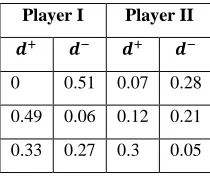
Calculate the Separation measures for Player I and Player II
[image:4.612.115.220.413.504.2]Table :1
Table showing the separation measures for Player I and Player II in TOPSIS procedure with octagonal payoffs
Player I Player II
0 0.51 0.07 0.28 0.49 0.06 0.12 0.21 0.33 0.27 0.3 0.05
Step (6)
Calculate the relative closeness distance of strategies with maximum gain for Player Iand minimum loss of player II
Table : 2
Table showing the closeness distance of strategies with maximum gain for Player I and minimum loss of Player II in TOPSIS procedure with
octagonal payoffs
Strategies of Player I
Closeness distance of strategies
with maximum
gain for Player I
Strategies of Player II
Closeness distance of
strategies with minimum loss of Player
II
A1 0 B1 0.8
A2 0.89 B2 0.64
A3 0.55 B3 0.14
Step (7)
Since the closeness coefficient forA1 and B3 are least,
the best strategies of player I and II are A1 and B3
respectively.
Pay off matrix with pay offs as Trapezoidal Fuzzy numbers
For the above problem if k=1, then the payoffs reduce to trapezoidal fuzzy numbers and the payoff matrix is given by
Player I
Player I (
( ) ( ) ( )
( ) ( ) ( ) ( ) ( ) ( ) )
Step (1) The Normalized Decision matrix is
̃
̃
√∑ ( ( ̃ ))
where ( ̃ )
Player II Player
I (
( ) ( ) ( ) ( ) ( ) ( ) ( ) ( ) ( )
)
Step (2)
Calculate the weighted normalized decision matrix with ( )is Player B
Player A
(
( ) ( ) ( ) ( ) ( ) ( ) ( ) ( ) ( ))
Step (3)
Resultant Crisp value matrix is
( )
Step (4)
Determine the Maximum of Player I & II (Positive Ideal) and Minimum of Player I & II (Negative Ideal)
* + = { 0.35,0.38, 0.25}
* + = {0.38, 0.2, 0.17}
International Journal of Emerging Technology and Advanced Engineering
Website: www.ijetae.com (ISSN 2250-2459, ISO 9001:2008 Certified Journal, Volume 7, Issue 10, October 2017)
376
* + = {0.25, -0.1, 0.11}Step (5) Calculate the Separation measures for Player I and Player II
[image:5.612.108.227.214.311.2] [image:5.612.41.296.394.540.2]Table :3
Table showing the separation measures for Player I and Player II in TOPSIS procedure with trapezoidal payoffs
Player I Player II
0 0.54 0.07 0.32
0.5 0.09 0.16 0.2
0.36 0.28 0.33 0.06
Step (6) Calculate the relative closeness distance of strategies with maximum gain for Player Iand minimum loss of player II
Table : 4
Table showing the closeness distance of strategies with maximum gain for Player I and minimum loss of Player II in TOPSIS procedure with
trapezoidal payoffs
Strategies of Player I
Closeness distance of strategies
with maximum
gain for Player I
Strategies of Player II
Closeness distance of
strategies with minimum
loss of Player II
A1 0 B1 0.82
A2 0.85 B2 0.56
A3 0.56 B3 0.16
Step (7) Since the closeness coefficient forA1 and B3 are
least, the best strategies of player I and II are A1 and B3
respectively.
Pay off matrix with pay offs as triangular Fuzzy numbers
For the above game problem with pay offs as trapezoidal fuzzy numbers, if we take the pay offs become triangular fuzzy numbers and the pay off matrix is given by
Player II
Player I(
( ) ( ) ( )
( ) ( ) ( )
( ) ( ) ( ) )
Step (1) The Normalized pay off matrix is ̃
̃
√∑ ( ( ̃ )) where ( ̃ )
(
( ) ( ) ( )
( ) ( ) ( )
( ) ( ) ( ))
Step (2)The weighted normalized payoff matrix with is
(
( ) ( ) ( ) ( ) ( ) ( )
( ) ( ) ( ))
Step (3) Resultant Crisp value matrix is
(
)
Step (4) Determine the Maximum of Player I&II (Positive Ideal ) and Minimum of Player I&II (Negative Ideal )
* + = * +
{ } =* +
* + = { }
* + ={ }
Step (5) Calculate the Separation measures for Player I and Player II
Table :5
Table showing the separation measures for Player I and Player II in TOPSIS procedure with triangular payoffs
Player I Player II
0 0. 4 0.08 0.26
International Journal of Emerging Technology and Advanced Engineering
Website: www.ijetae.com (ISSN 2250-2459, ISO 9001:2008 Certified Journal, Volume 7, Issue 10, October 2017)
377
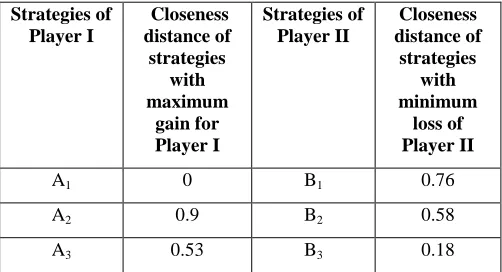
Step (6) Calculate the relative closeness distance of strategies with maximum gain for Player I and minimum loss of player II
[image:6.612.43.294.222.358.2]Table : 6
Table showing the closeness distance of strategies with maximum gain for Player I and minimum loss of Player II in TOPSIS procedure with
triangular payoffs
Strategies of Player I
Closeness distance of strategies
with maximum
gain for Player I
Strategies of Player II
Closeness distance of
strategies with minimum
loss of Player II
A1 0 B1 0.76
A2 0.9 B2 0.58
A3 0.53 B3 0.18
Step (7) Since the closeness coefficient forA1 and B3 are
least, the best strategies of player I and II are A1 and B3
respectively.
V. CONCLUSION
In this paper, we have considered two person zero sum game with pay offs as triangular, trapezoidal and Octagonal Fuzzy Numbers. TOPSIS (Technique for order preference by similarity to ideal solution) procedure is proposed when the relative importance of strategies are not the same that is weights are assigned to the strategies.
We explain the proposed method through a numerical example in which k value for octagonal fuzzy number is taken as 0.5 and the weights for strategies are taken as 0.5,0.3 and 0.2. For different weights we will get different solution.
REFERENCES
[1] Hwang, C.L.; Yoon, K. (1981). Multiple Attribute Decision Making: Methods and Applications. New York: Springer-Verlag.
[2] Hwang, C.L.; Lai, Y.J.; Liu, T.Y. (1993). "A new approach for multiple objective decision making". Computers and Operational Research. 20: 889–899.
[3] John Von Newmann and O.Morgenstern, Theory of Games and Economic Behaviour, Princeton University press, Princeton, New Jersey, 1947.
[4] Maeda.T, On Characterization of equilibrium strategy of two-person zero sum games with fuzzy payoffs, Fuzzy sets & systems, 139(2)(2004), 283-296.
[5] Malini.S.U., Felbin.C.K., An Approach for solving fuzzy transportation problem using octagonal Fuzzy numbers, Applied Mathematical Sciences, 7(54) (2013) 2661-2673.
[6] Selvakumari.K,Lavanya.S, On Solving Fuzzy Game Problem using Octagonal Fuzzy Numbers”, Annals of Pure and Applied Mathematics, Vol.8, No.2.2014,211-218.
[7] Song Q.and Kandel A.. Fuzzy approach to strategic games, IEEE Transactions on fuzzy systems 7(6):99-116, 1999.
[8] Vijay V., A.Mehra, S.Chandra, C.R.Bector, Fuzzy Matrix games via a fuzzy relation approach. Fuzzy Optimization and Decision making, 6 (4) (2007), 299-314.
[9] Yong H.U. the improvement of the application of TOPSIS method to comprehensive evaluation [J].mathematic in practice and theory ,32(4),572-572,2002.
[10] Zadeh L. A. , Fuzzy sets, Information and 338-353 (1965).control, 8: 338-353 (1965).