ISSN 1450-216X Vol.26 No.1 (2009), pp.80-86 © EuroJournals Publishing, Inc. 2009
http://www.eurojournals.com/ejsr.htm
Implementing Outcome Based Education Using Project Based
Learning at University of Malaya
Roslan Hashim
Civil Engineering Department, University of Malaya, Kuala Lumpur, Malaysia E-mail: [email protected]
Tel: 603-7967 5269; Fax: 603-7967 5318
Mokhtar Azizi Mohd Din
Civil Engineering Department, University of Malaya, Kuala Lumpur, Malaysia E-mail: [email protected]
Tel: 603- 603-7967 5351; Fax: 603-7967 5318
Abstract
In this paper, the authors evaluated the implementation of a Project Based Learning (ProjBL) incorporating the development of students’ soft skills as well as technical or professional competences. The research question addressed here is the suitability of ProjBL in achieving the desired learning outcomes i.e. practical knowledge of engineering surveying, basic knowledge on engineering design, and soft skills or personal competences. The objectives are two-fold; (i) to evaluate the effectiveness, and (ii) to identify potential improvement. The course, the Engineering Surveying Camp offered at Year-I of a four-year civil engineering degree programme, is a two-week field course. During the course, the students carried out an actual surveying and design project in groups of 6-7 students supervised by the academics. Assessment of technical aspects was based on daily output and final products while for soft skills on performance during the various sessions. Evaluation was carried out based on the outputs and student performance during the various sessions. It was found that the technical aspects were achievable though with lesser degree for the engineering design. On soft skills, students demonstrated an overall improvement of competency but it was difficult to ascertain the levels for the average students while the best and poor performers were easily observed.
Keywords: Evaluation, Outcome based education, Project based learning.
1. Introduction
In carrying out the curriculum review, especially when seeking to implement changes towards a new educational model, the elements that are reasonably difficult to deal with are training students to develop their personal skills and abilities. Such skills are normally referred to as transferable and incorporate life-long learning abilities. These elements are generally documented, but yet have proven difficult to implement with regard to the operational levels in an organisation, as the focus is traditionally on science and conventional technical issues.
The development of a new curriculum must include securing vertical and lateral coherency for the technical and scientific content. Here, the additional aspects on how to find time for the project work, and how to find training gaps in additional elements like personal skills and abilities must be dealt with. This often leads institutions to review their curricula and rethink their overall objectives from the perspective of a new project oriented educational model. This process can be hard as lecturers have been brought up with a traditional paradigm that is based on lectures.
The Department of Civil Engineering, University of Malaya had reviewed and revised its degree programme in respond to this new requirement. It had taken a gradual and cautious stance and adopted a continuous quality improvement (CQI) approach in implementing the new requirement. Most courses undergo the necessary adjustment in particular in terms of restating its learning outcomes and assessment methods. This is considered prudent in the light that both, the academic staff and the students require some time to familiarise and acclimatise to new teaching and learning regimes. However, some new courses have been introduced to cater for the needs. One such course, Engineering Surveying Camp that had been introduced and implemented at the end of Year-I of a four-year civil engineering degree programme is presented and discussed in this paper. In developing this course lessons learned from the experience of others e.g. Moesby (2002), Felder and Brent (2003) and Dochy et al (2003), were referred to.
In this respect, the Engineering Surveying Camp focus on the following attributes: • an ability to apply knowledge of mathematics, science, and engineering
• an ability to identify, formulate, and solve engineering problems • an ability to communicate effectively
• an ability to use the techniques, skills, and modern engineering tools necessary for engineering practice
This paper dealt with the evaluation of the Engineering Surveying Camp, a course centred on Project Based Learning (ProjBL) incorporating the development of students’ soft skills as well as technical or professional competences. The research question addressed here is the suitability of ProjBL in achieving the identified learning outcomes. The objectives are two-fold; (i) to evaluate the effectiveness of the course, and (ii) to identify potential improvement.
The course, Engineering Surveying Camp is offered at Year-I of a civil engineering degree programme. It is a two-week field course with three main learning outcomes; (i) practical knowledge of engineering surveying, (ii) basic knowledge on engineering design, (iii) soft skills or personal competences. The course was offered for the first time and there were many uncertainties in particular on the degree of success in achieving the course outcomes. During the course, the student carried out an engineering survey work and subsequently undertake design project supervised by the academics. The class is divided into groups and assigned tasks to be completed in two weeks. The technical assessment was based on daily outputs and final products while for soft skills on performance during the various sessions throughout the duration of the camp.
1.1. Problem Based Learning (PBL)
In the University of Malaya, the move towards encouraging academics to adopt PBL seemed rather sluggish. The main challenge is the need to change the paradigm of the majority of lecturers that are used to the conventional teaching methods. Those opting for change require time to adapt, implement and gain experience in PBL techniques. It is also important for those promoting the technique to show evidence of the effectiveness of PBL for engineering education (Yusof et al 2005).
Moesby (2005) reported a study on the performance of students from Aalborg University, which generally is regarded as a problem based learning (PBL) institution, and students from the Technical University of Denmark, which is generally regarded as a conventional taught institution. The finding supports very well the edge of graduates of PBL institution have over those graduated from a conventional taught institution. It gives the same credit to the two Danish institutions concerning professional competences, but the personal competences that students develop in the PBL approach, are significantly higher when compared with conventional techniques. The learning outcomes concerning personal competences are significantly higher within the PBL approach than from conventional teaching.
2. Engineering Surveying Camp
The course, Engineering Surveying Camp offered at Year-One of a civil engineering degree programme is the third of engineering surveying courses offered to civil engineering students. The students had covered all basic engineering surveying materials during the first two courses with small scale field practices.
It is a two-week field course with three learning outcomes. At the end of the course, the students are expected to acquire these abilities;
• planning and conducting an actual engineering surveying work • carrying out conceptual engineering design project
• working and communicating effectively in a team
During the course, the students carried out an actual surveying and design project supervised by the academics, grouped into teams of six.
2.1. The Project
The Department of Civil Engineering, University of Malaya was appointed to carry out engineering surveying work on a piece of land of about 6 Ha and to submit a survey plan that will be used in developing the land by the owner, UM Holding. Two possible options for the development of the land were a resort cum training centre or a research station. The site was located about 700 km from Kuala Lumpur, the capital of Malaysia. In addition to the survey plan, a preliminary conceptual development plan was to be proposed.
2.2. Course Outcomes
The course outcomes for Engineering Surveying Camp cover both the hard and the soft skills as outlined below.
2.2.1 Course Outcome I: Practical knowledge of engineering surveying
2.2.2 Course Outcome II: Knowledge of conceptual civil engineering design
At the level that the students were, the expected outcomes were the awareness of; utilization of space, provision of basic infrastructure, requirement for safety and security, functionality and constructability, cost effectiveness, environmental and sustainability consideration as well as aesthetic aspects. The students were given limited access to the internet to acquire as much information as possible within the given time duration. At the end of the two weeks, they were expected to prepare a conceptual plan of either a resort cum training centre or a research station.
2.2.3 Course Outcome III: Soft skills or personal competences
In the two week duration, the required personal competencies were the ability to communicate effectively, and the ability to function in a team or teamwork skills.
2.3. Learning Experience
The main challenge faced by both the academic staff and the students was the project that the students worked on were real project to be completed within a short duration of the course. The students were primarily focused on the achievement of course outcomes. The academics, though, had another goal of ensuring that the project was completed with quality outputs.
Other than this, the academics had to ensure the other aspects including the day to day running of the camp, transportation, logistics, student welfare and safety on top of the course outcomes.
The course was designed such that the intended course outcomes could be achieved. With previous experiences it was anticipated that the students would go through learning experience that consolidated their understanding of engineering surveying and at the same time enhanced their personal competences.
As there was no internet connection available on site, cyber cafes at the nearest town had to be used. It was arranged for the groups to send representatives to carry out internet searches for information and secondary data collection.
2.4. Routines and Tasks
The groups had 10-working days to ensure that the following tasks were completed during the two week course:
• Field work and field data collection including levelling, contouring and detailing • Data analysis and the preparation of survey plans
• Information gathering and secondary data collection
• Performing conceptual engineering design and preparation of drawings • Preparation of a group report (written and oral)
The daily routines started with a morning briefing followed by group discussion on the work for that day. The team had to elect a new team leader for each working day as well as to appoint a reporter that would present the daily report during the evening session.
Once the discussion was over the group began its work for the day. During the initial few days, the whole group went out to carry out the field work. For latter days, the group might decide to leave some members behind to do the analysis and developing the survey plan. The different group could cooperate whenever necessary.
3. Course Assessment and Evaluation
outputs and the performance of the students during the daily briefing and presentation sessions formed the basis of the course assessment.
It should be pointed out that the students were not graded but rather they were assessed either to have met the requirement of passing the course or the contrary.
3.1. Course Outputs and Assessment
The outputs required from each group were the group report, the survey plan and the conceptual design plan. The group report contained the daily reports, raw and processed field data and the write-up for conceptual engineering design. These outputs or products formed the basis for the assessment of the team performance.
It was the duty of the team leader for the day to ensure that the team daily activities were carried out accordingly and any problems were settled collectively. The team leader had to ensure that each team member worked as planed. In a way the appointment of a daily reporter was a check-and-balance measure to ensure that the team work together. Based on the progress of work, it had to be assumed that this strategy worked. During the evening oral presentation, the group matters, problem encountered and related issues were discussed.
3.2. Course Evaluation
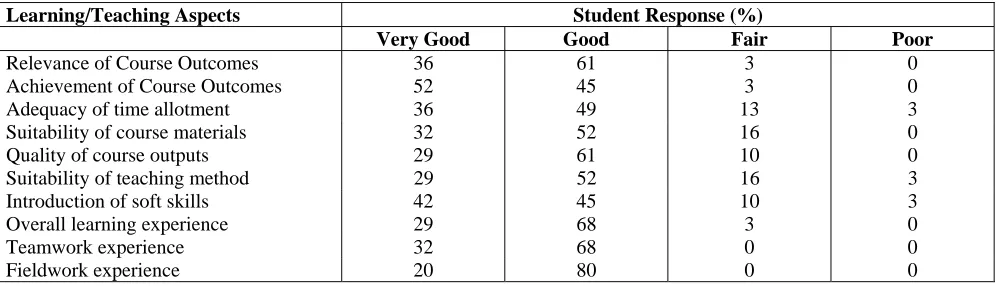
[image:5.612.53.556.412.555.2]Apart from evaluating based on the various outputs from the course, the course was assessed through questionnaire as indicated by Table 1. As shown by the table a large majority of students were satisfied with the conduct and the outcomes of the course. They were of the opinion that the course outcomes, teaching methods and materials as well as learning experience were good.
Table 1: Student rating of the Engineering Surveying Camp
Learning/Teaching Aspects Student Response (%)
Very Good Good Fair Poor
Relevance of Course Outcomes 36 61 3 0 Achievement of Course Outcomes 52 45 3 0 Adequacy of time allotment 36 49 13 3 Suitability of course materials 32 52 16 0 Quality of course outputs 29 61 10 0 Suitability of teaching method 29 52 16 3 Introduction of soft skills 42 45 10 3 Overall learning experience 29 68 3 0 Teamwork experience 32 68 0 0 Fieldwork experience 20 80 0 0
Peer assessment was also introduced for the soft skills component of the course. However, there was not much success due to the reluctance of the students to be critical of their team members. This aspect needs to be reviewed and feasible changes need to be introduced in future session.
3.2.1. Effectiveness of Project Based Learning
All groups successfully completed their assigned task and submitted the required outputs within the stipulated time frame. In accomplishing this feat, each group had undergone the necessary field surveying work, compiled and analysed the fieldwork data, produced the survey plan, developed the conceptual engineering design and drawn the layout plan.
As far as the soft skills were concerned, all students had participated actively in all planned activities and individually could be observed communicating and working as a team. Based on theses observations, it could also be argued that the identified soft skills components had also been attained.
3.2.2. Potential Improvement
Based on the outcome of the recently completed Engineering Surveying Camp course potential improvement could be achieved through the implementation of several measures.
The organization of the whole surveying camp could be enhanced. It could be more meaningful if the course is offered in Year-II (Semester 6) as to allow for the student to acquire better engineering knowledge. The students will be in a position to gain much more from such a beneficial course.
Further details should be to look into assessment of the soft skills. Similarly, individual component should be identified in order for a grading reflective of the levels attained to be awarded to student in place of the present pass-fail grade. This change will enhance the effectiveness of the program as the students will work harder to gain better grades or to avoid failing.
However, it should be highlighted that these changes could cause an increase in terms of the overall cost and the manpower requirement of running the course. Special budget should be sought from the university authority as this Engineering Surveying Camp was implemented with the normal budget allocation.
4. Conclusion
As had been stated earlier, the objectives of the study presented in this paper were to evaluate the effectiveness in implementing the course employing project based learning method, and to identify potential improvement for future implementation of the course.
As a group, it was found that the outcomes for the hard skills, engineering survey and conceptual engineering design, were achieved though with lesser degree for the engineering design. The surveying plan produced by the students was of acceptable quality and had been submitted to the client with minor improvement. The conceptual engineering design however shows some shortcomings. This could be simply explained by the fact that the student had completed all materials related to engineering surveys by the time they went through the Engineering Surveying Camp. On the other hand, the students hardly had the necessary engineering design knowledge as their earlier courses focus more on engineering basics e.g. drawings, mathematics, materials and engineering mechanics.
With regard to the soft skills, the students benefited from the two-week course by showing a marked enhancement in their personal competences level. As the course progressed, the various aspects of communication between the students, supporting staff and the academics improved. However, it was difficult to ascertain the levels attained by individual students in particular the average, or middle ranking students. The best and poor performers were easily observable.
References
[1] Dochy, F., Segers, M., Van den Bossche, P. and Gijbels, D., 2003. “Effects of problem-based Learning: a meta-analysis”, Learning and Instruction, 13, 533-568.
[2] Engineering Accreditation Council, Malaysia, 2007. Engineering Programme Accreditation Manual.
[3] Felder, R.M. and Brent, R., 2003. “Designing and teaching courses to satisfy the ABET engineering criteria”, J. of Engng. Educ., 92, 1, 7-25.
[4] Moesby, E., 2002. “From pupil to student – a challenge for universities: an example of a PBL study programme”, Global J. of Engng. Educ., 6, 2, 145-152.
[5] Moesby, E., 2005. “Curriculum Development for Project-Oriented and Problem-Based Learning (POPBL) with Emphasis on Personal Skills and Abilities”, Global J. of Engng. Educ., Vol.9, No.2, 121-128.