IT Controls in the Public Cloud: Success Factors
for Allocation of Roles and Responsibilities
Shafaq Naheed Khan
School of Computing, Science and Engineering
University of Salford
2
Table of Contents
LIST OF TABLES ... 4
LIST OF FIGURES ... 5
LIST OF PUBLICATIONS... 7
LIST OF ACRONYMS AND ABBREVIATIONS... 8
DECLARATION... 9
ABSTRACT ...10
1 CHAPTER 1: INTRODUCTION ...12
1.1. RESEARCH MOTIVATIONS ... 13
1.2. RESEARCH GAP ... 15
1.3. RESEARCH QUESTION ... 17
1.4. RESEARCH AIM AND SUB-QUESTIONS ... 17
1.5. RESEARCH OBJECTIVES ... 18
1.6. EXPECTED CONTRIBUTIONS ... 19
1.7. ORGANISATION OF THE THESIS ... 20
2 CHAPTER 2: LITERATURE REVIEW ...24
1.1. CLOUD COMPUTING DEPLOYMENT AND SERVICE MODELS ... 25
1.1.1. IMPACT OF CLOUD COMPUTING ON PEOPLE’S ROLES AND RESPONSIBILITIES ... 28
1.2. ITGOVERNANCE ... 29
1.2.1. THREE POPULAR ITG FRAMEWORKS... 32
1.2.2. AN EVALUATION OF IT GOVERNANCE FRAMEWORKS ... 35
1.3. CONCLUSION ... 41
3. CHAPTER 3: THEORETICAL FACTORS FROM THE LITERATURE ...43
3.1. ORGANISATIONAL THEORY ... 44
3.2. CLOUD COMPUTING THEORIES ... 48
3.2.1. IT OUTSOURCING AND ITS GOVERNANCE ... 49
3.2.2. ROLES AND RESPONSIBILITIES ALLOCATION FACTORS SPECIFIC TO THE PUBLIC CLOUD ... 52
3.3. IT GOVERNANCE THEORY ... 54
3.4. SUCCESS FACTORS FOR ALLOCATION OF ROLES AND RESPONSIBILITIES... 56
3.5. CONCLUSION ... 60
4 CHAPTER 4: RESEARCH METHODS ...62
4.1 RESEARCH METHODOLOGY ... 63
4.1.1 PHILOSOPHY ... 64
4.1.2 APPROACH TO THEORY DEVELOPMENT ... 66
4.1.3 METHODOLOGICAL CHOICE ... 67
4.1.4 STRATEGIES ... 69
4.1.5 TIME HORIZON ... 72
4.1.6 TECHNIQUES AND PROCEDURES ... 73
4.2 RELIABILITY AND VALIDITY ... 79
4.3 METHODOLOGICAL REVIEW OF PREVIOUS RESEARCH ... 80
3
5 CHAPTER 5: DATA COLLECTION AND ANALYSIS – 1 ...85
5.1 CASE PROFILES ... 86
5.2 PHASE-1:EMERGED SUCCESS FACTORS ... 91
5.2.1 STAGE 1:TIDYING UP ... 91
5.2.2 STAGE 2:FINDING ITEMS ... 93
5.2.3 STAGE 3:CREATING STABLE SETS OF ITEMS ... 95
5.3 PHASE-2:SUCCESS FACTOR (T-VERSION) VALIDATION ... 102
5.3.1 ANALYSING INTERVIEWEES’ RESPONSES ... 105
5.4 CONCLUSION ... 125
6 CHAPTER 6: DATA COLLECTION AND ANALYSIS – 2 ...128
6.1. ANALYSIS AND INTERPRETATIONS ... 128
6.1.1. STAGE 4:CREATING PATTERNS ... 129
6.1.2. STAGE 5:ASSEMBLING STRUCTURES ... 131
6.2. DELPHI TECHNIQUE ... 134
6.2.1. DELPHI ROUNDS ... 137
6.3. CONCLUSION ... 144
7 CHAPTER 7: FINDINGS AND CRITICAL EVALUATION ...146
7.1 SUB-RESEARCH QUESTION 1 ... 147
7.2 SUB-RESEARCH QUESTION 2 ... 151
7.3 SUB-RESEARCH QUESTION 3 ... 153
7.4 SUB-RESEARCH QUESTION 4 ... 158
7.5 APPLICATION OF THE SUCCESS FACTORS (VRR-VERSION) ... 159
7.6 COMPARING PROPOSED SUCCESS FACTORS WITH THE RELATED TOOL ... 162
7.7 CONCLUSION ... 164
8 CHAPTER 8: CONCLUSIONS AND FUTURE WORK...166
8.1 SUCCESS FACTORS FOR ROLES AND RESPONSIBILITIES ALLOCATION ... 168
8.2 RELIABILITY AND VALIDITY OF THE DATA ... 171
8.3 ETHICAL CONSIDERATIONS ... 172
8.4 CONTRIBUTIONS, LIMITATIONS AND FUTURE WORK ... 173
8.4.1 CONTRIBUTION TO PRACTICE ... 173
8.4.2 CONTRIBUTION TO THEORY ... 175
8.4.3 LIMITATIONS AND FUTURE WORK ... 175
8.5 CONCLUSION ... 177
9 REFRENCES ...179
10 APPENDICIES ...206
APPENDIX A:INTERVIEW RELATED FORMS ... 206
4
LIST OF TABLES
TABLE 2.1:ITG CONSTRUCTS ... 31
TABLE 2.2:TRENDS IN USAGE OF ITG FRAMEWORKS ... 32
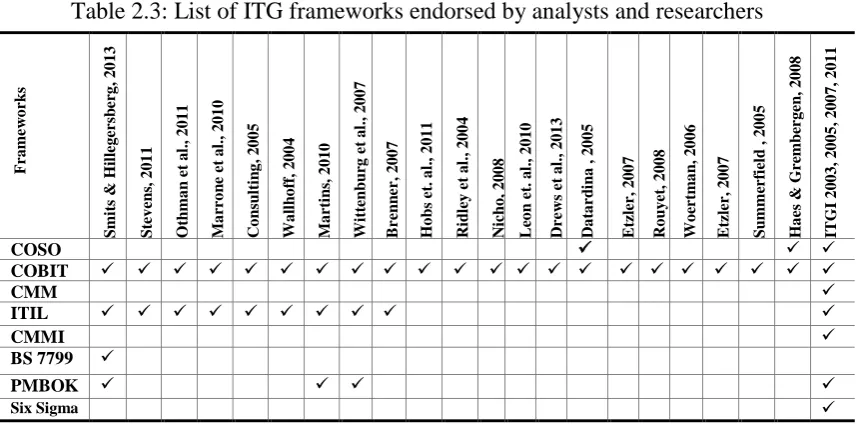
TABLE 2.3:LIST OF ITG FRAMEWORKS ENDORSED BY ANALYSTS AND RESEARCHERS ... 35
TABLE 3.1:ROLE ALLOCATION FACTORS DEDUCED FROM ORGANISATION DESIGN (GALBRAITH,2011) ... 48
TABLE 3.2:ROLES AND RESPONSIBILITIES ALLOCATION FACTORS IN AN IT OUTSOURCED ENVIRONMENT ... 51
TABLE 3.3:ROLES AND RESPONSIBILITIES ALLOCATION FACTORS IN THE PUBLIC CLOUD ENVIRONMENT .... 54
TABLE 3.4:ROLE AND RESPONSIBILITY ALLOCATION FACTORS FROM ITG THEORY ... 56
TABLE 3.5:THEORETICAL BACKGROUND FOR ROLES AND RESPONSIBILITY ALLOCATION ... 57
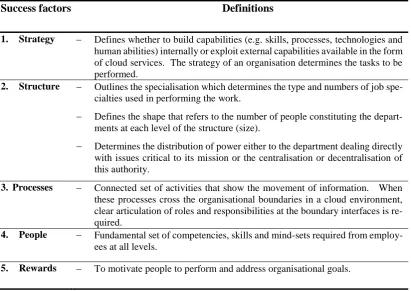
TABLE 3.6:THEORETICAL SUCCESS FACTORS (T-VERSION) ... 59
TABLE 4.1:RESEARCH PARADIGMS (ADAPTED FROM OATES,2005) ... 65
TABLE 4.2:EVALUATING METHODOLOGICAL CHOICE IN RELATION TO THE PRESENT STUDY ... 68
TABLE 4.3:GUIDELINES FOR TIDYING UP AND THE CORRESPONDING ANALYSIS IN THE PRESENT STUDY ... 77
TABLE 4.4:GUIDELINES FOR FINDING ITEMS AND THE CORRESPONDING ANALYSIS IN THE PRESENT STUDY 78 TABLE 4.5:GUIDELINES FOR CREATING STABLE SETS OF ITEMS ... 78
TABLE 4.6:GUIDELINES FOR CREATING PATTERNS ... 79
TABLE 4.7:METHODS FOR FOUR DESIGN TESTS ... 80
TABLE 4.8:ANALYSIS OF THE THREE RELEVANT CASE STUDIES ... 81
TABLE 5.1:RESPONDENT AND ORGANISATIONAL PROFILES ... 87
TABLE 5.2:STAGE 1 OF THE ANALYSIS AND ACTIONS TAKEN ... 92
TABLE 5.3:THE SECOND STEP IN THE ANALYSIS AND STEPS TAKEN ... 93
TABLE 5.4:THEMES EMERGED FROM THE INTERVIEWS (OVERLAPPED) ... 94
TABLE 5.5:STEPS IN CREATING STABLE SETS OF ITEMS ... 95
TABLE 5.6:THEMES EMERGED DURING THE EMPIRICAL RESEARCH. ... 99
TABLE 5.7:SUCCESS FACTORS (T-VERSION) VALIDATION- PERCENTAGE COVERAGE ... 103
TABLE 5.8:COMPARING SUCCESS FACTORS (T-VERSION) WITH THE PHASE -1&2 RESULTS. ... 125
TABLE 5.9:VALIDATED SUCCESS FACTORS (V-VERSION). ... 126
TABLE 6.1:STEPS IN STAGE 4:CREATING PATTERNS (AUDIT OF ANALYSIS PLAN: STAGE 4) ... 129
TABLE 6.2:VALIDATED AND REFINED SUCCESS FACTORS (VR- VERSION) ... 133
TABLE 6.3:DETAILS OF TWO DELPHI ROUNDS ... 139
TABLE 6.4:DELPHI RATINGS AND FINAL RANKINGS ... 142
TABLE 6.5:VALIDATED, REFINED AND RANKED SUCCESS FACTORS (VRR-VERSION) ... 143
TABLE 7.1:WEIGHTED DECISION MATRIX FOR ROLE AND RESPONSIBILITIES ALLOCATION ... 161
5
LIST OF FIGURES
FIGURE 2.1:CLOUD COMPUTING SERVICE MODELS (EMC,2014) ... 27
FIGURE 2.2:ROLES AND RESPONSIBILITIES IN PHASE 1(ISACA,2012) ... 36
FIGURE 2.3:SAMPLE RACI MATRIX IN ITIL(RUDD &LOYD,2007) ... 37
FIGURE 2.4:SAMPLE RACI MATRIX IN PMBOK(SCHWALBE,2014) ... 39
FIGURE 3.1:RESEARCH THEMES ... 44
FIGURE 3.2:THE “STAR MODEL” (GALBRAITH,2011) ... 46
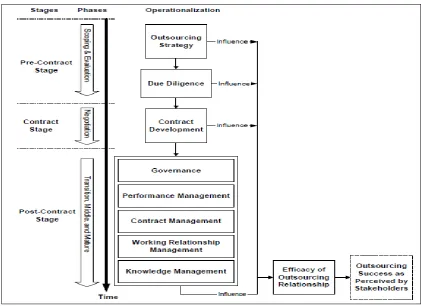
FIGURE 3.3:IT OUTSOURCING RELATIONSHIPS MODEL (ALBORZ ET AL.,2003) ... 50
FIGURE 3.4:ITG FRAMEWORK (HAES &GREMBERGEN,2008) ... 55
FIGURE 3.5:OVERLAPPED SUCCESS FACTORS ... 58
FIGURE 4.1:THREE PHASED EMPIRICAL RESEARCH ... 62
FIGURE 5.1:SPRADLEY’S RELATIONSHIP BETWEEN ‘VENDOR MANAGEMENT’ AND OTHER FACTORS. ... 96
FIGURE 5.2:SPRADLEY’S RELATIONSHIP BETWEEN FACTORS. ... 98
FIGURE 5.3:COVERAGE OF THE EMERGED THEMES. ... 100
FIGURE 5.4:GROUPING THE EMERGED FACTORS UNDER THE THEORETICAL SUCCESS FACTORS (T-VERSION). ... 101
FIGURE 5.5:SUCCESS FACTOR (T-VERSION) VALIDATION- THEMES COVERAGE ... 104
FIGURE 5.6:VALIDATING ‘STRATEGY’ FACTOR ... 105
FIGURE 5.7:VALIDATING ‘STRUCTURE’ FACTOR ... 107
FIGURE 5.8:VALIDATING ‘PROCESSES’ FACTOR ... 108
FIGURE 5.9:VALIDATING ‘PEOPLE’ FACTOR ... 109
FIGURE 5.10:VALIDATING ‘REWARDS’ FACTOR ... 110
FIGURE 5.11:VALIDATING ‘RELATIONAL MECHANISMS’ FACTOR ... 112
FIGURE 5.12:VALIDATING ‘RISK MANAGEMENT’ FACTOR ... 113
FIGURE 5.13:VALIDATING ‘COMPLIANCE MANAGEMENT’ FACTOR ... 114
FIGURE 5.14:VALIDATING ‘SECURITY MANAGEMENT’ FACTOR ... 115
FIGURE 5.15:VALIDATING ‘CSP MANAGEMENT’ FACTOR ... 117
FIGURE 5.16:VALIDATING ‘CONTRACTS MANAGEMENT’ FACTOR ... 118
FIGURE 5.17:VALIDATING ‘TECHNICAL COMPETENCIES’ FACTOR ... 120
FIGURE 5.18:VALIDATING ‘NEGOTIATION SKILLS’ FACTOR ... 121
FIGURE 5.19:VALIDATING ‘PERFORMANCE MANAGEMENT’ FACTOR ... 122
FIGURE 5.20:VALIDATING ‘CONFLICT MANAGEMENT’ FACTOR ... 123
FIGURE 5.21:VALIDATING ‘KNOWLEDGE MANAGEMENT’ FACTOR ... 124
FIGURE 6.1:CREATING PATTERNS OF FACTORS. ... 130
FIGURE 6.2:COVERAGE OF THE VALIDATED AND REFINED SUCCESS FACTORS (VR-VERSION). ... 132
FIGURE 6.3:THREE LAYERS OF ITG RESPONSIBILITY ... 135
FIGURE 6.4:SNAPSHOT OF THE DELPHI EVENT CONDUCTED THROUGH ISACACPE SESSIONS. ... 136
FIGURE 6.5:THE DELPHI ROUNDS AND THE RESULTING CHANGES ... 140
FIGURE 6.6:CHANGES SUGGESTED BY DELPHI PANELLISTS ... 140
FIGURE 7.1:DISCUSSION AND RESULTS RELATED TO RESEARCH QUESTION #1 ... 148
FIGURE 7.2:DISCUSSION AND RESULTS RELATED TO RESEARCH QUESTION #2 ... 152
FIGURE 7.3:DISCUSSION AND RESULTS RELATED TO RESEARCH QUESTION #3 ... 156
6
ACKNOWLEDGEMENTS
I would like to extend my sincere thanks to my main supervisor Prof. Haifa Takruri and
other supervisors Dr. Mathew Nicho, Prof. Zakaria Mamaar, Dr. Faouzi Kamoun and Dr.
Grahame Cooper. Without their help and support this work could not have been
com-pleted.
I would like to thank all the interview respondents and Delphi panellists who provided me
with the data and valuable feedback. I appreciate their contributions, frank responses and
willingness to share.
Last but not the least, I would like to thank my family and friends for their
7
LIST OF PUBLICATIONS
As a result of this research, three papers were published in two international peer
re-viewed journals and a conference. Published papers are as follows:
- Khan, S., Nicho, M., & Takruri, H.(2016): IT controls in the public cloud: Success factors for allocation of roles and responsibilities, Journal of Information Technology Case
and Application Research, DOI: 10.1080/15228053.2016.1237218
- Khan, S., Nicho, M., Cooper, G., “A Role Allocation Model for IT Controls in a Cloud Environment”, Review of Business Information Systems (RBIS) Journal 19(1),
5-14, 2015.
- Khan, S.,“Impact of Cloud Computing on The IT Portfolio Management: UAE Case Study”, International Business Information Management Conference (19th IBIMA),
8
LIST OF ACRONYMS AND ABBREVIATIONS
ACM Association for Computing Machinery
AIS Association of Information Systems
AMOS Analysis of Moment Structures - an add-on module for SPSS software
AR Accountability and Responsibility
BS 7799 Standard containing the best practices for Information Security Manage-ment
CMMI Capability Maturity Model Integration
COBIT Control Objectives for Information and Related Technology
COSO Committee of Sponsoring Organizations
CSP Cloud Service Provider
EMC2 EMC Corporation - an American multinational corporation
ERM Enterprise Risk Management
GRC Governance, Risk, and Compliance
IaaS Information as a Service
IEC International Electrotechnical Commission
IS Information System
ISACA Information Systems Audit and Control Association
ISO International Organization for Standardization
IT Information Technology
ITG IT Governance
ITIL IT Infrastructure Library
ITSM IT service management
MENA Middle East and North Africa region
MIS Management Information Systems
NIST National Institute of Standards and Technology
OWASP Open Web Application Security Project
PaaS Platform as a Service
PMBOK Project Management Book Of Knowledge
RACI Responsible, Accountable, Consulted, Informed
RAM Resource assignment matrix
SaaS Software-as-a-Service
SF Success Factor
SLA Service Level Agreement
SOX Sarbanes-Oxley Act
U.S.A United States of America
UAE United Arab Emirates
VM Virtual Machine
9
DECLARATION
This dissertation is an original and authentic piece of work from me. I have fully
acknowl-edged and referenced material incorporated from secondary sources. It has not been
sub-mitted elsewhere for assessment.
Shafaq Naheed Khan
School of Computing, Science and Engineering
University of Salford
10
ABSTRACT
The rapid adoption of cloud computing by organizations has resulted in the transformation
of the roles and responsibilities of personnel in managing the information technology (IT)
resources (via IT governance controls) that have migrated to the cloud. Hence, the
objec-tive of this research is to provide a set of success factors that can assist IT managers to
allocate the roles and responsibilities of IT controls appropriately to personnel to manage
the migrated IT resources. Accordingly, this study generated a set of success factors from
behavioral and information systems (IS) literature. These success factors were validated
using in-depth interviews of executives from the United Arab Emirates (UAE), and ranked
using Delphi technique. The empirical intervention suggests that the role allocation is
driven predominantly by people’s skills, competencies, organizational strategy, structures,
and policies. In addition, the research made clear that the most significant competency and
skill for a person allocated to IT controls is to be able to evaluate and manage a cloud
service provider, especially in terms of risks, compliance, and security issues related to
public cloud technology. The findings of this study not only offer new insights for scholars
and practitioners involved in assigning responsibilities but also provide extensions for IT
governance framework authorities to align their guidelines to the emerging cloud
11
CHAPTER 1
12
1
CHAPTER 1: INTRODUCTION
The rapid adoption of cloud computing by organisations worldwide has brought the issue
of Information Technology (IT) resource control into focus. IT control is a procedure that
provides a reasonable assurance that the IT used by an organisation operates as intended,
that data is reliable and that the organisation is in compliance with applicable laws and
regulations. Two organisations (cloud user and cloud provider) have different perspectives
of IT control over the IT resources that have been migrated to the cloud. In this regard, the
issue of allocation of roles and responsibilities of IT controls to appropriate staff in the
cloud user organisation becomes very important. In the absence of guidelines for IT
prac-titioners of cloud, this thesis investigates the key drivers of success that would guide IT
decision makers in allocating staff to roles and responsibilities of relevant IT controls in a
cloud environment.
There is an unceasing research and development into cloud computing across the globe
and it has rapidly become one of the hottest topics in the field of IT (Puthal, Sahoo, Mishra,
& Swain, 2015). While some industry experts are predicting more than 60% of enterprises
to have at least half of their infrastructure on cloud-based platforms by 2018 (Columbus,
2015), by the same year at least half of the IT spending is predicted to be on cloud
(Cherrayil, 2016). Businesses are no longer asking the question “should we put our
appli-cations in the cloud?” but rather “which aspects of our business can be run more effectively
in the cloud?” (Hamid, 2014, para. 7).
Cloud technology represents a key tool in the global race for innovation across industries
(Ramel, 2014) and thus it cannot be overlooked. With considerable growth and huge
in-vestments made in this technology globally, there is no doubt that the cloud is here to stay.
Nevertheless, many organisations remain cautious about using the cloud, thus providing a
solid impetus for this research. Currently, organisations govern IT systems through the use
of internal IT controls by assigning personnel to the roles and responsibilities for these
controls. However, the migration of organisational IT systems to the cloud raises concerns,
especially in relation to the changing roles and responsibilities of the staff concerned with
the governance of the relevant IT controls. The purpose of this chapter is to introduce the
reader to the rationale for conducting this research, thereby leading to the aims and
objec-tives of the study. Expected contributions of the study will be briefly discussed at the end
13
1.1. Research motivations
Motivations for doing this study include lack of guidelines for practitioners regarding the
allocation of personnel to the IT controls in the cloud environment and lack of clarity regarding people’s changing roles, accountability and responsibilities of IT controls, when
migrating IT resources to the cloud, resulting in the issue of failed cloud projects. These
issues are discussed in detail below.
Lack of guidelines: The allocation of people to the roles and responsibilities is an IT Governance (ITG) activity, since it involves leadership, control, and directions from
those with authority within an organisation (Webb, Pollard, & Ridley, 2006). Role
alloca-tion in the form of Responsibilities, Accountability, Consulted, and Informed (RACI)
charts has been used in IT controls and processes, within such ITG and security models as
Control Objectives for Information and related Technology (COBIT) (ISACA, 2012), In-formation Technology Infrastructure Library (ITIL) (Rudd & Loyd, 2007), and in Project
Management Body of Knowledge (PMBOK) (Schwalbe, 2014). Moreover, the RACI
charts has been employed in outsourcing (Ramakrishnan & Pro, 2008; Simonova &
Zavadilova, 2011) and managing governance in outsourcing (Meng, He, Yang, & Ji, 2007)
too. While these governance frameworks use RACI to assign various roles and
responsi-bilities in completing tasks or deliverables, in COBIT, its implementation is too generic
for practical use (Zhang & Le, 2013). In PMBOK, allocation is left up to the decision maker’s experience, judgment and authority, whereas in ITIL, only generic guidelines for
employing RACI in the non-cloud environment are provided. Apart from a few general
attributes given in ITIL (Rudd & Loyd, 2007), no guidelines have been found in COBIT,
ITIL or PMBOK that can be used to allocate staff to the roles and responsibilities of IT
controls in a cloud (Khan, Nicho, & Takruri, 2016). To address this concern, ITG
frame-works need to provide guidelines that can assist IT decision makers to allocate the roles
and responsibilities of IT controls appropriately to personnel to manage the migrated IT
resources.
Accountability and responsibility concerns: Migration to a cloud environment involves a myriad of potential Governance, Risk, and Compliance (GRC) issues (Farrell,
2010) with‘accountability’ as the foremost risk among the top ten cloud risks (OWASP,
2011). When an organisation places selected organisational assets in the custody of a
14
accountability for security and regulatory compliance (Julisch & Hall, 2010). In this
re-gard, one major issue organisations are facing is the data owner's loss of control during
movement to the cloud (Hughes, 2014). Laudon and Laudon (1999, p. 457) suggest that “Accountability is a feature of systems and social institutions: It means that mechanisms
are in place to determine who took responsibility of actions”. In other words,
accountabil-ity is closely aligned with responsibilaccountabil-ity. The introduction of cloud services does not
ab-solve an organisation from its accountability and responsibility of IT functions in the
cloud, neither does it relieve it of its responsibility for managing the relevant IT controls
for voluntary or regulatory compliance. It does, however, require an extension of these
responsibilities to incorporate the unique elements of applying ITG to third-party service
providers (Becker & Bailey, 2014). Accordingly, ITG frameworks need to extend and
provide guidelines to organisations, in order to ensure the accountability and responsibility
of migrated IT resources.
Failure of cloud projects: Organisations have been moving to the cloud in huge numbers. However, despite its enormous potential, many organisations struggle to make
effective use of the cloud (Marston, Li, Bandyopadhyay, Zhang, & Ghalsasi, 2011). Given
the lack of guidance available to IT practitioners from either the academic or the
non-academic forums, cloud migration projects are fraught with challenges (Rashmi & Sahoo,
2012) resulting in striking numbers of failed or stalled cloud projects. With Infrastructure
as a Service (IaaS) implementation failure rates as high as 63% (Ramel, 2014), most
busi-nesses believe that their private clouds have failed (World, 2015).
Cloud projects are facing obstructions and failures not only because of the lack of
under-standing (Opara-Martins, Sahandi, & Tian, 2014), but also because of the lack of skills
and experience of the deployment team and a lack of talent (Linthicum, 2013). Gartner
reported a ‘failure to focus on people’ as one of the six reasons for the failure of private cloud projects(Bittman, 2015). According to another report, all Gartner clients have faced
challenges with the human side of project success (Rollings, 2013). Cloud failures have
been attributed to the actions and inactions of senior leadership in understanding how new
roles will really work (Glaser, 2005) and by not allocating people with the right skills to
the cloud projects (Venkatraman, 2014).
Uptake of cloud computing depends on the IT practitioners and their skills (Søndergaard
15
IT job roles at an alarming rate (Marquis, 2015). Adoption of cloud by organisations not
only requires the redefinition of the roles of staff and the skills they need, but it is also
essential to identify the skill gaps that should be filled in order to successfully utilize cloud
services (EMC, 2014). Since IT leaders today have to deal with managerial issues, there
is a need to update job descriptions under these changing circumstances (Marquis, 2015).
Organizations are advised to be prepared to manage a significant change in their IT
staff-ing and roles (IDC, 2015).However, it has been observed that researchers and practitioners
are not keeping up with the changes brought in by this technology in relation to the peo-ple’s roles and responsibilities of IT controls. In this regard, a lack of emphasis on people
and their required skills is a great concern. Therefore, there is a need to understand new
roles and responsibilities of people involved, and accordingly allocate people with the
right skills or talents to all cloud initiatives.
Less emphasis on non-technical aspects: Cloud computing is more than a tech-nological enabler (Iyer & Henderson, 2010), but industries have been focusing too much
on the technical outcomes, and failing in areas like mapping the demand of the
organisa-tion to the right cloud soluorganisa-tion (Cruiser, 2014). Ignoring the development of non-technical
skills of IT practitioners has similarly been a common obstacle to the success of cloud
projects (Rollings, 2013). A re-examination of IT management is required to meet the
needs of twenty-first-century cloud users.
1.2. Research gap
Researchers as well as practitioners have identified a gap in the ITG guidelines on the
roles and responsibilities allocation mechanism, in the cloud environment.
Practitioners’ perspective: Industries pursue technological scalability by moving their enterprise architectures to the next level of the cloud. In this regard, Schmuck (1940,
p. 8) stated: “You can’t do business today with yesterday’s tools and be in business tomor-row”. Thus, one critical pre-requisite for a great plan of technological scalability is a good governance model. In today’s age of digital metamorphosis, governance policies and
pro-cedures must be aligned in a dynamic fashion. If new technologies have governed our own
thought processes, they have given IT governance authorities an advanced outlook of
16
up with guidelines for allocating people to roles and responsibilities in a cloud
environ-ment. Therefore, these governance policies need to be extended, or an ITG guideline
pro-duced, aligned to the scalable cloud technology. Such research will help the community
by producing Information Systems (IS) research that is relevant to practice (Kuechler &
Vaishnavi, 2011), especially to policymakers (Gallivan & Aryal, 2012), and thereby
re-ducing the gap between academic research and information systems practice.
Research perspective: A title search using the words, roles and responsibilities, IT governance, and cloud computing in the Association of Information Systems (AIS)
da-tabase spanning the years 2008 to 2014 was performed to identify relevant literature on
allocation of roles and responsibilities of IT controls in a cloud environment. The search
resulted in papers focusing on the identification of necessary steps for implementing the
appropriate IT governance for a cloud environment (Becker & Bailey, 2014) and driving
factors of success for the service recipient of IT outsourcing (Hodosi & Rusu, 2013). The
resulting outputs provided topics discussing organisational integration of green IS through
specific roles and responsibilities (Loeser, 2013), suggestions to help IT practitioners in
organisations to look beyond Sarbanes-Oxley Act (SOX) regulations at governance of
end-user developed content (Leon, Abraham, & Kalbers, 2010), organisational change
re-sulting from IT innovations (Suo, Techatassanasoontorn, & Purao, 2011) and the
im-portance of adequate IT management capabilities, manifested in IT governance (Kim,
Shin, Kim, & Lee, 2011). The search in Google Scholar using similar words, spanning the
years 2008 to 2014, but did not yield any relevant results. However, changing the search
to roles and responsibilities in IT governance, between 2008 and 2014, within Google
Scholar, generated four results. One article proposed an IT governance (ITG) model for
partnering and value co-creation (Karayilan, 2013), another investigated implementing
and continually improving ITG (ISACA, 2010), yet another gave only an overview of the
impact of this technology on the IT leadership (Khan, 2012). Since the allocation of IT
decision rights between IT units and business units remains an important IT governance
challenge, Winkler and Brown (2013) addressed this at the application level, including the
governance of applications delivered on premise versus those delivered with a
software-as-a-service (SaaS) model. These search results revealed that, there is no research
con-ducted to guide practitioners on the allocation of the roles and responsibilities of staff, for
17
Although cloud computing has been examined from several specific business perspectives,
including pricing models, resource allocation for IaaS and critical adoption capabilities,
its impact on people’s roles and responsibilities has remained unexplored. Cloud related concerns, stated in the previous sections (1.1 and 1.2) directed the researcher to the
subsequent research question.
1.3. Research question
Governance in the cloud requires the definition and implementation of mechanisms with
well-defined roles for the responsibilities of information technology management,
busi-ness processes, and applications, since these elements migrate from the traditional IT
en-vironment into the cloud (Becker & Bailey, 2014). No matter how detailed and complete
a project plan may be, the confusion or omission of participant’s roles and responsibilities
can cause major problems (Kantor, 2012). Consequently, the lack of expertise to handle
IT controls that have been migrated to the cloud, is a major challenge (Weins, 2016). In
this regard, IS researchers have been encouraged to analyse, suggest and prescribe skill
requirements for changing IT roles (Palvia & Vemuri, 2016). Looking at the strong
poten-tial, but with the high concerns and research gaps related to people’s roles and
responsi-bilities allocation in the cloud environment, leads to the research question: What are the key success factors in the allocation of staff to the roles and responsibilities for the
con-trol of cloud based IT resources? The term ‘success factors’ in this question refers to
those inputs to the management system that lead directly or indirectly to the success of a
project or business (Cooke-Davies, 2002) or that determines the success or failure of IT
implementations (Roztocki & Weistroffer, 2011). This research question led the
re-searcher to the following research aim, four sub-research questions and corresponding
ob-jectives of the research.
1.4. Research aim and sub-questions
The aim of this study is to provide a set of success factors that can guide IT decision
makers to allocate the roles and responsibilities of IT controls appropriately to staff to
manage the migrated IT resources. This current study is focused on all cloud services
(In-formation as a Service [IaaS], Platform as a Service [PaaS], and Software-as-a-Service
[SaaS]) of the public cloud deployment model, because transformation of people’s roles
18
To address this aim, this research is built around four sub-research questions:
1. What is the impact of cloud computing on the roles and responsibilities of people in
charge of IT controls?
2. What are the current mechanisms inherent in ITG frameworks for allocating people to
roles and responsibilities of IT controls in non-cloud as well as in cloud environments?
3. What are the success factors inherent in determining the allocation of staff to the roles
and responsibilities for the control of cloud based IT resources, specific to the UAE
public cloud environment?
4. What is the perceived ranking of these success factors in terms of their importance?
1.5. Research objectives
To meet the aim of the research and answer the research questions, five objectives have
been formulated, as follows:
1. Identify the impact of cloud computing on the roles and responsibilities of people in
charge of IT controls (aligned to sub-research question 1). This will help in identifying
new roles and responsibilities for managing IT controls for cloud based resources.
2. Identify the popular ITG frameworks. Evaluate the existing mechanisms used by them
to allocate people to roles and responsibilities of IT controls in non-cloud and cloud
environments (aligned to sub-research question 2). This will help in identifying the
guidelines provided by ITG frameworks and used by organisations for the allocation
of people to roles and responsibilities of IT controls.
3. Propose the key success factors to allocate staff to roles and responsibilities for the
control of IT resources that have been moved, are being moved or are planned to be
moved to the public cloud environment (aligned to sub-research question 3). This
will help in providing guidelines to organisations on the allocation of people to roles
and responsibilities of IT controls in a cloud environment.
4. Validate the success factors using in-depth interviews with IT decision-makers
19
(aligned to sub-research question 3). This will help in providing guidelines that are
validated by IT practitioners and which are relevant to the UAE market.
5. Re-validate and rank the success factors using Delphi technique with IT practitioner’s
working at the operational (IT and business management) levels of the organisation
(aligned to sub-research question 4). This will help in providing organisations with
success factors which are ranked in the order of their importance.
1.6. Expected contributions
This PhD study is the first of its kind that strives to obtain an understanding of the success
factors in allocating people to the roles and responsibilities of IT controls in a cloud
con-text. This study aims to make a significant contribution to research and practice, in the
following ways:
Contribution to practice: This research expects to identify the changes that cloud technology brings to staff roles and responsibilities. In addition, IT decision makers,
re-sponsible for roles and responsibilities allocation, will be presented with a set of ranked
success factors for allocating people to the IT controls that have been moved to the public
cloud. Besides allocation, research results will also help IT decision makers to assess their existing workforces’ capabilities, to meet their business needs. Results of this research
will guide IT decision makers to make informed decisions on hiring and allocating right
people to increase the chances of success of their cloud projects.
Governance in the cloud requires the definition of policies and the implementation of
well-defined roles and responsibilities of these migrated IT assets. On evaluating the guidelines
provided by popular ITG authorities like COBIT, ITIL and PMBOK, it was observed that
all three of them use RACI charts for allocating roles and responsibilities. However, none
of them provides any criteria or factors based on which IT decision-makers can allocate
their people to RACI charts, for IT controls that have been migrated to the clouds. This
research expects to address the gap by providing the success factors that can be used by
ITG authorities as an extension to their existing guidelines to organisations on RACI chart
allocations, for cloud based IT controls.
IS researchers have raised concerns about a gap between academic research and the world
20
& Vaishnavi, 2011). Bridging this gap, the researcher expects to determine the success
factors that can guide practitioners in allocating personnel to the roles and responsibilities
of IT controls in a public cloud environment.
Contribution to theory: The researcher expects the proposed success factors to develop academic research in three directions. Firstly, industry experts are predicting
mas-sive shifts to cloud adoption by businesses in the UAE (D'Mello, 2015), thus making it
relevant to determine success factors specific to UAE public cloud environment. However,
it would be useful to examine the proposed success factors at a global level, encompassing
countries of diverse cultures. Secondly, while the proposed success factors can provide
guidance on roles and responsibilities allocation in a cloud environment, there is a need to
know how this is done in a classical data structure (non-cloud environment). Thirdly, while
this study contributes by contributing to the academic research on ITG, its scope is limited
to the public deployment model. It provides a ground for future researchers who can
mod-ify these success factors for other cloud deployment models (private and hybrid) as well.
1.7. Organisation of the thesis
This thesis provides a review of the literature in the subject area, it explains the
method-ology used, gives details of data collected, results of the data analysis, proposes a set of
success factors for roles and responsibilities allocation and finally provides directions for
further research work. This thesis is structured into eight chapters. A brief description of
each chapter is given below:
Chapter 1: Introduction: The purpose of this chapter is to provide the motivation behind starting this research, eventually leading to the research gap, research questions, aim and
objectives of conducting this research. Expected contributions to theory and practice are
also discussed in this chapter.
Chapter 2: Literature review: In this chapter, the researcher explores the ITG and its frameworks. Based on a triangulation method of academic research and survey analysis,
the researcher identifies the three most popular ITG frameworks, and subsequently
exam-ines them for guidelexam-ines on the roles and responsibilities allocation of IT controls in a
21
Chapter 3: Theoretical factors from the literature: This chapter investigates the litera-ture in IS and the behavioural domain to determine the driving factors of success that
influence how organisations allocate staff to the roles and responsibilities of IT controls.
Justifications for using these theoretical lenses for the development of the proposed factors
are provided.
Chapter 4: Research methods: This chapter explains and justifies in detail the research methods undertaken, by presenting the research approach, philosophy, strategies and data
collection methods. The data analysis approach is planned in this chapter. Three case
stud-ies from the literature are presented, with the purpose of finding the correlation of this
study with the work of others.
Chapter 5: Data collection and analysis - 1: Success factors are validated through two-phase interviews with IT decision makers. An overview of the interview respondents and
their organisations is provided here. This chapter lists the driving factors of success that
emerged during interviews, validates the list derived from the literature and then both lists
are analysed using first three analytical stages of ‘tidying up’, ‘findings items’, and ‘cre-ating stable sets of items’.
Chapter 6: Data collection and analysis - 2: Chapter six presents the results of the last two analysis stages of ‘creating patterns’ and ‘assembling structures’, with a primary focus
on the presentation of the key success factors. Finally, using the Delphi technique, this
chapter presents the re-validated and ranked driving factors of success.
Chapter 7: Findings and critical evaluation: Chapter seven presents a summary of the study findings and critical evaluation, while linking the findings to the existing literature.
Proposed success factors are compared to the related guidelines provided by an ITG
frame-work.
Chapter 8: Conclusions and future work: Chapter eight highlights the research findings, presents the reliability and validity measures of the research, displays the important code
of ethics followed in this study, summarizes the contributions of this thesis, points out
limitations of the current work and discusses the important directions of future work.
23
CHAPTER 2
24
2
CHAPTER 2: LITERATURE REVIEW
The research question ‘What are the key success factors in the allocation of staff to the
roles and responsibilities for the control of cloud based IT resources?’ links two main
domains, namely cloud computing and ITG (IT controls) through a roles and
responsibil-ities allocation model called the RACI chart. When organisations move their IT resources
to the cloud, the issue of IT controls on those resources became an issue, which in turn
raises questions of how to allocate these resources, which this research aims to answer.
Cloud computing offers great potential while being increasingly used in industry,
aca-demia and wider society (Zhan et al., 2015). Dating back to 1960, its popularity increased with Amazon’s publication of the Elastic Compute Cloud (EC2) in 2006 (Barr, 2006) and
by the official launch of Google Docs service in July 2009 (Taylor & Hunsinger, 2011),
with further increase by the launch of iCloud in 2011. Large multinational organisations
such as Facebook, LinkedIn, eBay, Salesforce.com and telecom service providers already
operate in the cloud making it a safe alternative for others. With rapid growth in cloud
computing adoption (Baburajan, 2011; Repschlaeger, Zarnekow, Wind, & Klaus, 2012),
it was considered a big trend in enterprise IT during 2012 (Injazat, 2012), predicted to be
one of the top 10 strategic technology trends during 2014 (Gartner, 2014), the hottest topic
in the field of IT in 2015 (Puthal et al., 2015) and predicted to form half of IT spending
during 2016 (Cherrayil, 2016). In spite of the growth of cloud technology, organisations
are facing high rates of cloud project failures.
When organisations move their IT resources to the cloud, the relevant IT controls and
processes adopted by organisations are also subject to review. These IT controls relate to
ITG frameworks, project management models, and security standards like ISO 27K series.
When IT assets and processes shifts to the cloud, the issue that concerns IT management
is the methodology of allocation of personnel to the roles and responsibilities of relevant IT controls, due to the addition of the cloud company which hosts the organisation’s IT
assets. In this regard, ITG concepts and related models play a major role in roles and
responsibilities allocation.
Due to the shift in controlling IT resources, the main challenge faced by organizations, in
this regard, is related to people. A lack of understanding of how new roles will work, not
25
capabilities have resulted in failed cloud projects. This indicates the need for a better
un-derstanding of the cloud technology and its impact on people’s roles and responsibilities,
which is the focus of Section 2.1. Cloud model with most security, risk and compliance
concerns, along with all IaaS, PaaS and SaaS is shortlisted for this study.
Besides, the understanding of the cloud computing and its impact on people’s roles and
responsibilities, organizations need guidelines on the kind of skills and capabilities needed
to ensure accountability and control in the cloud. This pinpoints the desire to evaluate the
current ITG frameworks in detail to identify the guidelines provided by them for the
allo-cation of people to roles and responsibilities of IT controls. Section 2.2 focuses on the
different perspectives on ITG to evaluate the nature of allocation of personnel to IT
con-trols, the relevant IT controls frameworks deployed, and the nature of roles and
responsi-bilities allocation factors in the different ITG frameworks.
2.1. Cloud computing deployment and service models
Researchers, practitioners, IT organisations and market research firms (like Forrester,
IBM, Sun Microsystems, Gartner) have provided various definitions of cloud computing.
While researchers Buyya, Yeo, Venugopal, Broberg, and Brandic (2009, p. 3) have
de-fined it as:
A type of parallel and distributed system consisting of a collection of inter-con-nected and virtualized computers that are dynamically provisioned and presented as one or more unified computing resource(s) based on service-level agreements established through negotiation between the service provider and consumers.
Others (Rittinghouse & Ransome, 2016, p. xxvii) consider it as the “delivery of
computa-tional resources from a location other than the one from which you are computing”. Wang
et al. (2008, p. 3) have also defined it as “a set of network enabled services, providing
scalable, QoS guaranteed, normally personalized, inexpensive computing platforms on
demand, which could be accessed in a simple and pervasive way”.
However, summarizing the given definitions, the National Institute of Standards and
Technology (NIST) gave a simple, comprehensive and widely accepted definition,
de-scribing cloud computing as “a model for enabling ubiquitous, convenient, on-demand
network access to a shared pool of configurable computing resources (e.g., networks,
serv-ers, storage, applications, and services) that can be rapidly provisioned and released with
26
Cloud computing thus helps in leveraging shared services of ‘commodity’ applications
across functional organisations, allowing organisations to redirect management attention
and resources towards value-added activities. In order to analyse the management of IT
controls in a cloud environment, it is necessary to evaluate cloud computing deployment
and services models. The management of computational resources in an organisation is
broadly characterised by the cloud deployment model adopted by the organisation (Jansen
& Grance, 2011). A variety of deployment models of cloud services have evolved in the
marketplace (Krieger, McGachey, & Kanevsky, 2010; Vanmechelen, Depoorter, &
Broeckhove, 2011; Venkatraman, 2013), with public, private, hybrid and community
cloud deployment models being the most popular ones. While a private cloud is a shared
multi-tenant environment built on a highly efficient automated and virtualised
infrastruc-ture using in-house resources and can belong to an organisation solely (Pathak et al.,
2012), a public cloud represents a publicly accessible distributed system hosting the
exe-cution of applications and providing services billed on a pay-per-use basis (Mattess,
Vecchiola, Garg, & Buyya, 2011). Some of the major public cloud players are Amazon
(EC2 and S3 services), Google (App Engine PaaS) and Microsoft (Azure cloud services)
(Pathak et al., 2012). Public clouds will play a significant role in fulfilling conventional
enterprise compute needs, but organisations may not want to move their key
differentiat-ing applications out of the enterprise because of their mission-critical or business-sensitive
nature. Such organisations can use hybrid clouds, combining both private and public
clouds whenever private/local resources are overloaded (Mattess et al., 2011). Lastly,
there are instances where the cloud infrastructure is shared by several organisations and
supports a specific community that has shared concerns. Such a community cloud may be
managed by the organisations themselves or by a third party (Credle et al., 2013;
Schmotzer & Donovan, 2011).
Public cloud model – focus of this study: The main thrust of cloud computing has been to provide a vehicle for outsourcing parts of the organisational computing environment to
an outside party via a public cloud (Jansen & Grance, 2011). Chief Information Officers
(CIOs) are looking to the ubiquitous public cloud for future growth. Currently, 16% of
enterprise workloads running in the public cloud are expected to triple over the next five
years (BI Intelligence, 2016). According to "Worldwide and Regional Public IT Cloud
Services 2012-2016 Forecast”, public IT cloud services will observe a compound annual
27
(Burns, 2012). However, given the growth of public cloud adoption, concerns about
secu-rity, privacy and legal are highest in this deployment model (Ferrer & Montanera, 2015).
Because computing resources are shared, data is arguably more susceptible to hacking and
theft, and unauthorised users can more readily intrude on applications. With a strong
po-tential, but highest security concerns, the role of IT controls significantly changes in the
public cloud deployment model. Therefore, the current study is focused on all the services
(IaaS, PaaS and SaaS) of the public deployment model.
Just as deployment models dictate an organisation’s control over the computational
envi-ronment, cloud service models also constitute an important consideration. Cloud
compu-ting services are often classified by the type of services being offered. Three popular cloud
services are IaaS, SaaS and PaaS.
Infrastructure as a service Platform as a service Software as a service
Figure 2.1: Cloud computing service models (EMC, 2014)
In Figure 2.1, IaaS is the base layer of the cloud stack. It serves as the foundation for the
execution of the other two layers, SaaS and PaaS. In this layer, the consumer does not
manage or control the underlying cloud infrastructure directly, but instead has control over
the operating systems and deployed applications. Consumers upload both applications and
platform software to the cloud. In the PaaS model, the consumer does not manage or
con-trol the underlying cloud infrastructure, such as network, servers, operating systems and
storage but controls the deployed applications and possibly the application-hosting
envi-ronment configurations. In terms of software, only the platform software is provided by
the Cloud Service Providers (CSPs); consumers export their applications to the cloud.
SaaS is the top layer of the cloud computing stack, which is directly consumed by the end
user. The cloud provider will host and manage the required infrastructure and applications
to support these services. For SaaS, applications and platform software are provided by
28
It has been noticed that in spite of the enormous growth of all deployment models of cloud
computing, organisations are struggling with cloud project failures (Ramel, 2014).
Fail-ures of cloud projects have been attributed to the challenges with the human side of project
success (Rollings, 2013), lack of focus on people skills, failure to focus on people
(Bittman, 2015), ineffective use of people, lack of talent (Linthicum, 2013) and inefficient
human resource management (Schwalbe, 2014). Therefore, to ensure the success of the
growing cloud ventures within organisations, and to address the main concern related to
this technology, it is important to study the impact of cloud computing on the roles and
responsibilities of the people in charge of IT controls (objective # 1).
2.1.1. Impact of cloud computing on people’s roles and responsibilities
An IT control is a procedure that provides a reasonable assurance that the IT used by an
organisation operates as intended, that data are reliable and that the organisation is in
com-pliance with applicable laws and regulations (Rouse, 2010). One of the five elements of
ITG is ‘resource management’, which determines if adequate activities are being
per-formed to align the use of people to meet the needs of the business. Currently,
organisa-tions govern IT systems through the use of internal IT controls by assigning roles and
responsibilities for them. When IT controls are migrated to the cloud, during and after
cloud migration, there is a corresponding restructuring of roles and responsibilities relating
to changed internal IT controls in the new cloud data centre. Cloud security, which used
to be the main challenge of cloud users, is now replaced by a lack of expertise (Weins,
2016) required to handle the IT controls that have been migrated to the cloud environment.
As more organisations are placing greater workload on the cloud, the need for expertise
has grown and IT organisations are challenged by a shortage of trained resources needed
to fuel the growth. Moreover, it has been realised that the success of a cloud project
di-rectly depends on the skills and experience of the team deploying it. Therefore, to be
suc-cessful in their cloud migration projects, IS researchers are advised to suggest skill
re-quirements for people in changing IT jobs (Palvia & Vemuri, 2016) and organisations
need to understand the importance of human resource management and take actions to
make effective use of people (Schwalbe, 2014).
The roles and responsibilities of the IT practitioners undergo changes (CSA, 2011) with
IT departments changing from being technical solution providers to business integrators,
29
Stern, 2011). Many tasks that staff would normally undertake are outsourced in a cloud
environment, thus requiring people to have different sets of skills and capabilities than
those required previously. For example, staff require skills in contracting, outsourcing and
managing vendors rather than engaging in in-house development (Gefen et al., 2012).
De-mand and capacity management skills are emphasised for successful cloud projects
(Cruiser, 2014), while people need the capabilities to identify cloud-suitable workloads
and transition them onto the cloud (Bhattacharya, 2011). Moreover, emphasis needs to be
put on the non-IT skills of the IT practitioners for the success of cloud projects (Rollings,
2013) and people with change management skills and domain expertise will be sought
after (Gartner, 2012). Even though IT controls are moved to the CSPs, their accountability,
responsibility and assurance of regulatory compliance still lies with the organisation
(Julisch & Hall, 2010), thus requiring unique elements of applying ITG to the CSPs
(Becker & Bailey, 2014). Researchers have suggested that organisations staff cloud
initi-atives with people who have the appropriate skills and experience, and emphasis has been
placed on the development of the non-technical skills and capabilities of their IT staff.
There is also a growing sense among organisations that academia is not preparing
gradu-ates adequately for the needs of industry (Gefen et al., 2012). Industry not only needs
graduates with IS skills but employees who know how to contract and manage vendors,
who have an ability to do business analytics and who can do all this in a business context
(Ragowsky, Licker, & Gefen, 2012).
With the roles and responsibilities of IT staff undergoing significant changes in the cloud
environment, and the allocation of roles and responsibilities being an ITG activity (Webb
et al., 2006), an examination of ITG frameworks will assist in analysing the methodology
adopted by these frameworks in roles and responsibilities allocation. In this regard,
popu-lar ITG frameworks will be first identified and then evaluated to explore the mechanisms
used by them in allocating the roles and responsibilities of IT controls in both non-cloud
and cloud environments (objective # 2). This objective will be pursued through a detailed
exploration of research publications and ITG frameworks guidelines.
2.2. IT Governance
IT has become crucial for the support, sustainability and growth of organisations (Lazic,
2011) and is considered to be the major enabler (Weill, 2004; Xue, Ray, & Gu, 2008) and
30
the important role IT plays for the creation of business value, it is important to understand
how IT can be effectively governed. Even though the concept of ITG did not feature in
literature until the late 1990s (Brown & Grant, 2005), it is an important issue on the agenda
of many organisations (Simonsson, Johnson, & Wijkstrom, 2007). Effective ITG is seen
as a vital way to ensure improved organisational performance (Dahlberg & Kivijarvi,
2006) and is considered as a key enabler as well as the single most important predictor
of the value an organisation generates from IT (Haes & Grembergen, 2009). ITG, which
is an integral part of corporate governance, has become a focal point in every business
(Willson & Pollard, 2009). In this regard, an evaluation of ITG perspectives can assist in
delving deep into the success factors for role allocation of IT controls.
Definitions of ITG are broad and ambiguous (Simonsson & Johnson, 2006). However,
according to one of the most widely cited definitions:
IT Governance is the responsibility of the Board of Directors and executive man-agement. ITG is an integral part of enterprise governance and consists of the lead-ership and organisational structures and processes that ensure that the organisa-tion’s IT sustains and extends the organisaorganisa-tion’s strategies and objectives (ITGI, 2007, p. 1).
Grembergen and Haes’s (2006) definition conforms to the ITGI definition while adding
relational mechanisms for the support of business/IT alignment and business value
crea-tion. Effective ITG requires its responsibilities to be clearly defined and assigned
(Satidularn, Tanner, & Wilkin, 2011). Viewing from the ‘roles and responsibilities’
per-spective, ITG can be used in forming decision-making structures and roles and
responsi-bilities matrices to minimise and balance risks (ITGI, 2000). ITG is also defined as the
patterns of authority for key IT activities in business firms, including IT infrastructure, IT
use, and project management (Sambamurthy & Zmud, 1999, p. 261). Considering this wide field of ITG, it is not surprising that it has been explained in many different ways
(Haes & Grembergen, 2008; ITGI, 2007; Peterson, 2004).
ITG frameworks provide a set of IT controls. These IT controls define what needs to be
managed in each IT process to address the business requirements of ensuring IT delivers
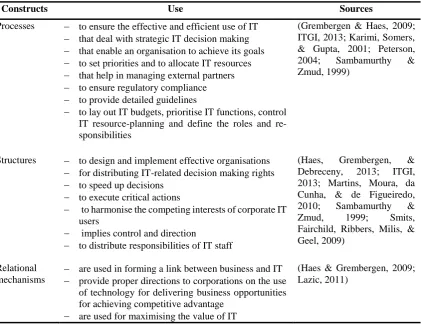
value, risks are managed and requirements are met. ITG is based on three constructs
namely structures, processes, and relational mechanisms (Grembergen, Haes, &
31
These processes, structures and relational mechanism have been explained by various
[image:31.595.104.526.133.461.2]re-searchers in their own perspectives, as can be seen in table 2.1.
Table 2.1: ITG constructs
Even though most of the ITG definitions focus on processes and the distribution of
deci-sion-making rights and responsibilities to govern the IT function, there is still no unique
and broadly accepted definition (Martins et al., 2010), and it is still considered a maligned
and misused term with multiple meanings in different contexts (Rau, 2004).
Drawing from the literature review and based on the constructs identified in table 2.1, the
researcher of this study formulated a comprehensive definition of ITG as follows:
ITG is defined as a set of IT controls, with clearly defined and assigned roles and
responsibilities, geared towards the right use of technology to meet the strategic
goals of the organization.
The derived ITG definition distilled from extant literature emphasises the predominant role of ‘responsibilities of IT control’. With the numerous ITG frameworks available, it is
Constructs Use Sources
Processes to ensure the effective and efficient use of IT that deal with strategic IT decision making that enable an organisation to achieve its goals to set priorities and to allocate IT resources that help in managing external partners to ensure regulatory compliance to provide detailed guidelines
to lay out IT budgets, prioritise IT functions, control IT resource-planning and define the roles and re-sponsibilities
(Grembergen & Haes, 2009; ITGI, 2013; Karimi, Somers, & Gupta, 2001; Peterson, 2004; Sambamurthy & Zmud, 1999)
Structures to design and implement effective organisations for distributing IT-related decision making rights to speed up decisions
to execute critical actions
to harmonise the competing interests of corporate IT users
implies control and direction
to distribute responsibilities of IT staff
(Haes, Grembergen, & Debreceny, 2013; ITGI, 2013; Martins, Moura, da Cunha, & de Figueiredo, 2010; Sambamurthy & Zmud, 1999; Smits, Fairchild, Ribbers, Milis, & Geel, 2009)
Relational mechanisms
are used in forming a link between business and IT provide proper directions to corporations on the use
of technology for delivering business opportunities for achieving competitive advantage
are used for maximising the value of IT
32
challenging to identify the success factors and criteria used by all ITG frameworks to
al-locate people to the roles and responsibilities of IT controls, for cloud as well for
non-cloud environments. Therefore a list of available ITG frameworks will be first identified,
and then top three frameworks will be shortlisted and examined to evaluate the role
allo-cation methods used in these frameworks.
2.2.1. Three popular ITG frameworks
A detailed study was conducted to identify the popular ITG frameworks and then shortlist
the top three. Using survey analysis and academic research, top three ITG frameworks
were selected, based on the popularity and their widespread usage. Each of these selected
frameworks is examined to understand the factors/criteria used by them for the allocation
of the roles and responsibilities of IT controls that have been migrated to the cloud
envi-ronment.
Survey analysis to identify top ITG frameworks
Detailed surveys initiated by the ITG Institute (ITGI) were conducted by a leading
re-search company (PricewaterhouseCoopers) during the years 2003, 2005, 2007 and 2011
(ITGI, 2011; Steuperaert, 2004). The objective of these surveys was to identify the
frame-works that are considered leaders in the ITG environment and marketplace. Results of the
study presents a list of fourteen available popular ITG frameworks (standards/best
prac-tices will be referred to as frameworks in this study) as shown in table 2.2.
Table 2.2: Trends in usage of ITG frameworks
Frameworks 2003 2005 2007 2011
ITIL 6% 13% 24% 28%
ISO 17799, ISO 27000 or other security frameworks 6% 9% 10% 21%
Six Sigma N/A 5% 2% 15%
COBIT (ISACA) 11% 9% 14% 13%
PMI/PMBOK N/A 3% 1% 13%
Risk IT (ISACA) N/A N/A N/A 12%
IT Assurance Framework (ISACA) N/A N/A N/A 10%
CMM or CMMI 6% 4% 4% 9%
ISO 38500 N/A N/A N/A 8%
BMIS (Business Model for Information Security, ISACA) N/A N/A N/A 8%
PRINCE2 N/A N/A 2% 6%
Val IT (ISACA) N/A N/A N/A 5%
TOGAF N/A N/A N/A 3%
33
According to the surveys conducted, prior to 2003 a large percentage (75%) of
organisa-tions were using a variety of local or internal soluorganisa-tions instead of internationally known
ITG frameworks. Around 30% of organisations had no apparent framework or solution in
place. Among the internationally known frameworks, COBIT was used by a majority
(11%) of the organisations surveyed. An analysis of the surveys conducted during 2005
shows that one third of the participants used or were considering using an internally
de-veloped framework. Nearly one quarter of the participants had not yet decided which
framework to use. The use of the ITIL framework has been experiencing steady growth
each year. The results of the 2007 survey indicate an increase of more than 50% in COBIT
awareness, while its adoption and use remained around 30%. According to the 2011 report,
ISO 20000 was the external standard most frequently mentioned as the basis for an enter-prise’s governance of its IT approach, followed by the Information Security Framework
ISO 17799/ISO 27000, or other security standards.
An analysis of the four surveys conducted over a period of eight years (table 2.2) revealed
an increase in the acceptance of frameworks and standards as tools for achieving ITG.
However, there is no single framework recognised as the market leader, and organisations
tend to look at multiple sources for guidance. The survey results revealed the top five
governance frameworks to be ITIL, ISO 27K COBIT, Six Sigma, and PMBOK.
Shortlisted ITG frameworks are examined to find the guidelines used by them to allocate
roles and responsibilities of IT controls that have been migrated to the cloud. Apart from
statistical results, this study subsequently considers numerous perspectives of ITG
re-searchers to shortlist the three commonly deployed ITG frameworks.
Researchers’ perspective for identifying the top ITG frameworks
Among the range of ITG frameworks, COBIT and ITIL are considered well-known
frame-works that support the implementation of effective ITG processes (Coelho & Rupino da
Cunha, 2009; Othman, Chan, & Foo, 2011; Stevens, 2011). By adopting and implementing
these, organisations can achieve alignment between business and IT, resulting in a possible
positive effect on business performance, competitive advantage and increased profitability
(Marrone, Hoffmann, & Kolbe, 2010; Marrone & Kolbe, 2011; Mohd Fairuz Iskandar
Othman, Chan, Foo, Nelson, & Timbrell, 2011). Using COBIT and ITIL together links proven IT best practices (ITIL) to COBIT’s regulatory and business requirements and
34
relates primarily to management rather than governance and to tactics rather than to
strategy (Haes et al., 2013).
COBIT is less detailed than ITIL for operational matters, yet it provides a structured,
high-level approach to ITG. The COBIT framework is often quoted in the literature (Simonsson
& Johnson, 2006) as the best known ITG framework (Drews, Morisse, & Zimmermann,
2013; Etzler, 2007; Hobbs & Scheepers, 2010; Leon et al., 2010; Nicho, 2008; Ridley,
Young, & Carroll, 2004). COBIT lists a set of IT control practices and instruments in four
domains: Planning and Organisation, Acquisition and Implementation, Delivery and
Sup-port, and Monitoring and Evaluation. Although COBIT describes decision-making
struc-tures, it emphasises control over the IT function. The control is implemented using a
col-lection of control objectives for IT processes over the entire ITG life cycle (ITGI, 2007).
COBIT has been mostly used by large organisations with the support of consultants in
order to adjust its recommendations to specific contexts (Guldentops, 2006).
In addition to COBIT and ITIL, organisations use ISO 27K to address security issues to
mitigate risks, while some recommend adopting ITG best practices such as PMBOK
(Martins et al., 2010; Smits & Hillegersberg, 2013). Organisations attain certifications like
ISO/IEC 27K to facilitate many of the legal and regulatory requirements, to gain
compet-itive advantage and to obtain an objective validation by an impartial certifying body
(Brenner, 2007). Authors such as Nfuka and Rusu (2013) suggest certifications like ISO
together with COBIT as best practices for ITG. Some organisations adopt ISO 27001 to
increase staff awareness of information security, mitigate threats and provide better data
and privacy protection (Othman et al., 2011).
Another framework that can be used by management along with COBIT for guidance in
establishing and maintaining a well-controlled information technology environment is
Committee of Sponsoring Organizations (COSO). While COSO/ERM is recognised as a
very good framework for general internal control, its impact on IT business alignment is
limited (Haes & Grembergen, 2008). Even though researchers are unanimous in asserting
that a universal best ITG structure does not exist (Brown & Grant, 2005), there are some
frameworks which are much more popular and widely accepted and used than others. Six
frequently cited frameworks include COBIT, ITIL, ISO/IEC 270K, CMMI and BS 7799
(Smits & Hillegersberg, 2013). Most of the researchers have identified COBIT and ITIL