Exploring the Interface Between
Scientific and Technical Translation
and Cognitive Linguistics
The Case of Explicitation and Implicitation
Ralph KRÜGER
School of Humanities, Languages and Social Sciences
University of Salford, Salford, UK
I
Table of contents
I
List of tables and illustrations ... VII
Acknowledgements ... X
Declaration of already published sections ... XII
List of abbreviations and acronyms ... XIII
Abstract ... XIV
1 Introduction 1
2 Scientific and technical translation 7
2.1 Issues of terminology ... 7
2.2 Historical and current significance of scientific and technical translation ... 10
2.3 The status of scientific and technical translation in translation studies ... 13
2.4 Distinctive features of scientific and technical translation ... 15
2.4.1 The role of subject-matter knowledge in scientific and technical translation ... 16
2.4.2 Stability of meaning in scientific and technical translation ... 17
2.4.3 Invariance of meaning in scientific and technical translation ... 18
2.4.4 Communicative function of scientific and technical translation ... 20
2.4.5 The relevance of linguistics to scientific and technical translation ... 21
2.5 Theoretical approaches to scientific and technical translation ... 22
2.6 Scientific and technical translation as a prototype category ... 25
2.7 A three-dimensional classification of scientific and technical texts ... 31
2.7.1 The three dimensions of the classification ... 32
2.7.1.1 Text function ... 32
2.7.1.2 Subject-matter competence of the discourse participants ... 33
2.7.1.3 Degree of technicality ... 35
2.7.2 Overview of the classification ... 38
2.8 Scientific and technical translation and linguistic underdeterminacy ... 40
II
3 A philosophical grounding for scientific and technical translation
and cognitive linguistics 43
3.1 The fundamental dichotomy: objectivism vs. subjectivism ... 44
3.1.1 Objectivism ... 44
3.1.2 Subjectivism ... 46
3.2 The embodied realist alternative ... 49
3.2.1 Origins in cognitive science ... 50
3.2.2 Embodied experience ... 51
3.2.3 Embodied cognition ... 52
3.2.4 Embodied realism ... 57
3.3 Embodied realism and science ... 61
3.4 Chapter summary ... 66
4 The framework of cognitive linguistics 67
4.1 Three approaches to meaning ... 68
4.2 Basic tenets of cognitive linguistics ... 71
4.2.1 Symbolic and usage-based character of grammar ... 71
4.2.2 Generalisation commitment and cognitive commitment ... 74
4.2.3 Dictionary vs. encyclopaedic view of linguistic meaning ... 76
4.2.4 Schemas and instances ... 78
4.3 A critical assessment of the cognitive linguistic approach to meaning ... 81
4.4 Cognitive linguistics and linguistic relativism ... 85
4.5 Theoretical components of the CL framework relevant to the present study ... 88
4.5.1 Linguistic construal ... 88
4.5.1.1 Langacker’s model of linguistic construal operations ... 90
4.5.1.2 Croft and Cruse’s model of linguistic construal operations ... 91
4.5.2 Common ground ... 92
4.5.3 Cognitive semantics ... 95
4.5.3.1 Frame semantics ... 97
4.5.3.2 Theory of domains ... 99
4.5.3.3 Frames and domains: a combined approach ... 104
4.6 Cognitive linguistics and linguistic underdeterminacy ... 106
III
5 Scientific and technical translation from a cognitive linguistic perspective 109
5.1 A model of the scientific and technical translation process ... 109
5.1.1 Author and source text ... 112
5.1.2 Translator, source text and target text ... 114
5.1.3 TT reader and target text ... 115
5.2 Some epistemological aspects of scientific and technical translation ... 116
5.2.1 Domain-related reality, conceptualization and conceptual systems ... 116
5.2.2 Conceptualization and language ... 120
5.3 The notion of context in scientific and technical translation ... 122
5.3.1 Situational context ... 124
5.3.2 Discourse context ... 125
5.3.3 Knowledge context ... 125
5.3.4 Contextual “shaping” of frames/domain matrices in usage events ... 126
5.3.5 Current discourse space: cognitive representation of the three context types .. 128
5.4 The notion of text in scientific and technical translation ... 130
5.4.1 The meaning dimension of text ... 130
5.4.2 Stability vs. instability of textual meaning ... 133
5.5 A cognitive linguistic view on invariance of meaning in scientific and technical translation ... 137
5.6 Chapter summary ... 145
6 Explicitation and implicitation 147
6.1 Explicitation and implicitation as areas of inquiry in translation studies ... 147
6.1.1 Theoretical and empirical imbalance between explicitation and implicitation ... 148
6.1.2 Explicitation and translational universality ... 149
6.1.3 Major strands in research on explicitation ... 150
6.2 Examining the explicitation concept ... 154
6.2.1 Conceptual issues ... 154
6.2.2 S-explicitation vs. T-explicitation ... 155
6.2.3 Distinction between explicitation and adjacent concepts ... 158
6.2.3.1 Explicitation vs. expansion ... 159
6.2.3.2 Explicitation vs. addition ... 161
IV
6.3 Examining the implicitation concept ... 163
6.3.1 Distinction between implicitation and adjacent concepts ... 164
6.3.1.1 Implicitation vs. reduction ... 165
6.3.1.2 Implicitation vs. omission ... 166
6.3.1.3 The reduction-implicitation-omission continuum ... 166
6.4 Explicitation and implicitation vs. explicitness and implicitness ... 167
6.4.1 Theoretical accounts of explicitness and implicitness ... 169
6.4.1.1 Explicitness and implicitness in Anglo-American pragmatics ... 169
6.4.1.2 Explicitness and implicitness in cognitive linguistics ... 173
6.5 Explicitation and implicitation from a cognitive linguistic perspective ... 175
6.5.1 Explicitation and implicitation as cross-linguistic construal operations ... 176
6.5.1.1 Explicitation and implicitation in Langacker’s model of linguistic construal operations ... 177
6.5.1.2 Explicitation and implicitation in Croft and Cruse’s model of linguistic construal operations ... 178
6.5.1.3 Comparing the two models with regard to their applicability to explicitation and implicitation ... 179
6.5.2 A cognitive linguistic distinction between explicitation/implicitation and their adjacent concepts ... 181
6.6 Defining explicitation and implicitation in cognitive linguistic terms ... 184
6.7 Explicitation and implicitation and linguistic underdeterminacy ... 185
6.8 Chapter summary ... 186
7 Corpus design and methodology 187
7.1 Corpus design ... 187
7.1.1 Primary design considerations ... 187
7.1.1.1 Translation corpus ... 187
7.1.1.2 Domain-controlled corpus ... 188
7.1.1.3 Bidirectional corpus ... 188
7.1.1.4 Subcorpora with different degrees of technicality ... 189
7.1.1.5 Functional invariance between STs and TTs ... 189
7.1.1.6 High-quality corpus ... 190
7.1.2 Corpus data ... 191
V
7.1.2.2 Statistical corpus data ... 192
7.1.3 Text data ... 193
7.1.3.1 General information, text type and genre ... 193
7.1.3.2 Degree of technicality ... 195
7.1.3.3 Translation context ... 195
7.1.4 Epistemic value of “corpora in context” ... 197
7.2 Methodology ... 199
7.2.1 Tertium comparationis of the translation comparison ... 199
7.2.1.1 Explicitation and implicitation as translation shifts ... 202
7.2.2 Classification of explicitation and implicitation shifts ... 203
7.2.2.1 Linguistic classification proposed by Klaudy/Károly ... 203
7.2.2.2 Revised cognitive linguistic classification ... 206
7.2.3 Identification and classification procedure ... 208
7.3 Chapter summary ... 210
8 Data analysis 212
8.1 Quantitative dimension of the analysis ... 212
8.1.1 Frequency and distribution of shifts in relation to the translation direction ... 214
8.1.2 Frequency and distribution of shifts in relation to the degree of technicality ... 216
8.2 Lexical insertion and deletion ... 217
8.2.1 Qualitative discussion of lexical insertion/deletion shifts ... 220
8.2.1.1 Explicitation: lexical insertion ... 220
8.2.1.2 Implicitation: lexical deletion ... 235
8.2.2 Linguistic distribution of lexical insertion/deletion shifts ... 245
8.3 Lexical specification and schematization ... 247
8.3.1 Qualitative discussion of lexical specification/schematization shifts ... 249
8.3.1.1 Explicitation: lexical specification ... 249
8.3.1.2 Implicitation: lexical schematization ... .268
8.3.2 Linguistic distribution of lexical specification/schematization shifts ... 280
8.4 Relational specification and schematization ... 283
8.4.1 Qualitative discussion of relational specification/schematization shifts ... 286
8.4.1.1 Explicitation: relational specification ... 286
8.4.1.2 Implicitation: relational schematization ... 295
VI
8.5 Borderline cases ... 301
8.5.1 Expansion vs. explicitation ... 302
8.5.2 Explicitation vs. addition ... 303
8.5.3 Reduction vs. implicitation ... 304
8.5.4 Implicitation vs. omission ... 305
8.6 Chapter summary ... 307
9 Conclusion 309
List of tables and illustrations
Chapter 1
-
Chapter 2
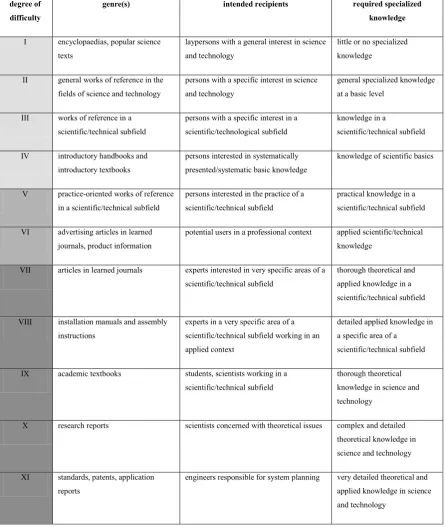
Table 1: Degrees of technicality/difficulty of scientific and technical texts
according to Arntz 37
Figure 1: Snell-Hornby’s stratificational model of translation studies 16
Figure 2: STT as a prototype category 26
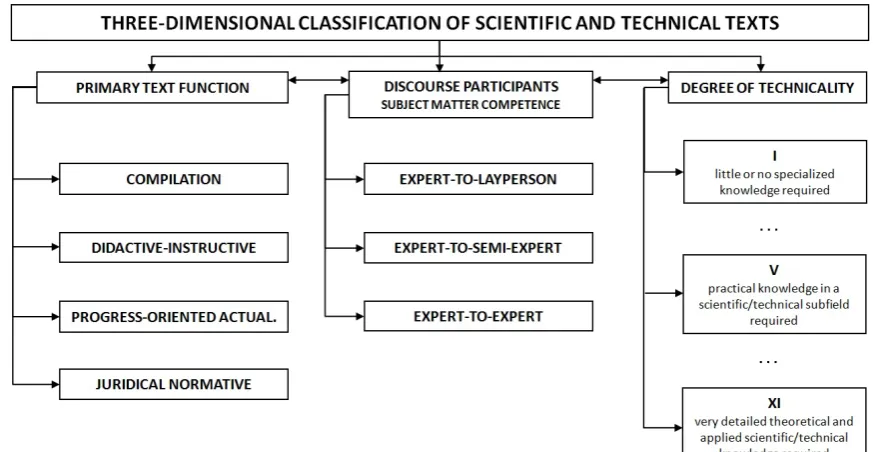
Figure 3: Albrecht and Schreiber’s equivalence model 27 Figure 4: Three-dimensional classification of scientific and technical texts 39
Chapter 3
-
Chapter 4
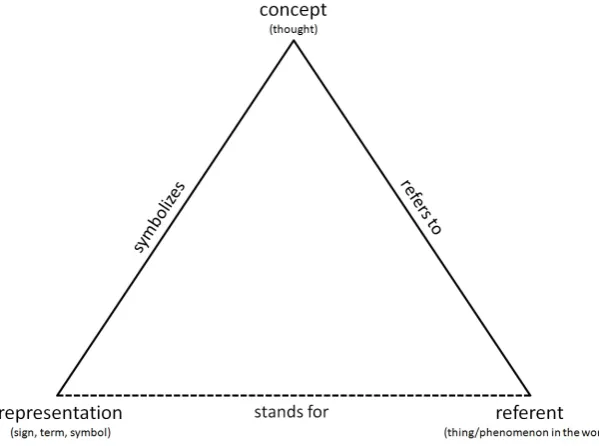
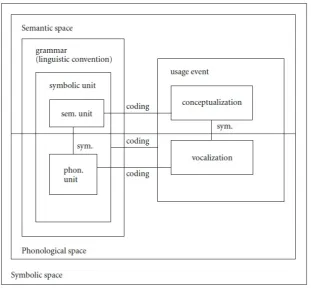
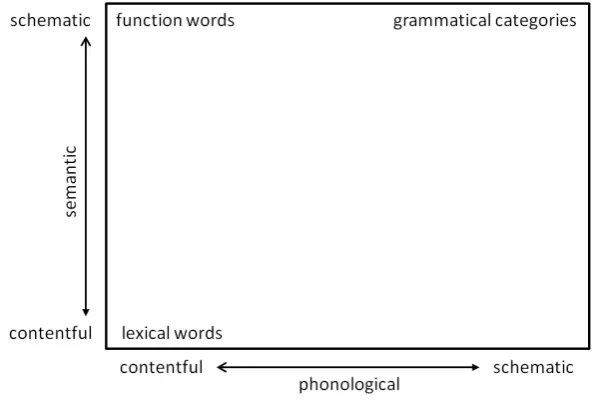
Figure 1: Three approaches to meaning based on the semiotic triangle 68 Figure 2: The structure of symbolic assemblies in cognitive linguistics 72 Figure 3: Contentfulness vs. schematicity of phonological and
semantic structures 80
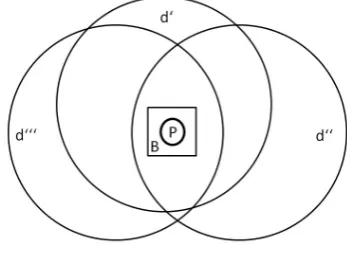
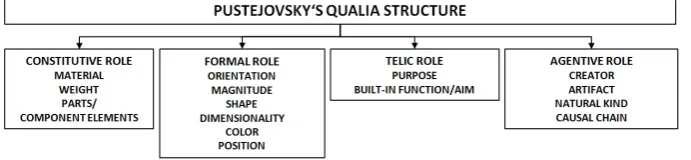
Figure 4: Langacker’s model of linguistic construal operations 90 Figure 5: Croft and Cruse’s model of linguistic construal operations 91 Figure 6: The distinction between profile, base, domain and domain matrix 101 Figure 7: Detailed overview of Pustejovsky’s qualia structure 103
Chapter 5
Figure 1: Model of the scientific and technical translation process 110 Figure 2: Extended and revised model of the scientific and technical
translation process 112
Figure 3: Common ground in expert-to-expert, expert-to-semi-expert
Chapter 6
Figure 1: Strands of explicitation research in translation and
interpreting studies 151
Figure 2: The expansion-explicitation-addition continuum 162
Figure 3: The reduction-implicitation-omission continuum 166
Figure 4: Langacker’s model of linguistic construal operations 177
Figure 5: Croft and Cruse’s model of linguistic construal operations 178
Figure 6: The expansion-explicitation-addition continuum from a cognitive linguistic perspective 181
Figure 7: The reduction-implicitation-omission continuum from a cognitive linguistic perspective 181
Figure 8: Possible domain matrix of the term CO2 182
Chapter 7 Table 1: Statistical overview of the scientific/technical corpus 192
Table 2: Labels used for annotating explicitation and implicitation shifts in the corpus texts 210
Chapter 8 Table 1: Statistical overview of explicitation/implicitation shifts in the four subcorpora 212
Table 2: Frequency and distribution of explicitation/implicitation shifts in relation to the translation direction 214
Table 3: Frequency and distribution of explicitation/implicitation shifts in relation to the degree of technicality 216
Table 4: Overview of lexical insertion/deletion shifts 220
Table 5: Overview of lexical insertion/deletion shifts – distribution over subcorpora and word classes 245
Table 6: Overview of lexical specification/schematization shifts 249
Table 7: Overview of lexical specification/schematization shifts – distribution over subcorpora and word classes 280
Table 8: Prototypicality of lexical specification/schematization shifts 282
distribution over subcorpora and linguistic realization 299 Table 11: Overview of borderline cases identified in the analysis 302
Figure 1: Fuel – differences between English and German conceptual systems 256 Figure 2: Functional principle of a GCC power plant 271 Figure 3: Functional principle of PPC technology (pressurized pulverized
Acknowledgements
Although the only perceivable outcome of a PhD research is a book-length thesis that is attributed to a sole author, the whole process is by no means an isolated endeavour. During the course of my work, I was able to rely on the assistance and support of a multitude of people, whom I would like to express my deepest gratitude.
Firstly, I would like to say a big thank you to the PhD students in translation studies and linguistics at the Universities of Salford and Manchester for their academic support and for stimulating discussions about life, the universe and everything. My special thanks go to Fabrizio Gallai, Li Minghui, Yannis Kostopoulos, Ahmed Altahri, Khalid Al Saleem and Mario Bisiada for being good friends and for sharing all the concerns that only PhD students can have (and actually consider relevant). I am particularly indebted to Fabrizio for sharing his house, to Mario for helping me with hard-to-find literature and to Yannis for valuable literature recommendations on all things cognitive linguistics and for being a fierce but fair opponent from the camp of relevance theory.
In Salford, I would also like to thank Verena Jung, Andrew Read and Vanessa John from the German department at the School of Humanities, Languages and Social Sciences. It was a pleasure teaching and working together with you.
At Cologne University of Applied Sciences, I am especially indebted to my friend and colleague Jesús Serrano Piqueras for his personal support, his patience in sharing the office with a despairing PhD student and for his academic input from a translation process perspective, which more than once helped me avoid the danger of thinking too statically amidst my comparatively well-behaved corpus texts.
I would also like to thank Susan Turner-Lorenz for supporting my first publishing steps as a thorough English proofreader of several articles and Lisa von Domarus for critically proofreading various draft chapters of this thesis. Furthermore, I would like to express my gratitude to the students of the translation studies seminar in Cologne in the summer semester 2013 for enthusiastically (or at least patiently) working with me on the interface between scientific and technical translation and cognitive linguistics. Several of their comments and suggestions have made their way into this thesis.
I would like to express an equally special thanks to my supervisors professor Myriam Salama-Carr from the University of Salford and professor Monika Krein-Kühle from Cologne University of Applied Sciences for their invaluable support both academic and personal. Initially, I feared that the split-site research programme I had entered would make me feel torn between two worlds. Instead, you helped me feel at home in both of them.
The last and biggest thank you goes to Stefanie for always being there when times were difficult and for never failing to show me that there was still a world beyond the PhD. In hindsight, I appreciate this even more than I did at the time. It's about time we go to that dancing class!
Declaration of already published sections
List of abbreviations and acronyms
CCS Carbon dioxide capture and storage
CDS Current discourse space
CG Common ground
CL Cognitive linguistics
COORETEC CO2 reduction technologies for fossil-fuelled
power plants
CSTC Cologne Specialized Translation Corpus
DE German
DIN Deutsches Institut für Normung
e-continuum Explicitness continuum
EN English
i-continuum Implicitness continuum
IPCC Intergovernmental Panel on Climate Change
ISO International Organization for Standardization
LA Langue d’arrivée
LD Langue de départ
lm Landmark
LSP Language for special purposes
SAE Society of Automotive Engineers
SL Source language
ST Source text
STT Scientific and technical translation
TL Target language
tr Trajector
TS Translation studies
T-semantics Truth-conditional semantics
TT Target text
Abstract
This thesis aims to explore the interface between scientific and technical translation (STT) and cognitive linguistics (CL), placing particular emphasis on the translationally relevant phenomena of explicitation and implicitation. The two concepts are regarded as potential indicators of translational text-context interaction, which may be of specific importance in the knowledge-intense field of STT and which can be modelled within the CL framework. Parallel to the microscopic attempt to give a coherent account of explicitation and implicitation in STT from a CL perspective, the thesis follows a macroscopic approach that aims to highlight the wider potential which cognitive linguistics holds for the field of scientific and technical translation. Translationally relevant elements of the CL framework include a coherent and cognitively plausible epistemological basis that explains the stability of scientific knowledge, the concept of common ground, which can be used to model the shared knowledge of specialized discourse communities, the field of cognitive semantics, which has developed tools for modelling the organization and representation of specialized knowledge, and the concept of linguistic construal, which allows the description of various linguistic aspects of STT (explicitation and implicitation among them) from a cognitively plausible perspective.
1 Introduction
“Scientific and technical translation is part of the process of disseminating information on an international scale, which is indispensable for the functioning of our modern society.” (Pinchuck 1977:13)
“Given the general goals of Cognitive Linguistics, one would […] assume that of the linguistic frameworks currently in the limelight, Cognitive Linguistics would have the most to say about translation.” (Faber/Ureña Gómez-Moreno 2012:74)
“We can only understand language if we understand more than language.” (Hörmann 1976:210, my translation)
As indicated by the title of the present thesis and illustrated by the three quotes above, the thesis engages with three principal areas of investigation. The main area, in whose name the theoretical and empirical work in this thesis is primarily carried out, is the field of scientific and technical translation (STT). Despite the high societal relevance of this field of translation, as illustrated by Pinchuck’s quote above, a brief survey of current translation studies shows that STT is not the most obvious choice of topic since it is often considered to lack the multidimensionality and general appeal of other types of translation. However, having been trained in this field and having worked as a scientific and technical translator for several years, I have already experienced the highly complex nature of scientific and technical translation on many occasions and eventually came to the conclusion – as Jumpelt (1961:186) did quite a while ago – that this high complexity of STT and the considerable demands placed on scientific and technical translators warrant an in depth theoretical exploration of this field in its own right.
An aspect which I was particularly interested in and which may be of high relevance to the knowledge-intense field of STT was the fundamental underdeterminacy of language
linguistically highly condensed in order to ensure efficient and economic communication within expert communities. Two concepts which seem particularly suited to illustrate both the linguistic underdeterminacy and the resulting text-context interaction in scientific and technical translation and which have already been firmly established in translation studies are the phenomena of explicitation and implicitation, which became the second area of investigation of this thesis.
However, very soon after I started reviewing the literature on explicitation and implicitation, it became obvious that, in order for these concepts to be meaningful and applicable in empirical analyses, a proper theoretical notion of the more fundamental concepts of explicitness and implicitness was required, which unfortunately was often missing in the existing body of work. If we go back to the iceberg metaphor of human communication, it becomes clear that any study evoking the huge body of information hidden under water requires a sound theoretical foundation if it hopes to achieve the much desired comparability and repeatability of its findings or any form of intersubjective consensus among fellow researchers. After all, when talking about things under water, we are talking about things which, in the words of Pym (2005:34), are “paradoxically held to be at once hidden and obviously available to all”.
Let me briefly illustrate the epistemic aims of the thesis as perceivable at this juncture with the following rather trivial, yet illustrating example from the scientific/technical corpus to be analyzed in this study:
Depending on the process or power plant application in question, there are three main approaches to
capturing the CO2 generated from a primary fossil fuel [...]:
Abhängig vom jeweiligen Verfahren oder Kraftwerkstyp gibt es drei Hauptansätze zur Abtrennung des bei der Verbrennung eines fossilen Primärenergieträgers [...] entstandenen CO2:
This example, which will be taken up again in the thesis, can be considered as a prototypical instance of scientific and technical discourse. The source text information that CO2 is generated from a primary fossil fuel is rendered more explicitly in the target text,
which specifies that CO2 is generated from the combustion of a primary fossil fuel. This
meaning” of CO2 or part of our general world knowledge about CO2? How is this
information organized, and how is it made “prominent” in a given communicative context? When can a piece of information be claimed to be implicit in the source text and when not? Can any informational gain in the TT as compared to the ST be considered as explicitation? And so on.
translation.1
The epistemic aims of this thesis can therefore be described as follows: Firstly, the – corpus-based – investigation of explicitation and implicitation in scientific and technical translation is intended to illustrate the interface between text and context in this form of translation. This investigation is intended to illustrate how and – to a lesser degree – why
translators perform this text-context interaction in STT. The analysis should also yield insightful patterns of text-context interaction (as realized by explicitation and implicitation) which can be correlated with parameters such as the translation direction or the degree of technicality of the corpus texts. Secondly, the thesis aims to explore the interface between scientific and technical translation and cognitive linguistics by identifying various relevant aspects of STT and modelling them in cognitive linguistic terms. Thirdly, the thesis aims to show that explicitation and implicitation, although being firmly established and widely studied concepts in translation studies, can also profit from a cognitive linguistic perspective, which may provide better answers to some pertinent issues in explicitation and implicitation research and which also ensures a coherent integration of the two concepts into the overall framework of the thesis. Finally, the empirical analysis is intended to illustrate the overall validity of the proposed framework by discussing the identified explicitation and implicitation phenomena in translational and cognitive linguistic terms, thus bringing the theoretical strands of the thesis together.
This rather fortunate encounter with the cognitive linguistic framework and the lack of previous detailed work on the interface between CL and STT brought about a shift of focus away from the initially conceived exclusive consideration of STT and explicitation/implicitation – with a linguistic framework as a necessary theoretical adjunct – to considering cognitive linguistics as a third theoretical area of investigation in its own right. This thesis will therefore also attempt to answer the question whether, of all the linguistic frameworks currently on stage, CL does indeed “have the most to say about translation”.
The three main areas of investigation of the thesis and its epistemic aims translate into the following overall thesis structure. Chapter 2 is intended to set the overall scene, focusing on scientific and technical translation, its societal relevance and theoretical status. This chapter will also consider relevant textual and extratextual dimensions of STT that will be combined in a three-dimensional classification of scientific and technical texts serving as a point of reference for relevant discussions over the course of the thesis. This chapter
1 But see the various articles by Halverson on the interface between cognitive linguistics and translation (for
qualitative in nature since explicitation and implicitation are inherently “unruly” phenomena which – without taking an overly reductionist approach – cannot be tied down to specific and predefined linguistic indicators that would lend themselves to an automated and large-scale corpus analysis. The implementation of the cognitive linguistic framework in the thesis led to a further backgrounding of the quantitative dimension in favour of the qualitative discussion of the results in translational and cognitive linguistic terms, which is considered to be the main contribution of the empirical investigation. Of course, the quantitative side of the investigation will not be ignored but the ability to generalize the findings may be somewhat constrained by the relatively small corpus, which reflects the primarily exploratory character of the investigation illustrated above.
2 Scientific and technical translation
This chapter provides a general overview of the field of scientific and technical translation as the main area of investigation of the present thesis. I will start the discussion by clarifying some persistent terminological issues that often hinder a transparent discourse about STT, before attempting a brief survey of the historical significance of scientific and technical translation and its role in today’s highly technology-dependent society. This survey is intended to illustrate the high societal relevance of STT and can at the same time be understood as a call for and a justification of a higher visibility of this field of translation in translation studies. Against this background, the focus will be shifted to the general status of STT in translation studies and the distinctive features that differentiate it from other forms of translation. The theoretical position of STT in the well-known dichotomy of source-text vs. target-text orientation will then be discussed and a prototypical approach to STT will be proposed that aims to reconcile – to some extent – the two poles of this dichotomy. Following this, I will propose a three-dimensional classification of scientific and technical texts which captures various important dimensions of STT and which is specifically tailored to the epistemic aims of this thesis. This classification and STT in general will then be linked to the notion of linguistic underdeterminacy as a recurring theme tying the various topics of the thesis together.
2.1 Issues of terminology
1. The results of basic or pure science
2. The results of applied scientific research geared toward solving particular problems
3. The work of technologists, which is intended to create marketable industrial products or processes
1987:298, see 3.3). So, when Byrne (2012:2) claims that technical texts are “designed to
convey information as clearly and efficiently as possible”, while scientific texts “will
discuss, analyze and synthesize information with a view to explaining ideas, proposing new theories or evaluating methods”, he may in fact be describing a continuum, with science and technology as the two endpoints and applied science covering the middle ground. While keeping in mind this general distinction between science and technology, the symbiotic relationship between the two fields and the hybrid nature of many scientific and technical texts encountered in the real world seem to justify the joint use of the two terms in the designation scientific and technical translation.1
However, a distinction that should be made for the sake of clarity is that between technical translation and specialized translation. Olohan (22009:246) notes that the term technical
translation is often used to refer to the translation of texts outside the fields of science and technology and that some scholars see technical translation as a synonym for specialized translation. In the same context, Byrne (2006:3) criticizes the tendency to subsume LSP texts from the fields of law, finance or economy under the label technical translation. The problem, as Byrne (ibid.) rightly points out, is that “[s]imply because a field or subject area has unique or specialised terminology does not make it technical”. For the purpose of the present thesis and in line with Borja et al. (2009:58), I understand specialized translation
as the translation of texts that serve practical rather than aesthetic purposes.
After all, when dealing with texts that can clearly be assigned to one of the two fields, we can still resort to the more specific designations scientific translation or technical translation.
2
After this brief discussion and clarification of terminological issues pertaining to STT, we will now consider the societal relevance of this field of translation.
Specialized translation can thus be seen as a cover term for various more specific modes of translation, such as legal translation, financial translation and also STT, while scientific and technical translation is to be understood in the narrower sense discussed above.
1 In her pragmatic classification of LSP texts in science and technology, Göpferich (1995:306) makes no
distinction between text types pertaining specifically to the fields of science or technology since, according to her, the two fields are separated by a very fuzzy boundary. Concerning text-type conventions, Göpferich (ibid.) also claims that texts from these two fields will exhibit more similarities than differences.
2.2 Historical and current significance of scientific and technical translation
Since the invention of writing, translation has always been a key factor in fostering scientific progress across barriers of language and culture. This, in turn, has a profound impact on the shaping and development of human societies. Concerning the importance of translation for the proliferation of scientific knowledge, some scholars, like the Italian Renaissance philosopher Giordano Bruno, went so far as to state that “[f]rom translation, all science has its offspring” (Salama-Carr et al. 1995:101). And indeed, the travel of the “torch of knowledge“ (ibid.:102) between major cultural and intellectual centres – from Asia to Greece, from Greece to the Middle East and from there on to Europe, the Americas and finally the entire world – has always been accompanied by “waves of translation activity” (Jumpelt 1961:184; Pinchuck 1977:17) as a prerequisite for the export and import of scientific ideas. Störig (32007:150) even claims that the whole intellectual history of
mankind could be structured in terms of these translation waves. In the following sections, I will briefly elaborate on this “wave metaphor” since it provides a useful background for illustrating the historical significance of scientific and technical translation.
According to Störig (ibid.), there are three prerequisites for a wave of translation activity to occur: (1) there must be a disparity in the intellectual standard of two cultures or language communities; (2) the societal and intellectual development in the culture/language community possessing a lower intellectual standard must have reached a point where a natural demand arises for the reception of external knowledge; (3) the two cultures/communities must come into contact with each other; this contact then provides a vital spark igniting a large-scale exchange of knowledge.
the development and consolidation of Arabic as a scientific language and in establishing a new system of thought that would become the foundation of Arabic-Islamic culture (Salama-Carr et al. 1995:113-114). The intellectual stimuli induced by this inflow of knowledge were among the most important factors for the intellectual superiority that the Muslim-Arab culture gained over medieval Europe before another wave of translation activity would restore the balance between the cultures again, eventually tipping it in favour of Europe (Störig 32007:150). This considerable intellectual imbalance between the
Muslim-Arab culture and the European culture and the pressure felt by European scholars to redress the balance between the two cultures would correspond to the first two requirements of a wave of translation activity as identified by Störig. The spark that would eventually ignite this translation activity (i.e. the contact between the two cultures) came in the form of the reconquest of the Spanish city of Toledo by Christian forces in 1085, which ended the Moorish rule over the city and constituted the first step of the Reconquista that ended with the fall of Granada in 1492. A prominent figure in the “reimport” of the Ancient Greek knowledge into Europe was Gerard of Cremona (1114-1187), who profited from the access that European scholars had now regained to the wealth of Arabic-Islamic (and Ancient Greek) knowledge stored in Toledo and who dedicated his life to translating the Arabic versions of the Ancient Greek works into Latin (Störig 32007:150). After
coming into contact with the works of their cultural ancestors by way of “relais translation”, European scholars eventually returned to the original Greek versions of the texts and translated these into Latin as well. This process culminated in the work of William of Moerbeke (1215-1286), who, partly upon request from his famous friend Thomas Aquinas, translated the original Greek texts of Hippocrates and Galen, Archimedes, Heron and Aristotle into Latin (ibid.:151). After this wave of translation activity, the torch of knowledge had passed on again from the Orient to the Occident. This account of the journey of the Ancient Greek knowledge between Europe and the Muslim-Arab world shows that scientific and technical translation already played an important role in the development of societies and cultures even before translation fully came into its own with Gutenberg’s invention of the printing press and the ensuing explosion of the number of books produced (Byrne 2012:3). The decline of Latin as a scientific lingua franca and the corresponding rise of vernacular languages in the 17th
– and which saw the birth of the Anglo-Saxon scientific discourse as we know it today (Bennett 2007:159-160) –, and the industrial revolution generated further scientific knowledge that could now be easily codified in books and had to be made available in various languages in order to gain international attention. In the first half of the 20th century, for example, leading physicists Max Planck and Albert Einstein published parts of their works in German, Niels Bohr in Danish and Hideki Yukawa in Japanese. In the field of radiology and medical diagnostics on the other hand, Pierre and Marie Curie published, again in part, in French and Wilhelm Conrad Röntgen in German (Byrne 2012:4). This temporary distribution of scientific and technical discourse over various vernacular languages was interrupted in the 18th century by a brief period of French hegemony and
finally ended in the middle of the 20th century with the rise of English as the dominant
lingua franca of science (Brekke 2004:628). Since the majority of scientists are nowadays being required to publish their findings in English, “pure” scientific translation may, for the time being, be in decline, whereas the demand for technical translation is still on the rise (Olohan 22009:246).
This brief historical excursus was intended to illustrate the historical significance of translation in the proliferation of scientific knowledge and the ensuing transformation of whole cultures. To put the significance of scientific and technical translation again into perspective, Byrne (2012:3) points out how impoverished and underdeveloped science would be if every scientific breakthrough through the ages had happened in cultural isolation, without propagating this new knowledge across linguistic and cultural barriers so that it could in turn stimulate new research, inventions and discoveries. It is probably this effect of “cross-fertilization” (Salama-Carr et al. 1995:101) that Fischbach (1992) had in mind when he called translators “the great pollinators of science”.
legal requirements regarding the availability of multiple language versions of technical documentation accompanying a specific product (Schmitt 1999:12). In the European context, for example, Annex I section 1.7.4 of the Directive 2006/42/EC regulating the health and safety requirement relating to the use of machinery (“Machinery Directive”) contains the requirement that “[a]ll machinery must be accompanied by instructions in the official Community language or languages of the Member State in which it is placed on the market and/or put into service.” Similar pieces of European legislation which fuel the demand for scientific and technical translation are, for example, Directive 2001/95/EC relating to general product safety or Directive 90/385/EEC relating to medical devices (Byrne 2012:7).
It seems then that the significance of STT may not only be illustrated by pointing out its historical influence on high-level developments on a societal or even global scale. In the light of the recent developments described above, which have led to an extremely high demand for STT, its significance will almost certainly be felt in the immediate reality of professional translators as well since this is generally the field in which they will generate a substantial amount of their income (Byrne 2012:1). According to a study conducted in Germany by Schmitt in the early 1990s, the German translation market is overwhelmingly dominated by LSP texts, about 75% of which are of a technical nature (for a summary of the results, see Schmitt 1999:41). Although the study and its findings are now quite dated, Krein-Kühle (2003:12) assumes that any subsequent changes will have led to an increase instead of a decrease of this already high figure.
2.3 The status of scientific and technical translation in translation studies
As researchers working in the field of scientific and technical translation often point out, this huge significance of STT both at a societal level and at the level of individual translation practice stands in sharp contrast to the scarcity of translational research carried out in this field (e.g. Krein-Kühle 2003:14; Byrne 2006:1; Carr 2009:43; Salama-Carr 2013:20). Traditionally, STT has been considered as easier or as more straightforward than literary translation3
3 See, for example, Wilss (1991:3), Schmitt (21994:252), Horn-Helf (1999:101-102).
due to the “perceived universality of the language of science and/or of scientific thought” (Olohan 22009:247) and due to the apparent absence of
reduced to a simple, almost automatic transcoding process. Some scholars, such as Mounin (1967:158), went so far as to claim that scientific translation could eventually be completely automated (see also Arntz 2001:172). This derogatory view of STT and specialized translation in general has a long tradition that can be traced back to Friedrich Schleiermacher, who claimed that in the field of commerce (as a subfield of specialized translation), translation is “little more than a mechanical task which can be performed by anyone who has moderate knowledge of the two languages” (Schleiermacher 1813/32012:45). What is also interesting is Schleiermacher’s justification for his
disparaging view of commercial translation since he claims that “[b]usiness dealings generally involve readily apparent, or at least fairly well defined objects; all negotiations are, as it were, arithmetical or geometrical in nature, and numbers and measurements come to one’s aid at every step” (ibid.). What is striking with regard to this quote is that, if we disregard his remark on “negotiations”, Schleiermacher’s description seems to be readily applicable to technology and science, the former dealing with well-defined objects and the latter trying to uncover and to describe regularities in the world, often by resorting to measurements or arithmetical or geometrical operations. Therefore, it seems that Schleiermacher’s criticism of commercial translation can also be interpreted as a criticism of STT.
Another philosopher, José Ortega y Gasset, also considers specialized translation and, in this case, particularly scientific translation to be easier or more straightforward than literary translation. According to Ortega y Gasset (1937/2000:50-51), authors of scientific texts translate their thoughts into a pseudolanguage of technical terms, i.e. a terminology, which guarantees a language-independent, almost universal scientific discourse:
[This terminology] is a Volapuk, an Esperanto established by a deliberate convention between those who cultivate that discipline. That is why [scientific] books are easier to translate from one language to another. Actually, in every country these are written almost entirely in the same language. (ibid.:51)
easier to translate than, for example, literary or general language texts is another question that will be discussed in the next section. What seems clear, however, is that the views held by these prominent thinkers are to some extent exemplary for the general attitude towards specialized (and often also scientific and technical) translation and it should therefore not come as a surprise that this field “remains relatively unchartered territory within the discipline [of translation studies] and is deemed a less prestigious test case for translation models” (Salama-Carr 2009:43). Over the past few years, the situation has changed slightly and STT has become more visible in translation studies, for example in the form of a proper entry in the second edition of the Routledge Encyclopedia of Translation Studies (Olohan 22009) or in the form of a Special Issue “Science in Translation” of The
Translator (Olohan/Salama-Carr 2011). But as Salama-Carr (2013:20) points out, it seems that this field of translation “is still to acquire its lettres de noblesse and to be given its share in anthologies of translation studies”.
2.4 Distinctive features of scientific and technical translation
A good reference point for the discussion of distinctive features of scientific and technical translation is the “stratificational” model proposed by Snell-Hornby (e.g. 21994:17; 21995:32), in which the author attempts to provide an integrated account of the traditional
areas of translation (literary translation, general language translation and special language translation) based on a prototypical approach. The model is quite ambitious and, as such, naturally not without its shortcomings (see, for example, Munday 32012:119) but it convincingly illustrates some general distinctive features of STT and its relation to other fields of translation. The model adopts a top-down approach, starting from a macroscopic perspective on the previously mentioned three traditional areas of translation (level A in the model) and then moving down to the microscopic level via a prototypology of basic translationally relevant genres (level B), the non-linguistic disciplines linked to the various areas of translation and text types (level C), essential aspects of the translation process itself (level D4
4 At level D, (i) refers to the source text, (ii) indicates the relevant quality criteria for translation and (iii)
focuses on the function of the translation from a recipient perspective.
Figure 1: Snell-Hornby’s stratificational model of translation studies5
In the following sections, we will consider in more detail the relevant levels and sub-levels of this model.
2.4.1 The role of subject-matter knowledge in scientific and technical translation
Starting from the top of this model, STT is considered as a specific form of special language translation or specialized translation (this is in line with the distinction between STT and specialized translation made above). At the level of non-linguistic disciplines with relevance to translation (level C), we find the first distinctive feature of STT, namely that it relies on the study of special subjects underlying the various texts to translate. This has important consequences for the translator and the translation process. For example, Rickheit/Strohner (1993:214-215) point out from a cognitive perspective that readers or hearers of narrative texts, compared to those of expository texts (e.g. scientific and technical texts), generally possess more world knowledge which they can bring to bear in text understanding. Narrative texts usually refer to situations, actional contexts and actions that are more or less well-known by the text recipients, the new elements being primarily the relations between the events described in the text. Expository texts, on the other hand, usually do not only refer to new relations between individual events but to new events altogether (for example in the form of new scientific findings in cutting-edge research).
Also, Jahr (2009:82) points out that scientific and technical knowledge is quite strongly organized in a vertical hierarchy that often encompasses more and much deeper reaching levels than in other disciplines. In order to understand a highly specialized scientific/ technical text, readers normally have to acquire first the basic knowledge at the top of such a hierarchy (since the more specific topic they want to understand is related to this basic knowledge in systematic ways) and then work their way downwards to increasingly more specific levels of knowledge. On the other hand, in literary and general language translation, the knowledge required to understand a given text is normally structured more horizontally and can thus be more readily associated with our general knowledge of the world (see Rickheit/Strohner’s claim above). For STT, however, the vertical organization of scientific and technical knowledge translates into the widely accepted but still not trivial fact that translators cannot just rely on their general world knowledge but often need to acquire a considerable amount of subject-matter knowledge if they are to produce high quality translations (Krein-Kühle 2003:11; Byrne 2006:5-6). As Faber/Ureña Gómez-Moreno (2012:83) put it, “[o]nly a fragment of the conceptual system is mentioned in the text, but the translator must rebuild an important part, if not all, in order to obtain a comprehension of the content [to be conveyed]”. Due to the vertical organization of such conceptual systems in science/technology, STT generally seems to exhibit a greater “conceptual distance” between the translator and the text than literary or general language translation.
2.4.2 Stability of meaning in scientific and technical translation
therefore, the organization of this subject matter is reflected in the organization of the text. The notion of a prestructured reality that could serve as a fully stable frame of reference in scientific and technical texts will be scrutinized from a philosophical point of view in the next chapter and will be discussed in the context of STT in chapter 5. For the present discussion, I take it to be pre-theoretically evident that the frames of reference in scientific and technical discourse are much more tightly structured than in other forms of discourse and that this structure, regardless (for now) of its ontological and epistemological status, influences and delimits to a considerable extent the scope of interpretation and consequently the scope of action of authors and translators of scientific and technical texts. This narrow scope of interpretation can be linked to the high stability of (monolingual) meaning that is generally attributed to STT. On the other hand, specifically in literary translation and to a lesser extent in general language translation, the conceptual systems underlying a text are often of an ad hoc nature (for example in fictional novels) and therefore less stable, bearing the idiosyncratic imprint of the author. Also, as a specific rhetorical means, such texts may exhibit instances of “intentional polysemy” (see Prunč
2007:128), whereas such polysemy is an unwanted phenomenon in scientific and technical discourse and STT, both of which strive for clarity, efficiency, formalization, standardization, non-contradiction, completeness, objectivity and non-redundancy (Beier 1980:83).6
2.4.3 Invariance of meaning in scientific and technical translation
Since there is often no tightly structured ordo naturalis to which literary or (to a lesser extent) general language texts refer, the admissible scope of interpretation will sometimes be much wider than that in STT.
This leads to point (ii) of this level, which is concerned with various quality criteria for translation. Snell-Hornby claims in this context that equivalence criteria can only be posited “for certain types of special language translation” and that “the notion of invariance can only apply in cases of conceptual identity” (21995:34).7
6 Of course, this is an idealized conception of scientific and technical discourse and translation that may not
exist in reality in this pure form (see, for example, Salama-Carr (2013) on the notions of norms and power in the context of scientific and technical discourse/translation). However, it cannot be denied that there are converging efforts to these ends (by the various scientific communities) and that scientific and technical discourse exhibits these features to a much higher degree than other forms of discourse.
The complex
7 Snell-Hornby’s model is somewhat misleading here. Conceptual identity is situated at level D (i), which is
concepts of equivalence and invariance will be discussed, in more detail, in the context of theoretical approaches to STT in 2.5. Since the ideas of invariance and conceptual identity are linked with some profound epistemological issues, such as the nature of concept formation and the influence of linguistic systems on human conceptual systems, they will be taken up again in the cognitive linguistic discussion of scientific and technical translation in chapter 5. By then, we will have laid out the philosophical and linguistic basis of this thesis (chapters 3 and 4) and can tackle these issues in a more informed way. What I want to focus on at this point, again at a rather pre-theoretical level, is the consequences for STT that arise from the assumption of tightly structured conceptual systems underlying scientific and technical texts, as already discussed in the previous section. These consequences are already hinted at in Snell-Hornby’s notions of invariance
and conceptual identity. It was claimed that scientific and technical discourse offers only a very narrow scope of interpretation, which can be equated with a high stability of meaning in this form of discourse. Assuming that the relevant conceptual systems in source and target languages are to a large extent congruent (see Scarpa 2002:146; Brekke 2004:620)8,
invariance of meaning is generally deemed to be achievable in STT. Accordingly, STT is considered to be governed by “absolute priority of information content over form and the accuracy of its transmission” (Jumpelt 1961:VII). Regarding the actual translation process, the primary requirement is generally considered to be invariance at the denotational/ content level (Schreiber 1993:72; Fluck 51996:136; Brekke 2004:634), at the level of
text-external reference9
source text and target text and would just have to be situated at level D (ii) dealing with translation quality criteria.
(Horn-Helf 1999:250-251) or at the level of (intended) sense (Krein-Kühle 2013:5). Jumpelt (1961:186) points out that the strictness of these requirements for
8 This does not mean that we should expect full identity of such conceptual systems in SL and TL. Schmitt
(21994:256-259), for example, points out the differences in English and German steel classifications, with
differences also pertaining between seemingly identical terms such as carbon steel and Kohlenstoffstahl. In her contrastive analysis of English and German coal gasification systems, Krein-Kühle (1995) also uncovers various differences between the SL and TL conceptual systems. Besides cases of full conceptual identity or equivalence, we should therefore also expect to find many cases of what General Terminology Theory calls “partial overlapping” of terms (Arntz et al. 62009:153). The issue of conceptual asymmetry in STT will be
discussed in more detail in chapter 5.
9 Horn-Helf (1999:109-110) ranks the level of text external reference higher than the denotational level since,
scientific and technical translation clearly differentiates it from other areas of translation and warrants its independent and large-scale investigation.
2.4.4 Communicative function of scientific and technical translation
At level D (iii), which is concerned with the communicative function of translation, Snell-Hornby unsurprisingly claims that the prototypical function of scientific and technical translation is the informative one. In the context of the classification of scientific and technical texts in 2.7, I will discuss Göpferich’s (1995) finer subclassification of this informative function of scientific and technical discourse. What I want to point out here is that the informative function (in its different manifestations) is so closely linked to scientific and technical discourse that the variance of this skopos seems to be a very peripheral phenomenon in STT, where functional invariance seems to be the norm. If this is the case, we may have a reason for bringing the often-chided concept of equivalence back into the picture, which, in functionalist theories of translation, is understood as “adequacy to a Skopos that requires that the target text serve the same communicative function or functions as the source text, thus preserving ‘invariance of function between source and target text‘ […]” (Nord 1997:36). This may also allow us to again factor in, to a higher degree, the retrospective ST-TT relation of the translational “’double-binding’ relationship” (House 1997:29), which, in recent teleological accounts of translation, has often been neglected in favour of an almost exclusively prospective perspective on the function of the translation in the target-language culture. The line of reasoning for bringing the ST-TT relation back into focus in STT is as follows: (a) if a scientific/technical source text refers to a tightly structured frame of reference, allows only a narrow scope of interpretation and thus exhibits a high stability at the level of textual meaning and, (b), if we assume that the respective conceptual systems in the source and target language cultures are largely congruent (thus allowing, at least in principle, invariance of meaning in translation) and finally, (c), if we further assume that invariance of function (i.e. to inform, in the target text, about the same subject matter as presented in the source text) is the prototypical case in STT, then the source text becomes very much alive again as an important factor. After all, it is the information presented in and the frame of reference underlying this text that will, to a considerable extent, guide the translator’s composition of the target text.10
10 However, see the discussion of socioculturally induced shifts of meaning in STT in 2.6.
have to be considerably reshaped if the TT is to function as a high quality translation – but rather to its content, i.e. its reference to a tightly (and interlingually more or less congruently) structured conceptual configuration. This case for keeping the equivalence concept and the ST-TT relation in the picture should neither be interpreted as an attempt to “reenthrone” the source text, nor as an ideologically-guided “re-turn” toward the normative equivalence paradigm of the 1980s, in which the various linguistic levels of the source text seemed to determine quite strictly what a proper translation had to look like. Rather, it is fuelled by practical reflections on the relevant factors of STT, among which are the content of the source text and the effort to render this content as accurately as possible in the target language.
2.4.5 The relevance of linguistics to scientific and technical translation
The last level in Snell-Hornby’s model to be commented on here is level E, referring to translationally relevant areas of linguistics. I think it is of general importance to highlight the very fact that different areas of translation and translation studies can still profit from sound linguistic frameworks; an idea that, in the wake of Bassnett and Lefevere’s (1990) criticism of linguistic approaches to translation from a cultural studies perspective, has become less and less popular in the discipline. However, as Saldanha (22009:148) rightly
points out:
[...] much of that criticism assumes a view of linguistics that has long ceased to be representative of current trends in the field and, in particular, of the linguistic theories that have informed the great majority of the discussions of translation at least since the late 1980s and 1990s […].
While acknowledging that different areas of linguistics can provide valuable input to various areas of translation, it is not clear from Snell-Hornby’s model whether she only considers text linguistics and work on terminology and languages for special purposes relevant to special language translation since, apart from text linguistics, the arrows for the other areas of linguistics do not extend to this area of translation in her figure.11
11 Also, the comments Snell-Hornby makes on her model in various publications (e.g. 21994:18 ff.; 21995:33 ff.) do not give any further indication as to which areas of linguistics she actually considers relevant
to scientific and technical translation.
considerable potential that the framework of cognitive linguistics offers, at a macroscopic level, for the general field of scientific and technical translation and, at a more microscopic level, for the investigation of linguistic phenomena such as explicitation and implicitation in STT. This call for a linguistic framework is of course not intended to mean that linguistics can provide an exhaustive explanatory tool for all aspects of translation. Functionalism, the theory of translational action and the cultural, social and cognitive turns in translation studies have demonstrated the multilayered nature of translation (which is by no means restricted to the relation between ST and TT) and the multiple perspectives from which it can be studied. At the same time, however, it cannot be ignored that a major part of translation does indeed involve an operation on language and that many interesting translational phenomena (explicitation and implicitation among them) exhibit a linguistic dimension. To make sound statements about these important but by no means exclusive aspects of translation, a grounding in an equally sound linguistic framework is desirable (see also Krüger 2013:291).
2.5 Theoretical approaches to scientific and technical translation
In line with the generally low status of scientific and technical translation in translation studies as compared to the more “interesting” field of literary translation, there have been relatively few explicit attempts at providing comprehensive theoretical accounts specifically concerned with STT (Horn-Helf 1999:102; Krein-Kühle 2003:14; Byrne 2006:22). In his introductory book on scientific and technical translation, Byrne (2012:8 ff.) makes the all too familiar distinction between retrospective perspectives on STT that focus on recreating the source text and prospective perspectives that place the focus on the target text. The underlying dichotomy is of course that between equivalence-based approaches to translation on the one hand and functional and historical/descriptive approaches on the other (see, for example, Halverson 1997:217). I will not again revisit the entire debate between the proponents of both camps here. Instead I will try to identify some particular merits and shortcomings of both approaches from the specific perspective of STT, before proposing an account that attempts to reconcile the advantages of both approaches while at the same time doing justice to the epistemic aims of this thesis.12
12 It has to be pointed out that the equivalence vs. functionalist/descriptivist debate is a theoretical minefield
According to Byrne (2012:8 ff.), who discusses equivalence-based vs. functionalist approaches (and here specifically skopos theory) from the perspective of STT, equivalence focuses on recreating the source text in some form, thereby highlighting the relation between source text and target text. Early extreme versions of the equivalence concept, which were primarily informed by systemic linguistic or contrastive linguistic theories, assigned a perhaps unreasonably high status to the source text. Here, the basic claim is that the ST is the sole input determining – by way of linguistic transformation or transcoding rules – the creation of the target text, at the detriment of other factors, such as the purpose of the translation or target reader expectations.13
account given here will therefore inevitably be cursory and oversimplified. For a comprehensive equivalence-based perspective on translation studies see Koller (82011), for a functionalist perspective see Reiss/Vermeer
(21991) and Nord (1997).
Examples of such strong linguistically focused equivalence conceptions would be Catford’s (1965) theory of translation shifts or Jäger’s (1975) translational linguistics. With the rise of text linguistics, these highly reductionist notions of equivalence were generally discarded in favour of more functionally oriented approaches that placed a stronger focus on the communicative character of translation (Siever 2010:55 ff.). While in these approaches there is still a strong relation between a translation and its source text, the source text ceases to be the sole guiding principle for the creation of a target text, and factors of the wider communicative situation can be incorporated. Also, Koller’s (82011:218 ff.) five
equivalence relations of denotative, connotative, text-normative, pragmatic and formal equivalence highlight the multidimensional character of text and the fact that a source text and its translation can only be equivalent with regard to a certain parameter or dimension. However, the ultimate orientation of translation towards its source text is still often felt to disregard important real-world factors such as time constraints, reader expectations or customer-preferred terminology or style (Byrne 2012:11). Also, multidimensional approaches such as the one proposed by Koller cannot explain which level of equivalence to favour in certain contexts without taking recourse to the purpose of the translation, which still sits somewhat uneasy with most equivalence approaches. Finally, equivalence-based approaches cannot – in fact, they do not attempt to – account for cases in which there simply is no discernible equivalence relation holding between ST and TT or between parts of these texts. In these cases, most equivalence-based approaches would deny the target
13 It is these narrow linguistic conceptions of translation that led Bassnett and Lefevere (1990) to question the
text or the respective part of the text its status as translation (since it lacks the definitional equivalence criterion) and would instead classify it as an adaptation.14
These functionalist approaches and here specifically skopos theory fully recognize the wider professional reality of translation (Byrne 2012:11) and, by conceptualizing translation as a specific form of human action, allow for the incorporation of a wealth of extratextual factors in the description and investigation of translation, factors that often cannot be properly captured by equivalence-based approaches. The most radical manifestation of such a holistic and action-based approach is probably Holz-Mänttäri’s (1984) model of “translational action”, which aims to capture the interplay between the translator and the various other agents involved in the translation process (such as the initiator of the translation, the translation agency and the user and the receiver of the target text) in the wider sociocultural context. In functionalist approaches, the relation between a translation and its source text does not derive from any ST dimension but rather from the purpose or skopos of the translation in the target culture. Accordingly, and this may be one of the disadvantages of such a holistic and teleological approach, the source text has not only been “dethroned” but the ST-TT relation (whatever it may look like) has generally been neglected in favour of wider concerns about the translation process. As Byrne (2012:13-14) rightly claims, while functionalist approaches are extremely useful for capturing important extratextual aspects of the professional reality of translators, they have relatively little to say on how to achieve specific skopoi when the perspective is narrowed down again to the translator creating a specific target text based on a specific source text. Also, the skopos of the translation is derived from a perhaps somewhat overidealized and overtheorized translation brief, which, in an ideal world, contains information such as the However, in cases where there is indeed a very close relationship between source text and target text (at whatever textual level this relation may hold), equivalence-based approaches do indeed offer valuable theoretical criteria for comparing translations with their originals (Byrne 2012:13). Also, they provide more nuanced yardsticks for the immediate textual work of the translator than the more holistic functional approaches to translation.
14 This is somewhat problematic for, as Siever (2010:77) points out, in this case a situation may arise where
intended text function(s), the addressees, (prospective) time and place of reception, medium and motive for the production and reception of the text (see Nord 1997:60). In reality, however, such a translation brief often consists in quite concise information such as “7000 words technical text till Friday” – as theoretically undesirable and embarrassing as this may be.
2.6 Scientific and technical translation as a prototype category
As mentioned previously, this thesis will not attempt to cut the Gordian knot between equivalence-based and functionalist/descriptive approaches to translation. Instead, I will follow Byrne’s (2012:14) pragmatic advice and try to combine the best features of both equivalence-based and functional approaches with regard to STT. To do so, I will start from a very macroscopic perspective and refer to Hermans (1999:48-49) and Prunč
(2007:27), who both claim that the idea of an equivalence relation between source text and target text as a defining criterion of translation is a culture-specific notion that emerged in European intellectual life in the late 18th and early 19th century. If we do not want our idea
of translation to be a strictly culture-bound concept that has to remain agnostic towards other cultural notions of translation or to deny them their status of translation based on its own culturally shaped assumptions, we should probably discard the idea of equivalence being a definitional criterion of translation. Hence, we should also abandon any clear-cut
distinction between translation on the one hand and adaptation on the other. As Prunč
(ibid.:28) claims, quite rightly in my opinion, the concept of translation must be able to also accommodate those forms of translational action which yield a rather loose relation between ST and TT. At the same time, it cannot be denied that many professional translations in the European context exhibit a rather close relation to their source texts, possibly even more so in the case of STT, where a call for denotational invariance of content seems to be the norm (see 2.4.3 above). I would like to reconcile this fact with the more holistic stance taken above by proposing a prototypical approach to translation in the sense of Halverson (1998, 1999).15 STT as a prototype category could look like this:16