International Journal of Emerging Technology and Advanced Engineering
Website: www.ijetae.com (ISSN 2250-2459,ISO 9001:2008 Certified Journal, Volume 3, Issue 9, September 2013)
266
Improved Face Recognition with Multilevel BTC using YCbCr
Colour Space
Shoan Herman Pinto
1, Shreyas S Sogal
2, Chitra V Kumar
31,2,3 SJBIT
Abstract—The motive of the work presented in the paper is to achieve a better efficiency in Face Recognition using block truncation coding (BTC) using RGB and YCbCr colour space. Multilevel Block Truncation Coding is applied to image in RGB and YCbCr colour space up to four levels for face recognition. The experimental analysis has shown an improved result for Block Truncation Coding at Level 4 (BTC-level 4) as compared to other BTC levels of RGB colour space. Results displaying a similar pattern are realized when the YCbCr colour space is used. In addition, an improved result on all four levels is observed for YCbCr colour space.
Keywords— Face recognition; BTC; RGB; YCbCr; Multilevel BTC; Mean Square Error;
I. INTRODUCTION
Face recognition refers to identifying and verifying a face image. A face recognition system accomplishes this by comparing the input query face image with the existing face images stored in the data base. It exploits the unique characteristics of an individual’s face. Face recognition is the fastest growing biometric technology. Biometrics may be defined as an automated method of recognizing person based on the physiological and behavioral characteristics. There are many biometric systems such as finger prints, iris, voice, retina and face. Among these systems, face recognition has proved to be the most effective and
universal system. These systems are used in a wide
range of applications that require reliable recognition
of humans. Some of the
applications of face recognition include security, physical and computer access controls, law enforcement [11], [12], criminal list verification, surveillance at various places [14], authentication at airports, forensic, etc.Face recognition has become a centre of attention for researchers from the field of biometrics, computer vision, image processing, neural networks and pattern recognition system. Many algorithms are used to make effective face recognition systems. Some of the algorithms include Principle Component Analysis (PCA) [2], [3], [4], Linear Discriminant Analysis (LDA) [5], [6], [7], Independent Component Analysis (ICA) [8], [9], [10] etc.
The face images in a data base might not be of constant size. Thus, to make the algorithm independent of the size of a face image, Block Truncation Coding (BTC) [12], [13] has been used. This coding technique has been implemented till four levels in two colour face image databases.
II. BLOCK TRUNCATION CODING
Block truncation coding (BTC) [1] [11] [12] [13]is a relatively simple image coding technique developed in the early years of digital imaging more than 29 years ago. Although it is a simple technique, BTC has played an important role in the history of digital image coding in the sense that many advanced coding techniques have been developed based on BTC or inspired by the success of BTC. Block Truncation Coding (BTC) was first developed in 1979 for grayscale image coding [13]. In the given
implementation of BTC, the colour face images
data base
in the RGB (Red, Green and Blue) colour space [16],
[17] has been used. It is
later converted to YCbCr colour space.
III. COLOUR SPACE
The various colour spaces exist because they present colour information in ways that make certain calculations more convenient or because they provide a way to identify colours that is more intuitive. Few examples being RGB, XYZ, xyY, L*a*b, YCbCr, HSV. In this paper RGB and YCbCr colour space is used.
International Journal of Emerging Technology and Advanced Engineering
Website: www.ijetae.com (ISSN 2250-2459,ISO 9001:2008 Certified Journal, Volume 3, Issue 9, September 2013)
267 IV. MULTI-LEVEL BTC
To calculate the feature vector in this algorithm, Block Truncation Coding has been used (For further information refer [11], [12],[13]).It has been implemented on four levels which are explained below:
4.1 BTC Level 1
A face image is taken from the database and the average intensity value of each colour plane of the image is calculated. The colour space considered in this algorithm is the RGB colour space [16], [17]. So the average intensity value of each of the RGB plane of a face image is calculated. The further discussion is done using the Red plane of an image. The same has to be carried out for the Blue and Green colour space.
After obtaining the average intensity value of the Red colour plane of the face image, each pixel is compared with the mean value and the image is divided into two regions: Upper Red and Lower Red [18].The average intensity values of these regions is calculated and stored in the feature vector as UR and LR. Thus, after repeating this procedure for the Blue and the Green colour space our feature vector has six elements: Upper Red, Lower Red, Upper Green, Lower Green, Upper Blue, Lower Blue
(UR,LR,UG,LG,UB,LB)[18]. Refer figure 1
.
4.2 BTC Level 2
At level two the values Upper Red and Lower Red are extracted from the feature vector of BTC level1 and using these values, the Red plane of face image is now divided into four regions
.
These are Upper Red, Upper-Lower Red, Upper-Lower-Upper Red and Upper-Lower-Upper-Lower Red [18].The average intensity values in these four regions is calculated and stored in the feature vectors.The above process is reiterated for the Blue and Green colour spaces of the face image. Thus the feature vector at this level has 12 elements, 4 elements for each plane. Refer figure 1.
4.3 BTC Level 3 and Level 4
Using the procedures described in the Levels1& 2, the face images are further divided into more regions in each of the colour space. These regions are depicted in figure1. The average intensity value at these regions are calculated and stored in the feature vector. The feature vector has 24 elements at BTC- level 3 and 48 elements at BTC-level 4. The feature vectors obtained in BTC-levels1, 2, 3, 4 are used for comparison with the database image set.Figure1 depicts the four BTC-levels with their feature vectors.
4.4 BTC for YCbCr plane
YCbCr is a family of colour spaces used as a part of
the colour image pipeline in video and digital
photography systems.
International Journal of Emerging Technology and Advanced Engineering
Website: www.ijetae.com (ISSN 2250-2459,ISO 9001:2008 Certified Journal, Volume 3, Issue 9, September 2013)
268 V. PROPOSED METHOD
5.1 Feature vector extraction
The Feature vector at each BTC level for the query image and data base set is extracted by using the method described in the previous section (section 4). Feature vector for Red, Green, Blue components of the image is obtained. This Feature vector is then used in the face recognition system.
5.2 Implementation using feature vectors
The feature vectors obtained in each level of BTC are used to compare with the database images (Training set).The comparison (Similarity measure) is done by Mean Square Error (MSE) given by equation.
Where,
X&X’ are two feature vectors of size m*n which are being compared. False Acceptance Rate (FAR) and Genuine Acceptance Rate (GAR) are used to evaluate the performance of the different BTC levels based face recognition techniques.
Mean square error is calculated for every feature vector and then it is compared with the query image mean square vector. The minimum MSE obtained for a image after comparing gives us the required image.
VI. IMPLEMENTATION
6.1 Platform
The implementation of the Multilevel BTC is done in MATLAB 2010b. It was carried out on a computer using an Intel Core i3 processor.
6.2 Database
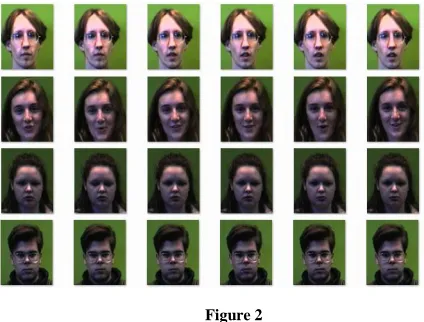
The experiments were performed on face database: Created by Dr Libor Spacek this database has 1000 images (each with 180 pixels by 200 pixels), corresponding to 100 persons in 10 poses each, including both males and females.
All the images are taken against a dark or bright homogeneous background, little variation of illumination, different facial expressions and details. The subjects sit at fixed distance from the camera and are asked to speak, whilst a sequence of images is taken. The speech is used to introduce facial expression variation.
[image:3.612.327.539.163.324.2]The images were taken in a single session. The six poses of Face database are shown in Figure 2.
Figure 2
6.3 YCbCr based BTC Algorithm
Step 1: Train images are read into vector and RGB colour space is converted to YCbCr colour space.
Step 2: Implementation of BTC levels-Level 1, Level 2, Level 3 and Level 4 is done to the train images.
Step 3: Implementation of BTC Levels is done for the test image.
Step 4: For each image in train mean square error is determined with respect to test image.
Step 5: The image in train with least mean square error is the recognized image with respect to the test image.
VII. RESULTS AND DISCUSSION
False Acceptance Rate (FAR) and Genuine Acceptance Rate (GAR) are standard performance evaluation parameters of face recognition system.
The False acceptance rate (FAR) is the measure of the likelihood that the biometric security system will incorrectly accept an access attempt by an unauthorized user. A system’s FAR typically is stated as the ratio of the number of false acceptances divided by the number of identification attempts.
FAR = (False Claims Accepted/Total Claims) X 100
The Genuine Acceptance Rate (GAR) is evaluated by subtracting the FAR values from 100.
GAR=100-FAR (percentage)
International Journal of Emerging Technology and Advanced Engineering
Website: www.ijetae.com (ISSN 2250-2459,ISO 9001:2008 Certified Journal, Volume 3, Issue 9, September 2013)
269 At the end the average FAR and GAR of all queries in respective face data bases are considered for performance ranking of BTC levels based face recognition techniques.
7.1 Face Database [15]
In all, 99 queries are tested on the Libor database of 100 images for analyzing the performance of proposed algorithms. The feature vectors of each image or all four BTC levels were calculated and then compared with the database. FAR for the algorithm was obtained to be zero. A graph of the efficiency of the program is shown below
.
The graph gives the efficiency values of the different BTC levels for Face data base. Here it is observed that with each successive level of BTC the efficiency values go on increasing. Thus it is observed that the BTC-level 4 gives us the best performance for RGB colour space.
It is also observed that the efficiency for YCbCr colour space is more compared to that of RGB colour space. 100% efficiency is obtained for Level 2, 3, 4 when applied to YCbCr colour space.
VIII. CONCLUSION
The three primary aspects on which face recognition depends are cost, accuracy of the algorithm and execution time of the program.
As the level increases in BTC the GAR increases. The highest GAR is obtained for level 4 implementation of BTC for RGB colour space.
YCbCr colour space gives an improved result with highest GAR for BTC Level 2, 3, 4. This can be attributed to the relatively larger size of the feature vector at this level. The proposed technique can be implemented in real world
scenarios choosing the appropriate BTC level
implementation.
REFERENCES
[1] H.B.Kekre, Sudeep D. Thepade, Sanchit Khandelwal, Karan Dhamejani, Adnan Azmi, ―Face Recognition using Multilevel Block Truncation Coding‖ International Journal of Computer Applications (IJCA) December 2011 Edition.
[2] Xiujuan Li, Jie Ma and Shutao Li 2007. A novel faces recognition method based on Principal Component Analysis and Kernel Partial Least. IEEE International Conference on Robotics and Biometrics, 2007 ROBIO 2007
[3] Shermin J ―Illumination invariant face recognition using Discrete Cosine Transform and Principal Component Analysis‖ 2011 International Conference on Emerging Trends in Electrical and Computer Technology (ICETECT).
[4] Zhao Lihong , Guo Zikui ―Face Recognition Method Based on Adaptively Weighted Block-Two Dimensional Principal Component Analysis‖; 2011 Third International Conference on Computational Intelligence, Communication Systems and Networks (CICSyN) [5] Gomathi, E, Baskaran, K. ―Recognition of Faces Using Improved
Principal Component Analysis‖; 2010 Second International Conference on Machine Learning and Computing (ICMLC) [6] Haitao Zhao, Pong Chi Yuen‖ Incremental Linear Discriminant
Analysis for Face Recognition‖, IEEE Transactions on Systems, Man, and Cybernetics, Part B: Cybernetics
[7] Tae-Kyun Kim; Kittler, J. ―Locally linear discriminant analysis for multimodally distributed classes for face recognition with a single model image‖ IEEE Transactions on Pattern Analysis and Machine Intelligence, March 2005
[8] James, E.A.K., Annadurai, S. ―Implementation of incremental linear discriminant analysis using singular value decomposition for face recognition‖. First International Conference on Advanced Computing, 2009. ICAC 2009
[9] Zhao Lihong, Wang Ye, Teng Hongfeng; ―Face recognition based on independent component analysis‖, 2011 Chinese Control and Decision Conference (CCDC)
[10] Yunxia Li, Changyuan Fan; ―Face Recognition by Non negative Independent Component Analysis‖ Fifth International Conference on Natural Computation, 2009. ICNC'09’.
[11] Yanchuan Huang, Mingchu Li, Chuang Lin and Linlin Tian. ―Gabor Based Kernel Independent Component Analysis on Intelligent Information Hiding and Multimedia Signal Processing (IIH-MSP). [12] H.B.Kekre, Sudeep D. Thepade, Varun Lodha, Pooja Luthra, Ajoy
Joseph, Chitrangada Nemani ―Augmentation of Block Truncation Coding based Image Retrieval by using Even and Odd Images with Sundry Colour Space‖ Int. Journal on Computer Science and Engg. Vol 02, No. 08, 2010, 2535-2544
International Journal of Emerging Technology and Advanced Engineering
Website: www.ijetae.com (ISSN 2250-2459,ISO 9001:2008 Certified Journal, Volume 3, Issue 9, September 2013)
270
[14] H.B.Kekre, Sudeep D. Thepade, ―Boosting Block Truncation Coding using Kekre’s LUV Colour Space for Image Retrieval‖, WASET International Journal of Electrical, Computer and System Engineering (IJECSE), Volume 2, Number 3, pp. 172-180, Summer 2008.
[15] H.B.Kekre, Sudeep D. Thepade, ―Image Retrieval using Augmented Block Truncation Coding Techniques‖, ACM International Conference on Advances in Computing, Communication and Control (ICAC3-2009), pp. 384-390, 23-24 Jan 2009, Fr. Conceicao Rodrigous College of Engg., Mumbai.
[16] Developed by Dr. Libor Spacek. Available Online at: http://cswww.essex.ac.uk/mv/otherprojects.html
[17] Mark D. Fairchild, ―Colour Appearance Models‖, 2nd Edition, WileyIS&T, Chichester, UK, 2005. ISBN 0-470-01216-1