M a n c h e s t e r
Gi b b o n s , AR, H o w a r t h , M a n d Lyt h g o e , A
T i t l e
S o ci al p r e s c r i bi n g in G r e a t e r M a n c h e s t e r
A u t h o r s
Gi b b o n s , AR, H o w a r t h , M a n d Lyt h g o e , A
Typ e
M o n o g r a p h
U RL
T hi s v e r si o n is a v ail a bl e a t :
h t t p :// u sir. s alfo r d . a c . u k /i d/ e p ri n t/ 5 2 9 6 8 /
P u b l i s h e d D a t e
2 0 1 9
U S IR is a d i gi t al c oll e c ti o n of t h e r e s e a r c h o u t p u t of t h e U n iv e r si ty of S alfo r d .
W h e r e c o p y ri g h t p e r m i t s , f ull t e x t m a t e r i al h el d i n t h e r e p o si t o r y is m a d e
f r e ely a v ail a bl e o nli n e a n d c a n b e r e a d , d o w nl o a d e d a n d c o pi e d fo r n o
n-c o m m e r n-ci al p r iv a t e s t u d y o r r e s e a r n-c h p u r p o s e s . Pl e a s e n-c h e n-c k t h e m a n u s n-c ri p t
fo r a n y f u r t h e r c o p y ri g h t r e s t r i c ti o n s .
Social Prescribing in
Greater Manchester
Andrea Gibbons, Michelle Howarth, Anne Lythgoe
With support from Kirsty Marshall and Alison Brettle
About the authors
University of Salford – The Sustainable Housing and Urban Studies Unit is a dedicated multi-disciplinary research and consultancy unit of the University of Salford. it draws together researchers from a variety of disciplines across the University. This work has also been supported by the Centre for Applied research in Health, Welfare and Policy (CARe) https://www.salford.ac.uk/research/care/research-groups/shusu https:// www.salford.ac.uk/research/care
Salford CVS – Salford CVS is the city-wide infrastructure organisation for the voluntary, community and social enterprise sector; providing specialist information, advice, development support and opportunities for influence and collaboration. For further information see https://www.salfordcvs.co.uk/
Start is an arts & wellbeing charity which was established twenty five years ago and delivers a range of asset-based holistic mental health services. These services provide emotional wellbeing, recovery interventions and training opportunities through creative arts-based and horticultural activities to vulnerable individuals. For further information, see https://www.startinspiringminds.org.uk/.
Greater Manchester Devolution VCSE Reference Group – The Reference Group seeks to promote the role and involvement of the VCSE sector and communities in devolution. It comprises individuals from 22 voluntary, community, faith, and social enterprise organisations from across Greater Manchester. For more information, see https://www.vsnw.org.uk/our-work/devolution/gm-vcse-devolution-referencegroup/.
Dr Michelle Howarth is a Senior Lecturer in nursing with a specialist interest in social prescribing and the use of nature based approaches to promote health and wellbeing. Michelle is a member of the BLF Social Prescribing Advisory Group and the National Nurses Specialist Social Prescribing Specialist Interest group lead.
Dr Andrea Gibbons is an Urban Planner and Geographer with the Sustainable Housing and Urban Studies Unit (SHUSU) at the University of Salford. She researches social movement, housing, health and homelessness, and is the author of City of Segregation: 100 Years of Struggle for Just Housing in Los Angeles.
Preface
In early 2018 the Greater Manchester Devolution Voluntary, Community and Social Enterprise
Reference Group (The Reference Group) decided to commission from within its membership a
piece of research to map what was happening across Greater Manchester (GM) in terms of social
prescribing.
Reference Group members were keen to find out more about what was going on in GM because
we wanted to make the case for VCSE-led schemes, based on emerging national evidence of the
value of such approaches. The GM Health and Social Care Partnership, with whom the Reference
Group has an MoU (Memorandum of Understanding), also wanted to get a clearer picture of what
types of schemes were in operation already across the 10 local authority areas.
As a member of the Reference Group, with prompting from Bernadette Conlon, Chief Executive
of Start and a fellow Reference Group member, I agreed that Salford CVS would submit a proposal
to undertake this work. My first port of call in marshalling support for the task was my Salford
CVS colleague Anne Lythgoe, who agreed to undertake some of the work. We then approached
Dr Michelle Howarth from the University of Salford, a leading proponent of the benefits of social
‘prescribing’, to help us with the research.
This report reflects the partnership work undertaken by Salford CVS and the University of Salford
to map social prescribing in Greater Manchester during the spring / summer of 2018.
I would urge you to read the whole report, which provides useful information on social prescribing
in Greater Manchester, in the context of a review of national evidence. There is also a summary
version available. The report ends with some key recommendations for those working in localities
and for Greater Manchester as a whole.
Our challenge now is to get the recommendations adopted!
To conclude, I’d like to thank the following people for their contributions and support:
Anne Lythgoe (Salford CVS), Dr Michelle Howarth and Dr Andrea Gibbons (University of
Salford), Bernadette Conlon (Start inspiring minds), fellow members of the GM Devolution VCSE
Reference Group, and colleagues from GM Health and Social Care Partnership.
Alison Page
Social Prescribing in Greater Manchester
“I welcome this excellent report from Salford CVS and the University of Salford. It’s in- depth review
of the extent and varieties of social prescribing across Greater Manchester add significantly to our
understanding of where we are now, identifying the many strengths we can build on as well as the
challenges we must overcome together. Combining this Greater Manchester work with a study
of some of the best examples of social prescribing from around the country has helped reach the
clear shared vision for Greater Manchester set out in the report: to support a GM holistic social
prescribing approach devolved within each locality.”
Giles Wilmore
Contents
1. The Brief
6
2. Context
8
2.1 Social Prescribing: A growing movement across the UK
9
3. Methodology
10
3.1 Survey and deep dive
10
3.2 Systematic scoping review of the literature
10
3.3 GM plenary and international Social Prescribing conference
11
4. Existing Models
12
4.1 An Exploration of specific models around the UK
12
4.2 The five models compared
17
4.3 Sense checking the research
22
4.4 Best practices for link workers
24
4.5 Mapping Greater Manchester
25
5. Findings
28
5.1 Understanding Social Prescribing
28
5.2 A diversity of activities
30
5.3 A wealth of partnerships, and the need for communication
31
5.4 The importance of funding
31
5.5 Measuring outcomes
33
5.6 Mapping of Social Prescribing through a Salford ‘Deep Dive’
35
6. Conclusions and Recommendations
40
6.1 Enablers
41
6.2 Challenges
41
6.3 Towards a vision: a holistic approach
42
Works Cited
44
Appendix A: Systematic Reviews of Social Prescribing
47
Appendix B: Survey Questions
55
Appendix C: Poster Presentation
58
Social Prescribing in Greater Manchester
Tables
Table 1. The five models compared ...18
Table 2. Academic Studies: Newcastle Social Prescribing Project and Wellspring Healthy Living Centre ...22
Table 3. What social prescribing activities is your organisation involved in? ... 27
Table 4. Which model do you identify with? ...29
Table 5. What are the most common reasons for referral? ...30
Table 6. What types of support are included in the service? ...30
Table 7. Is your social prescribing activity commissioned? ...31
Table 8. How else is your service funded? ...32
Table 9. Does funding follow or support the individual? ...32
Figures
Figure 1. West and Wakefield Logic Model (Esmond, Fay, Haining, & Thackray, 2017) ...13Figure 2. Brochure (Health Connections Mendip, 2016) ...14
Figure 3. All Together Better’s Health Champion Approach (Davies, 2009) ...15
Figure 4. Bromley By Bow’s Social Prescribing Referral Model (Bromley By Bow Centre, n.d.) ..16
Figure 5. Rotherham Social Prescribing Model ...17
Figure 6. Survey Results Mapped Across GM ...26
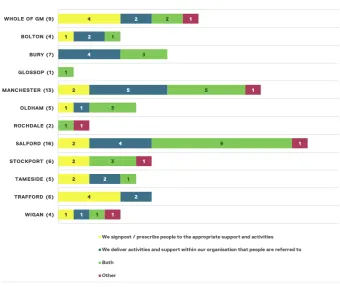
Figure 7. The benefits of Social Prescribing (University of Westminster, 2016) ...33
Figure 8. Draft common outcomes framework from NHS England ...34
Figure 9. Mapping of Salford results ...36
Figure 10. Starting model of Social Prescribing, updated to show further prescription ... 37
Figure 11. ‘Stepping up’ and ‘Stepping down’ through the referral process ... 37
Figure 12. The Social Prescribing ‘ecosystem’ ...38
Figure 13. Referrals into the VCSE ...38
Figure 14. Public health triangle ...39
1. The Brief
In February 2018, the Greater Manchester Devolution VCSE Reference Group (The Reference Group) decided to commission from amongst its membership a review of social prescribing in Greater Manchester. Alison Page, Chief Executive of Salford CVS and Bernadette Conlon, Chief Executive of Start, as members of The Reference Group, agreed that Salford were well placed to do this work and so Bernadette became the ‘sponsor’ of the work and Alison and Salford CVS were commissioned to lead on it. Salford CVS subsequently met with the University of Salford’s Dr Michelle Howarth, who agreed to work in partnership with Salford CVS to deliver against the agreed brief.
The main task of the research was to carry out a mapping exercise of the existing patterns and nature of social prescribing across Greater Manchester (GM). The particular focus was to establish what was happening across the GM Voluntary, Community and Social
Enterprise (VCSE) sector in relation to social prescribing. The VCSE sector is defined as ‘voluntary organisations, community groups, the community work of faith groups, and those social enterprises where there is a wider accountability to the public via a board of trustees or a membership and all profits will be reinvested in
their social purpose’ and as such, includes a diverse
population.
The perception of both the Reference Group and GM Health & Social Care Partnership was that there was a range of formal and ad hoc arrangements for social prescribing across GM’s ten districts. Each locality seemed to be different in terms of the approach(es) it used, nor did there seem to be a single overall map of the VCSE market into which people were being (or could in future be) referred into.
It was also thought to be useful to better understand the efficiency and effectiveness of existing social prescribing models, both in terms of their outcomes for people as well as operational and process impacts. This research could thus identify models of good practice for sharing across GM, as well as highlighting learning from social prescribing which hasn’t been as successful.
Working in partnership, the University of Salford and Salford CVS have undertaken a review of existing research, a survey of social prescribing activity across GM and a deep dive involving interviews and qualitative investigation in one locality (Salford). The research aimed to provide the following:
ȫ
ȫ An overview of the current picture across GM
ȫ
ȫ A description of documented good practice (VCSE sector
and beyond both in GM and across the country)
ȫ
ȫ A description of models of social prescribing in use in GM,
Social Prescribing in Greater Manchester 3
ȫ
ȫ A description of the VCSE provision and capacity across GM
to receive social prescribing
ȫ
ȫ Analysis covering what an exemplar offer might look like and
what might prevent GM achieving this at the moment
ȫ
ȫ Recommendations as to the options now available for GM on
how best to support social prescribing through a developing partnership with the public and VCSE sectors
Taking Charge of our Health and Social Care in Greater
Manchester (Greater Manchester Health and Social
Care Partnership, 2015) set out the view that it is vital to change the relationship between people and public services to better enable people to prevent and/ or manage long-term health conditions, maintain their independence longer, and improve their health and well-being. This builds on the work undertaken by NESTA and The Health Foundation for NHS England to support the NHS Five Year Forward View vision to develop a new relationship with people and communities that can both support people to live happier and healthier lives while also reducing demand on services (NESTA & The Health Foundation, 2016). This view also dovetails with the growing salutogenic as opposed to pathogenic philosophy enshrined within the social prescribing movement. This also reflects the Greater Manchester Population Health Plan, which clearly articulates its view of the VCSE sector role going forward and provides examples gleaned from the ‘Taking Charge Together’ consultation. It clearly references how investing via the VCSE sector can produce social and added value and deliver wider benefits to the community.
Patients, peers and communities represent a huge resource. Whether in terms of effective behaviour change at scale, high-quality volunteering, informal networks of care, impactful models of VCSE Sector practice or growing social enterprises, there is significant opportunity within Greater Manchester to support people living with long-term conditions, prevent ill health and reduce costs (Greater Manchester Health and Social Care Partnership, 2017, p.20).
In 2017, the GM VCSE sector and the Greater
Manchester Health and Social Care Partnership agreed a Memorandum of Understanding (MOU). This document transforms the relationships between local VCSE
organisations and health and social care devolution to the benefit of all groups involved with health, social care and wellbeing. The mapping and evidence presented in this report supports the implementation of the commitments within the MOU to collaborate towards the following shared outcomes over the next five years:
A step change in the understanding and involvement of people and communities in the transformation of health and social care
ȫ
ȫ Better services and greater support for the public
ȫ
ȫ The development of Local Care Organisations with highly
bespoke local place-based characteristics
ȫ
ȫ Increased mutual learning and continuous professional
development
ȫ
ȫ Increased leverage of the talent, capacity and social value
of VCSE organisations above and beyond whatever is commissioned from it
ȫ
ȫ Effective development of VCSE activity.
The MOU embodies certain common values and ways of working within the sector – including a spirit of inclusion and collaboration. Many VCSE organisations from across GM have now signed up to the MOU, which was a national first driven by devolution.
Data and intelligence such as that reported here will be key in the development of a thriving and sustainable VCSE sector. Social prescribing is a key component of GM Person and Community-Centred Approaches, and the VCSE sector has a huge part to play in embedding effective social prescribing arrangements into the GM health and social care system.
This piece of work has been driven by the VCSE sector to inform the development of locality and neighbourhood activities across GM. The goal has been to promote self-care, provide community-based support, and really get to grips with the prevention agenda across GM. Ultimately, this will also have a financial and operational benefit for the clinical system, with GP visits avoided, fewer A&E admissions and reduced prescribing costs.
2. Context
The dramatic rise in the use of various forms of social prescribing lies at the intersection of several forces: the increased understanding of wider social and environmental determinants of health as highlighted in the Marmot Report (2012); a move towards providing more holistic person-centred care to promote wellbeing rather than focusing simply around interventions to heal sickness; and an increasing understanding of the potential of non-medical solutions to help reduce the pressures on GPs and costs to the NHS (Kimberlee, 2015; Marmot & Bell, 2012; NESTA & The Health Foundation, 2016; Polley, Bertotti, Kimberlee, Pilkington, & Refsum, 2017). Within the wide range of existing academic literature, evaluations, reports and working papers that have been developed across the country, one of these strands will often be made central, although all three will be present to different degrees. It is this confluence of much broader shifts in thinking about health and priorities emerging from national government, however, that perhaps explains how similar approaches have arisen almost independently in different parts of the country, tailored to regional differences and local health priorities, and employing very different terminologies to describe a multitude of variations of what could be described as social prescribing.
Thus there exist a number of different definitions of just what social prescribing is, most simply ‘a process whereby primary care patients are linked or referred to nonmedical sources of support in the community and
voluntary sector’ (Pilkington, Loef, & Polley, 2017). The
first Social Prescribing Network conference in 2016
worked to construct a more detailed definition that ensures the process is built in:
A means of enabling GPs and other frontline healthcare professionals to refer patients to a link worker – to provide them with a face to face conversation during which they can learn about the possibilities and design their own personalised solutions, ie ‘co-produce’ their ‘social prescription’ so that people with social, emotional or practical needs are empowered to find solutions which will improve their health and wellbeing, often using services provided by the voluntary, community and social enterprise sector (University of Westminster, 2017).
This clearly excludes certain kinds of signposting and care navigation often described as social prescribing, such as the West and Wakefield model ( Jones, 2014). A broader version of this comes from the Social Prescribing in Bristol Working Group:
Social prescribing provides a pathway to refer clients to non-clinical services, linking clients to support from within the community to promote their wellbeing, to encourage social inclusion, to promote self-care where appropriate and to build resilience within the community and for the individual (Social Prescribing in Bristol Working Group, 2012).
Social Prescribing in Greater Manchester 5
practice very deeply rooted in place, whose development of social prescribing emerged from their ‘fundamental belief […] that local people have the inherent capability to transform their lives and enable the community to
be renewed’ (Bromley By Bow Centre, 2015, p. 3). This
had led to a very expansive understanding of their role as a GP practice both within in the community, and in supporting the psychosocial wellbeing of their patients not often found elsewhere (Brandling & House, 2009).
While this expansive understanding has not necessarily been taken up more widely, social prescribing has been adopted across the country in the period since Bromley By Bow held their first workshop to explore its potential in 2002 (Brandling & House, 2009). Sixteen years later, it is now being promoted across the NHS, with multiple projects and studies taking place across the country within very different contexts. There now exists a wealth of evidence documenting both process and outcomes, which within the past few years have themselves generated a number of systematic and scoping reviews of work already conducted around social prescribing in general, as well as focused explorations of work being done in relation to particular activities (ie arts therapies or horticultural therapy) or particular conditions (ie dementia, mental health and long-term conditions). Rather than replicate this work, this report focuses on bringing together the key findings around models and best practices from among these wider reviews drawing out the relevant findings from work being done on the key interventions that primary care and link workers would be referring individuals to.
There are a number of difficulties in undertaking a review of the social prescribing literature, even one focused on a review of reviews. Principle among these is the continued problem of social prescribing’s multiple definitions, multiple models, and the multiplicity of situations in which a primary care provider might decide that a social—rather than, or in addition to—a medical intervention would be useful as well as a wide range of possible activities that could also be subject to prescription. Some social prescriptions have been captured under the terminology of daily activities or
health promotion, the person making the links between
service users and social activities which are described
as link worker, health connecter, health champion etc.
Kimberlee (2015) describes not just this complexity, but also the many differences in the scope of the service provided, with models ranging from the most basic of signposting, to what he terms light, medium and holistic support provision in accessing community services. Many of the referral systems developed around particular interventions have also be referred to as models interchangeably with how the link is made. Thus, as Chatterjee et al. (2017) describe, Arts on
Prescription; Books on Prescription or Bibliotherapy;
Education on Prescription; and Exercise Referral/
Exercise on Prescription; Green Gyms and other Healthy
Living Initiatives; and Time Banks all involve their own
complexity.
2.1 Social Prescribing: A growing
movement across the UK
2.1.1 National Guidance and Standards This is a pivotal time for social prescribing across the country – within two years of the founding of the Social Prescribing Network (2016) and in the midst of efforts to consolidate definitions and explore more broadly used outcome measures and models, there has been a proliferation of social prescribing models, services and interventions. These are often predicated in the variation that the population and community needs. NHSE refer to 3 distinct models which include:
1 Referral to a commissioned ‘one-stop connector service’,
2 The involvement of ‘Collaborative Practices: GP surgeries as
community ‘hubs’, invite citizens in to work collaboratively, as ‘health champions’, ‘In-house ‘community link workers/
navigators’ – employed by GP Practices and,
3 ‘Active Signposting: ‘Care Navigators’ in GP practices,
having different conversations with patients, signposting them to community support, as well as pharmacy, physiotherapists and care providers.
The range of interventions provided as a result is also reflected in the titles proffered to describe social prescribing – for example, community referral or
non-medical prescribing. The models and associated
terms have some common elements which include the
referrers, the connecters or links and the intervention
or service provided. The recent NHSE interest in
3. Methodology
This study is comprised of three sections – a survey to map existing social prescribing activity across Greater Manchester, a systematic desk-based mapping of best practices in social prescribing across the UK, and a ‘deep
dive’ involving a more extensive survey and interviews
with key personnel in Salford.
3.1 Survey and deep dive
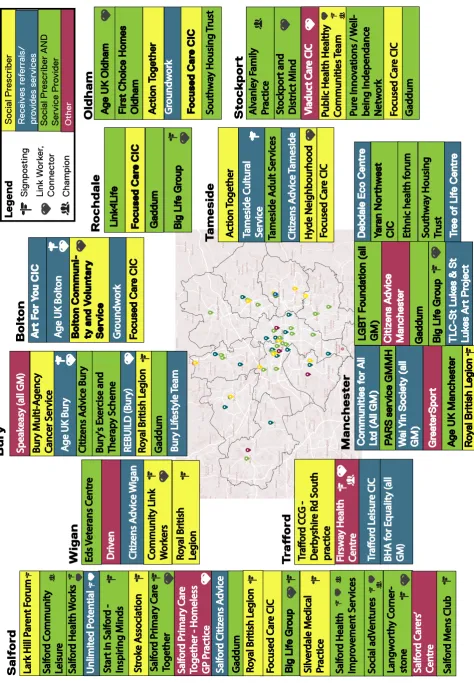
The survey was co-produced with Salford CVS. The sampling strategy used a stratified purposive sample, with a sampling framework developed in cooperation with Salford CVS and members of local CCGs. This enabled the research team to ensure that the sample was as representative as possible- reaching out across all ten GM districts through relevant personal. The survey was developed using Bristol Online Survey, and links were cascaded through a wide variety of CCG and VCSE sector contacts in April of 2018, with follow up efforts made to ensure that the survey was distributed to a representative sample of organisations that provide social prescribing across the ten GM districts.
Key stakeholders in Salford were identified both through the initial discussions in developing the sampling
framework, and through survey responses and ongoing discussions with the project team. Interviews were conducted with key stakeholders in May, 2018.
3.2 Systematic scoping review of the
literature
An initial scoping review identified a large number of existing systematic reviews of social prescribing practices within the UK undertaken within the past two years, and it was therefore determined that an additional full systematic review would be an unnecessary replication. A modified review was therefore undertaken to identify and examine existing systematic and scoping reviews in order to consolidate an understanding of the state of the field and emerging consensus around definitions, best practices and outcomes. Thus, this review follows a simplified version of the framework described by Arksey and O’Malley (2005). The research question was:
What are the current systematic or scoping reviews of the literature around social prescribing that exist nationally, and is there any emerging consensus around definitions, typologies or best practices?
Social Prescribing in Greater Manchester 7
In speaking with practitioners, we were also able to identify five key models that are felt by those in practice to broadly represent the different models currently being promoted as best practice. It is curious that only one of these was included within the 13 projects identified through the academic literature. This report therefore looks at both sets of evaluations to draw out a wider overall picture of emerging best practices.
3.3 GM plenary and international Social
Prescribing conference
There was an opportunity to present this research on two separate occasions to different groups (with some overlap between the two), initially to sound out some of the key findings, and latterly, to test out the emergent findings. The first was in a plenary on 24th May for people interested in social prescribing across GM. Thirty-nine people attended, among them those who identified as social prescribers and service providers, others as a mixture of both along with a range of other management or academic roles. The plenary ran from 9:00 to 15:00, with presentations in the morning and discussion in the afternoon. Presentations included:
ȫ
ȫ Andrea Gibbons, Researcher from the University of Salford:
Social Prescribing in GM Mapping Project: Initial results
ȫ
ȫ Siân Brand, Consultant & Programme Manager, Co-Chair
of East of England Social Prescribing Network: Connect
Well: The Social Prescribing Model of Mid Essex & the Royal Borough of Kingston
ȫ
ȫ Giles Wilmore, Associate Lead for People & Communities
within the Greater Manchester Health & Social Care
Partnership: Person and Community Centred Approaches
The results of a very rich set of discussions within small groups that followed and built on the presentations will be integrated into the body of results.
The second presentation of results took place across the 13th and 14th of June. The first day consisted of a networking lunch scheduled before the first International Social Prescribing Conference hosted at the University of Salford. Twenty-seven people attended: eight
academics, two providers and prescribers, two providers, two commissioners and seven others in a variety of other roles. Again, the rich discussion that took place in the small groups will be further explored through the discussion of results.
4. Existing Models
4.1 An Exploration of specific models
around the UK
The multitude of studies now existing on social prescribing broadly agree: 1) that it is an area that is quickly expanding; 2) that the term remains differently defined and covers a diverse array of models,
interventions and outcomes both from area to area and from project to project; and 3) that it is widely felt to be beneficial both by those being prescribed to the VCSE sector as well as by those doing the prescribing and the NHS more generally (though not everyone agrees that there is enough evidence of this). To ground this diversity in actual practice, five case studies felt by the study team to represent the spectrum of available models are presented below. The models range from basic sign-posting (West and Wakefield) to holistic support (Bromley By Bow):
ȫ
ȫ West and Wakefield – Training of receptionists, Apple style
kiosks and direct referral to physio and pharmacy
ȫ
ȫ Health Connections Mendip, Frome – Volunteer community
coordinators supported by 7 Health Connectors
ȫ
ȫ Rotherham Social Prescribing Service – GP referrals to
Voluntary and Community Sector Advisors (VCSAs) based in Voluntary Action Rotherham combined with direct funding for VCSE programmes
ȫ
ȫ AllTogether Better, York & Humber – Health Champions
ȫ
ȫ Bromley By Bow, East London – Social Prescribing in
combination with Health Trainers within a holistic community centre/GP practice(s)
Each model is explained briefly below alongside images they have developed to help describe their process and pathways. The principal details can be found in Figure 1, comparing each against the other.
Social Prescribing in Greater Manchester 9
4.1.1 West and Wakefield
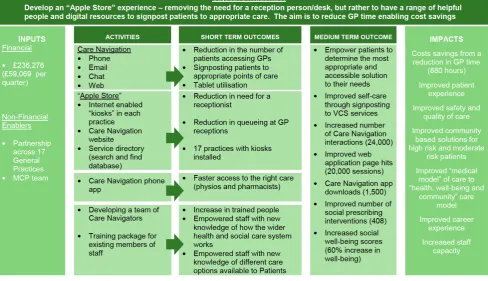
West and Wakefield is one of the few models developed in a top down approach, and the most basic of the models explored in the report. From its inception in 2016, the goal has been ‘To create a multidisciplinary workforce to improve care for patients and relieve pressure on GPs’ (C. Jones, 2016). This is primarily achieved through training receptionists or other existing staff, termed
care navigators, to refer patients directly to physio and
pharmacy services or signpost them to other community or statutory services. It has also included Apple style kiosks for online signposting in GP offices.
Despite the visual complexity of the above logic model, there is little complex in a model that empowers
receptionists to direct patients away from GPs to physio, pharmacy (often newly provided in GP offices, and with extended hours) or offsite community groups. Its day-to-day outcome metrics focus primarily on hours of time saved through GP dashboards, and the results of the initial evaluation seem fairly ambiguous. A survey of 720 patients revealed that only 7% of those surveyed reported accepting signposting as an alternative to the GP, and concerns were raised by both receptionists and patients about lack of privacy and lack of sufficient knowledge for an appropriate signpost in lieu of medical support. The referrals to physio and pharmacy seemed most successful, the number actually following up on a referral to the third sector unclear (Esmond et al., 2017).
4.1.2 Health Connections Mendip, Frome There has been little robust evaluation undertaken of the Health Connections Mendip programme centred in Frome and running since 2015. Other publicity, however, including George Monbiot’s (2018) article in the Guardian, has given it some prominence. It developed out of GP offices funded both by the GPs and the local CCG, recruiting volunteer Community Coordinators to support people to access resources and funding seven Health Connectors to provide one-to-one support for more complex cases. In addition, its goals have been to map existing community resources and compile a resource directory available online, and to form new groups where there appear to be gaps.
[image:16.595.49.538.88.369.2]The programme now extends across all 12 GP practices in the area, has trained 53 volunteer coordinators and runs weekly talking cafes in 5 different villages. They have used both the Patient Activation Measure (PAM) and the Warwick-Edinburgh Mental Well-being scale (WEMWBS) to measure outcomes for those participating, but both have been found difficult to complete. They have emphasised support for the broader development of community networks and flexibility in adjusting service provision to the needs and preferences of local communities as key to their success (Health Connections Mendip, 2016).
4.1.3 AllTogether Better
AllTogether Better is another model that emerged from GP practices in 2008 through a Big Lottery grant, whereby community health champions are identified and trained to provide peer support, referrals to existing programmes and the development of new programmes where there are gaps. They in turn feed back to the GP practice, which is thus able to adapt and improve their offer to their patients. The process as outlined consists of: 1) Recruiting and supporting project leads; 2) Finding and supporting practices; 3) Finding and supporting champions; 4) The practice and champions working together supported by the project lead; 5) Champions developing offers and making them happen; 6) The practice evolving to do things differently. They describe their vision as:
[T]o build the region’s capacity to empower communities to improve their own health and well-being and reduce health inequalities. Our model of empowerment is three pronged: building capacity (awareness, knowledge and awareness); building confidence (self-esteem and social capital); and collectively supporting a systematic change of culture in ¬policy and practices (Davies, 2009).
[image:17.595.57.594.72.446.2]Their view of champions acting as catalysts for broader, more holistic change can be seen in Figure 3.
Social Prescribing in Greater Manchester 11
In this model, the greatest transformation in wellbeing seems to be experienced by the health champion (whose ongoing meaningful engagement also means outcomes are easier to document), but they support improved health outcomes for patients, improved practices among GPs, and better networked communities. They
[image:18.595.63.282.535.756.2]have used, and found useful, the New Economics Foundation’s (NEF) Five Ways to Wellbeing as a tool to measure outcomes (Davies, 2009).
4.1.4 Bromley By Bow, East London
Bromley By Bow is one of the first, and most unique, of the social prescribing models, including a GP practice and community centre that has been working to develop an asset-based community health model over the past 30 years. The service provided by their social prescribing coordinator is only one of an array of support services in addition to Health Trainers and community programming. The model above is designed to provide individuals referred the level of support they need to engage with community programmes and services provided within the Bromley By Bow Centre itself and other local groups.
The website shows the array of issues the Centre offers support in accessing: health and wellbeing; work or training; help and advice; learning new skills; enjoying the Centre’s spaces; activities, sports and groups; starting a new business; making new friends; adult social care
(“Bromley By Bow Centre Website,” n.d.). They trialled
[image:19.595.70.538.106.360.2]the use of SWEMWBS in documenting patient outcomes but found it too unwieldy. Their findings on best practice emphasise adequate time given to communication and building relationships with patients and partners. They advise where possible having link workers actually accompany patients to services and provide additional, holistic provision of services, along with more, longer-term funding to the VCSE sector to provide the services that are being referred into.
Social Prescribing in Greater Manchester 13
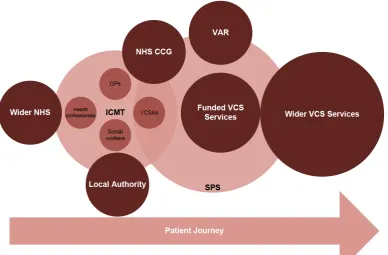
4.1.5 Rotherham Social Prescribing Service The Rotherham model perhaps stands in greatest contrast to the others and of most use to work spearheaded by another VCSE organisation given that it is managed by Voluntary Action Rotherham (VAR). They have been funded by the CCG since 2008 both to provide Voluntary and Community Sector Advisors (VCSAs) based in VAR itself (though they typically carry out a home visit as the first appointment) who receive the initial referral from GPs and then refer on to services, as well as to further distribute a pot of funding to other VCSE organisations to support those services referred to, whether it is existing work or the commissioning of new projects where needed. This model has been more extensively evaluated than most others by Chris Dayson et al. (Dayson & Bashir, 2014; Dayson, Bashir, Bennett, & Sanderson, 2016).
They have used a bespoke well-being measurement tool to look at patient outcomes, and a NEF Cost benefit analysis to look at the cost savings to the NHS. They too emphasise the importance of relationships and clarity about the level of services provided, the importance of patients feeling in control of their care, and the importance of full funding of the VCSE sector.
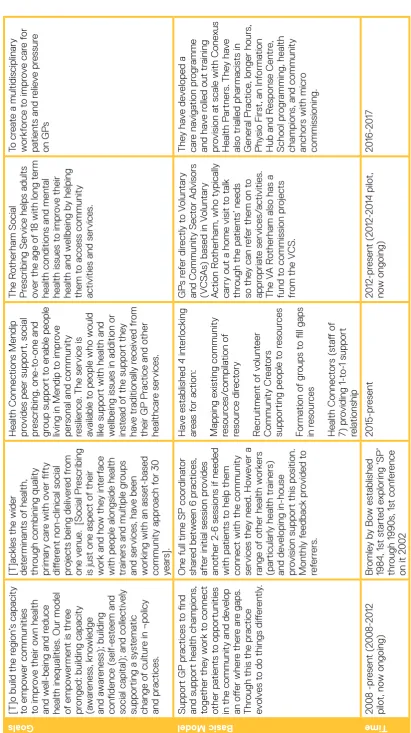
4.2 The five models compared
[image:20.595.104.493.96.351.2]The chart in Table 1 gives a quick snapshot of the five models as they compare in terms of goals, structure, scale and funding, patterns of participation, outcome measures, challenges and enablers.
Table 1
-
The fiv
e models compar
ed
Goals
[T]o build the r
egion ’s capacity to empo w er communities to impr ov
e their o
wn health
and w
ell-being and r
educe
health inequalities
. Our model
of empo
w
ermen
t is thr
ee
pr
onged: building capacity
(a w ar eness , kno wledge and a w ar eness ); building con fidence ( self -est eem and social capit
al); and collec
tiv
ely
supporting a s
yst
ema
tic
change o
f cultur
e in ¬polic
y
and pr
ac
tices
.
[T]ackles the wider determinan
ts o
f health,
thr
ough combining quality
primary car
e with o
ver fifty
diff
er
en
t non-clinical social
pr
ojec
ts being deliv
er ed fr om one v enue . [ Social Pr escribing
is just one aspec
t o
f their
w
ork and ho
w the
y in
terf
ace
with people alongside health trainer
s and multiple gr
oups
and services
, ha
ve been
w
orking with an asse
t-based community appr oach f or 30 year s]. Health Connec tions Mendip pr
ovides peer support,
social pr escribing, one-to-one and gr
oup support t
o enable people
living in Mendip t
o impr
ov
e
per
sonal and community
resilience
. The service is
av
ailable t
o people who w
ould
lik
e support with health and
w
ellbeing issues in addition or
inst
ead o
f the support the
y ha ve tr aditionally r eceiv ed fr om their GP Pr ac
tice and o
ther healthcar e services . The R otherham Social Pr escribing
Service helps adult
s
ov
er the age o
f
18 with long t
erm
health conditions and men
tal
health issues t
o impr
ov
e their
health and w
ellbeing b
y helping
them t
o access community
ac
tivities and services
.
To cr
ea
te a multidisciplinary
w orkf or ce t o impr ov e car e f or pa tien
ts and r
elie ve pr essur e on GP s Basic Model Support GP pr ac tices t o find
and support health champions
, toge ther the y w ork t o connec t other pa tien ts t o opportunities
in the community and de
velop an o ff er wher e ther e ar e gaps . Thr
ough this the pr
ac
tice
ev
olv
es t
o do things diff
er
en
tly
.
One full time
SP coor dina tor shar ed be tw
een 6 pr
ac
tices
,
aft
er initial session pr
ovides
ano
ther 2
-6 sessions if needed
with pa
tien
ts t
o help them
connec
t with the community
services the y need. Ho w ev er a range o f o
ther health w
ork
er
s
(particularly health tr
ainer
s)
and de
veloping in-house
pr
ovision support this position.
Mon thly f eedback pr ovided t o ref er re rs. Ha ve est ablished 4 in terlocking ar eas f or ac tion: Mapping e xisting community resour ces/ compila tion o f resour ce dir ec tory R ecruitmen t o f v olun teer Community Cr ea tor s
supporting people t
o r esour ces Forma tion o f gr oups t
o fill gaps
in r esour ces Health Connec tor s ( st aff o f 7) pr oviding 1- to-1 support rela tionship GP s r ef er dir ec tly t o V olun tary
and Community Sec
tor A dvisor s (V CS As
) based in V
olun tary A ction R otherham, who typically
carry out a home visit t
o t
alk
thr
ough the pa
tien
ts
’ needs
so the
y can r
ef
er them on t
o appr opria te services/ ac tivities . The V A R
otherham also has a
fund t
o commission pr
ojec
ts
fr
om the V
CS . The y ha ve de veloped a car e na viga tion pr ogr amme and ha ve r
olled out tr
aining
pr
ovision a
t scale with
Cone xus Health P artner s. The y ha ve
also trialled pharmacist
s in
Gener
al Pr
ac
tice
, longer hour
s, Ph ysio Fir st, an In forma tion
Hub and R
esponse Cen tr e, School pr ogr amming, health champions
, and community
anchor
s with micr
o commissioning. Time 2008 -pr esen t ( 2008-2012 pilo t, no w ongoing ) Br omle y b y Bo w est ablished 1984, 1st st art ed e xploring ‘SP’ thr ough 1990s , 1st con fer ence
on it 2
Social Prescribing in Greater Manchester 15 Alt oge ther Be tt er: York & Humber Br omle y-B y-Bo w Cen tr e, East L ondon Health Connec tions Mendip : Fr ome R otherham W est & W ak efield
Scale & Funding
2008-2012 phase 1: ov er 1, 100 Health Champions , outr each t o 1,000 citiz ens
, 7 pr
ojec
t ar
eas
acr
oss 3 r
egions w
orking in 30
diff er en t Gener al Pr ac tices .
2013 phase 2: £2.
7 million
fr
om the Big L
ot
tery Fund t
o
con
tinue in the same ar
eas , tw o pr ojec ts ( one hospit al based, the o ther f or y oung people
) added t
o de veloping Pr ac tice Health Champions 2016 : £ 30 ,000 funded b y To w er Hamle ts CCG, 2 017 wider r
oll out o
f SP acr oss TH 2016
: 534 r
ef
err
als acr
oss
the 6 pr
ac
tices in 2
016 , vary consider ably be tw een pr ac tices
. One thir
d triaged
to health tr
ainer s, the r est support ed thr ough signposting
and up t
o 6 sessions with the
SP w ork er . Funded b y
CCG and local
GP
s: 7 part
-time (5 full time
equiv alen t) Health Connec tor s w orking with
all 12 GP
pr
ac
tices in ar
ea, 53 v olun teer coor dina tor s tr ained, w eekly talking ca
fes in 5 villages
2008-2012 Pilo t: 2 4 v olun tary
and community or
ganisa
tions
(V
COs
) -- gr
an
ts with a t
ot
al
value o
f just o
ver £600
,000
.
31 separ
at
e social pr
escribing services . 1, 60 7 pa tien ts r ef err ed: 1,118 w er e r ef err
ed on t
o funded V CS services , 2 00 t o non-funded V CS , o ver 300 r ef err als to st atut ory services 2012 -015
: up t
o 2
7 V
CS
or
ganisa
tions commissioned a
t
an
y one time
, in 2
015
, 17 V
COs deliv er ed 2 0 diff er en t services . £2 36 ,00 de vo ted t o car e na viga
tion but e
xpec
ted
£
4.22M t
o be in
vest
ed in
pr
ogr
amme as a whole thr
ough 2020 . Pat terns o f Participan tion Champions : Fairly e venly spr ead acr oss
all age gr
oups fr
om t
eens t
o
elderly
, and some pr
et een. Majority (75% ) w omen Majority (7 8% ) whit e, but range o f fr om 5 1% t o 98% whit
e in diff
er en t ar eas sho w ed pr ogr amme r eflec ted local div er sity Fairly e venly spr ead acr oss age gr oups , w omen 30-39 the
highest 62% f
emale Mostly Bangladeshi, r acial br eak do wn r oughly ma tches tha t o f ar ea Fairly e venly spr ead acr oss all age gr oups Majority ( 66% ) w omen 2012 -2 015
Majority older (
86% o ver 60 ) Majority ( 62% ) w omen Majority whit e ( 93 % ) No t giv en Outcome Measur ements Ne
w Economics F
ounda tion ’s (NEF ) Fiv e W ays t o W ellbeing, st
atistical analysis o
f champion surv ey da ta t o e xplor e their in
fluences on w
ellbeing Qualit ativ e f eedback embedded in SP pr ocess thr ough anon ymous questionnair es aft er SP sessions
, and thr
ough f ocus gr oups . F eedback also collec ted fr om GP s and
community service pr
ovider
s.
Trialled use o
f
S
WEMWBS
but
found it w
as no
t a use
ful t
ool in
sessions
.
Ha
ve used pa
tien
t f
eedback
forms and tw
o st
andar
dised
measur
es
: P
atien t A ctiv ation Measur e (P
AM) and the
W arwick -Edinbur gh Men tal W
ell-being scale (
WEMWBS
).
These w
er
e difficult t
o
comple
te and f
ew w er e collec ted. For individuals : Bespok e w ell-being measur emen t t ool consisting o f eigh t measur es associa
ted with diff
er en t aspec ts of self -managemen t (F eeling positiv e; L ifestyle ; L ooking a ft er your self
; Managing s
ymp toms ; W ork, v olun
teering and o
ther ac tivities ; Mone y; Wher e y ou liv e; F
amily and friends
).
NEF
cost bene
fit analysis f
or sa
vings
to NHS
and on social impac
t. Look ed a t GP dashboar ds , and br oad NHS da
ta on admissions
,
lengths o
f st
ay and A
Alt oge ther Be tt er: York & Humber Br omle y-B y-Bo w Cen tr e, East L ondon Health Connec tions Mendip : Fr ome R otherham W est & W ak efield Challenges Institutional in visibility: ‘in almost e very case
, this w
ork
w
as in
visible t
o the NHS’
.
Securing ongoing funding Language
, and under
st anding the diff er en t ‘lif e w orlds ’ o f pa tien
ts as opposed t
o the institutional ‘lif e w orlds ’ o f
clinics and service pr
ovider s Best pr ac tice one SPC per pr ac tice
. This model ho
w
ev
er is
much higher in cost and o
ft
en
no
t applicable f
or lo w er funded schemes co vering man y pr ac tices . Oper ating e ff ec tiv ely with existing st affing le
vels is a
challenge ; one SPC acr oss six pr ac tices . Thr ea ts t
o community service
funding ar
e a const
an
t thr
ea
t
to the e
ff ec tiv eness o f the social pr escribing in terv en tion. Language barrier s con tinue to pr esen
t a pr
oblem a
t times
with the v
aried e
thnic mix o
f the pa tien t popula tion. Finding rele van t in terpr et ation r esour ce
at the righ
t time is some
times
still a challenge f
or sensitiv
e
and nuanced con
ver sa tions . Some pa tien ts f ound P AM difficult t
o fill out (t
oo long,
the
y w
er
e upse
t or in crisis e
tc
)
In
volv
ed a leap o
f f aith t o w orking diff er en
tly - ther
e had t
o
be ano
ther dimension t
o mee ting pa tien t needs Significan t v aria
tion in whe
ther and ho w car e na viga tion is implemen
ted in individual
pr ac tices . R ecep tionist s f elt some reluc tance (f eelings o f ‘going abo ve one ’s st ation ’ and
making quasi clinical judgemen
t
of pa
tien
ts
’ health needs
) Incr eased w orkload, no incr eased pa y. Some pa tien ts r esist ed being ask
ed questions b
y the recep tionist. Most pa tien ts didn ’t under st and the y w er e being support
ed in a pr
ocess o
f car
e
na
viga
tion – only
18% said the
y
remember
ed being signpost
ed,
and only 7% said the
y ac
tually
accep
ted the alt
Social Prescribing in Greater Manchester 17 Alt oge ther Be tt er: York & Humber Br omle y-B y-Bo w Cen tr e, East L ondon Health Connec tions Mendip : Fr ome R otherham W est & W ak efield Enablers Clear me thods f or selec ting, ex
cluding and supporting
champions . The v alue o f div er
sity in the
champion gr
oup
.
The need t
o a
void dela
ys and
obstruc
tions when dr
awing on
the passion o
f champions
.
The critical import
ance o f the da y-to-da y w orking r ela tionship be tw
een the champions and
their pr
ac
tice
, service or issue
.
Under
st
anding the deep
challenges f
aced b
y an NHS
tha
t is so str
et
ched and has so
lit
tle r
oom t
o man oeuvr
e tha
t
its capacity t
o inno va te , and ev en t o no
tice when pr
omising
things de
velop
, is so limit
ed.
it t
ak
es time and ongoing
communica tion t o k eep HCP s aw ar e o
f the bene
fit s o f social pr escribing. K
eeping clinicians up t
o da
te
with r
ef
err
als and services help
rein for ce import ance o f SP . Good communica tion a t re ferr al st age be tw een HCP and pa tien
t is k
ey
, need t
o help pa tien ts ( who ar e o ft en distr essed) under st
and a lit
tle
mor
e about the pr
ocess the
y
ar
e being r
ef err ed t o. Face-
to-face support with
boundaried sessions is pr
oving
eff
ec
tiv
e f
or those a
tt
ending
SP
a
t this le
vel. Signposting is gener ally accep ted t o be less e ff ec tiv
e in helping people
engage and a
tt
end services
.
A link w
ork er t o w ork alongside the SPC is r ecommended to : pr
ovide admin support,
accompan
y some pa
tien ts t o services , conduc t outr each, se t
up and run gr
oups . SP r equir es commit ted oper at or
s and r
ef err er s AND commit ted funder s. L onger term, sust
ainable funding is the
only w
ay t
o de
velop
, run and
ev alua te a SP scheme pr operly . Ability t
o be fle
xible in service
pr
ovision – initia
te home visit
s, mo ve T alking Ca fé loca tion or initia te additional Talking ca fes ,
adjust length o
f tr
ainings
,
incr
ease phone pr
ovision f
or
signposting
Social Pr
escribing has a gr
ea
ter
eff
ec
t f
or people who ar
e
able t
o engage fully
, and who
con
tinue t
o engage with the
V
CSE be
yond their initial social
pr
escrip
tion.
Be clear about the out
comes/ tar ge t popula tion & clarity
on the model - is it
SPS ‘lit e’ or in tensiv e/ signposting or pr escrip tion. K
eep the model and r
ef
err
al
mechanisms simple - single gat
ewa
y.
K
eep it local - kno
wledge and
expertise out ther
e fr
om local
V
C
S.
The perils and bene
fit
s o
f scaling
up. Role o
f link w
ork er s/ advisor s - link ed t o pr ac tices/ localities part o
f MD
T
t
eam - build the
rela
tionships and combine
expertise
.
Import
ance o
f pa
tien
t/
user t
o
be in char
ge
/ ha
ve r
esponsibility
for their car
e – k
eep simple
.
R
esour
ce the sec
tor t o deliv er the solutions . E
vidence base - wha
t t
ar
ge
t
needs ar
e and wha
t w orks . 3 R’ s: R ela tionships , R esear ch, R esour ces . S ta ff cit
e the wide r
ange
of op
tions as a k
ey part o
f
the success
, with Pharmac
y
Fir
st and Ph
ysio Fir
st making
a big impac
t, t oge ther with dir ec
t signposting t
o social
pr
escribing op
tions
. Use o
f
the local Ph
ysio Fir st scheme , for e xample , incr eased b y 43 % a ft
er the in
tr oduc tion o f recep tion car e na viga tor s. R ecep tionist s themselv es also
find additional job sa
tisf
ac
tion
in this e
xpanded r
ole
.
Tr
aining with r
egular upda tes essen tial. In forma
tion on services needs
to be compr
ehensiv
e,
simple
and up t
o da
te
.
Time is needed f
or bo th st aff and pa tien ts t o ge
t used t
4.3 Sense checking the research
The challenges and best practices emerging from the seven academic evaluations of models that have developed over the period between 1996 and the present are very similar to those emerging from the analysis above. A summary similar to the chart comparing the five models can be found in Appendix A, though not all evaluations contained the information needed to complete the chart fully. Most evaluations were unable to be supplemented or triangulated through use of a variety of sources, as many of the services evaluated had received limited, short-term funding and no longer existed. As social prescribing is now being rolled out nationwide by NHS England, this highlights the need for ongoing, long-term funding to ensure programmes do not need to be reinvented with great expense of time, energy and money.
Services were found to be more successful the more holistic the provision, the more face-to-face contact provided for the time needed by the patient, and the stronger the relationships between the health worker, the link worker, the VCSE sector and the patient. Primary challenges were:
ȫ
ȫ changing commissioning models,
ȫ
ȫ funding for the VCSE sector and funding for the link worker
position, and
ȫ
ȫ streamlined communication between GP and link worker
(a single data system or point of access to records was recommended by one project).
[image:25.595.56.568.351.679.2]Kimberlee et al’s (2014) evaluation of the Wellspring Healthy Living Centre is particularly useful in thinking about how to best measure outcomes both for patients and for social value, while the work on Newcastle is highly relevant given the model involved siting link workers in anchor VCSE institutions. They are summarised in Table 2 below.
Table 2 - Academic Studies: Newcastle Social Prescribing Project and Wellspring Healthy Living Centre
Pr
ojec
t Goal to develop a single cohesive approach to social
prescribing in Newcastle, 6 GPs participated in pilot working with 5 VCSE organisations with a strategic linkworker, also goal to develop a model to track patient journey and online ‘Health Signpost Directory’.
Approach that offers GP-referred patients 12 weeks of one to one support followed by 12 months of group support around a particular activity.
Basic model
GPs refer to link worker who refers on to five key VCSE organisations.
GP refers to holistic service that provides a key worker, the service is person-centred and non-prescriptive, is based on co-production of path to recovery, uses a range of therapeutic tools, refers to agencies that address the range of social determinants of health, works in partnerships with other agencies when psychological or substance misuse outside the programmers expertise; is based on assets of both the person and the community, and is based on the five ways of wellbeing. Involves both 1 to 1 services and peer group support.
Out
come eaasur
es SWEMWBS and a confidence scale – most did not
fill out. A single recording system set up in excel spreadsheet form and submitted monthly. Also aspired to develop a tool to map the whole patient journey, but not used to full due to funding constraints.
Social Prescribing in Greater Manchester 19
Newcastle Social Prescribing Project Wellspring Healthy Living Centre
Chellenges
Commissioning and purchasing processes were in a state of flux and still dominated by outputs and not outcomes that did not encourage innovative approaches.
The transformational change required to overcome organisational and cultural issues that lead to silo working and a lack of collaboration and integrations.
Difficulties measuring and accounting for the value produced by the project’s approach, making it hard to convince existing sceptics of the value of the model.
Only able to hire one linkworker rather than three as hoped.
It was difficult to collect the data to demonstrate progress across some important outcomes areas.
Referrals from health professionals did not provide any details on the patient’s medical history, the health professional’s view of what could realistically be achieved, or any information on additional support or treatment the patient was receiving.
Referrals from health care professionals did not provide any details on the patient’s willingness to change.
There was no systematic way to inform health professionals of the impact in either a case by case or combined way. Each Linkworker Organisation has its own internal monitoring system and there were varying approaches to client confidentiality in the way that information could be provided to third parties.
There was no single point of access to all records, individual practices were unable to extract data electronically, and there were complex issues around data sharing protocols that were unable to be resolved in the lifetime of the project.
Limited take up by GPs and HCPs despite repeated engagement, 2 of the 6 practices provided vast majority of 124 referrals made, far short of project goal of 200.
Focused on broad rather than specific challenges as in other study challenges:
i growing crisis in GP provision;
ii need for long-term funding of the VCSE sector; and
iii Need for VCSE and patient involvement in shaping
Newcastle Social Prescribing Project Wellspring Healthy Living Centre
Enabl;
er
s Capacity was provided by staff of VCSE organisations
with broadly same role, but it was found that specialist knowledge in behavior change and relevance to health and wellbeing central.
Linkwork Organisations were able to participate in the project with staff funded from other sources.
Linkwork Organisations worked together in a mature and collaborative way to determine the organisation best placed to take a lead support role.
Linkwork Organisations deliver the one to one casework as part of their core delivery in the city so are experienced in providing the service.
For linkworker:
i Receiving appropriate referrals;
ii first contact through home visit; and
iii direct contact between link worker and referrer about
case.
Need for truly holistic approach that provides highly flexible access to the full array of services needed over the full period of time needed.
The usefulness of SROI analysis to show social value and help VCSE sector better understand the value they create.
The current opportunities for local authorities and communities to make a difference in these discussions responding to resource scarcity and crisis in GP provision.
Both challenges and enabling characteristics of
successful programmes will be further explored through the results of the survey.
What both sets of evaluations show, however, is the lack of work looking at the full impact of social prescribing on the VCSE sector, particularly in terms of increased demand on their services which is only tied to increased funding in the Rotherham model. As the Westminster report on social prescribing highlights:
Experience suggests that social prescribing schemes can become popular very quickly. It’s important to ensure that local community services are ready for the likely increase in the take-up of their services. This means ensuring that they are properly supported, resourced and able to meet increasing need. Commissioners should consider the most appropriate way to do this within the local context (University of Westminster, 2017, p. 26).
4.4 Best practices for link workers
The link worker or navigator is the most important ingredient within any social prescribing scheme, and needs to able to successfully and independently work with a very wide range of people, many of whom will be trying to get through very difficult periods in their lives (University of Westminster, 2017). From the many models examined above, a number of best practices can be drawn for the position of link worker, particularly for those models looking to provide more holistic support for the often complex cases presented by those who tend to present most frequently to GP practices. However even for signposting or ‘social prescribing lite’ services, referrals are most effective when carried out via staff who have wide experience in the community and the security of long-term contracts
allowing for the development of extensive community contacts and knowledge. This, and the allocation of time for fully assessing client needs are foundational to improved outcomes. All best practices can ultimately be understood in terms of the relationships that link workers are able to build with the patients, with the GPs and other health workers providing referrals, and with the services that they are referring into. This remains true even for those models where some activities (particularly accompanying people to services and the development of new groups or activities to fill gaps in provision) are provided by other staff members or volunteers, such as health champions or peer support workers.
The first set of relationships are with patients, and the link worker must be skilled in the ways that they are able to ‘engage, empathise, listen, empower and motivate individuals’ (University of Westminster, 2017, p. 38). Key facilitators of link work are:
ȫ
ȫ Quick follow-up from time of referral
ȫ
ȫ Identification of the level of support needed and allocation of
appropriate time, acknowledging that many of those referred will only need one or two conversations for a successful intervention but others will need longer
ȫ
ȫ Face-to-face meetings where the patient feels most
comfortable (ie home, café, VCSE office)
ȫ
ȫ Time and private space made available just for listening to
build rapport, understand what is needed by the patient as well as their individual and distinctive barriers to accessing services, and supporting the patient to feel in control of their own journey
ȫ
ȫ Ability to personally accompany patients to services when