University of Zurich
Zurich Open Repository and Archive
Winterthurerstr. 190 CH-8057 Zurich http://www.zora.uzh.ch
Year: 2011
Network discovery with DCM
Friston, K J; Li, B; Daunizeau, J; Stephan, K E
http://www.zora.uzh.ch
Posted at the Zurich Open Repository and Archive, University of Zurich. http://www.zora.uzh.ch
Originally published at:
Friston, K J; Li, B; Daunizeau, J; Stephan, K E (2011). Network discovery with DCM. NeuroImage, 56(3):1202-1221.
http://www.ncbi.nlm.nih.gov/pubmed/21182971. Postprint available at:
http://www.zora.uzh.ch
Posted at the Zurich Open Repository and Archive, University of Zurich. http://www.zora.uzh.ch
Originally published at:
Friston, K J; Li, B; Daunizeau, J; Stephan, K E (2011). Network discovery with DCM. NeuroImage, 56(3):1202-1221.
Abstract
This paper is about inferring or discovering the functional architecture of distributed systems using Dynamic Causal Modelling (DCM). We describe a scheme that recovers the (dynamic) Bayesian dependency graph (connections in a network) using observed network activity. This network discovery uses Bayesian model selection to identify the sparsity structure (absence of edges or connections) in a graph that best explains observed time-series. The implicit adjacency matrix specifies the form of the network (e.g., cyclic or acyclic) and its graph-theoretical attributes (e.g., degree distribution). The scheme is illustrated using functional magnetic resonance imaging (fMRI) time series to discover functional brain networks. Crucially, it can be applied to experimentally evoked responses (activation studies) or endogenous activity in task-free (resting state) fMRI studies. Unlike conventional approaches to network discovery, DCM permits the analysis of directed and cyclic graphs. Furthermore, it eschews (implausible) Markovian assumptions about the serial independence of random fluctuations. The scheme furnishes a network description of distributed activity in the brain that is optimal in the sense of having the greatest conditional probability, relative to other networks. The networks are characterised in terms of their connectivity or adjacency matrices and conditional distributions over the directed (and
reciprocal) effective connectivity between connected nodes or regions. We envisage that this approach will provide a useful complement to current analyses of functional connectivity for both activation and resting-state studies.
Network discovery with DCM
Karl J. Friston†, Baojuan Li†*, Jean Daunizeau†‡ and Klaas E. Stephan†‡
The Wellcome Trust Centre for Neuroimaging, University College London, Queen Square,
London WC1N 3BG UK†;
Laboratory for Social and Neural Systems Research, Institute of Empirical Research in
Economics, University of Zurich, Switzerland‡;
College of Mechatronic Engineering and Automation. National University of Defense
Technology. Changsha, Hunan, 410073, P. R. China*
Address for Correspondence
Karl Friston
The Wellcome Trust Centre for Neuroimaging, Institute of Neurology, UCL
Queen Square, London, UK WC1N 3BG Tel (44) 207 833 7454
Fax (44) 207 813 1445
Email: k,[email protected]
Keywords: Bayesian; Neuronal; Generalised Filtering; Dynamic Causal Modeling; fMRI; Random differential equations; Stochastic; Resting-state; Connectivity.
ABSTRACT
This paper is about inferring or discovering the functional architecture of distributed systems using Dynamic Causal Modelling (DCM). We describe a scheme that recovers the (dynamic) Bayesian dependency graph (connections in a network) using observed network activity. This network discovery uses Bayesian model selection to identify the sparsity structure (absence of edges or connections) in a graph that best explains observed time-series. The implicit adjacency matrix specifies the form of the network (e.g., cyclic or acyclic) and its graph-theoretical attributes (e.g., degree distribution). The scheme is illustrated using functional magnetic resonance imaging (fMRI) time series to discover functional brain networks. Crucially, it can be applied to experimentally evoked responses (activation studies) or endogenous activity in task-free (resting state) fMRI studies. Unlike conventional approaches to network discovery, DCM permits the analysis of directed and cyclic graphs. Furthermore, it eschews (implausible) Markovian assumptions about the serial independence of random fluctuations. The scheme furnishes a network description of distributed activity in the brain that is optimal in the sense of having the greatest conditional probability, relative to other networks. The networks are characterised in terms of their connectivity or adjacency matrices and conditional distributions over the directed (and reciprocal) effective connectivity between connected nodes or regions. We envisage that this approach will provide a useful complement to current analyses of functional connectivity for both activation and resting-state studies.
INTRODUCTION
Historically, Dynamic Causal Modelling (DCM) has been portrayed as a hypothesis-led approach to understanding distributed neuronal architectures underlying observed brain responses (Friston et al., 2003). Generally, competing hypotheses are framed in terms of
different networks or graphs, and Bayesian model selection is used to quantify the evidence for one network (hypothesis) over another (Penny et al., 2004). However, in recent years, the number of models over which people search (the model-space) has grown enormously; to the extent that DCM is now used to discover the best model over very large model-spaces (e.g., Stephan et al., 2010; Penny et al., 2010). Here, we take this discovery theme one step further and throw away prior knowledge about the experimental causes of observed responses to make DCM entirely data-led. This enables network discovery using observed responses during both activation studies and (task-free) studies of autonomous or endogenous activity during the “resting state”. In what follows, we describe this scheme in terms of the underlying generative model, the construction of model-spaces and how these spaces are searched for the optimum model. In addition to covering the theoretical background to DCM discovery, we illustrate its application to an fMRI (attention to motion) dataset used previously in technical papers. In subsequent work, we will illustrate its application to resting-state fMRI data (Li et al., – in preparation)
This paper comprises four sections. In the first, we describe the form of the DCM used in subsequent sections. This is exactly the same as the conventional DCM for fMRI but includes endogenous fluctuations, which are represented by random differential equations (Li et al. 2010). These equations can be regarded as a [bi]linear approximation to any nonlinear model of neuronal dynamics. In this paper, we take a closer look at what this linear approximation means, when considering endogenous fluctuations that arise from self-organised dynamics (e.g., Suckling et al., 2008; Honey et al, 2009). Having established the basic form of our model, we then turn to model inversion and consider briefly the distinction between deterministic and stochastic schemes. This distinction is important because stochastic or random fluctuations are inevitable, when modelling self-organised dynamics at a macroscopic scale. The second section deals with the construction of model-spaces and how each model within these spaces is evaluated or ‘scored’. The main focus of this section will be on efficient scoring and plausible constraints or priors on models that restrict the search to
sensible subspaces. We consider the difficult problem of scoring very large numbers of models. To finesse this problem we use a proxy for the model evidence based upon the conditional density over the parameters of a fully connected network (the Savage-Dickey density ratio; Dickey 1971). This section borrows several ideas from graph theory and connects them with Bayesian constructs in DCM. The resulting search scheme is used in Monte Carlo simulations to evaluate and validate the accuracy of model selection; i.e., network discovery. The third section applies these procedures to an empirical fMRI time-series, acquired under an attention to motion paradigm. This section illustrates the sorts of results that can be obtained and revisits some key questions about the functional architecture of hierarchies in the brain and the relative expression of top-down and bottom-up influences. We conclude with a brief discussion of the relevance of this scheme for determining neuronal architectures from measured brain responses in general, and its implications for the characterisation of fMRI time-series in particular.
THE GENERATIVE MODEL AND ITS INVERSION
This section describes the causal or generative model for the specific fMRI application considered in this paper. The model is basically the same as the conventional DCM for fMRI; however, we will motivate the assumptions implicit in the usual approximation. This more detailed examination of DCM for fMRI discloses the central importance (and nature) of fluctuations in neurophysiologic states, which have been ignored in classical (deterministic) variants of dynamic causal modelling.
We have introduced several schemes recently that accommodate fluctuations on hidden neuronal and other physiological states (Penny et al., 2005; Daunizeau et al, 2009; Friston et al., 2010; Li et al., 2010). This means that one can estimate hidden states generating observed data, while properly accommodating endogenous or random fluctuations. These become
particularly important when modelling endogenous dynamics, which are itinerant (wandering) and sometimes ergodic (e.g., resting-state fMRI time-series). We will exploit these schemes to search over models that couple fluctuating dynamics in different parts of the brain. We first consider the generative model per se and then turn to its inversion or optimisation. Here, we take the opportunity to consider two alternative approaches to dealing with fluctuations in neuronal activity; the first is based upon Generalised Filtering for stochastic DCM described in Friston et al. (2010) and applied to fMRI in Li et al. (2010). The nature of these generalised schemes speaks to the fact that there is no real difference between hidden states and parameters in DCM; therefore, it should be possible to cast unknown fluctuations in neuronal states as unknown parameters. In fact, this approach was used in the pioneering work of Riera et al. (2004). We will address the implicit exchangeability of states and parameters by comparing stochastic DCM (Daunizeau et al., 2009; Li et al., 2010) with deterministic DCMs that model unknown fluctuations in neuronal states with a mixture of temporal basis functions.
The generative model
DCM for fMRI rests on a generative model that has two components. The first is a neuronal model describing interactions (dependencies) in a distributed network of neuronal populations. The second component maps neuronal activity to observed hemodynamic responses. This component has been described in detail many times previously and rests on a hemodynamic model (subsuming the Balloon model; Buxton et al., 1998; Friston et al 2003; Stephan et al., 2007) and basically corresponds to a generalised (nonlinear) convolution. In this paper, we will focus exclusively on the neuronal model, because the hemodynamic part is exactly the same as described previously (Stephan et al., 2007). Although we will focus on neuronal systems, the following arguments apply to any complex distributed system with
coupled nonlinear dynamics. This means that the procedures described later could (in principle) be applied in different domains.
This material that follows is a bit abstract and could be skipped by the pragmatic reader. It is presented to make four key points: (i) The dynamics of coupled systems can be summarised with a small number of macroscopic variables that describe their behaviour; (ii) the time constants of these macroscopic dynamics are necessarily greater than those of the underlying macroscopic dynamics; (iii) reducing the dynamics to macroscopic variables necessarily induces fast fluctuations in these variables (cf., system noise) even if the system is
deterministic and (iv) these fluctuations are analytic (continuously differentiable). The last
point is crucial because it renders the model non-Markovian and calls for (inversion) schemes that eschew Markovian assumptions (e.g., Generalised Filtering: Friston et al 2010; Li et al., 2011).
Consider the system generating neurophysiologic time-series. This comprises a set of n
regions, vertices or nodes, where each node corresponds to a vast number of neurons in a cortical area, source or spatial mode (pattern). We will first assume that the dynamics of
neuronal states in one node
[ ,
1 2,
]
T evolve according to some unknown and immensely complicated equations of motion:1 1 1 2 2 1 3 ( ) ( , , ) ( , , ) N N f f f
1These two equations represent the same dynamics but the first is expressed in terms of the original neuronal states (e.g., transmembrane voltages and conductances) of every neuron in
the node, while the second equations are expressed in terms of the amplitude of patterns or
modes of the original variables,
U
( )
U
. This alternative description can be regarded as a change of variables
U
U
. We assume that this mappingU
:
is chosen so that it conforms locally to the generalised eigenvectorsU
( )
of the Jacobianf
, with eigenvalues U
U
. The Jacobian describes the stability of flow in state-space; i.e., how quickly flow changes with position. We now appeal (heuristically) to the centre manifold theorem and synergetic treatments of high-dimensional, self-organising systems (Ginzburg and Landau 1950; Carr 1981; Haken 1983); see De Monte et al (2003), Melnik & Roberts 2004 and Davis 2006, for interesting examples and applications. Namely,we make the assumption that the eigenvalues
k
U
k
U
k associated with each modek
U
k
are distributed sparsely;
1
2
3
. That is, one or a small number of them are near zero, whereas the rest are large and negative. This assumption has additional plausibility for neuronal systems, given their tendency to show self-organised criticality and slowing (Stam & de Bruin 2004; Shin & Kim 2006; Suckling et al., 2008; Kitzbichler et al., 2009). Critical slowing means that some modes decay slowly and show protracted correlations over time.Put simply, all this means is that the dynamics of any system comprising many elements can be decomposed into a mixture of (orthogonal) patterns over variables describing its state. By necessity, some of these patterns dissipate more quickly than others. Generally, some patterns decay so slowly that they predominate over others that disappear as soon as they are created.
Mathematically, this means that P (principal) eigenvalues
p
0 :
p
P
are nearly zeroand the associated eigenvectors or modes
U
p( )
are slow and unstable. In this case,:
p Up p P
are known as order parameters. Order parameters are mixtures of states
Other fast (stable) modes
q Uq
:qP have large negative eigenvalues, which means that they decay or dissipate quickly to an invariant attracting set or manifold,h
(
p)
, suchthat
q fq(
p, (h
p))0. In other words, the invariant (centre) manifoldh
(
p)
attractstrajectories and contains the solutions to Equation 1. When there is only one order parameter
or principal mode, this manifold is a line or curve in state-space and
1 could represent the distance along that curve (see Figure 1). The unstable fast modes decay quickly because the eigenvalue is effectively their rate of decay. One can see this easily by taking a first-order Taylor expansion of Equation 1 about the centre manifold:(
, (
))
(
(
))
(
(
))
q q p p q q q q p q q q pf
h
U
U
h
h
2The slow modes (which flow on the centre manifold) are then said to enslave the fast modes (which the centre manifold attracts): this is the “slaving principle” (Ginzburg and Landau 1950; Carr 1981; Haken 1983). The crucial thing here is that the distribution of eigenvalues (rates of dissipation) induces a separation of temporal scales, so that we can approximate Equation 1 with: ( , ( )) ( ( )) p p p p p p p q q p q q f h f h
3Here, we have gathered the influences of the fast modes, on the motion of the slow modes,
into fast fluctuations
p
using a Taylor expansion about the centre manifold. We can do this because the states are generally near the centre manifold. Basically, we have thrown away the fast or stable modes and replaced them with fluctuations on the centre manifold. It shouldbe noted that the transverse fluctuations
q( )
t
about the centre manifold are not necessarilysmall. Large fluctuations can occur fairly generically, if periodic orbits embedded in the centre manifold remain transversely unstable. In this case, the transverse dynamics can be of large amplitude, giving rise to what is known as bubbling (Ashwin et al. 1994; 1996).
An important example of the resulting contractions of state-space dynamics are those subtended by symmetries (or near symmetries) among the dynamics, such as the coupling of nearly identical systems (e.g., cortical macrocolumns). In such a setting, the centre manifold approximates a hyper-diagonal subspace or a smoothly mapped (synchronisation) manifold close by (e.g., Hu et al., 2010): The presence of strong transverse flow towards this manifold and a weakly stable or unstable flow on the manifold is exactly the sort of behaviour described by Equation 3 and has clear relevance for cortical dynamics. Indeed, manifolds that arise from near symmetry in coupled dynamical systems have been studied extensively as models of synchronised neuronal activity (e.g. Breakspear 2004; Breakspear & Stam 2005).
Usually, the centre manifold theorem is used to characterize the dynamics on the centre manifold in terms of its bifurcations and structural stability, through normal forms for the associated equations of motion. Here, we are simply using the existence of a centre (or synchronization) manifold to place formal priors on the form of a generative model. The resulting form (Equation 3) comprises slow deterministic dynamics and fast fluctuations that can be treated as analytic (differentiable) random terms. These fluctuations are analytic because they are a mixture of fast deterministic dynamics. Furthermore, in complex self-organising systems, they will exhibit smoothness. This is because some of the fast modes will show critical slowing (i.e., their eigenvalues will move towards zero). This is important because it means Equation 3 is a random differential equation, not a stochastic differential equation (in which the random terms are Markovian and have no smoothness). Dynamic causal models based on random differential equations call for a slighter more sophisticated
treatment than conventional state-space models based on stochastic differential equations (see below).
In summary, we have exploited the separation of temporal scales seen in self-organising dynamics (and the ensuing adiabatic expansion implicit in Equation 3) to summarise the behaviour of a neuronal ensemble in terms of random differential equations. The key thing about this formulation is that the dynamics of order parameters are much slower than the fluctuations they enslave. We have not considered the exact nature of the order parameters
p
but have in mind a single circular (phase) variable (see Figure 1), such that the rate of change
1:
reflects the instantaneous frequency of an oscillating mode (cf., Brown et al., 2004; Kopell, & Ermentrout 1986; Penny et al., 2009). If we definex
i:
( )i as thefrequency of the i-th node and
i:
( )i as fluctuations in that frequency, Equation 3 tells us that (dropping the subscript for clarity)( ) ( ) ( ) ( ) ( ) ( ) i i i i i i i i i i
f
x
x
4This equation says that, in the absence of exogenous influences, each node will show smooth fluctuations in the frequency at which its principal mode oscillates. Note that the frequency will not decay because the underlying (quasiperiodic) dynamics are on the centre manifold,
where
( )i
f
( )i
( )i
0 :
i
(there is no imaginary component because there is only one order parameter). One could use either Equation 3 or Equation 4 as the formal basis of a generative model for neuronal dynamics. Both share the same key attribute; namely, smooth fluctuations on slow macroscopic dynamics. We will use Equation 3 as the basis for stochastic DCMs for electromagnetic brain signals in future papers. When modelling fMRIdata (in this paper) we will use Equation 4, because this summary of neuronal activity is the most prescient for fMRI responses. This is because it is generally assumed that fMRI signals scale with the predominant frequency of neuronal activity (Kilner et al., 2005; Laufs & Duncan 2007; Rosa et al., 2010). We now turn to how different nodes are coupled and see how a separation of fast and slow dynamics in a distributed network of nodes provides a model for network dynamics. We will see that only the slow dynamics are communicated among nodes, which means we can model distributed activity with a small number of macroscopic variables (e.g. one per node) with fast fluctuations that are specific to each node.
Generative models of network activity
To simplify the model of responses distributed over n nodes, we adopt a mean-field assumption (see Deco et al., 2008). This simply means that the dynamics of one node are determined by the mean or average activity in another. Intuitively, this is like assuming that each neuron in one node ‘sees’ a sufficiently large number of neurons in another to render the effective influence the same as the average over all neurons in the source node. The dynamics of these averages are enslaved by the slow modes of other regions so that the motion of the order parameter of each mode is a function of the order parameters from all nodes and local fluctuations:
( ) ( ) ( ) ( ) ( ) ( ) ( ) ( ) 1 (1) ( ) (1) ( ) (1) ( ) ( ) ( )
( )
( )
[
,
,
]
[
,
,
]
[
,
,
]
i i i i n i j i j j n T n T n T i ij jf
f
x
A
x
x
f
A
5Here A
are unknown quantities or parameters encoding the effective connectivity or coupling among nodes. Crucially, this is the random differential equation used in stochastic DCM for fMRI (ignoring bilinear terms and exogenous inputs). In summary, we end up with a very simple model of neuronal dynamics that has been used for many years. In previous work, we motivated the deterministic variant of this model by a Taylor series approximation to unknown non-autonomous dynamics (Friston et al., 2003; Stephan et al., 2008). Here, we have shown how this form emerges naturally from a basic but fundamental principle (the slaving principle), which applies to coupled dynamical systems that self-organise (Ginzburg and Landau 1950; Haken 1983). It should be acknowledged that this model is less physiologically grounded than equivalent DCMs for electromagnetic data (where the hidden states are the voltages and currents of neural masses). The hidden neuronal states here are some (unspecified) phase-variable that reports the frequency at which neuronal states orbit an (unspecified) manifold: However, unlike our previous treatments, we have principled reasons to suppose this phase-variable (and its manifold) exist. In previous motivations, we represented the macroscopic behaviour of each node with one (Friston et al 2003) or two (Marreiros et al 2008) macroscopic neuronal states; with no motivation for why this was appropriate or sufficient. The current treatment provides that motivation and shows that using a small number of macroscopic states creates fast (analytic) fluctuations, which are ignored indeterministic models. Crucially, these fluctuations are mandated by the slaving principle, even in the absence of stochastic or random effects. This completes our specification of the generative model for distributed neuronal responses under adiabatic and mean field assumptions. We now turn to the inversion of this model, given empirical data.
Model inversion
In DCM, models are usually inverted by optimising a free-energy bound
( , )
ln ( |
)
F
y q
p y m
on the model log-evidence (or log marginal likelihood of the data yconditioned upon a model m), assuming the posterior is approximately Gaussian (the Laplace assumption). Optimising this bound, with respect to a proposal density,
q
( )
, provides two things: First, it provides a free-energy or bound approximationF
ln ( |
p y m
)
to the log-evidence. This will be used in the next section for model comparison or scoring. Second, it makes the proposal density an approximate conditional densityq
( )
N
( , )
C
on the unknown states and parameters
{ , }
x
of the model, given the data. This conditional density obtains from the construction of the free-energy, which is simply the log-evidence minus the divergence between the proposed and true conditional density. This means that maximising the energy minimises the difference between the two, such that the free-energy becomes an approximate log-evidence and the proposal density becomes an approximate conditional density (for technical details see Friston et al., 2003; 2007; 2010).The key thing that we need to consider here is the nature of the conditional density; in other words, what are the unknown states and parameters,
{ , }
x
? Above, we appealed to the separation of temporal scales (and the slaving principle) to separate the dynamics into a deterministic and a fluctuating part. These fluctuations mean that hidden neuronal states have to be represented probabilistically and call for DCMs that allow for system or state noise (cf.the fluctuations above). Recently, we introduced a Generalised Filtering scheme (Friston et al., 2010) that represents hidden states in generalised coordinates of motion and absorbs unknown (time-invariant) parameters into the filter. This scheme is efficient and allows one to infer on hidden states and parameters using models based on random differential equations like Equation 5. It accommodates random differential equations by representing the generalised motion of hidden states, which means that their fluctuations are analytic. We will use this scheme in subsequent sections. However, at this point, we note that there is an alternative to Generalised Filtering that uses a deterministic formulation, without random fluctuations. This scheme uses exogenous inputs in deterministic DCMs to model the fluctuations on neuronal states. Essentially, this converts the problem of inferring hidden states into a problem of inferring the parameters (coefficients) of temporal basis functions modelling unknown hidden states (cf. Riera et al., 2004). This rests on reformulating Equation 4 to give
( )
ij ij( )
j jx
Ax
Ax Cu
t
C u t
6Here,
u t
( ) :
jj
1,
,
J
is the j-th temporal basis function. In what follows, we use a discrete cosine basis set, where the number of components is one quarter of the length of the time series. This basis set was chosen because of its well known efficiency in modelling (compressing) typical signals. Note that this deterministic model ensures the fluctuations are smooth and analytic. Under this model, there is no uncertainty about the states, given the parameters
{ , }
A C
, and therefore our conditional density is just over the parameters. In short, the deterministic scheme optimizesq
( ) :
q
( )
by absorbing unknown fluctuations into the parameters, while Generalised Filtering absorbs unknown parameters into the fluctuating states.Equation 6 has been introduced to show the formal connection between stochastic and deterministic DCM and promote a particular perspective on exogenous inputs: namely, that they are prior expectations (usually based on known experimental design) about hidden neuronal fluctuations. This perspective is exploited in the last section and provides a graceful link (conceptually and practically) between activation and resting-sate studies; i.e., activation studies can be treated as task-free and vice-versa. The only difference is the prior belief we have about the motion of hidden neuronal states. The following comparative evaluations of deterministic and stochastic formulations are not meant to be exhaustive or definitive but are presented to highlight when their formal connection breaks down.
Stochastic vs. deterministic models
To compare and contrast the stochastic and deterministic schemes, we generated synthetic fMRI data using Equation 5 and the hemodynamic equations of motion in the forward model of DCM for fMRI (Friston 2003; Stephan et al. 2007). The results of these simulations are shown in Figure 2 and exhibit the characteristic amplitude and ultra slow fluctuations seen in resting state time-series. This figure shows the response of three nodes, over 256 (3.22 sec) time-bins, to smooth neuronal fluctuations that were generated independently for each region. These fluctuations were generated by smoothing a sequence of independent Gaussian variables so that they had a Gaussian autocorrelation function of two time-bins width and a log-precision of four (precision is inverse variance). Small, random fluctuations in the hemodynamic states (like normalised flow, volume and deoxyhemoglobin content) had a Gaussian autocorrelation width of half a time bin and a log-precision of sixteen. These values were chosen to produce a maximum signal change of about 1% in the fMRI signals. The coupling parameters used for this simulation used a small chain of three areas, with reciprocal connections (see black arrows in the insert in Figure 2):
.5 .4 0 .3 .5 .3 0 .2 .4 A 7
The use of positive and negative coupling parameters produces the anti-correlated responses seen between the first two nodes and the third (Figure 2, upper left panel). The remaining model parameters controlling the hemodynamic convolution (response function) were set to their usual priors (c.f. Friston et al. 2003) and scaled by a small Gaussian deviate with a log-precision of six (i.e., perturbed in a region-specific way by a random scaling with a standard deviation
exp( 6 / 2)
0.0498
of about 5%). These synthetic data were then used for model inversion using (i) a conventional deterministic scheme (Friston et al., 2003) that modelled exogenous input with a discrete cosine set with 64 components and (ii) Generalised Filtering (Friston et al., 2010), respectively. In both schemes, we assumed a prior log-precision of six for observation noise and (for Generalised Filtering) a log-precision of six for hidden neural states and sixteen for the remaining hemodynamic states. This essentially treats neuronal fluctuations as the predominant source of hemodynamics and assumes hemodynamic fluctuations are largely neuronal in origin. The priors on the coupling parameters were mildly informative with a mean of zero and a precision of one half (a variance of two). The ensuing (marginal) conditional densities of the parametersq A
( )
for both schemes are shown in Figures 3 and 4.Figure 3 shows the conditional density of the coupling parameters for the deterministic scheme in terms of their 90% conditional confidence intervals (red bars) and true values (black bars). It can been seen that the deterministic scheme, modelling fluctuations with fixed temporal basis functions, underestimates the coupling strengths and consequently overestimates the amplitude of the neuronal fluctuations (represented by exogenous inputs) causing them (i.e., it overestimates the parameters C
). This is not an invalid result, inthat the true values lie within the conditional confidence intervals; however, this model provides inefficient estimates in relation to Generalised Filtering: Figure 4 shows the equivalent results for Generalised Filtering, which are much more accurate and precise (note the smaller confidence intervals in the upper left panel). In this model, there are no exogenous inputs because dynamics are explained by hidden fluctuations in neuronal and hemodynamic states. Here, the inferred neuronal fluctuations are much closer to the true values used to generate data (lower right panel). Crucially, in contrast to deterministic schemes, stochastic DCM also infers the hidden physiological states that mediate neurovascular coupling (e.g., flow, volume and deoxyhemoglobin content), which are shown in the upper right panel.
Because the deterministic scheme used a discrete cosine set with 64 parameters to model neuronal fluctuations, it implicitly imposes smoothness constraints on the fluctuations. The equivalent smoothness constraints in Generalised Filtering come from priors on the precision of generalised fluctuations (i.e., fluctuations and their high-order temporal derivatives). Interestingly, the computational cost of using the Generalised Filtering scheme was less than the deterministic scheme (about 80 and 100 seconds per iteration during model inversion, respectively). This was a bit surprising, because Generalised Filtering allows for random fluctuations, not just on the neuronal states, but all (four) hemodynamic states in each node or region (see Figure 4). In other words, Generalised Filtering was not just estimating the neuronal states but all unknown physiological states. In short, (in this instance) there is little to be gained, either in terms of accuracy, completeness or computational efficiency, from the deterministic formulation. Therefore, we used Generalised Filtering for the rest of this work.
Summary
In summary, this section has rehearsed the linear approximation to network dynamics used in DCM for fMRI, but from a new perspective. Here, we have taken care to develop this
approximation from basic principles (e.g., centre manifold theorem and the slaving principle) and to highlight the role of endogenous fluctuations. These fluctuations model the dynamics attributable to fast (stable) modes that become enslaved by the slow (unstable) modes, which determine macroscopic behaviour. We then used a mean-field assumption to provide a generative model for distributed responses, cast as a random differential equation. One important insight from this motivation is that the time-constants (implicit in the model parameters) of macroscopic network dynamics are much longer than the microscopic time constants (e.g., effective membrane time constants). For example, fluctuations in the characteristic frequency of each mode (Equation 4) may be much slower (e.g., 100 - 10000 ms) than the oscillatory dynamics (e.g., 10 to 1000 ms) of the (slow) modes themselves, which again are far slower than the dynamics of the fast modes (e.g., 0.1 to 10 ms). This is important because it suggests that priors on the parameters should allow for slow dynamics. In the next section, we focus on the priors on the effective coupling matrix, A
, which determines the network dynamics and its architecture.SEARCHING MODEL-SPACES
Having established the form of the generative model and the optimisation of its parameters, we now turn to optimising the model per se. In terms of model optimisation or scoring, we are searching for the model that has the highest evidence or marginal likelihood. Usually, in DCM, one uses the free-energy bound as an approximation to the log-evidence. The problem we now contend with is how to score large numbers of models. For the purposes of network discovery, we can associate each model m with a particular sparsity structure on the effective connectivity matrix, A
. In what follows, we will use several terms from graph theory: a graph comprises a set of nodes and edges (connections), where the edges are deployed according to an adjacency matrixA
( )
m
. This contains zero or non-zero elements thatdesignate the absence or presence of a connection respectively. In general, graphs can be directed or undirected, cyclic or acyclic. We will deal with directed cyclic graphs. This means that we allow for directed connections and for cycles or loops within the graph; this includes reciprocal connections between two nodes. It is worthwhile noting structural causal modelling based on Bayesian networks (belief networks or directed acyclic graphical models; Spirtes et al 2000; Pearl 2009) generally deal with directed acyclic graphs; although there are treatments of linear cyclic graphs as models of feedback (Richardson & Spirtes 1999). Furthermore, analyses of functional connectivity (and of diffusion tensor imaging data) only consider undirected graphs because the direction of the influence between two nodes is not accessible. This is because functional connectivity is the statistical dependence between two time-series, which has no inherent directionality; although one could argue that directed transfer entropy tests for functional connectivity over time (e.g., Lizier et al., 2010). We can relax these (undirected and acyclic) constraints, because we have an explicit (directed and cyclic) generative model of how data are produced. In what follows, we will consider restrictions on the size of the model-space that is searched, using priors based on each model’s adjacency matrix. We then turn to approximate scoring, based upon the conditional densities on the coupling parameters of fully connected graphs from the previous section. Finally, we demonstrate the sensitivity and specificity of the scoring scheme, using simulated data.
Graphs, priors and dependencies
In this section, we cast network discovery in terms of inference on Bayesian dependency graphs. A Bayesian dependency graph encodes conditional dependencies with edges among variables associated with each node of the graph. The absence of an edge (anti-edge) represents causal independence; i.e., changing the variable in a source node does not change
the variable in the target node. This means that discovering the network entails discovering the anti-edges that determine the sparsity structure.
It is important to realise that a dynamic causal model is (formally) a Bayesian dependency graph, in which the form of the dependencies among hidden states are described with deterministic or random differential equations. This means that a DCM can be structurally cyclic (e.g., nodes can be reciprocally connected); however, the underlying Bayesian dependency graph is acyclic. This is because the variables in a parent node change the motion of variables in their children, which can only affect their parent in the future. This precludes instantaneous (cyclic) dependencies. Formally speaking, for every DCM there is an equivalent Dynamic Bayesian Network (DBN), whose nodes represent variables at successive time points. The conditional dependencies among these nodes are specified by the solutions of the differential equations over the discrete time intervals of the DBN. Crucially, the equivalent DBN is acyclic because future variables cannot affect past variables. In short, although a DCM can be structurally cyclic, the implicit dynamic Bayesian network is acyclic.
In the present context, establishing an anti-edge means inferring a DCM (graph) without a particular connection is more likely than the equivalent graph that includes the connection. The implicit difference in log-evidence for these two models is the log-Bayes factor and (by the Neyman-Pearson Lemma) is the most efficient statistic for testing the relative likelihood of both models. This means, in principle, we have a straightforward way to identify conditional dependencies and, by scoring all possible models, discover the underlying dependency graph. Note that this can, in theory, finesses so called missing region problem (c.f., Roebroeck et al. 2009; Daunizeau et al 2010) that can arise when a connection is inferred that is actually mediated by common input. This is because an exhaustive model search will preclude a false inference of conditional dependency between two unconnected nodes, provided the source of common input is part of the full model (and that one can invert it). Furthermore, DCM discovery discloses the underlying network in a way that equivalent
analyses of functional connectivity cannot aspire to. This is because functional connectivity is simply the statistical dependence between two nodes that could be conditionally independent when conditioned on a third node. Having said this there are finessed functional connectivity analyses that use partial correlations (e.g., Marrelec et al., 2006; 2009; Smith et al., 2010). Indeed, the principal aim of structural causal modelling (Meek 1994; Spirtes 2000; Pearl 2009) is to identify these conditional independencies.
An anti-edge requires that the effective connectivity between two nodes in a DCM is zero. This is enforced by a prior on the unknown coupling parameters, which defines a model. The variances of these priors can be encoded in an adjacency matrix: a prior variance of zero (i.e., no uncertainty) forces the posterior estimate to take its prior mean. Under zero mean priors (as for all coupling parameters in DCM for fMRI), a zero entry in the adjacency matrix thus prohibits an effective connection, establishing an anti-edge between the respective regions. Conversely, a finite value in the adjacency matrix means that the connection has finite variance and that its posterior estimate can take non-zero values. In short, the adjacency matrix from graph theory furnishes formal priors on coupling parameters
( )
0
(
|
)
(0)
A
ijm
p A
ijm
. This means that there are as many models as there are adjacency matrices. Although, in principle, it should be easy to optimise the model (adjacency matrix) with an exhaustive search, this is seldom possible in practice. This is because the combinatorics of deploying k edges among nnodes becomes unmanageable when the size of the graph is large.To finesse this problem we can assume all connections in the brain are directed and reciprocal. This (bidirectional coupling) assumption rests on longstanding anatomical observations (Zeki & Shipp 1988) that it is rare for two cortical areas to be connected in the absence of a reciprocal connection (there are rare but important exceptions in sub-cortical circuits). More recently, this notion was confirmed in comprehensive analyses of large
connectivity databases demonstrating a very strong tendency of cortico-cortical connections to be reciprocal (Kötter & Stephan 2003). From a functional point of view, modern theories of brain function that appeal to the Bayesian brain, call on reciprocal message passing between units encoding predictions and prediction errors (Mumford 1992; Friston 2008). Others theories that rest on reciprocal connections include belief propagation algorithms and Bayesian update schemes that have been proposed as metaphors for neuronal processing (Deneve 2008). Despite this strong motivation for introducing symmetry constraints on the adjacency matrix, it should be noted that the assumption of reciprocal coupling is not necessary for network discovery; it is used here to demonstrate how prior beliefs can constrain model spaces. Furthermore, this constraint does not mean that the effective connection strengths are identical for both directions of a reciprocal connection: the posterior estimates of coupling can be very different.
Even with this constraint, the number of models
|
A
(
m
i) | 2
n n( 1) 2 can still be too great to explore exhaustively (see Figure 5). For example, with three regions there are 8 models, for four regions there are 64, for eight regions there are 268435456; and so on. This means that there is a combinatoric explosion as one increases the number of nodes in the network. In what follows, we describe a procedure that deals with this problem by scoring models based on the inversion of just one (full) model.Approximating the model evidence
We want to find a simple way of scoring large numbers (thousands or millions) of models. We can do this by exploiting the fact that each model can be formed from a fully connected model by switching off various coupling parameters. If we can find a way to approximate the log-evidence of any reduced model (graph), nested within the full model, from the conditional
density over the parameters of the full model, then we only need to invert a single model (i.e., the full model) to score an arbitrary number of reduced models extremely efficiently.
More formally, we seek the log-evidence
ln ( |
p y m
i)
of model i. Here,m
i denotes a reducedmodel with a subset of (reduced) parameters
i
F that are zero; these define the anti-edges we are trying to discover. By definition, the likelihood of any data underm
i is the sameas their likelihood under the full model, given the reduced parameters are zero. This means (via Bayes rule)
( 0 | , ) ( | ) ( ) ( | 0, ) ( 0 | ) ln ( | ) ln ( 0 | , ) ln ( 0 | ) ln ( | ) i F F i i F i F i i F i F F p y m p y m p y m p y m p m p y m p y m p m p y m
8The last term is just the log-evidence of the full model, which we will treat as zero, because evidences are only unique up to an additive constant. Equation 8 says that the relative evidence of a reduced model, given some data, is equal to the posterior minus the log-prior that its reduced parameters are zero, under a full model. This is intuitively sensible; in that a conditional density over reduced parameters that is far from a prior of zero suggests the reduced parameters are needed to explain the data. Equation 8 contains the Savage-Dickey density ratio (Dickey 1971; see also Friston & Penny 2011) that is used for nested model comparison, and indeed all classical inference using the extra sum of squares principle (such as F-tests or analysis of variance, ANOVA).
We can approximate the marginal posterior in Equation 8 using the approximate conditional density
q
( |
m
)
N
( , )
C
from the inversion schemes considered in the previous section.
lnp y m| i ln (q
i 0 |mF) ln ( p
i 0 |mF) 9Here q
i 0 |mF
is the marginal conditional density over the reduced parameters under the full model. Crucially, after inverting a single (full) model, we can score any new model using Equation 9. The reason this works is that the new (reduced) model is defined in terms of priors on quantities (parameters) that have been fully characterised during inversion of the full model. Furthermore, Equation 9 provides an internal test of the quality of the free-energy bound on log-evidence. This is because the relative log-evidences anticipated by Equation 9 should be the same as those following explicit inversion of each reduced model. In short, we have a way to scan all the models we are interested in and identify the model with the greatest evidence.To illustrate this post hoc model selection we repeated the simulations above using four nodes (with independent neuronal fluctuations in each region) and coupling parameters
.5
.3
0
0
.3
.5
.3
0
0
.3
.5
.3
0
0
.3
.5
A
10This corresponds to the coupling architecture (adjacency matrix) illustrated by the insert in Figure 5 (where the solid black arrows denote edges and the grey arrows denote anti-edges). We then evaluated the log-evidence using Equation 9, for all (64) models with a prior on the coupling parameters, defined in terms of allowable adjacency matrices
|
(0,
)
2
(
) :
1,
, 64
{0,1}
N
A
A
i i i i ijp A m
m
i
11The conditional densities of the coupling parameters, following inversion of the full model, are shown in Figure 6 (upper left panel). As before, these are relatively accurate, with a slightly overconfident underestimate of the (negative) self-connections that had a prior precision of 128. The resulting log-evidences over the 64 models are depicted on the upper right, showing that seven of the reduced models had a greater log-evidence than the full model. Of these, the model with the true architecture had, under flat priors over models, the greatest posterior probability. The lower right panel shows the same results but in terms of model posteriors
p m y
(
i| )
p y m
( |
i)
(Equation 9). To illustrate the dependency of the log-evidence on the size of each graph (model), we have plotted the log-log-evidence for each model as a function of its number of (reciprocal) connections (lower left panel). One can see that generally, models with more connections have greater evidence because they provide a more accurate explanation for the data. However, the best model within each graph size shows the opposite behaviour; when the number of connections exceeds the true number, the log-evidence diminishes and always falls below that of the true model (here zero, by definition, and denoted by the red dot). This reflects the fact that model evidence automatically penalises redundant parameters or complexity.To assess the accuracy of the free-energy bound on log-evidence, we explicitly inverted each model and recorded its energy. The results in Figure 7 testify to the quality of the free-energy bound and demonstrate a reasonable correspondence between the proxy in Equation 9 and the log-evidence as approximated with the free-energy of each reduced model. To achieve this correspondence we had to apply a model prior that penalised each connection by a fixed amount (by subtracting a log-prior cost of 45.8 per connection). Strictly speaking this should not be necessary; however, Generalised Filtering optimises a posterior over parameters that is time-dependent (i.e., optimises the time or path integral of free-energy). This complicates the relationship between posteriors on parameters (which change with time) and
priors (which do not). The free-energy used here is therefore based on the Bayesian parameter average over time (see Friston et al., 2010, Appendix 2 for details). Despite this complication, it is reassuring to note that, in models with the correct size, both the post hoc and explicit log-evidence proxies identify the same and correct model (see the lower panel of Figure 7).
Specificity and sensitivity
Finally, we repeated the simulations described above 200 times and recorded the distance between the true model and the model with the largest evidence. Data were generated by sampling coupling parameters from a uniform distribution 1 1
4 2
~
U
( , )
ijA
and switching thesign of reciprocal connections randomly. Connections were then eliminated using an adjacency matrix selected at random from the middle row of Figure 5 (lower panel).
Self-connections were sampled from 1 1
2 4
~
N
(
, )
iiA
. Candidate simulations were discarded if the simulated data exceeded 2% BOLD signal change. The results of these Monte Carlo simulations are shown in Figure 8: To assess the sensitivity and specificity of the discovery scheme, we used the prior covariance matrix of the model selected to record the number of false positives (when an anti-edge was falsely inferred to be present) and false negatives (when an edge was falsely inferred to be absent). However, this assessment was unnecessary because the model selection procedure attained 100% accuracy. In other words, the correct adjacency structure (model) was selected in all cases and, implicitly, the scheme had a 100% specificity and selectivity for identifying the presence or absence of a connection. This compares favourably with simulations using similar graphs and levels of noise that tested a comprehensive battery of functional connectivity analyses (Smith et al., 2010). Their results show that “in general correlation-based approaches can be quite successful, methods based on higher-order statistics are less sensitive, and lag-based approaches perform very poorly. More specifically: there are several methods that can give high sensitivity to network connectiondetection on good quality FMRI data, in particular, partial correlation, regularised inverse covariance estimation and several Bayes net methods; however, accurate estimation of connection directionality is more difficult to achieve”. Smith et al. (2010) generated realistic fMRI data using the same type of DCM used here; however, they focussed on the application of functional connectivity methods and (structurally) acyclic graphs. The current results show that it is possible to achieve 100% sensitivity and specificity, with cyclic graphs, provided one uses an appropriate generative model to make inferences about effective connectivity.
The conditional means of individual connections are plotted against their true values (over all simulations) in Figure 8, for the full model (upper left panel) and selected model (upper right panel). The key thing to note here is the shrinkage of the conditional estimates to the true value of zero, under the optimal model (see the central black dot in the upper right panel). This reflects the fact that this form of model selection implements automatic relevance determination (MacKay 1995), by virtue of optimising the model evidence with respect to model hyperparameters; in this instance, the shrinkage priors prescribed by an adjacency matrix. Interestingly, there was a mild shrinkage to the true values in the remaining (relevant) connections. This is seen more clearly when plotting the change in conditional estimate against the error (lower panel). One would hope to see that these changes were positive when the error was negative (i.e., the estimate was too high) and vice versa. This is exactly what was found (on average).
These results are presented to show that, in principle, is a fairly easy to identify the correct functional architecture of directed cyclic graphs, provided one uses an appropriate generative model and has sufficiently precise data. The data and noise in these simulations had a standard deviation of about 0.35 and
exp( 4 / 2)
0.14
, respectively, giving a signal to noise ratio of about 2.6. This is large for a single voxel but not untypical of eigenvariates or averages used to summarise regional activity. For comparison, Smith et al. (2010) used anoise level of 0.1% to 1% and fMRI signals with maximum amplitudes of about 4%, whereas we used a noise level of 0.14% and signals with maximum amplitudes of about 2%. For both the simulations and empirical analyses below we used 256 bins of 3.22 seconds, corresponding to 13.7 minutes of scanning time.
Summary
In this section, we have cast network discovery in terms of optimising dynamic Bayesian dependency graphs (represented as DCMs) and considered how this translates into Bayesian model selection. We finessed the problem of searching large model-spaces on two fronts. First, motivated by empirical evidence on anatomical connectivity patterns, we restricted the model-space to bidirectional connections. Although helpful, this constraint is not, strictly speaking, necessary. More importantly, we introduced a proxy scoring scheme based upon the Savage-Dickey density ratio. This works well for the time-series and levels of noise considered. Equipped with this scoring scheme, we can search over enormous model-spaces, while only inverting a single (full) DCM. For a typical fMRI study, model inversion takes about five to ten minutes on a modern computer and post hoc model selection takes a few seconds.
It should be remembered that these simulation results show only that it is possible to recover the connectivity structure from realistic responses; however, this clearly rests on having the right generative model. In this section, we used the same model to generate and explain data. In the next section we turn to empirical data, where there is no such guarantee.
In this section, we apply the procedures described in the previous section to an empirical dataset that has been used previously to describe developments in causal modelling and related analyses. We have deliberately chosen an activation study to show that DCM discovery can be applied to conventional studies as well as (design-free) resting-state studies. The interesting distinction between the two applications reduces to prior constraints on the fluctuations. In other words, as discussed in Li et al. (2010), under stochastic DCM, designed or experimental manipulations furnish prior expectations about fluctuations in neuronal states. We can elect to include these priors or ignore them. In the analysis below, we throw these priors away and let the data tell us if our experimental manipulations had any discernable effect upon neuronal activity. We hoped to show that the inferred neuronal states did indeed reflect the experimental manipulations and, at the same time, discover the hierarchical (or non-hierarchical) architecture subtending observed responses. We are not suggesting that this is a good way to analyse activation studies; it just allows us to show the inversion scheme returns valid estimates of hidden states: However, applying stochastic DCM to activation data is potentially interesting, because it allows one to quantify how much neural activity can be attributed to evoked responses (i.e., the experimental design or exogenous inputs) relative to endogenous and recurrent activity. In what follows, we will briefly describe the data used for our analysis and then report the results of network discovery.
Empirical data
These data were acquired during an attention to visual motion paradigm and have been used previously to illustrate psychophysiological interactions, structural equation modelling, multivariate autoregressive models, Kalman filtering, variational filtering, DEM and Generalised Filtering (Friston et al., 1997; Büchel & Friston 1997, 1998; Friston et al., 2003, Friston et al., 2008; Friston et al., 2010; Harrison et al., 2003; Stephan et al., 2008; Li et al., 2010). Data were acquired from a normal subject at two Tesla using a Magnetom VISION
(Siemens, Erlangen) whole body MRI system, during a visual attention study. Contiguous multi-slice images were obtained with a gradient echo-planar sequence (TE = 40 ms; TR = 3.22 seconds; matrix size = 64x64x32, voxel size 3x3x3 mm). Four consecutive 100 scan sessions were acquired, comprising a sequence of ten scan blocks of five conditions. The first was a dummy condition to allow for magnetic saturation effects. In the second, Fixation, subjects viewed a fixation point at the centre of a screen. In an Attention condition, subjects viewed 250 dots moving radially from the centre at 4.7 degrees per second and were asked to detect changes in radial velocity. In No attention, the subjects were asked simply to view the moving dots. In a Static condition, subjects viewed stationary dots. The order of the conditions alternated between Fixation and visual stimulation (Static, No Attention, or
Attention). In all conditions subjects fixated the centre of the screen. No overt response was
required in any condition and there were no actual changes in the speed of the dots. The data were analysed using a conventional SPM analysis (http://www.fil.ion.ucl.ac.uk/spm). The regions or nodes chosen for network analysis were selected in a rather ad hoc fashion and are used here simply to demonstrate procedural details; however, we were careful to avoid the danger highlighted by the analyses of Smith et al. (2010) who note: “…the use of functionally inaccurate ROIs (when defining the network nodes and extracting their associated time series) is extremely damaging to network estimation”. We therefore ensured that the regional summaries were defined functionally by selecting regions showing evoked responses. Six representative regions were defined as clusters of contiguous voxels surviving an (omnibus)
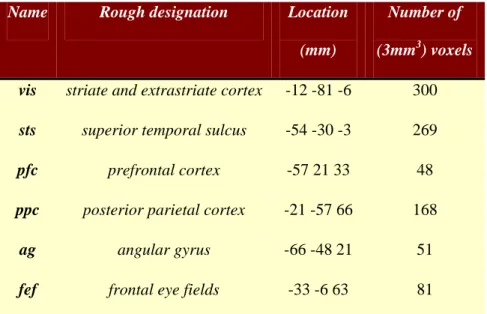
F-test for all effects of interest at p < .001 (uncorrected) in the conventional SPM analysis. These regions were chosen to cover a distributed network (of largely association cortex) in the right hemisphere, from visual cortex to frontal eye fields (see Table 1 for details). The activity of each region (node) was summarised with its principal eigenvariate to ensure an optimum weighting of contributions for each voxel with the ROI (see Figure 9). In this example, one can see evoked responses in visual areas (every 60 seconds) with a progressive loss of stimulus-bound activity and a hint of attentional modulation and other fluctuations in higher regions.
Name Rough designation Location (mm)
Number of
(3mm3) voxels
vis striate and extrastriate cortex -12 -81 -6 300
sts superior temporal sulcus -54 -30 -3 269
pfc prefrontal cortex -57 21 33 48
ppc posterior parietal cortex -21 -57 66 168
ag angular gyrus -66 -48 21 51
fef frontal eye fields -33 -6 63 81
Table 1: Regions selected for DCM analysis on the basis of an (Omnibus) SPM of the F-statistic testing for evoked responses. Regions are defined as contiguous voxels in the SPM
surviving a threshold of p<0.001 (uncorrected).The anatomical designations should not be
taken too seriously because the extent of several regions covered more than one
cytoarchitectonic area, according to the atlas of Talairach and Tournoux.
Model inversion and selection
As for the simulated data of the previous section, we inverted a DCM with full connectivity using the first 256 volumes of the time-series. Because we did not know the level of observation noise in these data, we reduced the prior expectation of its log-precision to four; otherwise, the analyses of simulated and empirical data were identical. A summary of the conditional expectations of hidden states generating regional activity are shown in Figure 10 (upper right). The solid lines are time-dependent means and the grey regions are 90% confidence intervals (i.e., confidence tubes). These states comprise, for each region, neuronal activity, vasodilatory signal, normalised flow, volume and deoxyhemoglobin content, where
the last three are log-states. These hidden states provide the predicted responses in the upper left panel for each region and the associated prediction errors (red dotted lines). The same data are plotted in the lower panels for the first four minutes of data acquisition, with hidden neuronal states on the left and hemodynamic states on the right (where log-states are plotted as states). These results are presented to show that inferred neuronal activity in the visual region (highlighted in blue) follows visual stimulation (grey filled areas – high for attention and low for no attention). This confirms that model inversion has effectively deconvolved neuronal activity from hemodynamic signals; and that this deconvolution is veridical, in relation to known experimental manipulations. Recall that the model was not informed of these manipulations but can still recover evoked responses. The associated hemodynamic states of all regions are shown on the lower right (blue highlights blood flow in the visual region). It can be seen that changes in blood flow are in the order of 10%, which is in the physiologically plausible range.
Figure 11 summarises the results of post hoc model selection. The inversion of the full model took about 16 minutes (about 16 iterations of about one minute each), while the post hoc
search took about 16 seconds. The upper left panel shows the log-evidence profile over the 215=32,768 models considered (reflecting all possible combinations of bidirectional edges among the six nodes analysed). There is a reasonably clear optimum model. This is evident if we plot the implicit log-posterior as a model posterior (assuming flat priors over models), as shown on the upper right. In this case, we can be over 80% certain that a particular network architecture generated the observed fMRI data. The parameter estimates of the connections under the full model (left) and the selected model (right) are shown in the lower panels. One can see that three (bidirectional) connections have been switched off, as their parameter estimates are reduced to their prior value of zero. It is these anti-edges that define the architecture we seek. This is a surprisingly dense network, in which all but three of the fifteen reciprocal connections appear to be necessary to explain observed responses. This dense connectivity may reflect the fact we are using macroscopic regional summaries of