International Journal of Emerging Technology and Advanced Engineering
Website: www.ijetae.com (ISSN 2250-2459, ISO 9001:2008 Certified Journal, Volume 4, Issue 2, February 2014)
121
EUCLBP Matching Algorithm for Forensic Applications
Gnanasoundari.V1, Balaji.S2
1
PG Scholar, 2Assistant Professor, Department of CSE, Angel College of Engineering and Technology, Tiruppur, India Abstract— Forensic Sketch to digital face matching is an
important research challenge and is very pertinent to law enforcement agencies. Forensic sketches are drawn based on the recollection of an eyewitness person and the expertise of a sketch artist. To extract discriminating information from local regions of both sketches and digital face images using the automated algorithm. The proposed system presents an Enhanced Uniform Circular Local Binary Pattern (EUCLBP) is used to extract the structural information along with minute details present in local facial regions. An evolutionary memetic optimization algorithm is proposed to assign optimal weight to every local facial region to boost the identification performance. Normally forensic sketches or digital face images can be of poor quality, a Discrete Wavelet Transform (DWT) fusion based preprocessing technique is used to enhance the quality of images and improve the identification performance. An automatic sketch to digital face image matching system can help the criminal investigation and make the recognition process efficient and relatively fast. Training the viewed sketches and semi-forensic sketches are used to
improve the performance evaluation. Comprehensive
experimental evaluation on different sketch databases show that the proposed algorithm yields better identification performance compared to existing face recognition algorithms and two commercial face recognition systems.
Keywords— Sketch Recognition, Discrete Wavelet Transform, EUCLBP, Memetic algorithm.
I. INTRODUCTION
Sketch recognition algorithms can be classified into two categories. They are generative and discriminative approaches. Generative approaches model a digital image in terms of sketch or vice versa and then match it with the query sketch. Discriminative approaches perform feature extraction and matching using the given digital image and sketch pair and do not generate the corresponding digital image from sketch or the sketch from digital image. Matching sketches with digital face images is a very important law enforcement application that has received relatively less attention. Forensic sketches are drawn based on the recollection of an eyewitness and the expertise of a sketch artist. Forensic sketches include several inadequacies because of the incomplete and approximate description provided by the eyewitness.
Generally, forensic sketches are manually matched with the database comprising digital face images of known individuals. The state of art face recognition algorithms cannot be used directly and require additional processing to address the nonlinear variations present in sketches and digital face images. An automatic sketch to digital face image matching system can assist law enforcement agencies and make the recognition process efficient and relatively fast.
II. OVERVIEW OF THE SYSTEM
Match the Forensic sketches with the digital face images using Enhanced Uniform Circular local binary pattern (EUCLBP) matching algorithm. Memetic algorithm is effectively used to optimize such large search spaces. The main objective of the project is to improve the recognition rate and identification accuracy for the given forensic sketch image. In addition to that we use a preprocessing technique is used to enhance the quality of forensic sketch digital image pairs.
It is very challenging to achieve the Rank-I Identification in matching the given probe image with the gallery set. The main motivation of the project is due to the marvellous growth in the law enforcement agencies, when the photo of the suspect is not available.
The proposed system is designed based on the following interpretations
Information present in local facial regions can have high discriminating power.
Local facial patterns in sketches and digital face images can be efficiently represented by local descriptors.
In this research, three different types of sketches are used for performance evaluation.
1. Viewed sketches are drawn by a sketch artist while looking at the digital image of a person.
2. Semi-forensic sketches are drawn by a sketch artist based on his recollection from the digital image of a person.
International Journal of Emerging Technology and Advanced Engineering
Website: www.ijetae.com (ISSN 2250-2459, ISO 9001:2008 Certified Journal, Volume 4, Issue 2, February 2014)
122 III. EXISTING SYSTEM
Local descriptors have received attention in face recognition due to their robustness to scale, orientation, and speed. Local Binary Patterns (LBP) is one of the widely used descriptors for face recognition. In face recognition literature, several variants of LBP have been proposed. Extended LBP to incorporate exact difference of gray level intensities among pixel neighbors and used it for sketch recognition. Local descriptors such as LBP are generally used as dense descriptors where texture features are computed for every pixel of the input face image. On the other hand, sparse descriptors such as Scale Invariant Feature Transform (SIFT) [1] is based on interest point detection and the descriptor is computed in the vicinity of detected interest points. SIFT is computed using the gradient magnitude and orientation of neighboring points sampled around every detected key point. As a sparse descriptor, SIFT has been used for face recognition. Applied SIFT in a dense manner (i.e. computing SIFT descriptor at specific pixels) for matching sketches with digital face images. It is our assertion that local descriptors can be used for representing sketches and digital face images because they can efficiently encode the discriminating information present in the local regions.
Weber’s local descriptor which is based on Weber’s law and draws its motivation from both SIFT and LBP. It is similar to SIFT in computing histogram using gradient magnitude and orientation, and analogous to LBP in analyzing small neighborhood regions and being computationally efficient. WLD [10] has some unique features that make it more efficient and robust as compared to SIFT and LBP. WLD computes the salient micro patterns in a relatively small neighborhood region with finer granularity. This allows it to encode more discriminative local micro patterns. In this research, WLD is optimized for matching sketches with digital face images by computing multiscale descriptor in a circular manner (in contrast to the originally proposed square neighborhood approach). Finally, two multiscale circular WLD [8] histograms are matched using memetically optimized weighted x2 distance.
Feature Extraction Using MCWLD has two components 1) differential excitation and 2) Gradient orientation. MCWLD representation for a given face image is constructed by tessellating the face image and computing a descriptor for each region. MCWLD descriptor is computed for different values of parameters and, where is the number of neighboring pixels evenly separated on a circle of radius centered at the current pixel. Multiscale analysis is performed by varying the radius and number of neighbors.
IV. PROPOSED SYSTEM
Extended Uniform Circular Local Binary Pattern Matching Algorithm extracts discriminating information present in local facial regions at different levels of granularity. Both sketches and digital face images are decomposed into multi resolution pyramid to conserve high frequency information which forms the discriminating facial patterns. The Extended uniform circular local binary pattern matching descriptors use these patterns to form a unique signature of the face image. Fig 1. Shows architecture diagram for matching sketches with digital face images. Further, for matching, a memetic optimization based approach is proposed to find the optimum weights corresponding to each facial region.
The Steps involved in process of matching sketches with digital face images are
1. The preprocessing technique is used to enhance the quality of both the digital face images and sketch images.
2. Both the sketches and digital face images are tessellated into non overlapping local facial regions (6x7).
3. EUCLBP descriptors are computedfor each local facial region.
4. The weighted distance measure is used where the weights are optimized using Memetic algorithm to match two EUCLBP descriptor.
5. This procedure is applied for each gallery probe image pair and top matches are obtained.
[image:2.612.335.573.471.666.2]6.
Fig 1. Architecture Diagram for matching sketches with photos
MUG SHOT [IMAGES]
INPUT IMAGE
IMAGE ENHANCEMENT
EUCLBP - FEATURE EXTRACTION EUCLBP - FEATURE
EXTRACTION IMAGE ENHANCEMENT
MEMETIC OPTIMIZATION
International Journal of Emerging Technology and Advanced Engineering
Website: www.ijetae.com (ISSN 2250-2459, ISO 9001:2008 Certified Journal, Volume 4, Issue 2, February 2014)
123 A. Image PreProcessing
Let f be the colour face image to be enhanced. Let and be the red and luma channels respectively. These two channels are processed using the multiscaleretinex (MSR) algorithm with four iterations. MSR is applied on both red and luma channels to obtain and , respectively. and , are subjected to wavelet based adaptive soft thresholding scheme [5] for image denoising. The algorithm computes generalized Gaussian distribution based soft threshold which is used in wavelet based denoising to obtain and , respectively.
Noise removal in the previous step may lead to blurring of edges. Experiments show that a symmetric low pass filter of size 7x7 with standard deviation of 0.5 efficiently restores the genuine facial edges. Applying this (Wiener) filter on and produces and .
After computing the globally enhanced red and luma channels, DWT fusion algorithm is applied on and to compute a feature rich and enhanced face image, F. Single level DWT (with db 9/7 mother wavelet) is applied on and to obtain the detailed and approximation
bands of these images. Let , , and be the four sub bands where j=1,2, LL represents the approximation band, and LH,HL, and HH represent the detailed subbands. To preserve features of both the channels, find the average of and for the coefficients from the approximation band.
Where is the approximation band of the enhanced image. All three detailed subbands are divided into windows of size 3× 3 and the sum of absolute pixels in each window is calculated. For the ith window in HL subband of the two images, the window with maximum absolute value is selected to be used for enhanced subband . Similarly, enhanced subbands and are also obtained. Finally, inverse DWT is applied on the four subbands to generate a high quality face image.
This DWT fusion algorithm is applied on both forensic sketches and digital face images. Note that the preprocessing technique enhances the quality when there are irregularities and noise in the input image, however, it does not alter good quality face images (i.e. sketch digital image pairs from the viewed sketch database).
Sketches are scanned as three channel color images and the forensic images obtained from different sources are also three channel color images. If a gray scale image is obtained, multiscaleretinex and Wiener filtering are applied only on the single channel. Along with quality enhancement, face images are geometrically normalized as well. The eye coordinates are detected using the OpenCV’s boosted cascade of haar like features.
B. Feature Extraction Using EUCLBP
Local Binary Patterns (LBP) based descriptor is a widely used texture operator because of its robustness to gray level changes and high computational efficiency. Basic LBP is a window based feature extractor where the texture descriptor is computed based on the neighboring pixel. It assigns a binary value to every neighboring pixel by thresholding it with respect to the central pixel. The binary patterns thus obtained from the neighboring pixels are transformed to a gray level value and is assigned to the central pixel. LBP representation of a given face image is generated by dividing the image into grids and computing histograms to measure the frequency of LBP values within each grid. An extension of this approach is to have the pixel neighbors well separated on a circle around a central pixel. The circle can have different diameters and varying number of neighbors to account for texture at different scales. Similar to basic LBP, Circular LBP (CLBP) descriptor is computed as shown in Eqs. (1) and (2)
International Journal of Emerging Technology and Advanced Engineering
Website: www.ijetae.com (ISSN 2250-2459, ISO 9001:2008 Certified Journal, Volume 4, Issue 2, February 2014)
124 Where corresponds to the gray level intensity of centre pixel of the circle and corresponds to the gray level intensities of N evenly spaced pixels on a circle of radius R. riu2 represents the use of rotation invariant uniform patterns.
Encoding difference of signs between the neighbouring pixels is not sufficient for describing facial texture. Other important features could also be derived from the information that lies in the difference of the gray level values. A method to encode the exact difference of gray level intensities and reported a marked improvement in the performance of texture descriptors. This forms the motivation to further extend Uniform CLBP to encode exact gray level difference along with the original encoding. The proposed descriptor is called Extended Uniform Circular Local Binary Pattern. The combination of the exact gray level difference and adds a complimentary layer of discrimination on top of the original descriptor which provides the assimilated information.
Layer 1 is Uniform CLBP that encodes difference of signs while the other three layers encode the exact gray level differences. We experimentally observed that Layer 1 and Layer 2 of EUCLBP are the most discriminating. Therefore, the final descriptor is the concatenation of Layer 1 and Layer 2 histograms.
C. Memetic Algorithm For Matching Sketches Images
Consider the following steps for assigning optimal weights to each tessellated face images using memtic optimization are:
1.Memetic Encoding - A chromosome of length (42*3*6=756) is encoded where each unit in the chromosome is a real valued number representing the corresponding weight.
2.Initial Population - Population of 100 chromosomes is generated starting with a seed chromosome.
3.Fitness Function - Fitness is evaluated by performing
recognition using the weights encoded by each chromosome. 10 best
performing chromosomes from a population are selected as survivors to perform crossover and mutation.
4. Hill Climbing Local Search - The survivors obtained in Step 3 are used to find better chromosomes in their local neighbourhood and parents are selected.
5. Crossover and Mutation - New population is generated from parents obtained after local search in Step 4. A set of uniform crossover operations is performed followed by mutation. To avoid local optima, adaptive mutation and random offspring generation techniques are used.
6. Repeat Steps 3–5 till a convergence criterion is satisfied.
D. Sketch Databases
To evaluate the performance of the proposed algorithm, three types of sketch databases are used
1)Viewed Sketch Database: It comprises a total of 549 sketch-digital image pairs from two sketch databases: the CUHK database and the IIIT-Delhi Sketch database. The CUHK database comprises 606 sketch-digital image pairs are used in this research. The sketches are drawn by a professional sketch artist for digital images collected from various sources. This database is termed as the IIIT-Delhi Viewed Sketch database.
2)Semi-forensic Sketch Database: As described earlier, sketches drawn based on the memory of sketch artist rather than the description of an eyewitness are termed as semi-forensic sketches. To prepare the IIIT-Delhi Semi-forensic Sketch database, the sketch artist is allowed to view the digital image once (for about 5–10 minutes) and is asked to draw the sketch based on his memory. The time elapsed between the artist viewing an image and starting to draw a sketch is about 15 minutes. Sketch artist is not allowed to view the digital image while preparing the sketch. These sketches are thus drawn based on the recollection of the sketch artist, thus eliminating the effect of attrition based on how well the eyewitness remembers an individual’s face and how well he/she is able to describe it to the sketch artist. 140 digital images from the IIIT-Delhi Viewed Sketch database are used to prepare the Semi-forensic Sketch database. Therefore, all images that are used to draw a semi-forensic sketch also have a corresponding viewed sketch.
International Journal of Emerging Technology and Advanced Engineering
Website: www.ijetae.com (ISSN 2250-2459, ISO 9001:2008 Certified Journal, Volume 4, Issue 2, February 2014)
125 V. EXPERIMENTAL RESULT
[image:5.612.328.560.116.242.2]In this paper, we have done our experimental setup based on the image processing tool to make the analysis for the feature extraction and to find the matching image in the data sets. Figure 2, shows the probe image and display the histogram of that original image. In the histogram, the x-axis represents the pixel intensity and the y-x-axis represents the pixel count respectively.
Fig 2. Probe image and its histogram
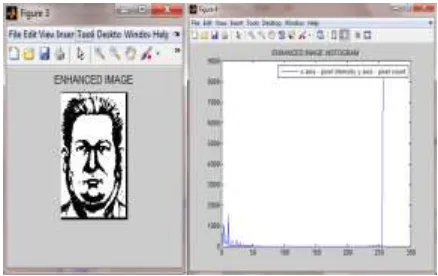
First we apply the preprocessing technique to remove the noises present in the probe image. The figure 3, shows the enhanced image after preprocessing and display the histogram of the enhanced image, which improves the quality of the given image.
Fig 3. Enhanced image after preprocessing and its histogram
[image:5.612.55.282.221.367.2]Next we are extracting the structural information present in the enhanced image. The image is divided into 6x7 non-overlapping tessellated local facial regions. By using EUCLBP algorithm, the features are extracted from the enhanced image. The figure 4 gives the feature extracted image and displays the histogram of the extracted image.
Fig 4.Feature extracted image using EUCLBP and its histogram
VI. CONCLUSION
One of the important cues in solving crimes and apprehending criminals is matching sketch with digital face images. This research presents a discriminative approach for matching sketch-digital image pairs using enhanced uniform circular local binary pattern and memetically optimized weighted distance. The algorithm starts with the preprocessing technique to enhance sketches and digital images by removing irregularities and noise. Next, EUCLBP encodes salient micro patterns from local regions to form facial signatures of both sketches and digital face images. Finally, the proposed memetic optimization based weighted distance is used to match two EUCLBP histograms. Comprehensive analysis, including comparison with existing algorithms and two commercial face recognition systems, is performed using the viewed, semi-forensic, and forensic sketch databases. In future work, we are going to calculate the optimized weight for the feature extracted image and then match it with the data set which obtain the top matches. Semi-forensic sketches are introduced to bridge the gap between viewed and forensic sketches. Training on semi-forensic sketches can better model the variations for matching forensic sketches as compared to algorithms trained on viewed sketches.
REFERENCES
[1] Anil K. Jain, Brendan Klare and Unsang Park, ―Face Matching and Retrieval in Forensics Applications‖ IEEE Multimedia in Forensics, Security, and Intelligence, pp.20-28, 2012.
[2] B. Klare and A. Jain, ―Sketch-to-photo matching: A feature-based approach‖, in Proceedings of Society of Photo-Optical Instrumentation Engineers Conference Series, Vol. 7667, 2010. [3] B. Klare and A. Jain, ―Heterogeneous face recognition using kernel
[image:5.612.58.277.439.577.2]International Journal of Emerging Technology and Advanced Engineering
Website: www.ijetae.com (ISSN 2250-2459, ISO 9001:2008 Certified Journal, Volume 4, Issue 2, February 2014)
126
[4] B. Klare, L. Zhifeng and A. Jain, ―Matching forensic sketches to mug shot photos‖, IEEE Transactions on Pattern Analysis and Machine Intelligence, Vol. 33, pp. 639–646, 2011.
[5] Grace Chang, Bin Yu and Martin Vetterli, ―Adaptive Wavelet Thresholding for Image Denoising and Compression‖ IEEE Transactions on Image Processing, Vol. 9, No. 9, pp.1532-1546, 2000.
[6] H. Bhatt, S. Bharadwaj, R. Singh, and M. Vatsa, ―On matching sketches with digital face images‖, in Proceedings of International Conference on Biometrics: Theory Applications and Systems, 2010. [7] H. Nizami, Adkins-Hill, P. Jeremy, Y. Zhang, J. Sullins, C.
McCullough, S. Canavan and L. Yin, ―A biometric database with rotating head videos and hand-drawn face sketches‖, in Proceedings of International Conference on Biometrics Theory, applications and systems, pp. 38–43, 2009.
[8] Himanshu S. Bhatt, Samarth Bharadwaj, Richa Singh and MayankVatsa, ―Memetically Optimized MCWLD for Matching Sketches With Digital Face Images‖ IEEE Transactions On Information Forensics And Security, Vol. 7, No. 5, pp.1522-1535,2012.
[9] Hongfeng Wang, Dingwei Wang, Shengxiang Yang, ―A memetic algorithm with adaptive hill climbing strategy for dynamic optimization problems‖ Springer J Soft computing 13:763–780,DOI 10.1007/s00500-008-0347-3, 2008.
[10] Jie Chen, Shiguang Shan, Chu He, Guoying Zhao, MattiPietikäinen, Xilin Chen, and Wen Gao, ―WLD: A Robust Local Image Descriptor‖ IEEE Transactions On Pattern Analysis And Machine Intelligence, TPAMI-2008-09-0620, pp.1-16, 2009.
[11] L. Yung-hui, M. Savvides and V. Bhagavatula, ―Illumination tolerant face recognition using a novel face from sketch synthesis approach and advanced correlation filters‖, in Proceedings of International Conference on Acoustics, Speech and Signal Processing, Vol. 2, 2006.
[12] P. Yuen and C. Manv, ―Human face image searching system using sketches‖, IEEE Transactions on Systems, Man and Cybernetics -A, Vol. 37, No. 4, pp. 493–504, 2007.
[13] Q. Liu, X. Tang, H. Jin, H. Lu and Songde Ma, ―A nonlinear approach for face sketch synthesis and recognition‖, in Proceedings of International Conference on Computer Vision and Pattern Recognition, Vol. 1, pp. 1005–1010, 2005.
[14] X. Gao, J. Zhong, J. Li and C. Tian, ―Face sketch synthesis algorithm based on E-HMM and selective ensemble‖, IEEE Transactions on circuits and Systems for Video Technology, Vol. 18, No. 4, pp. 487–496, 2008.
[15] X. Tang and X. Wang, ―Face photo recognition using sketch‖, in Proceedings of International Conference on Image Processing, Vol. 1, pp. 257–260, 2002.
[16] X. Tang and X. Wang , ―Face sketch synthesis and recognition‖, in Proceedings of International Conference on Computer Vision, Vol. 1, pp. 687–694, 2003.
[17] Xiaogang Wang and Xiaoou Tang, ―Face Photo-Sketch Synthesis and Recognition‖ IEEE Transactions on Pattern Analysis and Machine Intelligence, Vol. 31, No. 11, pp.1955-1967, 2009. [18] Yong Zhang, Christine McCullough, John R. Sullins and Christine
R. Ross, ―Hand-Drawn Face Sketch Recognition by Humans and a PCA-Based Algorithm for Forensic Applications‖ IEEE Transactions On Systems, Man, And Cybernetics—Part A: Systems And Humans, Vol. 40, No. 3, pp.475-485, 2010.
BIOGRAPHY
Ms. Gnanasoundari. V, is currently pursuing Master degree in Computer Science and Engineering at Angel College of Engineering and technology affiliated to Anna University, Chennai. She had two years of lecturing experience in M.Kumarasamy college of Engineering, karur and she has completed her Bachelor degree in Computer Science and Engineering at V.L.B Janakiammal College of Engineering and Technology affiliated to Anna University, Chennai. She is a member of ISTE and CSI. She has presented two papers in International & National Conferences, one journal and attended seminars & workshops to improve her skills. Her area of interest is Image Processing and Data Structures.