International Journal of Emerging Technology and Advanced Engineering
Website: www.ijetae.com (ISSN 2250-2459,ISO 9001:2008 Certified Journal, Volume 4, Issue 2, February 2014)
592
Simulation studies on Energy Requirement, Work Input and
Grindability of Ball Mill
Abanti Sahoo
Chemical Engg. Dept., National Institute of Technology, Rourkela-769008,Odisha, India
Abstract— Energy requirement, work input and grindability of ball mill have been studied by varying different system parameters (viz. particle size & density of materials, number of balls, time of grinding and speed of the mill). Attempt has also been made to correlate the output with these inputs on the basis of regression analysis. Different C++ programmings were written to compute energy requirement, work input and grindability for the ball mill using the above
mentioned system parameters. Finally a comparisonhas been
made among experimentally observed values and the values determined by other methods (i.e. C++ programming, and regression analysis). For comparing the goodness of the fit, the correlation coefficient and chi-square test have been used.
Keywords — Comminution, Bond’s Work Index,
Grindability, Dimensional analysis approach,
C++programming, correlation coefficient and Chi-square test.
I. INTRODUCTION
Grinding is one of the most energy-intensive operations in the preparation of ores and has a significant effect on the economics of processing these raw materials. Therefore it becomes especially important to select the correct equipment for this operation. The choice of equipment chosen for the comminution of ore is mainly based on the Bond work index, which is usually determined by the standard method of dry grinding. Traditionalmeasurements of ore grindability are the Bond Work Index. The Bond test is still surprisingly popular, despite the advances in modelling and computing power.
Grindability data, based on various techniques to measure comminution characteristics, are used to evaluate the crushing and grinding efficiency in mineral processing operations. The importance of achieving improved comminution efficiency, in terms of energy consumption, has been emphasized by increase in the cost of electricity (Horst and Bassarear, 1976). Bond’s grindability can be empirically related to the energy required for comminution and thus is useful for the design and selection of crushing and grinding equipment (Deniz et al., 1996).
Ball milling is a wide spread milling technology, particularly in mining; mainly because of its simple construction and application.
The Bond grindability testing procedure has been standardized to obtain the grindability values (i.e., Bond work index (BWi)) on the same ore when tests are performed in different laboratories or by different operators. The results for the Bond work index grindability thus obtained may differ substantially with different standard Bond ball mills (Kaya et al., 2003). Therefore there is need for development of a more general and standard model to measure the performance of the ball mill.
II. PREVIOUS WORK
Comminution in a mineral processing plant or, mill involves a sequence of crushing and. grinding processes (Prasher, C.L., 1987). Literature on impact crusher performance in relation to machine configuration and operational conditions, by experimental work and mathematical modelling is given by Austin et al. (1979) and Shi et al.(2003). The Bond grindability test has been widely used for predictions of ball and rod mill energy requirements and for selection of plant scale comminution equipment (Babu and Cook,1973). It is known that the efficiency of the mill can be increased by tuning the rotation velocity so that the average collision velocity becomes maximum. In this context attempt has been made for a meticulous study for the effect of the various system parameters on the performance of ball mills. If the peripheral speed of the mill is very high, it begins to act like a centrifuge and the balls do not fall back, but stay on the perimeter of the mill and that point is called the "Critical Speed‖ (McCabe et al., 1993). Ball mills usually operate at 65% to 75% of the critical speed and this is calculated as under.
r R
g 2
1 nc
(1)
Grindability (G):
International Journal of Emerging Technology and Advanced Engineering
Website: www.ijetae.com (ISSN 2250-2459,ISO 9001:2008 Certified Journal, Volume 4, Issue 2, February 2014)
593
The standard Bond grindability test is a closed-cycle dry grinding and screening process, which is carried out until steady state conditions are obtained (Bond, F., 1961, Yap et al., 1982 and Magdalinovic, N., 1989). Meaningful expressions between Bond index, grindability index and friability value have been developed by Ozkahraman (2005).
Work Index:
Work index is defined as the gross energy required in kilowatt-hours per ton of feed needed to reduce a very large feed to such a size that 80% of the undersize passes through 100-μm screen [8]. The expression for the work index is as given below
0.5
F 5 . 0 P i d 1 d 1 W 3162 . 0
W (2)
Magdalinovic (1989) has stated simplified procedure for a rapid determination of the work index by just two grinding tests. The applicability of the simplified procedure has been proved on samples of Cu ore, andesite and limestone. The result by this method was not more than 7% from the values obtained in the standard Bond test.
Yalcin et al., (2004) investigated the effect of various parameters on the grindability of pure Sulfur and used the obtained grinding data to establish mathematical models and set up a computer simulation program. The established mathematical model is as shown below.
n d d e k
y 5 0
2 ln
1
100
(3)
Where, y is cumulative percent passing size d, d50 is the
50% passing size, n is distribution constant (The n values ranged from 0.84 to 1.84), k is a correction factor (k values ranged from 0.95 to 1.00).
By using the Bond method of grindability, Ipek et al. (2005) have observed that less specific energy input is required in separate grinding of ceramic raw materials than grinding them in admixtures. The Bond work indices of the admixtures containing softer component have been observed greater than the weighted average of the work indices of the individual components in the mixture. Deniz and Ozdag (2003) have investigated the effect of elastic parameters on grinding and examined the relationship between them. The most widely known measure of grindability is Bond’s work index which is defined as the resistance of the material to grinding. The standard equation used by them for the ball mill work index (Bond work index) is as follows.
80 80
82 . 0 23 .
0 10/ 10/
5 . 44 1 . 1 F P G P W bg i
i (4)
In designing and optimizing a milling circuit using Bond Ball Mill Work Index the most commonly used equation is as follows (Bond, F., 1961).
80 80 1 1 10 F P W W i
&
P
T
*
W
(5)Based on this equation it is possible to calculate, the specific energy requirement for a given grinding duty, BBMWI, feed size and required product size. With the knowledge on energy requirement it is possible to determine the size of mill required and thereby the motor power requirement can be determined. Bond has suggested an intermediate course in which he postulated n to be-3/2 which leads to
5 . 0 1 1 5 . 0 2 1 10 2 / 1 1 1 2 / 1 2 100 L L i E q L i E
E (6)
Bond defines the quantity Ei as the amount of energy
required to reduce unit mass of the material from an infinitely large particle size down to a particle size of 100 micro meters. It is also expressed in terms of q, the reduction ratio.
Where, q= L1 /L2; L1and L2 are the feed and product
size in micrometers respectively.
International Journal of Emerging Technology and Advanced Engineering
Website: www.ijetae.com (ISSN 2250-2459,ISO 9001:2008 Certified Journal, Volume 4, Issue 2, February 2014)
594
They have correlated this characteristic with the mineralogical composition and textural-structural features of bauxite.
III. EXPERIMENTATION
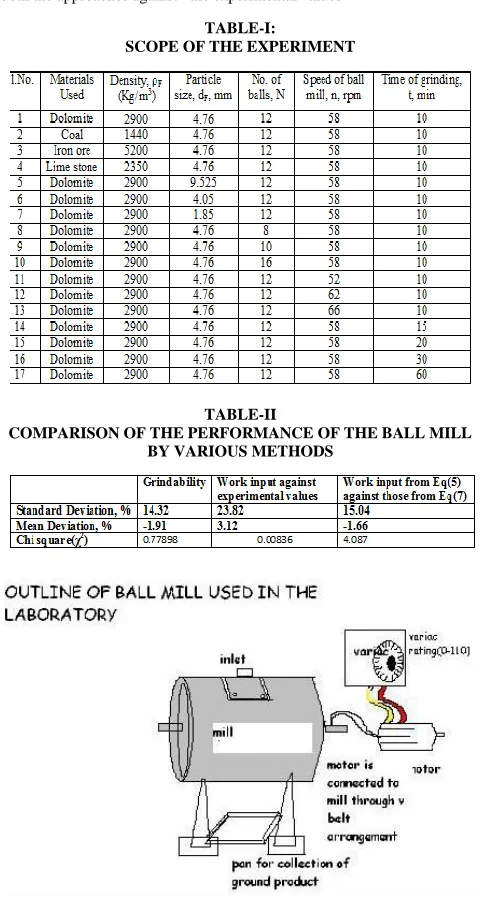
A ball mill of 36.6 cm diameter and 50 cm length was used in the laboratory for experimentation. The material of construction of the grinding media was mild steel. The steel balls each of 5.41 cm diameter and density 7.85kg/m3 were used for the experiments. The mill was made to revolve at different speeds (0-110 rpm) to grind various materials like dolomite, iron ore, coal and limestone by using a variac which was set at different supplied voltages for each type of material. The effects of various system parameters (viz. particle size, material density, speed of the mill, time of grinding and the number of balls) on the performance of the ball mill were studied. The product was sieved and measured. The amounts of undersize or fines were found out by sieving with a 120-mesh size. Bond Index and grindability of the mill were calculated using the amount of fines per revolution. Scope of the experiment is given in Table 1 and the experimental set up is shown in Fig. 1(A). Mechanism of operation in a ball mill is shown in Fig.-1(B). Energy consumed for grinding the given feed sample into fines was noted down from the energy meter reading. The same procedure was repeated with different parameters as mentioned in the scope of the experiment. Each time 1.0 kg of material was taken as feed for running the ball mill and bond index was calculated from the energy meter reading observed for getting around 800gms of fines passing through the 100 micron mesh size from 1kg of feed.
IV. RESULTS AND DISCUSSION
Development of the Correlations:
Values of the work index and grindability have been calculated as per their definitions. In the present work, attempt has been made to develop expressions for the Bond Work input and grindability of the ball mill on the basis of dimensional analysis by correlating the experimentally observed values of the work index and the grindability (calculated as per the definitions) against the various system parameters. The correlation plots for work index and the grindability are shown in Fig.- 2 and 3 respectively. The developed correlations are given as under.
0.524 1.711 0.207 0.172 1.364
07
4E dF n N t F
W (7)
0.662 1.975 0.711 0.542 1.284
36815
dF n N t F
G (8)
The correlation coefficients or coefficients of
determination were found out to be 0.761 and 0.893 for work input and grindability correlations respectively indicating that the developed correlations fit closely to the particular set of experimental data.
The values of the grindability calculated as per Eq-(8) based on dimensional analysis was again used in Eq-(4) to determine the Bond Work Index of the ball mill. The values of Bond Work Index thus obtained were used in Eq-(5) to determine the work input of the ball mill. Finally the calculated values of the work input calculated as per Eq-5 and Eq-7 are compared with each other and also against the experimental values. The comparison plot is shown in Fig.-4. The standard deviation, mean deviation and chi square (χ2) obtained from various comparisons are shown in
Table-2. It is observed that values of the work input calculated by both the methods i.e. from Eq-(5) and (7) agreeing well with each other and with the experimentally measured values in most of the cases.
International Journal of Emerging Technology and Advanced Engineering
Website: www.ijetae.com (ISSN 2250-2459,ISO 9001:2008 Certified Journal, Volume 4, Issue 2, February 2014)
595
V. CONCLUSION
In today’s industrial scenario, ball mill is widely used in multifarious industries as size reduction process is energy inefficient, it is necessary to optimize the operation so as to reduce cost to some extent. As it has been explicitly seen that the parameters influencing the performance of ball mill cannot be ignored, the expressions correlating all these variables can considerably be used to optimize the operation of a ball mill in general over a wide range of parameters which has been justified with correlation coefficient (R2) and Chi-square-test (χ2) values. Thus these results can be used as the basis of calculation to determine the design criteria or the ranges of various parameters to be used for a specific process. The chi-square test indicates good correlation fit for both the type of performances. The bond work index and grindability calculations are the determining factors for the design of ball mill and size reduction of ores as the power consumption will indicate directly about the cost benefit too.
Nomencature
d : Particle diameter (size) mm F80 : 80% passing size of feed µm
g : Gravitational constant, 981 gm/cm2 G : Grindability of the mill g/rev Gbg : Bond’s std ball mill grindability g/rev n : Speed of ball mill, rpm
N : Number of balls P : Power draw kW
Pi : screen size for performing the test µm P80 : 80% passing size of product µm
r : radius of grinding balls cm R : Radius of the ball mill cm t : Time of grinding min T : Throughput of new feed t/h W : Work input kW-hr/t Wi : Work index of the material kW-hr/t
: Density of material kg/m3 Subscripts:
c : for critical condition f : for feed particles p : for product particles
REFERENCES
[1 ] Austin, L.G., Jindal, V.K. and Gotsis, C., 1979. A model for continuous grinding in a laboratory hammer mill. Powder Tech. 22, 199–204.
[2 ] Babu, S.P. and Cook, D.S., 1973. Breaking, crushing and grindingSME, Mining Engineering Handbook, vol. 2. AIMMPE, Inc., New York.
[3 ] Bond, F., 1961. Crushing and grinding calculations. Brit. Chem. Eng. 6, 543–548.
[4 ] Deniz, V. and Ozdag, A new approach to Bond grindability and work index: dynamic elastic parameters, Mineral Engineering, Vol. 16, Issue-3, March-2003, p 211-217.
[5 ] Deniz, V., Balta, G. and Yamik, A. The interrelationships between Bond grindability of coals and impact strength index (ISI), point load index (Is) and Friability index ( FD), in: M. Kemal, et al (Eds.), Changing Scopes in Mineral Processing, A.A. Balkema, Rotterdam, Netherlands, 1996, pp. 15–19.
[6 ] Horst, W.E. and Bassarear, J.H., Use of simplified ore grindability technique to evaluate plant performance, Trans. Soc. Min. Eng. AIME, 260 (1976) 348–351.
[7 ] Ipek, H., Ucbas, Y. and Hosten,C., The bond work index of mixture of ceramic raw materials, Mineral Engineering, Vol. 18, (2005), p 981-983.
[8 ] Kaya, E.; Fletcher P. C. an Thompson P., Minerals & metallurgical processing, vol. 20, (3), 2003, p 140-142.
[9 ] Magdalinovic, N. 1989(a), Calculation of energy required for grinding in a ball mill, International Journal of Mineral Processing, Vol. 25, (1-2), p 41-46.
[10 ]Magdalinovic, N., 1989(b), A procedure for rapid determination of the Bond work index. Int. J. Mineral Processing, 27, 125–132. [11 ]McCabe, W. L., Smith, J. C. and Harriot, P., Unit Operation in
Chemical Engineering, (Fifth Edition), McGraw-Hill, Inc, Singapore, 1993, p-980.
[12 ]MIKRONS, Design Highlights
http://www.ballmill.in/ballmill_design.html, Copyright © 2011 MIKRONS.
[13 ]Ozkahraman, H. T., A meaningful expression between bond work index, grindability index and friability value, Minerals Engineering 18 (2005) 1057–1059.
[14 ]Perry, R. H. and Chilton, C. H., Chemical Engineers’ Handbook , (5th edition), McGraw-Hill, p- 8-25.
[15 ]Prasher, C.L., 1987. Crushing and grinding process handbook. Consultant to chemical and mechanical engineering industry, Linora Technical Associates, John Wiley & Sons Limited, Chichester, New York.
[16 ]Safonov, A. I., Suss, A. G., Panov, A. V., Luk’yanov, I. V., Kuznetsova, N. V. and Damaskin, A. A.; Effect of process parameters on the Grindability and bond index of bauxites And alumina-bearing ores, Metallurgist, Vol. 53, Nos. 1–2, 2009. [17 ]Sahoo, A. and Roy, G. K., ―Correlations For The Grindability Of
The Ball Mill as a measure of its Performance‖, Asia Pacific Journal of Chemical Engineering, vol- 3, Issue – 2, June – 2008, p 230-235. [18 ]Shi, F.N., Kojovic, T., Esterle, J.S. and David, D., 2003. An energy
based model for swing hammer mills. Int. J. Miner. Process. 71, 147–166.
International Journal of Emerging Technology and Advanced Engineering
Website: www.ijetae.com (ISSN 2250-2459,ISO 9001:2008 Certified Journal, Volume 4, Issue 2, February 2014)
596 Figure Caption:
Fig.-1: Experimental set-up
Fig.-2: Correlation plot for Bond Work Index against system parameters by dimensional analysis.
[image:5.612.45.553.76.644.2]Fig.-3: Correlation plot for grindability against system parameters by dimensional analysis.
Fig.-4: Comparison plot of calculated values of Bond Work Index by both the approaches against the experimental values
TABLE-I:
SCOPE OF THE EXPERIMENT
TABLE-II
COMPARISON OF THE PERFORMANCE OF THE BALL MILL BY VARIOUS METHODS
Fig.-1(A) : Experimental set-up
[image:5.612.48.289.203.653.2]Fig.-1(B) : Mechanism of operation in a Ball Mill
Fig. 2 : Correlation plot for the Work Index of the ball mill
Fig. 3 : Correlation plot for the Work Index of the ball mill
[image:5.612.324.562.204.648.2]International Journal of Emerging Technology and Advanced Engineering
Website: www.ijetae.com (ISSN 2250-2459,ISO 9001:2008 Certified Journal, Volume 4, Issue 2, February 2014)
597
Fig.-5 : Flow chart for MATLAB Coding for verification of developed correlation
Fig.-6 : Comparison plot between theoretical data and experimental data on particle size for both grindability and Bond’s work input of
the ball mill.
Fig.-7 : Comparison between theoretical data and experimental data on effect of number of Balls for both grindability and Bond’s work