Open Access
Vol 12 No 1Research
Withholding and withdrawing life-sustaining treatment: a
comparative study of the ethical reasoning of physicians and the
general public
Anders Rydvall
1and Niels Lynöe
21Department of Surgical and Perioperative Sciences, Anaesthesiology, University Hospital of Northern Sweden, Lasarettsbacken SE-90185 Umeå, Sweden
2Department of Learning, Informatics, Management and Ethics, Karolinska Institutet, Berzelius vaeg 3 SE-17177 Stockholm, Sweden Corresponding author: Anders Rydvall, [email protected]
Received: 1 Jun 2007 Revisions requested: 4 Jul 2007 Revisions received: 16 Oct 2007 Published: 15 Feb 2008
Critical Care 2008, 12:R13 (doi:10.1186/cc6786)
This article is online at: http://ccforum.com/content/12/1/R13 © 2008 Rydvall and Lynöe; licensee BioMed Central Ltd.
This is an open access article distributed under the terms of the Creative Commons Attribution License (http://creativecommons.org/licenses/by/2.0), which permits unrestricted use, distribution, and reproduction in any medium, provided the original work is properly cited.
Abstract
Background Our objective was to investigate whether a
consensus exists between the general public and health care providers regarding the reasoning and values at stake on the subject of life-sustaining treatment.
Methods A postal questionnaire was sent to a random sample
of members of the adult population (n = 989) and to a random sample of intensive care doctors and neurosurgeons (n = 410) practicing in Sweden in 2004. The questionnaire was based on a case involving a severely ill patient and presented arguments for and against withholding and withdrawing treatment, and providing treatment that might hasten death.
Results Approximately 70% of the physicians and 51% of the
general public responded. A majority of doctors (82.3%) stated that they would withhold treatment, whereas a minority of the general public (40.2%) would do so; the arguments forwarded
(for instance, belief that the first task of health care is to save life) and considerations regarding quality of life differed significantly between the two groups. Most physicians (94.1%) and members of the general public (77.7%) were prepared to withdraw treatment, and most (95.1% of physicians and 82% of members of the general public) agreed that sedation should be provided.
Conclusion There are indeed considerable differences in how
physicians and the general public assess and reason in critical care situations, but the more hopelessly ill the patient became the more the groups' assessments tended to converge, although they prioritized different arguments. In order to avoid unnecessary dispute and miscommunication, it is important that health care providers be aware of the public's views, expectations, and preferences.
Introduction
Health care providers have a long tradition of ethical reason-ing, which is evolving continuously alongside the development of modern medicine. The overall assumption is that the primary task of health care providers is to promote health and, when-ever possible, to save lives and alleviate suffering. Health care providers are also supposed to avoid harming patients when they provide treatment. Finally, they are expected to respect a patient's autonomy and integrity as well as the principle of jus-tice, which requires all to be treated equally.
However, when a patient is unable to make decisions, who should do so in their place – doctors or relatives? Alternatively, should we adhere to the patient's previously oral or written
perspectives on the role of relatives and others in the decision making process regarding care for terminally ill patients [11].
Differences in attitude, reasoning and judgement result from divergent systems of values or interpretation of empirical data, and from use of different methodological approaches that may focus on alternative aspects [12]. The objective of the present survey was to evaluate the specific arguments, values at stake and the degree to which consensus exists in the critical care setting.
Materials and methods
The study was conducted during the Autumn of 2004 and included a multidisciplinary group of doctors (112 neurosur-geons and 298 intensive care doctors) and a random sample of the adult population (n = 989) of the county of Västerbotten in northern Sweden. All participants were sent a postal ques-tionnaire based on the case of a 72-year-old patient suffering from a severe intracerebral haemorrhage (for details, see Table 1). The case description was presented to both groups using
the same, plain language. Two reminders were sent at 2-week intervals.
The case is developed step by step in the questionnaire text. Initially, arguments are presented for and against performing neurosurgery (Table 2). The focus then shifts to after the sur-gery. One week postoperatively it becomes clear that the patient will not survive; arguments for and against withdrawing life-supporting treatment are provided (Table 3). Finally, the patient is disconnected from the ventilator. In order to keep the patient calm and free from pain, they are treated with potent sedatives and analgesics, despite the risk that this will hasten death; arguments for and against this approach are provided (Table 4). The arguments presented were based on experi-ence gained from similar cases in an intensive care unit.
The respondents answered in terms of 'agreeing entirely', 'agreeing mostly', 'disagreeing mostly' and 'disagreeing entirely'. They then indicated which of the provided arguments they perceived to be the most important. The results are pre-sented as proportions of those who agreed mostly or entirely
Table 1
Case description and arguments presented
Case description Argumentsa
Situation A: A previously healthy 72-year-old woman is brought to the emergency room in a deep coma for what is believed to be a stroke with a right-sided hemiphlegia. In order to conduct a CT scan and to secure respiratory function, it is necessary to intubate and mechanically ventilate the patient. The CT scan shows a large haemorrhage in the left central part of the brain. A surgical evacuation in this delicate area is considered undesirable. However, without neurosurgery, intracranial pressure will probably increase, and a herniation of the brain will occur. Accordingly, without treatment, the patient is presumed fated to die within a few days.
In favour of surgery:
• Surgery should be performed because it is the first task of health care to safe lives
• A neurosurgeon refers to experience from a successful case 2 years ago; thus, the surgery should be performed.
• Surgery should be performed because otherwise it might be interpreted as a kind of euthanasia
• Surgery should be performed because a son has asked the doctor to do everything to save his mother's life
Against surgery:
• Surgery should be avoided because the patient's quality of life would be greatly reduced
• Surgery should be avoided because of the age of the patient • Surgery should be avoided because of the cost and uncertain result • Surgery should be avoided because of the patient's wish not to end up in a persistent vegetative state
Situation B: Neurosurgery has been performed and the patient is transferred to the intensive care unit. After 2 days the patient is still on the ventilator, no improvement has been observed and the patient is still deeply unconscious. After 10 days a new CT scan is conducted, which indicates that a large area of the brain is incarcerated. The patient is no longer able to breathe without a ventilator, and the physicians discuss whether to continue the treatment
In favour of continuation of ventilation:
• Ventilator treatment should be continued because discontinuing it might be perceived as a kind of euthanasia
• The patient's son is strongly against discontinuing ventilator treatment, thus, treatment should be continued
Against continuation of ventilation:
• The treatment should be discontinued because it only prolongs the dying process
• The treatment should be discontinued because it is in accordance with the wishes of the patient
Situation C: The physicians have now decided to withdraw ventilator treatment and inform the relatives. After 12 hours of breathing unaided, the patient develops convulsions and forced breathing. The condition looks painful and stressful. In order to alleviate the patient's symptom, morphine and tranquillizers may be provided. However, these drugs might also affect the respiratory centre in the brain and accordingly hasten death
In favour of morphine and tranquillizers:
• Tranquillizers and morphine should be provided in order to keep the patient free from symptoms even though they might hasten death • Tranquillizers and morphine should be provided in order to shorten the dying process
Against morphine and tranquillizers:
• Tranquillizers and morphine should be provided but without risking acceleration of death
• Tranquillizers and morphine should not be provided if the purpose is to hasten the dying process
(with 95% confidence interval) and a priority list of arguments regarding to be the most important. Similar to performing a hypothesis test, a 95% confidence interval that does not over-lap another reflects a statistically significant difference. We also used the χ2 test to estimate differences and we identify
very small P values with 'P << 0.001' (which was generally the case), although the present study was not conducted to test any hypothesis. The validity of the questionnaire was tested in a group of local intensive care physicians (n = 18) and a group of medical students (n = 68) before and after a course on medical ethics given during the third term. Apart from sex and age, we also evaluated (as background variables) the partici-pants' experiences of health care as a patient and as a relative, which were ranked as mainly positive, mainly negative, mixed positive and negative, or no experience.
Results
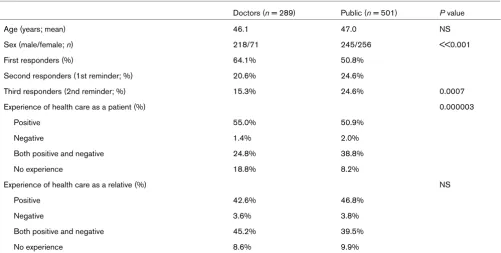
Among physicians the response rate was approximately 70%, and among the general public it was about 51%. There were no differences in age and sex between responders and nonre-sponders. No difference was observed between the two groups in terms of their experiences of the health care system as a relative of a patient (Table 5), but there was a significant difference between groups in their experiences as a patient (P
<< 0.001). Specifically, more members of the general public had experience as a patient, mixed positive and negative, whereas physicians had less experience of the health care sys-tem as a patient. Physicians tended to respond more promptly than members of the general public, but we found no differ-ences in response pattern between those who responded immediately and those responding after one or two reminders.
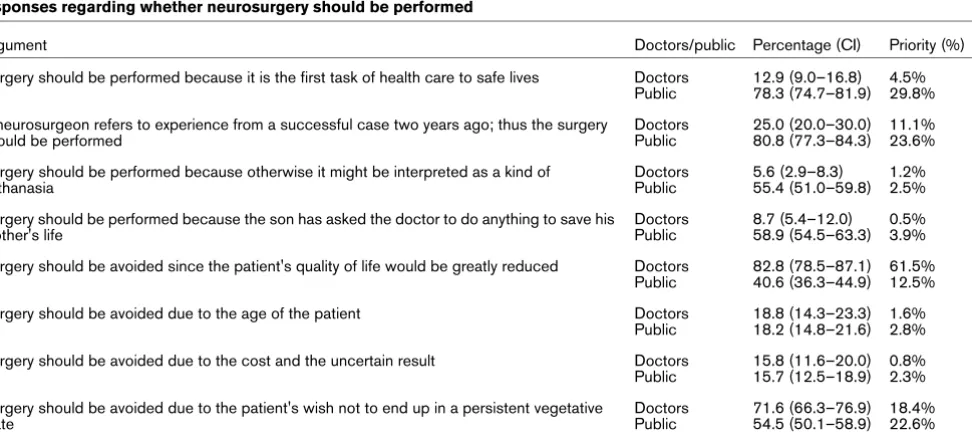
Table 2
Responses regarding whether neurosurgery should be performed
Argument Doctors/public Percentage (CI) Priority (%)
Surgery should be performed because it is the first task of health care to safe lives Doctors Public
12.9 (9.0–16.8) 78.3 (74.7–81.9)
4.5% 29.8% A neurosurgeon refers to experience from a successful case two years ago; thus the surgery
should be performed
Doctors Public
25.0 (20.0–30.0) 80.8 (77.3–84.3)
11.1% 23.6% Surgery should be performed because otherwise it might be interpreted as a kind of
euthanasia
Doctors Public
5.6 (2.9–8.3) 55.4 (51.0–59.8)
1.2% 2.5% Surgery should be performed because the son has asked the doctor to do anything to save his
mother's life
Doctors Public
8.7 (5.4–12.0) 58.9 (54.5–63.3)
0.5% 3.9% Surgery should be avoided since the patient's quality of life would be greatly reduced Doctors
Public
82.8 (78.5–87.1) 40.6 (36.3–44.9)
61.5% 12.5% Surgery should be avoided due to the age of the patient Doctors
Public
18.8 (14.3–23.3) 18.2 (14.8–21.6)
1.6% 2.8% Surgery should be avoided due to the cost and the uncertain result Doctors
Public
15.8 (11.6–20.0) 15.7 (12.5–18.9)
0.8% 2.3% Surgery should be avoided due to the patient's wish not to end up in a persistent vegetative
state
Doctors Public
71.6 (66.3–76.9) 54.5 (50.1–58.9)
[image:3.612.70.556.104.324.2]18.4% 22.6% This table shows the response pattern of the doctors and members of the general public who answered the question regrding whether neurosurgery should be performed in a formerly healthy 72-year-old patient suffering from a major haemorrhage in the left central part of the brain. The results are presented as proportions of those who agreed 'mostly' or 'entirely', with a 95% confidence interval (CI). The percentages of those who considered the argument to be the most important are also presented
Table 3
Responses regarding whether to continue ventilator treatment
Argument Doctors/public Percentage (CI) Priority (%)
Ventilator treatment should be continued because discontinuing it might be perceived as a form of euthanasia
Doctors General public
6.3 (3.5–9.1) 28.3 (24.3–32.3)
5.5% 14.9% A son is strongly against discontinuing ventilator treatment, thus treatment should be
continued
Doctors General public
10.1 (6.6–13.6) 35.2 (31.0–39.4)
0.4% 7.4% The treatment should be discontinued because it only prolongs the death process Doctors
General public
91.9 (88.9–94.9) 81.5 (78.1–84.9)
73% 42.5% The treatment should be discontinued because it is in accordance with the wishes of the
patient
Doctors General public
83.9 (79.6–88.2) 76.2 (72.4–80.0)
Almost 95% of neurosurgeons and most of the intensive care physicians were male; these majorities contrast with the 50:50 split among the general public. Analysis shows that the differ-ences are due to group affiliation and not differdiffer-ences in sex distribution.
When evaluating the specific arguments presented in the case, the internal dropout rate(respondents who have returned the questionnaire but answered partly) was low, but when estimating which of the arguments applied in a specific situation, the internal dropout rate was higher. In the first step,
surgery or not, (Table 2), 84% (244/289) of physicians and 86% (433/501) of members of the general public answered; corresponding percentages for the second step, withdrawing ventilator treatment, were 89% (256/289) and 87% (435/ 501), and for the third step, giving sedatives and potent anal-gesics, they were 93% (268/289) and 87% (434/501). A few respondents identified two arguments as being the most important when they were asked to prioritize them; in such cases, both arguments were identified as being most important.
Table 4
Responses regarding whether to administer tranquillizers and morphine
Argument Doctors/public Percentage (CI) Priority (%)
Tranquillizers and morphine should be provided in order to keep the patient free of symptom even though it might hasten death
Doctors General public
97.6 (95.8–99.4) 95.9 (94.2–97.6)
94.4% 76.2% Tranquillizers and morphine should be provided in order to shorten the dying process Doctors
General public
9.9 (6.4–13.4) 45.7 (41.3–50.1)
0.7% 5.8% Tranquillizers and morphine should be provided but without risking the acceleration of death Doctors
General public
29.6 (24.3–34.9) 49.2 (44.8–53.6)
1.9% 12.2% Tranquillizers and morphine should not be provided if the purpose is to hasten the dying
process
Doctors General public
72.7 (66.5–77.9) 52.0 (47.6–56.4)
3.0% 5.8% This table shows the response pattern of the doctors and members of the general public who answered the question regarding whether to provide tranquillizers and morphine to a terminally ill patient disconnected from life-sustaining ventilator treatment. The results are presented as
[image:4.612.56.557.447.700.2]proportions of those who agreed 'mostly' or 'entirely', with a 95% confidence interval (CI). The percentages of those who considered the argument to be the most important are also presented.
Table 5
Distribution of age and sex in doctors and members of the general public
Doctors (n = 289) Public (n = 501) P value
Age (years; mean) 46.1 47.0 NS
Sex (male/female; n) 218/71 245/256 <<0.001
First responders (%) 64.1% 50.8%
Second responders (1st reminder; %) 20.6% 24.6%
Third responders (2nd reminder; %) 15.3% 24.6% 0.0007
Experience of health care as a patient (%) 0.000003
Positive 55.0% 50.9%
Negative 1.4% 2.0%
Both positive and negative 24.8% 38.8%
No experience 18.8% 8.2%
Experience of health care as a relative (%) NS
Positive 42.6% 46.8%
Negative 3.6% 3.8%
Both positive and negative 45.2% 39.5%
No experience 8.6% 9.9%
Should neurosurgery be performed?
When prioritizing the arguments, most members of the public (59.8%) supported arguments in favour of performing the sur-gery, whereas a majority of the doctors (82.3%) were against surgery (Table 2); this difference was statistically significant (P
<< 0.001). The most important value-based argument empha-sized by the general public was that 'the primary task of health care is to save lives'. The empirically based arguments were the reference to 'the personal experience of the neurosurgeon' and 'the [lack of] quality of life'; the general public gave priority to the first argument, whereas the physicians stressed the lat-ter. Neither group was swayed by the age of the patient and cost-benefit argument for not performing surgery, and there was little support for the son's wish that the surgery be per-formed or for regarding the withholding of surgery as a form of euthanasia.
Should life-sustaining treatment be discontinued?
When evaluating the arguments for and against withdrawing life-sustaining treatment, most doctors (94.1%) and members of the general public (77.7%) deemed the most important arguments to be those against continuation of treatment. The prioritization of the arguments for withdrawing treatment dif-fered significantly between groups, however (Table 3). The argument receiving the most support by both groups was that 'it only prolongs the death process', although significantly more physicians emphasized this argument (P << 0.001). Although a minority in both groups believed that withdrawing ventilator treatment might be regarded as a form of euthanasia, significantly more of the general public attributed priority to this argument (P << 0.001). A greater percentage of members of the general public also regarded adherence to the patient's wishes to be the most important argument (P << 0.001).
Should potent sedatives and analgesics be administered?
Most doctors (95.1%) and members of the general public (82%) agreed that potent sedatives and analgesics should be provided in the case presented. Significantly more physicians (P << 0.001) were found to support this assertion when the arguments were specified (for example, that treatment should be provided even though it might hasten death; Table 4). It was also stressed by both groups that the intention should be to keep the patient calm and free from pain, and not primarily to hasten death, although some members of the general public felt that an intention to hasten death in the case presented is also acceptable. On the other hand, compared with doctors, significantly more members of the general public stated that potent sedatives and analgesics should not be provided if there were any risk for hastening death (P << 0.001).
Discussion
The most significant difference between the two groups is that concerning arguments in favour of performing neurosurgery in the case presented; the physicians were more reluctant to
per-form heroic surgery in the setting of a poor prognosis. How-ever, as the case develops, differences in reasoning between doctors and members of the general public diminish somewhat, although they never quite disappear. On the whole, the results indicate that the general public has high expecta-tions of what the health care system can achieve. Differences in judgement between the two groups result from divergent approaches to assessing empirical data and differences in moral reasoning.
Validity factors
Among the doctors the response rate was not significantly lower than that in other similar studies. The fact that the response rate was rather low among members of the general public might be due to the nature of the six-page-long questionnaire focusing on special medical issues. Although the questionnaire was written using nontechnical terminology and was tested in pilot studies that included medical students in their third term, the issues at hand could have provoked strong emotions in potential questionnaire responders, such that only those who were interested in and capable of consid-ering such questions actually responded. However, there was no difference between those who responded and nonre-sponders in terms of age and sex, and there was no differ-ences in the response pattern between those who answered initially and those who responded to the second reminder. The two groups' experiences of health care as relatives of patients were rather similar, but the general public had greater experi-ence of health care as a patient and had more combined pos-itive and negative patient experiences. The age distributions of the two groups were similar, but there was a significant differ-ence in sex distribution between groups; however, we only found statistical associations between the response patterns in the two groups, not between sex distribution within the groups. Differences in judgements might thus result from gen-uine differences between the two groups rather than sex bias.
The strengths of this study include the case-based question-naire, which focuses on ethical reasoning and takes into account both fact and value judgements. By elucidating the ideas and expectations of the general public it might be possi-ble to prevent miscommunication in future discussions with patients and relatives. Limitations of the study include the use of a vignette; these do not necessarily reflect real-life decision making. Accordingly, our findings should be interpreted in the light of other studies [12]. Furthermore, the rather low response rate among members of the general public man-dates caution when interpreting the findings.
Providing or withholding treatment
patients were more inclined to prioritize this; these results are reflected in the present study. The important issue is whether public support for a proactive attitude is based on somewhat unrealistic expectations about the capability of medicine and the health care system, or whether other concerns should be taken into consideration. Evidence-based findings are now available that indicate that neurosurgical interventions in such cases are rather futile [14], but when the present study was conducted no such evidence existed. Only when treatment is clearly futile can its withholding be deemed ethically accepta-ble, and in such cases it is ethically equivalent to withdraw life-sustaining treatment [12]. If the outcome of such treatment is deemed to be uncertain (the personal experience of a neuro-surgeon might influence this assessment), then it could be proposed that treatment be initiated and later withdrawn if it becomes clear that the intervention is futile. Withholding treat-ment that is not clearly futile is ethically more controversial than withdrawing clearly futile treatment. Such considerations might account for why significantly more of members of the general public regarded withholding life-sustaining treatment to be a kind of euthanasia, as compared with withdrawing such treatment. The significant difference between physicians and the public indicates that health care providers should be aware of how the general public reason in such cases.
Both physicians and members of the general public agreed that the patient's previously stated wishes is an important issue, but doctors were not inclined to consider the wishes of the patient's son, whereas most the public supported the value of the son's wishes.
Finally, it is interesting that neither members of the general public nor physicians considered the cost of such an opera-tion or the age of the patient. These consideraopera-tions may be taboo specific to Sweden, and responders may provide socially conventional answers. In the daily routine of an inten-sive care unit, both priority-settings (I. a. "Age alone is not rel-evant for decision of treatment" in Sweden) and age are relevant considerations [11] and are deemed standard factors to include in such studies [12].
Withdrawing life-sustaining treatment
Discontinuing treatment because it only prolongs the dying process was regarded by both groups to be the most important argument. Treatment that prolongs the dying proc-ess might be interpreted as futile and as violating the patient's dignity. The most important issue, however, is whether discon-tinuing the treatment might be interpreted as equivalent to accepting a hastened dying process. Furthermore, is it reason-able to view discontinuing life-sustaining treatment and thus hastening death as a form of euthanasia? Even though most doctors would reject the association of treatment discontinua-tion with the concept of euthanasia, more than one-quarter of the public accept that such an association exists.
Although both groups appeared to be keen to respect the patient's previously stated wishes, more members of the gen-eral public deemed this to be the most important argument. One explanation for this difference might be that in Sweden advanced directives have no legal status, either in writing or orally. Furthermore, the wishes of a relative, at least in terms of demanding treatments, are considered but rarely acted upon. It is interesting to consider whether the existence of a written advanced directive would have changed the response pattern, and been considered by physicians and the son.
Providing treatment that might hasten death
In the presentation of this case, it is stated that providing potent sedatives and analgesics could affect the respiratory centre and thus hasten death in a terminally ill patient. It is known that medical treatment can have two predictable effects: a desirable, positive one and an undesirable, harmful one. If we are unable to obtain the positive effect without also incurring the adverse one, then we face an ethical dilemma. However, if the overriding intention is to obtain the desirable effect (namely, to keep the patient symptom free), then it is considered acceptable to provide such a treatment, even though a predictable harmful and inevitable adverse effect might occur (hastening death); this reasoning is usually referred to as the 'principle of double effect' [15].
When they were presented with the case, all respondents were told about the potential harmful adverse effects of the drugs provided, and it is interesting that majorities of both groups apparently agreed with application of the principle of double effect in this specific case, and even attributed to it the highest priority. That we are actually dealing with a dilemma is reflected in the response pattern, with majorities of both groups supporting the argument that the drugs should not be provided if the purpose is to hasten death, even though both give little priority to the argument. Compared with the physi-cians, members of the general public were significantly more inclined to support the argument that drugs should be pro-vided without risking a hastening of death. This could suggest that acceptance of the principle of double effect is more wide-spread among doctors than among members of the general public.
Conclusion
Key Messages
Physicians are inclined to withhold treatment from a hope-lessly ill patient, whereas most members of the general public tend to recommend it.
Majorities of both physicians and members of the general pub-lic are in favour of withdrawing life-sustaining treatment from a hopelessly ill patient.
Physicians and members of the general public forward differ-ent argumdiffer-ents for action and inaction when reasoning on the withholding and withdrawing of life-sustaining treatment.
In order to avoid miscommunication with patients and their rel-atives, physicians should be aware of their reasoning.
Competing interests
The authors declare that they have no competing interests.
Authors' contributions
Both authors contributed equally to the manuscript. AR made the first draft.
Acknowledgements
The study was financially supported by grant from The Vardal Founda-tion, Sweden (grant no. V2000/239).
References
1. Faber-Langendoen K, Lanken PN: Dying patients in the intensive care unit: forgoing treatment, maintaining care. Ann Intern Med
2000, 133:886-893.
2. Watch LS, Saxton-Daniels S, Schermer CR: Who has life-sus-taining therapy withdrawn after injury? J Trauma 2005, 59:1320-1326.
3. Buckley T, Crippen D, DeWitt AL, Fisher M, Liolios A, Scheetz CL, Whetstine LM: Ethics roundtable debate: withdrawal of tube feeding in a patient with persistent vegetative state where the patients' wishes are unclear and there is family dissension.
Crit Care 2004, 8:79-84.
4. Quill TE: Terri Schiavo: a tragedy compounded. N Engl J Med
2005, 352:1630-33.
5. Benbenishty J, Ganz FD, Lippert A, Bulow HH, Wennberg E, Henderson B, Svantesson M, Baras M, Phelan D, Maia P, Sprung CL: Nurse involvement in end-of-life decision making: the ETHICUS Study. Intensive Care Med 2006, 32:129-132. 6. Sjokvist P, Berggren L, Svantesson M, Nilstun T: Should the
ven-tilator be withdrawn? Attitudes of the general public, nurses and physicians. Eur J Anaesth 1999, 16:526-533.
7. Sprung CL, Carmel S, Sjokvist P, Baras M, Cohen SL, Maia P, Beishuizen A, Nalos D, Novak I, Svantesson M, Benbenishty J, Henderson B, ETHICATT Study Group: Attitudes of European physicians, nurses, patients, and families regarding end-of-life decisions: the ETHICATT study. Intensive Care Med 2007, 33:104-110.
8. Ganz FD, Benbenishty J, Hersch M, Fischer A, Gurman G, Sprung CL: The impact of regional culture on intensive care end of life decision making: an Israeli perspective from the ETHICUS study. J Med Ethics 2006, 32:196-199.
9. Moselli NM, Debernardi F, Piovano F: Forgoing life sustaining treatments: differences and similarities between North Amer-ica and Europe. Acta Anaesth Scand 2006, 50:1177-1186. 10. Vincent JL: Forgoing life support in western European
inten-sive care units: the results of an ethical questionnaire. Crit Care Med 1999, 27:1626-1633.
11. Sjokvist P, Nilstun T, Svantesson M, Berggren L: Withdrawal of life support – who should decide? Differences in attitudes
among the general public, nurses and physicians. Intensive Care Med 1999, 25:949-954.
12. Cook D, Rocker G, Giacomi M, Sinuff T, Heyland D: Understand-ing and changUnderstand-ing attitudes towards withdrawal and withhold-ing of life support in the intensive care unit. Crit Care Med
2006, 34:217-223.
13. Sprung CL, Cohen SL, Sjokvist P, Baras M, Bulow HH, Hovilehto S, Ledoux D, Lippert A, Maia P, Phelan D, Schobersberger W, Wennberg E, Woodcock T, Ethicus Study Group: End-of-life practices in European intensive care units: the Ethicus Study.
JAMA 2003, 290:790-797.
14. Mendelow AD, Gregson BA, Fernandes HM, Murray GD, Teasdale GM, Hope DT, Karami A, Shaw MDM, Barer DH: Early surgery versus initial conservative treatment in patients with sponta-neous supratentorial intracerebral haematomas in the Interna-tional Surgical Trial in Intracerebral Haemorrhage(STICH): a randomized trial. Lancet 2005, 365:387-397.