International Journal of Emerging Technology and Advanced Engineering
Website: www.ijetae.com (ISSN 2250-2459, ISO 9001:2008 Certified Journal, Volume 6, Issue 9, September 2016)
204
Packet Scheduling Scheme for Wireless Sensor Network
Dr. Suvarna Nandyal
1, Sangamesh G S
21Professor, 2PG Student, Department of Computer Science and Engineering, Poojya Doddappa Appa College of
Engineering, Kalaburagi, Karnataka, India
Abstract
—
different applications in remote sensor systems (WSNs) amazingly rely on upon the information that is sent intermittently by the sensor hubs to the base station (BS). Promising applications like woodland fire disturbing, observing of patient wellbeing and any crisis circumstances have more prominent than any time in recent memory requests on remote sensor system to send data to base station(BS) the minute it happens, continuously. To set aside a few minutes transmission of information happens, it requires the working arrangement of a sensor hub to calendar parcels continuously. Here in WSNs planning of parcels, as non-continuous and ongoing (crisis) Packets, is essentially vital to decrease the end-to-end delay for transmitting information parcels; Hence to meet the above said necessities, middle person hubs required to change the request of conveying the information parcels from line. Most of the parcels planning components that are accessible for the working arrangement of remote sensor system are utilized with First Come First Served (FCFS) plan or pre-emptive booking instrument or non-pre-pre-emptive booking component. The utilization of these instruments in booking the information Packets at hubs in sensor systems prompts stretched out end-to-end delay in sending the information parcels. Subsequently if the Packet sort is of crisis sort then it must be sent to base station (BS) at the earliest opportunity or else clearly it will endure on the grounds that there is no organized planning that exists. Another Packet booking methodology is advanced in which delegate hubs change the request of conveyance of parcels from the line on the premise of their significance logically in the meantime guaranteeing that the Packets having distinctive inclinations are transmitted with minimized holding up time at the line contingent upon need of information Packets. In the proposed plan, every hub, aside from those at the last level of the virtual pecking order of zone based topology of WSN, has three levels of need lines. Continuous Packets are put into the most astounding need line and can pre-empt information parcels in different lines. Non-continuous Packets are put into two different lines. Leaf hubs have two lines for continuous and non-constant information parcels since they don't get information from different hubs and subsequently, decrease end-to-end delay.The execution of the proposed Packet planning plan is assessed through recreations for continuous and non-ongoing information. Reproduction comes about represent that the Proposed parcel planning plan beats traditional plans regarding normal information holding up time and end-to-end delay.
Keywords
—
Wireless sensor network, packet scheduling, pre-emptive priority scheduling, non-pre-emptive priority scheduling, real-time, non-real-time, data waiting time, FCFS.I. INTRODUCTION
Most recent improvements in innovation have made it conceivable to acknowledge little gadgets which have enough power, for example, memory, calculation, and proficient battery usage. These innovations make feasible for two small scale gadgets to speak with each other. As the result, remote sensor system has risen to be a more created one. Today remote sensor system discovers its application in all fields, for example, in controlling the air movement, observing of patients wellbeing, reconnaissance of activity, mechanization in assembling ventures, to likewise watch out for environment. It is figured out how to function in a zone where there is no legitimate foundation. The remote sensors have numerous issues, for example, steering conventions and information collection, parcel planning. Case in point, information detected for constant applications have higher need than information detected for non-continuous applications. Without a doubt, most existing Wireless Sensor Network (WSN) working frameworks use Firs Come First Serve (FCFS) schedulers that procedure information Packets in the request of their landing time and, in this way, require a considerable measure of time to be conveyed to a pertinent base station (BS). Be that as it may, constant crisis information ought to be conveyed to BS with the most limited conceivable end-to-end delay.
International Journal of Emerging Technology and Advanced Engineering
Website: www.ijetae.com (ISSN 2250-2459, ISO 9001:2008 Certified Journal, Volume 6, Issue 9, September 2016)
205
II.RELATED WORK
In this section, the present existing packet or task scheduling schemes are classified based on several factors as is illustrated in Figure below.
A. Factor: Deadline
Packet booking plans can be arranged in view of the Due date of entry of information parcels to the base station (BS), Which are as per the following.
To begin with Come First Served (FCFS): Most existing WSN applications utilize First Come First Served (FCFS) schedulers that procedure information in the request of their entry times good to go line.
Most punctual Deadline First (EDF): Whenever various information parcels are accessible good to go line and every Packet has a due date inside which it ought to be sent to BS, the information Packet which has the most punctual due date is sent first.
The exploration work done by Lu C. et al, 2002 have proposed ongoing correspondence engineering for expansive scale sensor systems, whereby they utilize a need based scheduler. Information that have ventured to every part of the longest separation from the source hub to BS and have the most limited due date, are organized. In the event that the due date of a specific errand terminates, the significant information parcels are dropped at a moderate hub. In spite of the fact that this methodology diminishes system activity and information preparing overhead, it is not effective since it devours assets, for example, memory and calculation power and expands handling delay.
Mizanian et al, 2009 have proposed RACE, a Packet planning approach and steering calculation for continuous largescale sensor organizes that uses a circle free Bellman-Ford calculation to discover ways with the base activity load and postpone amongst source and goal. RACE utilizes the Earliest Deadline First (EDF) booking idea to send parcels with most punctual due date. It additionally utilizes an organized MAC convention. Need lines effectively drop parcels whose due dates have lapsed to abstain from squandering system assets. Be that as it may, nearby prioritization at every individual hub in RACE is not adequate on the grounds that parcels from various senders can go up against each other for a mutual radio correspondence channel.
B. Factor: Priority
Packet planning plans can be characterized in view of the need of information parcels that are detected at various sensor hubs. Non-preemptive: In non-preemptive need Packet booking, when a parcel t1 begins execution, undertaking t1 carries on regardless of the possibility that a higher need parcel t2 than the as of now running parcel t1 touches base primed and ready line. In this way t2 needs to hold up in the prepared line until the execution of t1 is finished. Preemptive: In preemptive need Packet booking, higher need parcels are prepared first and can acquire lower need parcels by sparing the setting of lower need Packets in the event that they are as of now running.
Min Y.U. et al, 2008 have proposed parcel planning components that are utilized as a part of TinyOS (the broadly utilized agent arrangement of WSN) and order them as either agreeable or Preemptive. Agreeable booking plans can be founded on a dynamic need planning system, for example, EDF and Adaptive Double Ring Scheduling (ADRS) that utilizations two lines with various needs. The scheduler powerfully switches between the two lines in view of the due date of recently arrived parcels. On the off chance that the due dates of two Packets are distinctive, the shorter due date parcel would be put into the higher-need line and the more extended due date parcel would be set into the lower-need one. Helpful schedulers in TinyOS are appropriate for applications with restricted framework assets and with no hard constant necessities. Then again, preemptive planning can be founded on the Emergency Task First Rate Monotonic (EF-RM) plan. EF-RM is an expansion to Rate Monotonic (RM), a static need booking, whereby the most brief due date work has the most elevated Priority. EF-RM separates WSN errands into Period Tasks, (PT) whose needs are chosen by a RM calculation, and non-period assignments, which have higher need than PTs and can Interrupt, at whatever point required, a running PT.
C. Factor: Packet Type
Packet scheduling schemes can be arranged taking into account the sorts of information parcels, which are as per the following.
Constant Packet planning: Packets at sensor hubs ought to be booked in light of their sorts and needs. Continuous information Packets are considered as the most astounding need parcels among all information Packets in the prepared line. Consequently, they are prepared with the most astounding need and conveyed to the BS with a base conceivable end-to-end delay.
International Journal of Emerging Technology and Advanced Engineering
Website: www.ijetae.com (ISSN 2250-2459, ISO 9001:2008 Certified Journal, Volume 6, Issue 9, September 2016)
206
They are thus conveyed to BS either utilizing first start things out serve or most limited employment first premise when no continuous parcel exists primed and ready line of a sensor hub. These parcels can be instinctively seized by continuous Packets. Because of the long execution time of certain non-genuine information parcels, continuous Packets may be set into starvation. To stay away from the starvation of continuous Packets Zhao Y et al, 2008 have proposed an enhanced need based delicate ongoing parcel booking calculation. Schedulers navigate the sitting tight line for the information parcels and pick the littlest Packet ID as the most noteworthy need to execute. Be that as it may, Packet needs are chosen amid the accumulation stage, which can't be changed amid the execution time. In the event that high need parcels are dependably in execution, the low need Packets can't be actualized. On the off chance that low-need Packets possess the assets for quite a while, the consequent high-need parcels can't get reaction in time.D. Factor: Number of Queue
Can likewise be arranged taking into account the quantity of levels in the prepared line of a sensor hub. These are as per the following.
Single Queue: Each sensor hub has a solitary prepared line. A wide range of information Packets enter the prepared line and are booked taking into account diverse criteria: sort, need, size, and so on. Single line planning has a high starvation rate.
Multi-level Queue: Each hub has two or more lines. Information Packets are set into the diverse lines as per their needs and sorts. In this way, planning has two stages :(i) designating errands among various lines, (ii) booking Packets in every line. The quantity of lines at a hub relies on upon the level of the hub in the system. For example, a hub at the least level or a leaf hub has a base number of lines while a hub at the upper levels has more lines to lessen end-to-end information transmission postpone and adjust system vitality utilizations.
The creator Lee et al, 2010 have proposed a multilevel line scheduler plot that uses an alternate number of lines as indicated by the area of sensor hubs in the system. This methodology utilizes two sorts of planning: basic need based and multi-FIFO line based. In the previous, information enter the prepared line as per need yet this planning likewise has a high starvation rate. The multi-FIFO line is isolated into a most extreme of three lines, contingent upon the area of the hub in the system. On the off chance that the most reduced level is, hubs that are situated at level have one and only line however there are two lines for hubs at level . Every line has its need set to high, mid, or low. At the point when a hub gets a parcel, the hub chooses the Packet's need as per the bounce number of the parcel and likewise sends it to the important line.
III. PROPOSED METHODOLOGY
We make the accompanying suppositions to plan and execute the proposed Packet planning plan.
• Data activity involves just constant and non-ongoing information, e.g., continuous wellbeing information detected by body sensors and non-continuous temperature information.
• All information Packets (continuous and non-constant) are of same size.
• Sensors are time synchronized.
• No information conglomeration is performed at middle of the road hubs for constant information.
• Nodes are viewed as situated at various levels in light of the quantity of bounce tallies from base station (BS).
• Timeslots are apportioned to hubs at various levels utilizing TDMA plan, e.g., hubs at the least level, lk are doled out timeslot 1.
• The prepared line at every hub has most extreme three levels or segments for ongoing information (pr1) non-constant remote information (pr2) and non-continuous nearby information (pr3).
• The length of information lines is variable. For example, the length of constant information line (pr1) is thought to be littler than that of non-ongoing information lines (pr2 and pr3). Be that as it may, the length of the non-constant pr2 and pr3 lines are same.
International Journal of Emerging Technology and Advanced Engineering
Website: www.ijetae.com (ISSN 2250-2459, ISO 9001:2008 Certified Journal, Volume 6, Issue 9, September 2016)
207
Scheduling data packets among several queues of a sensor node is presented in Figure 2. Data packets that are sensed at a node are scheduled among a number of levels in the ready queue. Then, a number of data packets in each level of the ready queue are scheduled. For instance, Fig. 2 demonstrates that the data packet, Data1 is scheduled to be placed in the first level, Queue1. Then, Data1 and Data3 of Queue1 are scheduled to be transmitted based on different criteria. The general working principle of the proposed scheduling scheme is illustrated in Fig3.Fig.3 Proposed Packet Scheduling Scheme
The proposed planning plan expect that hubs are for all intents and purposes sorted out after a various leveled structure. Hubs that are at the same jump separation from the base station (BS) are thought to be situated at the same level. Information Packets of hubs at various levels are handled utilizing the Time-Division Multiplexing Access (TDMA) plan. For example, hubs that are situated at the most reduced level and the second least level can be allotted timeslots 1 and 2, individually.
This paper consider three-level of lines, that is, the most extreme number of levels in the prepared line of a hub is three: need 1 (pr1), need 2 (pr2), and need 3 (pr3) lines. Continuous information parcels go to pr1, the most elevated need line, and are prepared utilizing FCFS. Non-constant information Packets that touch base from sensor hubs at lower levels go to pr2, the second most astounding need line. At long last, non-ongoing information parcels that are detected at a neighborhood hub go to pr3, the most reduced need line.
The conceivable purposes behind picking greatest three lines are to process (i) continuous pr1 assignments with the most astounding need to accomplish the general objective of WSNs, (ii) non constant pr2 undertakings to accomplish the base normal errand holding up time furthermore to adjust the end-to-end delay by giving higher need to remote information parcels, (iii) non-ongoing pr3 errands with lower need to accomplish decency by pre-empting pr2 undertakings if pr3 errands hold up various back to back timeslots.
Since pre-emptive need planning brings about overhead because of the connection stockpiling and exchanging in asset requirement sensor arranges, the extent of the prepared line for pre-emptive need schedulers is relied upon to be littler than that of the preemptable need schedulers. The thought behind this is the most noteworthy need constant/crisis errands seldom happen. They are accordingly set in the pre-emptive need errand line (pr1 line) and can pre void the right now running undertakings. Since these procedures are little in number, the quantity of pre-emptions will be a couple. Then again, non-ongoing parcels that touch base from the sensor hubs at lower level are put in the preemptable need line (pr2 line). The preparing of these information Packets can be pre-empted by the most elevated need constant errands furthermore after a specific era if undertakings at the lower need pr3 line don't get handled because of the nonstop entry of higher need information parcels. Continuous Packets are normally handled in FCFS design. Every parcel has an ID, which comprises of two sections, to be specific level ID and hub ID. At the point when two equivalent need parcels touch base good to go line in the meantime, the information Packet which is produced at the lower level will have higher need. This wonder diminishes the end-to-end postponement of the lower level errands to achieve the BS. For two assignments of the same level, the littler errand (i.e., regarding information size) will have higher need.
IV. PERFORMANCE ANALYSIS
This segment dissect the execution of the proposed booking plan regarding end-to-end deferral of various sorts of movement good to go lines of dynamic hubs. In the accompanying, the normal end-to-end postponement of transmitting diverse need information Packets to the base station (BS) is planned.
International Journal of Emerging Technology and Advanced Engineering
Website: www.ijetae.com (ISSN 2250-2459, ISO 9001:2008 Certified Journal, Volume 6, Issue 9, September 2016)
208
This hub transmits the crisis need 1 information to BS through lk−1 middle of the road levels. Consider the accompanying situation whereby each time a constant information Packet achieves a neighboring dynamic hub, y at an upper Level, a non-continuous lower need information is being handled at that hub. Subsequently, information conveyance at y is pre-empted to send continuous information. Transmission time or defer that is required to put a continuous information from a hub into the medium is equivalent to Datapr1/St. The proliferation time or defer to transmit information from the source to goal can be detailed as d/Sp. considering the previously mentioned situation End-to-End delay for transmitting ongoing (crisis) information might be spoken to as given beneathdelaypr1≥ lk× (
+pr1proc(t)) + +(lk×toverhead)
Where
datapr1 = the real-time data size
St = the data transmission speed
d = distance between the source to base station. d = ∑
i
Sp = the propagation speed over the wireless
medium
pr1proc(t) = the processing time of real-time tasks at each node
toverhead = an overhead in terms of context switching and queuing time(including time for preemption)
B. Non-ongoing Priority 2 Queue Data: Tasks at pr2 line can be pre-empted by continuous ones. Taking the situation of Figure 3 for instance, first consider the situation when a continuous assignment is detected at hub 11 and is sent to BS through hand-off hubs 9, 6, and 2. It ought to be watched that errands are accessible at the pr2 line at hubs 9, 6 and 2. Since one continuous errand is accessible at the pr1 it is prepared and transmitted first amid the timeslot of hubs 9, 6, and 2. The pr2 errands are handled in the rest of the season of the timeslots. The transmission time or defer to put pr2 information from a hub into the medium can be hence registered as Datapr2/St. Along these lines, the aggregate end-to-end delay for a pr2 undertaking that can be prepared in the same timeslot surpasses
) t (lk sp d proc(t pr proc(t) pr st datapr st datapr lk delaypr overhead
) 2 1 2 1 2C. Non-constant Priority 3 Queue Data: In the best case, when no errand is accessible at the pr1 and pr2 lines, the end to-end postponement of the pr3 assignments will be verging on equivalent to that of the pr1 line undertakings (Equation 1) despite the fact that it can contrast marginally in view of the extent of the pr3 line assignment. It is expected that the pr3 line undertakings are prepared by acquiring pr2 line errands On the off chance that for α back to back timeslots there is no undertaking at the pr1 line yet, there are undertakings accessible at the pr2 line. Let tk mean the length of a timeslot of hubs at level lk. The transmission time or postpone to put pr3 information from a hub into the remote medium is equivalent to Datapr3/St. In any case, amid the preparing of the pr3 line errands, these assignments can be acquired by continuous undertakings. They are handled again after the finish of continuous assignments. Along these lines, the end-to-end delay for preparing pr3 errands will surpass
International Journal of Emerging Technology and Advanced Engineering
Website: www.ijetae.com (ISSN 2250-2459, ISO 9001:2008 Certified Journal, Volume 6, Issue 9, September 2016)
209
V. RESULTS AND DISCUSSION
[image:6.595.347.517.201.361.2]The recreation model is actualized in ns-2 test system. This test system helps in evaluating the execution of proposed Packet planning component in remote sensor systems. With the end goal of recreation diverse quantities of hubs are dispersed consistently as framework topology over a system territory of 100 meter x 100 meter. The base station is situated outside the system range. The reenactment is keep running for ongoing Packets and other kind of parcels till any information parcels from any hub achieve the base station.
Fig. 4 Deployment of nodes
[image:6.595.92.238.283.439.2]Fig 4 is the arrangement of hubs in the range 100 100m2. The hubs conveyed consistently over the surface of system zone taking after matrix topology. Hubs 0 to 41 are the sensor hubs and are orchestrated in seven levels and hub 42 is the BS which is situated outside the sensor hubs territory.
Fig. 5 Path establishment to BS
Fig 5 demonstrates that every hub in the system finds its way to BS by means of middle of the road hubs. Each hub sends a Packet to its neighbor hub and the neighbor hub answer with the comparative parcel there by setting up a way between them.
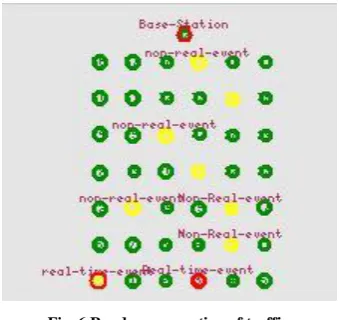
Fig. 6 Random generation of traffic
Fig 6 demonstrates the reenactment situation in which the Packets are produced arbitrarily in the remote sensor system. In certifiable situation the information movement can be anything, for example, crisis therapeutic data, backwoods fire or any sort of common debacle. The Packet/information activity is created haphazardly at the hubs and which should be transmitted through transitional hubs to the base station.
[image:6.595.94.235.523.665.2] [image:6.595.334.532.530.704.2]International Journal of Emerging Technology and Advanced Engineering
Website: www.ijetae.com (ISSN 2250-2459, ISO 9001:2008 Certified Journal, Volume 6, Issue 9, September 2016)
[image:7.595.56.273.137.304.2]210
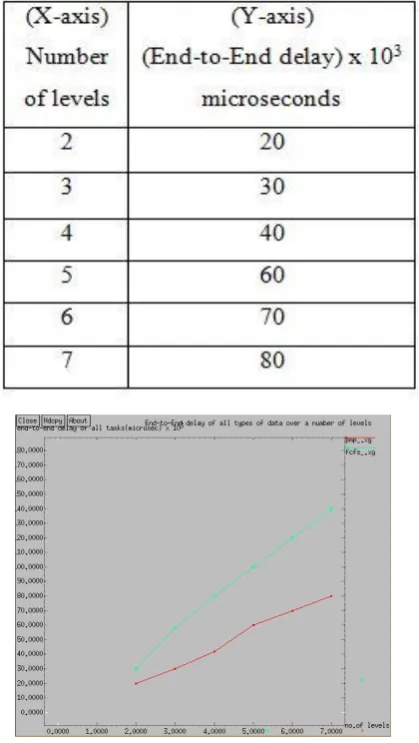
Fig. 7 End-to End delay of real-time-data for different number oflevels (Comparison with FCFS scheduling scheme)
[image:7.595.330.540.146.518.2]Fig 7 is the examination of end-to-end delay got by the proposed parcel planning plan and the current first start things out served system for various number of levels for transmission of ongoing information Packets to the BS. On the off chance that FCFS plan there is no arrangement of information Packets and every one of the information parcels are thought to have same need so they are sent on the premise of their landing time which comes about into longer end-to-end delay for transmission of the information parcels regardless of their significance. From figure 7 obviously the proposed booking plan performs superior to the current plan as far as end-to-end postpone, this is on account of in the proposed plan the most astounding need is given to constant Packets than the non-continuous parcels. Also, ongoing Packets can appropriate the preparing of non-continuous parcels. In this manner, continuous information parcels have lower information transmission delay. The execution (End-to-End delay for a wide range of information Packets) got for different levels of the hubs sending are caught as appeared in table.
International Journal of Emerging Technology and Advanced Engineering
Website: www.ijetae.com (ISSN 2250-2459, ISO 9001:2008 Certified Journal, Volume 6, Issue 9, September 2016)
211
Fig 8 is the examination of end-to-end delay acquired utilizing the proposed parcel planning plan and the current first start things out served plan for various number of levels for transmission of a wide range of information Packets from every hub to the BS. In existing planning plan of FCFS every one of the parcels are sent in first started things out served premise and there is no need doled out to the information Packets in view of their significance which prompts longer end-to-end defer independ-to-endent of sort of information parcels. In this way, from figure 8 plainly the proposed booking plan perform superior to the current first start things out served plan as far as end-to-end delay. This is on account of in the proposed plan we arrange the Packets as ongoing and non-continuous parcels and the most noteworthy need is given to constant parcels than the non-continuous Packets. What's more, ongoing Packets can likewise acquire the preparing of non-continuous parcels. In addition the end-to-end delay acquired considering a wide range of information is still less when contrasted with first started things out served.VI. CONCLUSIONS AND FUTURE SCOPE
The proposed system receives three need lines to plan the approaching parcels on premise of the kind of information Packet and their needs. The hubs in the reproduction of Wireless Sensor Node (WSN) are assembled to shape progressive structure on the premise of jumps they are inaccessible from the BS. The trial result show that proposed booking system has enhanced execution contrasted with the present first start things out served instrument as far as end-to-end deferral of both continuous information and non-constant information while displaying adequate decency towards most minimal need information.
The future work for the proposed planning instrument can be considered as to trim down additional time taken to prepare the Packets and diminishing the transmission capacity usage. Additionally, we can utilize the system of round hold up and pre-emptive instrument approach on suspicion of constant information Packets holding the assets for stretched out time that prompts a halt condition.
REFERENCES
[1] G. Anastasi, M. Conti, and M. Di Francesco, ―Extending the
lifetime of wireless sensor networks through adaptive sleep,‖ IEEE Trans. Industrial Informatics, vol. 5, no. 3, pp. 351–365, 2009.
[2] G. Bergmann, M. Molnar, L. Gonczy, and B. Cousin, ―Optimal
period length for the CQS sensor network scheduling algorithm,‖ in Proc. 2010International Conf. Netw. Services, pp. 192–199
[3] E. Bulut and I. Korpeoglu, ―DSSP: a dynamic sleep scheduling
protocol for prolonging the lifetime of wireless sensor networks,‖ in Proc. 2007International Conf. Advanced Inf. Networking Appl., vol. 2, pp. 725–730.
[4] P. Guo, T. Jiang, Q. Zhang, and K. Zhang, ―Sleep scheduling for
critical event monitoring in wireless sensor networks,‖ IEEE Trans. Parallel Distrib. Syst., vol. 23, no. 2, pp. 345–352, Feb. 2012.
[5] F. Liu, C. Tsui, and Y. J. Zhang, ―Joint routing and sleep
scheduling for lifetime maximization of wireless sensor networks,‖ IEEE Trans. Wireless Commun., vol. 9, no. 7, pp. 2258–2267, July 2010.
[6] O. Khader, A. Willig, and A. Wolisz, ―Distributed wakeup
scheduling scheme for supporting periodic traffic in wsns,‖ in Proc. 2009 European Wireless Conf., pp. 287–292.
[7] B. Nazir and H. Hasbullah, ―Dynamic sleep scheduling for
minimizing delay in wireless sensor network,‖ in Proc. 2011 Saudi International Electron., Communications Photon. Conf., pp. 1–5.
[8] D. Shuman and M. Liu, ―Optimal sleep scheduling for a wireless
sensor network node,‖ in Proc. 2006 Asilomar Conf. Signals, Syst. Comput.,pp. 1337–1341.
[9] N. Edalat, W. Xiao, C. Tham, E. Keikha, and L. Ong, ―A
price-based adaptive task allocation for wireless sensor network,‖ in Proc. 2009IEEE International Conf. Mobile Adhoc Sensor Syst., pp. 888–893.
[10] H. Momeni, M. Sharifi, and S. Sedighian, ―A new approach to
task allocation in wireless sensor actor networks,‖ in Proc. 2009 International Conf. Computational Intelligence, Commun. Syst. Netw., pp. 73–78.
[11] F. Tirkawi and S. Fischer, ―Adaptive tasks balancing in wireless sensor networks,‖ in Proc. 2008 International Conf. Inf. Commun. Technol.:From Theory Appl., pp. 1–6.
[12] X. Yu, X. Xiaosong, and W. Wenyong, ―Priority-based
low-power task scheduling for wireless sensor network,‖ in Proc. 2009 International Symp. Autonomous Decentralized Syst., pp. 1–5.
[13] C. Lu, B. M. Blum, T. F. Abdelzaher, J. A. Stankovic, and T. He,
―RAP a real-time communication architecture for large-scale wireless
sensor networks,‖ in Proc. 2002 IEEE Real-Time Embedded Technol. Appl. Symp., pp. 55–66.
[14] K. Mizanian, R. Hajisheykhi, M. Baharloo, and A. H. Jahangir,
―RACE:a real-time scheduling policy and communication architecture for large scale wireless sensor networks,‖ in Proc. 2009 Commun. Netw. Services Research Conf., pp. 458–460.
[15] M. Yu, S. J. Xiahou, and X. Y. Li, ―A survey of studying on task
scheduling mechanism for TinyOS,‖ in Proc. 2008 International Conf. Wireless Commun., Netw. Mobile Comput., pp. 1–4.
[16] Y. Zhao, Q. Wang, W. Wang, D. Jiang, and Y. Liu, ―Research on
the priority-based soft real-time task scheduling in TinyOS,‖ in Proc. 2009International Conf. Inf. Technol. Computer. Sci., vol. 1, pp. 562–565.
[17] E. M. Lee, A. Kashif, D. H. Lee, I. T. Kim, and M. S. Park, ―Location based multi-queue scheduler in wireless sensor network,‖ in Proc. 2010 International Conf. Advanced Commun. Technol., vol. 1, pp. 551–555.
[18] TinyOS. Available: http://webs.cs.berkeley.edu/tos, accessed June
2010
[19] K. Lin, H. Zhao, Z. Y. Yin, and Y. G. Bi, ―An adaptive double ring scheduling strategy based on TinyOs,‖ J. Northeastern University Natural Sci., vol. 28, no. 7, pp. 985–988, 2007.
[20] E. Karimi and B. Akbari, ―Improving video delivery over wireless