Study and Analysis of Scientific Scopes and Issues
towards Developing an Efficient LECIM
Shah Murtaza Rashid Al
Masud
Faculty of Computer Science and Information Systems
Najran University Najran, Saudi Arabia
ABSTRACT
In the field of communication technology the wireless networking system is rapidly escalating. Due to the usefulness and huge applications of this modern technology it is very important to make the system more effective to the users. In the functional point of view the effectiveness requiring certain criteria including lower energy consumption, security, reliability and lower cost. The recent development of low energy critical infrastructure monitoring (LECIM) [under IEEE P802.15 WPAN‟s task group TG4k] has vast applications including various monitoring and tracking systems. To accomplish the major quality issues and come up into a common and reachable goal LECIM requires more research and enormous concentration. At this moment a vast research scope is open for researchers. In this research paper the authors studied and analyzed the issues, scopes, usefulness, characteristics, requirements, topology, several comparative studies, existing MAC protocols for LECIM and wireless networks, and exiting LECIM applications for further development and improvement of LECIM networks, infrastructures, and applications. This paper will be very helpful for academicians, researchers, and industries towards constructing an efficient and effective LECIM.
General Terms
Wireless Networks, LECIMKeywords
LECIM, WPAN, IEEE, MAC, Network, Applications
1.
INTRODUCTION
In current research epoch critical infrastructure monitoring is one of the foremost and interested domains for researchers, and academicians. Towards effective and better functioning of a society as well as the economy of a society it's important to define and describe some assets and infrastructures those are essential and it can be expressed by using the term critical infrastructure [1]. This is very important to ensure monitoring in order to ensure the preventive maintenance, safety, and reliability. It helps to reduce the overall cost, but at the same time it improves operations, efficiency and increases reliability, reduces outage, speeds up the restoration service and increases safety through the prevention of catastrophic failures, environmental damage, and hazardous leaks [2]. The aforesaid features necessitate enormously low energy usage to maximize the deployment lifetime which are considered as LECIM network. Long lifetime for battery, low energy or
accessibility or availability, robustness or strength, maintainability, and safety or security is the main provisions for such a network [3]. The challenging environment including cities, rural areas, forests, mountains, and below/ underground locations are the required low energy based territory where power mains and the network infrastructures are not readily available. All the endpoints in this network are extremely disseminated and the distance between coordinator and these endpoints may vary up to 20 kilometers and also need to operate for long durations without human interactions. Towards concentrating on LECIM that should support simple and low cost communication environment with consistent or reliable data transfer capabilities, long life battery and power management of the radio the IEEE Task Group 4k is created which is the member of the family IEEE 802.15. LECIM is one of the very recent and new eras in modern information and communication technologies having unique features that require a huge research. In this research paper the authors are studied and analyzed most of the important issues necessitate for further advancement of its architecture, network infrastructure, management along with low energy, high battery life and low cost operations.
The rest of the paper is structured as follows. In Section 2 usefulness of monitoring applications are explicated. In Section 3 areas of LECIM applications are mentioned. In Section 4, we discussed existing wireless network architecture and LECIM Network. In Section 5, LECIM network and applications requirements are defined. In Section 6, LECIM network model and topology are presented. In Section 7, Operating frequency bands for LECIM are defined. In Section 8, we explained existing MAC protocol for LECIM network. In Section 9, we discussed existing LECIM applications. Finally, we conclude and discuss future work in Section 10.
2.
USEFULNESS OF MONITORING
APPLICATIONS
Table 1: Usefulness of LECIM
Main Issues Explanation
Preventive maintenance
Repairs can be scheduled, costs are reduced
Safety Prevention of catastrophic failures, environmental damage, hazardous leaks/spills
Reliability Reduces outage and speeds restoration of service
Cost reduction Cost reduction can be achieved through improved operations and efficiency
3.
AREAS OF LECIM APPLICATIONS
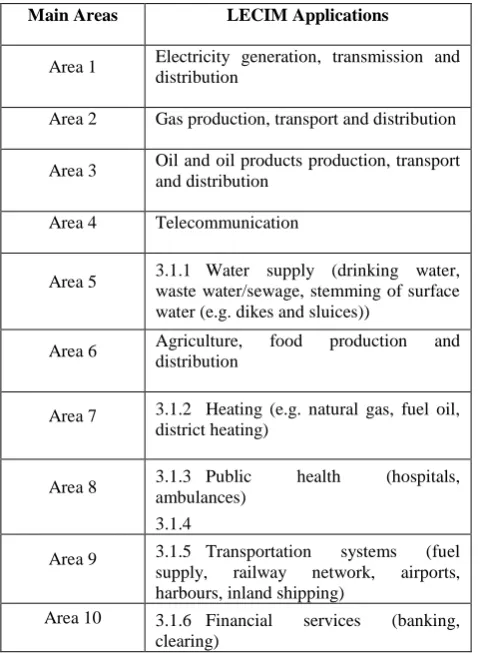
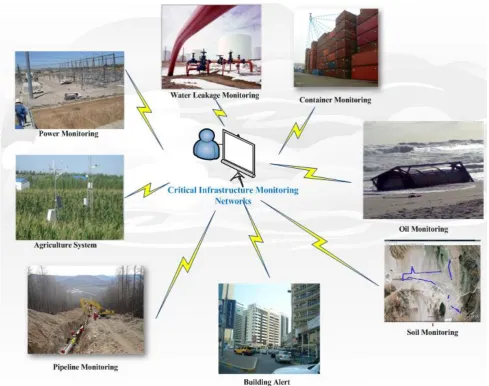
[image:2.595.49.292.379.706.2]Outdoor environment is primarily selected for LECIM applications as presented in Figure 1. The main areas of applications [4] are depicted in Table 2. All these applications are further specifically categorized into four main groups [5] as presented in Table 3. These four categories of LECIM applications are: infrastructure monitoring, transportation and asset tracking, security and life safety, and periodic traffic monitoring.
Table 2: LECIM: Main areas of applications
Main Areas LECIM Applications
Area 1 Electricity generation, transmission and distribution
Area 2 Gas production, transport and distribution
Area 3 Oil and oil products production, transport and distribution
Area 4 Telecommunication
Area 5 3.1.1 Water supply (drinking water, waste water/sewage, stemming of surface water (e.g. dikes and sluices))
Area 6 Agriculture, food production and distribution
Area 7 3.1.2 Heating (e.g. natural gas, fuel oil, district heating)
Area 8 3.1.3 Public health (hospitals, ambulances)
3.1.4
Area 9 3.1.5 Transportation systems (fuel supply, railway network, airports, harbours, inland shipping)
Area 10 3.1.6 Financial services (banking, clearing)
Area 11 3.1.7 Security services (police, military)
Area 12 3.1.8 Environmental monitoring (emissions, chemicals)
4.
EXISTING WIRELESS NETWORK
ARCHITECTURE AND LECIM
NETWORK
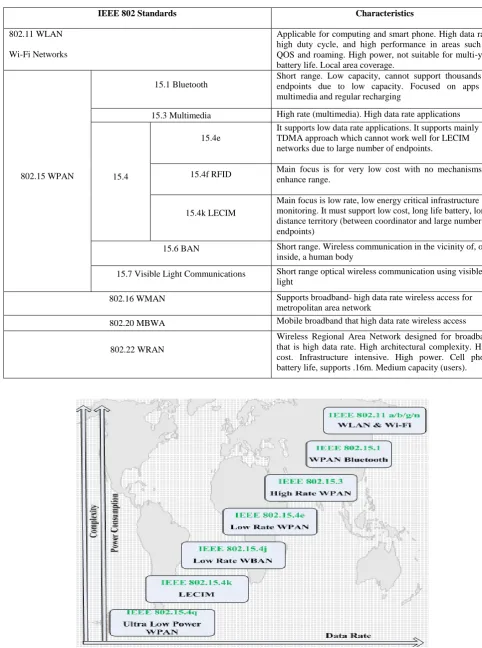
Existing architecture based on wireless communication network can‟t support the LECIM applications because LECIM architecture requires low energy, long life battery, low data rate and low cost communication infrastructure. The Table 4 shows the differences between existing architecture of several wireless technologies and LECIM requirements towards critical infrastructure monitoring. IEEE 802 standard for wireless technology consists of some working groups which support various wireless applications namely IEEE 802.11 WLAN, IEEE 802.15 WPAN or more specifically 15.1 Bluetooth, 15.3 Multimedia, 15.4e, 15.4f RFID, 15.4k LECIM, 15.6 BAN, 15.7 Visible light communication, IEEE 802.16 WMAN, IEEE 802.20 MBWA, IEEE 802.22 WRAN. The Table 5 shows the main characteristics of these existing technologies and their limitations towards fulfill the essential LECIM that is 15.4k requirements. The operating space of various WLAN and WPAN shows the increasing and decreasing rate of these networks‟ complexity, power consumption rate, and data flow rate as depicted in Figure 2 [6].
5.
LECIM NETWORK AND
[image:2.595.307.546.531.689.2]APPLICATIONS REQUIREMENTS
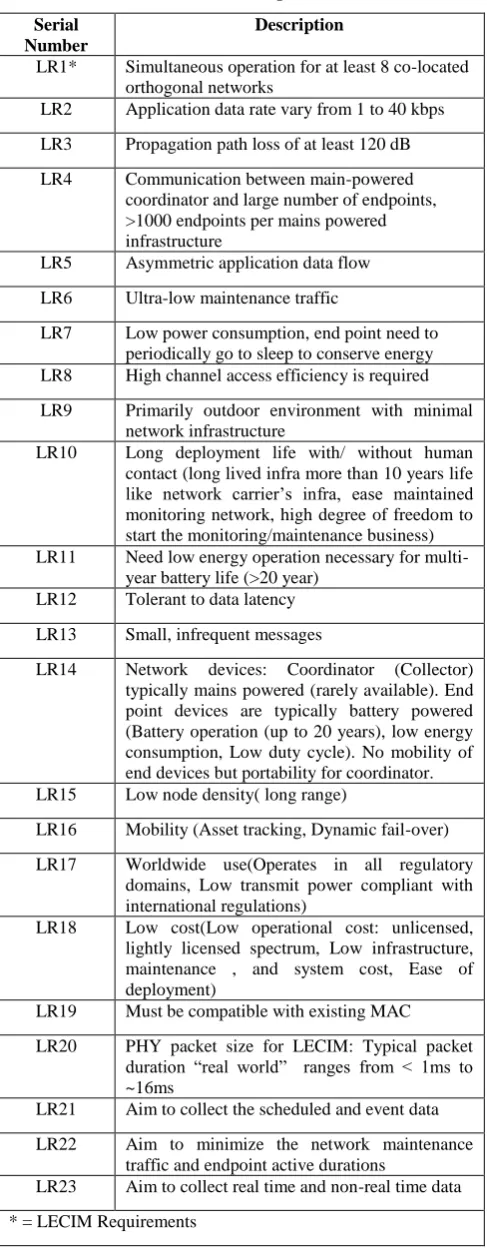
Requirements of LECIM are based on LECIM network that is infrastructures and LECIM applications. Low energy, long lifetime, scalability, reliability, availability, robustness, maintainability, and security are network based requirements, where large path loss, minimal infrastructure requirements, and multi-year battery life are applications based requirements. The overall LECIM requirements are illustrated in Table 6 [7] [8] [9]. And design requirements on LECIM MAC are illustrated in Table 7 [10].Table 4: Existing architecture vs. LECIM
Existing Architecture
Main Features
Satellite link High power, High cost, Subscriber fees
Cellular High power, Coverage, Subscriber fees
Wireless SCADA High unit, and installation costs, Limited capacity, High power, Proprietary
LECIM Low power, Low cost, Long life battery, Low data rate, Long distance territory.
Figure 1: LECIM applications monitoring networks
Table 3: Specifically categorized of LECIM applications
Infrastructure Monitoring Transportation and Asset
tracking
Security and Life Safety Periodic traffic
monitoring
• Urban WSN
• Water leak detection
• Sewer monitoring
• Structural integrity monitoring
• Building monitoring
• Streetlight control systems
• Soil monitoring
• Oil and gas pipeline monitoring
• Agriculture monitoring
• Electric substation monitoring
• Location tracking
• Wastewater monitoring
• Machine/Server room monitoring
• First Responder monitoring
• border surveillance
• Car parking management
• Bridge monitoring
• Public transport tracking
• Cargo container monitoring
• Railroad condition monitoring
• Traffic congestion monitoring
• Railroad condition monitoring
• Personal tracking
• Gas/hazardous material detection
• Perimeter security
• Fault Circuit Indicators
• Border surveillance
• Medical alert for at-risk populations
• First responder tracking
• Gas meter
• Water meter
• Electric meter
• Net metering
[image:3.595.63.537.500.744.2]Table 5: Main characteristics of IEEE 802 Standards and 15.4k LECIM
IEEE 802 Standards Characteristics
802.11 WLAN
Wi-Fi Networks
Applicable for computing and smart phone. High data rate, high duty cycle, and high performance in areas such as QOS and roaming. High power, not suitable for multi-year battery life. Local area coverage.
802.15 WPAN
15.1 Bluetooth
Short range. Low capacity, cannot support thousands of endpoints due to low capacity. Focused on apps of multimedia and regular recharging
15.3 Multimedia High rate (multimedia). High data rate applications
15.4
15.4e
It supports low data rate applications. It supports mainly TDMA approach which cannot work well for LECIM networks due to large number of endpoints.
15.4f RFID Main focus is for very low cost with no mechanisms to enhance range.
15.4k LECIM
Main focus is low rate, low energy critical infrastructure monitoring. It must support low cost, long life battery, long distance territory (between coordinator and large number of endpoints)
15.6 BAN Short range. Wireless communication in the vicinity of, or inside, a human body
15.7 Visible Light Communications Short range optical wireless communication using visible light
802.16 WMAN Supports broadband- high data rate wireless access for metropolitan area network
802.20 MBWA Mobile broadband that high data rate wireless access
802.22 WRAN
[image:4.595.50.540.85.490.2]Wireless Regional Area Network designed for broadband that is high data rate. High architectural complexity. High cost. Infrastructure intensive. High power. Cell phone battery life, supports .16m. Medium capacity (users).
Table 6: LECIM requirements
Serial Number
Description
LR1* Simultaneous operation for at least 8 co-located orthogonal networks
LR2 Application data rate vary from 1 to 40 kbps
LR3 Propagation path loss of at least 120 dB
LR4 Communication between main-powered coordinator and large number of endpoints, >1000 endpoints per mains powered infrastructure
LR5 Asymmetric application data flow
LR6 Ultra-low maintenance traffic
LR7 Low power consumption, end point need to periodically go to sleep to conserve energy LR8 High channel access efficiency is required
LR9 Primarily outdoor environment with minimal network infrastructure
LR10 Long deployment life with/ without human contact (long lived infra more than 10 years life like network carrier‟s infra, ease maintained monitoring network, high degree of freedom to start the monitoring/maintenance business) LR11 Need low energy operation necessary for
multi-year battery life (>20 multi-year) LR12 Tolerant to data latency
LR13 Small, infrequent messages
LR14 Network devices: Coordinator (Collector) typically mains powered (rarely available). End point devices are typically battery powered (Battery operation (up to 20 years), low energy consumption, Low duty cycle). No mobility of end devices but portability for coordinator. LR15 Low node density( long range)
LR16 Mobility (Asset tracking, Dynamic fail-over)
LR17 Worldwide use(Operates in all regulatory domains, Low transmit power compliant with international regulations)
LR18 Low cost(Low operational cost: unlicensed, lightly licensed spectrum, Low infrastructure, maintenance , and system cost, Ease of deployment)
LR19 Must be compatible with existing MAC
LR20 PHY packet size for LECIM: Typical packet duration “real world” ranges from < 1ms to ~16ms
LR21 Aim to collect the scheduled and event data
LR22 Aim to minimize the network maintenance traffic and endpoint active durations
LR23 Aim to collect real time and non-real time data
[image:5.595.304.549.82.283.2]* = LECIM Requirements
Table 7: LECIM MAC Requirements
Serial Number
Description
LMR1* Guaranteed link access on low duty cycle with low energy (management frame from coordinator for optimized configuration and ease maintenance, link power management) LMR2 Support to fair access between near and far
nodes
LMR3 Minimize contention on a link (distribute access loads on slotted link, three grades of
link access)
LMR4 Time-stamping (global time synchronization, adjust clock drift with light overhead) LMR5 Support to ease installation LMR6 Support to ease maintenance LMR7 Support to make network structure simple LMR8 Optimized to network configuration * = LECIM MAC Requirements
6.
LECIM NETWORK MODEL AND
TOPOLOGY
The purpose of TG4k group is to facilitate single point to multi-thousands of point‟s communication for critical infrastructure monitoring. The main components of LECIM network are coordinator or collector, devices or end points, and repeater. Coordinator is generally mains powered, and endpoints are battery powered. Endpoints require mobility and supports portability for coordinator. They can communicate between each other [11]. Topology used in LECIM is star topology that supports one to multipoint communication as shown in the Figure 3. LECIM network consists of only one coordinator that supports many devices. Topology of LECIM network may vary and it could be as near node, far node, linear, group, distributed, and range [10].
[image:5.595.318.543.467.646.2]7.
OPERATING FREQUENCY BANDS
FOR LECIM
Like IEEE 802.15.4, we propose three applicable frequency bands, and 27 channels with different bandwidth for LECIM networks. 16 channels are in 2.4 GHz band, 10 channels are in 915MHz band and 1 channel is in the 868MHz frequency band for certain applications.
8.
EXISTING MAC PROTOCOLS FOR
LECIM NETWORK
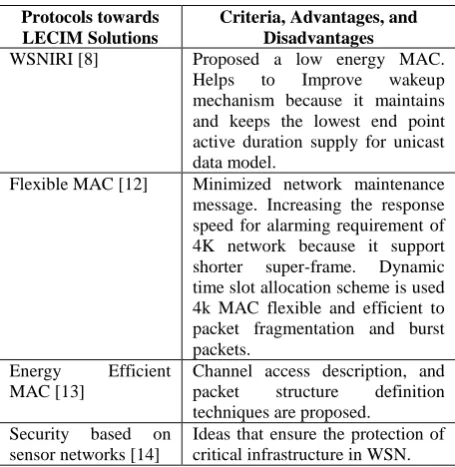
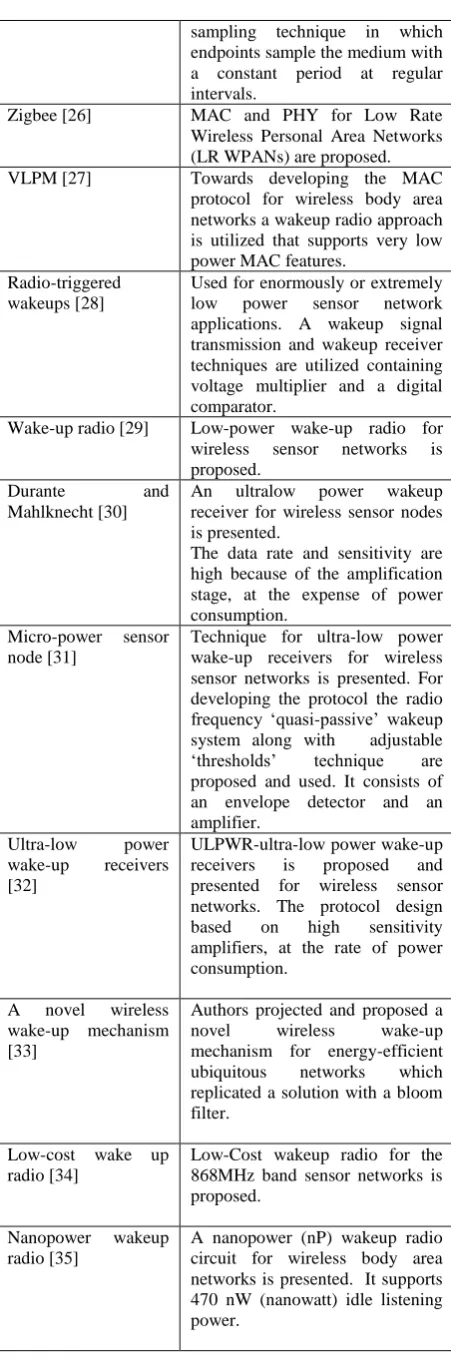
[image:6.595.53.281.536.770.2]The existing wireless technology can‟t gratify all the requirements of low energy based critical infrastructure monitoring applications. Towards developing a standard communication standard for LECIM applications IEEE task group 4K has been formed under full supervision of IEEE 802.15 working group. Some important issues related to developing efficient LECIM applications can be summarized like, protection of the sensed data, accessing the shared medium in LECIM network; endpoints sleep time; proper coordination between coordinator and endpoints basically the way of knowing how the endpoints will know that the coordinator wants to send them the data is a challenging job where battery power must work for several years; lack of energy conservation mechanism, where most of the existing MAC protocols that support wireless sensor networks can‟t support this important issue; determining the status of the channel, in LECIM this is very important because most of the nodes in LECIM system are situated in long distance and the distance among the nodes are also long, the large number of endpoints are also a crucial factor. In order to solve this problem the existing contention-based and scheduled-based MAC protocols are not the appropriate solution, it needs to give more attention to solve the above mentioned problems. After forming the IEEE TG4k for LECIM applications solutions many researchers have denoted, designed, and proposed some MAC protocol for IEEE 802.15.4k standard. In this research paper the authors studied and analyzed the major criteria, advantages, and disadvantages of existing wireless sensor network (WSN) based MAC protocols along with new MAC proposals for LECIM network infrastructures and applications those are represented in Table 8.
Table 8: Study and analysis of new and existing MAC protocols for LECIM solutions
Protocols towards LECIM Solutions
Criteria, Advantages, and Disadvantages
WSNIRI [8] Proposed a low energy MAC. Helps to Improve wakeup mechanism because it maintains and keeps the lowest end point active duration supply for unicast data model.
Flexible MAC [12] Minimized network maintenance message. Increasing the response speed for alarming requirement of 4K network because it support shorter super-frame. Dynamic time slot allocation scheme is used 4k MAC flexible and efficient to packet fragmentation and burst packets.
Energy Efficient MAC [13]
Channel access description, and packet structure definition techniques are proposed. Security based on
sensor networks [14]
Ideas that ensure the protection of critical infrastructure in WSN.
Roles for LECIM protection [15]
The authors provide an overview of the main challenges and open research issues on critical information infrastructure security Data survivability
model [16]
Recognized and identified the precise security requirements. The symmetric keys and lightweight key distribution techniques are used for monitoring and could be benefited for applications like perimeter surveillance and pipeline monitoring.
Ultra-lightweight key [17]
Proposed model helps to maximize the amount of monitoring-related data from disaster after surviving. Set up techniques for proper distribution of sensors in LECIM applications. Suitable for oil monitoring. Improving medium
reliability [3]
Proposed a model to improve apparent reliability of the medium. Shown a technique to acclimatize LECIM PHYs to operate with existing MAC.
4e TSCH [18] IEEE 802.15.4e time slotted channel hopping (TSCH) resource management scheme is proposed for LECIM MAC. Techniques to minimizing the negative effects of multipath fading and interference are discussed
MAC for wide area monitoring [19]
Projected and proposed contention free low-energy link access for LECIM by distributing the access load on a slotted link.
Flexible MAC [20] A flexible MAC proposal for TG4k networks is presented. A super frame structure is discussed and time slot allocation-based MAC is presented.
Energy Efficient MAC [21]
A batch transmission MAC which is based on IEEE 802.15.4e target group is proposed. A basic coordinated sleeping (CSL) operation system is also projected and proposed.
T-MAC [22] The proposed protocol is used to abridge or shorten the active period if the channel is idle for a short time. In the case of data and information, the node remains active till data reception or until the active period ends.
B-MAC [23] The proposed protocol operated and utilized low power listening (LPL) and an comprehensive preamble to achieve low power communication.
X-MAC [24] A diminutive or short preamble MAC protocol for duty-cycled wireless sensor networks is proposed.
sampling technique in which endpoints sample the medium with a constant period at regular intervals.
Zigbee [26] MAC and PHY for Low Rate Wireless Personal Area Networks (LR WPANs) are proposed. VLPM [27] Towards developing the MAC
protocol for wireless body area networks a wakeup radio approach is utilized that supports very low power MAC features.
Radio-triggered wakeups [28]
Used for enormously or extremely low power sensor network applications. A wakeup signal transmission and wakeup receiver techniques are utilized containing voltage multiplier and a digital comparator.
Wake-up radio [29] Low-power wake-up radio for wireless sensor networks is proposed.
Durante and
Mahlknecht [30]
An ultralow power wakeup receiver for wireless sensor nodes is presented.
The data rate and sensitivity are high because of the amplification stage, at the expense of power consumption.
Micro-power sensor node [31]
Technique for ultra-low power wake-up receivers for wireless sensor networks is presented. For developing the protocol the radio frequency „quasi-passive‟ wakeup system along with adjustable „thresholds‟ technique are proposed and used. It consists of an envelope detector and an amplifier.
Ultra-low power wake-up receivers [32]
ULPWR-ultra-low power wake-up receivers is proposed and presented for wireless sensor networks. The protocol design based on high sensitivity amplifiers, at the rate of power consumption.
A novel wireless wake-up mechanism [33]
Authors projected and proposed a novel wireless wake-up mechanism for energy-efficient ubiquitous networks which replicated a solution with a bloom filter.
Low-cost wake up radio [34]
Low-Cost wakeup radio for the 868MHz band sensor networks is proposed.
Nanopower wakeup radio [35]
A nanopower (nP) wakeup radio circuit for wireless body area networks is presented. It supports 470 nW (nanowatt) idle listening power.
ALOHA MAC [36] A dynamic framed ALOHA MAC for LECIM was proposed. The main features are: a beacon enabled super frame is used with EAP and NAP periods (with GTS for regular traffic), researchers analyzed throughput for different frame sizes and found optimum network size and utilization factor. Proposed protocol is simple to implement and flexible in terms of network size.
9.
EXISTING LECIM APPLICATIONS
[image:7.595.54.280.62.746.2]Table 9: Major LECIM Applications and Their Key Factors
LECIM Applications
Key Factors
Water Leakage Detection [37]
Underground logging systems that are large number of sensors those are permanently installed.
Long Range. Long lifetime battery.
Small data message and alarm event for leak detection
Low installation and maintenance cost Easy deployment
Oil and Gas Pipeline
Monitoring [37]
Major challenge: Pipeline sabotage, vandalism and security related issues. It ultimately increases operational costs, lost revenue and damage to corporate image.
It is very important to monitor and protect pipelines for failures, damage and theft.
Key factors:
Safety (human / environment) Reliability (critical resources) Cost savings (increasing cost) Compliance (regulators) Container
tracking [38]
Main features:
Ensure container‟s security Streamline supply chain Prevent loss
Reduce terrorism risk Reduce cost
Improve customer service Update status real-time status Monitoring communication technologies including satellite communication, RFID, Wi-Fi, UWB, Bluetooth, OCR, ZigBee
Application requirements:
Real time seamless monitoring including:
Good coverage Low infrastructure cost Low operational cost
Ability to install node inside container Battery life: > 2 years
Includes variety of sensors in same node (temperature, vibration, door open/ close
Access point connected to backhaul Includes variety of sensors in same node (temperature, vibration, door open/ close
Access point connected to backhaul
Agriculture [39] Green House:
Information in Green house collected by sensors. Major information like: Temperature
Humidity
PH, CO2 and other soil factors. Communication networks implement the remote monitor, real-time control
and quick actions.
Communication technology:
GPRS/GSM/3G, Internet, WPAN, but WPAN and 3G is an excellent application
Key factors related to smart agriculture:
Super Power Consumption
Networking support: Large scale network to cover wide fields, Mesh or Super-Tree Networking for complicated environment, Connecting WPAN with Mobile Networks. Reliability and Cost
Remote monitoring: Smart Buoys [40]
Application challenges: different user vessels, minimum maintenance cost Main features: Guarantee protected and secure mooring, confirm real time monitoring, prevent loss of buoys, ensure payment of service, reduce cost, and improve customer service. Monitoring communication technologies including satellite communication and GSM.
Application requirements for real time monitoring that supports:
Good coverage Low infrastructure cost Low operational cost
Ability to install node inside buoys Battery life: > 1 year
Includes variety of sensors in same node
Several square miles coverage with hundreds of buoys
Remote monitoring: Smart water meters, Smart gas meters [40]
Application challenges:
Bidirectional communication between system and meter
Large number of meters within urban areas
Large area of coverage for rural areas
Main features:
Monthly, daily, 15-min measuring Measuring on demand
Dynamic pricing Reduce cost
Improve customer service
Metering communication technologies including PLC (Power Line Communication), GSM, Euridis and ZigBee
Soil Monitoring [41]
Application challenges:
Sensors need to be installed in the soil once the crop is planted and removed at the end of the season.
The solar power and antenna need to extend above the bio mass.
Farmland may or may not have cellular connectivity.
Requirements:
Low power consumption.
Access point connected to wired or wireless internet connection.
Very high up-times with self recovery in case of break downs. No technical staff nearby.
Real time seamless monitoring including:
Good coverage – 10 miles or better Low infrastructure cost
Low operational cost Electronic
Equipment Monitoring [42]
Major challenges: Find fault circuit quickly, Prevent from stolen or damage. Major requirements:
Small data packet
Long distance transmission Anti-Interference
Location Tracking Application [43]
Major applications including: Soldiers in training
Security personnel at critical infrastructure
Coast Guard ports, vessels, and personnel
Forest fire fighting
Community (Large & Small) Emergency Management
Remote area monitoring
Geo-Fencing and unattended monitoring
Main reason:
>90% of security and emergency personnel are not being tracked while on duty.
Usefulness:
Enhance safety – nobody gets lost. Enhance learning opportunities – mapping the war games.
Improve logistics for all involved participants.
Major application challenges: Remote environments with limited or no other infrastructure
Rough terrain, heavy foliage
Must require limited network infrastructure to cover training locations
Key features:
Ensure secure communications Ensure real time monitoring Alert if soldier is not moving
Provide alert mechanism for soldier (2 way system)
Improve operational & situational awareness for supervisors
Major challenges:
Tracking to ensure safety and security Operational efficiency
Guarding critical infrastructure Responding to emergencies and natural disasters
Location tracking communication technologies including Satellite communication, GSM
Application requirements:
Long range coverage Low infrastructure cost Low operational cost Battery life: Several days
Two way communication for alerting and acknowledgements
High level of security and reliability Option to integrate location data with a host of legacy location awareness applications
Option to operate entire system as a mobile entity
Distribution
Grid and
Substation Monitoring [44]
Areas of applications:
Distribution Grid Sensor or Fault Current Indicators.
Key features:
In the tens of thousands Overhead and underground
Monitor state, possibly number of events
Distribution Transformers. Key features:
In the hundreds of thousands Voltage and current, power out Monitoring Remote Terminal Units. Key features:
Condition based monitoring Improve outage resolution
10.
CONCLUSION
The IEEE 802.15.4k task group is intended as an improvement to IEEE 802.15.4 to support and facilitate point to multipoint communication for LECIM devices. TG4k is formed to address the LECIM. LECIM networks are anticipated to perform significant roles in supporting the monitoring and management needs of critical infrastructure applications and networks management. It's a very recent and modern research arena and there are a huge scopes for the researchers to contribute their skills, knowledge and interests in this field. The main issues related to this research ground are low energy consumption, low data rate, long battery life, low cost and scalability. Still there is no protocol standard for LECIM that supports all these criteria mentioned previously, so there is an enormous scope to work on it. In this paper towards designing and developing an efficient LECIM network all the major characteristics, requirements, existing LECIN networks model, topology and frequency bands; existing MAC protocol for LECIM networks, and existing LECIM applications with their potentiality, merit and demerit are studied, analyzed, and exploited. This will help the researchers for further study, and exploration towards improving LECIM as a whole.
11.
REFERENCES
[1] Critical Infrastructure_ basic information http://en.wikipedia.org/wiki/Critical_infrastructure [2] Joaquin Silva, „Low Energy Critical Infrastructure
Monitoring‟, 15-10-0528-00-leci-low-energy-critical-infrastructure-monitoring.pptx
[3] Benjamin Rolfe, Preliminary Fragmentation Proposal for TG4k, 15-11-0478-00-004k-fragmentation-proposal-for-tg4k.pptx
[4] David A. Howard, IEEE 802.15.LECIM Interest Group Call For Applications, doc: IEEE P802.15-15-10-0128-00-leci
[5] https://mentor.ieee.org/802.15/dcn/10/15-10-0053-00-wng0-low-energy-critical-iinfrastructure monitoring.pptx [6]
https://mentor.ieee.org/802.15/dcn/10/15-10-0053-00-wng0-low-energy-critical-iinfrastructure-monitoring.pptx [7] David Howard, SG Low Energy, Critical Infrastructure
Monitoring (LECIM) Project Draft PAR, 15-10-0756-09-leci-sglecim-par-draft.docx
[8] Yang Yang, Xiang Wang, Heqing Huang, Jie Shen, Tao Xing, Haitao Liu, Betty Zhao, „Low Energy MAC Proposal for TG4k_WSNIRI‟, 15-11-0596-00-004k-wsniri-low-energy-mac-proposal-for-tg4k.ppt
[9] Kyungsup Kwak, Jaedoo Huh, Hyung Soo Lee, M. Al Ameen, Niamat Ullah, M.S. Chowdhury, „A Dynamic Framed Slotted ALOHA protocol for LECIM Networks‟, 15-11-0486-03-004k-inha-etri-tg4k-proposal.pptx
[10]Seong-Soon Joo, Jong-Arm Jun, Cheol-Sig Pyo, MAC Proposal for Low-Energy Wide Area Monitoring, 15-11-0597-00-004k-lecim-mac-proposal-for-tg4k.ppt [11]P. Kinney, “LECIM Call for Proposals, IEEE
P802.15-11-0147-02-004k, 2011,
https://mentor.ieee.org/802.15/documents
[12]Yong Li, Ping Wang, Heng Wang, „A Flexible MAC Proposal for TG4k Networks‟, 15-11-0606-01-004k-a-flexible-mac-proposals-for-tg4k-networks.ppt
[13]Hao Liu, Guolian Yao, Pingping Xu, „Energy Efficient MAC protocol for Low Energy Critical Infrastructure Networks‟, 15-11-0619-00-004k-energy-effi-mac-for-lecim.ppt
[14]J. Lopez, J. A. Montenegro, and R. Roman, “Service-oriented security architecture for CII based on sensor networks,” in 2nd International Workshop on Security, Privacy and Trust in Pervasive and Ubiquitous Computing (SecPerU ‟06), pp. 1–6, June 2006.
[15]R. Roman, C. Alcaraz, and J. Lopez, “The role ofWireless Sensor Networks in the area of Critical Information Infrastructure Protection,” Information Security Technical Report, vol. 12, no.1, pp. 24–31, 2007.
[16]M. Albano, S. Chessa, and R. Di Pietro, “A model with applications for data survivability in Critical Infrastructures,” International Journal of Information Assurance and Security, vol. 4, pp. 629–639, 2009 [17]K. M. Martin and M. B. Paterson, “Ultra-lightweight key
pre distribution in wireless sensor networks for monitoring linear infrastructure,” in 3rd IFIP WG 11.2 International Workshop on Information Security Theory and Practice (WISTP ‟09), vol. 5746 of Lecture Notes in Computer Science, pp. 143–152, 2009.
[18]J. Schwoerer and N. Dejean, “Elster & France Telecom proposal, doc.: IEEE 802. 15-11-0479-01-004k,” 2011, https://mentor.ieee.org/802.15/documents
[19]S. S. Joo, J. A. Jun, and C. S. Pyo, “MAC Proposal for Low-Energy Wide Area Monitoring, doc.: IEEE 802. 15-11-0597-01-004k,”2011,
https://mentor.ieee.org/802.15/documents.
[20]Y. Li, P. Wang, and H. Wang, “A Flexible MAC Proposal for TG4k Networks, doc.: IEEE 802. 15-11-0606-01-004k,”2011,
https://mentor.ieee.org/802.15/documents
[21]H. Liu, G. Yao, and P. Xu, “Energy Efficient MAC protocol for Low Energy Critical Infrastructure Networks, doc.: IEEE 802.15-11-0619-01-004k,” 2011, https://mentor.ieee.org/802.15/documents
[22]T. Van Dam and K. Langendoen, “An adaptive energy efficient MAC protocol for wireless sensor networks,” in 1st International Conference on Embedded Networked Sensor Systems (SenSys ‟03), pp. 171–180, Los Angeles, Calif, USA, November 2003.
[23]J. Polastre, J. Hill, and D. Culler, “Versatile low power media access for wireless sensor networks,” in 2nd International Conference on Embedded Networked Sensor Systems (SenSys ‟04), pp. 95–107, NewYork, NY, USA, November 2004.
[24]M. Buettner, G. V. Yee, E. Anderson, and R. Han, “X-MAC: a short preamble MAC protocol for duty-cycled wireless sensor networks,” in 4th International Conference on Embedded Networked Sensor Systems (SenSys ‟06), pp. 307–320, New York, NY, USA, November 2006.
[25]A. El-Hoiydi and J. D. Decotignie, “WiseMAC: an ultra low power MAC protocol for the downlink of infrastructure Wireless Sensor networks,” in 9th International Symposium on Computers and Communications (ISCC ‟04), pp. 244–251, July 2004. [26]IEEE, “Wireless Medium Access Control (MAC) and
Physical Layer (PHY) specifications for Low Rate Wireless Personal Area Networks (LR-WPANS),” IEEE 802.15.4-2003, 2003
[27]N. Ullah, P. Khan, and K. S. Kwak, “A very low power MAC (VLPM) protocol for wireless body area networks,” Sensors, vol. 11, no. 4, pp. 3717–3737, 2011 [28]J. Ansari, D. Pankin, and P. M¨ah¨onen, “Radio-triggered
wakeups with addressing capabilities for extremely low power sensor network applications,” International Journal of Wireless Information Networks, vol. 16, no. 3, pp. 118–130, 2009.
[29]P. Le-Huy and S. Roy, “Low-power wake-up radio for wireless sensor networks,” Mobile Networks and Applications, vol. 15, no. 2, pp. 226–236, 2010
[30]M. S. Durante and S.Mahlknecht, “An ultra low power wakeup receiver for wireless sensor nodes,” in 3rd International Conference on Sensor Technologies and Applications (SENSORCOMM ‟09), pp. 167–170, June 2009.
[31]M.Malinowski,M.Moskwa, M. Feldmeier, M. Laibowitz, and J. A. Paradiso, “CargoNet: a low-cost micro-power sensor node exploiting quasi-passive wakeup for adaptive asynchronous monitoring of exceptional events,” in 5th ACM Conference on Embedded Networked Sensor Systems (SenSys ‟07), pp. 145–159, November 2007.
[32]N. Pletcher and J. M. Rabaey, “Ultra-low power wake-up receivers for wireless sensor networks,” Tech. Rep. UCB/EECS-2008-59, EECS Dept, Univ. of California, Berkeley, Calif, USA, May 2008.
mechanism for energy-efficient ubiquitous networks,” in IEEE International Conference on Communications Workshops (ICC ‟09), June 2009.
[34]B. V. der Doorn, W. Kavelaars, and K. Langendoen, “A prototype Low-Cost wake up radio for the 868MHz band,” International Journal of Sensor Networks, vol. 5, no. 1, pp. 22–32, 2009
[35]S. Marinkovic and E. Popovici, “Nano-power Wake-Up Radio circuit for wireless body area networks,” in IEEE Radio and Wireless Symposium (RWS ‟11), pp. 398– 401, January 2011
[36]Kyungsup Kwak, Jaedoo Huh, Hyung Soo Lee, M. Al Ameen, Niamat Ullah, M.S. Chowdhury, „A Dynamic Framed Slotted ALOHA protocol for LECIM Networks‟, 15-11-0486-03-004k-inha-etri-tg4k-proposal.pptx [37]Johan Becker, Mike Calcagno, David Howard, „Low
Energy Critical Infrastructure Monitoring‟, 15-10-0053-
00-wng0-low-energy-critical-iinfrastructure-monitoring.pptx
[38]Roberto Aiello, „Container Monitoring Application‟, 15-10-0186-00-leci-container-tracking-application.pptx
[39]Liang Zhang, Bo Hu, Z.F. Zhao, Tao Xing, Haitao Liu, Betty Zhao, „Super-low Energy Consumption WPAN Application Case: Wireless Environment Monitor in Smart Agriculture‟, 15-10-0291-00-leci-super-low- energy-consumption-wpan-application-case-wireless-environment-monitor-in-smart-agricultur.ppt
[40]Nikica Mikulandra, 'Remote Monitoring Applications', 15-10-0297-01-leci-remote-monitoring-applications.pptx [41]Peter Ellegaard, „Soil Monitoring Application‟,
15-10-0299-00-leci-soil-monitoring-application.ppt
[42]JF Luo, Y Yang, Y X Fu, J Shen, X Wang, X Tao, Haituo Liu, L Li, „Low Energy Critical Infrastructure Monitoring Application in China‟, 15-10-0307-00-leci-
low-energy-critical-infrastructure-monitoring-application-in-china.pptx
[43]Stephen Gamache, 'Location Tracking Applications', 15-10-0519-00-leci-location-tracking-application.pptx [44]Mike Calcagno, „Use Case: Distribution Grid and