http://dx.doi.org/10.4236/ojs.2014.44029
A Class of Estimators for Population Ratio in
Simple Random Sampling Using Variable
Transformation
A. C. Onyeka, V. U. Nlebedim, C. H. Izunobi
Department of Statistics, Federal University of Technology, Owerri, Nigeria
Email: [email protected], [email protected], [email protected]
Received 25 April 2014; revised 19 May 2014; accepted 8 June 2014
Copyright © 2014 by authors and Scientific Research Publishing Inc.
This work is licensed under the Creative Commons Attribution International License (CC BY). http://creativecommons.org/licenses/by/4.0/
Abstract
This paper is an extension and generalization of the study carried out by [1] on the estimation of
the population ratio (R) of the population means of two variables (y and x) under Simple Random
Sampling (SRS) scheme, using a variable transformation of the auxiliary variable, x. All the six es-
timators proposed by [1] are easily identified as special cases of the proposed class of estimators.
Asymptotic properties of the proposed class of estimators are derived theoretically and subse- quently verified using empirical illustrations. Some of the proposed estimators are found to have
relatively large gains in efficiency over the customary ratio estimator,
R
ˆ
=
y x
/
for the given dataset.
Keywords
Variable Transformation, Ratio, Product and Regression-Type Estimators, Mean Squared Error
1. Introduction
Let n units be drawn from a population of N units using simple random sampling without replacement (SRSWOR) method, and let y xi
( )
i be ith observations on the study (auxiliary) variable. Reference [2] consi- dered the following variable transformation of the auxiliary variable, x, under the simple random sampling scheme.*
, 1, 2, , i
i
NX nx
x i N
N n
−
= =
− , (1)
while [6] employed the transformation for mean estimation under the post-stratified sampling scheme. An ex- pression of the (transformed) sample mean associated with the variable transformation in (1) is given as:
(
)
* 1 , n
x X x
N n
π π π
= + − =
− (2)
where x X
( )
is the sample (population) mean of the auxiliary variable, x.Using the variable transformation (1), the following six estimators for the estimation of the population ratio, R, were proposed by [1] in simple random sampling without replacement (SRSWOR) scheme:
(
)
1 *
ˆ y
R
x b x X
=
− − (regression-type estimator based on x) (3)
* 2
*
ˆ y yx
R
x xX
X x
= =
(ratio-type estimator based x) (4)
3 * *
ˆ y yX
R
xx xx
X
= =
(product-type estimator based on x or *
x ) (5)
4 *
ˆ y
R x
= (simple ratio estimator based on x*) (6)
(
)
5 *
ˆ y
R
x b x X
=
− − (regression-type estimator based on
*
x ) (7)
6 * *
ˆ y yx
R
x X x
X x
= =
(ratio-type estimator based on *
x ) (8)
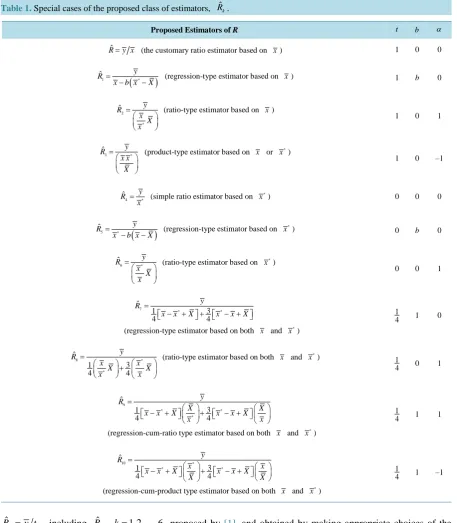
where y is the sample mean of the study variable, y, and b is a suitable constant, often chosen to be close to the population regression coefficient of y on x. In the present study, we introduce a class of estimators, which is both a generalization and an extension of the estimators (3) to (8), proposed by [1]. We observe that apart from the customary ratio estimator, Rˆ =y x, other estimators of the population ratio, R, in literature, like those proposed by [7]-[9], often require additional information on some auxiliary variables, and consequently involv- ing extra funds. Reference [1] argued that suchextra costs could be avoided by using variable transformation of the already observed auxiliary variable, x. Accordingly, cost reduction in constructing estimators of the popula- tion ratio, R, is a strong motivation for the general class of estimators, which the present study seeks to introduce in the estimation of population ratio, R, using variable transformation.
2. The Proposed Class of Estimators
Following [1], we propose a class of estimators of the population ratio (R) of the population means of two va- riables (y and x) under simple random sampling without replacement (SRSWOR) scheme, using variable trans- formation of the auxiliary variable, x, as:
ˆ
k k
R =y t (9)
where
(
*)
(
)
*(
)
* 1
k
X X
t t x b x X t x b x X
x x
α α
= − − + − − −
(10)
Table 1. Special cases of the proposed class of estimators, ˆRk.
Proposed Estimators of R t b α
ˆ
R=y x (the customary ratio estimator based on x) 1 0 0
(
)
1 *
ˆ y
R
x b x X =
− − (regression-type estimator based on x) 1 b 0
2 * ˆ y R x X x =
(ratio-type estimator based on x)
1 0 1
3 * ˆ y R x x X =
(product-type estimator based on x or * x )
1 0 ‒1
4 *
ˆ y
R x
= (simple ratio estimator based on *
x ) 0 0 0
(
)
5 *
ˆ y
R
x b x X =
− − (regression-type estimator based on *
x ) 0 b 0
6 * ˆ y R x X x =
(ratio-type estimator based on * x )
0 0 1
7 * * ˆ 3 1 4 4 y R
x x X x x X
=
− + + − +
(regression-type estimator based on both x and * x )
1
4 1 0
8 * * ˆ 3 1 4 4 y R x x X X x x = +
(ratio-type estimator based on both x and *
x ) 1
4 0 1
9 * * * ˆ 3 1 4 4 y R X X
x x X x x X
x x
=
− + + − +
(regression-cum-ratio type estimator based on both x and * x )
1
4 1 1
10 * * * ˆ 3 1 4 4 y R x x
x x X x x X
X X
=
− + + − +
(regression-cum-product type estimator based on both x and * x )
1
4 1 ‒1
ˆ
k k
R =y t , including Rˆk, k=1, 2,, 6 proposed by [1], and obtained by making appropriate choices of the constants, t, b, and α in (10).
2) above. For instance, choosing t=1 and α =0 in (10) reduces tk to x−b x
(
*−X)
, which is a kind of a regression-type estimator of X based on the sample mean x of the auxiliary variate, xi, while choosing0
t= and α =0 in (10) reduces tk to x*−b x
(
−X)
, which is a kind of a regression-type estimator of X based on the sample mean x* of the transformed auxiliary variable, xi*. Similarly, all the six estimators pro- posed by [1] could be easily identified as special cases of the proposed class of estimators. However, the advan- tage of the proposed class of estimators over the estimators proposed by [1] is that the proposed class of estima- tors generates a wider range of estimators of X, especially those based on both the sample mean, x and the transformed sample mean, *x . For instance, choosing 1 4
t= and α =0 in (10) reduces tk to
(
*)
3 *(
)
1
4x−b x −X +4x −b x−X , which is a kind of a regression-type estimator of X based on both the sample mean x of the auxiliary variate, xi, and the sample mean x* of the transformed auxiliary variable,
*
i
x . Such combinations of estimators are not included among the estimators considered by [1]. Notice that here we assume that X is already known and therefore needs not to be estimated. Hence the expression tk is not estimating X in the real sense of it. To obtain the properties of the proposed class of estimators, Rˆk, we de- fine the quantities:
0 and 1
y Y x X
e e
Y X
− −
= = . (11)
so that
( )
0( )
1 0E e =E e = (12)
( )
2( )
20 2 2
1 Sy
V y f
E e
n
Y Y
−
= =
(13)
( )
( )
22
1 2 2
1 x
V x f S
E e
n
X X
−
= =
(14)
and
(
0 1)
(
)
, 1 Syx
Cov y x f
E e e
YX n YX
−
= =
(15)
where S2y
( )
Sx2 is the variance of y x( )
and Syx is the covariance of y and x.Consequently, rewriting the proposed class of estimators in (9) in terms of e0 and e1, and expanding up to first order approximations in expected values, we obtain:
(
)
* 20 1 0 1 1
ˆ
k k k k
R −R =R e −θ e −θ e e +θ e (16) and
(
)
22 2 2 2
0 1 0 1
ˆ 2
k k k
R −R =R e +θ e − θ e e (17)
so that if we take the expectations of (16) and (17), and use (12)-(15) to make the necessary substitutions, then the bias and mean squared error of the proposed class of estimators, Rˆk, are obtained, up to first order approxi- mation, respectively as:
( )
* 22
1 1 ˆ
k k x k yx
f
B R RS S
n
X
θ
θ
−
= −
(18)
and
( )
2 2 2 22
1 1
ˆ 2
k y k x k yx
f
MSE R S R S RS
n
X
θ
θ
−
= + −
(19)
(
) ( )(
) (
)
k t 1 b 1 t b 1
θ
= + +α π
− −απ
+ +π
−α
−π
(20)and
(
)
(
)(
)
(
)
(
)(
)
(
)
(
)
(
) (
)
2 2 * 2 21 1 1
2
1 1 1 1 1
2 1
1 1 1
2
k k
t b b
t b b
θ θ α απ α α π απ
α α π π α π
α α π π π π α π π
= + − + − − − − − + − + − + + − − − + + − − + + (21)
Using (18) to (21), the biases and mean squared errors of the special cases of the proposed class of estimators given in Table 1 are obtained as follows:
( )
22
1 1 ˆ
x yx f
B R RS S
n X
−
= −
(22)
( )
(
) (
)
21 2
1 1
ˆ 1 1
x yx f
B R b b RS S
n
X
π
π
−
= + + −
(23)
( )
(
)
22 2
1 1
ˆ 1
x yx f
B R RS S
n
X
π
−
= + −
(24)
( )
(
2)
2(
)
3 2
1 1
ˆ 1 1
x yx
f
B R RS S
n
X
π π
π
−
= − + − −
(25)
( )
24 2
1 1 ˆ
x yx f
B R RS S
n
X
π π
−
= +
(26)
( )
(
) (
)
25 2
1 1
ˆ
x yx f
B R b b RS S
n
X
π
π
−
= + + +
(27)
( )
(
)
26 2
1 1
ˆ 1
x yx f
B R RS S
n
X
π π
−
= + +
(28)
( )
( )
(
) (
)
27 2
1 1 1
ˆ 1 1 2
4 x yx
f
B R RS S
n
X
π
π
−
= + + +
(29)
( )
( )
(
)
(
2)
8 2
1 1 1
ˆ 1
2 x yx
f
B R RS S
n
X
π
−
= − + −
(30)
( )
( )
(
2)
2(
)
9 2
1 1 1
ˆ 1 2 7 4 5
16 x yx
f
B R RS S
n
X
π
π
π
−
= + − + +
(31)
( )
( )
(
2)
2(
)
10 2
1 1 1
ˆ 13 2 13 4 1 3
16 x yx
f
B R RS S
n
X
π
π
π
−
= + + − −
(32)
and,
( )
2 2 22
1 1
ˆ 2
y x yx
f
MSE R S R S RS
n X
−
= + −
(33)
( )
2(
)
2 2 2(
)
1 2
1 1
ˆ 1 2 1
y x yx
f
MSE R S b R S b RS
n
X
π
π
−
= + + − +
(34)
( )
2(
)
2 2 2(
)
2 2
1 1
ˆ 1 2 1
y x yx
f
MSE R S R S RS
n
X
π
π
−
= + + − +
(35)
( )
2(
)
2 2 2(
)
3 2
1 1
ˆ 1 2 1
y x yx
f
MSE R S R S RS
n
X
π
π
−
= + − − −
( )
2 2 2 24 2
1 1
ˆ 2
y x yx
f
MSE R S R S RS
n
X
π
π
−
= + +
(37)
( )
2(
)
2 2 2(
)
5 2
1 1
ˆ 2
y x yx
f
MSE R S b R S b RS
n
X
π
π
−
= + + + +
(38)
( )
2(
)
2 2 2(
)
6 2
1 1
ˆ 1 2 1
y x yx
f
MSE R S R S RS
n
X
π
π
−
= + + + +
(39)
( )
2(
)
2 2 2(
)
7 2
1 1 1
ˆ 1 1
4
y x yx
f
MSE R S R S RS
n
X
π
π
−
= + + + +
(40)
( )
2(
)
2 2 2(
)
8 2
1 1 1
ˆ 1 1
4
y x yx
f
MSE R S R S RS
n
X
π
π
−
= + + + +
(41)
( )
2(
)
2 2 2(
)
9 2
1 1 1 1
ˆ 5 5
16 2
y x yx
f
MSE R S R S RS
n
X
π
π
−
= + + + +
(42)
( )
2(
)
2 2 2(
)
10 2
1 1 1 1
ˆ 1 3 1 3
16 2
y x yx
f
MSE R S R S RS
n
X
π
π
−
= + − − −
(43)
Notice that the estimators, Rˆ7 and Rˆ8 have equal mean squared errors.
3. Efficiency Comparison
The efficiency comparison here is carried out on the basis of the estimators with smaller mean squared errors. Generally, it holds that any particular estimator, say Rˆj, in the proposed class of estimators, Rˆk, would per- form better than any given estimator, Rˆk, k=1, 2,; j≠k, in terms of having a smaller mean squared error if
( )
( )
1 and
2 and
j k k
j k k
R R
β
θ θ θ
β
θ θ θ
< <
> >
(44)
where
β
=Syx Sx2 is the population regression coefficient of y on x; θj and θk are obtained from (20). If θj =θk, then the estimator Rˆj would be as efficient as the estimator Rˆk, since both estimators would have equal mean squared errors. Again, notice that θ =1 for the customary ratio estimator, Rˆ= y x, which reduces (44) to( )
( )
1 1 and 1
2 1 and 1
j j R R β θ β θ
< <
> >
(45)
Consequently, the expression (45) is the efficiency condition for any particular estimator, say Rˆj, in the pro- posed class of estimators, Rˆk, to perform better than the usual ratio estimator, Rˆ, in terms of having a smaller mean squared error.
4. Numerical Illustration
Consider the data set given by [10], which can be summarized as follows: N=20, n=8, Y =19.55, 18.80
X = , Sy2=48.2340,
2
54.9599 x
[image:6.595.95.541.84.324.2]S = , Syx= −47.3631
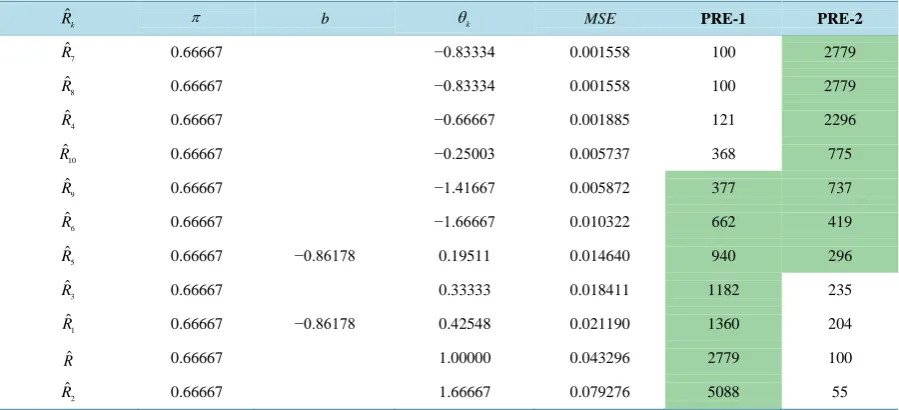
Table 2. Percentage relative efficiencies (pre) of proposed estimators.
ˆ
k
R π b θk MSE PRE-1 PRE-2
7
ˆ
R 0.66667 −0.83334 0.001558 100 2779
8
ˆ
R 0.66667 −0.83334 0.001558 100 2779
4
ˆ
R 0.66667 −0.66667 0.001885 121 2296
10
ˆ
R 0.66667 −0.25003 0.005737 368 775
9
ˆ
R 0.66667 −1.41667 0.005872 377 737
6
ˆ
R 0.66667 −1.66667 0.010322 662 419
5
ˆ
R 0.66667 −0.86178 0.19511 0.014640 940 296
3
ˆ
R 0.66667 0.33333 0.018411 1182 235
1
ˆ
R 0.66667 −0.86178 0.42548 0.021190 1360 204
ˆ
R 0.66667 1.00000 0.043296 2779 100
2
ˆ
R 0.66667 1.66667 0.079276 5088 55
The percentage relative efficiencies (PRE-1) of Table 2 reveal that apart from the estimator, Rˆ8, the pro- posed regression-type estimator, Rˆ7, based on both the sample means, x and x*, is more efficient than the other estimators in Table 1, including the customary ratio estimator, Rˆ, in terms of having a smaller mean squared error. The table also shows that the estimator, Rˆ7, has very large gains in efficiency over majority of
the other estimators. Again, the percentage relative efficiencies (PRE-2) indicate that many of the proposed es- timators have very large gains in efficiency over the customary ratio estimator, Rˆ. However, the estimator, Rˆ is more efficient than the ratio-type estimator, Rˆ2 based on the sample mean, x. This means that estimators in the proposed class are not uniformly better than the customary ratio estimator, Rˆ. Theoretically, the efficiency condition (45) must be satisfied for any particular estimator in the proposed class to be more efficient than the customary ratio estimator, Rˆ.
5. Concluding Remarks
In this paper, we have both generalized and extended the study carried out by [1] on the estimation of the popu- lation ratio (R) of the population means of two variables (y and x) under simple random sampling without re- placement (SRSWOR) scheme, using variable transformation of the auxiliary variable, x. A class of estimators of the population ratio, R, has been proposed, and all the six estimators earlier proposed by [1] are easily identi- fied as special cases of the proposed class of estimators. Properties of the proposed estimators, including their biases, mean squared errors, and efficiency conditions were obtained up to first order approximation. The theo- retical results were numerically supported and illustrated, and consistency between the theoretical and empirical results was vividly observed. Furthermore, it was observed that for the given data set, majority of the proposed estimators was found to have relatively large gains in efficiency over the customary ratio estimator, Rˆ=y x. Finally, it was remarked that the application of variable transformation of the auxiliary variable, x, in the present study, has effectively and maximally resulted in the use of auxiliary information for ratio estimation, without extra and real-time cost, often associated with the use of additional auxiliary information in estimating popula- tion ratio. This, of course, is the general motivation and advantage of the proposed class of estimators over other estimators of population ratio (R), under the simple random sampling scheme.
References
[1] Onyeka, A.C., Nlebedim, V.U. and Izunobi, C.H. (2013) Estimation of Population Ratio in Simple Random Sampling Using Variable Transformation. Global Journal of Science Frontier Research, 13, 57-65.
[2] Srivenkataramana, T. (1980) A Dual of Ratio Estimator in Sample Surveys. Biometrika, 67, 199-204. http://dx.doi.org/10.1093/biomet/67.1.199
Auxiliary Variables. Statistica, 65, 407-418.
[4] Tailor, R. and Sharma, B.K. (2009) A Modified Ratio-Cum-Product Estimator of Finite Population Mean Using Known Coefficient of Variation and Coefficient of Kurtosis. Statistics in Transition—New Series, 10, 15-24.
[5] Sharma, B. and Tailor, R. (2010) A New Ratio-Cum-Dual to Ratio Estimator of Finite Population Mean in Simple Random Sampling. Global Journal of Science Frontier Research, 10, 27-31.
[6] Onyeka, A.C. (2013) Dual to Ratio Estimators of Population Mean in Post-Stratified Sampling Using Known Value of Some Population Parameters. Global Journal of Science Frontier Research, 13, 13-23.
[7] Singh, M.P. (1965) On the Estimation of Ratio and Product of the Population Parameters. Sankhya, B27, 321-328. [8] Srivastava, S.R., Khare, B.B. and Srivastaca, S.R. (1988) On Generalized Chain Estimator for Ratio and Product of
Two Population Means Using Auxiliary Variables. Assam Statistical Review, 2, 21-29.
[9] Upadhyaya, L.N., Singh, G.N. and Singh, H.P. (2000) Use of Transformed Auxiliary Variable in the Estimation of Population Ratio in Sample Survey. Statistics in Transition, 4, 1019-1027.
[10] Pandey, B.N. and Dubey, V. (1988) Modified Product Estimator Using Coefficient of Variation of Auxiliary Variate.
currently publishing more than 200 open access, online, peer-reviewed journals covering a wide range of academic disciplines. SCIRP serves the worldwide academic communities and contributes to the progress and application of science with its publication.
Other selected journals from SCIRP are listed as below. Submit your manuscript to us via either