Performance analysis and classification of Clone
attack detection procedures in mobile wireless sensor
networks
Mohammad Hasan Ansari
Iran University Science and Technology(IUST)
Vahid Tabataba Vakili
Iran University Science and Technology(IUST)
ABSTRACT
Regarding accelerating development of mobile sensor nodes tech-nology, increasing the utilization of them, and also facing with se-curity challenges in these networks; specially clone nodes attack, this paper focuses on exploiting optimum criteria of node clone intrusion detection procedures in mobile wireless sensor networks by using experimental analysis of procedures. Since many of rec-ommended protocols in this area have not been experimentalised, also no comprehensive study has been performed on the possibil-ity and capabilpossibil-ity of these procedures; in this paper all types of sensor network architecture, with the presence of mobile sensor node, are analyzed. Then according to the type of architecture, the procedures of clone node intrusion detection is classified and meticulously scrutinized. Besides, due to measuring the efficiency, exploiting the optimum parameters and also appraising the ex-penses of procedures, via using OMNeT++ simulator, these proce-dures are analyzed by comprehensive simulation. Finally, the con-clusion based on theoretical analysis and simulation is presented.
General Terms:
Performance,Security
Keywords:
wireless sensor network (WSN), clone attack, intrusion detec-tion, mobility
1. INTRODUCTION
Utilizing WSNs in different environments, such as medical and military areas, because of the inexpensiveness, self-organizing and not needing constant supervision of sensor nodes is increas-ing. Because lack of physical shield layer on these nodes and utilize them in enemy environment without protection, usually these networks expose to different internal and external attacks [1]-[4]. The limited energy and memory sources of these sensor nodes, because the security challenges in these networks are to encounter more complexity compared to other mobile telecom-munication networks. These complexities are significantly in-creasing, if the sensor nodes have mobility. Regarding the struc-ture and architecstruc-ture of WSNs among different attacks intro-duced in papers [1]-[7], because of the clone node attacks capa-bility in passing through encrypting layer and authentication and also proper conditions for other attacks, these attacks are consid-ered as the most serious security threat for the WSNs. In clone node attacks, the attacker first compromises the network sensor node and then by using side channel attacking techniques ex-ploits the information on the node in a certain amount of time and
International Journal of Computer Applications (0975 - 8887) Volume 71 - No. 21, June 2013
Wireless sensor network (WSN) Mobilesensornode
Static sensor node
Stat icse nso rn
e
tw
o
rk and
M ob ile
in
tru de
r
Staticwirelesssensor network
St atic sen sor
n
etw ork A
n
d
Mo bile atta cke
r
[image:2.595.75.261.104.291.2]Mobile wireless sensor network
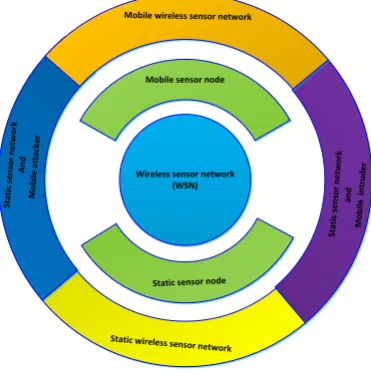
Fig. 1. Schematic diagram of all types of wireless sensor networks
in terms of nodes mobility
2. NETWORK AND ATTACKER MODEL
2.1 network model
The WSN usually contains hundreds and sometimes thousands of cheap and small size wireless sensor nodes which are acci-dentally or in a pre-designed way distributed in a vast geographic area. In WSNs it is assumed that every moment there is the pos-sibility that a number of sensor nodes get lost or be added to the network [1]. While in old networks, all the sensor nodes are static and have a base station for gathering data, today, respect-ing the robotics technology advancement and the emergence of mobile wireless sensor nodes, the structure of sensor networks has been changed. Different types of sensor networks with the combination of mobile and static are illustrated in Fig.(1). Therefore, here it is assumed that wireless sensor nodes are mo-bile and regarding this criterion, the networks are considered based on below architectures;
(i) Mobile-WSN (MWSN): in this network all of the nodes have mobile capability;
(ii) WSN with mobile attacker: in this network all of the net-work sensor nodes are static but the attacker has mobile ca-pability;
(iii) WSN with mobile intrusion detection node: in this network all of the network sensor nodes are static but the intrusion detector nodes have mobile capability;
Besides, here in hybrid networks it is supposed that mobile nodes have more potential and sources compared to static nodes. Be-cause of the more intensity of security challenges in homoge-neous networks, the general architecture of homogehomoge-neous net-works is considered.
2.2 attacker model
With referencing to the definition of clone node attack [7]-[9], in this attack, the attacker compromises between one or some net-work nodes and exploits their stored information and replicates a preferred number of nodes from a certain node with specific identity and places them in appropriate locations in network, so that respecting the desired goals, it will be able to make differ-ent attacks including, eavesdropping, DoS, inject fake data and attacking the network protocols. Also it is assumed that the at-tacker is not able to allocate a new identity to the clone nodes and mostly the attacker can only compromise a small part of the net-work nodes. Otherwise, with referencing to clone attacks costs,
there is no need for node replicate. In addition, it is assumed that the attacking nodes can communicate and even collude with each other. It is also possible that the attacker nodes have more capa-bility and flexicapa-bility compared to the valid nodes of the network which is a reasonable hypothesis. Finally, it is supposed that the attacker nodes can use various mobility models for moving in the network. But, due to the RWM model is comprehensive and ideal, in this paper it is assumed that the attacker utilizes this model. Indeed, from a general point of view, the attacker node can be either mobile or static in the network.
2.3 Framework for clone node intrusion detection
Regarding to the point that in clone node attack, first the attacker compromises one or some nodes and then exploits the informa-tion, second, by reprogramming the information in desired num-ber of nodes, next, places it in appropriate location in order to ful-fill the desired goals. Therefore, after the attack is implemented by the attacker, the clone node requires a reciprocal link between itself and the neighbors, then shares the session keys for creat-ing secured link and eavesdrops the information which is sent by neighbors and attacks controlling protocol in the network. But before creating all these communications, all the nodes added to the network are forced to pass through intrusion detection protocol as the second security layer. In other words unless the attacker nodes have not passed the intrusion detection process, they are not able to fulfill their malicious goals. According to this framework, the attacker for being successful and reaching is desired goals should pass the detection protocols designed for the wireless sensor network. Consequently, real and exact anal-ysis of the protocols and intrusion criteria, regarding the limita-tions of the WSN and simulating them with real protocol layers are essential. Hence, initially, these procedures are theoretically analyzed and classified. Also in order to assess the performance procedures with real hypotheses, the procedures are extensively simulated and experimental analyses are presented according to simulation.
3. INTRUSION DETECTION PROCEDURES IN
WIRELESS SENSOR NETWORKS WITH MOBILE NODE
Regarding the hypotheses of the network model, in this paper, network configurations, in terms of combination of sensor nodes, are divided into three categories:
(i) All the nodes of mobile wireless network; (ii) mobile attacker node;
(iii) Mobile detection node;
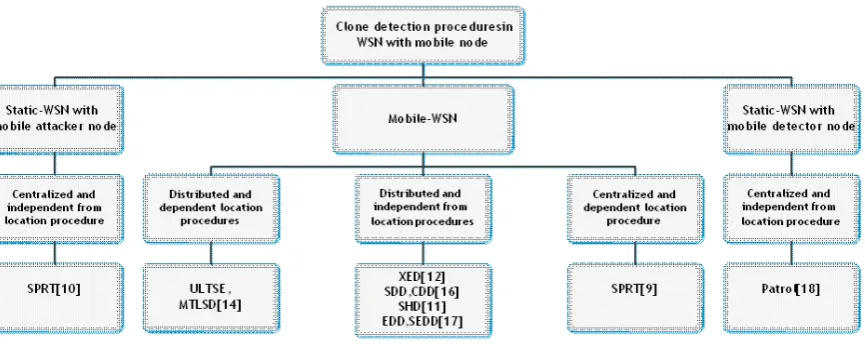
Then the suggested procedures, based on the criteria of being centralized or distributed, local detection or involvement of the whole network in detection process, or being based on conflict with more details are divided. Thus, from Fig.2. it can be ob-served that the intrusion procedures based on detection method, performing strategy and detection criterion, are divided.
3.1 Clone node detection procedures in mobile wireless sensor network
While all the nodes of WSN have mobility, considering the men-tioned criteria in section 2, the clone node detection attack pro-cedures are divided as follow:
Fig. 2. Classifications of WSNs detection procedures with mobile node
MWSNs, XED ignores the location information criteria for iden-tifying the clone node. Indeed, XED applies ?challenge and re-member? strategy for detecting the presence of the clone node. In fact, in the accepted strategy in XED, it has been supposed that the sensor node is equipped with a random number genera-tor and has a unique identity. In this protocol when thesiandsj arrive at the communication domain of each other, any of them will produce the random numbers ofrsiandrsjrespectively and
exchange them, then the received and sent numbers together with identities will be stored in any of the nodes. Whensiandsjmeet each other once again, at first the previous random numbers are exchanged and checked in any node, whether the received and stored numbers are equal or not. In this case if they are not the same, the clone intrusion is detected and node identity revoke message is broadcasted throughout the network. Otherwise, the random numbers are exchanged and replaced with the previous ones. It is observed that the algorithm has low memory overhead. But the detection probability is not high. Also, because of the communication and storage error, there is the probability of neg-ative and positive errors. The results of simulation in section 5 prove this point. In addition, XED is vulnerable to smart attacker and collusion of the nodes.
3.1.2 Central clone detection procedure based on the cri-teria of speed. In [9], due to the fact that the majority of wireless nodes speed are limited, authors has defined speed threshold(Vmax)as detection criteria. Central clone node intru-sion detection procedure is proposed based on the location infor-mation for the MWSNs. In this paper because of the probability of increasing the positive and negative errors resulted by calcula-tion error in measuring speed or lack of simultaneity among the nodes, SPRT mechanism is used. In fact the authors have pro-posed their procedures by assuming that the network nodes are aware of their location and RTM mobility model is used. Gen-erally, in this procedure when the mobile sensor nodes reach the desired location, first by using localization protocols, positions are located and their claimshID, Ti, li, H(IDkTikli), Sigiiare sent to their neighbors. Secondly the claim message is authen-ticated and Neighbors with the probability of p send claim to BS. After authentication of the nodeimessage, the base station calculates the speed at thei+ 1moment, by usingCiandCi+1
information and compares the results withVmax. Then this pro-cedure assumes distribution as Bernoulli random variable and by calculating the logarithmic probability rate for n samples re-ceived claim of the nodei, carries out the decision making pro-cess it. So when SPRT exceeds its higher bound, the clone node will be identified and the revocation message is broadcasts in the network.
3.1.3 Locally distributed clone node attack detection proce-dure, based on the time of exploiting the information on the com-promised node. To replicate clone nodes from a certain node of the network, it needs to be separated from the network and then the information is exploited by spending times. In [16], by us-ing this fact, the SDD procedure has been proposed for intrusion detection in MWSN. In reality the suggested solution in [16] is based on the fact that if nodeadoes not meet nodebtwice in an
λinterval, we can probably conclude that the node b has been separated from the network by the attacker to be replicated. The accuracy of SDD procedure depends on an interval with high probability that nodes may meet each other. Indeed, the detection takes place within a trade of detection time and rate of positive error. In SDD each node is considered as a witness for the rest of the network nodes and thus each node should send a message throughout the network for announcing its presence, which in-creases the communicative overhead and energy consumption. It is also observed that the detection probability of SDD is not high and to improve that, authors in [16] by using participation of the neighbors and exchanging the information of the joint nodes, proposed CDD procedure. New procedure increases the detec-tion probability and decreases the negative error; but increases the communication overhead and memory. In [17] with an atti-tude different from [16] and regarding the fact that the number of the meets of two nodes in a certain interval with a high proba-bility is restricted, EDD procedure is proposed. EDD procedure contains two phases; one of them is offline phase and deals with calculation of interval length and threshold of the meets of two nodes in a certain interval, and other one is online phase that deals with exchanging and comparing the messages of different nodes and detects node clone attack. By analyzing EDD, it is observed that this procedure is vulnerable to smart attacker, and also has high memory overhead. In order to solve the second problem, by using an exchange between the memory and the in-terval length, authors in[17] have proposed SEDD procedure. In SEDD each node analyzes only one set of nodes named monitor set and stores their messages; by doing this, the memory of the nodes is saved.
indepen-International Journal of Computer Applications (0975 - 8887) Volume 71 - No. 21, June 2013
dence from downer layer routing protocol. In UTLSE protocol, each node is forced to trace a certain set of the nodes and all the witness nodes store only one location-time claim. So when wit-ness nodes arrive at the radio domain of each other, exchange the claims and carry out the detection protocol. Of course it must be noted that in this procedure, the detection process is always done with smaller ID nodes. With meticulous analysis, it is observed that sometimes detection fails, because two witness nodes before they meet each other, they meet a third clone node. In order to solve this problem and increase the probability of detection, au-thors in [17], proposed MTLSD procedure, which benefits from ULTSE principles and uses of a queue with at least two lengths and the optimum of three lengths.
3.1.5 Locally Distributed detection procedure based on the list of the neighbors. In[11], by extending the routing problem with the help of mobility, authors proposed distributed intrusion de-tection procedure (SHD) for mobile wireless sensor network. Regarding that access to the location information is a strict hy-pothesis and the mobility models are different, SHD procedure dispenses with these two criteria. So SHD procedure uses the exchanging list of the neighbors among the mobile nodes and selects witness nodes for detection. This procedure is protected against the collusion of the attacker nodes. Generally, the de-tection process in SHD is based on sending the message of
hID, neighbor−listito the nodes in its communication range. At the first time the protocol is performed and then uses question and answer method.
3.1.6 Centralized detection procedure based on key pre-distribution. Authors in [13], by using the pair-wise pre-distribution key and bloom filter have proposed a centralized detection procedure, which is independent from the location of wireless sensor nodes. Generally, by assuming that the base sta-tion is trusted, the server key method is applied and its confi-dentiality is always maintained. Then by using a two variable polynomial inGF(p) ,unique confidentiality pair-wise key is produced and loaded on each node. Also In this procedure, to decrease communication costs, alongside server key method, bloom filter method is used. Then, in order to communicate with the neighboring nodes and by using functions and filters, each node produces a pair-wise key and shares it with the neighbors. In the next phase, each node sends a ciphering report to the BS containing its ID and CBF. After receiving all the reports, BS deciphers them and counts the number of created keys of each node. Regarding that, at first the keys have been distributed uni-formly and the mobility model is RWM; the statistic of produc-ing keys of legally nodes should be close to each other. Thus, if the number of keys of a node is more than the predetermined threshold, it can be concluded that the replicated node and the message of revoking it from network has been announced by BS.
3.2 Clone node detection procedure, for static sensor networks with mobile detector node
Regarding the limitation of energy consumption and high amount of communication overhead of detection procedures based on static nodes with progresses made in the technology of micro-robots, authors in [18], proposed a clone node detec-tion procedure by using mobile wireless sensor nodes. In Patrol procedure the network model is considered as a combination of mobile and static nodes. Also it has been supposed that the static nodes have access to their location information. Regarding the attempt made by the attacker for compromising the static and patrol nodes and the possibility of presence of two mobile and static clone nodes, two criteria are introduced and utilized in the procedure: ”each single node only is in one location in any mo-ment” and ”maximum speed of mobile node”.
The Patrol procedure is based on assumption that for the purpose of providing a secured communication all of the static nodes
re-quire exchange of confidentiality information among static nodes with the patrol nodes. By moving throughout the network and inspecting the static nodes, Patrol nodes collect their claim. It is supposed that when the static node cannot communicate with the patrol in any round, the static node will be separated from the network in the next round. In addition, in [18] it is assumed that each static node is inspected by at least two patrol nodes in the network and any of them is considered as the reference node. In Patrol procedure, the static node detection is carried out by receiving the nodes location claims with the patrol node and an-alyzes the location conflict among the nodes with identical IDs. Under these circumstances, communication cost in comparison with the traditional detection procedures such as LSM [7] and RED [21] decreases greatly. Besides, for situations in which the attacker compromises the patrol nodes, the procedure uses the maximum speed criteria in central or distributed method and per-forms the detection by the static nodes.
3.3 Clone node detection procedure for static sensor networks with mobile attacker
Usually for attacking the network protocols like routing and clus-tering protocols, the attacker requires a large number of com-promised nodes. For a lot of attackers it is hard and sometimes impossible to achieve this goal. Due to the above mentioned circumstances, if attacker uses mobile nodes and they become member in the list of different nodes neighbors at the time of preparing the list by the network nodes, the DDoS capability for the attacker is provided [4] . Since the static detection protocols are not able to detect the DDoS attacks, imposing limitations to the attacker is not a reasonable assumption to confront with the attacks made in the network. Therefore in [10] , authors proposed a distributed procedure to detect the mobile attacker node, it has been supposed that the network applies the traditional methods like RED and LSM to detect the static attacker. In fact [10] has used an unusual silence criterion of the neighboring node in or-der to detect the clone node and has established a procedure in-dependent from the location information. Also to increase the precision of detection, SPRT technique has been utilized. Fur-thermore, the detection of the virtual mobile nodes is done by using RSSI technique.
4. THEORETICAL ANALYSIS OF THE
DETECTION PROCEDURES
In this section, about the necessity of non-deterministic and full distributed detection procedures will be discussed and then secu-rity requirements that should be fulfilled by the detection proce-dures will be investigated.
4.1 Selecting the type of protocol
First, the procedures with the highest distribution rate against the procedures having central controlling node is demonstrated. Usually the central controlling node (BS) decreases the complex-ity of the detection procedures as compared to distributed proce-dures [7]. But worse problem in centralized proceproce-dures is the presence of BS as the error point, which leads to the extreme de-crease of the energy of the neighboring nodes compared to the other nodes networks, and also causes security threats in the net-work.
International Journal of Computer Applications (0975 - 8887) Volume 71 - No. 21, June 2013
Table 1. Classification of node clone detection procedures
optimum procedure that could fulfill all the
security requirements for MWSNs is the
SHD
procedure.
Because
SHD
is
independent from the location information
and in comparison with other procedure for
network with big dimensions has lower
overhead are medium in the order
(√ )
.
Therefore we can conclude that coming up
with a full optimum procedure is one of the
open discussions in this area; Besides, the
need for presenting theoretical analyses
and modeling in this area is extremely felt.
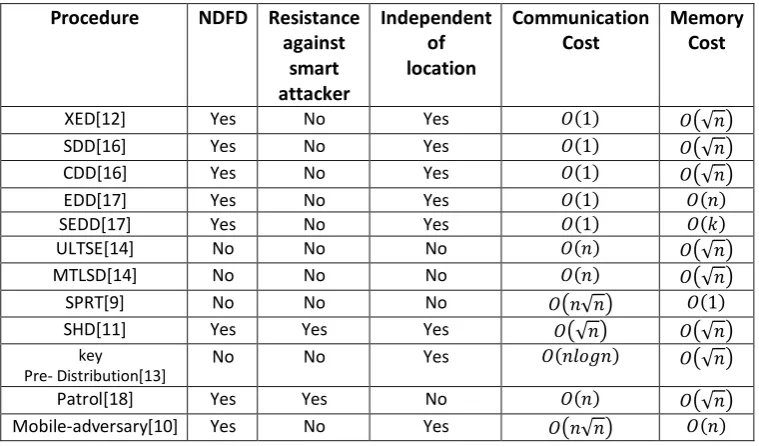
Table (1) Classification of node clone detection procedures
Memory
Cost
Communication
Cost
Independent
of
location
Resistance
against
smart
attacker
NDFD
Procedure
(√ ) ( ) Yes No Yes XED[12] (√ ) ( ) Yes No Yes SDD[16] (√ ) ( ) Yes No Yes CDD[16] ( ) ( ) Yes No Yes EDD[17] ( ) ( ) Yes No Yes SEDD[17] (√ ) ( ) No No No ULTSE[14] (√ ) ( ) No No No MTLSD[14] ( ) ( √ ) No No No SPRT[9] (√ ) (√ ) Yes Yes Yes SHD[11] (√ ) ( ) Yes No No key Pre- Distribution[13] (√ ) ( ) No Yes Yes Patrol[18] ( ) ( √ ) Yes No Yes Mobile-adversary[10]5. Simulation and experimental
analysis
of
the
detection
procedures
1.5. The principles of simulation
A. Simulation environment
Regarding the special characteristics of the
WSNs, many papers have focused on
analysis and classification of simulation
software's of these networks [35-39].
Regarding
criteria
like,
development
capability, and being free, by investigating
the common network simulator packages
[35-38], the network simulator software
"OMNeT4.2.2" has been selected for the
purpose of performing the clone node
detection procedures in WSNs with mobile
node and comparative study. In simulation,
to gain the highest similarity of real results,
the protocol layers are in accordance with
is deficient. Therefore, an optimum procedure should be non-deterministic and full distributed (NDFD), so as to detect the clone node in the mobile WSN reliable. The classification of the procedures is presented in table(4.1) according to these criteri-ons.
4.2 Requirements of clone node detection procedures
Considering the studies conducted in different papers [7]-[20], and the inherent characteristics of the WSNs and the capabilities of the attacker, the analysis and classification of different proce-dures have been carried out according to the below criteria:
(i) The procedure to be NDFD ;
(ii) The resistance capability against the smart attacker: in the smart attack, the enemy recognizes and inactivates the crit-ical witness nodes (e.g. jamming). Thus, for stopping the enemy from training the critical witness nodes, a security requirement should be designed, which by the detection pro-tocol is fulfilled. The requirement: in each round for a node, all the nodes must have the same probability in order to be a witness node. Besides, if the enemy is able to delete some of the nodes, it cannot obtain anything about the nodes that have high probability of being as witness nodes of a certain node;
(iii) Independent from the location information: Since the awareness of each node of its own location is a strict con-dition, to be independent from awareness location condition is important criteria of rationality of the detection procedure; (iv) Communication and memory overhead: Regarding the ex-treme limitation of energy and hardware sources in WSNs, these criteria are also considered as an effective factor for rationality of the detection procedure;
In table (4.1), it is observed that the optimum procedure that could fulfill all the security requirements for MWSNs is the SHD procedure. Because SHD is independent from the location infor-mation and in comparison with other procedure for network with big dimensions has lower communication and memory over-head. But generally, communication and memory overhead are medium in the orderO(√n). Therefore we can conclude that
coming up with a full optimum procedure is one of the open dis-cussions in this area; Besides, the need for presenting theoretical analyses and modeling in this area is extremely felt.
5. SIMULATION AND EXPERIMENTAL
ANALYSIS OF THE DETECTION PROCEDURES
5.1 The principles of simulation
5.1.1 Simulation environment . Regarding the special charac-teristics of the WSNs, many papers have focused on analysis and classification of simulation software’s of these networks [35]-[39]. Regarding criteria like, development capability, and being free, by investigating the common network simulator packages [35]-[38], the network simulator software ”OMNeT4.2.2” has been selected for the purpose of performing the clone node de-tection procedures in WSNs with mobile node and comparative study. In simulation, to gain the highest similarity of real results, the protocol layers are in accordance with both IEEE802.15.4 [51] and IEEE82.11 standards and are separately simulated. For radio specifications, a real model ”CC2420” the real radios of the name by Texas Instruments is utilized and unit disk mode is con-sidered as propagation model. Beside, in simulation, the energy, memory and calculation power limitations have been considered. It is also supposed that the extent of the area, in which the WSN is performed, is area.
International Journal of Computer Applications (0975 - 8887) Volume 71 - No. 21, June 2013
0 1e+06 2e+06 3e+06 4e+06 5e+06 6e+06 7e+06
20 40 60 80 100 120 140 160 180 200
Total ener
gy consumed(mj)
numer of nodes CDD
[image:6.595.55.296.100.243.2]SDD XED EDD SEDD SPRT SHD UTLSE MTLSD
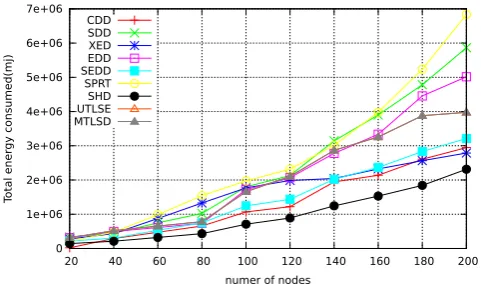
Fig. 3. Total consumed energy of difference procedures for
detection one node replica
the least speed of the nodes is supposed to be zero, the average speed will converge at zero. To stop the occurrence of that, the least permitted speed should be regulated with more than zero. The details of RTM are similar to RWM. The only difference is the time of the presence of the mobile node in the destina-tion which is the same for all the nodes and equals a fixed time. Then the minimum and the maximum permitted speed for the sensor nodes are supposed1m/sand20m/srespectively. Also the waiting interval for RTM model in the destination consider equals20s.
5.1.3 Cryptography mechanisms. In order to establish security against the cryptography common attacks as the first security layer, confidentiality and authentication mechanisms based on TinyECC[52] software package is utilized. Regarding the cost analysis carried out [53], in simulation, the hash function SHA-1 is used to provide the integrity of the nodes claims. Also digital signature algorithm ECDSA-160 is used for claims signing of each node. Which in accordance with [54], the cost of consumed energy used in ECDSA-160 for signing and confirming equals
22.83mjand45.09mjrespectively. Also the cost of calculating the checksum by SHA-1 is supposed to equal to0.0059mj.
5.2 Results of simulation
To compare the performance and capability replica node detec-tion approaches in WSNs, criteria presented in Table (2) is used. Simulation results using repeated averaging over 1000 simula-tions for each approach the implementasimula-tions are presented. The comparison between different approaches are taken and plotted in Figures 3-5.
5.2.1 Energy cost. Energy and resource constraints are the most important limiting factor affecting the performance of the proposed protocols for WSNs. So a good replica node detection approach should have appropriate energy overhead. To evaluate the energy overhead of different approaches, the simulation re-sults for different network configurations plotted in Fig.(3). Form Fig.(3), it is obvious that, generally collision based approaches are dealing with lower power overhead. It should also be noted that though we initially think that SPRT approach has lower en-ergy overhead due to centralized, simulation results show that SPRT energy overhead is higher than the distributed approach; because the energy overhead of digital signature in SPRT is very high.
[image:6.595.315.553.101.280.2]5.2.2 Clone detection probability . Node replica detection pro-cedures must have a high probability of node replication detec-tion [2]. Moreover, in the optimal approach, the detecdetec-tion prob-ability should be independent of the network physical character-istics such as sensor network configuration and the number of
Fig. 4. Detection probability of difference procedures verse change
[image:6.595.314.551.325.503.2]number of nodes
Fig. 5. false alarm rate of difference procedures verse change
number of nodes
sensor nodes. Figure (4) represents the simulation result of the replica node detection probability for different approaches, when there is only one clone node in the network. From Fig.(4) it is ob-served that for networks with a little number of nodes, detection probability of procedures is acceptable. Also it is observed that detection probability in collision based approaches (like XED, and SDD) with increasing size of networks are reduced, because location of nodes change continuously; therefore routing over-head and packet loss are increased.
In addition, Fig.(4), illustrates that the SPRT has the highest probability of detection and minimal change with increasing number of network nodes. The result is admissible because SPRT is a centralized approach and uses location information.
Table 2. Performance Metrics for simulation
Performance Metrics Description
Total consumed energy(Ed) The sum of communication and computation costs consumed by all nodes to detect a clone Clone detection probability(Pd) The probability of successful detection
False alarm error(eF A) Major detection error measured in mobile WSNs, which may deteriorate the quality of clone detection schemes due to costly false detection with regard to the high clone detection ratio
procedures (such as EDD), because of the reduced possibility of nodes meeting and communication link failure, false alarm rate increases. It is also observed that for XED procedure, at first the error rate is high, but with increasing network size it decreases; its reason is that, Based on simulation, XED is not able to detect node replication in large networks.
6. CONCLUSION
In this paper all procedures presented for the detection of replica node attacks in sensor networks with mobile nodes is reviewed and analysis. Also, by using mobility criteria, a new classifica-tion for node replica detecclassifica-tion procedures and attacker model are proposed. To compare and evaluate different procedures, differ-ent metrics are introduced and used for theoretical analysis and classification procedures. Moreover, results of theoretical anal-ysis and metrics are used for assessment procedures. Then, for a realistic assessment with considering different network layer protocols and constraints WSN, simulation and experimental analysis is done. Finally, the theoretical analysis and simulation results of the performance of different approaches are discussed. Analysis results demonstrate that the procedures, based on lo-cation information (UTLSE, MTLSD, and SPRT) have a higher detection rate and low false alarm rate. But, here are two im-portant notices; first, generally, due to the constraints of WSNs, access location information for all nodes is a strict assumption. Moreover, it can be seen that the energy overhead in this ap-proach is too high. Therefore, regarding the simulation and the-oretical analysis it can be seen that the SHD largely meets the criteria for a suitable solution and also shows good performance. However SHD energy consumption in large-scale WSNs still is high. Therefore, regarding limitations WSN, to achieve an opti-mal solution for node replica detection, there is an open area for researchers.
7. REFERENCES
[1] Chen et al, Sensor Network Security: A Survey.IEEE Com-munications Survey and Tutorials. Vol 11, No2, Second Quarter2009
[2] W.T. Zhu et al, Detecting node replication attacks in wireless sensor networks: A survey.Journal of Network and Com-puter Applications 20121022-1034
[3] Michael Riecker et al, A Survey on Intrusion Detection in Wireless Sensor Networks.Technical Report, SEEMOO-TR
-2011
[4] V.Manjula et al, Replication attack mitigations for static and mobileWSN.International Journal of Network Security and Its Applications (IJNSA), Vol.3, No.2, March2011
[5] S.K.Das et al, A synopsis on node compromise detection in wireless sensor networks using sequential analysis. Com-puter Communications 3420112003-2012
[6] Roberto Di Pietro et al, Securing Mobile Unattended WSNs against a Mobile Adversary.IEEE2010
[7] Bryan Parno et al, Distributed Detection of Node Replication Attacks in Sensor Networks.IEEE2005
[8] Ming Zhang et al, Memory Efficient Protocols for Detect-ing Node Replication Attacks in Wireless Sensor Networks. IEEE2009
[9] Ho et al, Fast Detection of Mobile Replica Node Attacks in Wireless Sensor Networks Using Sequential Hypothesis Testing.IEEE Transactions on Mobile Computing, Vol. 10, No. 6, June2011
[10] J.-W. Ho et al, Distributed detection of mobile malicious node attacks in wireless sensor networks.Ad Hoc Networks 102012512-523
[11] YanYxainaxniga and et al, Single Hop Detection of Node Clone Attacks in Mobile Wireless Sensor Networks. Inter-national Workshop on Information and Electronics Engi-neering (IWIEE)2012
[12] Chia-Mu Yu et al, Mobile Sensor Network Resilient against Node Replication Attacks.IEEE2008
[13] Deng XM, Xiong Y, A new protocol for the detection of node replication attacks in mobile wireless sensor networks. Journal of Computer Science and Technology 26(4): 732-743 July2011
[14] Xiaoming Deng et al, Mobility-assisted Detection of the Replication Attacks in Mobile Wireless Sensor Networks. IEEE 6th International Conference on Wireless and Mobile Computing, Networking and Communication2010
[15] Mauro Conti et al, Mobility and Cooperation to Thwart Node Capture Attacks in MANETs.EURASIP Journal on Wireless Communications and Networking Volume,Article ID 9459432009
[16] Mauro Conti et al, Emergent Properties: Detection of the Node-capture Attack in Mobile Wireless Sensor Networks. WiSec?08, March 31- April 2, Alexandria, Virginia, USA., 2008
[17] Chia-Mu Yu et al, Efficient and Distributed Detection of Node Replication Attacks in Mobile Sensor Networks. IEEE2009
[18] Liang-Min Wang et al, Patrol Detection for Replica At-tacks on Wireless Sensor Networks.Sensors 11, 2496-2504; doi:10.3390/s1103024962011
[19] Emil Selvan et al., Detection of Compromised Nodes in Mobile Ad-Hoc Networks.Journal of Computational Infor-mation Systems 7:620111823-1829
[20] J.-W. Ho et al, Distributed detection of replica node attacks with group deployment knowledge in wireless sensor net-works.Ad Hoc Networks 720091476-1488
[21] Mauro Conti, Distributed Detection of Clone Attacks in Wireless Sensor Networks.IEEE Transactions on Depend-able and Secure Computing, VOL. 8, NO. 5, Septem-ber/October2011
[22] XiaoAmutihnogr et al, A Replication Detection scheme for Sensor Networks. rPinrogc 0e0d i(a2 E01n1g)i n0e0e0r?in0g0 02 9201221-26
[23] Wen Tao Zhu, Node Replication Attacks in Wireless Sen-sor Networks: Bypassing the Neighbor-Based Detection Scheme.International Conference on Network Computing and Information Security2011
[24] Chunming Rong, An Efficient Intrusion Detection Scheme for Wireless Sensor Networks.STA 2011 Workshops, CCIS 187, pp. 116-129,2011
International Journal of Computer Applications (0975 - 8887) Volume 71 - No. 21, June 2013
[26] Tamara Bonaci et al, Distributed Clone Detection in Wireless Sensor Networks: An Optimization Approach. IEEE2011
[27] bf Abu Saleh Md. Tayeen et al, Mobility Assisted Solu-tions for Well-known Attacks in Mobile Wireless Sensor Network.(IJCSIS) International Journal of Computer Sci-ence and Information Security, Vol. 9, No. 5, May2011
[28] Thanh Dai Tran et al, Early and Lightweight Distributed Detection of Node Replication Attack in Sensor Networks. IEEE Communications Society subject matter experts for publication in the WCNC2010proceedings
[29] Tamara Bonaci et al, Node Capture Attacks in Wireless Sensor Networks: A System Theoretic Approach.IEEE2010
[30] Bin Tong et al, A three-tier framework for intruder infor-mation sharing in sensor networks.Ad Hoc Networks 82010
345-360
[31] Shigen Shen, A game-theoretic approach for optimizing in-trusion detection strategy in WSNs.IEEE2011
[32] Abderrezak Rachedi, muDog: Smart Monitoring Mecha-nism for Wireless Sensor Networks based on IEEE 802.15.4 MAC.IEEE International Conference on Communications ICC2011 (IEEE ICC’11), Kyoto: Japan2011
[33] Noman Mohammed et al, Mechanism Design-Based Se-cure Leader Election Model for Intrusion Detection in MANET.IEEE Transactions on Dependable and Secure Computing2012
[34] Bo Zhu et al, Localized Multicast: Efficient And Dis-tributed Replica Detection in Large-Scale Sensor Networks. IEEE Transactions on Mobile Computing, Vol. 9, No. 7, July2010
[35] Muhammad Imran et al, A Survey of Simulators, Emula-tors and Testbeds for Wireless Sensor Networks.IEEE2010
[36] Ansgar Kellner et al, Simulation Environments for Wireless Sensor Networks.Technical Reports of the Institute of Com-puter Science at the Georg-August-University at Gottingen, June2010
[37] C. Mallanda et al, Simulating Wireless Sensor Networks with OMNeT++?.LSU Simulator, Version 1,2005
[38] Xuedong Xian et al, Comparison of OMNET++ and Other Simulator for WSN Simulation.IEEE2008
[39] Klaus Wehrle et al,Modeling and Tools for Network Simu-lation, Springer-Verlag Berlin Heidelberg 2010
[40] Roberto Di Pietro et al, Intrusion-Resilience in Mobile Unattended WSNs. IEEE Communications Society sub-ject matter experts for publication in the IEEE INFO-COM2010proceedings
[41] Sooyeon Shin, An Experimental Study of Hierarchical In-trusion Detection for Wireless Industrial Sensor Networks.
IEEE Transactions on Industrial Informatics, Vol. 6, No. 4, November2010
[42] P. Samundiswary et al, Detection of Sinkhole Attacks for Mobile Nodes in Heterogeneous Sensor Networks with Mo-bile Sinks..International Journal of Computer and Electrical Engineering, Vol. 2, No. 1, February,20101793-8163 [43] Mauro Conti, The Quest for Mobility Models to Analyses
Security in Mobile Ad Hoc Networks.WWIC 2009, LNCS 5546, pp. 85-96,2009
[44] Marjan Kuchaki Rafsanjani et al, Identifying Monitoring Nodes with Selection of Authorized Nodes in Mobile Ad Hoc Networks. World Applied Sciences Journal 4 ,2008
444-449
[45] Patrick Tague et al, Modeling Node Capture Attacks in Wireless Sensor Networks.IEEE2008
[46] T. Bonaci et al, A convex optimization approach for clone detection in wireless sensor networks.Pervasive and Mobile Computing2012
[47] N. Komninos et al, Detecting unauthorized and compro-mised nodes in mobile ad hoc networks.Ad Hoc Networks 5
2007289-298
[48] T. C. Lam et al, A Mobile Agent Clone Detection System with Itinerary Privacy. Proceedings of the Eleventh IEEE International Workshops on Enabling Technologies: Infras-tructure for Collaborative Enterprises (WETICE?02)2002
[49] Yingpei Zeng et al, Random-Walk Based Approach to De-tect Clone Attacks in Wireless Sensor Networks.IEEE Jour-nal on Selected Areas in Communications, Vol. 28, No. 5, June2010
[50] Chia-Mu Yu et al, CSI: Compressed Sensing-Based Clone Identification in Sensor Networks.8th IEEE International Workshop on Sensor Networks and Systems for Pervasive Computing2012, Lugarno
[51] The IEEE 802.15.4 standard (ver. 2006)
http://standards.ieee.org/getieee802/ download/802.15.4-2006.pdf
[52] A. Liu and P. Ning, TinyECC: A configurable library for elliptic curve cryptography in wireless sensor networks.in Proc. IPSN, Apr.2008,pp. 245?256.
[53] A. S. Wander, N. Gura, H. Eberle, V. Gupta, and S. C. Shantz, Energy analysis of public-key cryptography for wireless sensor networks.in Proc. IEEE Int. Conf. Pervasive Comput. Commun., Mar. 2005, pp.324-328.